Description
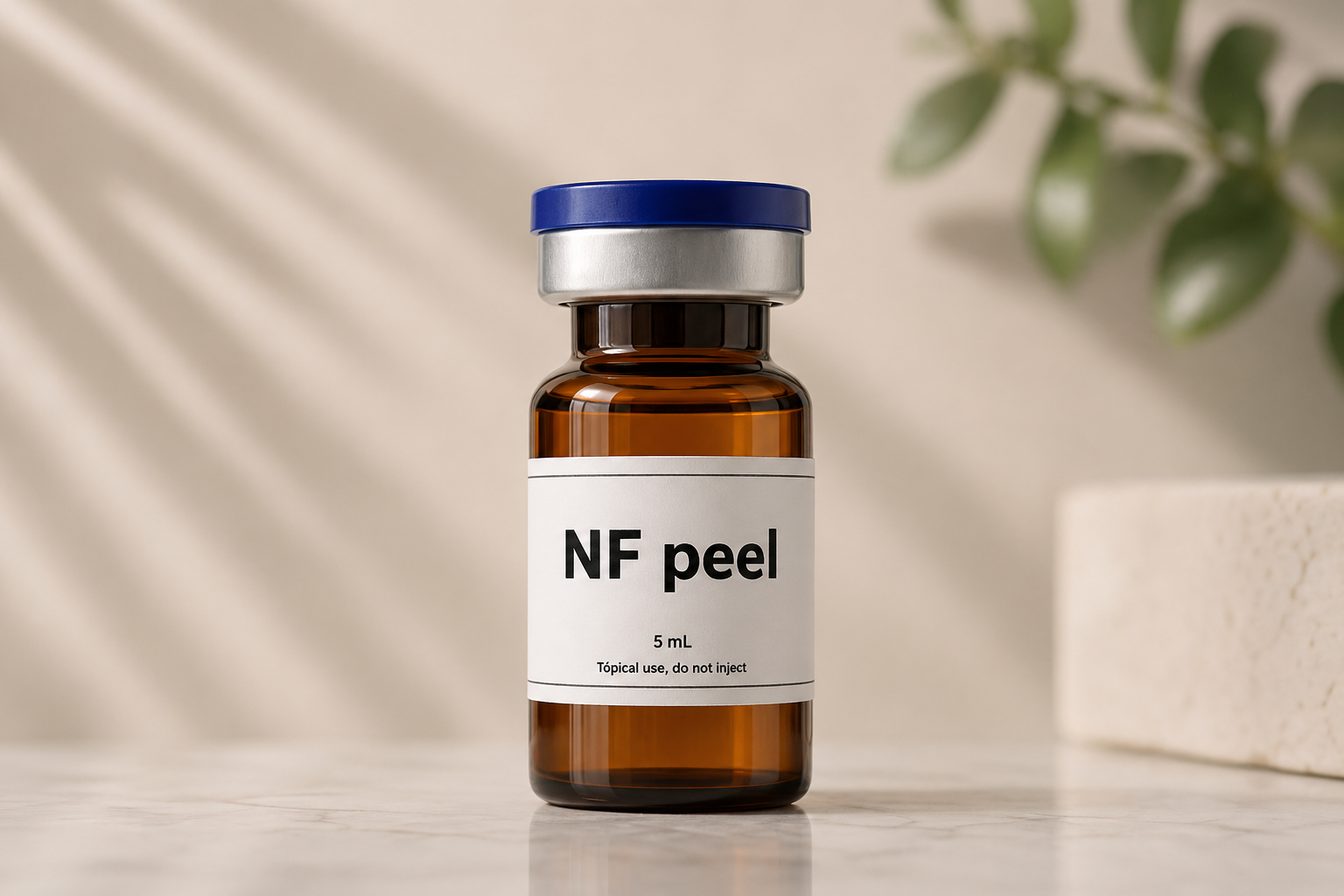
NF Peel / PR360
360° Skin Biorevitalisation, Progressive Remodelling, Antioxidant Action and Overall Improvement of Skin Quality through a Multifunctional Professional Chemical Cocktail
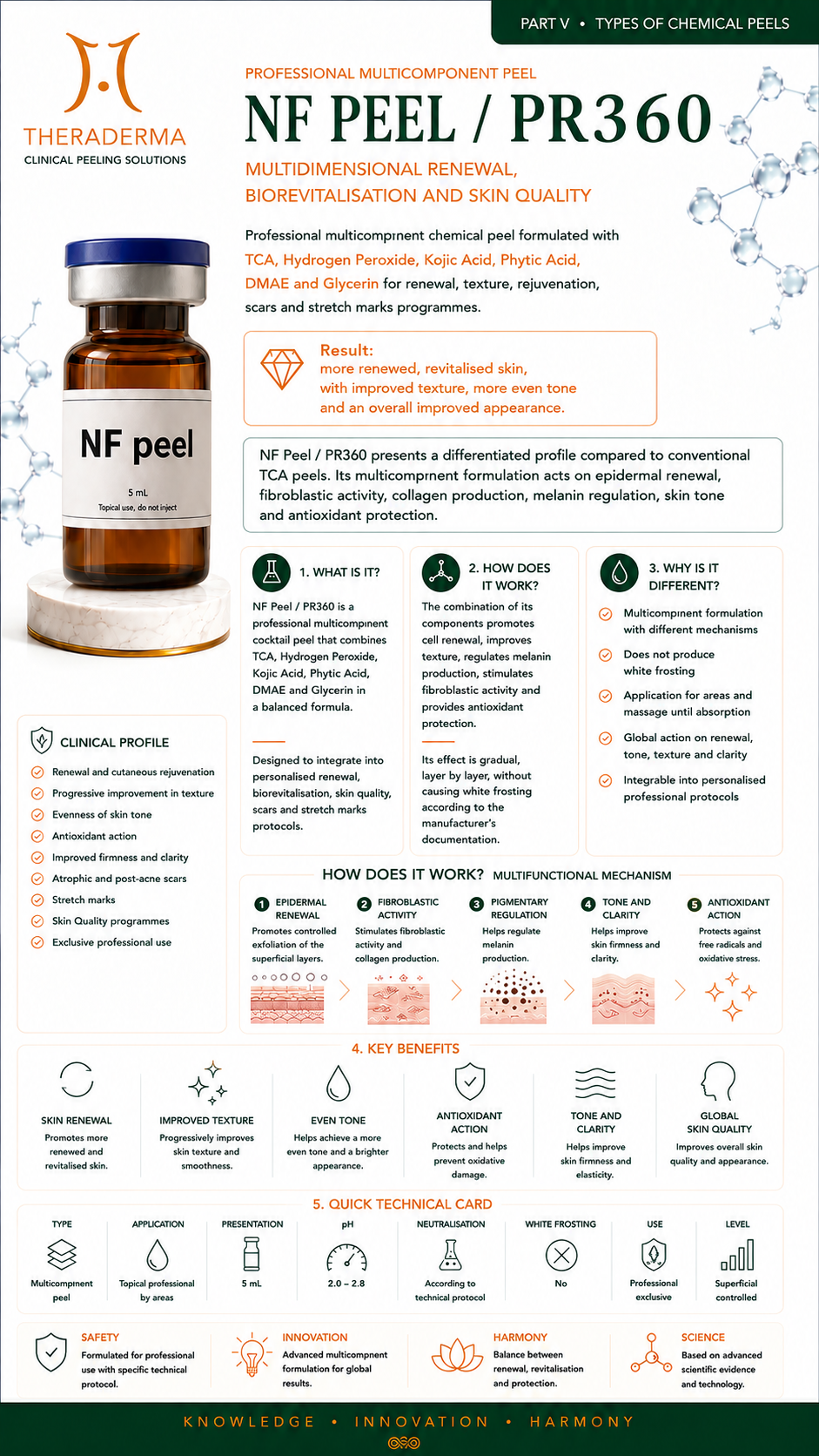
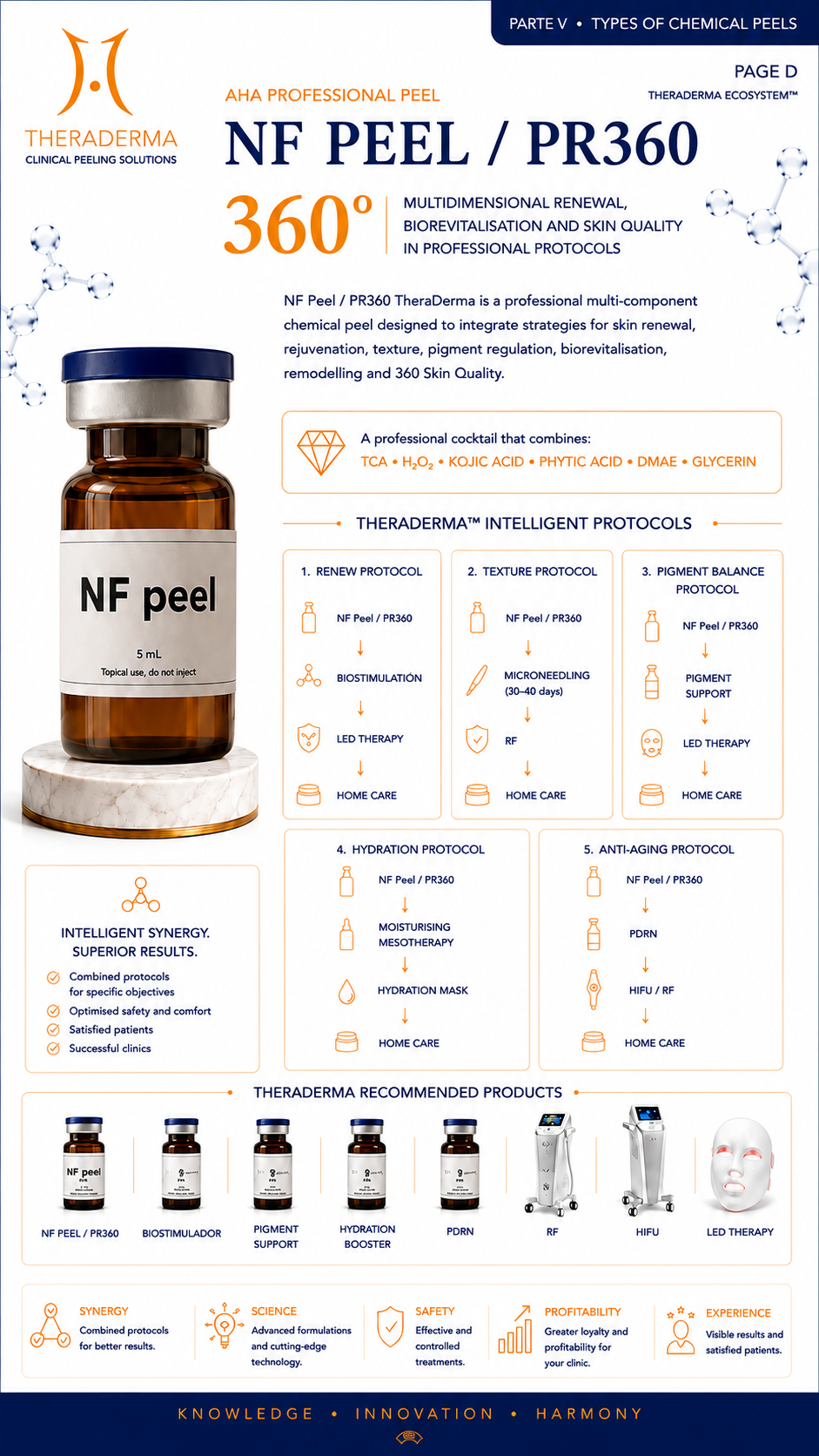
NF Peel / PR360 TherapDerma is a multifunctional professional chemical peel formulated with a combination of TCA, Hydrogen Peroxide, Kojic Acid, Phytic Acid, DMAE and Glycerin, components documented in the original product formulation.
Unlike peels structured around a single acid, NF Peel / PR360 combines different components within the same chemical system, allowing the integration of renewal, biorevitalisation, pigmentation regulation, antioxidant action and improvement of skin turgor objectives.
The manufacturer’s technical documentation describes PR360 as a peeling cocktail gel whose formulation allows gradual, layer-by-layer penetration. It also attributes to the product action on the stratum corneum, epidermis and dermis, stimulation of fibroblast activity and cell renewal, induction of collagen production, activation of certain growth factors, inhibition of melanin production and improvement of skin tone and turgor.
A documented distinguishing characteristic is that PR360 does not produce the “white frosting” characteristic of certain TCA peels. For this reason, the absence of frosting should not be interpreted as an absence of activity or used as a criterion for arbitrarily prolonging or intensifying the application.
The manufacturer’s documentation positions the product within biorevitalisation, rejuvenation, antioxidant and hyperpigmentation programmes, and also includes applications related to skin ageing, premature ageing, general skin irregularities, stretch marks and certain scars.
Within TherapDerma, these characteristics are integrated into a clinical strategy based on individualised assessment, appropriate patient selection, therapeutic planning and reassessment of the skin response.
More than an isolated procedure, NF Peel / PR360 forms part of the TherapDerma Clinical Ecosystem™, a methodology designed to integrate diagnosis, professional treatment, complementary procedures, home care and continuity of care.
What makes NF peel / PR360 different?
A chemical peel that should not be interpreted as a conventional TCA peel
Not all chemical peels produce their clinical effect through the same mechanism, nor should they be assessed using the same visual criteria.
NF Peel / PR360 takes a specific approach: it is not composed solely of TCA, but rather of a multicomponent system in which different substances with complementary functions are involved.
Its documented formulation combines:
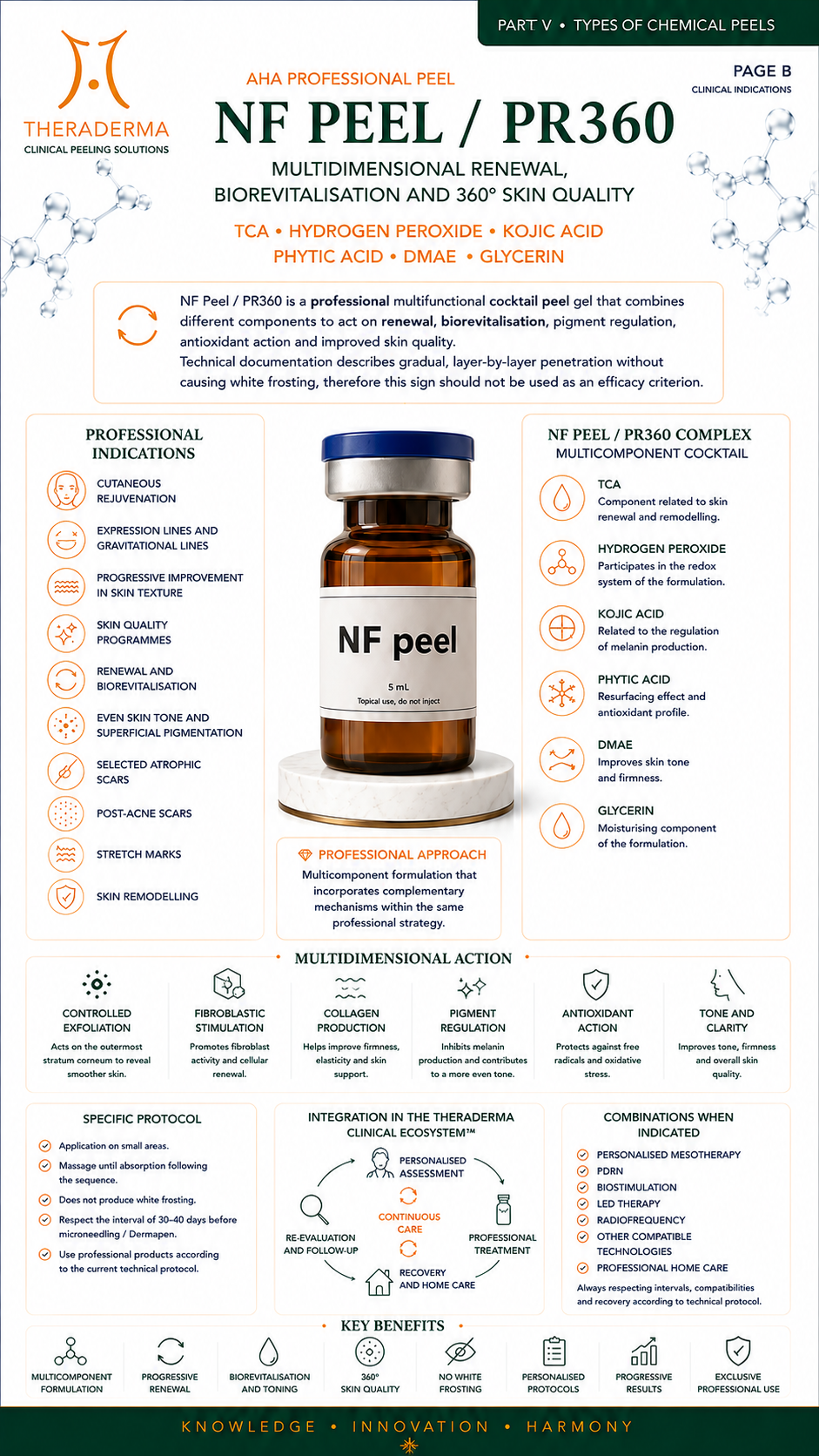
• TCA: a chemical component of the formulation associated with skin renewal and remodelling.
• Hydrogen Peroxide (H₂O₂): participates in the redox system described by the manufacturer within the overall mechanism of the formulation.
• Kojic Acid: a component associated with the strategy for regulating melanin production.
• Phytic Acid: incorporated for its contribution to the resurfacing effect described for the formulation and within its antioxidant profile.
• DMAE: a component integrated into a formulation aimed, among other objectives, at improving skin tone and turgor.
• Glycerin: a humectant component of the formulation.
This architecture allows NF Peel / PR360 to be understood as a multifunctional chemical system rather than simply as “a TCA peel”.
The technical documentation expressly defines it as a peeling cocktail gel**, describes gradual layer-by-layer penetration and states that it does not produce white frosting.**
Therefore, its clinical behaviour should be interpreted according to the specific characteristics of the formulation and its technical protocol, avoiding the automatic transfer of application criteria, timings, neutralisation or endpoints from other TCA peels.
________________________________________
WHAT IS THE NF PEEL / PR360 COMPLEX?
A multifunctional chemical biorevitalisation system
NF Peel / PR360 is a professional cocktail peel based on the interaction of different chemical components within a single formulation.
According to the manufacturer’s technical documentation, its action is associated with the combination of TCA, Kojic Acid and DMAE, the dismutation capacity of Hydrogen Peroxide through a redox reaction and the resurfacing effect attributed to Phytic Acid. The same documentation attributes antioxidant activity and protection against free radicals to the formulation.
Within the functional profile described for the product, different objectives can be identified:
• skin renewal;
• biorevitalisation;
• stimulation of fibroblast activity;
• support for collagen production;
• improvement of tone and turgor;
• modulation of melanin production;
• antioxidant action;
• protection against oxidative stress;
• overall improvement of skin quality.
The manufacturer’s technical documentation specifically mentions the activation of growth factors such as PDGF-β, TGF-β1, TGF-α and VEGF within the mechanism it attributes to the formulation.
These statements should be interpreted as part of the mechanism described by the manufacturer for PR360 and not as independent demonstration that each of these effects occurs to the same extent in all patients.
In this way, NF Peel / PR360 is conceptually differentiated from a peel whose primary purpose is to produce intense visible desquamation: its positioning is oriented towards a broader strategy of skin renewal and biorevitalisation.
________________________________________
WHEN TO CHOOSE NF PEEL / PR360?
NF Peel / PR360 may be considered when the professional identifies the need to develop a strategy for biorevitalisation, rejuvenation or overall improvement of skin quality and considers the specific profile of this formulation to be appropriate.
The available documentation allows it to be considered within protocols related to:
• skin ageing;
• premature ageing;
• general skin irregularities;
• hyperpigmentation and, according to supplementary technical materials, melasma, always subject to differentiated professional assessment;
• stretch marks;
• certain scars, including post-acne scars;
• the need for skin hydration and revitalisation;
• professional programmes for rejuvenation and overall improvement of skin quality.
Within the TherapDerma clinical methodology, and provided that individual assessment justifies it, these objectives may be extended to programmes aimed at:
• loss of radiance;
• irregular skin texture;
• visible loss of tone and turgor;
• visible signs of photoageing;
• overall skin revitalisation;
• advanced Skin Quality programmes;
• individualised maintenance strategies.
These latter applications constitute a TherapDerma clinical interpretation of the functional profile of the formulation and should not be confused with textual indications directly attributed to the manufacturer.
The final indication should always be established following an individualised assessment, taking into account the characteristics of the skin, its integrity, sensitivity, phototype, medical history, concomitant treatments, anatomical area and recovery capacity.
________________________________________
POSITIONING WITHIN THE THERAPDERMA CLINICAL LADDER™
At TherapDerma, we understand that the concentration of a single component does not, by itself, determine the overall clinical behaviour of a formulation.
This principle is particularly relevant to NF Peel / PR360 because it is a multicomponent system whose behaviour should not be inferred exclusively from the presence of TCA.
The currently available documentation identifies TCA, Hydrogen Peroxide, Kojic Acid, Phytic Acid, DMAE and Glycerin as the main components and describes progressive penetration of the formulation.
Within the TherapDerma Clinical Ladder™, NF Peel / PR360 is positioned as a tool aimed at professional protocols for biorevitalisation, rejuvenation, remodelling and overall improvement of skin quality, particularly when the objective requires the integration of different mechanisms within the same therapeutic strategy.
Its functional profile can be summarised as:
RENEWAL
+
BIOREVITALISATION
+
REMODELLING
+
PIGMENTATION REGULATION
+
ANTIOXIDANT ACTION
+
OVERALL IMPROVEMENT OF SKIN QUALITY
Treatment selection and progression should be established according to diagnosis, observed response, tolerance, skin recovery and professional reassessment.
NF Peel / PR360 may also form part of sequential strategies with other procedures when there is clinical justification, but combinations should not be established automatically.
A particularly relevant technical aspect is that the available documentation establishes that microneedling / Dermapen procedures should be postponed for approximately 30–40 days after NF Peel / PR360.
________________________________________
THERAPDERMA PHILOSOPHY
Visible intensity does not, by itself, define the quality of the treatment
At TherapDerma, we understand that the response to an advanced peel should not be assessed exclusively by the intensity of desquamation or by the appearance of visual signs associated with other types of peel.
A more intense visible reaction does not necessarily equate to a better clinical result.
This principle is particularly important with NF Peel / PR360 because the manufacturer’s documentation specifically states that the formulation does not produce white frosting, despite containing TCA and having its own mechanism of action.
The objective is to select:
the appropriate procedure,
↓
for the appropriate patient,
↓
with the appropriate objective,
↓
using the formulation-specific protocol,
↓
and subsequently reassessing the response obtained.
For this reason, NF Peel / PR360 is integrated within the TherapDerma Clinical Ecosystem™, a working model that enables chemical peels, mesotherapy, medical-aesthetic technologies and home care to be coordinated through personalised strategies based on diagnosis, therapeutic sequencing and clinical reassessment.
________________________________________
THERAPDERMA CONCLUSION
NF Peel / PR360 is a multifunctional professional tool designed to be integrated into protocols for biorevitalisation, rejuvenation and overall improvement of skin quality.
Its documented formulation combines TCA, Hydrogen Peroxide, Kojic Acid, Phytic Acid, DMAE and Glycerin, and the manufacturer describes gradual layer-by-layer penetration, activity associated with fibroblast renewal and collagen production, modulation of melanin, improvement of tone and turgor, and antioxidant activity.
The absence of white frosting is also an expressly documented characteristic of PR360 and requires its application to be interpreted according to the specific behaviour of this formulation, without automatically transferring the criteria used for other TCA peels.
Its true clinical value lies not solely in one of its components, but in the overall architecture of the formulation and its use within a structured therapeutic strategy based on appropriate patient selection, application in accordance with the specific protocol, observation of the response, reassessment and continuity of care.
Within the TherapDerma Clinical Ecosystem™, NF Peel / PR360 represents a 360° approach to skin quality:
RENEW
↓
BIOREVITALISE
↓
REMODEL
↓
PROTECT
↓
PROGRESSIVELY OPTIMISE OVERALL SKIN QUALITY
Clinical Benefits
360° Biorevitalisation, Progressive Skin Remodelling, Antioxidant Action and Overall Improvement of Skin Quality within Personalised Professional Protocols
NF Peel / PR360 TherapDerma is a multifunctional professional chemical peel formulated with a combination of TCA, Hydrogen Peroxide, Kojic Acid, Phytic Acid, DMAE and Glycerin.
Its formulation allows different objectives related to skin quality to be integrated. The manufacturer’s technical documentation describes gradual, layer-by-layer penetration and attributes to PR360 activity on the stratum corneum, epidermis and dermis, stimulation of fibroblast activity and cell renewal, induction of collagen production, inhibition of melanin production and improvement of skin tone and turgor. It also describes antioxidant activity and protection against free radicals.
Unlike peels whose clinical effect is interpreted mainly through intense visible exfoliation, NF Peel / PR360 presents a specific behaviour. The manufacturer describes it as a peeling cocktail gel with progressive penetration that does not produce “white frosting”.
For this reason, its response should not be assessed using the same visual endpoints used for other TCA peels. Its evolution should be interpreted in accordance with the formulation-specific protocol and each patient’s individual response.
________________________________________
🧬 BIOREVITALISATION AND SKIN RENEWAL
What does it provide clinically?
The technical documentation describes PR360 as a biorevitalisation product capable of progressively penetrating through the stratum corneum, epidermis and dermis, associating its activity with skin and fibroblast renewal processes.
This profile allows it to be integrated into professional strategies aimed at improving the overall quality and appearance of the skin.
Clinical benefits
✔ Promotes skin renewal.
✔ Integrates into professional biorevitalisation protocols.
✔ Contributes to strategies aimed at improving overall skin quality.
✔ Enables the development of multifactorial rejuvenation protocols.
________________________________________
🧬 FIBROBLAST STIMULATION AND COLLAGEN SUPPORT
What does it provide clinically?
The manufacturer’s technical documentation attributes to PR360 stimulation of fibroblast activity and cell renewal and induction of collagen production. It also mentions the activation of growth factors such as PDGF-β, TGF-β1, TGF-α and VEGF within the mechanism described for the formulation.
These actions form part of the mechanism proposed by the manufacturer and allow NF Peel / PR360 to be positioned within professional programmes aimed at biorevitalisation and skin remodelling.
Clinical benefits
✔ Promotes mechanisms associated with fibroblast activity.
✔ Supports processes associated with collagen production.
✔ Integrates into skin remodelling strategies.
✔ Can form part of professional rejuvenation and Skin Quality programmes.
________________________________________
✨ SKIN TONE AND TURGOR
What does it provide clinically?
The manufacturer’s documentation attributes to the formulation an improvement in skin tone and turgor and describes a more turgid and smoother appearance after the procedure.
DMAE forms part of the chemical architecture of PR360 and participates, together with the other components, in the overall mechanism attributed to the formulation.
Clinical benefits
✔ Contributes to improving the appearance of skin tone.
✔ Promotes a visually more turgid and smoother appearance.
✔ Can be integrated into strategies aimed at visible signs of ageing.
✔ Complements the overall objectives of biorevitalisation and rejuvenation.
________________________________________
🛡️ ANTIOXIDANT ACTION AND PROTECTION AGAINST OXIDATIVE STRESS
What does it provide clinically?
The technical documentation expressly attributes antioxidant activity and protection against free radical attacks to PR360. It also describes the resurfacing effect of Phytic Acid within the overall mechanism of the formulation.
This profile allows the product to be integrated into professional strategies in which renewal and biorevitalisation are accompanied by an antioxidant component.
Clinical benefits
✔ Provides antioxidant activity according to the technical documentation.
✔ Helps protect against the action of free radicals.
✔ Complements the mechanisms of skin renewal and biorevitalisation.
✔ Can be integrated into professional strategies aimed at skin with visible signs of ageing or devitalisation.
________________________________________
🌟 PIGMENTATION REGULATION AND VISUAL EVENNESS OF SKIN TONE
What does it provide clinically?
NF Peel / PR360 incorporates Kojic Acid and Phytic Acid within its multicomponent system. It may be considered within strategies aimed at melasma only when an appropriate differential assessment has been carried out and the formulation profile is compatible with the individualised strategy.
These characteristics allow NF Peel / PR360 to be considered within professional strategies aimed at the pigmentary component, always following an appropriate assessment of the type and origin of the alteration.
Clinical benefits
✔ Participates in strategies aimed at pigmentation regulation.
✔ May contribute to progressively improving the visual evenness of skin tone.
✔ Can be incorporated into professional protocols for certain properly assessed pigmentary irregularities.
✔ May be considered within individualised strategies for melasma when an appropriate differential assessment has been carried out and the formulation profile is compatible with the therapeutic objective.
________________________________________
🎯 SKIN TEXTURE REMODELLING
What does it provide clinically?
The combination of skin renewal and the remodelling mechanisms described for PR360 allows it to be incorporated into professional strategies aimed at certain irregularities of the skin surface.
The manufacturer’s documentation specifically includes its use for stretch marks and certain scars, including post-acne scars.
The response will depend on the characteristics of the alteration, its depth, age, location and the skin’s individual response capacity.
Clinical benefits
✔ May contribute to the progressive refinement of skin texture.
✔ Can form part of protocols aimed at certain irregularities of the skin surface.
✔ Can be integrated into professional strategies aimed at properly selected post-acne scars.
✔ Can be incorporated into protocols aimed at improving the appearance of certain stretch marks.
________________________________________
🌿 REJUVENATION AND OVERALL REVITALISATION
What does it provide clinically?
The manufacturer positions PR360 within biorevitalisation and rejuvenation and includes skin ageing and premature ageing among its benefits.
Its multicomponent nature allows different objectives related to renewal, remodelling, the pigmentary component, antioxidant activity and skin tone to be integrated within the same professional strategy.
Clinical benefits
✔ Promotes an overall revitalised appearance.
✔ Can be integrated into strategies aimed at visible signs of ageing.
✔ Contributes to professional skin rejuvenation programmes.
✔ Allows different components of skin quality to be addressed within the same strategy.
________________________________________
💎 OVERALL IMPROVEMENT OF SKIN QUALITY
What does it provide clinically?
The multifunctional profile of NF Peel / PR360 allows different components related to the appearance and quality of the skin to be addressed in an integrated manner.
The documented combination of TCA, Hydrogen Peroxide, Kojic Acid, Phytic Acid, DMAE and Glycerin, together with the mechanisms attributed by the manufacturer to the formulation, allows it to be positioned within professional programmes aimed at an overall improvement of Skin Quality.
Clinical benefits
✔ Integrates different mechanisms related to skin quality.
✔ May contribute to progressively improving texture, visual evenness and the overall appearance of the skin.
✔ Supports strategies aimed at tone, turgor and rejuvenation.
✔ Enables the development of professional 360° renewal and biorevitalisation programmes.
________________________________________
📈 CLINICAL EVOLUTION AND TREATMENT PROGRAMME
The effects of NF Peel / PR360 should not be assessed exclusively on the basis of the visible response immediately after a single application.
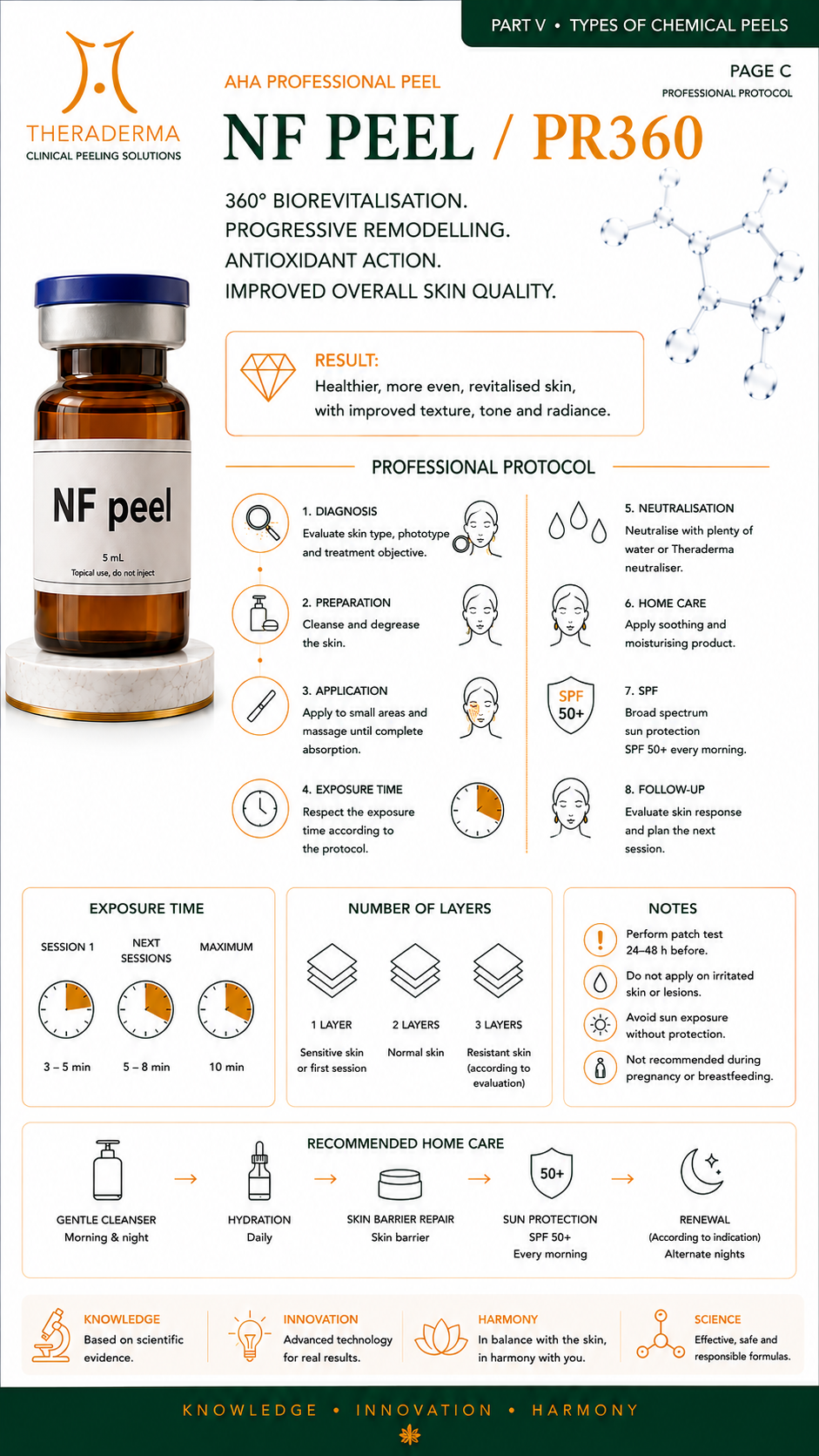
The available technical documentation includes an indicative programme of 3–5 sessions, generally performed weekly.
This schedule should be interpreted as the documented programme for the formulation, not as an obligation to automatically complete a predetermined number of sessions.
Progress should be reassessed before continuing the programme, considering:
✔ skin response obtained;
✔ tolerance to the procedure;
✔ skin recovery;
✔ evolution of the treated objective;
✔ persistence of the indication;
✔ absence of new contraindications.
The final number of sessions and any subsequent procedure should be adapted to individual progress and the current technical protocol.
________________________________________
CLINICAL SUMMARY
Main benefits of NF Peel / PR360
✔ Biorevitalisation and skin renewal.
✔ Stimulation of mechanisms associated with fibroblast activity.
✔ Support for the collagen production processes described for the formulation.
✔ Improvement of skin tone and turgor.
✔ Antioxidant activity and protection against free radicals.
✔ Pigmentation regulation and progressive improvement of the visual evenness of skin tone.
✔ Improvement of texture and certain skin irregularities.
✔ Documented application in strategies aimed at stretch marks and certain scars, including post-acne scars.
✔ Rejuvenation and overall revitalisation.
✔ Integration within professional programmes aimed at improving overall Skin Quality.
________________________________________
THERAPDERMA CLINICAL CONCLUSION
The main clinical value of NF Peel / PR360 lies in integrating different mechanisms within the same professional biorevitalisation and skin renewal formulation.
Its documented composition includes TCA, Hydrogen Peroxide, Kojic Acid, Phytic Acid, DMAE and Glycerin, while the manufacturer attributes to the product progressive penetration, activity on fibroblasts and collagen production, modulation of melanin production, improvement of tone and turgor, and antioxidant activity.
Its multifunctional nature and the documented absence of white frosting differentiate its behaviour from that of certain conventional TCA peels and make it necessary to assess its response in accordance with the formulation-specific protocol.
Integrated within the TherapDerma Clinical Ecosystem™, NF Peel / PR360 can form part of professional strategies based on individualised assessment, appropriate patient selection, application in accordance with the specific protocol, clinical reassessment and the correct sequencing of any complementary procedure.
NF Peel / PR360 thus represents a 360° strategy aimed at integrating renewal, biorevitalisation, remodelling, pigmentation regulation, antioxidant action and overall improvement of skin quality.
NF Peel / PR360 should be assessed according to the formulation-specific protocol and individual response; therefore, patient selection, contraindications and clinical reassessment criteria determine the safety and coherence of the programme.
Why Choose NF PEEL / PR360?
A professional option for biorevitalisation, skin remodelling, rejuvenation and overall Skin Quality improvement protocols
In professional aesthetic medicine, the choice of a chemical peel should not be based solely on the presence or concentration of an acid or on the visible intensity of exfoliation. It should be based on the correspondence between the formulation, its mechanisms of action, the characteristics of the skin and the established clinical objectives.
NF Peel / PR360 TherapDerma presents a distinctive profile as a peeling cocktail gel whose composition includes TCA, Hydrogen Peroxide, Kojic Acid, Phytic Acid, DMAE and Glycerin.
The manufacturer’s technical documentation describes a formulation with gradual, layer-by-layer penetration and attributes to the product activity on the stratum corneum, epidermis and dermis. It also attributes to the product stimulation of fibroblast activity and cell renewal, induction of collagen production, inhibition of melanin production, improvement of skin tone and turgor, and antioxidant activity.
One of its distinctive characteristics is that it does not produce “white frosting”, so its clinical response should not be interpreted exclusively using the visual endpoints characteristic of certain conventional TCA peels.
For this reason, NF Peel / PR360 may be particularly interesting when the professional is seeking a multifunctional biorevitalisation and skin remodelling strategy, rather than limiting the procedure to an exclusively exfoliating objective.
________________________________________
WHEN CAN IT BE A SUITABLE OPTION?
NF Peel / PR360 may be considered when professional assessment identifies an indication compatible with the applications described for the formulation.
The manufacturer’s technical documentation specifically includes its use for:
✔ skin rejuvenation;
✔ mimic wrinkles;
✔ gravitational wrinkles;
✔ atrophic scars;
✔ stretch marks;
✔ post-acne scars.
The product’s supplementary documentation broadens this positioning and includes:
✔ prevention and treatment of photoageing;
✔ depressed scars;
✔ adjunctive treatment of skin hyperpigmentation and dark spots.
Supplementary technical materials also include melasma within its scope of use, always subject to differential assessment.
The documentation currently available does not establish active acne as an indication, nor does it specifically list loss of tone in the neck or décolletage or firming of the breast area as anatomical indications for the product.
Therefore, its selection may be particularly relevant when different components of skin deterioration coexist and the professional considers it appropriate to use a multifunctional formulation.
The final indication should always be established after an individualised assessment and after ruling out the product’s specific contraindications.
________________________________________
WHAT TYPE OF PROFESSIONAL HAS IT BEEN DESIGNED FOR?
NF Peel / PR360 is intended for professionals who wish to develop rejuvenation and biorevitalisation protocols from a multifactorial perspective, without limiting the therapeutic decision to the intensity of exfoliation.
Its profile allows work on objectives related to:
• skin rejuvenation;
• photoageing;
• loss of tone and turgor;
• wrinkles;
• skin irregularities;
• pigmentary alterations;
• atrophic or depressed scars;
• post-acne scars;
• stretch marks;
• overall biorevitalisation.
Professional use requires identifying the priority objective for each patient, assessing indications and contraindications, and observing the evolution obtained before determining whether the programme should continue.
The objective is not to use NF Peel / PR360 for every aesthetic concern, but to select it when the characteristics of the formulation are consistent with the needs identified.
________________________________________
THERAPDERMA CLINICAL LADDER™
Each peel responds to a different clinical need
The TherapDerma Clinical Ladder™ does not represent a mandatory progression from a peel considered “milder” to another considered “more intense”.
Each solution should be selected according to:
✔ professional diagnosis;
✔ predominant clinical indication;
✔ characteristics and current condition of the skin;
✔ integrity of the skin surface;
✔ presence of photoageing;
✔ presence of pigmentary alterations;
✔ skin tone and turgor;
✔ medical history and recent treatments;
✔ specific contraindications;
✔ clinical objectives;
✔ response observed during the course of treatment.
________________________________________
NF PEEL / PR360
May be of particular interest when the predominant needs are:
✔ need for biorevitalisation and rejuvenation;
✔ photoageing;
✔ loss of tone and turgor;
✔ mimic or gravitational wrinkles;
✔ skin irregularities;
✔ properly assessed hyperpigmentation and dark spots;
✔ atrophic or depressed scars;
✔ post-acne scars;
✔ stretch marks;
✔ need to address simultaneously different components related to skin quality.
Its combination of mechanisms related to skin renewal, fibroblast activity, collagen production, melanin regulation, tone and turgor, and antioxidant activity gives it a different profile from a peel whose primary purpose is exclusively to produce superficial exfoliation.
________________________________________
QUICK SELECTION GUIDE
Priority clinical objective NF Peel / PR360 may be considered
Biorevitalisation / rejuvenation Yes
Photoageing Yes
Loss of tone Yes
Mimic and gravitational wrinkles Yes
Skin irregularities Yes
Hyperpigmentation and dark spots As an adjunct
Atrophic or depressed scars Yes
Post-acne scars Yes
Stretch marks Yes
Active acne Not established as an indication in the documentation currently available
The applications included in this guide are derived from the available technical documentation for the product.
The table provides guidance to facilitate selection and does not imply that NF Peel / PR360 is automatically suitable for all patients presenting any of these conditions.
________________________________________
WHY IS ITS PROFILE PARTICULARLY INTERESTING?
Because different manifestations of ageing and deterioration in skin quality may coexist in the same patient.
PHOTOAGEING
+
LOSS OF TONE
+
WRINKLES
+
SKIN IRREGULARITIES
+
PIGMENTARY ALTERATIONS
+
OXIDATIVE STRESS
NF Peel / PR360 brings together different components within the same formulation:
TCA
+
HYDROGEN PEROXIDE
+
KOJIC ACID
+
PHYTIC ACID
+
DMAE
+
GLYCERIN
↓
SKIN RENEWAL
+
BIOREVITALISATION
+
ANTIOXIDANT ACTIVITY
+
REGULATION OF MELANIN PRODUCTION
+
SUPPORT FOR TONE AND TURGOR
+
SKIN REMODELLING
The technical documentation associates this multicomponent architecture with stimulation of fibroblast activity and collagen production, inhibition of melanin production, increased tone and turgor, and antioxidant activity.
This combination allows NF Peel / PR360 to be positioned as a particularly interesting tool when there is a multifactorial indication and the aim is not to reduce the entire therapeutic strategy to producing more intense exfoliation.
________________________________________
WHY SHOULD IT NOT BE INTERPRETED AS A CONVENTIONAL TCA PEEL?
The presence of TCA does not mean that NF Peel / PR360 should be used or interpreted in exactly the same way as a conventional isolated TCA formulation.
The manufacturer’s documentation describes its action based on the balanced combination of TCA, Kojic Acid and DMAE, together with the dismutation capacity of Hydrogen Peroxide and the resurfacing effect of Phytic Acid.
Its distinctive characteristics include:
✔ multicomponent formulation;
✔ gradual, layer-by-layer penetration;
✔ described activity on the stratum corneum, epidermis and dermis;
✔ fibroblast activity and support for collagen production;
✔ inhibition of melanin production;
✔ antioxidant activity;
✔ improvement of tone and turgor;
✔ absence of “white frosting”.
For this reason, the presence of TCA should not be used in isolation to interpret the clinical behaviour of NF Peel / PR360.
________________________________________
WHEN IS IT NOT THE RIGHT CHOICE?
Choosing correctly also means recognising when the procedure should not be performed or when another strategy may be more appropriate.
NF Peel / PR360 should not be used when any of the contraindications established by the manufacturer are present, including:
✔ pregnancy or breastfeeding;
✔ herpes;
✔ warts;
✔ secondary infection;
✔ minor skin lesions or scratches;
✔ skin hypersensitivity;
✔ oncological diseases;
✔ chronic diseases in the acute phase;
✔ acute inflammatory diseases.
Another strategy should also be selected when the priority clinical objective does not correspond to the applications or mechanisms specific to NF Peel / PR360.
Selection should always be based on professional assessment and not simply on product availability.
________________________________________
WHY INTEGRATE IT INTO A PROGRESSIVE PROGRAMME?
The technical documentation establishes that the treatment may be repeated once a week for the required number of sessions, usually between 3 and 5, and describes a cumulative effect on the appearance of the skin.
This allows the treatment to be structured according to a progressive logic:
TREAT
↓
OBSERVE THE RESPONSE
↓
REASSESS
↓
CONTINUE, MODIFY OR COMPLETE THE PROGRAMME
↓
INTEGRATE OTHER PROCEDURES WHEN APPROPRIATE
↓
MAINTAIN THE RESULTS
The number of sessions should not be interpreted as an automatic obligation. Clinical evolution and individual tolerance should guide the continuation of the programme.
When complementary procedures are planned, the manufacturer’s specific instructions should be respected. In particular, the documentation establishes that microneedling or Dermapen should not be performed until 30–40 days after NF Peel / PR360.
________________________________________
THERAPDERMA CLINICAL CONCLUSION
NF Peel / PR360 is a differentiated professional tool for developing biorevitalisation, rejuvenation and skin remodelling protocols through a multifunctional formulation.
Its value lies not only in the presence of TCA, but in a composition that integrates TCA, Hydrogen Peroxide, Kojic Acid, Phytic Acid, DMAE and Glycerin, whose behaviour should be interpreted as that of a complete formulation.
The manufacturer’s documentation attributes to PR360 gradual penetration, activity on fibroblasts and collagen production, inhibition of melanin production, improvement of tone and turgor, and antioxidant activity, in addition to establishing specific applications in rejuvenation, wrinkles, scars, stretch marks, photoageing and certain pigmentary alterations.
Within the TherapDerma Clinical Ladder™, it therefore occupies a specific position for strategies in which different components of ageing and deterioration in skin quality require a multifactorial approach.
As part of the TherapDerma Clinical Ecosystem™, its selection should answer one essential question:
Do the specific characteristics of NF Peel / PR360 truly correspond to this patient’s clinical needs and objectives?
When the answer is yes, NF Peel / PR360 ceases to be simply a peel containing TCA and becomes a professionally selected tool, chosen on a sound basis within an individualised therapeutic strategy.
The selection of NF Peel / PR360 should respond to the patient’s clinical needs and objectives; therefore, it is particularly useful to compare its profile with that of other TherapDerma peels according to the priority objective before defining the therapeutic strategy.
Areas Of Application
One peel. Different clinical possibilities according to the anatomical area, the identified condition and the individual biological response
NF Peel / PR360 TherapDerma can be integrated into professional protocols for biorevitalisation, rejuvenation, skin remodelling and overall Skin Quality improvement, provided that the selected area is compatible with the indications and conditions of use of the formulation.
The documented composition combines TCA, Hydrogen Peroxide, Kojic Acid, Phytic Acid, DMAE and Glycerin, and the manufacturer attributes to the formulation gradual penetration, activity related to fibroblasts and collagen production, inhibition of melanin production, improvement of tone and turgor, and antioxidant activity.
The available documentation includes applications related to stretch marks, atrophic or depressed scars and post-acne scars. Supplementary documentation also includes photoageing and adjunctive use in hyperpigmentation and dark spots, while supplementary technical materials include melasma within its scope of use.
The documentation currently available also describes effects related to tone and turgor, but does not specifically establish loss of tone in the neck or décolletage or firming of the breast area as documented anatomical indications.
Therefore, the choice of area should not be made simply because ageing, pigmentation or visible irregularity is present.
The indication should arise from the combination of:
ANATOMICAL AREA
+
CONDITION
+
SKIN CONDITION
+
PROFESSIONAL OBJECTIVE
+
COMPATIBILITY WITH THE PROTOCOL
Each region presents anatomical and functional differences that may modify the response to the procedure. The amount applied, total surface area treated, application sequence and frequency should be adjusted to the specific technical protocol and the evolution observed.
________________________________________
FACE
One of the main areas of application
The face constitutes the main anatomical reference for the NF Peel / PR360 technical protocol. The manufacturer describes a facial application by sections, usually dividing the face into four areas, applying approximately 3–4 drops per area and massaging until absorbed.
The face may simultaneously present different conditions compatible with the documented profile of the formulation, including photoageing, wrinkles, loss of tone, skin irregularities, certain pigmentary alterations and post-acne scars.
When professionally indicated, NF Peel / PR360 can be incorporated into strategies aimed at:
✔ skin rejuvenation;
✔ photoageing;
✔ mimic and gravitational wrinkles;
✔ loss of tone and turgor;
✔ texture irregularities;
✔ properly assessed hyperpigmentation and dark spots;
✔ atrophic or depressed scars;
✔ post-acne scars;
✔ overall improvement of skin quality.
The eyelids should be expressly avoided during application, in accordance with the technical protocol.
________________________________________
NECK
Biorevitalisation and improvement of tone
The available documentation attributes effects related to skin tone and turgor to NF Peel / PR360, but does not specifically establish loss of tone in the neck as a documented anatomical indication.
Therefore, any professional use on the neck should only be considered when there is a compatible condition, the current technical protocol permits application in this area and the skin surface is in suitable condition to receive the procedure.
Professional objectives may include:
✔ promoting skin biorevitalisation;
✔ improving the appearance of tone;
✔ promoting a visually more even texture;
✔ contributing to rejuvenation strategies for the area;
✔ maintaining greater aesthetic continuity between the face and neck.
The technique should be adapted to the anatomical characteristics of this region and should not be automatically extrapolated from the facial protocol.
________________________________________
DÉCOLLETAGE
Photoageing, tone and skin quality
The available documentation describes effects related to skin tone and turgor, but does not specifically establish loss of tone in the décolletage as a documented anatomical indication.
Furthermore, as this is an area frequently exposed to the sun, it may present conditions compatible with professional objectives of rejuvenation and overall improvement of skin quality.
When there is professional justification, the current technical protocol permits application in this region and the skin is in suitable condition, NF Peel / PR360 may be considered within strategies aimed at:
✔ photoageing;
✔ loss of tone;
✔ skin irregularities;
✔ certain pigmentary alterations;
✔ revitalisation of the appearance of the skin;
✔ overall improvement of Skin Quality.
The extent of the treated area and the total amount of product should be planned specifically for the region.
________________________________________
STRETCH MARKS
An expressly documented body indication
Stretch marks are explicitly listed among the applications contemplated by the manufacturer for PR360.
They are also mentioned in the commercial documentation as one of the conditions that PR360 can be used to treat.
Stretch marks represent a structural alteration and should not be interpreted as a simple superficial irregularity.
When correctly selected, NF Peel / PR360 can be integrated into strategies aimed at:
✔ progressively improving the visual appearance of stretch marks;
✔ promoting texture remodelling;
✔ supporting mechanisms related to fibroblast activity;
✔ contributing to the overall improvement of the quality of the treated area.
The response should be documented and progressively reassessed, avoiding promises of complete elimination of the condition.
________________________________________
ATROPHIC OR DEPRESSED SCARS
When the objective requires skin remodelling
The technical documentation includes atrophic scars among the applications of PR360, while the supplementary documentation mentions depressed scars.
These conditions require specific assessment because not all scars have the same depth, morphology or capacity to respond.
When there is a compatible indication, the procedure can be incorporated into strategies aimed at:
✔ promoting skin remodelling processes;
✔ progressively improving certain texture irregularities;
✔ visually reducing the contrast of certain depressions;
✔ supporting programmes aimed at improving the structural quality of the skin.
The depth and characteristics of the scar should determine whether NF Peel / PR360 constitutes a suitable tool on its own or whether another therapeutic strategy needs to be planned.
________________________________________
POST-ACNE SCARS
An expressly documented application
Post-acne scars are specifically listed among the possible applications of PR360 in the manufacturer’s technical documentation.
In addition, the supplementary documentation indicates its use for scars caused by acne.
When the scar is compatible with the procedure, NF Peel / PR360 can be integrated into strategies aimed at:
✔ promoting skin remodelling;
✔ progressively improving certain texture irregularities;
✔ contributing to a visually more even surface;
✔ forming part of professional programmes for post-acne structural sequelae.
A post-acne scar should not be confused with a post-inflammatory pigmented mark. Both may coexist, but they represent different conditions and require differentiated assessment.
________________________________________
HYPERPIGMENTATION AND DARK SPOTS
The pigmentary component should be assessed according to the condition, not only the area
The supplementary documentation includes PR360 as an adjunct in skin hyperpigmentation and dark spots, while the commercial documentation also mentions melasma.
Therefore, when there is a correctly assessed pigmentary alteration, the selection of the area should fundamentally depend on:
✔ pigmentary diagnosis;
✔ distribution of the condition;
✔ condition of the skin surface;
✔ pigmentary history;
✔ sun exposure;
✔ compatibility with the procedure.
The presence of a visible dark spot alone does not constitute an automatic indication for NF Peel / PR360.
________________________________________
OTHER ANATOMICAL REGIONS
Do not automatically extrapolate indications
The available documentation does not establish an exhaustive list of all anatomical areas that can be treated with NF Peel / PR360.
For this reason, regions such as the backs of the hands, back or other body surfaces should not be presented in the catalogue as areas specifically documented by the manufacturer solely because they are clinically plausible.
They may only be considered when:
✔ the condition present is compatible with the documented indications;
✔ the current technical instructions permit application in that region;
✔ the professional considers the surface to be treated appropriate;
✔ there are no contraindications;
✔ safe application and follow-up can be guaranteed.
This distinction allows a correct separation between:
DOCUMENTED INDICATION
and
PROFESSIONAL ANATOMICAL EXTRAPOLATION
________________________________________
CLINICAL GUIDANCE ACCORDING TO AREA
Area / Condition Main clinical objective Level of documentation
Face Rejuvenation, wrinkles, texture, pigmentation and post-acne scars Facial protocol and documented indications
Neck Loss of tone and rejuvenation Anatomical application not specifically documented; requires compatibility with the current protocol
Décolletage Loss of tone and photoageing Anatomical application not specifically documented; requires compatibility with the current protocol
** ** ** ** ** **
Stretch marks Remodelling and visual improvement Expressly documented indication
Atrophic / depressed scars Texture remodelling Expressly documented indication
Post-acne scars Remodelling of structural sequelae Expressly documented indication
Hyperpigmentation / dark spots Pigment regulation as an adjunct Supplementary documentation
Other body regions According to the identified condition Requires specific compatibility; do not automatically extrapolate
________________________________________
MULTI-AREA PROTOCOLS
When compatible conditions exist in different anatomical regions, a multi-area strategy may be considered only when permitted by the technical protocol and professional assessment.
The decision should consider:
✔ total surface area treated;
✔ total amount of product;
✔ anatomical characteristics of each region;
✔ regional sensitivity;
✔ observed response;
✔ recovery capacity;
✔ possibility of providing adequate follow-up.
In certain cases, it may be more reasonable to treat the areas in phases:
AREA 1
↓
PROFESSIONAL APPLICATION
↓
RECOVERY
↓
REASSESSMENT
↓
AREA 2
This approach allows information to be obtained about the response of one region before extending the treatment area.
________________________________________
INTEGRATION WITH OTHER PROCEDURES ACCORDING TO AREA
NF Peel / PR360 can form part of sequential strategies in which other procedures are subsequently incorporated when a new clinical need exists.
Selection should only be made after recovery and reassessment of the treated area.
Depending on the indication and technical compatibility, the following may be considered:
✔ mesotherapy;
✔ LED therapy;
✔ radiofrequency;
✔ other compatible medical-aesthetic technologies;
✔ professional home care.
The technical documentation establishes a specific precaution: microneedling or Dermapen should not be performed until approximately 30–40 days after NF Peel / PR360.
________________________________________
CLINICAL CONSIDERATIONS
NF Peel / PR360 should always be applied after specifically assessing the area to be treated.
Before the procedure, the following should be considered:
✔ integrity of the skin surface;
✔ sensitivity and reactivity;
✔ presence of infection, inflammation or lesions;
✔ type of condition;
✔ depth and extent;
✔ relevant medical history;
✔ recent or concomitant treatments;
✔ recent sun exposure;
✔ recovery capacity;
✔ specific contraindications of the product.
The technique should follow the documented professional protocol, based on the application of small amounts per area, approximately 3–4 drops, followed by massage until absorption, subsequently progressing section by section.
NF Peel / PR360 does not have a documented protocol based on a “number of layers”.
Therefore, the number of layers should not be used as an adjustable treatment variable unless future official technical instructions from the manufacturer expressly establish this.
Nor should the quantities used on the face be automatically extrapolated to larger body surfaces.
________________________________________
QUICK SUMMARY
Areas and conditions expressly supported by the available documentation
✔ face as the main anatomical reference for the documented facial protocol;
✔ neck and décolletage only when compatible with the indication, the current technical protocol and professional assessment;
✔ areas with stretch marks;
✔ regions with atrophic or depressed scars;
✔ regions with post-acne scars;
✔ areas with certain properly assessed pigmentary alterations.
Main objectives
✔ biorevitalisation;
✔ rejuvenation;
✔ photoageing;
✔ improvement of tone and turgor;
✔ texture remodelling;
✔ pigment regulation;
✔ support for protocols targeting scars and stretch marks;
✔ overall improvement of Skin Quality.
The anatomical area alone never constitutes an indication.
The decision should result from:
AREA
+
CONDITION
+
SKIN CONDITION
+
OBJECTIVE
+
COMPATIBILITY WITH NF PEEL / PR360
________________________________________
THERAPDERMA CONCLUSION
NF Peel / PR360 can be integrated into different anatomical regions, but its versatility should not be interpreted as authorisation to apply the formulation indiscriminately to any body surface.
The available documentation particularly supports the facial protocol and applications related to stretch marks, atrophic or depressed scars and post-acne scars. Supplementary documentation also includes photoageing and hyperpigmentation, while any use on the neck, décolletage or other anatomical areas should be conditional upon compatibility with the current technical instructions and professional assessment.
Other anatomical areas should only be considered when there is a clear correspondence between the identified condition, the documented indications and the current technical instructions for the product.
Within the TherapDerma Clinical Ecosystem™, the fundamental criterion is:
DO NOT SELECT THE AREA FIRST.
↓
IDENTIFY THE CONDITION FIRST.
↓
ASSESS ITS DEPTH AND CHARACTERISTICS.
↓
CONFIRM THAT THE SKIN CAN RECEIVE THE PROCEDURE.
↓
DETERMINE WHETHER NF PEEL / PR360 IS TRULY THE APPROPRIATE TOOL.
The indication should be based on the condition and its depth, making it particularly useful to establish a decision matrix relating each condition to the anatomical area and clinical objective before defining a protocol.
The indication should be based on the condition and its depth, making it particularly useful to establish a decision matrix linking each condition to the anatomical area and clinical objective before defining a protocol.
How does it work?
Understanding the interaction between formulation, application and skin response allows more precise protocols to be planned
NF Peel / PR360 TherapDerma should not be interpreted simply as a conventional TCA-based peel.
Its professional behaviour derives from a multicomponent formulation that combines TCA, Hydrogen Peroxide, Kojic Acid, Phytic Acid, DMAE and Glycerin. The technical documentation attributes its action to the balanced mixture of TCA, Kojic Acid and DMAE, the dismutation capacity of Hydrogen Peroxide and the resurfacing or remodelling effect of Phytic Acid.
The manufacturer also describes an interaction with the stratum corneum, epidermis and dermis, associated with stimulation of fibroblast activity and cell renewal, induction of collagen production, activation of growth factors, inhibition of melanin production, increased tone and turgor, and antioxidant activity.
For this reason, its mode of action should be understood as the result of the interaction between:
FORMULATION
+
APPLICATION TECHNIQUE
+
SKIN CHARACTERISTICS
+
BIOLOGICAL RESPONSE
+
CLINICAL EVOLUTION
The documentation also specifies that NF Peel / PR360 does not produce the “white frosting” characteristic of certain conventional TCA peels.
This characteristic is fundamental for correctly interpreting the procedure: the absence of frosting does not mean absence of activity and no attempt should be made to induce it through additional applications or arbitrary prolongation of the protocol.
________________________________________
EVERYTHING BEGINS WITH THE CONTROLLED INTERACTION BETWEEN THE FORMULATION AND THE SKIN
The application of NF Peel / PR360 begins with the controlled contact of small amounts of product with the skin surface.
The technical protocol establishes a specific methodology: approximately 3–4 drops per area, massaged until absorbed, working progressively section by section. On the face, the documentation indicates that the surface is usually divided into four sections.
Therefore, the documentation provided for NF Peel / PR360 does not include a protocol based on the successive application of a specific number of layers.
Its behaviour should not be extrapolated from other TCA peels.
The final response depends on the interaction between:
✔ formulation;
✔ amount applied;
✔ product distribution;
✔ massage until absorption;
✔ treated surface area;
✔ time established by the protocol;
✔ functional characteristics of the skin;
✔ individual sensitivity;
✔ anatomical area;
✔ previous treatments.
The response should be interpreted according to the specific behaviour of NF Peel / PR360 and not according to criteria belonging to other formulations.
________________________________________
STEP 1
Chemical interaction and skin renewal
The application of NF Peel / PR360 initiates a controlled chemical interaction between the formulation and the skin.
The manufacturer describes a formulation that penetrates the stratum corneum, epidermis and dermis, associating this behaviour with different biological mechanisms.
The professional objective is not to provoke the maximum possible visible exfoliation.
The intensity of the response may be influenced by:
✔ the complete formulation;
✔ the amount of product applied;
✔ distribution over the surface;
✔ the massage-until-absorption technique;
✔ the established contact time;
✔ the anatomical area;
✔ the functional condition of the skin;
✔ the integrity of the barrier function;
✔ individual sensitivity;
✔ procedures previously performed.
A more intense visual reaction should not be pursued as a therapeutic objective or automatically interpreted as greater efficacy.
________________________________________
STEP 2
Fibroblast activity and collagen-related processes
The technical documentation associates NF Peel / PR360 with stimulation of fibroblast activity and cell renewal, linked to the induction of collagen production.
This mechanism helps explain its positioning within professional strategies aimed at conditions such as:
✔ skin ageing;
✔ wrinkles;
✔ loss of tone;
✔ atrophic scars;
✔ post-acne scars;
✔ stretch marks;
✔ overall deterioration of skin quality.
The manufacturer expressly includes rejuvenation treatments, mimic and gravitational wrinkles, atrophic scars, stretch marks and post-acne scars among its possible applications.
The response should be understood as part of a progressive process and not as an immediate structural modification.
________________________________________
STEP 3
Activation of growth factors
The manufacturer’s documentation also associates the behaviour of the formulation with activation of the skin and growth factors.
This mechanism forms part of the biological approach attributed by the manufacturer to the product and helps conceptually differentiate it from a formulation whose objective is limited exclusively to producing superficial exfoliation.
Consequently, NF Peel / PR360 is integrated into a broader strategy of progressive renewal and remodelling.
The clinical relevance of this mechanism should always be interpreted within the formulation as a whole and not as an independent guarantee of results.
________________________________________
STEP 4
Modulation of the pigmentary component
NF Peel / PR360 incorporates Kojic Acid and Phytic Acid within its multicomponent system.
The technical documentation attributes an inhibitory action on melanin production to the formulation.
This mechanism helps explain its potential integration within professional strategies aimed at certain correctly diagnosed pigmentary alterations.
It may contribute to:
✔ promoting greater visual uniformity of skin tone;
✔ progressively improving the appearance of certain pigmentary irregularities;
✔ complementing rejuvenation strategies when ageing and tone alterations coexist;
✔ integrating the pigmentary component within a multifactorial Skin Quality approach.
Not all pigmentary alterations have the same origin, behaviour or depth.
Therefore:
VISIBLE DARK SPOT
≠
PIGMENTARY DIAGNOSIS
The presence of pigmentation alone does not constitute an automatic indication for NF Peel / PR360.
________________________________________
STEP 5
Antioxidant activity and protection against free radicals
The technical documentation attributes antioxidant activity and protection against free radical attack to NF Peel / PR360.
This component is consistent with its integration within strategies aimed at skin presenting signs associated with ageing and progressive deterioration of skin quality.
Within the formulation as a whole, it may:
✔ complement renewal mechanisms;
✔ incorporate an antioxidant dimension into the procedure;
✔ contribute to the overall concept of biorevitalisation;
✔ form part of multifactorial rejuvenation strategies;
✔ support the progressive optimisation of Skin Quality.
Antioxidant activity should be interpreted as one component of the system and not as the sole mechanism responsible for the clinical result.
________________________________________
STEP 6
Tone, turgor and overall skin quality
The manufacturer’s documentation also attributes an increase in tone and turgor to the formulation.
DMAE forms part of the balanced mixture described by the manufacturer, while Glycerin is listed as an additional component of the formulation.
From a clinical perspective, evolution should be assessed using parameters related to the objective initially established, including:
✔ tone;
✔ turgor;
✔ texture;
✔ visual uniformity of skin tone;
✔ appearance of wrinkles;
✔ appearance of scars or stretch marks when these constitute the objective;
✔ overall skin quality.
The relative importance of each parameter will depend on the specific indication for each patient.
________________________________________
STEP 7
Progressive evolution and cumulative effect
The response to NF Peel / PR360 should not be assessed exclusively after a single application.
The manufacturer establishes that the treatment may be repeated once a week for the required number of sessions, usually 3–5, and describes a cumulative effect on the appearance of the skin.
The documentation also indicates that, after three sessions, the appearance achieved may be maintained for approximately 4–6 months, with follow-up sessions contemplated every 5–6 months.
These data constitute the regimen documented by the manufacturer and do not eliminate the need for professional assessment.
Before each new application, the following should be considered:
✔ evolution of the clinical objective;
✔ observed tolerance;
✔ current condition of the skin;
✔ appearance of unexpected reactions;
✔ evolution of wrinkles, texture or tone;
✔ pigmentary evolution when this constitutes an objective;
✔ evolution of scars or stretch marks when applicable;
✔ compliance with post-procedure care;
✔ need to continue, modify, postpone or end the programme.
Reassessment turns each session into a source of information for the next professional decision.
________________________________________
WHY IS THE ABSENCE OF WHITE FROSTING CLINICALLY RELEVANT?
In certain conventional TCA peels, frosting may form part of the visual signs used to interpret the response to the procedure.
NF Peel / PR360 has a different documented behaviour.
The manufacturer specifies that it does not produce “white frosting”.
Therefore:
NO WHITE FROSTING APPEARS
↓
DOES NOT MEAN ABSENCE OF ACTIVITY
↓
NO ATTEMPT SHOULD BE MADE TO INDUCE IT
↓
ARBITRARY ADDITIONAL APPLICATIONS SHOULD NOT BE PERFORMED
↓
THE CONTACT TIME SHOULD NOT BE PROLONGED IN SEARCH OF THIS ENDPOINT
Assessment should be based on:
✔ compliance with the specific technique;
✔ appropriate quantity and distribution;
✔ tolerance during the procedure;
✔ subsequent evolution of the skin;
✔ evolution of the established clinical objectives;
✔ cumulative response throughout the programme.
Automatically applying the visual endpoints of other TCA peels to NF Peel / PR360 may lead to an incorrect interpretation of the procedure.
________________________________________
WHY IS ITS MECHANISM PARTICULARLY INTERESTING?
Because ageing and deterioration of skin quality may involve multiple components simultaneously:
WRINKLES
+
TEXTURE ALTERATION
+
LOSS OF TONE
+
PIGMENTARY ALTERATIONS
+
OXIDATIVE STRESS
+
SELECTED STRUCTURAL ALTERATIONS
NF Peel / PR360 brings together different documented mechanisms within a single formulation:
CONTROLLED CHEMICAL INTERACTION
↓
SKIN RENEWAL
+
FIBROBLAST ACTIVITY AND RENEWAL
↓
SUPPORT FOR PROCESSES RELATED TO COLLAGEN PRODUCTION
+
ACTIVATION OF GROWTH FACTORS
+
INHIBITION OF MELANIN PRODUCTION
+
ANTIOXIDANT ACTIVITY
+
SUPPORT FOR TONE AND TURGOR
↓
PROGRESSIVE REMODELLING AND BIOREVITALISATION
↓
OVERALL IMPROVEMENT OF SKIN QUALITY
This multifunctional architecture is one of the main reasons why NF Peel / PR360 occupies a specific territory within the TherapDerma professional collection.
________________________________________
A DIFFERENT RESPONSE IN EACH PATIENT
The same formulation may generate different responses between patients and between different anatomical regions of the same person.
Evolution may be influenced by:
✔ condition of the barrier function;
✔ skin sensitivity and reactivity;
✔ characteristics of the treated area;
✔ nature and depth of the condition;
✔ patient history;
✔ previous or concomitant treatments;
✔ sun exposure;
✔ application technique;
✔ individual recovery capacity.
For this reason, the following should not be used as isolated indicators of efficacy:
INTENSE PEELING
≠
GREATER EFFICACY
INTENSE ERYTHEMA
≠
BETTER RESULT
ABSENCE OF FROSTING
≠
ABSENCE OF ACTIVITY
The objective is to achieve favourable evolution of the treated condition within the expected behaviour of the formulation and the specific protocol.
________________________________________
PROCESS SEQUENCE
NF PEEL / PR360
↓
Specific professional application
↓
Controlled interaction between formulation and skin
↓
Skin renewal
+
Fibroblast activity
↓
Processes related to collagen production and remodelling
+
Activation of growth factors described by the manufacturer
+
Modulation of melanin production
+
Antioxidant activity
+
Support for tone and turgor
↓
Progressive evolution of clinical objectives
↓
PROFESSIONAL REASSESSMENT
↓
CONTINUE · ADAPT · POSTPONE · END
________________________________________
KEY MECHANISMS
According to the technical documentation, NF Peel / PR360 presents a multifunctional profile associated with:
✔ chemical interaction and skin renewal;
✔ fibroblast activity and renewal;
✔ induction of processes related to collagen production;
✔ activation of growth factors;
✔ inhibition of melanin production;
✔ antioxidant action and protection against free radicals;
✔ improvement of tone and turgor;
✔ progressive remodelling;
✔ cumulative effect on the appearance of the skin.
The clinical relevance of each mechanism will depend on the predominant condition, the treated area and the established professional objective.
________________________________________
BIOLOGICAL INTEGRATION AND SEQUENCING
Understanding how NF Peel / PR360 works also means respecting the established intervals before incorporating other procedures.
The manufacturer’s documentation expressly establishes that microneedling or Dermapen should not be performed until 30–40 days after NF Peel / PR360.
Therefore:
NF PEEL / PR360
↓
SKIN EVOLUTION AND RECOVERY
↓
PROFESSIONAL REASSESSMENT
↓
ASSESSMENT OF THE NEXT INTERVENTION
When mesotherapy, LED therapy, radiofrequency or other medical-aesthetic technologies are considered, their incorporation should only take place when there is an indication, technical compatibility and an appropriate interval according to the specific instructions for both procedures.
A correctly designed combination strategy does not consist solely of knowing which procedures can be used.
It also consists of knowing in what order and at what time they can be incorporated.
________________________________________
THERAPDERMA CONCLUSION
Understanding how NF Peel / PR360 works means moving beyond interpreting it solely as a TCA-based peel and analysing it as a multicomponent chemical formulation with specific professional behaviour.
The manufacturer’s documentation associates its formulation with the interaction of TCA, Hydrogen Peroxide, Kojic Acid, Phytic Acid, DMAE and Glycerin, as well as with fibroblast activity and renewal, collagen production, activation of growth factors, inhibition of melanin production, tone, turgor and antioxidant activity.
Its documented absence of white frosting also establishes a fundamental clinical difference compared with certain conventional TCA procedures: the activity of the product should not be judged by attempting to induce a visual endpoint that does not belong to the behaviour described for this formulation.
Within the TherapDerma Clinical Ecosystem™, the correct interpretation can be summarised as follows:
FORMULATION
↓
SPECIFIC APPLICATION
↓
BIOLOGICAL RESPONSE
↓
CLINICAL EVOLUTION
↓
REASSESSMENT
↓
PROFESSIONAL DECISION
The efficacy of NF Peel / PR360 should be assessed by the clinical evolution of the defined objectives and not by the intensity of an isolated visual reaction.
The efficacy of NF Peel / PR360 should be assessed by the clinical evolution of the defined objectives, with each objective linked to its anatomical area and the corresponding professional assessment criteria, rather than by the intensity of an isolated visual reaction.
Mechanism Of Action
The science that explains how NF Peel / PR360 integrates chemical renewal, biorevitalisation, skin remodelling and pigment regulation
The mechanism of action of NF Peel / PR360 TherapDerma should be interpreted based on the overall behaviour of its formulation and not solely according to the classical logic of a TCA-based peel.
The documented composition includes TCA, Hydrogen Peroxide, Kojic Acid, Phytic Acid, DMAE and Glycerin. The manufacturer specifically attributes the action of the product to the balanced mixture of TCA, Kojic Acid and DMAE, to the dismutation capacity of Hydrogen Peroxide through a redox reaction and to the resurfacing or remodelling effect of Phytic Acid.
The documentation also describes penetration into the stratum corneum, epidermis and dermis, stimulation of fibroblast activity and cell renewal with induction of collagen production, activation of the skin and growth factors, inhibition of melanin production, improvement of tone and turgor, and antioxidant activity.
This multiplicity of mechanisms helps explain why NF Peel / PR360 should not be interpreted simply as a procedure intended to produce intense visible exfoliation.
Its professional interest lies precisely in integrating different pathways within the same strategy of skin renewal, biorevitalisation and remodelling.
________________________________________
TCA WITHIN A MULTICOMPONENT FORMULATION
A chemical agent integrated into a specific formulation system
Trichloroacetic Acid (TCA) is one of the main components of NF Peel / PR360, but in this formulation it does not act in isolation.
It forms part of a system that also incorporates Hydrogen Peroxide, Kojic Acid, Phytic Acid, DMAE and Glycerin.
Therefore:
TCA
+
HYDROGEN PEROXIDE
+
KOJIC ACID
+
PHYTIC ACID
+
DMAE
+
GLYCERIN
↓
NF PEEL / PR360 FORMULATION SYSTEM
The documentation describes progressive penetration of the formulation and expressly establishes that PR360 does not produce “white frosting”.
This requires the product to be interpreted according to its own technical documentation.
The presence of TCA does not justify automatically extrapolating concentrations, times, techniques, visual endpoints or protocols used with other TCA peels.
________________________________________
CHEMICAL INTERACTION AND SKIN RENEWAL
Renewal forms part of the mechanism, but is not its sole purpose
The application of NF Peel / PR360 initiates a controlled interaction between the formulation and the skin.
The manufacturer describes penetration through the stratum corneum, epidermis and dermis, subsequently associating this behaviour with different cellular and functional mechanisms.
From a clinical perspective, this interaction allows the procedure to be integrated into strategies related to:
✔ rejuvenation;
✔ wrinkles;
✔ atrophic scars;
✔ post-acne scars;
✔ stretch marks;
✔ selected alterations in skin quality.
These applications are expressly included among those contemplated in the technical documentation.
Efficacy should not be assessed by the intensity of visible peeling.
SKIN RENEWAL
is only one part of a broader formulation mechanism.
________________________________________
THE ROLE OF HYDROGEN PEROXIDE
A specific component of the formulation’s redox system
Hydrogen Peroxide (H₂O₂) is one of the documented components of NF Peel / PR360.
The manufacturer specifically attributes part of the product’s mechanism to its dismutation capacity, describing a redox reaction in which Hydrogen Peroxide is transformed into two compounds with different oxidation states.
This information should be distinguished from another characteristic independently documented for the formulation:
NF Peel / PR360 does not produce white frosting.
The available documentation does not support stating that Hydrogen Peroxide is, by itself, directly responsible for the absence of frosting.
Therefore, the correct interpretation is:
SPECIFIC FORMULATION SYSTEM
↓
DOCUMENTED BEHAVIOUR WITHOUT WHITE FROSTING
and not:
HYDROGEN PEROXIDE = ABSENCE OF FROSTING
This distinction avoids attributing to an isolated component a behaviour that belongs to the complete formulation.
________________________________________
FIBROBLAST ACTIVITY AND SKIN REMODELLING
The response described by the manufacturer reaches mechanisms related to the dermis
The technical documentation attributes to NF Peel / PR360 stimulation of fibroblast activity and cell renewal, associated with induction of collagen production.
It also mentions activation of the skin and growth factors, although the available technical documentation does not identify in that section which specific factors are involved.
This mechanism helps explain the positioning of the product within strategies aimed at:
WRINKLES
+
ATROPHIC SCARS
+
POST-ACNE SCARS
+
STRETCH MARKS
+
SKIN REJUVENATION
↓
PROGRESSIVE REMODELLING
These applications correspond to the indications expressly included by the manufacturer.
The response should be interpreted as a progressive process and not as an immediate structural transformation after a single session.
________________________________________
PROCESSES RELATED TO COLLAGEN PRODUCTION
Remodelling requires biological evolution
The documentation for NF Peel / PR360 associates fibroblast stimulation with the induction of collagen production.
From a clinical perspective, this mechanism helps explain why objectives such as wrinkles, scars, stretch marks and the structural quality of the skin should be assessed progressively.
INTERACTION WITH THE FORMULATION
↓
DESCRIBED FIBROBLAST ACTIVITY AND RENEWAL
↓
PROCESSES RELATED TO COLLAGEN PRODUCTION
↓
PROGRESSIVE REMODELLING
↓
CLINICAL EVOLUTION
Therefore, biological time and reassessment form part of the interpretation of the mechanism.
________________________________________
INTERACTION WITH PIGMENTATION
The pigmentary component forms part of the multifunctional profile
NF Peel / PR360 incorporates Kojic Acid and Phytic Acid, and the technical documentation attributes inhibition of melanin production to the formulation.
This characteristic helps explain its integration within professional strategies aimed at certain correctly assessed pigmentary alterations.
From a functional perspective:
PIGMENTARY ALTERATION
↓
ASSESSMENT OF ITS ORIGIN AND DEPTH
↓
SELECTION OF A COMPATIBLE STRATEGY
↓
MODULATION OF PROCESSES RELATED TO MELANIN PRODUCTION
The existence of this mechanism does not make NF Peel / PR360 a universal solution for every type of hyperpigmentation.
The aetiology, distribution, depth and behaviour of the pigmentation should be assessed before establishing the indication.
________________________________________
ANTIOXIDANT ACTIVITY
An additional dimension of the formulation profile
The technical documentation expressly attributes antioxidant activity and protection against free radical attack to PR360.
The manufacturer also includes Phytic Acid within the formulation mechanism due to its resurfacing or remodelling effect.
Therefore, the antioxidant component should be interpreted as an additional dimension of the formulation and not as the sole mechanism responsible for its action.
It may complement strategies aimed at:
✔ skin ageing;
✔ correctly assessed photoageing;
✔ progressive deterioration of skin quality;
✔ biorevitalisation and overall rejuvenation.
________________________________________
DMAE, TONE AND TURGOR
A component integrated within the formulation system
DMAE forms part of the documented composition and is expressly mentioned by the manufacturer within the balanced mixture on which the action of PR360 is based.
The documentation attributes increased tone and turgor to the product.
However, this result should not automatically be attributed solely to DMAE.
The formulation should be interpreted as a complete system.
RENEWAL
+
BIOREVITALISATION
+
FIBROBLAST ACTIVITY
+
TONE AND TURGOR
↓
OVERALL IMPROVEMENT OF SKIN QUALITY
________________________________________
GLYCERIN WITHIN THE FORMULATION
A complementary component of the system
Glycerin is expressly listed among the additional components of NF Peel / PR360.
Its presence reinforces the need to interpret the product as a complete formulation and not as a simple combination of acids.
The available technical documentation does not individually attribute a specific clinical result within PR360 to Glycerin.
For scientific rigour, it should be presented as a documented component of the formulation, avoiding the isolated attribution of clinical results that are not specifically established for the product.
________________________________________
WHY SHOULD IT NOT BE INTERPRETED AS A CONVENTIONAL TCA PEEL?
The complete formulation determines the clinical interpretation of the procedure
Two products containing TCA should not automatically be considered equivalent.
There may be differences in:
✔ overall composition;
✔ concentration of components, when documented;
✔ vehicle;
✔ excipients;
✔ application technique;
✔ amount used;
✔ distribution over the skin;
✔ contact time;
✔ expected clinical response;
✔ method of removal or completion;
✔ subsequent evolution.
For NF Peel / PR360, the available documentation establishes a specific protocol based on the application of approximately 3–4 drops per area, massage until absorption, working section by section, 2–3 minutes of contact time, removal of unabsorbed gel with damp gauze or cotton, followed by rinsing with cold running water.
The documentation provided does not include a protocol based on a “number of layers”.
Therefore, this variable should not be used as a criterion for intensifying the procedure.
________________________________________
RELATIONSHIP BETWEEN FORMULATION, APPLICATION AND SKIN RESPONSE
Composition represents only one part of the final response
The clinical behaviour of NF Peel / PR360 should be understood through an integrated interaction:
FORMULATION
TCA + Hydrogen Peroxide + Kojic Acid + Phytic Acid + DMAE + Glycerin
↓
SPECIFIC APPLICATION
Amount + distribution + massage until absorption + surface area + 2–3 minutes according to protocol
↓
SKIN
Integrity + sensitivity + anatomical area + alteration + depth + history and treatments
↓
BIOLOGICAL RESPONSE
↓
CLINICAL EVOLUTION
For this reason, the same formulation may produce different responses between patients and between different anatomical regions.
________________________________________
SCIENCE AT A GLANCE™
Parameter
NF Peel / PR360
Formulation system
Multicomponent
Documented components
TCA, Hydrogen Peroxide, Kojic Acid, Phytic Acid, DMAE and Glycerin
Described formulation mechanism
Balanced mixture of TCA, Kojic Acid and DMAE + dismutation of Hydrogen Peroxide + resurfacing/remodelling effect of Phytic Acid
Skin levels described by the manufacturer
Stratum corneum, epidermis and dermis
Fibroblast activity
Stimulation of activity and cell renewal according to technical documentation
Activity on collagen
Induction of collagen production according to technical documentation
Growth factors
Activation generically described by the manufacturer
Pigmentary activity
Inhibition of melanin production
Antioxidant activity
Antioxidant activity and protection against free radicals
Tone / turgor
Improvement attributed to the formulation by the manufacturer
White frosting
Does not occur according to the product documentation
Layer-based protocol
Not documented
Professional purpose
Biorevitalisation, rejuvenation, skin renewal and remodelling within the product indications
________________________________________
BIOLOGICAL BASIS
The interest of NF Peel / PR360 lies in integrating within a single formulation different mechanisms that may be relevant when several alterations coexist.
A patient may simultaneously present:
WRINKLES
+
LOSS OF TONE
+
TEXTURE ALTERATIONS
+
PIGMENTATION
+
OXIDATIVE STRESS
or present specific structural alterations such as:
ATROPHIC SCARS
+
POST-ACNE SCARS
+
STRETCH MARKS
NF Peel / PR360 brings together documented mechanisms that allow it to be associated with several of these dimensions.
This characteristic explains why its positioning does not lie solely in exfoliation, but in integrating different mechanisms within a multifactorial professional strategy.
________________________________________
SCIENTIFIC PRINCIPLES OF USE
The professional interpretation of NF Peel / PR360 should take into account that:
✔ it should not be interpreted as an isolated conventional TCA peel;
✔ its behaviour should be attributed to the complete formulation;
✔ the documentation describes action on the stratum corneum, epidermis and dermis;
✔ the documentation associates the formulation with fibroblast activity and renewal and collagen production;
✔ the manufacturer mentions activation of growth factors without individually specifying them in the available technical documentation;
✔ the formulation inhibits melanin production according to the manufacturer;
✔ it presents antioxidant activity and protection against free radicals according to the documentation;
✔ the formulation is associated with improved tone and turgor;
✔ the absence of white frosting does not mean absence of activity;
✔ frosting should not be pursued through more product, additional applications or longer contact time;
✔ there is no documented protocol based on the number of layers;
✔ the specific application technique forms part of the product’s behaviour;
✔ parameters belonging to other TCA peels should not be automatically extrapolated;
✔ the final response also depends on patient selection and correct professional application.
________________________________________
NF PEEL / PR360 MULTIFACTORIAL MECHANISM
MULTICOMPONENT FORMULATION
↓
CONTROLLED INTERACTION WITH THE SKIN
↓
SKIN RENEWAL
+
FIBROBLAST ACTIVITY AND RENEWAL
↓
COLLAGEN PRODUCTION DESCRIBED BY THE MANUFACTURER
+
ACTIVATION OF GROWTH FACTORS DESCRIBED BY THE MANUFACTURER
+
INHIBITION OF MELANIN PRODUCTION
+
ANTIOXIDANT ACTIVITY
+
IMPROVEMENT OF TONE AND TURGOR
↓
PROGRESSIVE BIOREVITALISATION AND REMODELLING
↓
EVOLUTION OF SKIN QUALITY
________________________________________
THERAPDERMA CONCLUSION
Understanding the mechanism of action of NF Peel / PR360 means moving beyond interpreting it solely as a peel containing TCA and analysing it as a multicomponent formulation with specific technical behaviour.
The manufacturer attributes its mechanism to the interaction between TCA, Kojic Acid and DMAE, to the dismutation capacity of Hydrogen Peroxide and to the resurfacing or remodelling effect of Phytic Acid, within a composition that also includes Glycerin.
The documentation also associates the formulation with penetration into different skin levels, fibroblast activity and renewal, collagen production, activation of growth factors, inhibition of melanin production, improvement of tone and turgor, and antioxidant activity.
Its documented absence of white frosting is an important characteristic of its professional behaviour, but should not be simplistically attributed to a single component of the formulation.
The correct interpretation should always maintain three distinct levels:
DOCUMENTED FORMULATION DATA
↓
SPECIFIC APPLICATION PROTOCOL
↓
INDIVIDUAL CLINICAL RESPONSE
Within the TherapDerma Clinical Ecosystem™, the true value of NF Peel / PR360 lies in coordinating different mechanisms within a professional strategy of renewal, biorevitalisation and remodelling, using the evolution of the skin — and not the intensity of an isolated visual reaction — as the basis for the next clinical decision.
Within this formulation-specific framework, the next clinical decision depends on how each mechanism is matched to the relevant anatomical area and assessed over time rather than on a single visual endpoint.
Scientific Foundations
The complete formulation determines the clinical behaviour of NF Peel / PR360
In NF Peel / PR360 TherapDerma, the scientific interpretation of the procedure should not focus solely on the presence of TCA or be extrapolated from other peels containing this same chemical agent.
The technical documentation provided identifies TCA, Hydrogen Peroxide, Kojic Acid, Phytic Acid, DMAE and Glycerin as active components. The manufacturer describes the mechanism based on the interaction between these components and specifically attributes the action of the product to the balanced mixture of TCA, Kojic Acid and DMAE, to the dismutation capacity of Hydrogen Peroxide and to the remodelling effect of Phytic Acid.
The same documentation describes penetration into the stratum corneum, epidermis and dermis, fibroblast activity and renewal, induction of collagen production, activation of growth factors, inhibition of melanin production, increased tone and turgor, and antioxidant activity.
Therefore, NF Peel / PR360 should be interpreted as a complete formulation in which composition, vehicle, amount applied, technique, contact time, treated surface area and individual skin characteristics jointly influence the final response.
SAME INGREDIENT
≠
SAME FORMULATION
≠
SAME PROTOCOL
≠
SAME CLINICAL BEHAVIOUR
________________________________________
CONCENTRATION
Do not include percentages that are not documented
The concentration of a component is a relevant parameter for interpreting a chemical formulation, but it should never be inferred or completed using information from another product.
The technical documentation currently available for NF Peel / PR360 expressly identifies the presence of:
✔ TCA;
✔ Hydrogen Peroxide;
✔ Kojic Acid;
✔ Phytic Acid;
✔ DMAE;
✔ Glycerin.
However, the technical document provided does not specify the individual concentrations of these components.
Therefore, with the information currently available, it is not scientifically correct to state that NF Peel / PR360 contains 35% TCA or to attribute any other specific concentration that has not been officially documented for this formulation.
The interpretation should be based exclusively on the data actually available.
DOCUMENTED COMPONENT
does not equal
DOCUMENTED CONCENTRATION
This principle constitutes an essential part of TherapDerma scientific rigour.
________________________________________
THE ROLE OF pH
A scientifically relevant variable that should not be reconstructed
pH is an important physicochemical characteristic of a chemical formulation because it can influence its behaviour and the interaction of certain components with the skin.
However, the technical documentation currently available for NF Peel / PR360 does not provide a specific final pH value.
For this reason, the pH should not be extrapolated from:
✔ other TCA peels;
✔ experimental formulations;
✔ products with apparently similar compositions;
✔ bibliographic references corresponding to other chemical systems.
A clear distinction should always be maintained between:
GENERAL SCIENCE OF THE COMPONENTS
and
NF PEEL / PR360-SPECIFIC DATA
Scientific knowledge allows a formulation to be interpreted.
It does not allow undocumented parameters to be invented.
________________________________________
THE ROLE OF TCA
An important component within a different system
Trichloroacetic Acid (TCA) forms part of the composition of NF Peel / PR360, but does not constitute the formulation by itself.
Its presence should be interpreted together with:
HYDROGEN PEROXIDE
+
KOJIC ACID
+
PHYTIC ACID
+
DMAE
+
GLYCERIN
The technical documentation describes progressive penetration for the complete system and also establishes that NF Peel / PR360 does not produce “white frosting”.
Therefore:
CONTAINS TCA
≠
BEHAVES LIKE ANY TCA PEEL
Criteria relating to intensity, visual endpoints, times, quantities or methods of completion used with other formulations should not automatically be transferred to NF Peel / PR360.
________________________________________
THE ROLE OF HYDROGEN PEROXIDE
A component of the redox system described by the manufacturer
Hydrogen Peroxide forms part of the formulation and appears specifically within the explanation provided by the manufacturer regarding the mechanism of NF Peel / PR360.
The documentation attributes part of the product’s action to its dismutation capacity, describing a redox reaction in which H₂O₂ is transformed into compounds with different oxidation states.
This information should be kept separate from another characteristic of the product:
NF Peel / PR360 does not produce white frosting.
With the data currently available, it is not correct to state that Hydrogen Peroxide alone is responsible for the absence of frosting.
The most scientifically rigorous interpretation is:
HYDROGEN PEROXIDE
↓
FORMS PART OF THE DOCUMENTED REDOX MECHANISM
whereas:
ABSENCE OF WHITE FROSTING
↓
IS A DOCUMENTED CHARACTERISTIC OF THE COMPLETE FORMULATION
________________________________________
KOJIC ACID
Integrated within the pigmentary component of the formulation
Kojic Acid is listed among the active components of NF Peel / PR360 and expressly forms part of the balanced mixture on which the manufacturer bases its mechanism.
The documentation attributes inhibition of melanin production to the product.
From a professional perspective, this information helps explain the presence of a pigmentary component within the overall profile of the formulation.
However:
ACTIVITY ON MELANIN PRODUCTION
≠
UNIVERSAL INDICATION FOR ANY HYPERPIGMENTATION
The diagnosis, origin, depth, distribution and behaviour of the pigmentary alteration should determine whether the formulation is appropriate.
________________________________________
PHYTIC ACID
A component associated with the remodelling effect described for the formulation
Phytic Acid is listed among the documented components of NF Peel / PR360.
The manufacturer specifically associates it with a resurfacing/remodelling effect within the product’s mechanism.
The documentation also attributes antioxidant action and protection against free radical attack to the formulation as a whole.
For scientific rigour, the entire antioxidant activity of NF Peel / PR360 should not automatically be attributed exclusively to Phytic Acid when the manufacturer describes it as part of the overall behaviour of the product.
________________________________________
DMAE
Integrated within the system aimed at tone and turgor
DMAE forms part of the documented composition and is expressly included in the balanced mixture used by the manufacturer to explain the mechanism of NF Peel / PR360.
The documentation attributes increased tone and turgor to the product.
However, in this case too, it is not correct to convert a function attributed to the complete formulation into an action demonstrated exclusively for one of its ingredients.
Therefore:
DMAE PRESENT
+
TONE AND TURGOR DESCRIBED FOR THE FORMULATION
≠
DMAE AS THE SOLE COMPONENT RESPONSIBLE FOR THE RESULT
The complete formulation architecture should remain the reference.
________________________________________
GLYCERIN
Documented component within the complete formulation
Glycerin is expressly listed among the active components enumerated in the technical documentation for NF Peel / PR360.
Although Glycerin has a widely recognised profile as an ingredient used in systems intended to maintain superficial hydration, the specific documentation provided for NF Peel / PR360 does not individually attribute a specific clinical benefit to it.
Therefore, in this catalogue it should be presented as:
DOCUMENTED COMPONENT OF THE FORMULATION
and not as independent evidence that the peel produces a specific hydrating effect.
This distinction avoids converting general properties of an ingredient into specific claims that are not documented for the final product.
________________________________________
SCIENTIFIC COMPONENT PROFILE™
Component
Role that can be specifically stated based on the available documentation
TCA
Component of the formulation and of the chemical mixture on which the product is structured
Hydrogen Peroxide
Participates in the dismutation / redox reaction mechanism described by the manufacturer
Kojic Acid
Forms part of the balanced mixture; the formulation is associated with inhibition of melanin production
Phytic Acid
Associated by the manufacturer with the resurfacing/remodelling effect
DMAE
Forms part of the balanced mixture; the formulation is associated with increased tone and turgor
Glycerin
Documented component of the formulation, with no specific individual functional attribution in the documentation provided
The scientific value of NF Peel / PR360 lies in interpreting these components within a single formulation system and not as six independent products.
________________________________________
WHY CAN TWO TCA PEELS BEHAVE DIFFERENTLY?
Sharing an ingredient does not mean sharing the same behaviour
Two products may contain TCA and exhibit different clinical behaviours due to variables such as:
✔ actual concentration of the components;
✔ complete formulation;
✔ vehicle and excipients;
✔ presence of other active ingredients;
✔ amount applied;
✔ distribution technique;
✔ massage or absence of massage;
✔ contact time;
✔ method of removal;
✔ treated surface area;
✔ professional purpose of the product;
✔ condition of the skin.
In NF Peel / PR360, the formulation includes five additional components alongside TCA and has its own professional technique.
Therefore, comparing products exclusively on the basis of the presence or percentage of TCA may lead to incorrect conclusions.
________________________________________
THE VEHICLE AND THE FORMULATION
The invisible architecture of the product
A professional formulation does not consist solely of the visible list of active ingredients.
The vehicle and excipients can influence aspects such as:
✔ distribution over the surface;
✔ stability of the formulation;
✔ release of the components;
✔ uniformity of application;
✔ experience during the procedure.
In NF Peel / PR360, the documentation provided does not offer a complete characterisation of the vehicle or all excipients.
For this reason, specific properties of the vehicle that are not officially documented should not be reconstructed or attributed either.
The correct interpretation remains:
DOCUMENTED COMPONENTS
+
ACTUAL FORMULATION
+
SPECIFIC PROTOCOL
+
SKIN RESPONSE
↓
CLINICAL BEHAVIOUR
________________________________________
CONTACT TIME
A technical parameter specific to NF Peel / PR360
The technical documentation establishes a clear sequence.
After applying approximately 3–4 drops per area, massaging until absorption and progressively completing the treated surface, avoiding the eyelids, the product should remain on the skin for 2–3 minutes.
Therefore:
APPROXIMATELY 3–4 DROPS PER AREA
↓
MASSAGE UNTIL ABSORPTION
↓
WORK SECTION BY SECTION
↓
2–3 MINUTES
This time specifically belongs to the documented NF Peel / PR360 protocol.
It should not be prolonged in an attempt to obtain a more intense visual reaction or induce frosting.
________________________________________
APPLICATION TECHNIQUE
The technique forms part of the product’s behaviour
The documentation establishes application using a small amount of product — approximately 3–4 drops per area — followed by massage until absorption, progressing gradually section by section.
On the face, the manufacturer indicates that the surface is usually divided into four sections and also specifies the use of nitrile gloves.
The documentation provided for NF Peel / PR360 does not include a protocol based on a “number of layers”.
Therefore, the number of layers should not be presented as an adjustable technical variable of the procedure.
Arbitrarily modifying:
✔ amount;
✔ number of applications;
✔ distribution;
✔ massage;
✔ contact time
may alter skin exposure and move the treatment away from the documented protocol.
________________________________________
BARRIER FUNCTION
The same formulation may interact differently with different skin surfaces
The integrity of the skin surface is an essential element of safety.
The manufacturer’s documentation expressly establishes that NF Peel / PR360 should not be applied to wounded skin and contraindicates situations such as minor scratch marks, skin hypersensitivity and acute inflammation.
Before the procedure, particular attention should be given to:
✔ surface integrity;
✔ sensitivity;
✔ inflammation;
✔ recent procedures;
✔ recent sun exposure;
✔ concomitant treatments;
✔ recovery capacity.
An appropriate aesthetic indication does not compensate for a skin surface that is unsuitable for the procedure.
________________________________________
BIOLOGICAL VARIABILITY
The protocol can be standardised. The individual response cannot.
Even when exactly the same procedure is followed, the response may vary depending on:
✔ individual skin characteristics;
✔ sensitivity;
✔ anatomical area;
✔ type and depth of the alteration;
✔ condition of the skin surface;
✔ treatment history;
✔ recent procedures;
✔ sun exposure;
✔ adherence to post-procedure care.
Therefore, professional reproducibility does not mean obtaining an identical reaction in every patient.
It means applying a technically consistent protocol and having sufficient criteria to interpret individual evolution.
________________________________________
FACTORS THAT MODIFY THE CLINICAL RESPONSE
An integrated view of the procedure
FORMULATION
✔ TCA
✔ Hydrogen Peroxide
✔ Kojic Acid
✔ Phytic Acid
✔ DMAE
✔ Glycerin
✔ actual vehicle and excipients of the formulation
↓
PROCEDURE
✔ skin preparation
✔ amount applied
✔ distribution by areas
✔ massage until absorption
✔ total treated surface area
✔ 2–3 minutes of contact time according to protocol
✔ specific removal
↓
PATIENT
✔ skin integrity
✔ sensitivity
✔ anatomical area
✔ predominant alteration
✔ depth
✔ history and treatments
↓
INDIVIDUAL SKIN RESPONSE
↓
CLINICAL EVOLUTION
________________________________________
SCIENCE AT A GLANCE™
Parameter
NF Peel / PR360
Type of formulation
Multicomponent chemical peel / cocktail peel
Documented components
TCA, Hydrogen Peroxide, Kojic Acid, Phytic Acid, DMAE and Glycerin
Individual TCA concentration
Not specified in the technical documentation currently available
Concentrations of the other components
Not specified in the technical documentation currently available
Specific pH of the formulation
Not documented in the information currently available
Described formulation mechanism
Balanced mixture of TCA, Kojic Acid and DMAE + dismutation of Hydrogen Peroxide + remodelling effect of Phytic Acid
Skin levels described by the manufacturer
Stratum corneum, epidermis and dermis
White frosting
Does not occur according to the technical documentation
Documented application
Approximately 3–4 drops per area + massage until absorption
Layer-based protocol
Not documented
Documented time
2–3 minutes after completing the surface area
Documented completion
Removal of unabsorbed gel + rinsing with cold running water
Documented immediate care
Hydrating Hyaluronic Acid Serum + SPF 30
Recommended frequency
Generally 3–5 sessions, once a week
Use in summer
The manufacturer describes it as non-photosensitising and suitable for use in summer
Sun precaution
Avoid sun exposure and tanning for at least one week before and after
Subsequent Microneedling / Dermapen
Postpone for approximately 30–40 days
Use
External and professional
The technical data above are derived from the instructions provided for NF Peel / PR360.
________________________________________
SCIENTIFIC FORMULATION PROFILE™
Data that can be specifically stated based on the documentation currently available
Parameter
Documentation status
TCA
Present
Hydrogen Peroxide
Present
Kojic Acid
Present
Phytic Acid
Present
DMAE
Present
Glycerin
Present
TCA concentration
Not documented
Remaining concentrations
Not documented
Final pH
Not documented
Described penetration
Stratum corneum, epidermis and dermis
White frosting
Does not occur
Approximate amount
3–4 drops per area
Technique
Massage until absorption, section by section
Time
2–3 minutes
Removal
Damp gauze or cotton + cold running water
Post-peel
Hyaluronic Acid Serum + SPF 30
Recommended frequency
3–5 sessions, usually weekly
Described maintenance
Follow-up sessions approximately every 5–6 months
Storage
Refrigerated below 10 °C
External use
Yes
Not incorporating technical data that are absent from the documentation is also a form of scientific rigour.
________________________________________
COMPLETION OF THE PROCEDURE
Do not automatically transfer the protocol used with other peels
The technical documentation establishes a specific method for completing NF Peel / PR360.
After the established time:
REMOVE UNABSORBED GEL WITH DAMP GAUZE OR COTTON
↓
RINSE THE SKIN WITH COLD RUNNING WATER
↓
APPLY HYDRATING HYALURONIC ACID SERUM
↓
APPLY SPF 30
The available documentation does not establish the use of a specific chemical neutraliser.
Therefore, the neutralisation protocol used for other peels should not automatically be transferred to NF Peel / PR360.
________________________________________
WHITE FROSTING
A technical difference that should be interpreted correctly
The manufacturer’s English documentation expressly establishes that NF Peel does not cause “white frosting”.
Therefore:
NO WHITE FROSTING OCCURS
↓
DOES NOT MEAN ABSENCE OF ACTIVITY
↓
SHOULD NOT BE USED AS AN ENDPOINT TO PURSUE
Attempting to obtain frosting through:
✔ more product;
✔ additional applications;
✔ prolonged contact time
would mean transferring to the product a criterion belonging to another formulation.
The specific protocol should take precedence over the pursuit of a visual reaction.
________________________________________
USE IN SUMMER AND PHOTOPROTECTION
“Non-photosensitising” does not mean “without sun precautions”
The manufacturer describes NF Peel as non-photosensitising and states that it can be used during the summer.
However, the same documentation establishes:
✔ avoid sun exposure and tanning for at least one week before and after;
✔ apply SPF 30 after the procedure;
✔ maintain photoprotection every day, not only on sunny days.
Therefore:
NON-PHOTOSENSITISING
≠
NO NEED FOR PHOTOPROTECTION
Both indications form part of the documentation and should be communicated together.
________________________________________
APPLICATION OF SCIENTIFIC KNOWLEDGE
From “what percentage does it contain?” to understanding a professional formulation
A patient or professional may ask:
“What concentration of TCA does it contain?”
With the documentation currently available, the rigorous answer is:
“NF Peel / PR360 contains TCA together with Hydrogen Peroxide, Kojic Acid, Phytic Acid, DMAE and Glycerin. The technical documentation provided does not specify the individual concentration of TCA, so the behaviour of the product should be interpreted through its specific formulation and protocol, and not through an undocumented percentage.”
This explanation transforms:
ASSUMED PERCENTAGE
into
DOCUMENTED DATA
+
FORMULATION CRITERIA
and avoids comparing NF Peel / PR360 with other peels using a concentration that cannot be confirmed.
________________________________________
SCIENTIFIC NOTE
The general properties of TCA, Hydrogen Peroxide, Kojic Acid, Phytic Acid, DMAE and Glycerin can help explain the possible role of the different components.
However, four levels of information should be kept separate:
GENERAL INGREDIENT SCIENCE
+
PRODUCT-SPECIFIC DATA
+
DOCUMENTED PROTOCOL
+
INDIVIDUAL RESPONSE
The science of an ingredient should not be used to automatically fill in missing data in the final formulation.
________________________________________
THERAPDERMA SCIENTIFIC INSIGHT™
In NF Peel / PR360, the scientifically relevant question is not only:
“what does it contain?”
It should also ask:
what data are actually documented?
which concentrations do we know and which do we not?
how is this specific formulation applied?
how long does it remain on the skin?
how is it removed?
what behaviour does the manufacturer describe?
what response does this patient present?
Understanding these differences makes it possible to move beyond comparing only ingredients and begin comparing complete formulation systems.
________________________________________
THERAPDERMA CONCLUSION
The scientific strength of NF Peel / PR360 should not be built around a TCA concentration that the technical documentation currently available does not specify.
Its true documented profile lies in a formulation combining TCA, Hydrogen Peroxide, Kojic Acid, Phytic Acid, DMAE and Glycerin, with a mechanism attributed by the manufacturer to the interaction of these components and a clearly defined professional protocol.
Application using small amounts per area and massage until absorption, the established 2–3 minutes after completing the surface area, removal of unabsorbed gel, rinsing with cold water and post-procedure care form part of the professional behaviour of the formulation and should not be replaced by protocols belonging to other peels.
The absence of white frosting, use in summer as described by the manufacturer and the simultaneous need to maintain strict sun precautions are further examples of why the product should be interpreted based on its specific documentation and not through generalisations.
Within the TherapDerma Clinical Ecosystem™, the fundamental scientific principle is:
KNOW THE COMPONENTS
↓
IDENTIFY WHICH DATA ARE ACTUALLY DOCUMENTED
↓
UNDERSTAND THE FORMULATION
↓
FOLLOW THE SPECIFIC PROTOCOL
↓
OBSERVE THE RESPONSE
↓
REASSESS
↓
DECIDE
Because true scientific rigour does not consist of filling in missing data. It consists of knowing exactly what we can state, what we cannot state and how to use that distinction to make better professional decisions.
Because the protocol is formulation-specific, the documented completion sequence and its safety rationale should be mapped into a concise professional checklist rather than supplemented with assumptions from other peels.
Indications
When should NF Peel / PR360 be chosen?
The indication for NF Peel / PR360 TherapDerma should be established on the basis of a professional assessment, the predominant skin condition and the correspondence between the clinical objective and the documented profile of the formulation.
The technical documentation currently available specifically contemplates its possible use in:
✔ rejuvenating treatment;
✔ expression wrinkles;
✔ gravitational wrinkles;
✔ atrophic scars;
✔ atrophic stretch marks;
✔ post-acne scars.
The formulation contains TCA, Hydrogen Peroxide, Kojic Acid, Phytic Acid, DMAE and Glycerin. The manufacturer also describes fibroblast activity and renewal, induction of collagen production, inhibition of melanin production and effects related to tone, turgor and protection against free radicals.
These mechanisms make it possible to scientifically understand the multifunctional profile of the formulation, but they should not automatically be converted into new clinical indications that are not included in the available documentation.
DOCUMENTED MECHANISM
≠
DOCUMENTED INDICATION
This distinction is fundamental.
________________________________________
PATIENT PROFILE
What characteristics may justify its selection?
NF Peel / PR360 may be considered particularly when there is a correspondence between one of the documented applications and the individual characteristics of the skin.
It may be of professional interest in the presence of:
✔ signs of skin ageing compatible with a rejuvenating treatment;
✔ expression wrinkles;
✔ gravitational wrinkles;
✔ correctly identified atrophic scars;
✔ post-acne scars;
✔ correctly selected atrophic stretch marks.
The presence of any of these characteristics does not in itself constitute an automatic indication.
The documentation establishes specific contraindications, including pregnancy and breastfeeding, herpes, warts, secondary infection, minor lesions or scratches, skin hypersensitivity, oncological diseases, chronic diseases in an acute phase and acute inflammatory diseases.
In addition, NF Peel should not be applied to wounded skin.
Therefore:
COMPATIBLE INDICATION
+
SUITABLE SKIN
+
ABSENCE OF CONTRAINDICATIONS
+
REALISTIC OBJECTIVE
=
POTENTIAL CANDIDATE
________________________________________
SKIN REJUVENATION
An expressly documented indication
Rejuvenating treatment is expressly listed among the applications contemplated for NF Peel.
This indication is consistent with different effects that the manufacturer attributes to the formulation, including:
✔ fibroblast activity and cellular renewal;
✔ induction of collagen production;
✔ activation of the skin and growth factors;
✔ effects related to tone and turgor;
✔ antioxidant activity and protection against free radicals.
Within this territory, the professional objective should not simply be formulated as:
“REJUVENATE”
but should identify which dimension is intended to be modified:
TEXTURE
+
WRINKLES
+
VISUAL QUALITY
+
TONE / TURGOR
+
OVERALL SKIN QUALITY
according to the patient’s actual characteristics.
________________________________________
EXPRESSION WRINKLES
A specifically contemplated application
Expression wrinkles are expressly included in the manufacturer’s documentation.
NF Peel / PR360 may therefore be considered within a professional rejuvenation strategy when this component forms part of the identified skin problem.
However, maintaining realistic expectations is essential.
A dynamic wrinkle produced primarily by muscular activity and an alteration in skin quality that visually accentuates that wrinkle do not represent exactly the same mechanism.
Therefore:
EXPRESSION WRINKLE
↓
IDENTIFY THE SKIN COMPONENT
↓
DETERMINE WHICH PART OF THE PROBLEM NF PEEL / PR360 CAN ADDRESS
The objective should not be to promise elimination of muscular dynamics, but to assess what improvement may be achieved through progressive optimisation of skin characteristics.
________________________________________
GRAVITATIONAL WRINKLES
Another specifically documented application
The documentation also includes so-called gravitational wrinkles among the possible applications of NF Peel.
Their inclusion is particularly interesting because it requires differentiation between:
SKIN QUALITY
≠
LAXITY
≠
VOLUME LOSS
≠
STRUCTURAL DESCENT OF THE TISSUES
NF Peel / PR360 may act on the cutaneous component of ageing, but it should not be presented as a solution capable of correcting by itself all the structural mechanisms responsible for facial ageing.
When the predominant alteration extends beyond the cutaneous territory, it should be considered whether another modality or a combined strategy is more appropriate.
________________________________________
ATROPHIC SCARS
An expressly contemplated structural indication
Atrophic scars are included among the documented applications of NF Peel / PR360.
This indication is consistent with the fibroblast activity and processes related to collagen production described by the manufacturer.
However:
SCAR
does not constitute a sufficiently precise diagnosis.
Before treatment, the following should be established:
✔ type of scar;
✔ depth;
✔ extent;
✔ location;
✔ age;
✔ surface characteristics;
✔ presence of active inflammation;
✔ presence of an associated pigmentary component.
An atrophic scar should not be confused with a residual pigmented mark.
STRUCTURAL DEPRESSION
≠
COLOUR ALTERATION
This distinction completely changes the therapeutic objective.
________________________________________
POST-ACNE SCARS
A documented application that requires correct identification of the residual lesion
Post-acne scars are expressly included among the applications of NF Peel.
Before indicating the procedure, it is necessary to distinguish between:
ACTIVE ACNE
≠
POST-INFLAMMATORY ERYTHEMA
≠
POST-INFLAMMATORY HYPERPIGMENTATION
≠
POST-ACNE ATROPHIC SCAR
These are different alterations and should not be grouped simply under the term “post-acne”.
When a true post-acne scar compatible with the procedure is present, NF Peel / PR360 may form part of a professional strategy for the progressive improvement of skin quality and texture.
________________________________________
ATROPHIC STRETCH MARKS
An expressly documented body application
The technical documentation includes atrophic stretch marks among the possible applications of NF Peel / PR360.
Stretch marks represent a structural alteration and not merely a superficial irregularity.
Therefore, before selecting the procedure, the following should be assessed:
✔ characteristics of the stretch mark;
✔ age;
✔ extent;
✔ anatomical area;
✔ local skin characteristics;
✔ patient expectations.
When an appropriate indication exists, the objective should be framed as a progressive improvement in the appearance and quality of the skin, avoiding promises of complete elimination.
________________________________________
PHOTOAGEING
An application contemplated in the product’s supplementary documentation
The supplementary documentation available for NF Peel / PR360 includes the prevention and treatment of photoageing within its territory of use.
Photoageing may manifest through different coexisting alterations, including changes in texture, pigmentation, wrinkles, loss of tone and overall deterioration of skin quality.
Therefore, NF Peel / PR360 may be considered within professional strategies aimed at photoageing when the characteristics of the formulation are consistent with the identified needs and there is an appropriate professional indication.
Selection should always be made after an individualised assessment of the condition of the skin, phototype, predominant alterations, history, sun exposure and recovery capacity.
________________________________________
HYPERPIGMENTATION AND SKIN SPOTS
An adjunctive application contemplated in the supplementary documentation
NF Peel / PR360 incorporates Kojic Acid and Phytic Acid, and the technical documentation attributes to the formulation an activity related to inhibition of melanin production.
The product’s supplementary documentation also contemplates its use as an adjunct in skin hyperpigmentation and spots.
This does not mean that every pigmentary alteration automatically constitutes an indication for NF Peel / PR360.
Before selecting the procedure, the nature of the alteration, its depth, triggering factors, individual skin characteristics and risk of adverse pigmentary response should be determined.
ACTIVITY RELATED TO MELANIN
≠
AUTOMATIC INDICATION FOR EVERY PIGMENTARY ALTERATION
________________________________________
MELASMA
An application contemplated in supplementary technical materials that requires differential assessment
Supplementary technical materials for NF Peel / PR360 include melasma within its territory of use.
However, this reference should not be interpreted as an automatic indication for every patient with melasma.
Melasma is a complex, multifactorial and recurrent pigmentary disorder, and therefore, before considering NF Peel / PR360, the pigmentary pattern, triggering factors, phototype, sun exposure, patient history and risk of post-inflammatory hyperpigmentation should be carefully assessed.
Therefore:
MELASMA DOCUMENTED IN SUPPLEMENTARY TECHNICAL MATERIALS
≠
AUTOMATIC INDICATION FOR ALL MELASMA
NF Peel / PR360 should only be selected when the professional assessment determines that its formulation profile is appropriate within the individualised pigmentary strategy.
________________________________________
ACTIVE ACNE
Do not confuse post-acne scars with treatment of active acne
The available documentation states:
“post-acne scars”,
but does not establish “active acne” as an indication.
In addition, the manufacturer itself contraindicates application on injured skin and in situations of acute inflammation.
Therefore:
POST-ACNE SCAR
≠
ACTIVE ACNE
and NF Peel / PR360 should not be presented as an adjunctive treatment for active acne based on the documentation currently available.
If, in the future, additional technical documentation from the manufacturer is obtained that expressly establishes this indication, it may then be incorporated.
________________________________________
FACE, NECK, DÉCOLLETAGE AND BREAST AREA
Do not attribute specific anatomical locations that are not established in the available documentation
The document currently available does not specifically list:
✔ loss of tone in the neck;
✔ loss of tone in the décolletage;
✔ firming of the breast area
as indications for NF Peel / PR360.
It does describe effects related to tone and turgor for the formulation.
Therefore, once again, we must separate:
DESCRIBED FUNCTIONAL EFFECT
≠
SPECIFIC DOCUMENTED ANATOMICAL INDICATION
Until additional documentation is available expressly establishing this use, the breast area should not be presented as a specific indication for NF Peel / PR360.
________________________________________
CLINICAL TREATMENT OBJECTIVES
Before starting NF Peel / PR360, the professional should establish exactly what is intended to be modified.
Within the territory supported by the available documentation, objectives may be established in relation to:
✔ skin rejuvenation;
✔ progressive improvement of selected cutaneous signs associated with ageing;
✔ improvement of selected expression wrinkles;
✔ improvement of the cutaneous component associated with gravitational wrinkles;
✔ progressive improvement of atrophic scars;
✔ improvement of correctly identified post-acne scars;
✔ progressive improvement of atrophic stretch marks;
✔ overall optimisation of selected Skin Quality characteristics.
Defining the objective in advance makes it possible to subsequently answer the most important question:
IS WHAT WE DECIDED TO TREAT ACTUALLY CHANGING?
________________________________________
CRITERIA FOR SELECTING NF PEEL / PR360
Before indicating the procedure, it should be confirmed that:
✔ there is a clearly identified need;
✔ the objective is consistent with the documented territory or with a justifiable professional rationale;
✔ the skin is intact;
✔ there are no contraindications;
✔ scars have been correctly classified;
✔ a pigmentary alteration is not being confused with a scar;
✔ a post-acne scar is not being confused with active acne;
✔ expectations are realistic;
✔ follow-up is possible;
✔ any subsequent procedure respects the established intervals.
The documentation specifically indicates that microneedling or Dermapen should be postponed for 30–40 days after NF Peel.
________________________________________
WHEN SHOULD NF PEEL / PR360 BE CHOSEN?
NF Peel / PR360 may represent a particularly coherent option when the professional needs to:
✔ develop a skin rejuvenation strategy;
✔ work on expression wrinkles within a programme to improve skin quality;
✔ address the cutaneous component associated with selected gravitational wrinkles;
✔ treat correctly selected atrophic scars;
✔ address post-acne scars;
✔ develop progressive programmes for atrophic stretch marks;
✔ use a multicomponent formulation when several documented mechanisms are relevant to the professional objective.
Its advantage does not lie in having an endless list of indications.
It lies in selecting it precisely when there is a correspondence between the problem, the mechanisms of the formulation and the result we intend to measure.
________________________________________
INDICATION EVIDENCE MAP™
Territory
Status based on the current documentation
Rejuvenating treatment
🟢 Documented
Expression wrinkles
🟢 Documented
Gravitational wrinkles
🟢 Documented
Atrophic scars
🟢 Documented
Atrophic stretch marks
🟢 Documented
Post-acne scars
🟢 Documented
Photoageing
🟡 Contemplated in supplementary documentation; requires individualised professional selection
Hyperpigmentation / spots
🟡 Contemplated as adjunctive use in supplementary documentation; requires pigmentary assessment
Melasma
🟡 Included in supplementary technical materials; does not constitute an automatic indication and requires differential assessment
Active acne
🔴 Not documented as an indication; do not confuse with post-acne scars
Loss of tone in the neck/décolletage
🟡 Tone/turgor described as an effect, but location not specifically documented as an indication
Firming of the breast area
🔴 Not specifically documented in the available material
Chickenpox scars
🔴 Not specifically documented in the available material
This classification reflects the documentation currently available; it does not mean that a more extensive future technical data sheet could not expand the documented territory.
________________________________________
THERAPDERMA CLINICAL INDICATION MATRIX™
1. IS THE INDICATION DOCUMENTED?
YES
↓
2. DOES THE PATIENT ACTUALLY PRESENT THAT ALTERATION?
YES
↓
3. IS THE SKIN INTACT AND FREE FROM CONTRAINDICATIONS?
YES
↓
4. CAN NF PEEL / PR360 ACT ON THE COMPONENT WE INTEND TO MODIFY?
YES
↓
5. DEFINE A MEASURABLE OBJECTIVE
↓
6. APPLY ACCORDING TO PROTOCOL
↓
7. RECOVERY
↓
8. REASSESSMENT
↓
NEXT BEST PROFESSIONAL ACTION™
CONTINUE · SPACE OUT · CHANGE · INTEGRATE · REFER · FINISH
This logic also corresponds to the decision model developed in the document: after recovery and reassessment, the next professional decision may be to continue, space out, change, integrate, refer or finish.
________________________________________
SUMMARY OF DOCUMENTED INDICATIONS
With the documentation currently available, NF Peel / PR360 can be presented in a solid and defensible manner for:
✔ rejuvenating treatment;
✔ expression wrinkles;
✔ gravitational wrinkles;
✔ atrophic scars;
✔ atrophic stretch marks;
✔ post-acne scars.
Other territories may have a scientific or formulation rationale, but they should not be presented as expressly documented indications until additional documentation confirming them is available.
________________________________________
THERAPDERMA CLINICAL CONCLUSION
NF Peel / PR360 does not need an artificially extensive list of indications in order to have a strong clinical positioning.
Its documentation already establishes a relevant professional territory covering rejuvenation, expression and gravitational wrinkles, atrophic scars, atrophic stretch marks and post-acne scars.
In addition, the formulation has documented mechanisms related to fibroblast activity, collagen production, melanin, tone, turgor and antioxidant activity.
The scientific strength lies precisely in not confusing these mechanisms with indications that the manufacturer has not documented.
Within the TherapDerma Clinical Ecosystem™, the indication should always begin by distinguishing:
WHAT ALTERATION DOES THE SKIN ACTUALLY PRESENT?
↓
IS IT DOCUMENTED AS AN INDICATION?
↓
WHAT COMPONENT OF THE PROBLEM DO WE INTEND TO MODIFY?
↓
DOES NF PEEL / PR360 RESPOND TO THAT PRIORITY?
↓
ARE THERE ANY CONTRAINDICATIONS?
↓
WHAT OBJECTIVE ARE WE GOING TO MEASURE?
↓
TREAT
↓
RECOVER
↓
REASSESS
↓
DECIDE
Because a scientifically sound indication does not consist of expanding the number of problems we can associate with NF Peel / PR360. It consists of knowing exactly when there is documentary evidence, when there is only a scientific rationale and when we still do not have a sufficient basis to recommend it.
A scientifically sound indication depends on distinguishing documented evidence from professional rationale, so the decision matrix can be converted into a one-page indication and reassessment form that records the alteration, contraindications, measurable objective, recovery and final decision.
Contraindications
Safety begins before treatment
The professional use of NF Peel / PR360 TherapDerma should only be considered after confirming that the patient and the surface intended for treatment meet the appropriate conditions to receive the procedure.
The existence of a documented indication — such as rejuvenating treatment, expression wrinkles, gravitational wrinkles, atrophic scars, atrophic stretch marks or post-acne scars — does not automatically mean that the patient is suitable for treatment.
The specific technical documentation for NF Peel / PR360 establishes contraindications related to infectious processes, alterations in skin integrity, hypersensitivity and certain general medical conditions.
Therefore, before each application, two different questions must be answered:
IS THERE AN INDICATION FOR NF PEEL / PR360?
and
CAN THE PATIENT RECEIVE NF PEEL / PR360 ACCORDING TO ITS CONTRAINDICATIONS AND THE CURRENT CONDITION OF THEIR SKIN?
Only when both conditions are compatible should the procedure be considered.
________________________________________
DOCUMENTED CONTRAINDICATIONS FOR NF PEEL / PR360
According to the technical documentation currently available, NF Peel / PR360 is contraindicated in the presence of:
✔ pregnancy;
✔ breastfeeding;
✔ herpes;
✔ warts;
✔ secondary infection;
✔ minor skin lesions or scratches;
✔ skin hypersensitivity;
✔ oncological diseases;
✔ chronic diseases in the acute phase;
✔ acute inflammatory diseases.
These conditions must be checked before starting each procedure.
________________________________________
PREGNANCY AND BREASTFEEDING
The technical documentation for NF Peel / PR360 expressly includes pregnancy and breastfeeding among the product’s contraindications.
For this reason, the procedure should not be performed during either of these periods.
It is not appropriate to attempt to justify its use through general safety data corresponding to any of the individual components.
NF Peel / PR360 is a professional multicomponent formulation and should be used in accordance with its own technical instructions.
________________________________________
HERPES
Herpes is expressly listed among the documented contraindications for NF Peel / PR360.
When this condition is present, the procedure should not be performed.
Any possible subsequent use should only be reconsidered after a new professional assessment and confirmation that the situation is compatible with the product’s current technical instructions.
It should not be assumed that the mere visual disappearance of a lesion automatically makes the patient a candidate for the procedure.
________________________________________
WARTS
Warts are expressly listed among the contraindications for NF Peel / PR360.
Their presence should be identified during the preliminary inspection of the skin surface.
No attempt should be made to arbitrarily adapt the procedure by simply applying less product or partially avoiding the lesion in order to override a contraindication expressly stated by the manufacturer.
When this condition is present, the technical documentation should be respected and the professional strategy reconsidered.
________________________________________
SECONDARY INFECTION
Secondary infection constitutes a specific contraindication for NF Peel / PR360.
Skin affected by an infectious process does not meet the appropriate conditions to receive the procedure.
Treatment should be postponed and any possible subsequent application will require a new assessment confirming skin recovery and resolution of the contraindicated condition.
The priority in the presence of an infectious process should always be to properly resolve that situation before reconsidering an aesthetic procedure.
________________________________________
LOSS OF SKIN INTEGRITY
NF Peel / PR360 should not be applied to injured skin
The product documentation establishes that NF Peel / PR360 should not be applied to wounded skin and also lists minor lesions or scratch marks among its contraindications.
Before the procedure, the integrity of the surface should be confirmed.
It should not be applied to:
✔ wounds;
✔ scratches;
✔ excoriations;
✔ erosions;
✔ traumatised areas;
✔ manipulated areas that have lost integrity;
✔ any open or injured skin surface.
Even a limited loss of integrity may locally modify the interaction between the formulation and the skin.
________________________________________
SKIN HYPERSENSITIVITY
Skin hypersensitivity constitutes a documented contraindication for NF Peel / PR360.
This concept should not automatically be confused with general terms such as “sensitive skin”.
The potential tolerability of a formulation and a specific contraindication are different levels of information.
Therefore:
SENSITIVE SKIN
does not necessarily mean
SKIN HYPERSENSITIVITY
but a genuine hypersensitivity condition included among the contraindications must take precedence over any general consideration regarding product tolerance.
Professional assessment should determine the actual condition of the skin before any application.
________________________________________
ONCOLOGICAL DISEASES
Oncological diseases are expressly included among the contraindications for NF Peel / PR360.
When this condition is present, the procedure should not be performed based solely on an aesthetic objective.
The patient’s medical condition must take precedence over any objective related to rejuvenation, wrinkles, scars, stretch marks or Skin Quality.
No attempt should be made to compensate for this contraindication by reducing the amount, time or surface area treated.
________________________________________
CHRONIC DISEASES IN THE ACUTE PHASE
The technical documentation contraindicates NF Peel / PR360 when a chronic disease is in an acute phase.
A stable chronic disease and an acute phase or exacerbation do not represent the same clinical situation.
When an acute phase is present, the procedure should be postponed.
Any subsequent treatment should only be reconsidered after a new assessment and when the situation no longer corresponds to the established contraindication.
________________________________________
ACUTE INFLAMMATORY DISEASES
Acute inflammatory diseases are also listed among the specific contraindications for NF Peel / PR360.
The presence of an acute inflammatory process indicates that the patient does not meet the established conditions for performing the procedure.
This contraindication should be respected regardless of whether an aesthetic condition suitable for treatment is simultaneously present.
AESTHETIC INDICATION
does not override
INFLAMMATORY CONTRAINDICATION
The procedure should be postponed until a new assessment determines that the situation has changed and that the patient may be reconsidered according to the current technical instructions.
________________________________________
SUN EXPOSURE AND TANNING
An important technical condition before and after the procedure
The NF Peel / PR360 documentation establishes that sun exposure and tanning should be avoided for at least one week before and after treatment.
Before starting a session, it should be confirmed that this recommendation can be followed.
The post-treatment photoprotection measures should also be clearly explained to the patient.
Although the manufacturer describes NF Peel / PR360 as non-photosensitising and contemplates its use during the summer, this characteristic does not eliminate the sun precautions expressly established for the procedure.
Therefore:
NON-PHOTOSENSITISING
≠
NO SUN PRECAUTIONS
Both pieces of information should be interpreted together.
________________________________________
WAXING AND SHAVING
Pre-treatment preparation is also part of safety
The specific documentation establishes that facial waxing and shaving should be avoided during the two days prior to the procedure.
These procedures may temporarily modify the condition of the skin surface.
Therefore, before applying NF Peel / PR360, it should be confirmed that this interval has been respected and that the skin is intact and free from signs of irritation related to these procedures.
________________________________________
MICRONEEDLING AND DERMAPEN
A specifically documented post-treatment interval
The technical documentation establishes that microneedling or Dermapen should not be performed until approximately 30–40 days after NF Peel / PR360.
This interval forms part of the specific instructions available and should be respected.
NF PEEL / PR360
↓
RECOVERY
↓
30–40 DAYS
↓
MICRONEEDLING / DERMAPEN WHEN INDICATED
This interval should not be arbitrarily shortened in order to accelerate a combined protocol.
________________________________________
CONTACT WITH THE EYES AND EYELIDS
Areas that must remain excluded from the procedure
The documentation establishes that contact of NF Peel / PR360 with the eyes should be avoided and specifies that, if accidental contact occurs, they should be rinsed thoroughly with running water.
The facial protocol also specifically states that the eyelids should be avoided.
Therefore, before starting the application, the following should be properly identified and protected:
✔ eyes;
✔ eyelids;
✔ areas not contemplated by the protocol;
✔ any region at risk of accidental contact.
Ocular safety forms part of the correct professional execution of the procedure.
________________________________________
A PARTICULARLY IMPORTANT DISTINCTION
DOCUMENTED INDICATION ≠ PATIENT AUTOMATICALLY SUITABLE
The existence of an indication for NF Peel / PR360 does not eliminate any contraindication.
For example:
POST-ACNE SCAR
may constitute a documented indication
but
SKIN WITH WOUNDS OR SCRATCHES
constitutes a contraindication.
Likewise:
REJUVENATING TREATMENT
may be indicated
but
ACUTE INFLAMMATORY DISEASE
contraindicates the procedure.
The correct decision always arises from:
INDICATION
+
CURRENT PATIENT CONDITION
+
SKIN INTEGRITY
+
ABSENCE OF CONTRAINDICATIONS
________________________________________
DOCUMENTED CONTRAINDICATIONS VS. PROFESSIONAL PRECAUTIONS
The two concepts should not be confused
The available documentation makes it possible to differentiate between:
CONTRAINDICATIONS
✔ pregnancy;
✔ breastfeeding;
✔ herpes;
✔ warts;
✔ secondary infection;
✔ minor skin lesions or scratches;
✔ skin hypersensitivity;
✔ oncological diseases;
✔ chronic diseases in the acute phase;
✔ acute inflammatory diseases.
PRECAUTIONS / SPECIFIC PROTOCOL CONDITIONS
✔ do not apply to wounded skin;
✔ avoid waxing and shaving during the two days prior;
✔ avoid sun exposure and tanning for at least one week before and after;
✔ avoid contact with the eyes;
✔ exclude the eyelids during facial application;
✔ allow approximately 30–40 days before performing microneedling or Dermapen.
Maintaining this distinction makes it possible to reproduce the product documentation more accurately without artificially expanding the list of contraindications.
________________________________________
SITUATIONS REQUIRING SPECIFIC PROFESSIONAL ASSESSMENT
The available documentation does not provide an exhaustive list of all diseases, medications, dermatological treatments or aesthetic procedures capable of modifying the response to NF Peel / PR360.
Therefore, in addition to ruling out the expressly documented contraindications, the medical history should identify any relevant circumstance that may justify additional assessment.
Particular attention should be paid when there is:
✔ concomitant medication or dermatological treatment;
✔ recent aesthetic procedure;
✔ previous abnormal reaction to chemical peels;
✔ incomplete skin recovery;
✔ evident alteration of the skin surface;
✔ relevant medical history not specifically contemplated in the documentation;
✔ any doubt regarding the patient’s ability to tolerate or recover from the procedure.
In these situations, discontinuation periods, intervals or safety criteria that are not documented should not be invented.
When there is a medical situation requiring additional evaluation, the corresponding healthcare assessment should be requested before proceeding.
________________________________________
PRE-PROCEDURE CLINICAL CHECKLIST
Before performing NF Peel / PR360, it should at least be confirmed that:
☐ The patient is not pregnant.
☐ The patient is not breastfeeding.
☐ There is no contraindicated herpes.
☐ There are no warts incompatible with the procedure.
☐ There is no secondary infection.
☐ There are no minor lesions, scratches or skin wounds.
☐ There is no contraindicated skin hypersensitivity.
☐ There is no oncological disease.
☐ There is no chronic disease in the acute phase.
☐ There is no acute inflammatory disease.
☐ No facial waxing or shaving has been performed during the previous two days.
☐ Recommendations regarding sun exposure and tanning have been followed.
☐ The skin is intact and in suitable condition for application.
☐ The eyes and eyelids will remain excluded and protected.
☐ Relevant concomitant treatments or procedures have been reviewed.
☐ The 30–40 day interval before any subsequent microneedling or Dermapen can be respected.
☐ There is a clearly defined professional indication.
☐ The patient understands the pre- and post-treatment recommendations.
________________________________________
PROFESSIONAL DECISION IN THE PRESENCE OF A CONTRAINDICATION
Identifying a contraindication should not lead to an attempt to arbitrarily modify the procedure in order to perform it.
Depending on the situation identified, the following should be considered:
POSTPONE
When there is a temporary condition and the procedure may be reconsidered after it is no longer present.
________________________________________
DO NOT TREAT
When the current conditions are incompatible with the use of NF Peel / PR360.
________________________________________
REQUEST HEALTHCARE ASSESSMENT
When there is a medical situation requiring additional evaluation before considering any aesthetic procedure.
________________________________________
SELECT ANOTHER STRATEGY
When NF Peel / PR360 is not appropriate and another option exists that is compatible with the patient’s characteristics and needs.
________________________________________
DO NOT PERFORM THE PROCEDURE
When there is a specific contraindication that excludes the use of NF Peel / PR360.
Arbitrarily reducing the amount applied, contact time or treated area does not transform a contraindication into safe use.
________________________________________
SAFETY PRINCIPLES
NF PEEL / PR360
+
APPROPRIATE INDICATION
is not sufficient without
SCREENING FOR CONTRAINDICATIONS
↓
SKIN INTEGRITY
↓
COMPLIANCE WITH PRE-TREATMENT PRECAUTIONS
↓
CORRECT PATIENT SELECTION
↓
SPECIFIC NF PEEL / PR360 PROTOCOL
↓
OBSERVATION OF THE RESPONSE
↓
POST-TREATMENT CARE
↓
RECOVERY
↓
REASSESSMENT
Safety begins before the first drop of product comes into contact with the skin.
________________________________________
STORAGE AND PRODUCT SAFETY
Safe use also depends on correct storage
The technical documentation establishes that NF Peel / PR360 should be stored refrigerated at a temperature below 10 °C.
Therefore, before the procedure, it should be confirmed that the product has remained within the storage conditions established by the manufacturer.
Professional safety does not depend solely on:
CORRECT APPLICATION
but also on:
CORRECT STORAGE
+
PRODUCT IN SUITABLE CONDITION
+
CORRECT PROTOCOL
Storage therefore constitutes another stage of responsible professional use.
________________________________________
THERAPDERMA CONCLUSION
NF Peel / PR360 has documented professional applications in rejuvenation, expression wrinkles, gravitational wrinkles, atrophic scars, atrophic stretch marks and post-acne scars, but the existence of an indication should never be confused with automatic suitability to receive the procedure.
The specific documentation establishes concrete contraindications:
pregnancy, breastfeeding, herpes, warts, secondary infection, minor skin lesions or scratches, skin hypersensitivity, oncological diseases, chronic diseases in the acute phase and acute inflammatory diseases.
In addition to these contraindications, there are specific protocol conditions that also form part of safe use: do not apply to wounded skin, avoid waxing and shaving during the two days prior, avoid sun exposure and tanning for at least one week before and after, avoid contact with the eyes and eyelids and allow approximately 30–40 days before incorporating microneedling or Dermapen.
Correct clinical selection therefore requires always answering two questions:
IS THERE AN INDICATION FOR NF PEEL / PR360?
↓
CAN THIS PATIENT RECEIVE NF PEEL / PR360 ACCORDING TO ITS CONTRAINDICATIONS, PRECAUTIONS AND CURRENT SKIN CONDITION?
↓
ONLY IF BOTH ANSWERS ARE COMPATIBLE
↓
PERFORM THE PROCEDURE ACCORDING TO THE SPECIFIC PROTOCOL
Within the TherapDerma Clinical Ecosystem™, recognising when not to perform NF Peel / PR360 is exactly part of the same professional judgement that makes it possible to know when to select it.
Because safety does not consist of adapting every procedure to every patient.
It consists of recognising when to treat, when to postpone, when to select another strategy and when the correct professional decision is not to perform the procedure.
Professional Application
A specific protocol where technical precision and respect for each phase determine the safety and reproducibility of the procedure
The professional application of NF Peel / PR360 TherapDerma must be carried out following the specific technical protocol for this formulation.
NF Peel / PR360 should not be used by automatically applying the criteria employed with other peels containing TCA. Its documentation establishes its own methodology based on application by areas, the use of small amounts of product, massage until absorption, a specific contact time and subsequent removal of the unabsorbed product followed by rinsing with cold water.
In the facial protocol, the documentation indicates that the face should generally be treated by sections, applying approximately 3–4 drops per area and massaging until the product is absorbed. After completing the intended surface, a period of approximately 2–3 minutes is established before proceeding with removal.
Therefore, a 10-minute contact time should not be used, nor a layer-based protocol, nor a chemical neutralisation system derived from other peels if these elements are not part of the specific instructions for NF Peel / PR360.
Each phase must comply with the current technical documentation and with the professional observation of the patient’s individual response.
________________________________________
PRE-TREATMENT PATIENT PREPARATION
Preparation begins before the day of the session
The specific documentation for NF Peel / PR360 establishes certain pre-treatment measures that form part of the safety protocol.
The patient should:
✔ avoid facial waxing during the 2 days prior;
✔ avoid shaving the area during the 2 days prior;
✔ avoid sun exposure and tanning for at least 1 week before the procedure;
✔ report any relevant changes in the condition of the skin;
✔ present with an intact skin surface compatible with treatment.
These measures should not be interpreted solely as cosmetic recommendations.
Their purpose is to prevent a recently traumatised, irritated or intensely sun-exposed surface from presenting a response different from that expected during the procedure.
________________________________________
ASSESSMENT IMMEDIATELY BEFORE APPLICATION
Before starting each session, a new assessment of the intended area should be performed.
The professional should confirm that there are no conditions incompatible with NF Peel / PR360, including:
✔ pregnancy or breastfeeding;
✔ herpes;
✔ warts;
✔ secondary infection;
✔ minor lesions or scratches;
✔ wounds;
✔ skin hypersensitivity;
✔ oncological disease;
✔ chronic disease in the acute phase;
✔ acute inflammatory disease;
✔ any other situation that makes it necessary to postpone or reconsider the procedure.
This assessment should be repeated before each application, even if the patient has previously received NF Peel / PR360 without incident.
PREVIOUS GOOD TOLERANCE
≠
AUTOMATIC SUITABILITY FOR THE NEXT SESSION
The condition of the skin may change between procedures.
________________________________________
SKIN PREPARATION
A clean surface promotes more homogeneous distribution
Before applying NF Peel / PR360, the surface should be properly cleansed.
Preparation should allow the removal of:
✔ make-up;
✔ sunscreen;
✔ cosmetic residues;
✔ impurities and superficial dirt;
✔ elements that may hinder uniform distribution of the product.
Cleansing should be performed without unnecessarily aggressive manoeuvres that could alter skin integrity immediately before the procedure.
Once preparation has been completed, it should be verified again that the surface is intact and in suitable condition to receive the formulation.
________________________________________
EYE PROTECTION AND EXCLUSION OF THE EYELIDS
An expressly documented instruction
The technical protocol establishes that facial application should be performed while avoiding the eyelids. Contact of NF Peel / PR360 with the eyes should also be avoided.
In the event of accidental eye contact, the documentation indicates rinsing thoroughly with running water.
Before beginning, the following should be clearly identified:
✔ eyes;
✔ eyelids;
✔ regions that should remain excluded;
✔ injured areas;
✔ any area where unwanted contact or accumulation may occur.
Protecting these regions forms part of the correct technical execution of the procedure.
________________________________________
APPLICATION OF NF PEEL / PR360
Small amounts, application by areas and massage until absorption
The technical documentation describes a specific application methodology.
On the face, it is generally recommended to work with the surface divided into four sections, using nitrile gloves during the procedure.
The documented sequence consists of:
1. Select the first area.
2. Apply approximately 3–4 drops of NF Peel / PR360.
3. Massage the product until absorbed.
4. Progressively continue with the next section.
5. Repeat the procedure until the intended surface has been completed, avoiding the eyelids.
The technique should remain:
✔ orderly;
✔ homogeneous;
✔ controlled;
✔ respecting the approximate documented amount;
✔ avoiding unnecessary accumulation;
✔ keeping excluded areas outside the application field.
NF Peel / PR360 does not have a protocol based on a “number of layers” in the documentation provided.
Therefore, successive applications should not be added with the aim of arbitrarily intensifying the response.
________________________________________
CONTACT TIME
A specific parameter of NF Peel / PR360
After completing application over the intended surface, the technical documentation establishes that the formulation should be left to act for approximately 2–3 minutes.
This time belongs to the specific NF Peel / PR360 protocol.
Therefore:
APPLICATION BY AREAS
↓
MASSAGE UNTIL ABSORPTION
↓
COMPLETE THE INTENDED SURFACE
↓
2–3 MINUTES
A 10-minute contact time should not be used, nor should the contact time be arbitrarily extended to obtain a more intense response.
The time reference also does not eliminate the need for professional observation.
If an unexpected reaction or a situation arises that warrants ending the procedure earlier, patient safety should take precedence over automatically completing the intended contact time.
________________________________________
OBSERVATION DURING THE PROCEDURE
The protocol is defined, but the response remains individual
Active observation of the surface and appropriate communication with the patient should be maintained throughout the application.
The professional should assess:
✔ uniformity of the response;
✔ appearance of erythema;
✔ sensations reported by the patient;
✔ differences between the different treated regions;
✔ any unexpected reaction;
✔ any sign that justifies ending the procedure early.
NF Peel / PR360 also presents a particularly important technical characteristic:
the documentation establishes that it does not produce the “white frosting” characteristic of certain conventional TCA peels.
Therefore:
ABSENCE OF FROSTING
≠
ABSENCE OF ACTIVITY
No additional product should be applied, nor should the procedure be prolonged with the aim of obtaining this visual endpoint.
________________________________________
COMPLETION AND PRODUCT REMOVAL
A specific sequence that must be respected
At the end of the contact time, the technical documentation establishes:
REMOVE ANY GEL THAT HAS NOT BEEN ABSORBED
with
DAMP GAUZE OR COTTON
↓
RINSE THE SKIN WITH COLD RUNNING WATER
The correct sequence is therefore:
PREPARATION
↓
APPLICATION OF APPROXIMATELY 3–4 DROPS PER AREA
↓
MASSAGE UNTIL ABSORPTION
↓
PROGRESSIVE APPLICATION SECTION BY SECTION
↓
2–3 MINUTES
↓
REMOVAL OF UNABSORBED GEL
↓
RINSING WITH COLD RUNNING WATER
This sequence corresponds to the specific technical protocol currently documented for NF Peel / PR360.
________________________________________
DOES IT REQUIRE NEUTRALISATION?
Do not incorporate phases derived from other peels
The technical documentation currently available for NF Peel / PR360 does not establish the use of a specific chemical neutraliser.
The documented completion consists of:
REMOVE THE UNABSORBED PRODUCT
↓
RINSE WITH COLD RUNNING WATER
Therefore, a neutraliser should not be incorporated by analogy with other TherapDerma peels or other TCA-based procedures.
PROTOCOL OF ANOTHER PEEL
≠
NF PEEL / PR360 PROTOCOL
If the manufacturer subsequently updates the technical instructions, the current professional version should always take precedence.
________________________________________
DOCUMENTED IMMEDIATE CARE
Post-procedure care is also part of the protocol
After completely removing NF Peel / PR360, the documentation includes:
APPLICATION OF HYALURONIC ACID HYDRATING SERUM
↓
APPLICATION OF SPF 30
Before applying this care, the treated surface should be visually reassessed.
Post-treatment care should be aimed at:
✔ supporting skin recovery;
✔ maintaining adequate hydration;
✔ avoiding unnecessarily irritating products;
✔ protecting the skin against solar radiation;
✔ maintaining the integrity of the treated surface.
Home-care recommendations should respect the product instructions and be adapted to the individual condition of the skin.
________________________________________
PHOTOPROTECTION AND SUN EXPOSURE
“Non-photosensitising” does not mean “without sun precautions”
The documentation describes NF Peel / PR360 as non-photosensitising and contemplates its use during the summer.
At the same time, it establishes:
✔ avoid sun exposure and tanning for at least one week before the procedure;
✔ avoid sun exposure and tanning for at least one week after the procedure;
✔ apply SPF 30 after treatment;
✔ use photoprotection daily.
Therefore:
NON-PHOTOSENSITISING
≠
WITHOUT PHOTOPROTECTION
The patient should understand this difference before leaving the clinic.
________________________________________
MICRONEEDLING AND DERMAPEN
A specifically documented post-treatment interval
The technical documentation establishes that microneedling or Dermapen should be postponed for approximately 30–40 days after NF Peel / PR360.
Therefore:
NF PEEL / PR360
↓
SKIN RECOVERY
↓
30–40 DAY INTERVAL
↓
PROFESSIONAL REASSESSMENT
↓
MICRONEEDLING / DERMAPEN WHEN INDICATED
This interval should not be arbitrarily shortened in order to accelerate a combined protocol.
________________________________________
EVOLUTION AND PROFESSIONAL FOLLOW-UP
The application ends, but the assessment continues
The documentation establishes that NF Peel / PR360 may generally be repeated once a week for 3–5 sessions, also describing a cumulative effect on the appearance of the skin.
However, this schedule should not be understood as an automatic obligation to complete five sessions.
Before each new application, the following should be assessed:
✔ current condition of the skin;
✔ tolerance to the previous procedure;
✔ evolution of the treated indication;
✔ changes in texture, wrinkles or skin quality;
✔ evolution of scars or stretch marks when these constitute the objective;
✔ appearance of any unexpected response;
✔ compliance with post-treatment care;
✔ persistence of the initial indication.
The professional decision may be:
CONTINUE
↓
SPACE OUT
↓
POSTPONE
↓
MODIFY THE STRATEGY
↓
FINISH
________________________________________
GOOD PROFESSIONAL PRACTICES
The use of NF Peel / PR360 should be integrated within an organised and reproducible methodology.
It is recommended to:
✔ verify the indications before treatment;
✔ rule out contraindications before each session;
✔ check the integrity of the skin surface;
✔ respect the recommendations regarding waxing, shaving and sun exposure;
✔ use nitrile gloves during facial application according to the documented protocol;
✔ properly cleanse the skin;
✔ exclude the eyelids and avoid eye contact;
✔ apply approximately 3–4 drops per area;
✔ massage until absorbed;
✔ progress section by section;
✔ respect the established 2–3 minutes after completing the surface;
✔ do not pursue white frosting;
✔ correctly remove the unabsorbed product;
✔ rinse with cold running water;
✔ apply the documented post-treatment care;
✔ provide clear home-care instructions;
✔ respect intervals before other procedures;
✔ document the session and clinical evolution.
________________________________________
ERRORS TO AVOID
During the professional use of NF Peel / PR360, the following should particularly be avoided:
✘ applying to injured skin;
✘ treating a patient with a documented contraindication;
✘ applying to the eyelids;
✘ allowing contact with the eyes;
✘ using arbitrarily higher amounts than those established;
✘ converting the application into an undocumented layer-based protocol;
✘ leaving the product to act for approximately 10 minutes;
✘ extending the contact time to achieve a more intense response;
✘ attempting to provoke white frosting;
✘ automatically using the protocol of another TCA peel;
✘ adding a chemical neutralisation step that is not contemplated;
✘ omitting removal of the unabsorbed gel;
✘ omitting rinsing with cold running water;
✘ performing microneedling or Dermapen before 30–40 days;
✘ ignoring sun precautions;
✘ automatically repeating a new session without professional reassessment.
________________________________________
NF PEEL / PR360 PROFESSIONAL CHECKLIST
BEFORE
☐ There is a compatible indication.
☐ Contraindications have been ruled out.
☐ The skin is intact.
☐ Recommendations regarding waxing and shaving have been followed.
☐ Recommendations regarding sun exposure and tanning have been followed.
☐ The surface has been properly cleansed.
☐ The eyes, eyelids and any other excluded areas have been identified.
☐ The product has been stored correctly.
________________________________________
DURING
☐ Appropriate gloves were used according to the protocol.
☐ The surface was treated in an orderly manner by areas.
☐ Approximately 3–4 drops were applied per area.
☐ The product was massaged until absorbed.
☐ The eyelids remained excluded.
☐ Eye contact was avoided.
☐ After completing the surface, approximately 2–3 minutes were respected.
☐ The skin response was continuously observed.
☐ No attempt was made to provoke white frosting.
________________________________________
COMPLETION
☐ The unabsorbed gel was removed with damp gauze or cotton.
☐ The skin was rinsed with cold running water.
☐ Adequate removal of the formulation was confirmed.
☐ The treated surface was reassessed.
☐ Hyaluronic Acid hydrating serum was applied when appropriate according to the protocol.
☐ SPF 30 was applied according to the documentation.
☐ The patient received clear home-care instructions.
☐ The patient was reminded to avoid sun exposure and tanning during the established period.
☐ The session and observed response were documented.
________________________________________
PROFESSIONAL STORAGE
Correct application begins with proper storage of the formulation
The NF Peel / PR360 documentation establishes refrigerated storage at a temperature below 10 °C.
Before using the product, it should be verified that the established storage conditions have been maintained.
Therefore:
CORRECT STORAGE
+
CORRECT PATIENT SELECTION
+
CORRECT APPLICATION
+
CORRECT COMPLETION
+
FOLLOW-UP
=
RESPONSIBLE PROFESSIONAL USE
________________________________________
NF PEEL / PR360 PROTOCOL AT A GLANCE™
PROFESSIONAL ASSESSMENT
↓
SCREENING FOR CONTRAINDICATIONS
↓
CONFIRMATION OF SKIN INTEGRITY
↓
CLEANSING OF THE SURFACE
↓
EXCLUSION OF EYELIDS AND NON-TREATABLE AREAS
↓
ORDERLY DIVISION OF THE SURFACE
↓
APPROX. 3–4 DROPS PER AREA
↓
MASSAGE UNTIL ABSORPTION
↓
CONTINUE SECTION BY SECTION
↓
2–3 MINUTES AFTER COMPLETING THE SURFACE
↓
REMOVE UNABSORBED GEL
↓
RINSE WITH COLD RUNNING WATER
↓
HYALURONIC ACID HYDRATING SERUM
↓
SPF 30
↓
HOME CARE
↓
FOLLOW-UP AND REASSESSMENT
________________________________________
THERAPDERMA CONCLUSION
The correct use of NF Peel / PR360 requires understanding that this formulation has its own technical protocol and should not be treated as an automatic adaptation of another TCA peel.
The documentation establishes a specific sequence based on small amounts of product — approximately 3–4 drops per area — massage until absorption, progressive application section by section and approximately 2–3 minutes of contact time after completing the treated surface.
Completion is carried out by removing the unabsorbed gel with damp gauze or cotton and subsequently rinsing with cold running water, followed by the documented post-procedure care.
This sequence is accompanied by specific safety conditions: respect the contraindications, avoid waxing and shaving during the two days prior, avoid sun exposure and tanning for at least one week before and after, do not apply to injured skin, exclude the eyelids, avoid eye contact and allow approximately 30–40 days before incorporating microneedling or Dermapen.
Within the TherapDerma Clinical Ecosystem™, professional excellence does not consist of increasing the amount, extending the contact time or pursuing an intense visual reaction.
It consists of:
SELECT CORRECTLY
↓
APPLY EXACTLY ACCORDING TO THE PROTOCOL
↓
OBSERVE
↓
REMOVE CORRECTLY
↓
PROTECT
↓
REASSESS
↓
DECIDE THE NEXT INTERVENTION
NF Peel / PR360 should therefore be understood as a professional tool whose value depends both on its formulation and on the precision with which each phase of the procedure is performed and the patient’s individual evolution is subsequently interpreted.
Professional application depends on respecting a documented sequence and interpreting the individual response; converting this sequence into an operational phase-by-phase control table makes it possible to verify each step without confusing documented requirements with clinical decisions.
Clinical Protocols
Professional strategies structured around documented indications and clinical reassessment
NF Peel / PR360 TherapDerma can be integrated into different professional programmes when there is an appropriate indication, contraindications have been ruled out and patient selection has been correctly carried out.
The technical documentation currently available specifically contemplates its use in:
✔ rejuvenation treatment;
✔ mimic wrinkles;
✔ gravitational wrinkles;
✔ atrophic scars;
✔ atrophic stretch marks;
✔ post-acne scars.
The formulation also presents documented mechanisms related to fibroblast activity and renewal, induction of collagen production, inhibition of melanin production, tone, turgor and antioxidant activity. These mechanisms help to explain its multifunctional profile, but should not automatically be converted into new indications not included in the available documentation.
The protocols developed in this tab represent TherapDerma clinical planning strategies built around the documented applications of the product.
They do not replace professional diagnosis or authorise modification of the technical instructions for NF Peel / PR360.
The procedure must always respect its specific protocol:
APPROX. 3–4 DROPS PER AREA
↓
MASSAGE UNTIL ABSORPTION
↓
PROGRESSIVE APPLICATION SECTION BY SECTION
↓
2–3 MINUTES AFTER COMPLETING THE SURFACE
↓
REMOVAL OF UNABSORBED GEL
↓
RINSING WITH COLD RUNNING WATER
↓
POST-PROCEDURE CARE
________________________________________
PR360 REJUVENATION™ PROTOCOL
Multifactorial skin rejuvenation
Objective
Integrate NF Peel / PR360 into a professional programme intended to progressively improve different cutaneous manifestations associated with ageing.
It may be considered when there is
✔ a professional indication for rejuvenation treatment;
✔ mimic wrinkles;
✔ gravitational wrinkles;
✔ deterioration in the visual quality of the skin associated with ageing;
✔ a need to address simultaneously different cutaneous components compatible with the product profile.
Clinical objectives
• Promote a progressive improvement in skin quality.
• Improve the appearance of selected wrinkles.
• Support the remodelling processes described for the formulation.
• Promote a more revitalised appearance.
• Progressively assess tone and turgor when they form part of the professional objective.
Protocol evolution
The response should be documented and reassessed after each session.
Rejuvenation treatment should not be interpreted as a promise to correct all mechanisms of facial ageing.
When alterations related to structural volume loss, advanced laxity, significant muscular activity or other components that exceed the cutaneous scope predominate, another therapeutic modality should be considered.
________________________________________
PR360 MIMIC WRINKLES™ PROTOCOL
Mimic wrinkles within a skin quality strategy
Objective
Progressively improve the visible cutaneous component associated with selected mimic wrinkles through a professional renewal and remodelling strategy.
It may be considered when there is
✔ a mimic wrinkle documented as an indication;
✔ concomitant alteration of texture or skin quality;
✔ realistic objectives regarding the component that can be modified through a cutaneous treatment.
Clinical objectives
• Progressively improve the superficial appearance of selected wrinkles.
• Promote a visually more uniform texture.
• Support the overall improvement of skin quality.
• Integrate the treatment into a rejuvenation programme when indicated.
A wrinkle whose expression depends mainly on muscular activity should not be interpreted as an exclusively cutaneous problem.
Therefore:
MIMIC WRINKLE
↓
IDENTIFY MUSCULAR COMPONENT
+
IDENTIFY CUTANEOUS COMPONENT
↓
DETERMINE WHICH PART OF THE PROBLEM CAN BE ADDRESSED BY NF PEEL / PR360
________________________________________
PR360 GRAVITATIONAL WRINKLES™ PROTOCOL
The cutaneous component within a more complex structural process
Objective
Integrate NF Peel / PR360 into strategies intended to improve the cutaneous component associated with selected gravitational wrinkles.
It may be considered when there is
✔ a documented indication of gravitational wrinkles;
✔ concomitant deterioration in skin quality;
✔ expectations compatible with the scope of a cutaneous procedure.
Clinical objectives
• Promote a progressive improvement in the quality of the skin surface.
• Support tone and turgor according to the individual response.
• Improve selected visual components associated with ageing.
• Complement broader professional strategies when necessary.
Gravitational wrinkles may be associated with mechanisms that extend beyond the skin.
Therefore, the following should be differentiated:
SKIN QUALITY
≠
VOLUME LOSS
≠
DEEP LAXITY
≠
STRUCTURAL DESCENT
When the predominant component does not correspond to the scope of action of NF Peel / PR360, another strategy should be selected.
________________________________________
PR360 ATROPHIC SCARS™ PROTOCOL
Progressive remodelling of correctly selected atrophic scars
Objective
Integrate NF Peel / PR360 into a professional programme intended to progressively improve the appearance of selected atrophic scars.
Before selecting the protocol, the following should be assessed
✔ type of scar;
✔ depth;
✔ morphology;
✔ extent;
✔ location;
✔ age;
✔ condition of the surface;
✔ presence of active inflammation;
✔ presence of associated residual pigmentation.
Clinical objectives
• Promote skin remodelling processes.
• Progressively improve selected texture irregularities.
• Visually reduce the contrast of certain depressions.
• Support the mechanisms related to fibroblasts and collagen production described for the formulation.
• Improve the overall quality of the treated area.
The response should preferably be documented using standardised clinical photography.
Complete elimination of the scar should not be promised.
________________________________________
PR360 POST-ACNE SCARS™ PROTOCOL
Treat the scar, do not confuse it with other post-acne sequelae
Objective
Develop a strategy specifically aimed at post-acne scars, one of the documented applications of NF Peel / PR360.
Before the procedure, the following should be differentiated:
ACTIVE ACNE
≠
POST-INFLAMMATORY ERYTHEMA
≠
POST-INFLAMMATORY HYPERPIGMENTATION
≠
POST-ACNE SCAR
It may be considered when there is
✔ a post-acne scar compatible with the procedure;
✔ an intact skin surface;
✔ absence of contraindications;
✔ a need for progressive texture remodelling.
Clinical objectives
• Progressively improve selected post-acne scars.
• Promote a more uniform texture.
• Support remodelling processes.
• Improve the visual quality of the treated region.
The presence of an “acne mark” should not be used as a sufficient diagnosis.
The strategy depends first on knowing exactly which sequela is actually present.
________________________________________
PR360 ATROPHIC STRETCH MARKS™ PROTOCOL
Progressive remodelling of atrophic stretch marks
Objective
Integrate NF Peel / PR360 into programmes intended to progressively improve the appearance of correctly selected atrophic stretch marks.
The assessment should consider
✔ characteristics of the stretch mark;
✔ age;
✔ extent;
✔ anatomical area;
✔ condition of the skin surface;
✔ individual skin characteristics;
✔ patient expectations.
Clinical objectives
• Promote progressive remodelling.
• Visually improve selected texture irregularities.
• Support mechanisms related to fibroblast activity and collagen.
• Improve the overall quality of the treated region.
The objective should be formulated as progressive improvement, not complete elimination of the stretch marks.
________________________________________
PR360 GLOBAL SKIN QUALITY™ PROTOCOL
A TherapDerma strategy built around a documented indication
Global Skin Quality™ does not constitute an independent indication documented by the manufacturer.
It represents a TherapDerma assessment methodology that may be used when NF Peel / PR360 has already been correctly selected for one of its documented applications.
Its purpose is to observe different evolution parameters in a structured manner.
Parameters that may be assessed
✔ texture;
✔ appearance of wrinkles;
✔ tone and turgor when they form part of the objective;
✔ visual uniformity;
✔ overall appearance of the skin;
✔ specific evolution of scars or stretch marks where applicable.
Sequence
DOCUMENTED INDICATION
↓
NF PEEL / PR360
↓
RECOVERY
↓
REASSESSMENT OF THE DEFINED PARAMETERS
↓
DECISION REGARDING CONTINUITY
The expression Skin Quality should be used here as a framework for overall assessment and not to artificially expand the technical indications of the product.
________________________________________
DOCUMENTED PROGRAMME FREQUENCY
The technical documentation indicates that the treatment may be repeated once a week, for the required number of sessions, usually 3–5 sessions, and describes a cumulative effect on the appearance of the skin.
This schedule constitutes a documentary reference from the manufacturer.
However:
3–5 SESSIONS
≠
OBLIGATION TO COMPLETE 5 SESSIONS
Before each new application, it should be verified:
✔ that the indication remains present;
✔ that the skin is in suitable condition;
✔ that no new contraindication has appeared;
✔ that the previous response is compatible with continuing;
✔ that the therapeutic objective continues to justify another session.
The documented frequency guides the programme.
Reassessment determines whether it should continue.
________________________________________
CUMULATIVE EFFECT AND MAINTENANCE
The manufacturer’s documentation describes a cumulative effect and also contemplates follow-up sessions afterwards.
Maintenance should not be interpreted as indefinite repetition of the procedure.
The decision should begin with a new assessment:
DOES THE SAME NEED STILL EXIST?
↓
YES
→ CONSIDER A NEW INTERVENTION
NO
→ MAINTENANCE WITHOUT PROCEDURE
or
NEW NEED
→ SELECT ANOTHER STRATEGY
The purpose of maintenance is to preserve or manage clinical evolution using only justified interventions.
________________________________________
THERAPDERMA COMBINED PROTOCOLS™
NF Peel / PR360 as a phase, not as an obligation to combine
The technical documentation currently available for NF Peel / PR360 does not generally establish mandatory combinations with mesotherapy, PDRN, radiofrequency, LED or other technologies.
Therefore, these tools should be considered as possible subsequent TherapDerma phases, and not as combinations officially documented by the manufacturer for NF Peel / PR360.
When there is a new clinical need and the corresponding recovery has been completed, the following may be considered:
✔ personalised mesotherapy;
✔ PDRN;
✔ biostimulation strategies;
✔ LED therapy;
✔ radiofrequency;
✔ other compatible medical-aesthetic technologies;
✔ professional home-care cosmetics.
Incorporation should meet three conditions:
1. A NEW NEED HAS BEEN IDENTIFIED
↓
2. THE TOOL PROVIDES A DIFFERENT AND JUSTIFIED FUNCTION
↓
3. THERE IS TECHNICAL AND CLINICAL COMPATIBILITY BETWEEN BOTH PROCEDURES
Specific compatibility should not be claimed when it is not documented.
________________________________________
NF PEEL / PR360 + MESOTHERAPY
Sequential TherapDerma integration, not automatic combination
Mesotherapy may be considered subsequently when there is a need different from that addressed by NF Peel / PR360 and adequate recovery has been confirmed.
Indicative sequence
NF PEEL / PR360
↓
RECOVERY
↓
REASSESSMENT
↓
IDENTIFICATION OF A NEW NEED
↓
ASSESSMENT OF COMPATIBLE MESOTHERAPY
↓
NEW PROFESSIONAL DECISION
The choice of mesotherapy should respond to its own indication and technical documentation.
It should not be assumed that all mesotherapy is automatically compatible with NF Peel / PR360.
________________________________________
NF PEEL / PR360 + LED
Integration only when the technology provides a defined function
LED therapy may be considered within a TherapDerma strategy when:
✔ there is a specific indication for the technology;
✔ the device used includes that application;
✔ the skin conditions are compatible;
✔ the sequence between procedures can be carried out safely.
The availability of a technology does not in itself constitute a reason to use it.
AVAILABLE TECHNOLOGY
≠
NECESSARY TECHNOLOGY
________________________________________
NF PEEL / PR360 + RADIOFREQUENCY
Two tools with different functions
Radiofrequency may form part of comprehensive programmes when there is a clinical need compatible with its own indications.
It should not be assumed that it constitutes an officially documented combination with NF Peel / PR360.
Its incorporation should be decided after assessing:
✔ specific objective;
✔ current condition of the skin;
✔ recovery from the previous procedure;
✔ parameters and contraindications of the device used;
✔ compatibility of the sequence.
Each tool should justify its presence.
________________________________________
NF PEEL / PR360 + MICRONEEDLING / DERMAPEN
A sequence with a specifically established interval
In this case, there is a specific temporal instruction.
The technical documentation establishes that microneedling or Dermapen should not be performed until approximately 30–40 days after NF Peel / PR360.
Therefore:
NF PEEL / PR360
↓
RECOVERY
↓
30–40 DAYS
↓
PROFESSIONAL REASSESSMENT
↓
MICRONEEDLING / DERMAPEN WHEN THERE IS AN INDEPENDENT INDICATION
This interval should not be shortened to artificially accelerate a programme.
The existence of a documented interval also does not mean that microneedling must necessarily be performed afterwards.
________________________________________
THERAPDERMA CLINICAL LADDER™
NF Peel / PR360 does not represent a mandatory level of intensity
The TherapDerma Clinical Ladder™ should not be understood as an automatic progression towards “stronger” treatments.
NF Peel / PR360 should be selected when there is correspondence between:
INDICATION
+
FORMULATION PROFILE
+
SKIN CONDITION
+
PROFESSIONAL OBJECTIVE
+
ABSENCE OF CONTRAINDICATIONS
Its position within the therapeutic pathway will depend on the problem being addressed.
Not on the desire to increase treatment intensity.
________________________________________
THERAPDERMA CLINICAL DECISION PATHWAY™
The protocol begins with a decision, not with the product
1. WHAT IS THE PRIORITY CONDITION?
↓
2. DOES IT CORRESPOND TO A DOCUMENTED INDICATION FOR NF PEEL / PR360?
↓
3. ARE THERE ANY CONTRAINDICATIONS?
↓
4. IS THE SKIN INTACT AND IN SUITABLE CONDITION?
↓
5. DEFINE THE MEASURABLE OBJECTIVE
↓
6. APPLY NF PEEL / PR360 ACCORDING TO ITS SPECIFIC PROTOCOL
↓
7. RECOVERY
↓
8. REASSESSMENT
↓
9. NEXT BEST PROFESSIONAL ACTION™
CONTINUE
or
SPACE OUT
or
POSTPONE
or
CHANGE STRATEGY
or
INTEGRATE ANOTHER TOOL
or
REFER
or
FINISH
The existence of a clinical protocol never replaces this decision-making process.
________________________________________
MAINTENANCE PROTOCOL
Once a clinically satisfactory result has been achieved, the objective is not necessarily to continue treating.
Maintenance may include:
✔ periodic reassessments;
✔ daily photoprotection;
✔ adapted home care;
✔ new sessions only when indicated;
✔ selection of another tool when a different need appears;
✔ documentation of medium- and long-term evolution.
Maintenance does not consist of indefinitely repeating NF Peel / PR360.
MAINTAIN
means using:
THE APPROPRIATE INTERVENTION
IN THE NECESSARY AMOUNT
AT THE RIGHT TIME
________________________________________
PROTOCOL PERSONALISATION
NF Peel / PR360 has documented technical parameters that must be respected.
Clinical personalisation does not mean arbitrarily modifying:
✘ the amount per area;
✘ the massage technique;
✘ the contact time;
✘ the method of removal;
✘ the technical sequence
with the aim of intensifying the procedure.
Individualisation should be carried out primarily through:
✔ patient selection;
✔ selection of a compatible area;
✔ definition of the objective;
✔ decision whether or not to initiate treatment;
✔ decision whether or not to repeat another session;
✔ total number of sessions according to evolution;
✔ selection of subsequent procedures;
✔ home care;
✔ follow-up and documentation.
With NF Peel / PR360:
CLINICAL PERSONALISATION
must coexist with
TECHNICAL REPRODUCIBILITY
________________________________________
CRITERIA FOR MODIFYING, POSTPONING OR ENDING THE PROGRAMME
The strategy should be reconsidered when:
✔ a contraindication appears;
✔ the skin is no longer intact;
✔ there is an unexpected response;
✔ recovery is inadequate;
✔ persistent sensitivity occurs;
✔ sun exposure incompatible with the recommendations occurs;
✔ the patient’s medical situation changes;
✔ a new relevant concomitant treatment appears;
✔ there is no evolution compatible with the established objective;
✔ the initial need has changed;
✔ the objective has been satisfactorily achieved.
After reassessment, it may be decided to:
• continue;
• postpone;
• space out;
• modify the objective;
• select another procedure;
• integrate another tool;
• request medical or dermatological assessment;
• finish.
Ending a protocol when there is no longer sufficient reason to continue it also constitutes a correct clinical decision.
________________________________________
CLINICAL PROTOCOL AT A GLANCE™
DIAGNOSIS / ASSESSMENT
↓
DOCUMENTED INDICATION
↓
SCREENING FOR CONTRAINDICATIONS
↓
MEASURABLE OBJECTIVE
↓
NF PEEL / PR360
↓
SPECIFIC TECHNICAL PROTOCOL
↓
RECOVERY
↓
REASSESSMENT
↓
DOES THE OBJECTIVE STILL JUSTIFY ANOTHER SESSION?
YES
→ CONTINUE ACCORDING TO EVOLUTION
NO
→ MAINTENANCE / COMPLETION
or
IS THERE A DIFFERENT NEED?
→ CONSIDER ANOTHER TOOL
or
DOES THE CONDITION EXCEED THE SCOPE OF THE PROCEDURE?
→ REFER / SELECT ANOTHER STRATEGY
________________________________________
PRINCIPLES OF NF PEEL / PR360 PROTOCOLS
✔ The indication always precedes the product.
✔ Documented indications must be differentiated from potentially relevant mechanisms.
✔ The therapeutic objective must be defined before the first application.
✔ The specific technical protocol of NF Peel / PR360 must be respected.
✔ The documentation establishes approximately 3–4 drops per area, massage until absorption and 2–3 minutes after completing the surface.
✔ The response should be assessed before repeating another session.
✔ The documented schedule of 3–5 weekly sessions does not constitute an automatic obligation.
✔ A more intense visual reaction does not necessarily equal a better response.
✔ Subsequent combinations should provide a different function and have sufficient compatibility.
✔ A combination should not be claimed as documented when the manufacturer does not establish it.
✔ Microneedling and Dermapen require an interval of approximately 30–40 days after NF Peel / PR360.
✔ Sun precautions form part of the programme.
✔ Maintenance should respond to the real needs of the skin.
✔ Reassessment determines the next intervention.
✔ Not performing another procedure may also be the correct decision.
________________________________________
THERAPDERMA CONCLUSION
NF Peel / PR360 can be integrated into professional programmes built around its documented applications: rejuvenation treatment, mimic wrinkles, gravitational wrinkles, atrophic scars, atrophic stretch marks and post-acne scars.
Its multifunctional profile also makes it possible to assess different dimensions of skin quality during the evolution of the programme, but these mechanisms should not be used to artificially expand the available official indications.
Correct planning begins by identifying exactly which condition is to be treated, defining a measurable objective, selecting the appropriate patient and performing NF Peel / PR360 according to its specific technical protocol.
After each intervention, the professional question should not simply be:
“WHEN DO WE REPEAT?”
but rather:
“WHAT IS THE SKIN TELLING US NOW?”
↓
IS THE OBJECTIVE EVOLVING?
↓
IS THERE STILL AN INDICATION FOR NF PEEL / PR360?
↓
SHOULD WE CONTINUE, SPACE OUT, CHANGE, INTEGRATE, REFER OR FINISH?
Within the TherapDerma Clinical Ecosystem™, protocols do not represent rigid sequences of products.
They represent clinical decision-making systems in which every intervention must justify its presence.
NF Peel / PR360 therefore ceases to be understood as a procedure that simply has to be repeated and becomes part of a progressive strategy in which indication, technical execution, recovery, measurement of results and reassessment continuously determine the next professional decision.
NF Peel / PR360 therefore becomes part of a progressive strategy in which each intervention must justify its presence, making the decision criteria for continuing, spacing out, changing, integrating, referring or finishing explicit after reassessment.
Combinaciones Therapderma™
Protocolos integrados para ampliar las posibilidades terapéuticas sin convertir la combinación en una acumulación de procedimientos
NF Peel / PR360 puede integrarse dentro de programas terapéuticos más amplios cuando, después de la valoración y la reevaluación clínica, se identifica una necesidad complementaria que no pretende resolverse exclusivamente mediante el peeling.
La integración con otras herramientas del TherapDerma Clinical Ecosystem™ debe entenderse como una estrategia secuencial, razonada e individualizada, y no como una autorización para realizar múltiples procedimientos simultáneamente.
La documentación específica disponible para NF Peel / PR360 no establece de forma general protocolos combinados obligatorios con mesoterapia, PDRN, bioestimulación, radiofrecuencia, LED u otros procedimientos.
Por tanto, estas integraciones deben interpretarse como estrategias clínicas TherapDerma, cuya utilización dependerá de la indicación propia de cada procedimiento, de su documentación técnica y del estado de recuperación de la piel.
Cada combinación deberá responder a cuatro preguntas:
¿QUÉ NECESIDAD PERSISTE DESPUÉS DE NF PEEL / PR360?
↓
¿NF PEEL / PR360 SIGUE SIENDO LA HERRAMIENTA ADECUADA?
↓
¿QUÉ FUNCIÓN DIFERENTE APORTARÍA EL PROCEDIMIENTO COMPLEMENTARIO?
↓
¿LA PIEL SE ENCUENTRA EN CONDICIONES ADECUADAS PARA INCORPORARLO?
Dentro del TherapDerma Clinical Ecosystem™, la combinación correcta nace siempre de una nueva decisión clínica.
________________________________________
NF PEEL / PR360 + MESOTERAPIA PERSONALIZADA
Renovación y tratamiento dirigido como fases complementarias
Después de NF Peel / PR360, y una vez confirmada una recuperación cutánea adecuada, puede valorarse secuencialmente una mesoterapia cuando exista una nueva necesidad profesional claramente identificada.
La mesoterapia no deberá seleccionarse simplemente porque el paciente haya realizado previamente NF Peel / PR360.
Deberá elegirse porque aporta una función específica que la nueva valoración considera necesaria.
Puede valorarse cuando la reevaluación identifica necesidades relacionadas con:
✔ hidratación;
✔ revitalización;
✔ soporte antioxidante;
✔ regeneración;
✔ pérdida de luminosidad;
✔ determinados signos de envejecimiento;
✔ necesidades específicas de Skin Quality compatibles con la solución seleccionada.
Objetivos de la integración
• Desarrollar una estrategia terapéutica secuencial.
• Utilizar mecanismos diferentes en momentos diferentes.
• Personalizar la siguiente fase según la evolución obtenida.
• Evitar exigir al peeling funciones que correspondan mejor a otra herramienta.
• Ampliar el programa sin duplicar innecesariamente mecanismos.
La solución de mesoterapia seleccionada deberá disponer de su propia indicación profesional y utilizarse conforme a su protocolo específico.
NF PEEL / PR360
↓
RECUPERACIÓN
↓
REEVALUACIÓN
↓
NUEVA NECESIDAD IDENTIFICADA
↓
MESOTERAPIA ESPECÍFICAMENTE SELECCIONADA
________________________________________
NF PEEL / PR360 + PDRN
Una posible transición hacia una estrategia regenerativa
Cuando la evolución clínica identifique posteriormente una necesidad regenerativa diferente, puede valorarse una solución basada en PDRN dentro de una planificación secuencial.
La lógica no deberá ser:
NF PEEL / PR360 → PDRN AUTOMÁTICAMENTE
sino:
NF PEEL / PR360
↓
RECUPERACIÓN
↓
REEVALUACIÓN
↓
¿EXISTE UNA NECESIDAD REGENERATIVA?
↓
SÍ → VALORAR PDRN SEGÚN SU PROPIA INDICACIÓN Y PROTOCOLO
Objetivos de la integración
✔ utilizar renovación y regeneración como mecanismos diferenciados;
✔ desarrollar programas progresivos de Skin Quality;
✔ adaptar la estrategia a la evolución real de la piel;
✔ incorporar una nueva herramienta únicamente cuando exista una nueva función que justifique su utilización.
No deberá asumirse que todo paciente tratado con NF Peel / PR360 necesita posteriormente PDRN.
________________________________________
NF PEEL / PR360 + BIOESTIMULACIÓN CUTÁNEA
Cuando la prioridad clínica evoluciona hacia otro componente del envejecimiento
Determinados pacientes pueden presentar necesidades que no deben atribuirse exclusivamente a la superficie cutánea.
Cuando la reevaluación identifique un componente que justifique una estrategia de bioestimulación, esta podrá valorarse como una fase diferente del recorrido terapéutico.
Objetivos de la integración
✔ desarrollar programas globales de rejuvenecimiento;
✔ incorporar mecanismos complementarios de forma secuencial;
✔ responder a necesidades que excedan el objetivo inicial del peeling;
✔ adaptar el tratamiento a la evolución del paciente.
La técnica utilizada, su indicación, el momento de incorporación y el intervalo necesario deberán corresponder al procedimiento específico seleccionado.
No deberá establecerse un intervalo universal entre NF Peel / PR360 y cualquier procedimiento denominado genéricamente “bioestimulación” si dicho intervalo no se encuentra específicamente documentado.
________________________________________
NF PEEL / PR360 + RADIOFRECUENCIA
Dos herramientas diferentes para necesidades diferentes
La radiofrecuencia puede valorarse dentro de programas profesionales cuando exista una indicación específica compatible con la tecnología utilizada.
Su posible integración con NF Peel / PR360 deberá plantearse como una estrategia secuencial y no como una combinación automática.
Puede adquirir interés cuando la reevaluación identifica:
✔ una necesidad relacionada con tonicidad;
✔ un componente de remodelación compatible con la tecnología;
✔ una necesidad de rejuvenecimiento que requiera un mecanismo diferente;
✔ un objetivo que el peeling no pretende resolver por sí solo.
Objetivos de la integración
• Incorporar mecanismos complementarios.
• Desarrollar programas globales de rejuvenecimiento.
• Evitar utilizar repetidamente una misma herramienta cuando la prioridad clínica ha cambiado.
• Adaptar el recorrido terapéutico a la evolución de la piel.
La secuencia, los parámetros y las contraindicaciones deberán corresponder al equipo de radiofrecuencia utilizado.
La ausencia de un intervalo específico documentado para NF Peel / PR360 y radiofrecuencia no autoriza a inventarlo.
________________________________________
NF PEEL / PR360 + TERAPIA LED
Una herramienta complementaria únicamente cuando existe una función definida
La terapia LED puede valorarse dentro de un programa relacionado con NF Peel / PR360 cuando exista una indicación concreta compatible con el dispositivo utilizado y con el estado actual de la piel.
No deberá incorporarse simplemente como un paso rutinario después del peeling.
Su utilización podrá considerarse cuando:
✔ exista un objetivo profesional específico;
✔ el dispositivo contemple esa aplicación;
✔ los parámetros sean adecuados para la situación clínica;
✔ la piel se encuentre en condiciones compatibles con el procedimiento.
La selección de longitud de onda, parámetros, duración y secuencia deberá corresponder a la documentación del equipo utilizado.
DISPONIBILIDAD DE LA TECNOLOGÍA
≠
NECESIDAD DE UTILIZARLA
________________________________________
NF PEEL / PR360 + MICRONEEDLING / DERMAPEN
Una integración con una restricción temporal específicamente documentada
En esta combinación existe una instrucción técnica concreta que debe prevalecer sobre cualquier planificación general.
La documentación específica de NF Peel / PR360 establece que microneedling o Dermapen deben posponerse aproximadamente 30–40 días después del procedimiento.
Por tanto:
NF PEEL / PR360
↓
RECUPERACIÓN CUTÁNEA
↓
INTERVALO DOCUMENTADO: APROX. 30–40 DÍAS
↓
REEVALUACIÓN PROFESIONAL
↓
¿EXISTE TODAVÍA INDICACIÓN PARA MICRONEEDLING / DERMAPEN?
↓
SÍ → PROCEDER SEGÚN EL PROTOCOLO ESPECÍFICO DE ESA TÉCNICA
Este intervalo no deberá reducirse para acelerar artificialmente el programa.
Tampoco deberá interpretarse de forma inversa:
30–40 DÍAS TRANSCURRIDOS
≠
MICRONEEDLING AUTOMÁTICAMENTE INDICADO
El tiempo permite reconsiderar la técnica.
La reevaluación decide si debe realizarse.
________________________________________
NF PEEL / PR360 + ESTRATEGIAS PARA CICATRICES
Cuando la morfología residual exige reconsiderar el mecanismo
Las cicatrices atróficas y las cicatrices post-acné se encuentran entre las aplicaciones documentadas para NF Peel / PR360.
Sin embargo, las cicatrices pueden presentar morfologías, profundidades y mecanismos diferentes.
Por ello, después de una fase con NF Peel / PR360 deberá reevaluarse qué componente de la cicatriz permanece realmente.
Secuencia de decisión
NF PEEL / PR360
↓
RECUPERACIÓN
↓
DOCUMENTACIÓN DE LA EVOLUCIÓN
↓
IDENTIFICACIÓN DE LA CICATRIZ RESIDUAL
↓
VALORACIÓN DE PROFUNDIDAD + MORFOLOGÍA + RESPUESTA
↓
CONTINUAR NF PEEL / PR360
o
SELECCIONAR OTRA MODALIDAD
La decisión podrá depender de:
✔ tipo de cicatriz;
✔ profundidad;
✔ morfología;
✔ distribución;
✔ respuesta obtenida;
✔ tolerancia;
✔ fototipo;
✔ estado actual de la superficie;
✔ capacidad de recuperación.
El objetivo no consiste en acumular técnicas.
Consiste en cambiar de mecanismo cuando la cicatriz residual justifique una estrategia diferente.
________________________________________
NF PEEL / PR360 + ESTRATEGIAS PIGMENTARIAS
Diferenciar mecanismo formulativo de indicación clínica
NF Peel / PR360 incorpora Ácido Kójico y Ácido Fítico, componentes relacionados con procesos pigmentarios dentro del perfil multifuncional de la formulación.
Sin embargo, la presencia de estos componentes no permite asumir automáticamente que cualquier hiperpigmentación constituye una indicación documentada del producto.
Cuando exista un componente pigmentario y se esté utilizando NF Peel / PR360 por una indicación compatible, la evolución del tono puede formar parte de la reevaluación.
Si posteriormente la pigmentación pasa a convertirse en la prioridad principal:
REEVALUAR EL TIPO DE PIGMENTACIÓN
↓
IDENTIFICAR SU MECANISMO Y PROFUNDIDAD
↓
DETERMINAR QUÉ HERRAMIENTA RESPONDE MEJOR A ESA NUEVA PRIORIDAD
↓
CONTINUAR NF PEEL / PR360 CUANDO SIGA JUSTIFICADO
o
CAMBIAR A OTRO PEELING THERAPDERMA CUANDO ESTÉ MEJOR INDICADO
o
INTEGRAR OTRA ESTRATEGIA COMPATIBLE
Cambiar correctamente de producto también constituye una forma de personalización.
________________________________________
NF PEEL / PR360 + COSMÉTICA DOMICILIARIA PROFESIONAL
La continuidad terapéutica también se desarrolla fuera de la clínica
El cuidado domiciliario puede influir significativamente sobre la recuperación, la función barrera, la fotoprotección y el mantenimiento de los resultados.
La rutina deberá adaptarse a la respuesta individual y evitar añadir innecesariamente estímulos irritantes durante la recuperación.
El programa domiciliario podrá contemplar, cuando corresponda:
✔ limpieza suave;
✔ hidratación;
✔ soporte de la función barrera;
✔ cosmética compatible con la fase de recuperación;
✔ activos seleccionados posteriormente según la necesidad clínica;
✔ fotoprotección adecuada.
El home care no deberá intentar reproducir en casa la intensidad de un procedimiento profesional.
Su función es:
PROTEGER
+
ACOMPAÑAR LA RECUPERACIÓN
+
MANTENER COHERENCIA CON EL PROGRAMA PROFESIONAL
________________________________________
NF PEEL / PR360 + FOTOPROTECCIÓN
Una medida de seguridad integrada en el recorrido terapéutico
La fotoprotección debe formar parte de la planificación profesional de NF Peel / PR360.
Cuando la documentación técnica establezca recomendaciones específicas relativas a exposición solar, estas deberán respetarse independientemente de otras características atribuidas al producto.
Por tanto:
CARACTERÍSTICAS FOTOBIOLÓGICAS DEL PRODUCTO
≠
AUTORIZACIÓN PARA IGNORAR LA EXPOSICIÓN SOLAR
La fotoprotección adquiere todavía mayor importancia cuando existe:
✔ tendencia a alteraciones pigmentarias;
✔ antecedentes de hiperpigmentación postinflamatoria;
✔ fotoexposición significativa;
✔ tratamiento de zonas habitualmente expuestas;
✔ un objetivo profesional relacionado con calidad y uniformidad visual de la piel.
La protección frente a la radiación forma parte de la estrategia y no debe presentarse como un elemento accesorio.
________________________________________
THERAPDERMA CLINICAL ECOSYSTEM™
Una combinación debe surgir de la evolución del paciente
DIAGNÓSTICO
↓
INDICACIÓN DOCUMENTADA
↓
DEFINICIÓN DEL OBJETIVO PRIORITARIO
↓
NF PEEL / PR360
↓
RECUPERACIÓN
↓
REEVALUACIÓN
↓
¿QUÉ NECESITA AHORA LA PIEL?
↓
MISMO NF PEEL / PR360
o
OTRO PEELING
o
MESOTERAPIA
o
PDRN
o
BIOESTIMULACIÓN
o
TERAPIA LED
o
RADIOFRECUENCIA
o
MICRONEEDLING / DERMAPEN DESPUÉS DEL INTERVALO DOCUMENTADO
o
HOME CARE
o
VALORACIÓN MÉDICA / DERMATOLÓGICA
o
MANTENIMIENTO / FINALIZACIÓN
↓
NUEVA REEVALUACIÓN
La calidad de una combinación no está determinada por el número de herramientas utilizadas.
Está determinada por la lógica clínica que justifica cada una.
________________________________________
NEXT BEST PROFESSIONAL ACTION™
La siguiente intervención nace de nueva información clínica
Después de NF Peel / PR360 pueden existir diferentes escenarios.
ESCENARIO 1
Buena evolución + indicación todavía presente + recuperación adecuada
↓
VALORAR UNA NUEVA SESIÓN DE NF PEEL / PR360
________________________________________
ESCENARIO 2
Mejora del objetivo inicial + aparición de una nueva prioridad
↓
REEVALUAR
↓
SELECCIONAR LA HERRAMIENTA ESPECÍFICA PARA ESA NUEVA NECESIDAD
________________________________________
ESCENARIO 3
Mejora parcial de una cicatriz + persistencia de un componente estructural
↓
CARACTERIZAR LA CICATRIZ RESIDUAL
↓
VALORAR OTRA MODALIDAD DE REMODELACIÓN
________________________________________
ESCENARIO 4
Evolución favorable + necesidad posterior de una estrategia regenerativa
↓
VALORAR MESOTERAPIA, PDRN O BIOESTIMULACIÓN
cuando exista una indicación independiente y compatibilidad técnica
________________________________________
ESCENARIO 5
Objetivo alcanzado
↓
MANTENIMIENTO
o
FINALIZACIÓN
________________________________________
ESCENARIO 6
Respuesta inesperada / recuperación insuficiente / nueva alteración cutánea
↓
NO AÑADIR PROCEDIMIENTOS
↓
PRIORIZAR RECUPERACIÓN
↓
REEVALUAR
↓
DERIVAR CUANDO PROCEDA
Esta lógica transforma la combinación en una herramienta de personalización y evita convertirla en sobretratamiento.
________________________________________
THERAPDERMA COMBINATION MATRIX™
Necesidad identificada después de la reevaluación Estrategia que puede valorarse
Hidratación / revitalización / soporte dirigido Mesoterapia personalizada, cuando exista indicación
Necesidad regenerativa PDRN, según su protocolo específico
Necesidad estructural complementaria Bioestimulación, según técnica seleccionada
Tonicidad / necesidad tecnológica compatible Radiofrecuencia, cuando esté indicada
Objetivo compatible con fotobiomodulación LED, según dispositivo e indicación
Cicatriz residual susceptible de microneedling 30–40 días → Reevaluación → Microneedling / Dermapen
Nueva prioridad pigmentaria Diagnóstico → estrategia pigmentaria específica
Recuperación y mantenimiento Cosmética domiciliaria profesional
Protección frente a exposición UV Fotoprotección
Objetivo alcanzado Mantenimiento o finalización
Todas las integraciones deberán individualizarse y respetar las instrucciones técnicas, contraindicaciones e intervalos específicos de cada herramienta.
________________________________________
COMBINACIONES QUE NO DEBEN IMPROVISARSE
La existencia de múltiples herramientas dentro del TherapDerma Clinical Ecosystem™ no autoriza su combinación automática.
Deben evitarse especialmente:
✘ incorporar procedimientos adicionales sin una indicación nueva o persistente;
✘ realizar procedimientos invasivos sobre una piel todavía en recuperación;
✘ asumir que dos procedimientos son compatibles únicamente porque pertenecen al mismo programa estético;
✘ inventar intervalos entre procedimientos cuando no están documentados;
✘ reducir arbitrariamente intervalos específicamente establecidos;
✘ realizar microneedling o Dermapen antes del intervalo aproximado de 30–40 días establecido para NF Peel / PR360;
✘ combinar tecnologías sin conocer sus indicaciones, parámetros y contraindicaciones;
✘ incorporar múltiples activos domiciliarios potencialmente irritantes durante la recuperación;
✘ cambiar de tratamiento únicamente porque no apareció una reacción visual intensa;
✘ utilizar procedimientos adicionales para intentar acelerar artificialmente la evolución biológica;
✘ confundir mayor número de intervenciones con mayor calidad terapéutica.
________________________________________
PRINCIPIOS DE COMBINACIÓN THERAPDERMA™
✔ La combinación comienza con una nueva valoración.
✔ Cada procedimiento debe disponer de una función clínica definida.
✔ Dos herramientas no deben incorporarse simplemente porque puedan utilizarse técnicamente.
✔ La recuperación cutánea precede a la siguiente decisión.
✔ Los protocolos y contraindicaciones de cada herramienta deben respetarse independientemente.
✔ La ausencia de un intervalo documentado no autoriza a inventarlo.
✔ Los 30–40 días antes de microneedling / Dermapen constituyen una instrucción específica que debe respetarse.
✔ Cambiar de herramienta puede ser más correcto que repetir el mismo procedimiento.
✔ Mantener el mismo tratamiento puede ser correcto cuando continúa existiendo indicación.
✔ No añadir ningún procedimiento puede ser la mejor decisión cuando la piel necesita recuperación.
✔ Finalizar el programa también constituye una decisión profesional.
________________________________________
FILOSOFÍA THERAPDERMA
Una estrategia clínica, no una suma de procedimientos
En TherapDerma, una combinación solo adquiere verdadero valor cuando cada herramienta aporta una función diferente y existe una razón clínica concreta para incorporarla.
NF Peel / PR360 puede constituir una fase importante dentro del recorrido terapéutico, pero no necesita convertirse en el centro permanente de todas las decisiones posteriores.
LA PIEL EVOLUCIONA
↓
EL OBJETIVO PUEDE CAMBIAR
↓
LA PRIORIDAD PUEDE CAMBIAR
↓
LA HERRAMIENTA TAMBIÉN PUEDE CAMBIAR
Por ello:
TRATAR
↓
RECUPERAR
↓
REEVALUAR
↓
IDENTIFICAR LA NECESIDAD ACTUAL
↓
SELECCIONAR LA SIGUIENTE HERRAMIENTA
↓
MEDIR
↓
VOLVER A DECIDIR
________________________________________
CONCLUSIÓN THERAPDERMA
NF Peel / PR360 puede adquirir mayor valor dentro de una estrategia terapéutica secuencial cuando otras herramientas son incorporadas para responder a necesidades diferentes que aparecen o persisten durante la evolución del paciente.
Mesoterapia, PDRN, bioestimulación, terapia LED, radiofrecuencia, microneedling, otros peelings y cosmética domiciliaria no deben entenderse como elementos que necesariamente deban añadirse después de NF Peel / PR360.
Representan posibilidades terapéuticas independientes cuya incorporación exige una nueva indicación, compatibilidad técnica, recuperación adecuada de la piel y respeto por el protocolo específico de cada herramienta.
Especial importancia adquiere la secuenciación con microneedling / Dermapen, para la que existe una instrucción concreta de esperar aproximadamente 30–40 días después de NF Peel / PR360 antes de reconsiderar el procedimiento.
Esta restricción resume uno de los principios fundamentales de una estrategia combinada correctamente construida:
SABER QUÉ HACER
es tan importante como
SABER CUÁNDO HACERLO
y también como
SABER CUÁNDO NO HACER NADA TODAVÍA.
Dentro del TherapDerma Clinical Ecosystem™, la lógica de combinación puede resumirse en:
NF PEEL / PR360
↓
RECUPERACIÓN
↓
REEVALUACIÓN
↓
NECESIDAD ACTUAL
↓
FUNCIÓN NECESARIA
↓
HERRAMIENTA ADECUADA
↓
SEGUIMIENTO
↓
NUEVA DECISIÓN
↓
MANTENIMIENTO O FINALIZACIÓN
Porque combinar correctamente no significa aumentar el número de procedimientos.
Significa construir un recorrido clínico en el que cada intervención tenga una razón concreta, ocupe el momento adecuado y aporte una función que la fase anterior no necesitaba —o no podía— resolver por sí sola.
La combinación correcta depende de que cada intervención aporte una función distinta en el momento adecuado; por eso, una matriz de decisión por necesidad clínica, indicación, recuperación e intervalo documentado permite convertir esta lógica en un criterio operativo.
Frequently Asked Questions (FAQ)
Clear answers to support professional practice with NF Peel / PR360
NF Peel / PR360 behaves differently from a conventional chemical peel based exclusively on TCA. Its multicomponent formulation, specific application technique, absence of white frosting, and integration into biorevitalisation and remodelling programmes raise particular questions that professionals should understand before incorporating it into their clinical practice.
The following questions address some of the most relevant considerations regarding patient selection, application protocol, frequency, recovery, and the integration of NF Peel / PR360 within TherapDerma professional strategies.
Their purpose is to facilitate clinical decision-making and complement the information developed throughout this catalogue, without replacing individual assessment or the current technical instructions for the product.
________________________________________
WHAT TYPE OF PEEL IS NF PEEL / PR360?
NF Peel / PR360 is a professional multicomponent peel, or cocktail peel, formulated with TCA, Hydrogen Peroxide, Kojic Acid, Phytic Acid, DMAE and Glycerin.
Its professional profile is not limited to chemical exfoliation. Product documentation associates its formulation with renewal processes, fibroblast activity, collagen production, melanin regulation, tonicity, turgor and antioxidant activity.
It can therefore be integrated into strategies aimed at:
✔ biorevitalisation;
✔ rejuvenation;
✔ improvement of skin texture;
✔ photoageing;
✔ appropriately selected pigmentation disorders;
✔ atrophic and post-acne scars;
✔ stretch marks;
✔ overall optimisation of Skin Quality.
________________________________________
WHAT DIFFERENTIATES NF PEEL / PR360 FROM A CONVENTIONAL TCA PEEL?
The fundamental difference is that TCA forms part of a multicomponent formulation and does not act in isolation.
NF Peel / PR360 combines TCA with Hydrogen Peroxide, Kojic Acid, Phytic Acid, DMAE and Glycerin. The documentation describes a progressive interaction of the formulation with different skin levels and behaviour without white frosting.
For this reason, the criteria used for other TCA peels should not automatically be applied to NF Peel / PR360 in relation to:
✔ frosting;
✔ amount applied;
✔ technique;
✔ contact time;
✔ neutralisation;
✔ clinical endpoint.
The specific NF Peel / PR360 protocol must always be followed.
________________________________________
DOES NF PEEL / PR360 PRODUCE WHITE FROSTING?
No.
The specific documentation states that NF Peel / PR360 does not produce the white frosting characteristic of certain conventional TCA procedures.
Therefore:
ABSENCE OF FROSTING
≠
ABSENCE OF ACTIVITY
The professional should not attempt to induce frosting by arbitrarily increasing the amount of product, the number of applications or the contact time.
Efficacy should be assessed through the clinical evolution of the objective defined for each patient.
________________________________________
HOW IS NF PEEL / PR360 APPLIED?
The technical documentation establishes a specific application technique by treatment area.
After cleansing and disinfecting the skin, a small amount of product — approximately 3–4 drops in the selected area — is applied and massaged until absorbed while wearing nitrile gloves.
On the face, the surface may usually be divided into four sections and treated progressively, avoiding the eyelids.
Correct technique forms part of the product’s behaviour and should not be arbitrarily replaced by the protocol used for other peels.
________________________________________
HOW LONG SHOULD IT BE LEFT ON THE SKIN?
The technical documentation currently available establishes a contact time of approximately 2–3 minutes after completing application over the treatment surface.
This contact time is specific to the NF Peel / PR360 protocol.
Professional observation should be maintained throughout the entire contact period.
The actual clinical response of the skin must always take priority if an unexpected reaction occurs that justifies ending the procedure earlier.
________________________________________
DOES NF PEEL / PR360 NEED TO BE NEUTRALISED?
The available technical documentation does not establish chemical neutralisation using a specific neutralising agent.
The protocol indicates removing any gel that has not been absorbed using damp gauze or cotton, followed by rinsing the skin with cold running water.
Therefore, a neutralising agent used for other peels should not automatically be incorporated if this step does not form part of the current technical instructions for NF Peel / PR360.
________________________________________
WHAT SHOULD BE APPLIED AFTER THE PROCEDURE?
After removing NF Peel / PR360, the manufacturer’s documentation recommends applying a hydrating Hyaluronic Acid serum to help prevent dryness and soothe possible temporary redness.
It also establishes the use of SPF 30 during the daytime, every day and not only when there is intense sunlight.
Post-procedure care should also be adapted to the skin’s response and the home-care programme established for each patient.
________________________________________
HOW MANY SESSIONS ARE USUALLY PERFORMED?
The manufacturer’s technical documentation generally describes programmes of 3–5 sessions, with one application per week, and indicates a cumulative effect on the appearance of the skin.
However, this should not be converted into a mandatory package of sessions for every patient.
Before each new application, the following should be confirmed:
✔ adequate skin recovery;
✔ good tolerance of the previous procedure;
✔ persistence of a professional indication;
✔ absence of new contraindications;
✔ evolution consistent with the established objective.
The documentation guides the programme.
Reassessment determines whether it should continue.
________________________________________
HOW OFTEN CAN IT BE APPLIED?
The manufacturer’s protocol provides for an approximate frequency of one session per week during the initial programme.
It also describes follow-up sessions approximately every 5–6 months after the initial programme.
These intervals should be interpreted together with the patient’s actual clinical response.
A new application should not be performed simply because one week has elapsed if the skin has not fully recovered the conditions required to receive the procedure.
________________________________________
ARE THE RESULTS CUMULATIVE?
Yes.
The NF Peel / PR360 documentation describes a cumulative effect on the appearance of the skin throughout the programme.
This means that progress should be assessed over time rather than exclusively through the immediate reaction produced during a single session.
Depending on the treatment objective, parameters that may be progressively assessed include:
✔ texture;
✔ luminosity;
✔ tonicity;
✔ turgor;
✔ visual uniformity of skin tone;
✔ appearance of scars or stretch marks;
✔ overall Skin Quality.
________________________________________
IN WHICH PATIENTS CAN IT BE CONSIDERED?
The manufacturer’s documentation includes NF Peel / PR360 within strategies related to rejuvenation, expression lines and gravitational wrinkles, atrophic scars, stretch marks and post-acne scars.
Other technical materials provided also describe potential relevance in skin ageing, premature ageing, general skin irregularities, hyperpigmentation and melasma.
The indication should always be established according to the specific alteration rather than simply because the patient requests “rejuvenation”.
________________________________________
CAN IT BE USED FOR POST-ACNE SCARS?
Yes, when the characteristics of the scar are compatible with the procedure.
Post-acne scars are expressly included among the documented applications of NF Peel / PR360.
However, it is essential to differentiate between:
POST-INFLAMMATORY PIGMENTED MARK
≠
ATROPHIC SCAR
≠
HYPERTROPHIC OR KELOID SCAR
The morphology and depth of the scar will determine whether NF Peel / PR360 can play a role within the programme or whether another strategy is more appropriate.
________________________________________
CAN IT BE USED FOR STRETCH MARKS?
Yes.
Stretch marks are specifically included among the applications described by the manufacturer for NF Peel / PR360.
Its use should form part of a progressive remodelling strategy and should not be presented as providing immediate or guaranteed elimination of stretch marks.
Progress may be documented through standardised clinical photography and periodic reassessment of the texture and appearance of the area.
________________________________________
CAN IT BE USED FOR MELASMA OR HYPERPIGMENTATION?
NF Peel / PR360 contains Kojic Acid and Phytic Acid, and the documentation describes an inhibitory action on processes related to melanin production. Some manufacturer materials also include melasma and hyperpigmentation within its field of use.
However, melasma and other pigmentation disorders require specific diagnosis.
Not every visible dark spot automatically constitutes an indication.
Particular consideration should be given to:
✔ aetiology;
✔ depth of pigmentation;
✔ phototype;
✔ sun exposure;
✔ pigmentation history;
✔ risk of post-inflammatory response;
✔ ability to maintain adequate photoprotection.
________________________________________
CAN IT BE USED ON SENSITIVE SKIN?
Tolerance should be assessed individually.
The product documentation specifically contraindicates skin hypersensitivity.
Therefore, it is not correct to state that every patient with “sensitive skin” is automatically a candidate.
A distinction should be made between subjectively sensitive but clinically stable skin and genuine hypersensitivity, inflammation or impaired barrier function.
Professional assessment should always take precedence over the commercial category used to describe the skin.
________________________________________
CAN IT BE USED DURING THE SUMMER?
The manufacturer’s documentation describes NF Peel / PR360 as non-photosensitising and states that it can be used during the summer.
However, the same documentation establishes that sun exposure and tanning should be avoided for at least one week before and after the procedure.
Therefore:
CAN BE USED DURING THE SUMMER
≠
CAN BE PERFORMED WITHOUT CONTROLLING SUN EXPOSURE
The patient’s ability to maintain photoprotection and comply with the recommendations should form part of the decision.
________________________________________
CAN IT BE COMBINED WITH OTHER PROCEDURES?
Yes, when there is a professional indication and adequate skin recovery is respected.
NF Peel / PR360 may form part of sequential strategies with:
✔ mesotherapy;
✔ PDRN;
✔ biostimulation;
✔ LED therapy;
✔ radiofrequency;
✔ other peels when a new priority justifies changing the mechanism;
✔ professional home-care cosmetics.
These combinations should be understood as sequential clinical strategies rather than mandatory combined protocols automatically established by the NF Peel / PR360 documentation.
Each complementary procedure should be used according to its own indications, contraindications and technical protocol.
________________________________________
CAN IT BE COMBINED WITH MICRONEEDLING OR DERMAPEN?
Yes, but not immediately.
The manufacturer’s documentation expressly establishes that microneedling or Dermapen should not be performed until approximately 30–40 days after NF Peel / PR360.
The sequence should be:
NF PEEL / PR360
↓
RECOVERY
↓
30–40 DAYS
↓
REASSESSMENT
↓
MICRONEEDLING / DERMAPEN WHEN APPROPRIATE
This interval should not be arbitrarily shortened.
________________________________________
WHAT SHOULD THE PATIENT AVOID BEFORE THE PROCEDURE?
The specific documentation establishes:
✔ no facial waxing during the 2 days before treatment;
✔ no shaving of the treatment area during the 2 days before treatment;
✔ avoid sun exposure and tanning for at least one week beforehand;
✔ do not perform the treatment on injured skin.
The professional should also confirm that no contraindication has arisen since the previous assessment.
________________________________________
WHAT ARE THE MAIN CONTRAINDICATIONS?
The current technical documentation includes:
✔ pregnancy;
✔ breastfeeding;
✔ herpes;
✔ warts;
✔ secondary infection;
✔ minor skin lesions or scratches;
✔ skin hypersensitivity;
✔ oncological diseases;
✔ chronic diseases in an acute phase;
✔ acute inflammatory diseases.
An aesthetic indication never overrides a contraindication.
________________________________________
WHICH HOME-CARE PRODUCT DOES THE MANUFACTURER’S DOCUMENTATION RECOMMEND?
The technical documentation recommends HYALURONIC SERUM-S01 for continuation of treatment at home.
The complete routine should be individually adapted to the skin and may also include gentle cleansing, hydration, skin barrier support and photoprotection.
________________________________________
HOW SHOULD NF PEEL / PR360 BE STORED?
NF Peel / PR360 should be stored refrigerated at a temperature below 10 °C, according to the technical instructions provided by the manufacturer.
Correct storage forms part of the professional use of the product and should be verified before application.
________________________________________
WHAT IS THE MAIN OBJECTIVE OF NF PEEL / PR360?
NF Peel / PR360 does not have a single isolated objective.
Its professional positioning derives precisely from a multifunctional formulation designed to integrate different mechanisms within the same strategy.
When there is an appropriate indication, it may contribute to:
✔ skin renewal;
✔ biorevitalisation;
✔ progressive remodelling;
✔ improvement of texture;
✔ support of tonicity and turgor;
✔ regulation of selected pigmentation irregularities;
✔ antioxidant activity;
✔ overall improvement of Skin Quality.
The primary objective should be defined before the procedure so that subsequent progress can be measured appropriately.
________________________________________
HOW DO WE KNOW WHETHER NF PEEL / PR360 SHOULD BE REPEATED?
The decision should not depend solely on the calendar.
Before repeating the procedure, the following should be confirmed:
✔ complete skin recovery;
✔ good tolerance of the previous procedure;
✔ persistence of an indication;
✔ progress consistent with the established objectives;
✔ absence of new contraindications;
✔ compliance with home-care recommendations.
After reassessment, the decision may be:
CONTINUE
or
SPACE SESSIONS
or
CHANGE THE OBJECTIVE
or
INTEGRATE ANOTHER TOOL
or
END THE PROGRAMME
________________________________________
QUICK SUMMARY
Key concepts about NF Peel / PR360
✔ Professional multicomponent cocktail peel.
✔ Formulated with TCA, Hydrogen Peroxide, Kojic Acid, Phytic Acid, DMAE and Glycerin.
✔ Does not produce the white frosting characteristic of certain conventional TCA peels.
✔ Professional application is performed by treatment area, using approximately 3–4 drops and massaging until absorbed.
✔ The technical protocol documents approximately 2–3 minutes of contact time after completing the application.
✔ Unabsorbed product is removed and the skin is rinsed with cold running water.
✔ The documentation generally provides for programmes of 3–5 weekly sessions.
✔ It presents a cumulative effect according to the manufacturer’s documentation.
✔ It may be used during the summer, but requires control of sun exposure and photoprotection.
✔ Microneedling or Dermapen should be postponed for approximately 30–40 days.
✔ It should be stored refrigerated below 10 °C.
✔ Patient selection, contraindications, correct technique and reassessment are inseparable components of the treatment.
________________________________________
THERAPDERMA CONCLUSION
The frequently asked questions regarding NF Peel / PR360 highlight an essential characteristic of this formulation: it should not be interpreted or used as though it were simply another conventional TCA peel.
Its combination of TCA, Hydrogen Peroxide, Kojic Acid, Phytic Acid, DMAE and Glycerin, together with a specific application technique by treatment area and the absence of white frosting, requires the product to be understood as a complete formulation system.
The technical documentation also provides specific parameters that must be respected: skin preparation, application of approximately 3–4 drops per treatment area with massage until absorbed, approximately 2–3 minutes of contact time, removal of unabsorbed product, rinsing with cold running water, post-procedure care, programmes generally consisting of 3–5 sessions at weekly intervals, and a specific interval of approximately 30–40 days before microneedling or Dermapen.
Within the TherapDerma Clinical Ecosystem™, the use of NF Peel / PR360 should follow a clear professional logic:
ASSESS
↓
SELECT
↓
APPLY ACCORDING TO ITS SPECIFIC PROTOCOL
↓
RECOVER
↓
MEASURE PROGRESS
↓
REASSESS
↓
CONTINUE · SPACE · CHANGE · INTEGRATE · END
Because knowing a professional product does not simply mean knowing what it contains.
It means understanding who it is indicated for, how it should be applied, what response should be expected, what limits must be respected and what clinical information will determine the next decision.
The repetition of NF Peel / PR360 should be based on complete recovery and the persistence of an indication. Objective criteria should therefore be defined to determine whether to continue, space or end the programme according to documented clinical progress.
Related Content
Discover the TherapDerma Professional Universe
NF Peel / PR360 should not be understood as an isolated procedure within a professional portfolio, but rather as a multifunctional tool that gains greater value when the professional can relate it to other formulations, technologies, regenerative strategies and clinical decision-making resources.
Its formulation combines TCA, Hydrogen Peroxide, Kojic Acid, Phytic Acid, DMAE and Glycerin, and the technical documentation positions it within strategies related to biorevitalisation, rejuvenation, remodelling, tonicity, pigmentation, scars and stretch marks.
For this reason, NF Peel / PR360 forms part of the TherapDerma Clinical Ecosystem™, a professional environment that connects chemical peels, mesotherapy, medical-aesthetic technologies, clinical protocols, decision-making systems, education and home care within a single working methodology.
In the specific case of NF Peel / PR360, related content is particularly useful in helping professionals differentiate between several areas that may coexist but should not be confused:
AGEING / PHOTOAGEING
↓
LOSS OF TONICITY AND SKIN QUALITY
↓
TEXTURE AND SCARS
↓
PIGMENTATION DISORDERS
↓
STRETCH MARKS AND BODY REMODELLING
Correct selection of complementary resources makes it possible to transform an individual formulation into a much more precise clinical strategy.
________________________________________
THERAPDERMA PEELING COLLECTION™
A collection in which every formulation must have a specific reason for being selected
The TherapDerma professional peeling collection brings together different chemical families, concentrations and formulation systems designed to address different skin needs.
NF Peel / PR360 occupies a particularly distinctive position because it should not be interpreted solely as a TCA peel.
Its multicomponent architecture and behaviour without white frosting distinguish it from conventional chemical peels based exclusively on a single acid. The technical documentation also describes a specific technique involving application by treatment area and massage until absorption.
Within a professional portfolio, formulations such as the following may coexist:
✔ Glycolic Peel;
✔ Lactic Peel;
✔ Malic Peel;
✔ Mandelic Peel;
✔ Salicylic Peel;
✔ Pyruvic Peel;
✔ TCA Peel;
✔ NF Peel / PR360;
✔ other professional TherapDerma formulations.
The value of having several options does not lie in using more products.
It lies in being able to select different mechanisms when the clinical priority is also different.
________________________________________
NF PEEL / PR360 VS. TCA PEEL
The presence of TCA does not make the two formulations equivalent
This comparison represents one of the most important areas of related content for NF Peel / PR360.
A conventional TCA Peel and NF Peel / PR360 may both contain TCA, but their formulation, technique and clinical behaviour are not necessarily the same.
NF Peel / PR360 additionally incorporates:
✔ Hydrogen Peroxide;
✔ Kojic Acid;
✔ Phytic Acid;
✔ DMAE;
✔ Glycerin.
The specific documentation also establishes that NF Peel / PR360 does not produce white frosting.
Therefore, the professional question should not be:
“Which one contains stronger TCA?”
But rather:
“Which formulation system and which mechanism best address the patient’s current objective?”
________________________________________
THERAPDERMA MESOTHERAPY COLLECTION™
When reassessment identifies a need that the peel is not intended to address on its own
NF Peel / PR360 may represent one phase within a broader rejuvenation or Skin Quality programme.
After recovery and a new assessment, the TherapDerma mesotherapy collection makes it possible to select solutions aimed at different needs.
Depending on the priority identified, strategies related to the following may be considered:
✔ hydration;
✔ revitalisation;
✔ antioxidant support;
✔ regeneration;
✔ Skin Quality;
✔ rejuvenation;
✔ personalised protocols.
Mesotherapy should not automatically be added after NF Peel / PR360.
It should only be incorporated when reassessment demonstrates that there is a complementary function that justifies this new phase.
________________________________________
THERAPDERMA PDRN & REGENERATIVE STRATEGIES™
When the priority evolves towards regeneration and skin recovery
NF Peel / PR360 may form part of sequential programmes in which a subsequent phase aims to support regenerative processes.
When indicated, PDRN or other TherapDerma regenerative strategies may be considered after adequate recovery and professional reassessment.
The logic should always be:
NF PEEL / PR360
↓
RECOVERY
↓
REASSESSMENT
↓
REGENERATIVE NEED IDENTIFIED
↓
SELECTION OF THE APPROPRIATE TOOL
The objective is not to make PDRN a mandatory complement.
It is to have another tool available when clinical progress demonstrates that a new priority now exists.
________________________________________
THERAPDERMA TECHNOLOGIES™
Technology should provide a function different from that of the peel
Medical-aesthetic technologies may be incorporated when there is a need that is not intended to be addressed exclusively by NF Peel / PR360.
Depending on the professional objective and the characteristics of the equipment used, strategies related to the following may be considered:
✔ LED therapy;
✔ radiofrequency;
✔ technologies aimed at Skin Quality;
✔ remodelling technologies;
✔ other compatible modalities when indicated.
Before integrating any technology, three questions should be answered:
WHAT NEED EXISTS NOW?
↓
WHAT FUNCTION DOES THE TECHNOLOGY PROVIDE?
↓
IS THE SKIN READY TO RECEIVE IT?
Technology should not be incorporated simply to increase the number of procedures within the programme.
________________________________________
MICRONEEDLING / DERMAPEN
An integration that requires a specific sequence to be respected
NF Peel / PR360 has a particularly important technical instruction in relation to microneedling and Dermapen.
The manufacturer’s documentation establishes that these procedures should not be performed until approximately 30–40 days after NF Peel / PR360.
Therefore, related content should always reinforce the following sequence:
NF PEEL / PR360
↓
RECOVERY
↓
30–40 DAYS
↓
REASSESSMENT
↓
MICRONEEDLING / DERMAPEN WHEN INDICATED
This point is particularly relevant in programmes aimed at atrophic scars, post-acne scars or texture remodelling.
________________________________________
THERAPDERMA SCAR MANAGEMENT™
Differentiate the alteration before selecting the tool
NF Peel / PR360 appears in the manufacturer’s documentation within strategies related to atrophic scars and post-acne scars.
However, “scar” does not represent a single clinical category.
The professional should differentiate between:
PIGMENTED MARK
≠
ATROPHIC SCAR
≠
HYPERTROPHIC SCAR
≠
KELOID
≠
SUPERFICIAL TEXTURE IRREGULARITY
This differentiation makes it possible to determine whether NF Peel / PR360 can play a role within the programme or whether another modality is more appropriate.
________________________________________
THERAPDERMA PIGMENTATION STRATEGIES™
When the main priority is skin tone
NF Peel / PR360 incorporates Kojic Acid and Phytic Acid, and the technical documentation describes activity related to the inhibition of melanin production.
Other technical product materials also include hyperpigmentation and melasma within its field of use.
However, related content should help the professional differentiate:
PIGMENTATION ASSOCIATED WITH PHOTOAGEING
from
MELASMA
from
POST-INFLAMMATORY HYPERPIGMENTATION
from
OTHER PIGMENTATION DISORDERS
because they do not all have the same origin, depth or evolution.
The possibility of subsequently switching to another, more specific TherapDerma formulation should form part of the reassessment process.
________________________________________
THERAPDERMA STRETCH MARK MANAGEMENT™
A specific vertical for a structural body alteration
Stretch marks are expressly included among the documented applications of NF Peel / PR360.
This area may be related to TherapDerma programmes aimed at body skin remodelling, always differentiating stretch marks from a simple superficial texture irregularity.
Follow-up should consider:
✔ location;
✔ extent;
✔ age of the stretch marks;
✔ visual characteristics;
✔ response obtained;
✔ need to subsequently introduce another therapeutic mechanism.
The professional objective should focus on progressively improving the appearance and quality of the skin, avoiding promises of complete elimination.
________________________________________
THERAPDERMA CLINICAL PROTOCOLS™
Transforming a versatile formulation into specific therapeutic objectives
One of the main purposes of related content is to prevent NF Peel / PR360 from being presented simply as:
“a peel for rejuvenation.”
Its use may be organised through professional programmes built around specific priorities, for example:
✔ PR360 Skin Renewal™;
✔ PR360 Revitalization™;
✔ PR360 Even Tone™;
✔ PR360 Texture Refinement™;
✔ PR360 Photoaging Support™;
✔ PR360 Age Management™;
✔ PR360 Skin Quality 360™;
✔ specific programmes for appropriately selected scars or stretch marks;
✔ maintenance.
Each programme should define in advance which variable it intends to modify and how progress will subsequently be measured.
________________________________________
THERAPDERMA CLINICAL DECISION GUIDE™
A multifunctional formulation requires even greater selection criteria
The more therapeutic possibilities a product offers, the greater the risk of using it too generically.
The TherapDerma Clinical Decision Guide™ allows selection to be structured through:
ASSESSMENT
↓
PREDOMINANT ALTERATION
↓
DEPTH
↓
SKIN CONDITION
↓
CONTRAINDICATIONS
↓
PRIMARY OBJECTIVE
↓
IS NF PEEL / PR360 THE APPROPRIATE TOOL?
↓
PROTOCOL
↓
RECOVERY
↓
REASSESSMENT
↓
NEXT DECISION
This logic prevents NF Peel / PR360 from being selected simply because it has multiple mechanisms of action.
________________________________________
THERAPDERMA CLINICAL DECISION SYSTEM™
From information to a reproducible decision
For NF Peel / PR360, the TherapDerma Clinical Decision System™ can organise questions such as:
IS THERE AN INDICATION?
↓
IS THERE ANY CONTRAINDICATION?
↓
WHICH COMPONENT IS THE PRIORITY?
Ageing
Texture
Tonicity
Pigmentation
Scar
Stretch mark
↓
DOES NF PEEL / PR360 PROVIDE AN APPROPRIATE FUNCTION?
↓
WHAT OBJECTIVE SHOULD WE MEASURE?
↓
APPLICATION ACCORDING TO ITS SPECIFIC PROTOCOL
↓
RECOVERY
↓
REASSESSMENT
↓
NEXT BEST PROFESSIONAL ACTION™
Continue · Space · Change · Integrate · Refer · End
________________________________________
THERAPDERMA SKINCARE™
Continuity of the programme between sessions
The manufacturer’s documentation recommends HYALURONIC SERUM-S01 as home maintenance after NF Peel / PR360 and also establishes daily use of photoprotection.
Within the TherapDerma ecosystem, the home-care routine may be structured according to individual needs around:
✔ gentle cleansing;
✔ hydration;
✔ skin barrier support;
✔ antioxidants when indicated;
✔ compatible pigmentation strategies;
✔ daily photoprotection;
✔ maintenance of Skin Quality.
The objective is not to accumulate active ingredients after the peel.
It is to maintain a routine compatible with the recovery phase and with the clinical objective of the programme.
________________________________________
THERAPDERMA PROFESSIONAL EDUCATION™
A complex formulation requires understanding the system, not memorising the product
NF Peel / PR360 represents an excellent example for professional education because it requires differentiation between several fundamental concepts:
✔ TCA as an active ingredient and NF Peel / PR360 as a complete formulation;
✔ concentration and clinical behaviour;
✔ frosting and absence of frosting;
✔ exfoliation and biorevitalisation;
✔ pigmentation and scars;
✔ superficial action and structural needs;
✔ combination and overtreatment;
✔ indication and contraindication;
✔ recovery and the appropriate time to integrate another modality.
TherapDerma education may also explore:
✔ skin physiology;
✔ ageing and photoageing;
✔ dermal remodelling;
✔ pigmentation;
✔ scars;
✔ stretch marks;
✔ combined protocols;
✔ safety;
✔ clinical photography;
✔ follow-up;
✔ referral criteria;
✔ advanced Skin Quality planning.
________________________________________
THERAPDERMA PROFESSIONAL ACADEMY™
From knowledge of ingredients to clinical reasoning
Within the TherapDerma Professional Academy™, NF Peel / PR360 can be used to develop particularly relevant competencies in professional aesthetic medicine:
✔ interpreting a multicomponent formulation;
✔ differentiating the product from the active ingredient;
✔ understanding why white frosting should not be pursued;
✔ correctly selecting the patient;
✔ identifying contraindications;
✔ structuring objectives according to the priority problem;
✔ respecting the specific application protocol;
✔ planning sequential combinations;
✔ respecting intervals between procedures;
✔ measuring results;
✔ deciding when to continue or change strategy.
The ultimate objective is not simply to teach “how to apply NF Peel / PR360.”
It is to teach when to use it, why to select it and what information will determine the next decision.
________________________________________
THERAPDERMA CLINICAL ECOSYSTEM™
A system in which each tool responds to a new decision
PATIENT
↓
ASSESSMENT
↓
WHAT IS THE PRIORITY?
Rejuvenation
Photoageing
Texture
Tonicity
Pigmentation
Scar
Stretch mark
↓
PROFESSIONAL SELECTION
NF Peel / PR360
when appropriate
or another TherapDerma formulation when it is more specific
↓
APPLICATION ACCORDING TO PROTOCOL
↓
RECOVERY
↓
REASSESSMENT
↓
WHAT DOES THE SKIN NEED NOW?
↓
SAME NF PEEL / PR360
or
ANOTHER PEEL
or
MESOTHERAPY
or
PDRN
or
BIOSTIMULATION
or
TECHNOLOGY
or
MICRONEEDLING / DERMAPEN AFTER THE DOCUMENTED INTERVAL
or
HOME CARE
or
MEDICAL / DERMATOLOGICAL ASSESSMENT
or
MAINTENANCE
↓
NEW REASSESSMENT
The ecosystem is not intended to make every patient receive every available tool.
Its purpose is to ensure that the professional has sufficient options to select only those that provide a clinically justified function.
________________________________________
RECOMMENDED RESOURCES
To explore the professional selection and use of NF Peel / PR360 in greater depth, the following resources may be consulted:
✔ TherapDerma Complete Peeling Catalogue™
To compare NF Peel / PR360 with other chemical families and formulation systems.
✔ NF Peel / PR360 vs. TCA Peel Comparative Guide™
To understand why sharing TCA does not mean sharing the same clinical behaviour.
✔ TherapDerma Scar Remodelling Guide™
To differentiate types of scars and select therapeutic mechanisms according to their morphology.
✔ TherapDerma Pigmentation Strategies Guide™
To differentiate melasma, post-inflammatory alterations and other pigmentation patterns.
✔ TherapDerma Clinical Decision Guide™
To select the appropriate tool according to the clinical priority.
✔ TherapDerma Clinical Decision System™
To structure assessment, selection, protocol, follow-up and reassessment.
✔ TherapDerma Mesotherapy Collection™
To identify potential complementary phases after recovery.
✔ TherapDerma Clinical Combination Guide™
To organise sequential strategies and respect intervals between procedures.
✔ TherapDerma Professional Academy™
To explore peels, TCA, biorevitalisation, pigmentation, scars, safety and clinical reasoning in greater depth.
________________________________________
FROM INFORMATION TO DECISION
Related content only provides real value when it enables specific questions to be answered
1. What alteration does the patient actually present?
↓
2. Does NF Peel / PR360 provide an appropriate mechanism for that priority?
↓
3. Is there another TherapDerma peel that is more specific for the objective?
↓
4. Does the alteration require only the peel, or is there a complementary need?
↓
5. Which procedure can provide a new function after recovery?
↓
6. Which indicator will I use to measure whether the strategy is working?
↓
7. Will the next decision be to continue, change, integrate or end?
When these questions can be answered clearly, the catalogue ceases to be merely a collection of products.
It becomes a clinical reasoning tool.
________________________________________
THERAPDERMA CONCLUSION
NF Peel / PR360 forms part of a professional portfolio in which every formulation should occupy a defined territory and have a specific reason for being selected.
Its combination of TCA, Hydrogen Peroxide, Kojic Acid, Phytic Acid, DMAE and Glycerin, together with its behaviour without white frosting and its specific application technique, gives it a different positioning from that of a conventional chemical peel based exclusively on a single acid.
The true value of related content lies in helping professionals compare, differentiate and decide.
Compare NF Peel / PR360 with other formulations.
Differentiate superficial rejuvenation from a structural need.
Separate pigmentation from scars.
Determine when mesotherapy, PDRN or technology provides a new function.
Respect the specific interval of approximately 30–40 days before microneedling or Dermapen.
Relate the procedure to home care, photoprotection, education and follow-up.
And continuously reassess whether NF Peel / PR360 remains the appropriate tool.
Within the TherapDerma Clinical Ecosystem™, our objective is not to provide professionals with the greatest possible number of treatments.
It is to provide something more important:
MORE TOOLS TO ANALYSE
↓
MORE CRITERIA TO SELECT
↓
GREATER ABILITY TO COMPARE
↓
GREATER PRECISION TO DECIDE
↓
INDIVIDUALISED, SEQUENTIAL AND JUSTIFIED TREATMENTS
The usefulness of the ecosystem depends on reassessing whether NF Peel / PR360 remains the appropriate tool.
Therefore, the professional decision should be reproducibly translated into four fundamental possibilities:
CONTINUE
when the indication persists and progress justifies maintaining the strategy;
CHANGE
when another tool better addresses the new clinical priority;
INTEGRATE
when there is a complementary need requiring a different mechanism;
END
when the objective has been achieved or continuing no longer provides a clinically justifiable benefit.
Because a true clinical ecosystem is not built around products.
It is built around decisions.
Therapderma Professional Academy™
Where knowledge is transformed into clinical excellence
Aesthetic medicine is constantly evolving, and formulations such as NF Peel / PR360 demonstrate why professional knowledge must evolve at the same pace.
Understanding a multicomponent formulation requires going beyond memorising ingredients, concentrations, times or application sequences. It requires interpreting the formulation as a system, understanding its documented clinical behaviour, recognising its limitations and correctly selecting the patient, indication and therapeutic objective.
With this vision, TherapDerma Professional Academy™ was created — an international training platform designed to support physicians, nurses, pharmacists, dentists and other aesthetic medicine professionals, always within the applicable legal and professional scope in each country.
Rather than simply providing information about NF Peel / PR360, our mission is to help professionals understand why, when, how and in what context it may constitute an appropriate tool within a personalised therapeutic strategy.
________________________________________
OUR MISSION
Training professionals capable of making decisions, not merely performing procedures
NF Peel / PR360 integrates TCA, Hydrogen Peroxide, Kojic Acid, Phytic Acid, DMAE and Glycerin within a single professional formulation.
This architecture requires an understanding that the clinical behaviour of a formulation cannot be interpreted solely from one of its components, nor automatically extrapolated from other products that share some of them.
For this reason, TherapDerma Professional Academy™ uses NF Peel / PR360 as a training opportunity to develop competencies related to:
✔ interpretation of multicomponent formulations;
✔ differentiation between active ingredient and formulated product;
✔ scientific foundations of TCA and the other components of the formula;
✔ differentiation between NF Peel / PR360 and a conventional TCA peel;
✔ understanding its behaviour without white frosting;
✔ appropriate patient selection;
✔ identification of indications and contraindications;
✔ adherence to the specific technical protocol;
✔ interpretation of skin response;
✔ planning of sequential programmes;
✔ responsible integration with other procedures;
✔ clinical follow-up and reassessment.
The objective is not simply to learn how to use NF Peel / PR360.
It is to understand when to use it, when not to use it, when to select another strategy and what information should determine the next decision.
________________________________________
OUR EDUCATIONAL MODEL
Learning to think clinically
Training acquires real value when it enables scientific and technical information to be transformed into structured clinical decisions.
For this reason, TherapDerma Professional Academy™ organises learning around a continuous process:
LEARN
↓
UNDERSTAND
↓
ANALYSE
↓
DIFFERENTIATE
↓
DECIDE
↓
APPLY
↓
OBSERVE
↓
REASSESS
↓
KEEP LEARNING
Applied to NF Peel / PR360, this model means that knowing the composition is only the starting point.
True learning begins when the professional can relate the characteristics of the formulation to:
✔ the indication;
✔ the current condition of the skin;
✔ contraindications;
✔ the primary objective;
✔ the specific protocol;
✔ the observed response;
✔ recovery;
✔ the patient’s progress.
________________________________________
NF PEEL / PR360 AS A CLINICAL LEARNING MODEL
One formulation. Multiple professional questions.
NF Peel / PR360 makes it possible to address questions that are particularly relevant to professional reasoning:
What is the difference between an ingredient and a complete formulation?
Why does the presence of TCA not mean that it should be interpreted as a conventional TCA Peel?
What does the absence of white frosting mean in this formulation?
What functions are attributed to the different components within the formulation system?
Which claims come specifically from the product documentation and which belong to general knowledge about its ingredients?
Which patient may benefit from this strategy?
Is there actually a documented indication?
Is there any contraindication?
What is the primary clinical objective?
What response should the professional observe during and after the procedure?
When can it be repeated?
When should sessions be spaced?
When should the strategy be changed?
When can another tool be integrated?
When should the programme be ended?
These questions transform product knowledge into applicable clinical reasoning.
________________________________________
SPECIFIC TRAINING AREAS
Understanding NF Peel / PR360 from different dimensions
Training programmes related to NF Peel / PR360 may explore:
✔ skin physiology and barrier function;
✔ fundamentals of chemistry applied to professional peels;
✔ TCA within multicomponent formulation systems;
✔ Hydrogen Peroxide within the formulation;
✔ Kojic Acid;
✔ Phytic Acid;
✔ DMAE;
✔ Glycerin;
✔ skin ageing;
✔ mimic and gravitational wrinkles;
✔ tonicity and turgor;
✔ texture alterations;
✔ pigmentation and melanogenesis as scientific foundations;
✔ atrophic scars;
✔ post-acne scars;
✔ atrophic stretch marks;
✔ Skin Quality;
✔ patient selection;
✔ contraindications;
✔ professional application technique;
✔ interpretation of skin response;
✔ post-procedure care;
✔ sequencing with other procedures;
✔ clinical follow-up;
✔ documentation and clinical photography;
✔ referral criteria;
✔ prevention of overtreatment.
________________________________________
LEARNING TO DIFFERENTIATE
One of the most important competencies in aesthetic medicine
An essential part of training consists of learning to distinguish between problems and concepts that may appear similar but do not necessarily represent the same clinical situation.
For example:
SKIN AGEING
≠
A SINGLE ALTERATION TREATABLE WITH A PEEL
________________________________________
POST-INFLAMMATORY MARK
≠
ATROPHIC SCAR
________________________________________
SUPERFICIAL TEXTURE ALTERATION
≠
STRUCTURAL ALTERATION
________________________________________
POST-INFLAMMATORY HYPERPIGMENTATION
≠
MELASMA
________________________________________
ACTIVE INGREDIENT
≠
FINAL FORMULATION
________________________________________
CONCENTRATION
≠
COMPLETE CLINICAL BEHAVIOUR
________________________________________
PEELING / DESQUAMATION
≠
CLINICAL EFFICACY
________________________________________
ABSENCE OF WHITE FROSTING
≠
ABSENCE OF ACTIVITY
________________________________________
INTENSITY OF THE VISIBLE RESPONSE
≠
QUALITY OF THE RESULT
This ability to differentiate reduces automatic decision-making and allows greater precision in determining when NF Peel / PR360 can provide value and when another strategy is more appropriate.
________________________________________
TRAINING IN PROFESSIONAL TECHNIQUE
Understanding why technique forms part of clinical behaviour
NF Peel / PR360 has a specific application methodology that must be understood and respected.
Professional training may address:
✔ prior patient preparation;
✔ assessment immediately before the procedure;
✔ preparation and cleansing of the skin;
✔ exclusion of eyelids and non-treatable areas;
✔ orderly division of the surface into areas;
✔ use of approximately 3–4 drops per area;
✔ application through massage until absorption;
✔ orderly progression section by section;
✔ approximately 2–3 minutes after completing the application;
✔ clinical observation throughout the procedure;
✔ criteria for early termination when the response requires it;
✔ removal of unabsorbed gel;
✔ subsequent rinsing with cold running water;
✔ post-procedure care;
✔ follow-up.
In the documentation currently available, NF Peel / PR360 does not have a protocol based on a number of layers that should be progressively increased.
Therefore, training should not automatically transfer concepts belonging to other peels.
The purpose of the technique is not to achieve a specific visible reaction.
It is to perform the procedure reproducibly, respect its specific documentation and correctly interpret the observed response.
________________________________________
WHITE FROSTING
Understanding what should not be pursued
One of the particularly important educational aspects of NF Peel / PR360 is understanding that its technical documentation establishes that the formulation does not produce the white frosting characteristic of certain conventional TCA peels.
Therefore:
NO WHITE FROSTING APPEARS
↓
DOES NOT MEAN LACK OF ACTIVITY
The professional should not use the appearance of frosting as an objective or as a necessary indicator of efficacy.
Nor should they attempt to induce it through:
✘ a greater quantity of product;
✘ additional undocumented applications;
✘ arbitrary prolongation of the application time;
✘ modification of the specific technique.
This difference is an excellent example of why automatically transferring criteria from one peel to another can lead to errors in interpretation and execution.
Each formulation must be understood according to its own behaviour and specific protocol.
________________________________________
TRAINING IN INDICATIONS AND CONTRAINDICATIONS
Knowing how to use a product begins with knowing how to select the patient
Training on NF Peel / PR360 should teach professionals to clearly differentiate:
INDICATION
↓
CONTRAINDICATION
↓
PRECAUTION
↓
TECHNICAL CONDITION OF THE PROTOCOL
The available documentation specifically includes applications related to:
✔ rejuvenation treatment;
✔ mimic wrinkles;
✔ gravitational wrinkles;
✔ atrophic scars;
✔ atrophic stretch marks;
✔ post-acne scars.
Training should also teach that the existence of an indication never overrides a contraindication.
Therefore:
APPROPRIATE INDICATION
+
ABSENCE OF CONTRAINDICATIONS
+
SKIN IN APPROPRIATE CONDITION
+
CORRECT PROTOCOL
constitute inseparable levels of responsible professional use.
________________________________________
TRAINING IN COMBINED PROTOCOLS
Learning to combine means learning to sequence
NF Peel / PR360 may be integrated within broader therapeutic programmes when there is an independent indication for a subsequent tool.
Training should teach professionals to decide:
✔ which need persists after the procedure;
✔ whether NF Peel / PR360 should be repeated;
✔ whether another tool would provide a different function;
✔ what objective each intervention fulfils;
✔ when the skin has recovered sufficiently;
✔ what specific instructions apply to the next procedure;
✔ when a combination provides genuine value;
✔ when adding another intervention simply increases the therapeutic burden.
Integration with microneedling or Dermapen is particularly relevant, as the technical documentation for NF Peel / PR360 establishes an approximate interval of 30–40 days.
Therefore:
NF PEEL / PR360
↓
RECOVERY
↓
30–40 DAYS
↓
REASSESSMENT
↓
MICRONEEDLING / DERMAPEN ONLY WHEN INDICATED
Sequencing forms part of safety.
________________________________________
TRAINING IN CLINICAL REASSESSMENT
The result of one session determines the next decision
An essential competency is learning to interpret what happens after the procedure.
At each review, the professional should be able to assess:
✔ skin recovery;
✔ tolerance;
✔ persistence or resolution of the indication;
✔ progress towards the defined objective;
✔ changes in texture when applicable;
✔ evolution of wrinkles when they constitute the objective;
✔ evolution of scars or stretch marks when applicable;
✔ changes in other previously documented parameters;
✔ appearance of unexpected responses;
✔ adherence to home care;
✔ need to modify the strategy.
Reassessment should lead to a decision:
CONTINUE
↓
SPACE
↓
POSTPONE
↓
CHANGE
↓
INTEGRATE
↓
REFER
↓
END
Knowing when to end a treatment once the objective has been achieved forms part of the same professional judgement required to know when to begin it.
________________________________________
TRAINING IN CLINICAL DOCUMENTATION
Better observation requires better recording
Documentation makes it possible to transform each procedure into useful information for the next decision.
Training may include:
✔ recording the initial assessment;
✔ selected indication;
✔ contraindications ruled out;
✔ treated area;
✔ protocol used;
✔ response observed during the session;
✔ subsequent progress;
✔ standardised clinical photography when appropriate;
✔ tolerance;
✔ recommended care;
✔ incidents;
✔ decision adopted during reassessment.
Documentation is not merely a historical record.
It enables professionals to compare, measure, learn and justify the evolution of the programme.
________________________________________
CLINICAL CASES
Learning from real decisions
Clinical cases make it possible to transform theoretical concepts into decision-making problems.
Training programmes may analyse scenarios related to applications and professional objectives compatible with NF Peel / PR360, including:
✔ rejuvenation;
✔ mimic wrinkles;
✔ gravitational wrinkles;
✔ atrophic scars;
✔ post-acne scars;
✔ atrophic stretch marks;
✔ patients in whom different skin alterations coexist;
✔ situations in which another tool is more appropriate.
Each case may be structured through:
ASSESSMENT
↓
IDENTIFICATION OF THE ALTERATION
↓
INDICATION
↓
SCREENING FOR CONTRAINDICATIONS
↓
PRIMARY OBJECTIVE
↓
SELECTION
↓
PROTOCOL
↓
PROGRESS
↓
REASSESSMENT
↓
NEXT BEST PROFESSIONAL ACTION™
CONTINUE · SPACE · CHANGE · INTEGRATE · REFER · END
________________________________________
TRAINING MODALITIES
Training adapted to different professional profiles
TherapDerma Professional Academy™ may develop content on NF Peel / PR360 through:
✔ in-person training;
✔ online training;
✔ scientific webinars;
✔ practical workshops;
✔ specialised masterclasses;
✔ clinical case analysis;
✔ protocol demonstrations;
✔ scientific update programmes;
✔ clinical decision-making guides;
✔ audiovisual training material.
Each format shares the same objective:
to transform knowledge into a tool applicable to professional practice.
________________________________________
THERAPDERMA PROFESSIONAL ACADEMY™ + CLINICAL DECISION SYSTEM™
Learning and decision-making are part of the same process
The Academy provides knowledge.
The TherapDerma Clinical Decision System™ helps structure it.
SCIENTIFIC AND TECHNICAL KNOWLEDGE
↓
PATIENT ASSESSMENT
↓
IDENTIFICATION OF THE ALTERATION
↓
INDICATION AND CONTRAINDICATIONS
↓
CLINICAL OBJECTIVE
↓
SELECTION OF NF PEEL / PR360 OR ANOTHER TOOL
↓
APPLICATION ACCORDING TO THE SPECIFIC PROTOCOL
↓
OBSERVATION
↓
RECOVERY
↓
REASSESSMENT
↓
NEXT PROFESSIONAL DECISION
This connection between education and decision-making constitutes one of the fundamental principles of the TherapDerma Clinical Ecosystem™.
________________________________________
WHAT MAKES THERAPDERMA PROFESSIONAL ACADEMY™ DIFFERENT?
More than teaching products, we develop clinical judgement
We do not simply teach NF Peel / PR360.
We teach professionals to understand its formulation.
________________________________________
We do not simply teach what it contains.
We teach professionals to differentiate between ingredient, formulation and clinical behaviour.
________________________________________
We do not simply teach where it can be used.
We teach professionals to identify when a genuine indication exists.
________________________________________
We do not simply teach contraindications.
We teach professionals to incorporate them into professional decision-making.
________________________________________
We do not simply teach a technique.
We teach why it must be respected and what should not be extrapolated from other peels.
________________________________________
We do not simply teach professionals to observe.
We teach them to interpret the response.
________________________________________
We do not simply teach combinations.
We teach professionals to decide when to combine, when to wait and when not to add any procedure.
________________________________________
We do not simply teach protocols.
We teach professionals to reassess whether the same protocol still makes sense.
________________________________________
We do not simply teach results.
We teach professionals to document them, analyse them and transform them into information for the next decision.
________________________________________
THERAPDERMA PHILOSOPHY
Knowledge as a clinical advantage
Products evolve.
Formulations change.
Technologies advance.
But the ability to think clinically remains one of the professional’s most valuable tools.
TherapDerma Professional Academy™ aims to develop precisely that ability.
Because:
a professional who understands the formulation can interpret it better;
a professional who differentiates can select better;
a professional who knows the contraindications can prevent complications more effectively;
a professional who respects the protocol can reproduce it more consistently;
a professional who observes can adapt more effectively;
a professional who documents can learn from their own practice;
and a professional who reassesses can recognise when continuing is no longer the best decision.
________________________________________
THERAPDERMA CONCLUSION
NF Peel / PR360 represents much more than a formulation that professionals need to learn how to apply.
It represents an opportunity to understand how chemistry, formulation, skin physiology, patient selection, indications, contraindications, technique, recovery and reassessment interact within a single professional decision.
TherapDerma Professional Academy™ transforms this knowledge into structured training, helping professionals develop the competencies required to:
UNDERSTAND NF PEEL / PR360
↓
DIFFERENTIATE IT FROM OTHER FORMULATIONS
↓
IDENTIFY WHEN AN INDICATION EXISTS
↓
RULE OUT CONTRAINDICATIONS
↓
APPLY IT ACCORDING TO ITS SPECIFIC PROTOCOL
↓
INTERPRET THE RESPONSE
↓
DOCUMENT PROGRESS
↓
REASSESS
↓
DECIDE WHAT SHOULD HAPPEN NEXT
Within the TherapDerma Clinical Ecosystem™, training does not end when the professional learns a procedure.
It achieves its true purpose when the professional can understand it, question it, select it, perform it correctly, evaluate its results and recognise when to continue, change, integrate another tool or end the programme.
Because the best treatment begins long before the first procedure.
It begins with a professional prepared to make the right decision.
Training achieves its true purpose when the professional can recognise when to continue, change, integrate another tool or end the programme, and that decision should be supported by a standardised clinical record connecting indication, protocol, response, recovery and reassessment.
TherapDerma Clinical Decision System™
Transforming a multifunctional formulation into individualised clinical decisions
NF Peel / PR360 brings together different components and potential uses within a single professional formulation. Precisely because of this versatility, its selection should not be based solely on the product name, the presence of TCA or a generic rejuvenation indication.
The TherapDerma Clinical Decision System™ (TCDS™) structures professional decision-making around one fundamental question:
Is NF Peel / PR360 truly the most appropriate tool for this patient’s clinical priority at this particular moment?
The system transforms the information obtained during assessment into a logical sequence of decisions, enabling each intervention to be selected, performed, observed, documented and reassessed within an individualised strategy.
Its purpose is to facilitate:
✔ structured clinical assessment;
✔ identification of indications and contraindications;
✔ differentiation of the priority problem;
✔ rational selection of NF Peel / PR360;
✔ performance according to its specific technical protocol;
✔ interpretation of the clinical response;
✔ planning of sequential strategies;
✔ follow-up and documentation;
✔ determination of the next professional decision.
The TCDS™ does not replace professional judgement, specific training, the applicable legal framework or the official technical instructions for NF Peel / PR360.
________________________________________
STEP 1
EVALUATION AND CLINICAL ASSESSMENT
Every decision begins before the product is selected.
The assessment should identify not only what the patient wishes to improve, but also the nature of the observed alteration and the current condition of the skin.
The evaluation may include:
✔ reason for consultation;
✔ patient expectations;
✔ medical and dermatological history;
✔ relevant medication and concomitant treatments;
✔ known allergies;
✔ previous aesthetic treatments;
✔ recent procedures;
✔ skin type and functional characteristics;
✔ integrity of the barrier function;
✔ skin sensitivity and reactivity;
✔ phototype;
✔ recent and anticipated sun exposure;
✔ presence of inflammation;
✔ active lesions;
✔ pigmentary alterations;
✔ texture;
✔ scars;
✔ stretch marks when applicable;
✔ signs of ageing or photoageing;
✔ home-care routine;
✔ recovery capacity;
✔ ability to comply with post-procedure care.
The initial assessment should make it possible to distinguish between alterations that may appear similar but do not represent the same problem and do not necessarily require the same strategy.
________________________________________
STEP 2
IDENTIFICATION OF THE CLINICAL PRIORITY
NF Peel / PR360 may be associated with different therapeutic territories, but they should not all be addressed simultaneously or used as a generic justification for selecting the product.
The professional should identify the predominant priority:
REJUVENATION / SKIN AGEING
↓
MIMIC OR GRAVITATIONAL WRINKLES
↓
LOSS OF TONICITY / SKIN QUALITY
↓
TEXTURE
↓
PIGMENTARY COMPONENT WHEN CORRECTLY ASSESSED
↓
ATROPHIC / POST-ACNE SCAR
↓
ATROPHIC STRETCH MARK
↓
COMBINED OBJECTIVE
When several alterations coexist, a therapeutic hierarchy should be established.
Attempting to correct all problems simultaneously may lead to unnecessarily complex programmes and make objective assessment of progress more difficult.
________________________________________
STEP 3
CLASSIFICATION OF THE PROBLEM
Before selecting NF Peel / PR360, it should be determined more precisely which alteration is being treated.
PIGMENTATION
↓
What type of alteration is present?
What is its possible origin?
What is its estimated depth?
Is there a component related to photoageing?
Is it compatible with melasma or another alteration requiring a specific strategy?
Does it require dermatological assessment?
________________________________________
SCAR
↓
Atrophic?
Post-acne?
Hypertrophic?
Keloid?
Is there only a residual mark without a structural scar?
________________________________________
TEXTURE
↓
Superficial irregularity?
Alteration related to ageing or photoageing?
Structural scar?
Is there active inflammation?
________________________________________
STRETCH MARK
↓
Is it atrophic and compatible with the documented territory of the product?
What is its location?
How extensive is it?
What are its clinical characteristics?
What is its approximate age?
Is there a realistic therapeutic expectation?
This classification prevents a multifunctional formulation from being used as a generic response to biologically different alterations.
________________________________________
STEP 4
IDENTIFICATION OF CONTRAINDICATIONS AND SAFETY CONDITIONS
Before considering NF Peel / PR360, it must be confirmed that no documented contraindication to the product is present.
The available technical documentation includes:
✔ pregnancy;
✔ breastfeeding;
✔ herpes;
✔ warts;
✔ secondary infection;
✔ small skin lesions or scratches;
✔ skin hypersensitivity;
✔ oncological diseases;
✔ chronic diseases in an acute phase;
✔ acute inflammatory diseases.
In addition, the safety and preparation conditions established in the protocol should be checked, including:
✔ integrity of the skin surface;
✔ absence of wounds in the treatment area;
✔ compliance with recommendations regarding sun exposure and tanning;
✔ compliance with prior recommendations regarding waxing and shaving;
✔ exclusion of the eyelids and prevention of eye contact;
✔ review of recent procedures and relevant concomitant treatments;
✔ ability to respect specific intervals before subsequent procedures.
When a contraindication exists, the correct decision may be to postpone, not treat, request additional assessment or select another strategy.
An indication never overrides a contraindication.
________________________________________
STEP 5
IS NF PEEL / PR360 THE RIGHT TOOL?
Once the problem has been defined, it must be determined whether the characteristics of NF Peel / PR360 truly correspond to the established professional objective.
The decision may consider its multicomponent formulation containing:
✔ TCA;
✔ Hydrogen Peroxide;
✔ Kojic Acid;
✔ Phytic Acid;
✔ DMAE;
✔ Glycerin.
The professional should ask:
Is there a sufficiently justified indication for NF Peel / PR360?
Does the profile of this formulation correspond to the identified priority?
Is there another TherapDerma peel that is more specific to the objective?
Does the alteration require another type of procedure?
Could NF Peel / PR360 constitute only one phase of the programme rather than the complete solution?
Are the patient’s expectations compatible with the scope of the procedure?
Selecting another tool when it is more appropriate constitutes a correct application of the TherapDerma Clinical Decision System™.
________________________________________
STEP 6
DEFINITION OF A MEASURABLE OBJECTIVE
Before starting the procedure, the change to be observed and documented should be defined.
Depending on the indication, objectives may include:
✔ progressively improving the overall appearance of the skin;
✔ improving certain visible signs associated with ageing;
✔ progressively softening the appearance of selected wrinkles;
✔ promoting a visually more uniform texture;
✔ supporting the appearance of tonicity and turgor when these form part of the objective;
✔ assessing the evolution of correctly selected pigmentary alterations;
✔ progressively improving the appearance of atrophic or post-acne scars compatible with the procedure;
✔ progressively improving the appearance of correctly selected atrophic stretch marks;
✔ integrating NF Peel / PR360 within a professional rejuvenation or remodelling programme.
Defining the objective in advance makes it possible to subsequently assess whether the strategy is producing clinically relevant progress.
________________________________________
STEP 7
INDIVIDUALISED PROCEDURE PLANNING
NF Peel / PR360 has a specific technical protocol and should not be applied by automatically transferring the methodology used with other peels.
Clinical individualisation should primarily consider:
✔ appropriate patient selection;
✔ specific indication;
✔ priority objective;
✔ compatible anatomical area;
✔ extent of the treated surface;
✔ prior preparation;
✔ current condition of the skin;
✔ previous treatments and procedures;
✔ expected tolerance;
✔ post-procedure care;
✔ decision regarding programme continuation;
✔ planning of any subsequent procedure.
The fundamental technical application parameters should remain consistent with the specific documentation for NF Peel / PR360.
Clinical personalisation does not mean arbitrarily modifying the quantity, technique, contact time or method of removal in order to intensify the procedure.
________________________________________
STEP 8
PROFESSIONAL APPLICATION
Application should be performed according to the specific technical protocol for NF Peel / PR360.
The available documentation establishes professional application by areas using a small quantity of product — approximately 3–4 drops per area — followed by massage until absorption.
Once the treatment surface has been completed, the protocol provides for approximately 2–3 minutes before removing the unabsorbed gel and subsequently rinsing with cold running water.
Throughout the procedure, the professional should monitor:
✔ correct preparation of the area;
✔ homogeneous distribution;
✔ quantity applied;
✔ orderly sequence by areas;
✔ massage until absorption according to protocol;
✔ tolerance;
✔ comfort reported by the patient;
✔ appearance of any unexpected response;
✔ need to terminate early when the clinical situation requires it.
NF Peel / PR360 should not be assessed using white frosting as a clinical objective.
The absence of frosting forms part of the documented behaviour of this formulation and prevents criteria specific to other TCA peels from being transferred to NF Peel / PR360.
________________________________________
STEP 9
COMPLETION AND SKIN RECOVERY
Completion of the procedure must also follow the specific NF Peel / PR360 documentation.
The available protocol establishes:
REMOVAL OF UNABSORBED GEL
↓
RINSE WITH COLD RUNNING WATER
↓
POST-PROCEDURE CARE
↓
PHOTOPROTECTION
An independent chemical neutraliser should not automatically be incorporated if this step does not form part of the product’s current technical instructions.
After the procedure, a clinically relevant phase begins.
The professional should assess:
✔ skin comfort;
✔ evolution of the immediate response;
✔ recovery of surface integrity;
✔ presence of persistent irritation;
✔ appearance of unexpected reactions;
✔ adherence to the home-care programme;
✔ compliance with photoprotection;
✔ evolution of the treated objective.
The next session should not be performed simply because a planned interval has elapsed.
Clinical recovery must be confirmed.
________________________________________
STEP 10
REASSESSMENT
Reassessment transforms the result of one session into information for the next decision.
Only parameters relevant to the defined objective should be analysed:
✔ photographic evolution when documented;
✔ texture;
✔ appearance of wrinkles;
✔ tonicity or turgor when applicable;
✔ visual uniformity of skin tone when this constitutes an objective;
✔ overall appearance of the skin;
✔ scars or stretch marks when they constitute the indication;
✔ tolerance;
✔ recovery;
✔ patient satisfaction;
✔ compliance with post-procedure care;
✔ emergence of new clinical circumstances.
The question is no longer:
“When do we repeat NF Peel / PR360?”
The correct question becomes:
“What is now the most clinically justified professional decision?”
________________________________________
STEP 11
NEXT BEST PROFESSIONAL ACTION™
After each reassessment, the professional should select the next clinically justified action.
CONTINUE
When progress is favourable, the skin has recovered and an indication for NF Peel / PR360 remains present.
SPACE
When progress is favourable but the clinical situation suggests extending the interval before another intervention.
POSTPONE
When a temporary circumstance makes it preferable to wait before continuing.
CHANGE
When another formulation or mechanism responds better to the new clinical priority.
INTEGRATE
When another procedure provides a clearly identified complementary function and there is sufficient compatibility to incorporate it.
REFER
When the situation requires medical, dermatological or another specific professional assessment.
END
When the objectives have been achieved or continuing would not provide a clinically justifiable benefit.
This phase constitutes one of the central elements of the TherapDerma Clinical Decision System™.
________________________________________
STEP 12
INTEGRATION OF OTHER PROCEDURES
When reassessment identifies a new need, sequential integration of other tools from the TherapDerma Clinical Ecosystem™ may be considered.
These may include, when there is an independent indication:
✔ personalised mesotherapy;
✔ PDRN;
✔ biostimulation;
✔ LED therapy;
✔ radiofrequency;
✔ compatible medical-aesthetic technologies;
✔ other peels;
✔ microneedling / Dermapen;
✔ professional home-care cosmetics.
These integrations should not be interpreted as mandatory combinations documented for NF Peel / PR360.
Each tool should respond to its own indication, protocol and safety conditions.
In the case of microneedling or Dermapen, the approximate 30–40 day interval indicated in the NF Peel / PR360 technical documentation should be respected before considering the procedure.
Combining does not mean accumulating.
It means incorporating another mechanism when there is a specific clinical reason to do so.
________________________________________
STEP 13
CLINICAL DOCUMENTATION
Each procedure should be adequately documented to ensure traceability and objective comparison of progress.
The record may include:
✔ initial assessment;
✔ classification of the problem;
✔ therapeutic objective;
✔ indication;
✔ contraindications ruled out;
✔ informed consent where applicable;
✔ product used;
✔ batch number and expiry date where applicable;
✔ treated area;
✔ approximate quantity applied;
✔ application technique used;
✔ contact time according to protocol;
✔ response observed during the procedure;
✔ method of removal;
✔ incidents;
✔ recommended post-procedure care;
✔ standardised clinical photography when appropriate;
✔ review date;
✔ progress;
✔ next professional decision.
Documentation makes it possible to transform each treatment into useful clinical information for subsequent decisions.
________________________________________
THERAPDERMA CLINICAL DECISION ALGORITHM™
From assessment to the next best decision
EVALUATION
↓
IS THERE A COMPATIBLE INDICATION?
NO → DO NOT TREAT WITH NF PEEL / PR360 / CONSIDER ANOTHER STRATEGY
YES ↓
IS THERE A DOCUMENTED CONTRAINDICATION?
YES → POSTPONE / DO NOT TREAT / REQUEST ASSESSMENT WHEN APPROPRIATE
NO ↓
IS THE SKIN IN AN APPROPRIATE CONDITION?
NO → ALLOW RECOVERY / REASSESS
YES ↓
WHAT IS THE PRIORITY PROBLEM?
Rejuvenation · Wrinkles · Tonicity · Texture · Pigmentary Component · Scar · Stretch Mark
↓
CLASSIFY THE ALTERATION
↓
DEFINE A MEASURABLE OBJECTIVE
↓
IS NF PEEL / PR360 THE RIGHT TOOL?
NO → SELECT ANOTHER STRATEGY
YES ↓
PLAN THE PROCEDURE
↓
APPLY ACCORDING TO THE SPECIFIC PROTOCOL
↓
COMPLETE ACCORDING TO PROTOCOL
↓
RECOVERY
↓
REASSESSMENT
↓
NEXT BEST PROFESSIONAL ACTION™
CONTINUE · SPACE · POSTPONE · CHANGE · INTEGRATE · REFER · END
↓
DOCUMENT
↓
NEW REASSESSMENT WHEN APPROPRIATE
This algorithm constitutes a reasoning framework, not a universal protocol.
________________________________________
THERAPDERMA CLINICAL DECISION MATRIX™
Clinical situation Decision question Possible professional action
Favourable progress Does NF Peel / PR360 continue to meet the objective and has the skin recovered? Continue
Need for a longer interval Does progress suggest waiting before another intervention? Space
Temporary incompatible condition Is there a circumstance that makes waiting preferable? Postpone
New clinical priority Is another tool more specific? Change
Complementary need Could another mechanism provide an additional justified function? Integrate
Diagnosis or situation outside the scope of the procedure Is another professional competency required? Refer
Objective achieved Is there a clinical reason to continue? End
Unexpected response Should continuity be interrupted and the situation reassessed? Suspend / Reassess
Insufficient benefit Is the current strategy still justified? Reassess / Change
________________________________________
BENEFITS OF THE THERAPDERMA CLINICAL DECISION SYSTEM™
Applied to NF Peel / PR360, a structured model can help to:
✔ avoid automatic selection based solely on the product name or presence of TCA;
✔ differentiate problems requiring different mechanisms;
✔ identify contraindications before the procedure;
✔ separate contraindications from precautions and technical conditions;
✔ establish therapeutic priorities;
✔ define measurable objectives;
✔ keep the technique within the product’s specific protocol;
✔ correctly interpret the absence of white frosting;
✔ organise recovery and follow-up;
✔ avoid unnecessary combinations;
✔ respect specifically documented intervals;
✔ document results;
✔ detect when another strategy is more appropriate;
✔ reduce the risk of overtreatment;
✔ transform every reassessment into a new professional decision.
________________________________________
TCDS™ PHILOSOPHY
The best decision does not always involve performing another procedure
At TherapDerma, we understand that no product should become an automatic response for every patient.
NF Peel / PR360 can be a clinically valuable tool precisely when there is a clear reason for selecting it.
Professional reasoning should make it possible to answer:
✔ what does the patient actually present?
✔ what is the priority?
✔ is there an indication compatible with NF Peel / PR360?
✔ is there any contraindication?
✔ is the skin in an appropriate condition?
✔ does NF Peel / PR360 genuinely address that priority?
✔ is there a more specific alternative?
✔ how should it be applied according to its documentation?
✔ which parameter should we observe?
✔ how will we know whether it is progressing appropriately?
✔ when can it be repeated?
✔ when should it be spaced or postponed?
✔ when should it be changed?
✔ when should another tool be integrated?
✔ when should the patient be referred?
✔ when should the programme be ended?
The quality of the decision lies as much in knowing when to intervene as in knowing when to wait, change or not intervene.
________________________________________
THERAPDERMA DECISION PRINCIPLE™
INDICATION
+
ABSENCE OF CONTRAINDICATIONS
+
SKIN IN APPROPRIATE CONDITION
+
DEFINED OBJECTIVE
+
SPECIFIC PROTOCOL
+
OBSERVED RESPONSE
+
RECOVERY
+
REASSESSMENT
↓
JUSTIFIED PROFESSIONAL DECISION
None of these elements should be interpreted in isolation.
________________________________________
THERAPDERMA CONCLUSION
The TherapDerma Clinical Decision System™ transforms NF Peel / PR360 from a multifunctional formulation into a tool integrated within a structured process of professional reasoning.
Its true value does not lie in attempting to use all its possibilities in every patient, but in precisely identifying the problem to be addressed, determining whether there is a genuine indication, ruling out contraindications, correctly performing its specific protocol and subsequently assessing whether the selected strategy remains the most appropriate.
Within the TherapDerma Clinical Ecosystem™, the process can be summarised in a fundamental sequence:
ASSESS
↓
CLASSIFY
↓
PRIORITISE
↓
RULE OUT CONTRAINDICATIONS
↓
SELECT
↓
DEFINE THE OBJECTIVE
↓
APPLY ACCORDING TO PROTOCOL
↓
OBSERVE
↓
RECOVER
↓
REASSESS
↓
DECIDE
↓
DOCUMENT
In this way, NF Peel / PR360 ceases to be simply a product within a catalogue and becomes part of a professional methodology based on selection, science, reproducible execution, observation and continuity of care.
Because the objective of the TherapDerma Clinical Decision System™ is not to recommend more treatments.
It is to help the professional make, at every stage, the most clinically justified decision:
CONTINUE
SPACE
POSTPONE
CHANGE
INTEGRATE
REFER
or
END.


 +1 (786) 546-8347 (Office)