Description
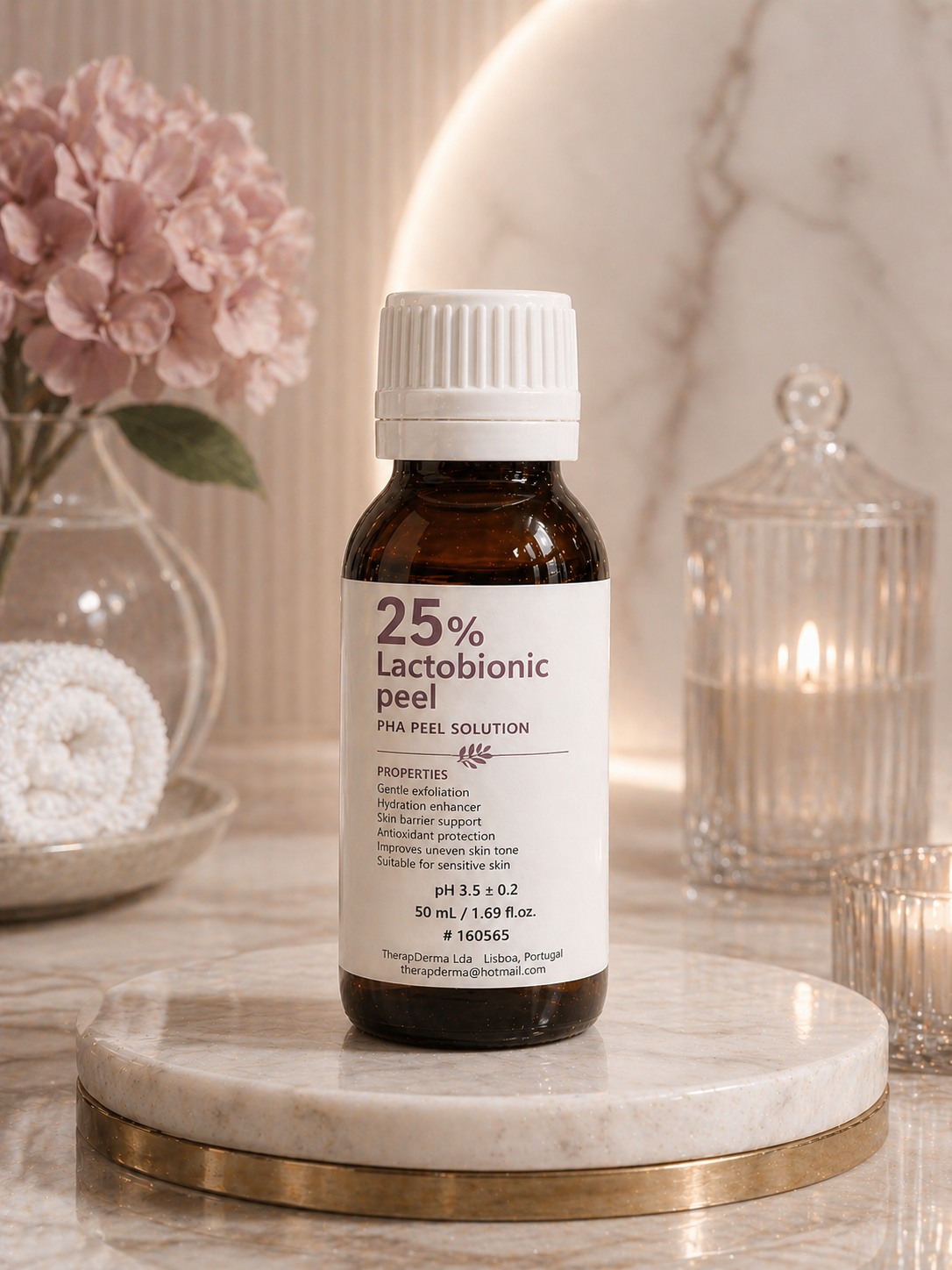
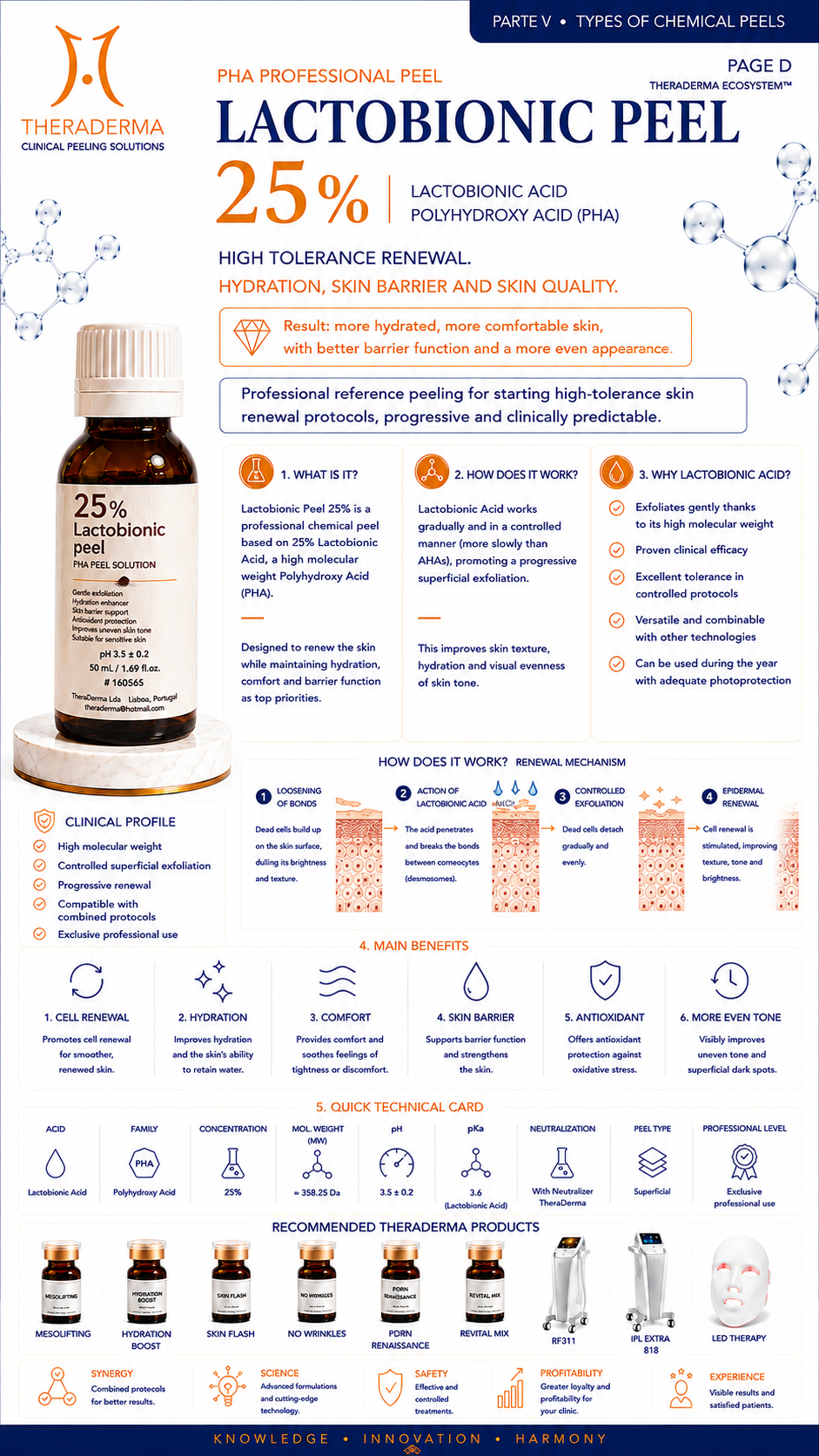
Lactobionic Peel 25%
High-tolerance PHA renewal, hydration, antioxidant protection and skin barrier support for appropriately selected sensitive or dehydrated skin
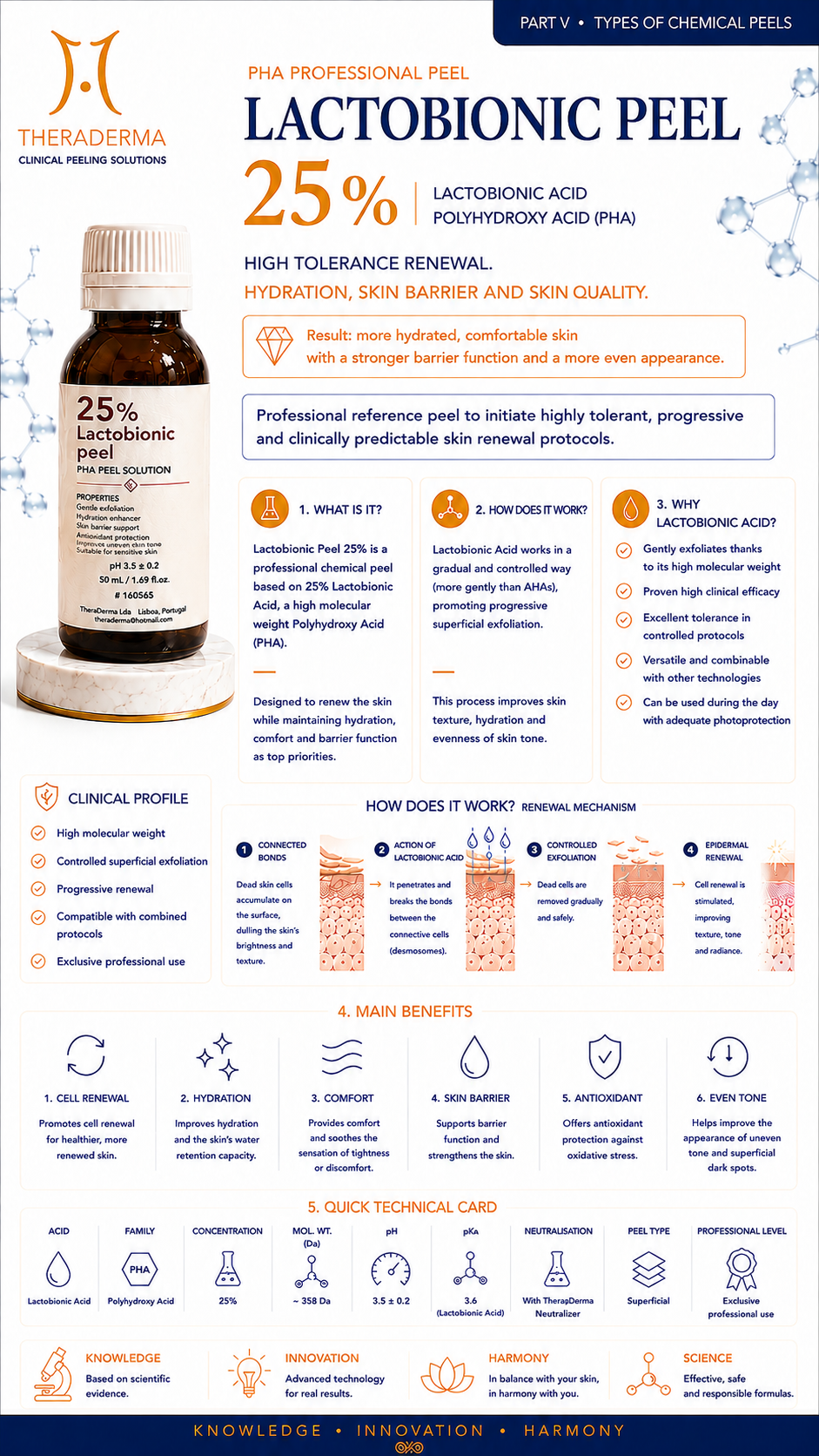
Lactobionic Peel 25% by TherapDerma is a professional chemical peel formulated with 25% Lactobionic Acid, a member of the Polyhydroxy Acid (PHA) family. Its distinctive molecular structure promotes a more gradual interaction with the skin surface than hydroxy acids with a smaller molecular size, enabling progressive superficial exfoliation with a high level of skin tolerance.
This characteristic makes Lactobionic Peel 25% particularly valuable when the objective is not simply to exfoliate, but to promote superficial renewal while maintaining comfort, hydration and skin barrier function as important elements of the treatment strategy.
Its profile combines controlled exfoliation, humectant properties and antioxidant activity, allowing skin quality to be addressed without necessarily resorting to more intensive exfoliation strategies.
Within appropriately indicated professional protocols, it can help improve hydration, visibly refine skin texture, enhance radiance and promote a more even-looking skin tone, while paying particular attention to the comfort of appropriately selected sensitive or dehydrated skin.
TherapDerma technical documentation specifically positions this 25% formulation as a superficial peel designed for the exfoliation of sensitive skin, improvement of hydration, skin barrier support, antioxidant protection and visible improvement in uneven skin tone.
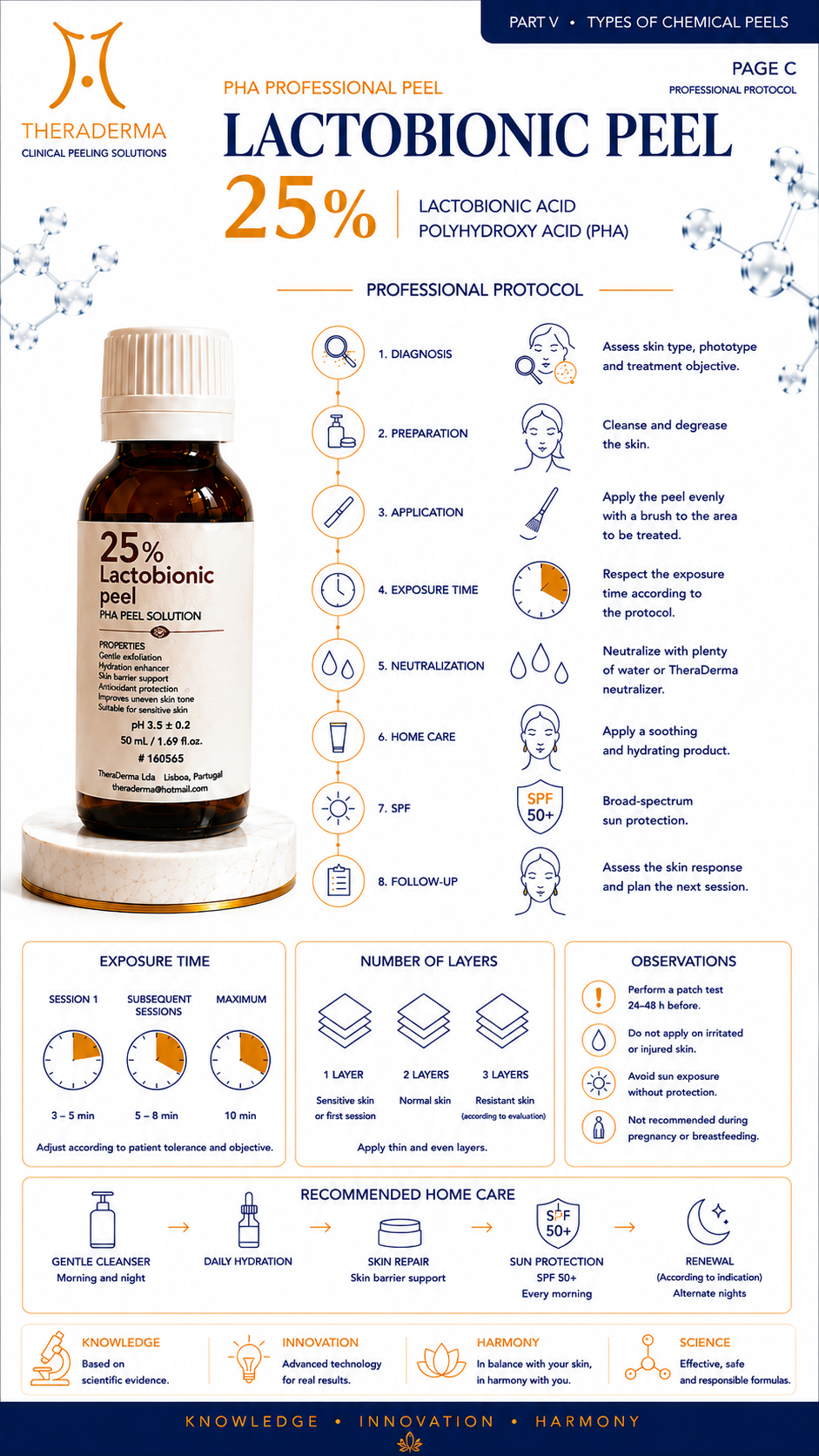
More than a stand-alone procedure, Lactobionic Peel 25% forms part of the TherapDerma Clinical Ecosystem™, a methodology based on professional assessment, treatment planning, treatment personalisation, reassessment and continuity of care.
What makes Lactobionic Peel 25% different?
Its primary value lies in combining superficial renewal, hydration and skin barrier support within a high-tolerance strategy.
PHAs have a larger molecular size and interact more gradually with the skin surface, promoting progressive, well-tolerated exfoliation. They are also recognised for their humectant properties, which are particularly relevant for sensitive or dehydrated skin.
With Lactobionic Peel 25%, this profile enables the practitioner to address patients for whom skin tolerance, hydration and preservation of the skin barrier are part of the treatment objective itself, rather than merely considerations for post-procedure care.
It therefore occupies a distinctive position within protocols designed for sensitive skin, stable and appropriately selected reactive skin, or skin prone to dehydration, as well as within Skin Quality strategies aimed at progressively improving:
✔ hydration;
✔ skin comfort;
✔ surface texture;
✔ radiance;
✔ the visible evenness of skin tone.
Lactobionic Acid also provides antioxidant activity, extending its relevance within programmes designed for skin exposed to oxidative stress and environmental factors.
It is not about exfoliating more. It is about selecting the right level of renewal for the right skin.
________________________________________
What is Lactobionic Acid?
Lactobionic Acid belongs to the Polyhydroxy Acid (PHA) family.
Technical documentation describes it as a compound obtained through the oxidation of lactose and composed of gluconic acid and galactose.
Compared with hydroxy acids of a smaller molecular size, its structure promotes a more gradual interaction with the skin surface, contributing to progressive superficial exfoliation and a high-tolerance profile.
Its cosmetic value extends beyond exfoliation.
Lactobionic Acid has humectant and antioxidant properties and is particularly relevant within strategies in which hydration, comfort and skin barrier function need to remain priorities throughout the renewal process.
This combination explains why PHAs occupy a distinct place within modern protocols for skin requiring progressive improvement in surface quality without necessarily resorting to a more intensive exfoliation strategy.
In other words, it enables a shift from the conventional approach of:
“exfoliate and then repair”
towards a more balanced strategy:
“renew while respecting the skin”.
________________________________________
When should Lactobionic Peel 25% be selected?
Lactobionic Peel 25% may be considered when professional assessment identifies the need for controlled superficial renewal in skin where hydration, tolerance and skin barrier function are determining factors in the selection of the peel.
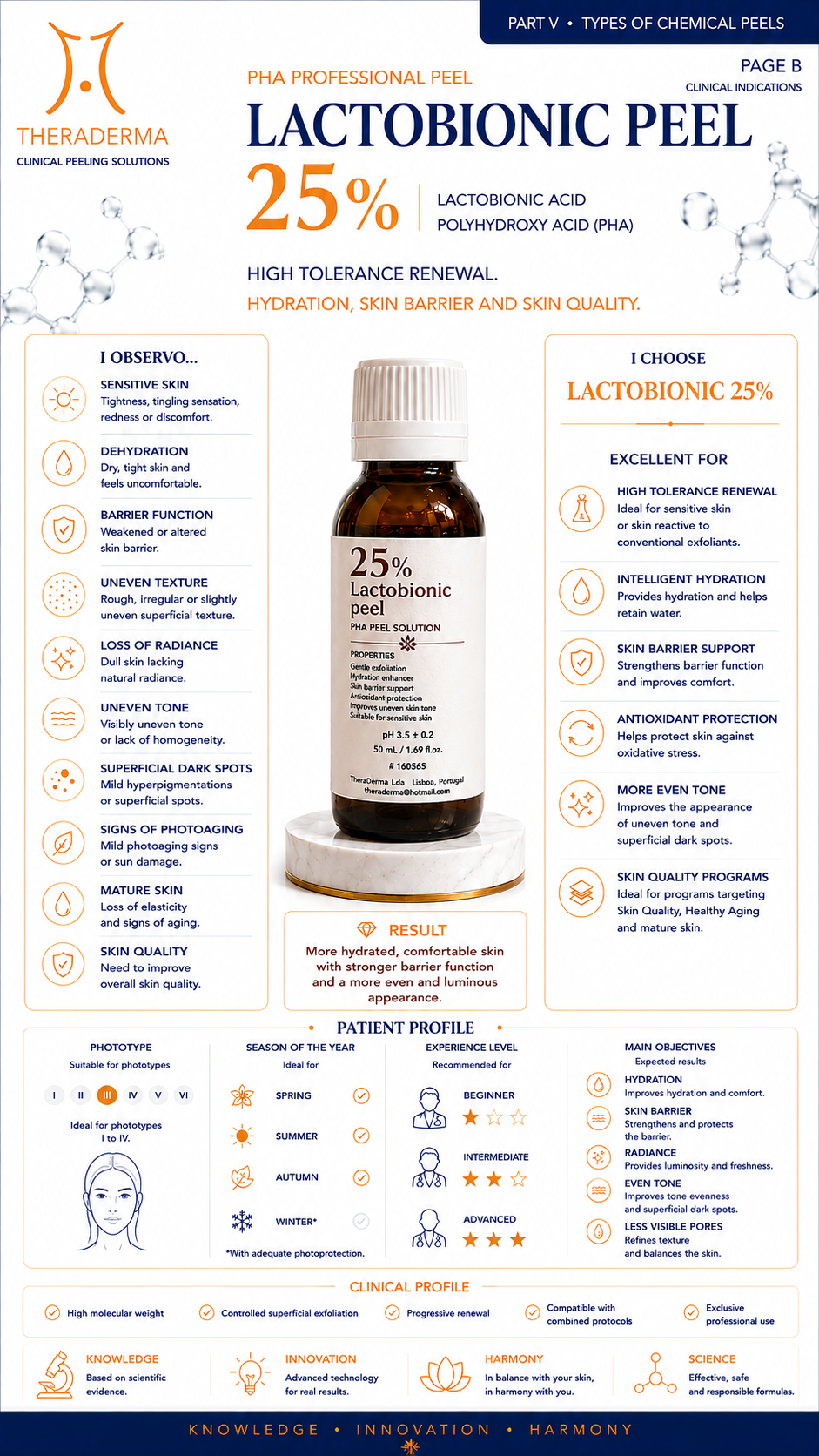
It may be incorporated into personalised protocols for patients presenting with:
✔ appropriately selected sensitive skin;
✔ stable and appropriately selected reactive skin;
✔ dry or dehydrated skin;
✔ sensations of dryness, tightness or discomfort;
✔ irregular surface texture;
✔ dull skin or loss of radiance;
✔ visibly uneven skin tone;
✔ the appearance of superficial dark marks;
✔ superficial signs of photoageing;
✔ mature skin requiring progressive renewal strategies;
✔ hydration and Skin Quality programmes;
✔ situations in which a high-tolerance exfoliation profile is particularly appropriate.
Product-specific documentation associates Lactobionic Acid with exfoliation, hydration, radiance and visible improvement in the appearance of uneven skin tone and superficial dark marks.
The final indication should always be established following an individualised professional assessment.
________________________________________
Positioning within the TherapDerma Clinical Ladder™
At TherapDerma, we understand that 25% does not automatically mean “more aggressive” or “better”.
Concentration is only one of the variables that influence the behaviour of a peel.
The final response also depends on factors including:
✔ the chemical family of the acid;
✔ molecular structure and size;
✔ pH;
✔ pKa;
✔ the complete formulation;
✔ contact time;
✔ professional technique;
✔ the condition of the skin barrier;
✔ the individual biological characteristics of the skin.
Lactobionic Peel 25% has an approximate pH of 3.5, a pKa of 3.6 and acts superficially. Within the TherapDerma Clinical Ladder™, it therefore occupies a position focused on high-tolerance PHA renewal, hydration, skin barrier support and progressive optimisation of Skin Quality.
This enables the practitioner to select it not simply because a “gentle peel” is required, but because a different action profile is sought: progressive superficial renewal in patients for whom preserving hydration, comfort and skin barrier function is particularly important.
Its continuation within a programme will depend on the initial diagnosis, the response observed, skin recovery and professional reassessment before deciding whether to maintain or adapt the approach, integrate another strategy or conclude treatment.
________________________________________
TherapDerma Philosophy
Sensitive skin does not necessarily need less treatment. It needs better-selected treatment.
At TherapDerma, we believe that the efficacy of a procedure should not be measured solely by the intensity of the immediate response.
Visible peeling or an intense skin reaction are not, in themselves, indicators of a better outcome.
The true objective is to select:
the right acid, for the right skin, at the right time.
Lactobionic Peel 25% particularly embodies this philosophy by harnessing the characteristics of PHAs to promote progressive renewal while maintaining comfort, hydration and respect for skin barrier function as priorities.
For this reason, it is integrated within the TherapDerma Clinical Ecosystem™, where chemical peels, mesotherapy, medical-aesthetic technologies and home care can be organised into sequential strategies defined according to the initial assessment and the individual evolution of the patient.
________________________________________
TherapDerma Conclusion
Lactobionic Peel 25% expands the practitioner’s options precisely for those patients in whom more intensive exfoliation is not necessarily the most appropriate strategy.
Its PHA profile enables progressive superficial renewal to be combined with hydration, skin barrier support and antioxidant protection, making it a differentiated tool for protocols designed for sensitive or dehydrated skin, or for skin requiring a particularly considerate approach.
Its true value lies in enabling the practitioner to progressively improve the visible quality of the skin while maintaining tolerance as part of the strategy, adapting each stage of the protocol to the observed response and the individual evolution of the patient.
Within the TherapDerma Clinical Ecosystem™, Lactobionic Peel 25% therefore occupies a strategic position:
when the skin needs renewal, but hydration, skin barrier function and comfort are also part of the desired outcome.
Clinical Benefits
High skin-tolerance profile, hydration, antioxidant protection and superficial renewal for skin that needs improvement without being over-exfoliated
Lactobionic Peel 25% by TherapDerma offers a particularly valuable profile when the objective is to improve skin quality without unnecessarily compromising comfort. As a member of the Polyhydroxy Acid (PHA) family, characterised by a larger molecular size and a more gradual interaction with the skin surface, it promotes progressive, well-tolerated superficial exfoliation, making it particularly relevant for appropriately selected sensitive or dehydrated skin.
Unlike strategies focused primarily on increasing exfoliation intensity, Lactobionic Acid combines superficial renewal with humectant and antioxidant properties. This combination allows hydration, skin barrier function, comfort and the visible quality of the skin to be addressed simultaneously, expanding professional treatment options for patients who require a particularly considerate approach.
The TherapDerma 25% formulation is specifically positioned for sensitive-skin exfoliation, hydration enhancement, skin barrier support, antioxidant protection and visible improvement in the appearance of uneven skin tone.
________________________________________
🛡️ High Skin-Tolerance Profile
What does it contribute clinically?
The larger molecular size characteristic of PHAs promotes a more gradual interaction with the skin surface. This allows the exfoliating action to develop progressively and makes Lactobionic Acid particularly relevant when skin tolerance influences the choice of peel.
Clinical benefits
✔ Promotes progressive superficial exfoliation.
✔ Helps maintain a high level of comfort during renewal programmes.
✔ Enables the treatment of appropriately selected sensitive skin.
✔ Expands treatment options when more intensive exfoliation strategies are not the first choice.
________________________________________
💧 Hydration and Humectant Capacity
What does it contribute clinically?
One of the distinguishing features of Lactobionic Acid is its humectant capacity.
Technical documentation describes its ability to support hydration and retain water at the skin surface, helping to reduce manifestations associated with dryness and tightness.
This means hydration is not merely a post-peel consideration, but part of the treatment objective itself.
Clinical benefits
✔ Promotes improved skin hydration.
✔ Helps reduce sensations of dryness and tightness.
✔ Contributes to skin that feels more supple and comfortable.
✔ Particularly relevant for appropriately selected dehydrated skin.
________________________________________
🧱 Skin Barrier Support
What does it contribute clinically?
Skin barrier function becomes particularly important when working with sensitive, stable reactive or dehydrated skin.
The PHA profile enables gradual exfoliation while helping to maintain favourable conditions for skin barrier function, hydration and comfort.
Lactobionic Peel 25% can therefore be integrated into programmes in which renewal and preservation form part of the same strategy.
Clinical benefits
✔ Supports maintenance of skin barrier function.
✔ Promotes more balanced skin conditions during renewal.
✔ Helps preserve skin comfort.
✔ Particularly relevant in protocols for appropriately selected sensitive or dehydrated skin.
________________________________________
⚛️ Antioxidant Protection
What does it contribute clinically?
Lactobionic Acid provides antioxidant activity, extending its relevance beyond superficial exfoliation.
This profile allows it to be incorporated into strategies for skin exposed to oxidative stress and environmental factors, contributing to the maintenance of the visible quality of the skin surface.
Clinical benefits
✔ Provides antioxidant support.
✔ Helps limit the impact of oxidative stress on the skin surface.
✔ Complements protocols designed for photoexposed skin.
✔ Contributes to maintaining a healthy-looking complexion.
________________________________________
🌸 Comfort in Sensitive Skin
What does it contribute clinically?
Not all skin requiring renewal tolerates exfoliating procedures in the same way.
Lactobionic Peel 25% addresses this specific need by promoting superficial renewal in patients for whom sensitivity, stable reactivity or dehydration make comfort and tolerance important priorities.
The gradual interaction of Lactobionic Acid with the skin surface contributes to its high-tolerance profile.
Clinical benefits
✔ Particularly relevant for appropriately selected sensitive skin.
✔ Promotes superficial renewal with greater comfort.
✔ Enables progressive and conservative programmes to be designed.
✔ Offers an alternative when tolerance limits other exfoliation strategies.
________________________________________
🌟 Radiance and Visible Evenness of Skin Tone
What does it contribute clinically?
Product documentation specifically associates Lactobionic Acid with radiance, visible improvement in uneven skin tone and the appearance of superficial dark marks.
Progressive superficial renewal can help improve the appearance of dull or visibly uneven skin, while its humectant capacity supports a brighter, more revitalised-looking surface.
Clinical benefits
✔ Promotes a more radiant appearance.
✔ Helps visibly improve uneven skin tone.
✔ May help reduce the appearance of superficial dark marks.
✔ Promotes a more even and revitalised-looking complexion.
________________________________________
✨ Global Optimisation of Skin Quality
What does it contribute clinically?
The value of Lactobionic Peel 25% does not lie in acting on a single parameter, but in influencing several elements that determine the overall perception of skin quality:
hydration + texture + comfort + radiance + visible evenness.
This allows it to be incorporated into Skin Quality programmes particularly suited to patients who need progressive improvement in the appearance of the skin without relying on an intensive exfoliation strategy.
Clinical benefits
✔ Promotes progressive improvement in the visible quality of the skin.
✔ Contributes to a more refined surface texture.
✔ Enhances a hydrated and radiant appearance.
✔ Integrates into professional Skin Quality programmes.
________________________________________
📈 Progressive Clinical Evolution
Lactobionic Peel 25% should be understood as a tool for progressive improvement rather than a procedure whose value depends on provoking an intense or immediate skin reaction.
Its PHA profile enables sequential programmes in which the practitioner can assess tolerance, hydration, skin barrier function and visible evolution before determining the next intervention.
This is particularly relevant in sensitive skin, where maintaining good tolerance, adequate recovery and stable progression may be more important than increasing the intensity of an individual session.
________________________________________
CLINICAL SUMMARY
Main Benefits of Lactobionic Peel 25%
✔ High skin-tolerance profile.
✔ Hydration and humectant capacity.
✔ Skin barrier support.
✔ Antioxidant protection.
✔ Comfort in appropriately selected sensitive skin.
✔ Improvement in radiance and visible evenness.
✔ Global optimisation of Skin Quality.
✔ Progressive and controlled superficial renewal.
________________________________________
THERAPDERMA CLINICAL CONCLUSION
The principal value of Lactobionic Peel 25% lies in enabling the practitioner to approach skin quality from a different perspective: not by unnecessarily increasing exfoliation intensity, but by achieving renewal while preserving hydration, comfort and skin barrier function.
Its PHA profile and 25% formulation combine progressive superficial exfoliation, hydration, skin barrier support and antioxidant protection, providing a particularly differentiated tool for appropriately selected sensitive or dehydrated skin and for programmes in which tolerance is a priority.
Integrated within the TherapDerma Clinical Ecosystem™, it enables progressive strategies based on professional assessment, appropriate patient selection and continuous reassessment, guided by one fundamental principle:
the efficacy of a peel is not measured by how much it irritates the skin, but by how much it improves it while respecting its biology.
Why Choose Lactobionic Peel 25%?
A professional option when skin renewal also requires the preservation of hydration, barrier function and skin comfort
In professional aesthetic medicine, not all skin requiring renewal needs greater exfoliation intensity. In certain patients, sensitivity, dehydration or the need to preserve barrier function make it particularly important to select an acid whose behaviour allows renewal, tolerance and comfort to remain balanced.
Lactobionic Peel 25% by TherapDerma is designed precisely for this profile. As a Polyhydroxy Acid (PHA), Lactobionic Acid has a larger molecular size and interacts more gradually with the skin surface, characteristics that promote progressive, well-tolerated superficial exfoliation. PHAs are also recognised for their humectant properties, making them particularly relevant for appropriately selected sensitive or dehydrated skin.
For this reason, Lactobionic Peel 25% provides practitioners with a strategic alternative when the aim is to renew without over-exfoliating, improve the visible quality of the skin and maintain hydration, comfort and skin barrier support as priorities.
The TherapDerma 25% formulation has an approximate pH of 3.5, a pKa of 3.6 and superficial activity, and is specifically positioned for sensitive-skin exfoliation, hydration enhancement, skin barrier support, antioxidant protection and visible improvement in the appearance of uneven skin tone.
________________________________________
WHEN MAY IT BE AN APPROPRIATE OPTION?
Lactobionic Peel 25% may be considered when professional assessment identifies the need to improve skin quality through progressive, highly tolerated superficial exfoliation, particularly when hydration, comfort and barrier function influence the choice of peel.
It may be incorporated into personalised programmes designed for:
✔ appropriately selected sensitive skin;
✔ stable, appropriately selected reactive skin;
✔ dry or dehydrated skin;
✔ the need to preserve barrier function during renewal;
✔ dull skin or loss of radiance;
✔ irregular surface texture;
✔ visibly uneven skin tone;
✔ the appearance of superficial dark marks;
✔ superficial signs of photoageing;
✔ mature skin requiring a progressive renewal strategy;
✔ Skin Quality programmes in which hydration and tolerance are priorities;
✔ strategies for maintaining skin quality.
Product documentation specifically associates Lactobionic Acid with exfoliation, hydration, radiance, visible improvement in uneven skin tone and the appearance of superficial dark marks.
Selection should always follow an individualised assessment of the skin, its sensitivity, skin barrier integrity, relevant history and the objectives of the protocol.
________________________________________
WHAT TYPE OF PROFESSIONAL IS IT DESIGNED FOR?
Lactobionic Peel 25% is particularly suited to practitioners who understand that having a high-tolerance solution expands their ability to personalise treatment rather than limiting it.
It is especially relevant for clinics treating sensitive, dehydrated patients or those with lower tolerance to more intensive exfoliation strategies who require an option specifically suited to this profile.
It also enables a different philosophy within a professional peel portfolio: selecting the procedure according to the behaviour of the acid and the needs of the skin, rather than solely according to percentage or intensity.
Its professional use allows programmes to be structured in which parameters such as tolerance, hydration, comfort, barrier function and visible evolution can be reassessed before deciding whether to continue, adapt or modify the protocol.
Within a professional peel portfolio, Lactobionic Peel 25% therefore occupies a very specific clinical space: the patient who needs renewal, but whose skin requires a particularly considerate strategy.
________________________________________
THERAPDERMA CLINICAL LADDER™
Each peel responds to a different clinical need
The TherapDerma Clinical Ladder™ does not classify peels simply from “milder” to “stronger”.
Professional selection should consider:
✔ diagnosis and treatment objective;
✔ acid family and behaviour;
✔ skin sensitivity and tolerance;
✔ hydration level;
✔ condition of skin barrier function;
✔ required depth of action;
✔ history of previous procedures;
✔ response observed throughout the programme.
________________________________________
Lactobionic Peel 25%
It may be particularly considered when the objective is:
✔ highly tolerated superficial exfoliation;
✔ renewal of appropriately selected sensitive skin;
✔ improved hydration;
✔ skin barrier support;
✔ antioxidant protection;
✔ progressive restoration of radiance;
✔ visible improvement in uneven skin tone;
✔ visible reduction in the appearance of superficial dark marks;
✔ Skin Quality in sensitive or dehydrated skin;
✔ progressive maintenance of skin quality.
Its position within the TherapDerma portfolio does not depend solely on its 25% concentration. Its clinical identity is determined primarily by the characteristic behaviour of Lactobionic Acid as a PHA.
________________________________________
QUICK SELECTION GUIDE
Clinical objective Lactobionic Peel 25% may be considered
Sensitive skin requiring renewal ✓ Particularly indicated
Skin dehydration ✓ Particularly indicated
Need for high tolerance ✓ Particularly indicated
Skin barrier support ✓ Particularly indicated
Dull skin / loss of radiance ✓
Irregular surface texture ✓
Visibly uneven skin tone ✓
Appearance of superficial dark marks ✓
Superficial photoageing ✓
Antioxidant protection ✓
Skin Quality in sensitive or dehydrated skin ✓ Particularly indicated
Maintenance of skin quality ✓
This guide provides general guidance and does not replace an individualised skin assessment.
________________________________________
WHY INTEGRATE IT INTO A PROGRESSIVE PROGRAMME?
Because, particularly in sensitive or dehydrated skin, maintaining good tolerance and stable progression may provide greater value than unnecessarily increasing the intensity of an individual session.
The gradual interaction characteristic of PHAs allows programmes to be structured in which skin evolution can be assessed sequentially, observing tolerance and recovery before determining the next intervention.
This approach allows the practitioner to:
✔ assess the skin’s actual response between sessions;
✔ progressively adapt the programme;
✔ prioritise recovery of barrier function when necessary;
✔ avoid increases in intensity without clinical justification;
✔ build strategies aimed at progressively improving skin quality.
Within the TherapDerma Clinical Ecosystem™, once the response has been assessed and favourable progress confirmed, the practitioner can decide whether to maintain the same approach, adapt the protocol, integrate complementary procedures when specifically indicated, or conclude the programme.
________________________________________
THERAPDERMA CLINICAL CONCLUSION
Why incorporate Lactobionic Peel 25% into a professional peel portfolio? Because it enables the practitioner to address a patient profile in which renewal and tolerance need to progress together.
Its behaviour as a PHA provides a particularly valuable combination of gradual superficial exfoliation, humectant capacity and a high-tolerance profile, while the TherapDerma 25% formulation is specifically positioned for hydration, skin barrier support, antioxidant protection and visible improvement in uneven skin tone.
Within the TherapDerma Clinical Ladder™, it therefore occupies a clearly differentiated position: it is not simply another superficial peel, but a strategic option for patients in whom sensitivity, dehydration or the need to preserve comfort influences treatment selection.
As part of the TherapDerma Clinical Ecosystem™, it enables progressive programmes based on diagnosis, tolerance, recovery and individual evolution.
Because expanding a clinic’s capabilities does not mean having increasingly intensive peels. It means having the right peel for each type of skin.
Areas of Application
One PHA formulation. Different application possibilities when the assessment prioritises tolerance, hydration and respect for barrier function.
Lactobionic Peel 25% by TherapDerma may be integrated into professional superficial-renewal protocols, particularly for appropriately selected sensitive, stable reactive or dehydrated skin, when the aim is to progressively improve skin quality without necessarily resorting to more intensive exfoliation.
Its PHA profile promotes gradual interaction with the skin surface and controlled superficial exfoliation, combined with humectant and antioxidant properties and a high-tolerance skin profile.
This allows practitioners to consider its use on different anatomical areas, provided that skin integrity, local sensitivity and recovery capacity are compatible with the procedure.
The available technical documentation clearly defines its cosmetic objectives — sensitive-skin exfoliation, hydration enhancement, skin barrier support, antioxidant protection and visible improvement in uneven skin tone — but does not establish a closed list of specific anatomical treatment areas.
For this reason, the areas below should be understood as professional guidance for integration into protocols, always subject to the current instructions for use and to an individual assessment of each area.
________________________________________
FACE
Primary area for integration into Skin Quality protocols
The face is one of the areas in which the characteristics of Lactobionic Peel 25% are particularly relevant, as sensitivity, dehydration, loss of radiance, irregular texture and superficial signs of photoageing may coexist in the same patient.
When professionally indicated, it may contribute to improving:
✔ skin hydration;
✔ surface texture;
✔ radiance;
✔ skin comfort;
✔ visible evenness of skin tone;
✔ the appearance of superficial signs of photoageing;
✔ Skin Quality in appropriately selected sensitive or dehydrated skin.
Application should be carefully adapted to the characteristics of each facial region, with particular attention to areas of greater sensitivity.
________________________________________
NECK
Progressive renewal in an area requiring particular control
The neck has anatomical characteristics that differ from those of the face and therefore requires particularly careful planning.
Because of its gradual interaction with the skin surface and high-tolerance profile, Lactobionic Peel 25% may be considered when the aim is to improve the superficial appearance of this area while maintaining hydration, comfort and respect for barrier function as priorities.
It may be incorporated into strategies aimed at:
✔ improving hydration;
✔ promoting a more even texture;
✔ enhancing radiance;
✔ improving the visible quality of photoexposed skin;
✔ maintaining aesthetic continuity between the face and neck.
The amount of product, treatment area and contact time should be individualised according to the current professional instructions and the observed skin response.
________________________________________
DÉCOLLETAGE
Renewal of an area frequently exposed to sunlight
The décolletage may simultaneously present dehydration, loss of radiance, irregular texture and visible tone irregularities associated with cumulative environmental and sun exposure.
The profile of Lactobionic Acid is particularly relevant when the aim is to combine superficial renewal, hydration and antioxidant support within a progressive strategy.
In appropriately selected patients, it may be considered to:
✔ improve hydration;
✔ promote a more radiant appearance;
✔ refine surface texture;
✔ visibly improve uneven tone;
✔ support Skin Quality programmes for photoexposed skin.
Because of the particular characteristics of the décolletage, application should be especially controlled and adapted to the tolerance of the area.
________________________________________
BACKS OF THE HANDS
Skin Quality in an area exposed to cumulative environmental factors
The backs of the hands may progressively develop dehydration, loss of radiance, irregular texture and visible tone irregularities.
When the practitioner considers the use of Lactobionic Peel 25% appropriate for this area, its humectant and antioxidant profile allows strategies to be developed with the aim of progressively improving the superficial appearance of the skin.
It may be considered to:
✔ improve superficial hydration;
✔ promote greater radiance;
✔ visibly refine texture;
✔ improve the appearance of uneven tone;
✔ complement Skin Quality programmes for photoexposed skin.
Selection should always depend on skin integrity, local sensitivity and the recovery capacity of the area.
________________________________________
OTHER AREAS
Use only when covered by the current professional protocol
The available technical documentation does not specifically identify other anatomical areas as indications for Lactobionic Peel 25%.
Therefore, use outside commonly treated areas should only be considered when the current professional instructions for the product specifically allow such application and when an appropriate indication exists.
The decision should take particular account of:
✔ the extent of the treatment area;
✔ local sensitivity;
✔ skin integrity;
✔ hydration level;
✔ recovery capacity;
✔ the objective of the procedure.
The versatility of the product should not be interpreted as authorisation to extend the treated surface indiscriminately.
________________________________________
CLINICAL GUIDANCE BY AREA
Anatomical area Primary objective Professional consideration
Face Hydration, texture, radiance, comfort and Skin Quality Adapt application to the sensitivity of the different facial regions
Neck Hydration, texture and aesthetic continuity Use a particularly controlled approach
Décolletage Hydration, radiance, texture and uneven tone Carefully individualise treatment area, amount and tolerance
Backs of the hands Skin Quality in photoexposed skin, hydration and tone Assess skin integrity and recovery capacity beforehand
________________________________________
MULTI-AREA PROTOCOLS
The high-tolerance profile of Lactobionic Peel 25% may be particularly relevant when the practitioner wishes to maintain aesthetic consistency across different areas, for example the face, neck and décolletage.
However, working on multiple areas does not necessarily mean treating all of them during the same session.
Planning may be organised sequentially in order to:
✔ better control the skin response;
✔ assess the tolerance of each area;
✔ avoid treating excessively large surface areas;
✔ adapt the amount of product to each area;
✔ modify the programme according to the observed evolution.
Within the TherapDerma Clinical Ecosystem™, the principle is to treat each area according to its own characteristics rather than automatically applying the same procedure across the entire skin surface.
________________________________________
CLINICAL CONSIDERATIONS
Before treating any area with Lactobionic Peel 25%, particular consideration should be given to:
✔ integrity of barrier function;
✔ local sensitivity and reactivity;
✔ the presence of irritation or active lesions;
✔ hydration level;
✔ recent sun exposure;
✔ previous aesthetic procedures;
✔ recovery capacity of the area;
✔ the actual treatment objective.
The gradual behaviour of PHAs promotes exfoliation with a high-tolerance profile, but high tolerance does not mean an absence of professional judgement or indiscriminate use.
________________________________________
QUICK SUMMARY
Lactobionic Peel 25% may primarily be considered for:
✔ face;
✔ neck;
✔ décolletage;
✔ backs of the hands.
Use on other areas should only be undertaken when covered by the current professional instructions for the product and when an appropriate indication exists.
Primary objectives
✔ hydration;
✔ highly tolerated superficial renewal;
✔ skin barrier support;
✔ improved texture;
✔ radiance;
✔ visible evenness of skin tone;
✔ antioxidant protection;
✔ Skin Quality in appropriately selected sensitive or dehydrated skin.
________________________________________
THERAPDERMA CONCLUSION
Lactobionic Peel 25% offers particular value in areas where the quality of the result depends as much on renewal as on maintaining hydration, comfort and barrier function.
Its PHA profile enables the development of protocols aimed at improving hydration, refining texture, promoting radiance and supporting barrier function, while maintaining superficial and progressive activity that is particularly relevant for appropriately selected sensitive, stable reactive or dehydrated skin.
Within the TherapDerma Clinical Ecosystem™, its versatility should not be understood as indiscriminate application to any area, but as the ability to strategically select those areas in which progressive, well-tolerated renewal can provide genuine clinical value.
The right area, the right patient and the right protocol are more important than unnecessarily increasing the treated surface area.
How Does It Work?
Understanding the behaviour of a PHA allows concentration to be used with greater professional precision
Lactobionic Peel 25% by TherapDerma works through progressive superficial exfoliation determined not only by its concentration, but also by the physicochemical characteristics of Lactobionic Acid as a Polyhydroxy Acid (PHA).
PHAs have a larger molecular size and interact more gradually with the skin surface, promoting progressive and controlled exfoliation with a high-tolerance profile. This characteristic distinguishes them from hydroxy acids with a smaller molecular size and explains their particular relevance for appropriately selected sensitive, dehydrated or stable reactive skin.
In the TherapDerma formulation, Lactobionic Peel 25% has an approximate pH of 3.5, a pKa of 3.6 and superficial activity. Its cosmetic profile is focused on sensitive-skin exfoliation, hydration enhancement, skin barrier support, antioxidant protection and visible improvement in uneven skin tone.
Its mode of action should therefore be understood as a balance between superficial renewal, hydration, tolerance and preservation of skin comfort.
________________________________________
EVERYTHING BEGINS WITH A MORE GRADUAL INTERACTION WITH THE SKIN
One of the fundamental characteristics of Lactobionic Acid is its molecular structure.
As a PHA with a larger molecular size than many hydroxy acids commonly used in peels, its interaction with the skin surface occurs more gradually.
This characteristic promotes progressive exfoliation and allows the development of protocols in which tolerance is a professional priority.
The TherapDerma technical documentation on PHAs specifically associates this progressive behaviour with controlled superficial exfoliation and a high level of skin comfort.
This gradual interaction is one of the key features of its differentiated behaviour.
________________________________________
STEP 1
Progressive Interaction of Lactobionic Acid
Following application, Lactobionic Acid begins to interact with the most superficial layers of the skin.
Its molecular structure promotes progressive interaction with the skin surface, allowing the exfoliating action to develop gradually.
This behaviour allows the practitioner to work with a 25% peel whose activity should not be interpreted solely on the basis of the percentage stated in the formulation.
The final response will be influenced by different variables:
✔ acid concentration;
✔ formulation pH;
✔ pKa;
✔ physicochemical characteristics of the active ingredient;
✔ formulation and vehicle;
✔ amount applied;
✔ contact time;
✔ professional technique;
✔ condition of the skin barrier;
✔ hydration level;
✔ individual sensitivity;
✔ history of previous procedures.
For this reason, 25% describes the concentration, but does not by itself determine the intensity or response that the formulation will produce in a particular skin.
________________________________________
STEP 2
Controlled Superficial Exfoliation
The gradual interaction of Lactobionic Acid promotes exfoliation of the superficial layers, contributing to the progressive removal of corneocytes and renewal of the skin surface.
The technical documentation for Lactobionic Peel 25% classifies it as a superficial peel, while the characteristic PHA profile allows progressive exfoliation with a high level of tolerance.
In professional terms, this means that:
✔ efficacy does not require intense peeling or flaking;
✔ the absence of an intense visible reaction does not imply an absence of activity;
✔ progress should be assessed using clinical and visual parameters, rather than solely by the immediate response following application.
A stronger or more visible reaction should not automatically be interpreted as a better result.
________________________________________
STEP 3
Water Binding and Support for Skin Hydration
This is where one of the distinguishing characteristics of Lactobionic Acid becomes particularly relevant compared with peels whose action is focused predominantly on exfoliation.
PHAs have humectant properties. Lactobionic Acid contains multiple hydroxyl groups capable of interacting with water, a characteristic associated with its ability to support hydration of the skin surface.
The technical documentation also describes its ability to help reduce manifestations associated with dryness and sensations of tightness.
Therefore, while superficial renewal is taking place, the treatment may simultaneously help maintain favourable hydration conditions.
This profile allows protocols to be developed in which hydration is not regarded solely as a compensatory aftercare measure, but as a property associated with the active ingredient itself and with the overall treatment objective.
________________________________________
STEP 4
Complementary Antioxidant Action
Lactobionic Acid adds another dimension to its activity profile: antioxidant activity.
The technical documentation attributes antioxidant properties to the active ingredient, associated with its ability to help limit oxidative processes, while the TherapDerma catalogue specifically includes antioxidant protection among the principal cosmetic objectives of Lactobionic Peel 25%.
This characteristic allows it to be integrated into programmes in which the objective is not limited to renewing the skin surface, but also includes supporting strategies aimed at preserving the visible quality of skin exposed to environmental and oxidative factors.
It exfoliates, but its professional value extends beyond exfoliation.
________________________________________
STEP 5
Progressive Evolution of Skin Quality
As a result of the combination of progressive exfoliation, hydration and antioxidant activity, the skin surface may progressively develop a more balanced appearance.
Within appropriately indicated protocols, the following may be observed:
✔ a visibly more refined texture;
✔ a greater sense of comfort;
✔ improved superficial hydration;
✔ enhanced radiance;
✔ a more even-looking skin tone;
✔ overall improvement in the appearance of the skin surface;
✔ progressive optimisation of Skin Quality.
These changes should be understood as part of a progressive evolution, the extent and speed of which may vary according to the individual characteristics of the skin and the selected treatment programme.
________________________________________
STEP 6
Reassessment Before Deciding on the Next Intervention
The profile of Lactobionic Peel 25% allows the protocol to be built around the individual response of the skin rather than around an automatic escalation in intensity.
Before a further application, the following should be assessed:
✔ observed tolerance;
✔ hydration status;
✔ integrity of barrier function;
✔ presence or absence of residual irritation;
✔ evolution of texture and radiance;
✔ visible evolution of skin tone;
✔ adherence to home-care recommendations;
✔ professional need to continue, maintain, space, adapt or conclude the strategy.
The next session should not be performed simply because it was scheduled on a calendar.
It should be undertaken when recovery and the evolution of the skin justify continuation of the protocol.
________________________________________
WHY IS ITS PROGRESSIVE INTERACTION IMPORTANT?
Because it is one of the main reasons why Lactobionic Peel 25% occupies a differentiated position within the TherapDerma portfolio.
In appropriately selected sensitive, dehydrated or stable reactive skin, simply increasing exfoliative intensity may unnecessarily compromise tolerance and make programme continuity more difficult.
The characteristic behaviour of PHAs allows a different strategy to be adopted:
PROGRESSIVE INTERACTION
↓
CONTROLLED SUPERFICIAL EXFOLIATION
↓
HIGH-TOLERANCE SKIN PROFILE
↓
SUPPORT FOR HYDRATION, BARRIER FUNCTION AND COMFORT
↓
PROFESSIONAL REASSESSMENT
↓
INDIVIDUALISED PROGRAMME CONTINUITY
The aim is not to artificially minimise the skin response, but to achieve the appropriate degree of renewal without unnecessarily pursuing an intense reaction.
________________________________________
A DIFFERENT RESPONSE IN EVERY PATIENT
The same formulation does not necessarily produce an identical response in every skin.
Its behaviour may vary according to:
✔ thickness and condition of the stratum corneum;
✔ hydration level;
✔ individual sensitivity;
✔ integrity of barrier function;
✔ phototype;
✔ age and skin condition;
✔ environmental and sun exposure;
✔ previous procedures;
✔ home-care products used;
✔ technique and parameters selected by the practitioner.
The objective is therefore not to produce a standardised reaction, but to achieve a response that is appropriate, controlled and consistent with the characteristics of the skin being treated.
________________________________________
PROCESS SEQUENCE
PROFESSIONAL APPLICATION
↓
Gradual interaction of the PHA with the skin surface
↓
Controlled superficial exfoliation
↓
Progressive renewal of the skin surface
↓
Support for hydration, barrier function and comfort
↓
Complementary antioxidant action
↓
Progressive evolution of texture, radiance and visible evenness
↓
Progressive optimisation of Skin Quality
↓
PROFESSIONAL REASSESSMENT
________________________________________
KEY PRINCIPLES OF HOW IT WORKS
Lactobionic Peel 25% bases its activity profile on:
✔ the larger molecular size characteristic of PHAs;
✔ progressive interaction with the skin surface;
✔ controlled superficial exfoliation;
✔ a high-tolerance skin profile;
✔ humectant properties;
✔ support for the maintenance of barrier function;
✔ antioxidant activity;
✔ progressive improvement in radiance and texture;
✔ progressive optimisation of Skin Quality.
________________________________________
THERAPDERMA CONCLUSION
Understanding how Lactobionic Peel 25% works makes it clear why the concentration stated on a peel does not, by itself, determine its behaviour.
Its profile combines gradual interaction with the skin surface, controlled superficial exfoliation, humectant properties and antioxidant activity, allowing renewal to be integrated into a strategy that maintains hydration, comfort and respect for barrier function as priorities.
Its true professional value therefore lies not in producing more visible exfoliation, but in enabling the practitioner to appropriately manage the relationship between renewal, tolerance and the individual evolution of the skin.
Integrated within the TherapDerma Clinical Ecosystem™, this behaviour allows programmes to be planned in which each new intervention is decided only after observing how the skin has actually responded.
Because understanding how a PHA works allows us to stop pursuing intensity and start controlling progression.
Mechanism of Action
The science behind how a PHA can renew the skin while maintaining a high-tolerance profile
The mechanism of action of Lactobionic Peel 25% by TherapDerma is based on the physicochemical characteristics of Lactobionic Acid as a Polyhydroxy Acid (PHA), its gradual interaction with the skin surface and the balance between exfoliation, hydration and antioxidant activity.
Unlike hydroxy acids with a smaller molecular size, PHAs have larger molecules and interact more gradually with the skin surface, promoting controlled superficial exfoliation and a high-tolerance profile. This characteristic is particularly relevant in appropriately selected sensitive, stable reactive or dehydrated skin.
In Lactobionic Peel 25%, this behaviour is combined with humectant and antioxidant properties, creating a mechanism whose purpose is not simply to remove superficial cells, but to promote renewal while supporting hydration, comfort and barrier function.
________________________________________
ACTION ON THE STRATUM CORNEUM
The stratum corneum is the outermost layer of the epidermis and represents the first level of interaction with the peel.
It consists of corneocytes organised within a lipid matrix whose integrity is essential for maintaining barrier function, limiting transepidermal water loss and protecting the skin from the external environment.
When superficial corneocytes accumulate or the organisation of this layer becomes less uniform, changes in texture, loss of radiance and a less even appearance may become more noticeable.
Lactobionic Peel 25% promotes progressive superficial exfoliation, contributing to the controlled removal of accumulated superficial cells and more uniform renewal of the skin surface.
Its formulation is classified as a superficial peel and is specifically positioned for sensitive-skin exfoliation, hydration enhancement, skin barrier support, antioxidant protection and visible improvement in uneven skin tone.
________________________________________
PROGRESSIVE MOLECULAR INTERACTION
Molecular size influences the behaviour of the acid
One of the most scientifically relevant characteristics of Lactobionic Acid is its larger molecular size within the hydroxy acid family.
This characteristic promotes a more gradual interaction with the skin surface, differentiating its behaviour from that of hydroxy acids with a smaller molecular size.
This profile allows:
✔ more controlled superficial exfoliation;
✔ reduced intensity of the immediate interaction with the skin;
✔ a high-tolerance skin profile;
✔ maintenance of comfort as part of the procedure itself;
✔ broader possibilities for renewal in appropriately selected sensitive or dehydrated skin.
This point is fundamental to understanding why a concentration of 25% cannot be interpreted in isolation as an indicator of clinical aggressiveness.
________________________________________
CONTROLLED SUPERFICIAL RENEWAL
The exfoliating action of Lactobionic Peel 25% promotes the progressive removal of accumulated superficial cells and renewal of the stratum corneum.
This process may progressively contribute to:
✔ refining texture;
✔ improving the visible evenness of the skin surface;
✔ enhancing radiance;
✔ improving the appearance of uneven skin tone;
✔ optimising the overall perception of Skin Quality.
With PHAs, exfoliation develops gradually, allowing superficial renewal without making an intense inflammatory response the objective of treatment.
The visible intensity of peeling or flaking should therefore not be regarded as a direct measure of efficacy.
________________________________________
HUMECTANT MECHANISM AND HYDRATION SUPPORT
This is where one of the mechanisms that most clearly differentiates Lactobionic Acid within a professional peel portfolio becomes apparent.
The active ingredient contains multiple hydroxyl groups capable of interacting with water, a characteristic associated with its humectant capacity and its ability to support superficial hydration.
The technical documentation also describes its ability to help reduce manifestations associated with dryness and sensations of tightness.
From a functional perspective, this property means that the procedure does not depend exclusively on exfoliation.
While superficial renewal is taking place, the active ingredient may simultaneously help maintain favourable hydration conditions.
This is particularly relevant in patients where dehydration and the need for renewal coexist, a profile in which simply increasing exfoliative intensity may not represent the most appropriate strategy.
________________________________________
SUPPORT FOR BARRIER FUNCTION
Barrier function directly influences the skin’s tolerance of any exfoliating procedure.
PHAs have a particularly interesting profile because their gradual interaction and humectant properties allow superficial exfoliation to be developed while maintaining conditions favourable to barrier function.
For this reason, Lactobionic Peel 25% is particularly coherent within protocols in which the practitioner aims to:
✔ improve superficial skin quality;
✔ avoid unnecessary over-exfoliation;
✔ preserve comfort;
✔ support progressive skin recovery;
✔ maintain programme continuity.
________________________________________
ANTIOXIDANT ACTION
The mechanism of Lactobionic Acid does not end with exfoliation or hydration.
The technical documentation attributes antioxidant activity to the active ingredient and the ability to help limit processes associated with free radicals and oxidative stress.
This profile broadens its relevance within programmes designed for skin exposed to environmental and oxidative factors.
Lactobionic Peel 25% therefore combines three functional dimensions:
RENEW
↓
HYDRATE
↓
PROTECT AGAINST OXIDATIVE STRESS
This combination represents one of its principal points of differentiation from peels whose activity is focused predominantly on exfoliation.
________________________________________
INTERACTION WITH PROCESSES ASSOCIATED WITH SKIN AGEING
Scientific literature has described antioxidant and chelating properties of Lactobionic Acid in relation to processes involving certain matrix metalloproteinases.
These mechanisms help explain the scientific interest of the active ingredient within cosmetic strategies for mature or photo-exposed skin.
However, they should not be interpreted as evidence of a specific dermal effect of Lactobionic Peel 25%.
Its primary positioning remains superficial: progressive exfoliation, hydration, support for barrier function and antioxidant activity.
________________________________________
RELATIONSHIP BETWEEN CONCENTRATION, pH, pKa AND SKIN RESPONSE
Nominal concentration represents only one part of the information required to interpret the behaviour of a chemical peel.
Lactobionic Peel 25% has:
• Lactobionic Acid: 25%
• approximate pH: 3.5
• pKa: 3.6
• depth of action: superficial
The behaviour of the formulation will also depend on:
✔ the relationship between pH and pKa;
✔ the available acid fraction;
✔ the molecular size of the active ingredient;
✔ the formulation and vehicle;
✔ the amount applied;
✔ contact time;
✔ prior skin preparation;
✔ hydration level of the stratum corneum;
✔ integrity of barrier function;
✔ individual sensitivity.
For this reason, two peels with the same percentage concentration may behave differently.
This principle is particularly important with Lactobionic Peel 25%: its concentration must be interpreted together with the characteristic molecular behaviour of PHAs.
________________________________________
INTEGRATION INTO PROFESSIONAL PROTOCOLS
The behaviour of Lactobionic Peel 25% allows it to be integrated into sequential strategies in which the objective is not simply to perform exfoliation, but to maintain appropriately assessed skin in suitable condition before deciding on subsequent stages of the programme.
After assessing skin recovery, the practitioner may consider integrating procedures focused on hydration, revitalisation or Skin Quality when a specific indication exists.
The product documentation includes professional associations with hydration-focused strategies, Hyaluronic Acid, antioxidant vitamins, LED therapy, gentle radiofrequency and anti-ageing programmes.
The selection and interval between procedures should always be determined according to the actual recovery and evolution of the skin.
________________________________________
SCIENCE AT A GLANCE™
Parameter Lactobionic Peel 25%
Active ingredient Lactobionic Acid
Concentration 25%
Chemical family Polyhydroxy Acid (PHA)
Approximate pH 3.5
pKa 3.6
Depth Superficial
Differentiating molecular characteristic Larger molecular size and progressive interaction with the skin surface
Exfoliating mechanism Gradual superficial renewal
Complementary mechanism Humectant capacity and hydration support
Functional support Antioxidant activity and support for barrier function
Priority skin profile Appropriately selected sensitive, stable reactive or dehydrated skin
Professional purpose Optimise Skin Quality while maintaining a high-tolerance profile
________________________________________
BIOLOGICAL BASIS
The behaviour of Lactobionic Peel 25% cannot be explained solely by its exfoliating capacity.
Its biological basis lies in the combined interaction between gradual behaviour, superficial renewal, humectant capacity, support for barrier function and antioxidant activity.
This combination allows the skin surface to be progressively modified while maintaining favourable conditions for tolerance and hydration.
Its mechanism is therefore particularly relevant when the professional strategy needs to balance two simultaneous requirements:
promoting renewal without unnecessarily compromising sensitive or dehydrated skin.
________________________________________
SCIENTIFIC PRINCIPLES OF USE
Professional interpretation of Lactobionic Peel 25% should take into account that:
✔ a 25% concentration does not automatically mean high aggressiveness;
✔ molecular size influences the rate of interaction with the skin surface;
✔ progressive interaction with the skin surface forms part of its tolerance profile;
✔ hydration is part of the functional profile of the active ingredient and not merely an aftercare consideration;
✔ barrier function influences tolerance and progression;
✔ antioxidant activity broadens its relevance beyond exfoliation;
✔ an intense visible reaction is not the objective of the procedure;
✔ progress should be assessed through professional reassessment;
✔ the outcome depends on appropriate patient selection and the protocol applied.
________________________________________
THERAPDERMA CONCLUSION
Understanding the mechanism of action of Lactobionic Peel 25% makes its true positioning within a professional portfolio clear: it is not designed to compete on intensity, but to offer a different physicochemical and functional behaviour.
Its larger molecular size promotes progressive interaction with the skin surface and controlled superficial exfoliation, while its humectant and antioxidant properties allow hydration, support for barrier function and protection against oxidative stress to be incorporated simultaneously into the strategy.
This combination explains why Lactobionic Peel 25% may be particularly strategic for appropriately selected sensitive, stable reactive or dehydrated skin that requires surface renewal without making aggressiveness the primary mechanism of treatment.
Within the TherapDerma Clinical Ecosystem™, understanding this science allows the practitioner to select the peel according to how it behaves in relation to the specific characteristics of that skin, rather than simply according to the percentage stated in the formulation.
Because true professional control begins when we stop asking only, “What concentration is it?” and start asking, “How does this acid behave on this skin?”
Scientific Foundations
Concentration matters. Physicochemical behaviour explains much more.
In a professional chemical peel, the percentage of acid represents only one part of the information required to understand how a formulation behaves on the skin.
With Lactobionic Peel 25% by TherapDerma, scientific interpretation must consider concentration, pH, pKa and formulation together with one particularly relevant characteristic of Lactobionic Acid as a Polyhydroxy Acid (PHA): its larger molecular size and progressive interaction with the skin surface.
PHAs interact more gradually with the skin surface than hydroxy acids with a smaller molecular size. This characteristic promotes controlled superficial exfoliation and a high-tolerance profile, explaining their particular relevance for appropriately selected sensitive, stable reactive or dehydrated skin.
The TherapDerma formulation contains 25% Lactobionic Acid, with an approximate pH of 3.5, a pKa of 3.6 and a superficial depth of action.
Scientifically, therefore, 25% should not be interpreted in isolation as a measure of clinical intensity.
________________________________________
CONCENTRATION
25% describes how much acid the formulation contains. It does not, by itself, describe how it behaves.
Lactobionic Peel contains 25% Lactobionic Acid.
However, nominal concentration alone cannot independently predict the intensity, depth or tolerance of the procedure.
The final behaviour will also be influenced by:
✔ formulation pH;
✔ acid pKa;
✔ molecular size and characteristics;
✔ formulation and vehicle;
✔ amount applied;
✔ effective contact time;
✔ professional technique;
✔ integrity of barrier function;
✔ individual hydration and sensitivity.
This explains why comparing peels solely through figures such as 15%, 20%, 25% or 30% can lead to incorrect interpretations.
Concentration quantifies the active ingredient. It does not, by itself, define how the formulation will behave on the skin.
________________________________________
THE ROLE OF pH
The chemical environment in which the acid exists
pH is one of the fundamental parameters for interpreting a chemical peel because it influences the balance between the different ionisation states of the acid.
For Lactobionic Peel 25%, the TherapDerma catalogue specifies an approximate pH of 3.5.
This value should be interpreted together with pKa, concentration and the rest of the formulation.
The same concentration of an active ingredient formulated at different pH values may behave differently.
For this reason, percentage concentration should never be used as the sole criterion for comparing the potential intensity of two peels.
________________________________________
THE MEANING OF pKa
A key to understanding the chemical equilibrium of the acid
pKa is a physicochemical property specific to each acid and helps explain the equilibrium between its ionised and non-ionised forms according to the pH of the environment.
For Lactobionic Peel 25%, TherapDerma technical documentation specifies a pKa of 3.6.
The close relationship between the formulation’s approximate pH of 3.5 and the pKa of 3.6 provides relevant information for understanding the chemical equilibrium of the active ingredient.
However, pKa alone cannot predict the response of a specific skin.
Its true value appears when it is interpreted together with:
pH + concentration + molecular structure + formulation + skin characteristics
________________________________________
PHYSICOCHEMICAL PROFILE OF LACTOBIONIC ACID
Molecular structure influences its behaviour on the skin
Lactobionic Acid belongs to the Polyhydroxy Acid (PHA) family.
The technical documentation chemically describes it as 4-O-β-galactopyranosyl-D-gluconic acid, composed of gluconic acid and galactose and obtained through the oxidation of lactose.
One of its differentiating characteristics is its larger molecular size, which is associated with a more gradual interaction with the skin surface.
This behaviour promotes progressive superficial exfoliation and a tolerance profile that differs from that of hydroxy acids with a smaller molecular size.
In addition, PHAs possess humectant and antioxidant properties, allowing renewal, hydration and support for barrier function to be integrated within the same professional strategy.
________________________________________
SCIENTIFIC MOLECULAR PROFILE™
Parameter Lactobionic Acid
Name Lactobionic Acid
Documented chemical name 4-O-β-galactopyranosyl-D-gluconic acid
Chemical family Polyhydroxy Acid (PHA)
Structural origin Gluconic acid + galactose
Described chemical origin Oxidation of lactose
Differentiating molecular characteristic Larger molecular size
Skin behaviour Progressive interaction with the skin surface
Documented pKa 3.6
Peel depth Superficial
Complementary properties Humectant and antioxidant
Priority skin profile Appropriately selected sensitive, stable reactive or dehydrated skin
The chemical name and structural origin are stated in the product documentation. Concentration, pH, pKa and depth data are taken from the TherapDerma technical catalogue.
________________________________________
WHY CAN TWO 25% PEELS BEHAVE DIFFERENTLY?
Sharing the same percentage does not mean sharing the same behaviour
Lactobionic Peel 25% and another peel also formulated at 25% do not necessarily have the same intensity, tolerance, depth or professional purpose.
Percentage alone does not describe:
✔ rate of interaction with the skin;
✔ molecular size;
✔ relationship between pH and pKa;
✔ depth of action;
✔ humectant capacity;
✔ expected tolerance;
✔ predominant cosmetic objective.
In the case of Lactobionic Peel 25%, the catalogue classifies it as superficial despite its 25% concentration, positioning it specifically for sensitive skin, hydration, support for barrier function, antioxidant protection and the appearance of uneven skin tone.
This demonstrates why “a higher percentage” cannot automatically be used as a synonym for “stronger”.
________________________________________
MOLECULAR SIZE
A particularly relevant variable in PHAs
The larger molecular size characteristic of Lactobionic Acid is one of the key factors in interpreting its behaviour.
Its more progressive interaction with the skin surface promotes gradual exfoliating action and a high-tolerance profile.
From a professional perspective, this property makes Lactobionic Peel 25% particularly relevant when the objective is:
✔ superficial renewal;
✔ high tolerance;
✔ hydration support;
✔ respect for barrier function;
without making an intense skin response the objective of the procedure.
With Lactobionic Peel 25%, molecular size is not merely a chemical fact: it helps explain its professional positioning.
________________________________________
HUMECTANT BEHAVIOUR
Hydration is part of the PHA identity
PHAs have humectant properties, and the TherapDerma catalogue identifies them as particularly relevant for sensitive or dehydrated skin.
For Lactobionic Peel 25%, the technical profile includes Hydration Enhancement and Skin Barrier Support among its principal cosmetic objectives.
From a scientific perspective, this helps explain that:
EXFOLIATION
does not necessarily imply
DEHYDRATION AS AN OBJECTIVE OF THE PROCEDURE
The humectant behaviour of the active ingredient allows renewal to be integrated into a strategy in which hydration and comfort also form part of the outcome that the practitioner aims to preserve.
________________________________________
ANTIOXIDANT SUPPORT
A function that broadens its profile beyond exfoliation
The TherapDerma catalogue specifically attributes Antioxidant Protection to Lactobionic Peel 25%.
Lactobionic Acid documentation also describes antioxidant properties and the ability to help limit processes associated with free radicals and oxidative stress.
Its functional profile can therefore be summarised as:
PROGRESSIVE EXFOLIATION
↓
HUMECTANCY
↓
SUPPORT FOR BARRIER FUNCTION
↓
ANTIOXIDANT ACTIVITY
This combination, rather than its 25% concentration alone, defines its identity within the TherapDerma collection.
________________________________________
THE VEHICLE AND THE FORMULATION
The acid does not act in isolation
A professional formulation is a complete system.
The vehicle and excipients may influence product distribution, stability, uniformity of application and the functional availability of the active ingredient during the procedure.
For this reason, even two products labelled “Lactobionic Acid 25%” should not automatically be considered equivalent from a professional perspective.
The formulation should be interpreted as a whole:
ACTIVE INGREDIENT + CONCENTRATION + pH + VEHICLE + PROTOCOL
and then related to:
DIAGNOSIS + BARRIER FUNCTION + INDIVIDUAL TOLERANCE
________________________________________
CONTACT TIME
Longer does not necessarily mean better
The length of time the formulation remains in contact with the skin is another variable capable of modifying the intensity of the procedure.
For this reason, automatically extending the application in an attempt to obtain a more visible reaction conflicts with the principle of professional control that should guide a chemical peel.
Contact time must be established according to the specific professional instructions for Lactobionic Peel 25% and the skin response observed during the procedure.
The objective is not to achieve the maximum tolerable reaction.
It is to achieve the required response while avoiding unnecessary aggression.
________________________________________
BARRIER FUNCTION
An essential variable in patient selection
Barrier function regulates the relationship between the skin and the external environment and significantly influences tolerance to exfoliating procedures.
This consideration is particularly relevant with Lactobionic Peel 25%, as the product positioning itself includes Skin Barrier Support and exfoliation designed for sensitive skin.
Two skins with an apparently similar appearance may have different functional barrier states and may therefore respond differently to the same procedure.
Assessing barrier function is therefore not merely a precaution.
It forms part of professional patient selection.
________________________________________
BIOLOGICAL VARIABILITY
The formulation can be standardised. Skin response cannot.
Even when the formulation remains identical, the response may vary according to:
✔ sensitivity;
✔ hydration;
✔ state of barrier function;
✔ thickness and condition of the stratum corneum;
✔ age;
✔ phototype;
✔ environmental exposure;
✔ previous procedures;
✔ home-care routine;
✔ treatment area.
Professional predictability therefore does not mean expecting exactly the same response in every patient.
It means understanding the formulation sufficiently well to interpret and adapt to different individual responses.
________________________________________
FACTORS THAT MODIFY THE RESPONSE
An integrated view
FORMULATION
Lactobionic Acid 25%
• pH ≈ 3.5
• pKa 3.6
• PHA molecular behaviour
• vehicle and excipients
↓
PROCEDURE
Skin preparation
• amount applied
• distribution
• contact time
• professional technique
↓
PATIENT
Barrier function
• hydration
• sensitivity
• biological characteristics
• diagnosis
↓
INDIVIDUAL SKIN RESPONSE
↓
PROFESSIONAL DECISION
This is the difference between simply applying a peel and working with a professional protocol.
________________________________________
SCIENCE AT A GLANCE™
Parameter Lactobionic Peel 25%
Active ingredient Lactobionic Acid
Concentration 25%
Chemical family Polyhydroxy Acid (PHA)
pH ≈ 3.5
pKa 3.6
Depth Superficial
Differentiating characteristic Larger molecular size and progressive interaction with the skin surface
Type of action Progressive superficial exfoliation
Relevant functional property Humectant capacity
Complementary support Barrier function and antioxidant activity
Priority profile Appropriately selected sensitive, stable reactive or dehydrated skin
Professional purpose Controlled renewal with high tolerance
The product-specific parameters are stated in the TherapDerma technical catalogue.
________________________________________
SCIENTIFIC FORMULATION PROFILE™
Documented characteristics of the formulation
Parameter Lactobionic Peel 25%
Active ingredient Lactobionic Acid
Concentration 25%
Chemical family Polyhydroxy Acid (PHA)
Approximate pH 3.5
pKa 3.6
Depth Superficial
Professional presentation 50 mL
Cosmetic profile Sensitive skin, hydration, barrier function, antioxidant protection and uneven skin tone
Use Professional
________________________________________
COMPLETION OF THE PROCEDURE
Always follow the formulation-specific protocol
The method used to complete the application must comply exclusively with the current professional instructions for Lactobionic Peel 25%.
Where the specific protocol includes removal or neutralisation, this must be carried out thoroughly and evenly before beginning post-procedure care.
It is not appropriate to automatically transfer completion procedures used for other acids or formulations to Lactobionic Peel 25%.
Each peel must be applied and completed according to its own professional protocol.
________________________________________
APPLYING SCIENTIFIC KNOWLEDGE
From chemistry to a better explanation of the treatment
Understanding the physicochemical properties of Lactobionic Peel 25% enables the practitioner to explain why this product occupies a specific position within their portfolio.
It does not need to be presented simply as:
“a 25% peel”.
It can be explained as:
“a PHA peel selected because we need to renew the skin while maintaining hydration, barrier function and tolerance as priorities”.
That distinction transforms a technical characteristic into professional judgement.
It also helps the patient understand why the peel has been selected according to the needs of their skin rather than solely according to a concentration.
________________________________________
SCIENTIFIC NOTE
Physicochemical parameters help explain the potential behaviour of a formulation, but they do not replace individual assessment or allow the response of a specific skin to be predicted with absolute certainty.
Professional interpretation should always integrate:
FORMULATION SCIENCE + DIAGNOSIS + OBSERVATION OF THE RESPONSE
________________________________________
THERAPDERMA SCIENTIFIC INSIGHT™
The most visible figure on a peel is usually its percentage. The most important information for the professional is understanding how that formulation actually behaves on the skin.
Lactobionic Peel 25% clearly represents this principle.
Its 25% concentration coexists with a superficial profile, progressive molecular interaction, high tolerance, humectant capacity and antioxidant activity, making it a differentiated tool for patients whose skin requires renewal without unnecessary aggressiveness.
________________________________________
THERAPDERMA CONCLUSION
The science behind Lactobionic Peel 25% explains why selecting a peel solely on the basis of concentration means overlooking an essential part of its behaviour.
The 25% figure indicates the concentration of Lactobionic Acid present in the formulation. pH, pKa, molecular size, progressive interaction, humectant properties and antioxidant activity help explain what type of professional tool it actually represents.
This understanding allows Lactobionic Peel 25% to be selected for a far stronger reason than its percentage:
because its PHA behaviour responds to a specific need of the skin.
Within the TherapDerma Clinical Ecosystem™, this is the difference between simply offering a collection of acids and providing genuine professional judgement:
not choosing the peel that appears to be the most powerful, but the one whose behaviour is best suited to the skin in front of us.
Indications
When should Lactobionic Peel 25% be selected?
The indication for a professional chemical peel should always be established according to the actual condition of the skin and the treatment objective, rather than solely on the concentration stated in the formulation.
Lactobionic Peel 25% by TherapDerma occupies a clearly defined position within the PHA portfolio: it may be considered when the practitioner needs to promote progressive superficial exfoliation while maintaining hydration, skin tolerance and support for barrier function as priorities.
Its technical documentation specifically positions it for sensitive skin, hydration enhancement, skin barrier support, antioxidant protection and improvement in the appearance of uneven skin tone, within a superficial level of action.
Its indication is therefore particularly relevant when the skin requires renewal, but a more intensive exfoliating strategy is not necessarily the most appropriate choice.
________________________________________
PATIENT PROFILE
Which skin types may benefit most?
The most characteristic profile is not simply that of a patient who wants to have a peel.
It is skin that requires controlled renewal.
Lactobionic Peel 25% may be considered particularly when one or more of the following characteristics are present:
✔ appropriately selected sensitive skin;
✔ appropriately selected stable reactive skin;
✔ skin dehydration;
✔ sensation of dryness or discomfort;
✔ irregular superficial texture;
✔ loss of radiance;
✔ visually uneven skin tone;
✔ appearance of superficial dark marks;
✔ superficial signs associated with photoageing;
✔ mature skin requiring a well-tolerated exfoliating strategy;
✔ overall reduction in Skin Quality.
PHAs are particularly relevant for sensitive or dehydrated skin because of their larger molecular size, progressive interaction, humectant properties and high level of tolerance.
The presence of these characteristics does not constitute an automatic indication. Barrier function and individual tolerance should always be assessed before beginning the procedure.
________________________________________
MAIN PROFESSIONAL INDICATIONS
Lactobionic Peel 25% may be incorporated into protocols designed for:
✔ sensitive skin requiring superficial renewal;
✔ dehydrated skin;
✔ appropriately selected stable reactive skin;
✔ loss of comfort associated with dryness;
✔ irregular superficial texture;
✔ dull skin or loss of radiance;
✔ visually uneven skin tone;
✔ appearance of superficial dark marks;
✔ photoexposed skin with superficial signs of photoageing;
✔ Skin Quality programmes in which tolerance is a priority;
✔ maintenance of skin quality in appropriately selected patients.
The product documentation specifically associates Lactobionic Acid with exfoliation, hydration, radiance, visual improvement in uneven skin tone and the appearance of superficial dark marks.
________________________________________
SENSITIVE OR STABLE REACTIVE SKIN
One of its most distinctive indications
Many sensitive skins need improvement in texture, radiance or uniformity, but do not tolerate more intensive exfoliating procedures in the same way.
The molecular behaviour of Lactobionic Acid promotes a more gradual interaction and well-tolerated superficial exfoliation, which is why PHAs are particularly relevant in appropriately selected sensitive profiles.
In these patients, the objectives may include:
✔ promoting progressive renewal of the skin surface;
✔ improving texture without pursuing an intense reaction;
✔ maintaining a high level of comfort;
✔ supporting hydration;
✔ progressively optimising Skin Quality.
Sensitivity does not eliminate the possibility of treating the skin. It requires more precise selection of the strategy.
________________________________________
DEHYDRATED SKIN
When renewal and hydration should form part of the same plan
Dehydration may accentuate roughness, loss of radiance, a feeling of tightness and certain superficial irregularities.
With Lactobionic Peel 25%, this indication is particularly coherent because the humectant capacity of PHAs forms part of their functional profile.
The product documentation describes the ability of Lactobionic Acid to support hydration and help reduce manifestations associated with dryness and tightness.
Typical objectives may include:
✔ supporting increased skin hydration;
✔ improving comfort;
✔ contributing to a smoother surface;
✔ progressively restoring radiance;
✔ improving the overall appearance of the skin.
This allows exfoliation and hydration to be integrated within the same strategy, avoiding the assumption that renewal must necessarily be associated with greater skin aggressiveness.
________________________________________
BARRIER FUNCTION AND SKIN TOLERANCE
When preservation is also part of the objective
Lactobionic Peel 25% may be particularly relevant in programmes where the practitioner wishes to integrate exfoliation into a strategy that also considers barrier function.
TherapDerma documentation expressly includes Skin Barrier Support among the principal objectives of the 25% formulation.
It may be considered when the aim is to:
✔ achieve high-tolerance exfoliation;
✔ avoid unnecessary over-exfoliation;
✔ maintain comfort during a renewal programme;
✔ support stable skin progression;
✔ facilitate continuation of the programme where indicated.
This does not mean applying the peel to an actively compromised barrier or damaged skin.
It means that, once the skin has been confirmed as suitable for the procedure, maintaining its balance forms part of professional treatment planning.
________________________________________
UNEVEN TONE AND THE APPEARANCE OF SUPERFICIAL DARK MARKS
Visible tone irregularities may have different origins and depths and should therefore be assessed before any peel is selected.
For Lactobionic Peel 25%, the technical documentation specifically includes Uneven Tone Appearance, while the product materials associate Lactobionic Acid with visual improvement in superficial dark marks.
Where appropriate, it may be integrated into strategies designed to:
✔ promote a more even-looking appearance;
✔ visually improve superficial tone irregularities;
✔ reduce the appearance of superficial dark marks;
✔ progressively enhance overall radiance.
Before establishing the protocol, particular consideration should be given to:
✔ origin of the alteration;
✔ estimated depth;
✔ phototype;
✔ history of post-inflammatory hyperpigmentation;
✔ recent sun exposure;
✔ skin tolerance.
________________________________________
LOSS OF RADIANCE
A dehydrated, irregular surface or one with accumulated superficial cells may reflect light less evenly and appear dull.
The combination of gradual exfoliation and humectant capacity makes Lactobionic Peel 25% a coherent option when the objective is to progressively restore radiance without necessarily using a more intensive exfoliating strategy.
It may be incorporated into programmes designed to:
✔ restore natural radiance;
✔ promote a fresher, more revitalised appearance;
✔ improve the visual uniformity of the surface;
✔ progressively optimise Skin Quality.
________________________________________
IRREGULAR SUPERFICIAL TEXTURE
When irregularities are concentrated primarily at the skin surface, progressive exfoliation may help create a visually more uniform microrelief.
Lactobionic Peel 25% may be particularly relevant when texture improvement needs to be achieved while maintaining high tolerance.
Objectives may include:
✔ refining the skin surface;
✔ visually reducing roughness;
✔ promoting skin that feels and looks more even;
✔ combining superficial refinement with hydration;
✔ optimising Skin Quality.
________________________________________
PHOTOAGEING AND OXIDATIVE STRESS
Accumulated environmental and sun exposure may contribute to tone irregularities, loss of radiance and progressive deterioration in the visual quality of the skin.
The relevance of Lactobionic Peel 25% in this context does not depend solely on its exfoliating capacity.
Lactobionic Acid also has antioxidant activity, a characteristic included in the product’s technical positioning.
It may therefore be integrated into programmes designed to:
✔ improve the appearance of photoexposed skin;
✔ progressively restore radiance;
✔ promote a more visually even skin tone;
✔ complement strategies aimed at managing oxidative stress;
✔ progressively maintain Skin Quality.
Antioxidant activity does not, under any circumstances, replace the need for appropriate photoprotection.
________________________________________
MATURE SKIN
Renewal without making intensity the objective
Mature skin may simultaneously present dehydration, loss of comfort, irregular texture, reduced radiance and superficial signs of photoageing.
This multifactorial profile may benefit from a strategy in which exfoliation is not considered in isolation.
Lactobionic Peel 25% may be considered when the aim is to combine progressive superficial renewal with hydration and high tolerance.
In these patients, the practitioner may establish objectives such as:
✔ progressive superficial renewal;
✔ improved hydration;
✔ greater skin comfort;
✔ refinement of texture;
✔ progressive restoration of radiance;
✔ overall maintenance of skin quality.
________________________________________
TREATMENT OBJECTIVES
The selection of Lactobionic Peel 25% should respond to clearly defined objectives before the programme begins.
Among the most relevant are:
✔ promoting high-tolerance superficial renewal;
✔ improving hydration;
✔ supporting barrier function;
✔ maintaining comfort in appropriately selected sensitive skin;
✔ refining texture;
✔ restoring radiance;
✔ promoting greater visual uniformity of skin tone;
✔ providing antioxidant support;
✔ progressively optimising Skin Quality.
Defining the intended outcome in advance helps prevent the peel from being selected simply because “it is gentle” or because “it is 25%”.
________________________________________
CRITERIA FOR SELECTING LACTOBIONIC PEEL 25%
Before indicating it, it is particularly important to confirm:
✔ that the objective is compatible with superficial action;
✔ that high tolerance offers a genuine advantage for that skin profile;
✔ that the skin is in an appropriate condition to receive the procedure;
✔ that sensitivity and barrier function have been properly assessed;
✔ that hydration is a relevant variable within the plan;
✔ that visible tone irregularities are compatible with a superficial strategy;
✔ that expectations are realistic;
✔ that follow-up and reassessment can be carried out.
The correct choice is not the peel that appears capable of addressing the greatest number of concerns.
It is the peel whose profile most closely matches the priority need of that skin.
________________________________________
WHEN SHOULD LACTOBIONIC PEEL 25% BE SELECTED?
It may represent a particularly strategic option when the practitioner needs to:
✔ renew sensitive skin without pursuing aggressive exfoliation;
✔ address dehydration and texture within the same strategy;
✔ improve radiance while preserving comfort;
✔ maintain barrier function as a priority throughout the programme;
✔ visually improve uneven tone and the appearance of superficial marks;
✔ incorporate antioxidant support into a Skin Quality strategy;
✔ develop programmes for appropriately selected sensitive, stable reactive or mature skin.
________________________________________
SUMMARY OF THE MAIN INDICATIONS
Lactobionic Peel 25% may be particularly considered for:
✔ appropriately selected sensitive skin;
✔ appropriately selected stable reactive skin;
✔ dehydrated skin;
✔ irregular superficial texture;
✔ loss of radiance;
✔ visually uneven skin tone;
✔ appearance of superficial dark marks;
✔ superficial signs of photoageing;
✔ mature skin;
✔ Skin Quality programmes in which hydration and tolerance are priorities.
Its technical positioning can be summarised as:
SENSITIVE SKIN EXFOLIATION
↓
HYDRATION ENHANCEMENT
↓
SKIN BARRIER SUPPORT
↓
ANTIOXIDANT PROTECTION
↓
UNEVEN TONE APPEARANCE
________________________________________
THERAPDERMA CLINICAL CONCLUSION
The primary reason for selecting Lactobionic Peel 25% is not simply that it has a high-tolerance profile. It is that its profile responds to a specific need: renewing skin in which hydration, barrier function and comfort also form part of the objective.
This makes it a particularly differentiated tool for appropriately selected sensitive, stable reactive or dehydrated skin, and for strategies in which Skin Quality, tolerance and continuity of treatment need to progress together.
Within the TherapDerma Clinical Ecosystem™, Lactobionic Peel 25% does not occupy the position of a “gentle peel for everyone”.
It occupies a much more specific position:
the peel selected when the skin requires renewal, but its biology demands control.
Contraindications
Safety begins before treatment
The selection of Lactobionic Peel 25% by TherapDerma should not be based solely on its indications or on its high-tolerance profile. Before any procedure, it is essential to confirm that both the patient and the treatment area are suitable for a professional chemical peel.
Although Lactobionic Acid belongs to the PHA family and interacts gradually with the skin, a high level of tolerance does not eliminate contraindications.
The product-specific technical documentation lists the following contraindications: pregnancy and breastfeeding, herpes, warts, secondary infection, minor skin lesions or scratches, skin hypersensitivity, oncological diseases, eczema, psoriasis, renal, cardiac or hepatic insufficiency, and diabetes.
Safe professional practice therefore requires knowing not only when Lactobionic Peel 25% may be used, but also when the procedure should not be performed.
________________________________________
CONTRAINDICATIONS STATED IN THE PRODUCT TECHNICAL DOCUMENTATION
PREGNANCY AND BREASTFEEDING
The product documentation includes pregnancy and breastfeeding among the contraindications for use of the peel.
The procedure should therefore be avoided during these periods.
Patient safety must always take priority over any aesthetic objective.
________________________________________
HERPES
The presence of herpes is a documented contraindication.
An active herpetic condition represents a clinical situation that is incompatible with applying the peel to the affected area.
Lactobionic Peel 25% should not be applied to areas affected by herpes.
Any future consideration of the procedure should only take place once the condition has fully resolved and following a new professional assessment.
________________________________________
WARTS
Warts are expressly included among the contraindications stated in the technical documentation.
Where these lesions are present within the intended treatment area, the product should not be applied over them.
Pre-procedure inspection of the skin surface therefore forms an essential part of professional assessment.
________________________________________
SECONDARY INFECTION
Infected skin should not be exfoliated
The documentation contraindicates treatment in the presence of secondary infection.
An infectious process alters the normal condition of the skin and makes chemical peeling inappropriate over the affected area.
The procedure should be postponed until the condition has resolved and a new assessment confirms that the skin is suitable for treatment.
________________________________________
LOSS OF SKIN INTEGRITY
The skin surface should be intact before treatment
The Lactobionic Peel documentation includes minor skin lesions or scratches among its contraindications. The precautions also state that the product should not be applied to damaged or peeling skin.
It should therefore not be applied where the area presents:
✔ minor wounds or scratches;
✔ visible loss of skin integrity;
✔ eroded areas;
✔ damaged skin;
✔ abnormal peeling or a compromised skin surface.
Before the procedure, the skin should be clinically intact.
________________________________________
SKIN HYPERSENSITIVITY
Skin hypersensitivity is specifically listed among the product contraindications.
This point is particularly important because Lactobionic Peel 25% is intended for certain sensitive-skin profiles.
Sensitive skin and skin hypersensitivity should not automatically be regarded as equivalent.
PHAs may be particularly relevant for appropriately selected sensitive skin because of their gradual interaction and high-tolerance profile. However, skin hypersensitivity is expressly listed as a contraindication in the product documentation.
This distinction should be carefully assessed before every procedure.
________________________________________
ECZEMA
Eczema is expressly included among the contraindications for the peel.
Lactobionic Peel 25% should not be applied to areas affected by eczema.
The condition of the skin should be assessed before any subsequent aesthetic procedure is considered.
________________________________________
PSORIASIS
Psoriasis is also listed as a contraindication in the technical documentation.
Where psoriasis is present in the intended treatment area, the procedure should not be performed.
Any future reconsideration should begin with a new professional assessment.
________________________________________
ONCOLOGICAL DISEASES
Oncological diseases are included among the documented contraindications for the product.
Where an oncological disease is present, the procedure should not be initiated on the basis of an aesthetic indication alone.
The patient’s medical condition must take priority over any cosmetic objective.
________________________________________
RENAL, CARDIAC OR HEPATIC INSUFFICIENCY
The product documentation lists the following as contraindications:
✔ renal insufficiency;
✔ cardiac insufficiency;
✔ hepatic insufficiency.
These conditions should be identified during the pre-treatment medical history.
The superficial nature of the peel should not be interpreted as a reason to disregard systemic conditions expressly included among the product contraindications.
________________________________________
DIABETES
Diabetes is also listed among the contraindications specified in the technical documentation for Lactobionic Peel.
It should therefore be identified during the pre-treatment medical history and taken into account before any professional decision is made.
A high-tolerance formulation remains a professional procedure subject to appropriate selection and safety criteria.
________________________________________
SPECIFIC PRECAUTIONS FOR USE
In addition to the contraindications, the product documentation establishes several important precautions:
✔ for external use only;
✔ do not apply to damaged or peeling skin;
✔ if excessive redness or irritation occurs, rinse immediately with water and discontinue use;
✔ keep out of reach of children.
These measures do not replace pre-treatment patient assessment; they complement safety during professional use of the product.
________________________________________
WHAT ABOUT SENSITIVE SKIN?
A particularly important distinction with Lactobionic Peel 25%
This formulation has a characteristic that must be interpreted correctly.
On the one hand, the current documentation specifically positions Lactobionic Peel 25% for Sensitive Skin Exfoliation, hydration and skin barrier support.
On the other hand, the technical documentation lists skin hypersensitivity among its contraindications.
There is no contradiction when the two concepts are properly differentiated:
APPROPRIATELY ASSESSED SENSITIVE SKIN
May represent one of the profiles in which a PHA is particularly relevant.
SKIN HYPERSENSITIVITY
Is a documented contraindication for the product.
This distinction demonstrates why professional assessment of the actual condition of the skin is essential before establishing an indication.
________________________________________
PRE-PROCEDURE CLINICAL CHECKLIST
Before performing Lactobionic Peel 25%, at minimum confirm that:
☐ The patient is not pregnant or breastfeeding.
☐ There is no herpes in the treatment area.
☐ There are no warts within the area to be treated.
☐ There is no secondary infection.
☐ The skin is intact, with no minor lesions or scratches.
☐ There is no skin hypersensitivity incompatible with the procedure.
☐ There is no eczema in the intended treatment area.
☐ There is no psoriasis in the intended treatment area.
☐ The systemic contraindications stated in the technical documentation have been excluded: oncological disease, renal, cardiac or hepatic insufficiency, and diabetes.
☐ The skin is not damaged or peeling.
☐ A clear professional indication has been established.
☐ The patient understands the recommendations associated with the procedure.
A systematic assessment before each session helps prevent the product’s high-tolerance profile from creating a false sense that the procedure is risk-free.
________________________________________
PROFESSIONAL DECISION-MAKING WHEN A CONTRAINDICATION IS IDENTIFIED
When a condition incompatible with treatment is identified during the pre-procedure assessment, the professional response should not be to arbitrarily reduce the amount of product or contact time in an attempt to proceed regardless.
The decision should be adapted to the situation identified:
POSTPONE
When the condition is temporary and reassessment can be carried out after complete resolution.
DO NOT TREAT THE AREA
When a localised contraindication prevents application of the product to that region.
REQUEST MEDICAL ASSESSMENT
When the patient’s clinical situation requires further medical evaluation before any aesthetic procedure is considered.
DO NOT PERFORM THE PROCEDURE
When a documented contraindication makes use of the product inappropriate.
Knowing when not to treat is also part of professional judgement.
________________________________________
SAFETY PRINCIPLES
The PHA profile of Lactobionic Peel 25% is characterised by gradual interaction and a high level of skin tolerance.
However:
HIGH TOLERANCE
≠
ABSENCE OF CONTRAINDICATIONS
and
SUPERFICIAL PEEL
≠
PROCEDURE WITHOUT PRIOR ASSESSMENT
Safety depends on correctly integrating:
INDICATION
↓
EXCLUSION OF CONTRAINDICATIONS
↓
SKIN INTEGRITY
↓
PROFESSIONAL TECHNIQUE
↓
OBSERVATION OF THE RESPONSE
________________________________________
THERAPDERMA CONCLUSION
The high-tolerance profile of Lactobionic Peel 25% expands professional possibilities, but it should never be interpreted as authorisation to treat every skin type or condition.
The product-specific technical documentation establishes contraindications that must be identified before every procedure, ranging from local conditions such as herpes, warts, infection, eczema, psoriasis or loss of skin integrity to certain systemic conditions expressly listed in the product documentation.
True safety lies in distinguishing between appropriately selected sensitive skin that may benefit from a PHA and skin that, at that time or because of its clinical condition, should not undergo the procedure.
Within the TherapDerma Clinical Ecosystem™, recognising a contraindication is not an obstacle to treatment.
It represents something far more valuable:
professional judgement, safety and trust.
Professional Application
A PHA protocol based on control, uniformity and respect for the skin’s response
The professional application of Lactobionic Peel 25% by TherapDerma should be carried out within a structured procedure in which each stage has a clear purpose: to prepare the skin appropriately, apply the formulation evenly, observe skin tolerance and complete the procedure in accordance with the specific characteristics of the product.
Its PHA profile — characterised by progressive interaction, controlled superficial exfoliation, humectant properties and high tolerance — makes it particularly suitable for appropriately selected sensitive, stable reactive or dehydrated skin.
Lactobionic Peel 25% is classified as a superficial peel, with an approximate pH of 3.5 and a pKa of 3.6. Its technical positioning prioritises sensitive skin exfoliation, hydration enhancement, skin barrier support, antioxidant protection and improvement in the appearance of uneven tone.
The objective of application should therefore not be to provoke the maximum visible reaction, but to achieve even, controlled and well-tolerated exfoliation consistent with the objectives defined for each individual skin.
________________________________________
PRE-TREATMENT PATIENT PREPARATION
The session begins before the peel is applied
Before the procedure, it should be confirmed that the skin is in a suitable condition to receive Lactobionic Peel 25%.
The product-specific documentation states that it should not be applied to damaged or peeling skin and lists certain conditions as contraindications. These factors should be checked before every session.
Before treatment, it is advisable to confirm:
✔ absence of visible lesions;
✔ absence of conditions incompatible with the procedure;
✔ skin stability;
✔ appropriate assessment of sensitivity and reactivity;
✔ integrity of the skin barrier;
✔ adherence to any home-care recommendations provided by the professional;
✔ absence of clinically relevant changes since the previous assessment.
Preparation should always reflect the actual condition of the skin rather than follow an automatic routine applied identically to every patient.
________________________________________
SKIN PREPARATION
A properly prepared surface supports more even application
Before applying Lactobionic Peel 25%, the treatment area should be clean and free from residues that could interfere with even distribution of the formulation.
The professional should:
✔ remove make-up and cosmetic products;
✔ cleanse the area carefully;
✔ remove superficial residues;
✔ dry the skin completely;
✔ reassess skin integrity;
✔ identify in advance any areas that should not come into contact with the product.
Preparation should avoid unnecessarily aggressive manoeuvres that could increase sensitivity or reactivity before application.
________________________________________
PROTECTION OF SENSITIVE AREAS
Before the procedure, areas where direct contact with the peel should be avoided must be carefully identified.
These include:
✔ the eye contour;
✔ eyelids;
✔ lips;
✔ mucous membranes;
✔ injured areas;
✔ areas with irritation or compromised skin integrity.
Any accidental contact with the eyes or mucous membranes should be avoided.
The product documentation also states that if excessive redness or irritation occurs, the product should be rinsed off immediately with water and use discontinued.
________________________________________
APPLICATION OF LACTOBIONIC PEEL 25%
Uniformity before intensity
The formulation should be applied in a controlled manner to the selected treatment area, with the aim of maintaining an even distribution.
During application, particular attention should be paid to:
✔ amount of product;
✔ uniformity of distribution;
✔ extent of the treated area;
✔ any accidental contact with unintended areas;
✔ skin tolerance;
✔ sensations reported by the patient;
✔ appearance of any unexpected response.
The progressive behaviour of the PHA should not create a false sense that the procedure can proceed without supervision.
High tolerance does not mean application without control.
________________________________________
APPLICATION BY SECTIONS
Greater control over the treated surface
Applying the product in an organised sequence by area can help achieve more even distribution and allows the professional to observe the response of each region more precisely.
On the face, it may be useful to follow a predefined sequence while taking particular care around the eye contour, lips and mucous membranes.
The exact application sequence should always comply with the current professional instructions for Lactobionic Peel 25%.
The methodology should allow the professional to maintain appropriate control over:
✔ order of application;
✔ amount used;
✔ uniformity;
✔ contact time in each region;
✔ individual response of different areas.
________________________________________
MONITORING THE SKIN RESPONSE
The skin determines when to continue and when to stop
Throughout application, the professional should observe:
✔ level of comfort;
✔ development of erythema;
✔ burning or stinging sensations;
✔ differences in response between areas;
✔ any sign of excessive or unexpected irritation.
The specific documentation for Lactobionic Peel states that, in the event of excessive redness or irritation, the product should be rinsed off immediately with water and use discontinued.
This criterion should always take priority over any intention to achieve a particular visible reaction.
The observed skin response takes precedence over the initial plan.
________________________________________
CONTACT TIME
Contact time should follow the product-specific protocol
The available documentation for Lactobionic Peel 25% does not establish a universal contact time that should be applied identically to all patients.
Contact time should therefore follow the current professional instructions for the product and be adapted to the skin response observed during the procedure.
Contact times used with other peels or acid families should not be transferred automatically.
Different formulations may have similar concentrations while displaying different physicochemical behaviours and tolerance profiles.
More time does not necessarily mean greater efficacy.
Unnecessarily prolonging contact in an attempt to provoke a more intense response contradicts the principle of professional control that should guide the procedure.
________________________________________
COMPLETING THE PROCEDURE
Removal or neutralisation according to the specific Lactobionic Peel 25% protocol
The method used to complete the application should follow exclusively the current professional instructions for Lactobionic Peel 25%.
It should not automatically be assumed that it requires the same neutralisation procedure used for other peels.
Where the specific protocol includes removal, rinsing, neutralisation or any other completion sequence, the instructions for this formulation should be followed exactly.
The application should be ended when:
✔ the established procedure has been completed;
✔ the intended response has been achieved;
✔ the professional protocol indicates removal;
✔ a skin response develops that indicates the procedure should be stopped;
✔ the patient reports abnormal discomfort;
✔ the professional considers that continuing may unnecessarily increase risk.
In the event of excessive redness or irritation, the documentation instructs that the product should be rinsed off immediately with water and use discontinued.
________________________________________
IMMEDIATE AFTERCARE
After exfoliation, preserve skin balance
The humectant profile of Lactobionic Acid is a differentiating characteristic, but post-procedure care remains part of appropriate professional use.
Once the product has been completely removed or the procedure has otherwise been completed, the aim is to maintain skin comfort and avoid unnecessary stress during recovery.
Depending on the observed response and the protocol used, the professional may recommend:
✔ gentle cleansing;
✔ appropriate hydration;
✔ compatible post-procedure products;
✔ daily photoprotection;
✔ temporary avoidance of potentially irritating products;
✔ avoidance of further exfoliating procedures until recovery is complete;
✔ reporting any unexpected reaction.
Aftercare should always be adapted to the characteristics of the skin and to the evolution observed following the procedure.
________________________________________
PROFESSIONAL FOLLOW-UP AND PROGRESSION
The procedure does not end when the peel is removed.
During the following days, progression should be assessed according to the objectives established initially and the individual response of the skin.
Aspects that may be monitored include:
✔ post-procedure tolerance;
✔ hydration level;
✔ skin comfort;
✔ recovery of barrier function;
✔ evolution of texture;
✔ luminosity;
✔ visual uniformity of skin tone;
✔ appearance of any unexpected reaction;
✔ whether or not a further session is indicated.
The evolution of parameters such as hydration, luminosity, texture and comfort should be interpreted progressively within properly planned programmes.
A further application should therefore be decided after professional reassessment rather than simply because a predetermined interval has elapsed.
________________________________________
PROFESSIONAL BEST PRACTICE
The use of Lactobionic Peel 25% should always follow clear principles:
✔ select the patient appropriately;
✔ confirm the absence of contraindications;
✔ apply only to intact skin;
✔ follow current professional instructions;
✔ maintain even application;
✔ continuously observe the skin response;
✔ avoid pursuing an intense reaction;
✔ complete the procedure when the response indicates that it is appropriate to do so;
✔ rinse immediately with water in the event of excessive irritation, in accordance with the product documentation;
✔ document the session;
✔ reassess the skin before continuing the programme.
An organised methodology supports reproducibility and contributes to more consistent and controlled professional practice.
________________________________________
ERRORS TO AVOID
During professional use of Lactobionic Peel 25%, particular care should be taken to avoid:
✘ interpreting 25% as an indication that the peel should produce an intense reaction;
✘ confusing high tolerance with absence of risk;
✘ applying to damaged or peeling skin;
✘ ignoring an excessive or unexpected response;
✘ automatically transferring contact times used with other peels;
✘ using a neutralising agent without confirming that it forms part of the specific protocol;
✘ prolonging contact time to “force” results;
✘ arbitrarily increasing the amount of product;
✘ performing further sessions without first confirming skin recovery;
✘ treating all sensitive skin in the same way.
________________________________________
PROFESSIONAL CHECKLIST
Before considering the procedure complete, confirm that:
☐ The indication was appropriately established.
☐ Contraindications were checked.
☐ The skin was intact before application.
☐ The product was distributed evenly.
☐ Sensitive areas remained protected.
☐ The skin response was observed throughout the session.
☐ No excessive irritation occurred or, if it did, action was taken in accordance with the product instructions.
☐ The formulation was removed, rinsed or neutralised according to the current product-specific protocol.
☐ The skin was reassessed after the procedure.
☐ Aftercare instructions were explained clearly.
☐ The session was documented appropriately.
☐ Any further application will be subject to professional reassessment.
________________________________________
KEY APPLICATION PRINCIPLE
Lactobionic Peel 25% should not demonstrate its efficacy through visible aggression.
Its value lies precisely in combining progressive superficial exfoliation with high tolerance, humectant properties and support of the skin barrier.
A technically correct application should therefore respect this identity.
More product, more time or a more intense reaction do not automatically mean a better procedure.
The objective is to achieve the appropriate response for the skin being treated, using only the level of intensity required.
________________________________________
THERAPDERMA CONCLUSION
The professional application of Lactobionic Peel 25% should be aligned with what differentiates this formulation: progressive superficial renewal with particular attention to tolerance, hydration and barrier function.
Technical precision allows these characteristics to become a genuine professional advantage.
Properly preparing the skin, controlling application, continuously observing its response, completing the procedure at the appropriate time and reassessing before every subsequent session are essential elements in making effective use of the product while respecting its PHA identity.
Within the TherapDerma Clinical Ecosystem™, Lactobionic Peel 25% should not be used according to the logic that it “allows more to be done because it causes less irritation”.
It should be used according to a more precise principle:
do exactly what is necessary to support renewal while keeping the skin in the best possible condition to continue progressing.
Clinical Protocols
PHA strategies designed to transform tolerance, hydration and skin quality into differentiated professional programmes
Lactobionic Peel 25% by TherapDerma can be integrated into professional programmes when the objective is not simply to exfoliate, but to develop a progressive strategy combining superficial renewal, hydration, skin comfort, support of barrier function and antioxidant activity.
Its PHA profile, characterised by more gradual interaction and high tolerance, makes it particularly interesting for appropriately selected sensitive, stable reactive or dehydrated skin.
The 25% formulation is classified as a superficial peel and its technical positioning specifically includes sensitive skin exfoliation, hydration enhancement, skin barrier support, antioxidant protection and improvement in the appearance of uneven tone.
The following programmes represent professional frameworks for integration rather than rigid sequences. The continuity, frequency and progression of each protocol should be adapted to the individual skin response and to the current professional instructions.
________________________________________
SENSITIVE SKIN RENEWAL™ PROTOCOL
Objective
To promote progressive superficial renewal in appropriately selected sensitive or stable reactive skin, while maintaining skin tolerance as a priority.
May be considered when there is
✔ skin sensitivity compatible with the procedure;
✔ a need for superficial renewal;
✔ visually uneven texture;
✔ loss of luminosity;
✔ lower tolerance to more intensive exfoliating strategies.
Professional objectives
• Promote progressive, well-tolerated superficial exfoliation.
• Gradually refine texture.
• Restore luminosity without pursuing an intense reaction.
• Maintain comfort as part of the outcome.
• Progressively optimise Skin Quality.
The larger molecular size and gradual interaction characteristic of PHAs help explain their particular relevance for appropriately selected sensitive skin profiles.
TherapDerma approach
Do not attempt to make sensitive skin tolerate a more aggressive strategy. Select a strategy whose behaviour is appropriate for that skin.
________________________________________
HYDRATION & BARRIER SUPPORT™ PROTOCOL
Objective
To combine superficial renewal and hydration within a programme designed to improve the comfort, balance and visual quality of dehydrated skin.
May be considered when there is
✔ skin dehydration;
✔ a sensation of tightness;
✔ rough skin surface;
✔ loss of luminosity;
✔ reduced Skin Quality associated with dryness.
Professional objectives
• Support skin hydration.
• Improve surface comfort.
• Gradually refine texture.
• Support barrier function.
• Promote a visually more balanced skin appearance.
Humectant capacity is one of the recognised functional characteristics of PHAs and forms part of the specific positioning of Lactobionic Peel 25%.
Differentiating value
In this programme, hydration is not understood merely as a measure taken after exfoliation. It forms part of the treatment objective itself.
________________________________________
GLOW & COMFORT™ PROTOCOL
Objective
To promote the gradual restoration of luminosity and visual vitality in patients whose treatment should maintain a high level of comfort.
May be considered when there is
✔ dull skin;
✔ loss of luminosity;
✔ a tired-looking complexion;
✔ associated dehydration;
✔ uneven superficial texture.
Professional objectives
• Gradually restore natural luminosity.
• Promote a fresher, revitalised appearance.
• Improve superficial texture.
• Maintain hydration and comfort.
• Enhance the overall perception of Skin Quality.
________________________________________
EVEN TONE SUPPORT™ PROTOCOL
Objective
To promote a visually more even appearance through a PHA strategy based on superficial renewal and high tolerance.
May be considered when there is
✔ visually uneven skin tone;
✔ appropriately assessed superficial tone irregularities;
✔ the appearance of superficial dark marks;
✔ simultaneous loss of luminosity;
✔ sensitive skin requiring a progressive strategy.
Professional objectives
• Promote visual uniformity of skin tone.
• Gradually improve luminosity.
• Refine the skin surface.
• Maintain a strategy compatible with appropriately selected sensitive skin.
Improvement in the appearance of uneven tone forms part of the product’s current technical positioning.
Where pigmentation irregularities are present, selection should always follow an assessment of phototype, the origin of the alteration, its estimated depth and any history of post-inflammatory hyperpigmentation.
________________________________________
PHOTOAGING DEFENSE™ PROTOCOL
Objective
To integrate superficial renewal and antioxidant support within programmes designed for photoexposed skin.
May be considered when there is
✔ superficial signs of photoageing;
✔ loss of luminosity;
✔ irregular texture;
✔ visually uneven tone;
✔ mature skin requiring a well-tolerated strategy.
Professional objectives
• Improve the appearance of photoexposed skin.
• Support texture and luminosity.
• Incorporate antioxidant support.
• Maintain hydration and comfort throughout the programme.
• Complement broader Skin Quality strategies.
Antioxidant activity forms part of the technical positioning of the formulation.
Positioning
This programme is not intended to compete with procedures designed for more intensive resurfacing.
Its value lies in addressing the superficial quality of photoexposed skin when tolerance, hydration and continuity also form part of the strategy.
________________________________________
MATURE SKIN COMFORT™ PROTOCOL
Objective
To develop a progressive renewal strategy for mature skin when hydration, comfort and surface skin quality are simultaneous priorities.
May be considered when there is
✔ mature skin;
✔ dehydration;
✔ loss of luminosity;
✔ irregular texture;
✔ superficial signs of photoageing;
✔ increased sensitivity compatible with the procedure.
Professional objectives
• Promote progressive superficial renewal.
• Improve hydration and comfort.
• Refine texture.
• Enhance luminosity.
• Integrate into broader Skin Quality programmes.
________________________________________
SKIN QUALITY PHA™ PROTOCOL
Objective
To use Lactobionic Peel 25% within a programme designed to optimise different parameters of skin quality without making exfoliation intensity the central element of the treatment.
Areas of focus
✔ hydration;
✔ texture;
✔ luminosity;
✔ comfort;
✔ visual uniformity of skin tone;
✔ antioxidant support;
✔ barrier function;
✔ Skin Quality.
This protocol may be particularly interesting when the patient does not present one single dominant concern, but rather a combination of superficial changes that together reduce the overall perception of skin quality.
Strategic objective
Do not treat multiple alterations as isolated problems. Optimise the overall quality of the skin surface through a coherent strategy.
________________________________________
MAINTENANCE PROTOCOL
Once the established objectives have been achieved, Lactobionic Peel 25% may be considered within maintenance programmes where a professional indication remains.
Maintenance may include:
✔ scheduled reassessments;
✔ further sessions when justified by skin progression;
✔ individually adapted home hydration;
✔ daily photoprotection;
✔ antioxidant support when indicated;
✔ modification of the programme when a new need emerges;
✔ ongoing Skin Quality monitoring.
The purpose of maintenance is not to establish indefinite treatment sessions.
It is to preserve the results achieved and identify when the skin requires a new intervention.
________________________________________
PROTOCOL PERSONALISATION
With Lactobionic Peel 25%, personalisation is particularly important because many selected patients may present sensitivity, dehydration or lower tolerance to more intensive exfoliating procedures.
The professional may adapt:
✔ treatment area;
✔ extent of application;
✔ amount of product;
✔ contact time in accordance with current instructions;
✔ interval between sessions;
✔ home-care recommendations;
✔ programme objectives;
✔ continuation or modification of the strategy.
No parameter should be modified automatically for the sole purpose of intensifying the response.
Every change should respond to a specific professional rationale.
________________________________________
CRITERIA FOR MODIFYING, SPACING OR DISCONTINUING THE PROGRAMME
The protocol should be reassessed if any of the following occur:
✔ greater irritation or sensitivity than expected;
✔ insufficient recovery;
✔ disruption of barrier function;
✔ a new clinical condition;
✔ relevant changes in home care;
✔ changes in the patient’s objectives;
✔ insufficient response suggesting that the strategy should be reconsidered;
✔ achievement of the objectives originally established.
Following reassessment, the professional may:
• maintain the programme;
• increase the interval between sessions;
• temporarily prioritise recovery and hydration;
• modify the objective of the protocol;
• consider another procedure where indicated;
• change strategy;
• complete the programme.
A professional protocol does not demonstrate quality simply because it is completed exactly as it was defined on the first day. It demonstrates quality when it can be appropriately adapted to the actual progression of the skin.
________________________________________
QUICK PROTOCOL SELECTOR™
Professional Priority Lactobionic Peel 25% Strategy
Sensitive skin / tolerance Sensitive Skin Renewal™
Dehydration / barrier Hydration & Barrier Support™
Dull skin / luminosity Glow & Comfort™
Uneven tone Even Tone Support™
Superficial photoageing Photoaging Defense™
Mature skin Mature Skin Comfort™
Overall skin quality Skin Quality PHA™
Maintenance Maintenance Program™
Selection should always be based on assessment and diagnosis, not solely on the name of the protocol.
________________________________________
THERAPDERMA CONCLUSION
The true potential of Lactobionic Peel 25% becomes evident when it moves beyond being used simply as “a peel for sensitive skin” and begins to form part of programmes designed around specific skin needs.
Its combination of superficial renewal, high tolerance, hydration, support of barrier function and antioxidant activity makes it possible to develop differentiated strategies for sensitivity, dehydration, loss of luminosity, superficial photoageing, uneven tone and Skin Quality.
Every programme shares the same principle: use the characteristics of the PHA to adapt renewal to the actual condition of the skin and reassess its progression before deciding on the next intervention.
Within the TherapDerma Clinical Ecosystem™, the value of Lactobionic Peel 25% does not lie in making every patient follow the same sequence.
It lies in enabling the professional to build different programmes around different needs while maintaining a common logic:
assess first, select second, and modify the protocol only when the progression of the skin justifies it.
TherapDerma™ Combinations
A PHA peel that can become a strategic phase within higher-value professional programmes
Lactobionic Peel 25% by TherapDerma offers a particularly valuable advantage within a combined strategy: its high-tolerance profile allows superficial renewal to be integrated as one phase within broader programmes focused on hydration, luminosity, recovery and Skin Quality.
The product-specific documentation includes its association with hydrating mesotherapy, Hyaluronic Acid, antioxidant vitamins, LED therapy, gentle radiofrequency, anti-ageing protocols and skin revitalisation strategies.
This enables the professional to build programmes in which each procedure performs a different function, avoiding combinations that become merely an accumulation of techniques.
Within the TherapDerma Clinical Ecosystem™, the question should not be:
“What can I add to the peel?”
But rather:
“What does this skin need after this phase of treatment?”
________________________________________
LACTOBIONIC PEEL 25% + HYDRATING MESOTHERAPY
Superficial renewal + targeted hydration
This is one of the combinations most consistent with the intrinsic profile of Lactobionic Acid.
Following adequate recovery and a new skin assessment, integration with hydration-focused mesotherapy may be considered where there is a professional indication.
Objective of the combination
To use Lactobionic Peel 25% to address the superficial quality of the skin and subsequently incorporate a complementary phase designed to intensify the hydration strategy.
It may be particularly relevant where there is
✔ persistent dehydration;
✔ loss of comfort;
✔ dull skin;
✔ irregular superficial texture;
✔ a need to enhance a Skin Quality programme.
Combination logic
LACTOBIONIC PEEL 25%
PHA superficial renewal
↓
RECOVERY AND REASSESSMENT
↓
HYDRATING MESOTHERAPY
↓
PROGRESSIVE SKIN QUALITY PROGRAMME
Hydrating mesotherapy is included among the professional associations contemplated for Lactobionic Peel.
________________________________________
LACTOBIONIC PEEL 25% + HYALURONIC ACID
Hydration Boost Strategy™
Integration with Hyaluronic Acid makes it possible to develop a strategy specifically designed for patients in whom dehydration and reduced visual skin quality coexist.
This combination is particularly coherent because Lactobionic Peel 25% has humectant properties and is positioned to support hydration and barrier function.
Objectives of the combination
✔ intensify the hydration strategy;
✔ progressively improve skin comfort;
✔ promote a more luminous appearance;
✔ support programmes for dry or dehydrated skin;
✔ enhance comprehensive Skin Quality programmes.
The aim is not simply to add hydration after the peel.
It is to build a strategy in which hydration becomes the connecting theme throughout the entire programme.
________________________________________
LACTOBIONIC PEEL 25% + ANTIOXIDANTS
Antioxidant Skin Defense™
The Lactobionic Peel documentation also includes its association with antioxidant vitamins.
This integration may be particularly relevant in skin presenting:
✔ cumulative environmental exposure;
✔ loss of luminosity;
✔ superficial signs of photoageing;
✔ visually uneven skin tone;
✔ a need to reinforce a strategy directed at oxidative stress.
Objective of the combination
To combine the antioxidant profile of Lactobionic Acid with a complementary phase specifically focused on support against oxidative stress.
It may be integrated into programmes designed for
• Photoaging Defense™;
• Skin Quality;
• restoration of luminosity;
• maintenance of photoexposed skin.
________________________________________
LACTOBIONIC PEEL 25% + LED THERAPY
Hydration & Glow Recovery™
The product documentation includes integration of Lactobionic Peel within a programme combining:
1️⃣ Lactobionic Peel 25%
Progressive superficial renewal.
↓
2️⃣ Hydrating Mesotherapy / Hyaluronic Acid
Reinforcement of the hydration strategy where professionally indicated.
↓
3️⃣ LED Therapy
Technology integrated as a complementary phase of the programme.
↓
HYDRATION & GLOW RECOVERY™
This strategy enables the development of a programme focused on parameters such as:
✔ hydration;
✔ luminosity;
✔ comfort;
✔ superficial texture;
✔ Skin Quality.
Each phase should be introduced only when skin recovery and professional reassessment confirm that the skin is ready to progress.
________________________________________
LACTOBIONIC PEEL 25% + GENTLE RADIOFREQUENCY
Skin Quality Technology Integration™
Gentle radiofrequency is also included among the professional associations contemplated in the product documentation.
Its integration should be sequential and considered only when the condition of the skin allows progression to the next stage of the programme.
Objectives of the combination
✔ integrate superficial renewal with complementary technology;
✔ develop comprehensive Skin Quality programmes;
✔ complement anti-ageing strategies;
✔ expand the possibilities of the programme beyond an isolated procedure.
The logic is not to perform both procedures simply because they can be combined.
It is to determine what function each one serves within the assessment and the objective established for that patient.
________________________________________
LACTOBIONIC PEEL 25% + ANTI-AGEING PROGRAMMES
A PHA within a progressive rejuvenation strategy
The documentation includes the integration of Lactobionic Peel into anti-ageing programmes.
Its role within these strategies may focus particularly on improving the superficial condition of the skin by providing progressive renewal, hydration and high tolerance.
It may be especially relevant for
✔ mature skin;
✔ superficial signs of photoageing;
✔ age-associated dehydration;
✔ loss of luminosity;
✔ irregular texture;
✔ patients in whom unnecessarily intense exfoliation should be avoided.
This allows the peel to be integrated into an anti-ageing programme without making exfoliation the most intensive component of the treatment.
________________________________________
LACTOBIONIC PEEL 25% + PROFESSIONAL HOME CARE
Continuity between sessions also forms part of the protocol
A professional programme does not end when the patient leaves the clinic.
Home care helps maintain favourable conditions for recovery between sessions, preserve comfort and support the progression of Skin Quality.
According to individual needs, the programme may include:
✔ gentle cleansing;
✔ hydration;
✔ barrier-function support;
✔ antioxidants where indicated;
✔ daily photoprotection;
✔ specific products compatible with the professional programme.
For a patient selected for Lactobionic Peel 25%, the home-care routine should follow one particularly important principle:
keep the skin in a condition that allows it to continue progressing favourably, without overtreating it between sessions.
________________________________________
THERAPDERMA CLINICAL ECOSYSTEM™
From individual product to personalised programme
One of the greatest opportunities offered by Lactobionic Peel 25% lies precisely in not viewing it as an isolated session.
ASSESSMENT
↓
IDENTIFICATION OF THE PRIORITY
Sensitivity
Dehydration
Luminosity
Photoageing
Skin Quality
↓
LACTOBIONIC PEEL 25%
PHA superficial renewal
↓
RECOVERY + REASSESSMENT
↓
SELECTION OF THE NEXT PHASE WHERE INDICATED
Hydrating Mesotherapy
or
Hyaluronic Acid
or
Antioxidants
or
LED Therapy
or
Gentle Radiofrequency
or
Anti-ageing Programme
↓
HOME CARE
↓
REASSESSMENT
↓
PERSONALISED MAINTENANCE
Each arrow represents a professional decision.
Not an obligation to add the next procedure.
________________________________________
COMBINING DOES NOT MEAN ACCUMULATING
A fundamental distinction within the TherapDerma philosophy
A programme with more procedures is not automatically a better programme.
A combination provides genuine value when:
✔ each procedure responds to a specific need;
✔ there is a logical sequence;
✔ the skin is ready for the next stage;
✔ the patient understands the purpose of each phase;
✔ the combination improves the plan rather than simply increasing the number of interventions.
Therefore, within the TherapDerma Clinical Ecosystem™:
ASSESSMENT
defines
OBJECTIVES
which determine
PROCEDURES
and not the other way around.
________________________________________
BENEFITS OF INTEGRATED PROTOCOLS
Strategic integration of Lactobionic Peel 25% can:
✔ transform an isolated intervention into a structured professional programme;
✔ adapt treatment to different patient profiles;
✔ address needs that the peel is not intended to resolve on its own;
✔ increase programme personalisation;
✔ develop specific strategies for hydration, luminosity, photoageing or Skin Quality;
✔ support continuity between clinic and home care;
✔ expand opportunities for follow-up and maintenance;
✔ increase perceived value through a professional rationale that the patient can understand.
Value does not come from adding procedures.
It comes from ensuring that each phase exists because it responds to a specific need of the skin.
________________________________________
QUICK COMBINATION SELECTOR™
Priority Objective Integration That May Be Considered
Dehydration Lactobionic Peel 25% + Hydrating Mesotherapy
Intensive hydration strategy Lactobionic Peel 25% + Hyaluronic Acid
Oxidative stress / photoexposure Lactobionic Peel 25% + Antioxidants
Hydration & Glow Lactobionic Peel 25% + Hydrating Mesotherapy / HA + LED
Skin Quality + technology Lactobionic Peel 25% + Gentle Radiofrequency
Mature skin / anti-ageing strategy Lactobionic Peel 25% + Anti-ageing Programme
Continuity between sessions Lactobionic Peel 25% + Professional Home Care
Associations with hydrating mesotherapy, Hyaluronic Acid, antioxidants, LED therapy, gentle radiofrequency and anti-ageing programmes are contemplated in the product documentation.
All integrations should be planned in accordance with the specific instructions for each procedure, skin recovery and the individual progression of the patient.
________________________________________
THERAPDERMA PHILOSOPHY
A professional strategy, not a treatment menu
The true value of combining procedures does not lie in offering more techniques.
It lies in being able to explain:
why each one is performed,
what objective it fulfils,
when it should be performed
and
what criterion will determine the next phase.
This transforms the patient experience.
The patient stops receiving:
“a peel + mesotherapy + LED”.
And starts receiving:
a programme designed around the needs of their skin.
That is the principle of the TherapDerma Clinical Ecosystem™.
________________________________________
THERAPDERMA CONCLUSION
Lactobionic Peel 25% gains even greater value when it moves beyond being used simply as a peel and begins to be integrated as a strategic phase within personalised programmes.
The product documentation allows its association with hydrating mesotherapy, Hyaluronic Acid, antioxidant vitamins, LED therapy, gentle radiofrequency and anti-ageing programmes, giving the professional different options for building strategies around different needs.
But the true TherapDerma differentiator does not lie in having numerous combinations available.
It lies in knowing which one to select, when to introduce it and what function it should fulfil.
Within the TherapDerma Clinical Ecosystem™, the same starting point can lead to completely different programmes:
one skin may require hydration, another antioxidant support, another complementary technology, and another simply time to recover before any further intervention.
Personalisation begins when we stop applying predefined combinations and start building each programme around the actual progression of the skin.
Frequently Asked Questions (FAQ)
Clear answers to support professional practice
During the professional selection and use of Lactobionic Peel 25% by TherapDerma, questions may arise regarding its behaviour as a PHA, the appropriate skin profile, skin tolerance, frequency of use and its integration within personalised programmes.
The following answers bring together the most relevant points for professional practice based on the available technical documentation for the product.
Their purpose is to support decision-making and help professionals explain the treatment more clearly, without replacing individual assessment or the current technical instructions.
________________________________________
WHAT TYPE OF PEEL IS LACTOBIONIC PEEL 25%?
Lactobionic Peel 25% is a professional superficial chemical peel formulated with 25% Lactobionic Acid, belonging to the Polyhydroxy Acid (PHA) family.
The formulation has an approximate pH of 3.5, a pKa of 3.6 and a superficial depth of action. Its technical positioning is focused on sensitive skin exfoliation, hydration enhancement, skin barrier support, antioxidant protection and improvement in the appearance of uneven skin tone.
Compared with hydroxy acids of smaller molecular size, PHAs interact more gradually with the skin surface, supporting progressive exfoliation and a high level of tolerance.
________________________________________
IN WHICH PATIENTS MAY IT BE CONSIDERED?
Lactobionic Peel 25% may be particularly considered in appropriately selected patients presenting:
✔ sensitive skin;
✔ stable reactive skin;
✔ skin dehydration;
✔ loss of luminosity;
✔ irregular superficial texture;
✔ visually uneven skin tone;
✔ appearance of superficial dark marks;
✔ superficial signs of photoageing;
✔ mature skin;
✔ a need to progressively improve Skin Quality.
The final indication should always depend on professional assessment, the condition of the skin barrier and the actual characteristics of the skin.
________________________________________
WHAT DIFFERENTIATES LACTOBIONIC ACID FROM TRADITIONAL AHAs?
One of the most relevant differences lies in its molecular behaviour.
PHAs have a larger molecular size and interact more slowly and progressively with the skin surface than many smaller-molecule hydroxy acids. This supports gradual, well-tolerated superficial exfoliation.
PHAs are also characterised by:
✔ humectant properties;
✔ skin barrier support;
✔ high tolerance;
✔ antioxidant activity.
For this reason, Lactobionic Peel 25% should not be interpreted simply as “another 25% peel”.
Its behaviour as a PHA defines its true professional positioning.
________________________________________
CAN IT BE USED ON SENSITIVE SKIN?
Yes, when sensitive skin has been properly assessed and no contraindications are present.
The formulation is specifically positioned for Sensitive Skin Exfoliation.
However, it is important to distinguish between:
APPROPRIATELY ASSESSED SENSITIVE SKIN
This may be one of the profiles in which Lactobionic Peel 25% is particularly relevant.
CUTANEOUS HYPERSENSITIVITY
This is listed among the documented contraindications for the product.
It is therefore not sufficient for the patient simply to describe their skin as “sensitive”. The professional should assess its actual condition, the integrity of the skin barrier, the presence of irritation and any history of reactivity before establishing the indication.
________________________________________
WHY CAN A 25% PEEL HAVE A HIGH-TOLERANCE PROFILE?
Because concentration alone does not determine the clinical behaviour of a peel.
With Lactobionic Peel 25%, the following should be interpreted together:
✔ 25% concentration;
✔ pH ≈ 3.5;
✔ pKa 3.6;
✔ the larger molecular size characteristic of the PHA;
✔ progressive interaction with the skin surface;
✔ the complete formulation;
✔ the individual skin response.
Its molecular profile helps explain why it can maintain superficial action and high tolerance despite a nominal concentration of 25%.
The percentage describes how much active ingredient it contains. It does not, by itself, describe how it will behave on a particular skin.
________________________________________
DOES IT CAUSE INTENSE PEELING?
Not necessarily.
Lactobionic Peel 25% is classified as a superficial peel, and PHAs are characterised by progressive, well-tolerated exfoliation.
For this reason, intense visible peeling should not be used as a direct measure of efficacy.
The professional should assess more relevant parameters such as:
✔ hydration;
✔ texture;
✔ luminosity;
✔ comfort;
✔ visual evenness of skin tone;
✔ overall progression of Skin Quality.
The absence of an intense visible reaction does not mean an absence of activity.
________________________________________
HOW MANY SESSIONS ARE USUALLY RECOMMENDED?
The available technical documentation for Lactobionic Peel 25% does not establish a universal number of sessions applicable to every patient.
The number of applications should be determined according to:
✔ initial assessment;
✔ defined objectives;
✔ tolerance;
✔ recovery of barrier function;
✔ hydration level;
✔ progression of texture and luminosity;
✔ visual response of skin tone;
✔ the actual need to continue the programme.
Each new session should respond to a professional indication rather than simply to a pre-established calendar.
________________________________________
HOW FREQUENTLY CAN IT BE APPLIED?
The available technical documentation does not establish a universal interval applicable to every patient.
Frequency should follow the current professional instructions for the product and be adapted to the actual progression of the skin.
Before a new session, the professional should confirm:
✔ adequate skin recovery;
✔ absence of residual irritation;
✔ stability of barrier function;
✔ good tolerance of the previous session;
✔ a continuing indication for treatment.
The appropriate frequency is the one that allows progress without compromising recovery.
________________________________________
CAN IT BE COMBINED WITH OTHER PROCEDURES?
Yes, where there is a professional indication and skin recovery is respected.
The product documentation includes association with:
✔ hydrating mesotherapy;
✔ Hyaluronic Acid;
✔ antioxidant vitamins;
✔ LED therapy;
✔ gentle radiofrequency;
✔ anti-ageing programmes;
✔ skin revitalisation strategies.
These associations should be organised sequentially, in accordance with the specific instructions for each procedure.
The aim is not to combine procedures simply for the sake of combining them. Each intervention should contribute a defined function within the programme.
________________________________________
IS NEUTRALISATION MANDATORY?
The method used to complete the procedure should follow only the current professional instructions for Lactobionic Peel 25%.
The available technical documentation does not support establishing a universal neutralisation protocol using a specific neutralising product.
The formulation should therefore be removed, rinsed or neutralised only in accordance with the technical protocol applicable to this product.
It is not appropriate to automatically transfer the completion procedure used with other peels.
Each formulation requires its own protocol.
________________________________________
WHAT SHOULD BE DONE IF EXCESSIVE IRRITATION OCCURS?
The specific documentation states that if excessive redness or irritation occurs, the product should be rinsed off immediately with water and use discontinued.
The professional should therefore continuously observe the skin response throughout the procedure and act if any unexpected reaction develops.
The characteristic tolerance of a PHA does not remove the need for professional monitoring.
________________________________________
WHAT AFTERCARE SHOULD THE PATIENT FOLLOW?
Post-treatment care should be adapted to the individual response and to the procedure performed.
In general, it may include:
✔ gentle cleansing;
✔ appropriate hydration;
✔ skin barrier support;
✔ daily photoprotection;
✔ temporarily avoiding potentially irritating products;
✔ avoiding further exfoliating procedures until recovery is complete;
✔ reporting any unexpected reaction.
For a peel whose positioning prioritises hydration and barrier function, aftercare should follow the same principle of supporting recovery and avoiding over-exfoliation.
________________________________________
CAN IT BE USED THROUGHOUT THE YEAR?
Whether the procedure is appropriate should not be determined by the season alone.
Planning should take into account:
✔ anticipated sun exposure;
✔ phototype;
✔ environmental conditions;
✔ current condition of the skin;
✔ individual risk of pigmentary changes;
✔ the patient’s ability to maintain adequate photoprotection.
Where these conditions are not favourable, the professional may adapt or postpone the procedure.
The season does not replace individual assessment.
________________________________________
CAN IT FORM PART OF ANTI-AGEING PROGRAMMES?
Yes.
The product documentation includes its integration within anti-ageing programmes.
It may be particularly relevant in mature, photoexposed or dehydrated skin where the aims include:
✔ progressive superficial renewal;
✔ improved hydration;
✔ refinement of texture;
✔ restoration of luminosity;
✔ antioxidant support;
✔ overall optimisation of Skin Quality.
Its role is not to replace other rejuvenation strategies, but to provide a high-tolerance superficial phase within a broader programme where professionally indicated.
________________________________________
CAN IT HELP WITH UNEVEN SKIN TONE?
Yes, when the concern is compatible with a superficial treatment strategy.
The formulation is positioned for Uneven Tone Appearance, and the product documentation associates Lactobionic Acid with visual improvement in skin tone and superficial dark marks.
Before establishing the indication, the following should be assessed:
✔ origin of the concern;
✔ estimated depth;
✔ phototype;
✔ history of post-inflammatory hyperpigmentation;
✔ sun exposure;
✔ skin tolerance.
Lactobionic Peel 25% should not be presented as a universal solution for every pigmentary concern.
________________________________________
WHAT IS THE MAIN OBJECTIVE OF LACTOBIONIC PEEL 25%?
There is no single benefit that fully explains the value of the formulation.
Its main interest lies in combining several functions within one PHA profile:
✔ progressive superficial exfoliation;
✔ high tolerance;
✔ hydration enhancement;
✔ skin barrier support;
✔ antioxidant activity;
✔ visual improvement in texture and luminosity;
✔ support for a more even-looking skin tone.
It is this combination that differentiates Lactobionic Peel 25% within a professional peel portfolio.
________________________________________
QUICK SUMMARY
Key concepts about Lactobionic Peel 25%
✔ Professional chemical peel with 25% Lactobionic Acid.
✔ Belongs to the Polyhydroxy Acid (PHA) family.
✔ pH ≈ 3.5.
✔ pKa 3.6.
✔ Superficial depth of action.
✔ Larger molecular size and progressive interaction.
✔ Particularly relevant for appropriately selected sensitive, stable reactive or dehydrated skin.
✔ Supports hydration and barrier function and provides antioxidant activity.
✔ May contribute to improvements in texture, luminosity and the appearance of uneven skin tone.
✔ Can be integrated with hydrating mesotherapy, Hyaluronic Acid, antioxidants, LED therapy, gentle radiofrequency and anti-ageing programmes.
✔ Sensitive skin should not be confused with cutaneous hypersensitivity.
✔ High tolerance does not mean an absence of contraindications.
✔ The number of sessions and frequency should be individualised.
✔ The procedure should be completed according to the product’s current specific protocol.
________________________________________
KEY QUESTION FOR THE PROFESSIONAL
When does it truly make sense to choose Lactobionic Peel 25%?
When the objective is not simply to “perform a peel”, but to respond to a more specific need:
“This skin needs renewal, but hydration, barrier function and tolerance must also form part of the plan.”
That is where the PHA profile delivers its true value.
________________________________________
THERAPDERMA CONCLUSION
The frequently asked questions surrounding Lactobionic Peel 25% demonstrate precisely why this formulation should not be selected on the basis of concentration alone.
A professional who understands its behaviour can explain more clearly why a 25% peel can maintain superficial action, why it may be particularly relevant for sensitive or dehydrated skin, and why high tolerance should be understood as a characteristic of its profile rather than as an absence of risk.
Within the TherapDerma Clinical Ecosystem™, Lactobionic Peel 25% occupies a clearly defined position: supporting superficial renewal within programmes where hydration, barrier function, comfort and continuity are as important as exfoliation itself.
This understanding also improves communication with the patient.
Instead of hearing:
“we are going to apply a 25% acid”.
They begin to understand:
“we have selected this peel because its behaviour is the most appropriate for the specific needs of your skin”.
Related Content
Discover the TherapDerma professional universe
Lactobionic Peel 25% should not be understood as an isolated solution, but as a tool whose value increases when the professional can compare it, select it and integrate it within a broader professional strategy.
For this reason, it forms part of the TherapDerma Clinical Ecosystem™, a professional environment connecting chemical peels, mesotherapy, technologies, protocols, education and home care under one shared principle:
select each tool according to the function it can contribute to the needs identified during the patient assessment.
In the specific case of Lactobionic Peel 25%, understanding its position within the collection is particularly important because its value does not lie in competing with higher-intensity peels, but in offering a PHA profile of progressive superficial renewal, high tolerance, hydration and skin barrier support.
________________________________________
THERAPDERMA PEELING COLLECTION™
There is no “best acid”. There is the formulation best suited to each objective.
The TherapDerma professional collection brings together different chemical families, concentrations and action profiles, allowing peel selection to be adapted to the characteristics of the skin and the defined treatment objective.
The technical catalogue includes, among others, solutions based on different types of acids:
AHA – Alpha Hydroxy Acids
✔ Glycolic Peel
✔ Lactic Peel
✔ Malic Peel
✔ Mandelic Peel
AHAs are primarily used within strategies focused on superficial renewal, texture, luminosity and visual improvement of skin quality, although each acid has a different physicochemical behaviour and professional positioning.
PHA – Polyhydroxy Acids
✔ Gluconolactone Peel 25%
✔ Lactobionic Peel 25%
PHAs are characterised by their larger molecular size and more gradual interaction with the skin surface, supporting progressive exfoliation and a high level of tolerance. Their humectant properties make them particularly relevant for appropriately selected sensitive or dehydrated skin.
BHA – Beta Hydroxy Acids
✔ Salicylic Peel
Salicylic Acid has lipophilic properties and a profile that is particularly relevant within protocols for oily skin, visible pores and skin prone to imperfections, always in accordance with professional assessment.
Other specific solutions within the collection
The TherapDerma collection also includes formulations based on other acids and exfoliating systems with their own specific profiles, including:
✔ Phytic Peel
✔ Pyruvic Peel
✔ Azelaic Acid Peel 20%
✔ V Whitening Intimate Gel Peel
These solutions address different objectives and should be selected according to the characteristics of each formulation, the needs of the skin and the corresponding professional indications.
This diversity makes it possible to build a portfolio in which each peel occupies a specific position rather than competing solely on concentration or intensity.
________________________________________
RELATED CONTENT PARTICULARLY RELEVANT TO LACTOBIONIC PEEL 25%
Gluconolactone Peel 25%
The PHA most relevant for comparison
If there is one related formulation that deserves particular attention alongside Lactobionic Peel 25%, it is Gluconolactone Peel 25%.
Both belong to the PHA family and, according to TherapDerma technical documentation, have a 25% concentration, an approximate pH of 3.5, a pKa of 3.6 and superficial action, but they have different cosmetic positioning.
GLUCONOLACTONE PEEL 25%
→ hydration support
→ gentle exfoliation
→ improved appearance of elasticity
→ antioxidant protection
→ comfort for acne-prone skin
→ improved appearance of dark spots
LACTOBIONIC PEEL 25%
→ sensitive skin exfoliation
→ hydration enhancement
→ skin barrier support
→ antioxidant protection
→ improvement in the appearance of uneven skin tone
This comparison helps demonstrate that two PHAs with the same concentration may respond to different priorities within a professional portfolio.
________________________________________
THERAPDERMA MESOTHERAPY COLLECTION™
When the skin’s needs extend beyond the surface
Working on the skin surface may represent only one phase within a broader programme.
When assessment identifies complementary needs, the TherapDerma mesotherapy collection allows strategies to be developed around objectives such as:
✔ hydration;
✔ revitalisation;
✔ Skin Quality;
✔ skin regeneration;
✔ rejuvenation;
✔ antioxidant support;
✔ personalised protocols according to the characteristics of the skin.
This integration is particularly coherent with Lactobionic Peel 25% because the product documentation includes its association with hydrating mesotherapy and Hyaluronic Acid within professional programmes.
The peel can address one part of the objective.
Mesotherapy can complement another need identified during reassessment.
________________________________________
THERAPDERMA TECHNOLOGIES™
When technology contributes a different function to the programme
Medical-aesthetic technologies may be incorporated where there is a need that is not intended to be addressed through chemical exfoliation alone.
In the case of Lactobionic Peel 25%, the documentation includes its integration with:
✔ LED therapy;
✔ gentle radiofrequency.
These technologies should only be incorporated where there is a professional indication and with respect for skin recovery and the specific instructions for each procedure.
This allows programmes to be built in which technology is not added simply as an extra stage, but because it contributes a specific function within the strategy.
TherapDerma principle
PEELING
does not replace
MESOTHERAPY
which does not replace
TECHNOLOGY
because each tool may respond to a different need within the programme.
________________________________________
THERAPDERMA CLINICAL PROTOCOLS™
From product to professional decision-making
Understanding the characteristics of a peel is important.
Knowing when to choose it, how to use it and when to modify the strategy adds even greater value.
TherapDerma protocols are designed to help professionals transform technical information into structured decisions:
✔ identify the priority objective;
✔ select the appropriate procedure;
✔ establish a sequence;
✔ assess recovery;
✔ decide whether to continue, adapt, combine or finish;
✔ develop maintenance where indicated.
With Lactobionic Peel 25%, this approach allows specific programmes to be built for sensitivity, dehydration, luminosity, superficial photoageing, uneven tone and Skin Quality without turning the peel into a generic solution for every patient.
________________________________________
THERAPDERMA CLINICAL DECISION GUIDE™
Which treatment should be selected when several options are available?
One of the main challenges of a broad professional portfolio is not having numerous solutions.
It is knowing which one to select for each situation.
The TherapDerma Clinical Decision Guide™ can be used as a support tool to connect:
ASSESSMENT
↓
PRIORITY NEED
↓
SKIN PROFILE
↓
PRIMARY SOLUTION
↓
POSSIBLE INTEGRATIONS
↓
REASSESSMENT
This methodology helps prevent peel selection from depending solely on concentration, the name of the acid or routine professional preference.
________________________________________
THERAPDERMA SKINCARE™
The strategy continues between sessions
For skin selected for Lactobionic Peel 25%, home care is particularly important because it should support what the programme is intended to preserve:
✔ hydration;
✔ comfort;
✔ stability of barrier function;
✔ protection against environmental factors;
✔ maintenance of Skin Quality.
The home-care routine should be selected individually and should avoid strategies that may encourage unnecessary over-exfoliation between procedures.
In this way, in-clinic treatment and home care no longer function as separate interventions.
They become part of the same continuity strategy.
________________________________________
THERAPDERMA PROFESSIONAL EDUCATION™
The broader the portfolio, the more important professional judgement becomes
A broad peel collection only delivers real value when the professional understands the differences between its formulations.
TherapDerma education may explore areas such as:
✔ acid families;
✔ concentration, pH and pKa;
✔ differences between AHAs, BHAs, PHAs and other acids used in peels;
✔ patient selection;
✔ barrier function;
✔ combined protocols;
✔ clinical cases;
✔ safety and complication prevention;
✔ complementary technologies;
✔ planning of Skin Quality programmes.
In the case of Lactobionic Peel 25%, education is particularly useful in avoiding an oversimplified interpretation:
25% does not automatically mean a highly aggressive peel.
Understanding the physicochemical behaviour of a PHA allows the formulation to be interpreted correctly and used with greater professional judgement.
________________________________________
THERAPDERMA CLINICAL ECOSYSTEM™
A system in which each tool has a function
PROFESSIONAL ASSESSMENT
↓
IDENTIFICATION OF THE PRIORITY NEED
Sensitivity
Hydration
Texture
Luminosity
Tone
Photoageing
Skin Quality
↓
PEEL SELECTION
For example:
Lactobionic Peel 25%
when its PHA profile is appropriate
↓
ASSESSMENT OF THE RESPONSE
↓
COMPLEMENTARY INTEGRATION WHERE INDICATED
Mesotherapy
Hyaluronic Acid
Antioxidants
LED Therapy
Gentle Radiofrequency
Anti-ageing Programme
↓
HOME CARE
↓
REASSESSMENT
↓
PERSONALISED MAINTENANCE
The ecosystem is not designed for every patient to receive every stage.
Its purpose is to provide the professional with different tools and enable them to select only those that contribute a justified function in each individual case.
________________________________________
RECOMMENDED RESOURCES
To explore the positioning and use of Lactobionic Peel 25% in greater depth, the following resources may be consulted:
✔ TherapDerma Complete Peeling Catalogue™
To compare chemical families, concentrations, action profiles and cosmetic objectives.
✔ TherapDerma PHA Comparative Guide™
Particularly useful for understanding the differences between Gluconolactone Peel 25% and Lactobionic Peel 25%.
✔ TherapDerma Clinical Decision Guide™
To support treatment selection according to the priority need.
✔ TherapDerma Mesotherapy Collection™
To design complementary phases focused on hydration, revitalisation and Skin Quality.
✔ TherapDerma Clinical Combination Guide™
To structure sequential programmes and understand the role of each intervention.
✔ TherapDerma Professional Education™
To explore selection, protocols, safety and the scientific foundations of professional chemical peels in greater depth.
________________________________________
FROM INFORMATION TO DECISION-MAKING
Related content has a purpose that goes far beyond simply providing “more information”.
It should help the professional answer four questions:
1. Is this the right peel for this skin?
↓
2. Is there another TherapDerma formulation that is more specific to the priority need?
↓
3. Is the peel sufficient, or is there another need that justifies integrating an additional tool?
↓
4. How do I structure all of this within a programme that is understandable, personalised and open to reassessment?
When TherapDerma resources allow these four questions to be answered, the catalogue stops being simply a collection of products.
It becomes a tool to support professional selection, planning and personalisation.
________________________________________
THERAPDERMA CONCLUSION
Lactobionic Peel 25% forms part of a collection in which each acid, concentration and chemical family occupies a specific position.
Its differentiating value lies in its PHA behaviour: progressive superficial exfoliation, high tolerance, humectant capacity, skin barrier support and antioxidant activity, with particular relevance for appropriately selected sensitive or dehydrated skin.
That value increases when the professional can compare it with other alternatives, correctly identify which skin profile may benefit and decide when it may be appropriate to integrate mesotherapy, Hyaluronic Acid, antioxidants, LED therapy, gentle radiofrequency or other resources within the ecosystem.
Within the TherapDerma Clinical Ecosystem™, our objective is not simply to provide professionals with more products.
It is to provide something more important:
more tools for selection, more possibilities for personalisation and a more structured methodology for building a different programme according to the real needs of each patient.
TherapDerma Professional Academy™
Where knowledge transforms a product into professional judgement
Professional aesthetic medicine is constantly evolving. New formulations, technologies and strategies expand the possibilities available to professionals, but they also make it increasingly important to understand why a particular solution should be selected, for which skin profile and within which professional strategy.
TherapDerma Professional Academy™ was created with this vision: an international education platform designed to support doctors, nurses, pharmacists, dentists and other aesthetic medicine professionals, always within the legal framework and scope of practice applicable in each country.
With products such as Lactobionic Peel 25%, this education becomes particularly relevant. A professional who sees only “25% acid” has limited information. A professional who understands the PHA family, molecular size, progressive interaction, pH, pKa, barrier function and skin tolerance can interpret with greater precision why and when this formulation should be selected.
TherapDerma technical documentation describes PHAs as hydroxy acids with a larger molecular size and a more gradual interaction with the skin surface, associated with progressive exfoliation, high tolerance and humectant properties. In Lactobionic Peel 25%, this profile is complemented by skin barrier support and antioxidant activity.
That transition — from knowing the product to understanding it — precisely defines the role of TherapDerma Professional Academy™.
________________________________________
OUR MISSION
To educate professionals capable of making better decisions
At TherapDerma, we believe education should not end when the professional learns how to apply a product.
That is where it should begin.
Our mission is to help professionals understand:
✔ why a formulation behaves in a particular way;
✔ which skin characteristics influence its selection;
✔ when an apparently logical indication may not be the most appropriate;
✔ how to interpret the skin response;
✔ when to continue, adapt, space or discontinue a protocol;
✔ which combination contributes a specific function and which simply adds procedures;
✔ how to transform scientific knowledge into a strategy the patient can understand.
Having more products increases the number of options.
Knowing how to select them correctly increases professional value.
________________________________________
FROM PRODUCT TO PROFESSIONAL JUDGEMENT
Lactobionic Peel 25% as an example
Lactobionic Peel 25% clearly illustrates this educational philosophy.
Its technical profile establishes:
Lactobionic Acid 25%
pH ≈ 3.5
pKa 3.6
Superficial depth of action
Profile: sensitive skin, hydration, skin barrier support, antioxidant protection and uneven tone appearance.
Without education, these data may remain simply part of a technical data sheet.
With education, they allow far more relevant questions to be asked:
Why can a 25% formulation maintain a high-tolerance profile?
What is the difference between sensitive skin and cutaneous hypersensitivity?
When might selecting a PHA make more sense than choosing another type of hydroxy acid?
What roles do molecular size, pH and pKa play?
When should hydration form part of the objective of the peel rather than only post-procedure care?
What are the positioning differences between Lactobionic Peel 25% and Gluconolactone Peel 25%?
Answering these questions correctly transforms the product into a true professional tool.
________________________________________
OUR EDUCATIONAL MODEL
Learning how to think before learning how to repeat
Education acquires real value when it enables the professional to manage a patient who differs from the example used during training.
For this reason, the TherapDerma Professional Academy™ methodology is based on a continuous process:
LEARN
Understand products, active ingredients, technologies and fundamentals.
↓
UNDERSTAND
Understand why they work and what determines their behaviour.
↓
ANALYSE
Interpret the skin, its characteristics and its needs.
↓
SELECT
Choose the tool that makes the greatest professional sense.
↓
PLAN
Build a sequential strategy.
↓
APPLY
Perform the procedure in accordance with the relevant professional protocol.
↓
EVALUATE
Interpret the response obtained.
↓
ADAPT
Modify the plan when the evolution justifies it.
↓
KEEP LEARNING
Because aesthetic medicine does not remain static.
Our objective is not for professionals to memorise more protocols. It is for them to depend less on rigid protocols and develop a greater ability to interpret each situation.
________________________________________
AREAS OF EDUCATION
A multidisciplinary view of aesthetic medicine
TherapDerma Professional Academy™ programmes may cover areas such as:
✔ professional chemical peels;
✔ AHA, BHA and PHA;
✔ concentration, pH and pKa;
✔ barrier function and skin tolerance;
✔ mesotherapy;
✔ PDRN;
✔ biostimulation;
✔ medical-aesthetic technologies;
✔ Skin Quality;
✔ professional skincare;
✔ combined protocols;
✔ patient assessment and selection;
✔ prevention, recognition and management of potential complications within the applicable scope of practice;
✔ clinical cases;
✔ clinical documentation;
✔ patient communication;
✔ scientific updates.
Each area is intended to answer the same question:
How can information be transformed into better professional decisions?
________________________________________
SPECIFIC EDUCATION IN CHEMICAL PEELS
Much more than learning concentrations
Within peel education, TherapDerma Professional Academy™ aims to help professionals interpret aspects such as:
✔ differences between AHA, BHA and PHA;
✔ the physicochemical behaviour of each acid;
✔ concentration versus potential intensity;
✔ the importance of pH and pKa;
✔ depth of action;
✔ barrier function;
✔ indications and contraindications;
✔ skin tolerance;
✔ selection according to phototype and skin condition;
✔ integration with other procedures;
✔ recovery and post-procedure care;
✔ interpretation of evolution and results.
In the case of PHAs, the TherapDerma catalogue specifically highlights their larger molecular size, gradual interaction, high tolerance and humectant properties.
Understanding these principles allows professionals to stop selecting a peel because it “seems stronger” and start selecting it because its behaviour is appropriate for that skin.
________________________________________
CLINICAL CASE LEARNING™
Theory gains meaning when a real patient appears
Clinical cases allow knowledge to be transferred into situations where several variables exist simultaneously.
A single patient may present, for example:
sensitive skin + dehydration + superficial signs of photoageing + uneven tone
The question is no longer:
“Which product is used for pigmentation?”
The question becomes:
“What is the priority need, and which formulation allows us to address it without ignoring the other characteristics of this skin?”
Case analysis helps professionals develop:
✔ structured reasoning;
✔ prioritisation of objectives;
✔ product selection;
✔ construction of sequences;
✔ interpretation of responses;
✔ protocol adaptation.
This model transforms education about a collection of solutions into training in decision-making.
________________________________________
EDUCATIONAL FORMATS
Knowledge adapted to different stages of professional development
TherapDerma Professional Academy™ may offer different learning formats for professionals with varying levels of experience and availability:
✔ face-to-face education;
✔ online education;
✔ scientific webinars;
✔ specialised masterclasses;
✔ practical workshops;
✔ clinical case analysis;
✔ sessions dedicated to product families;
✔ education in combined protocols;
✔ update programmes;
✔ professional meetings.
The format may change.
The philosophy remains:
education that can be transferred into professional practice.
________________________________________
WHAT MAKES THERAPDERMA PROFESSIONAL ACADEMY™ DIFFERENT?
We do not only teach what to do. We teach why a decision should be made.
We do not only teach products.
We teach professionals to understand the role each product occupies within practice.
We do not only teach concentrations.
We teach professionals to interpret formulation, pH, pKa and molecular behaviour.
We do not only teach protocols.
We teach professionals to understand, apply and adapt them.
We do not only teach combinations.
We teach professionals to decide when another tool should be integrated and when it should not.
We do not only teach results.
We teach professionals to interpret the skin evolution that leads to them.
We do not only teach what to do.
We also teach professionals to recognise when not to treat.
We do not only teach innovation.
We teach professionals to distinguish useful innovation from commercial novelty.
That judgement allows knowledge to remain valuable even as products and technologies evolve.
________________________________________
FROM KNOWLEDGE TO PATIENT COMMUNICATION
A professional who understands more can also explain more clearly
Scientific education also has an important consequence for patient communication.
When the professional understands the reasoning behind a selection, they no longer explain only:
“I’m going to perform a 25% peel.”
They can explain:
“I’ve selected a PHA because your skin needs renewal, but in your case we also need to prioritise hydration, barrier function and tolerance.”
The second explanation:
✔ demonstrates personalisation;
✔ communicates knowledge;
✔ differentiates a professional recommendation from simple product selection;
✔ improves patient understanding;
✔ makes the logic of the programme clearer;
✔ reinforces the perceived value of the treatment.
Scientific education and the ability to communicate value are not opposing concepts.
When genuine personalisation exists, each can strengthen the other.
________________________________________
FROM PROTOCOLS TO PROGRAMMES
An opportunity to expand the possibilities of the practice
An educated professional can progress from:
“Lactobionic Peel 25% session”
towards programmes such as:
Sensitive Skin Renewal™
Hydration & Barrier Support™
Glow & Comfort™
Even Tone Support™
Photoaging Defense™
Skin Quality PHA™
or integrated programmes such as Hydration & Glow Recovery™, when professional assessment justifies a sequential strategy incorporating Lactobionic Peel 25%, a hydration phase and LED therapy.
The same product acquires more possibilities because the professional learns to structure programmes around defined objectives rather than around a simple list of procedures.
________________________________________
THERAPDERMA PROFESSIONAL DEVELOPMENT™
Education that supports the evolution of the clinic
The Academy can support professionals at different levels:
PRODUCT KNOWLEDGE
↓
PROCEDURAL MASTERY
↓
PROFESSIONAL SELECTION
↓
PROTOCOL DEVELOPMENT
↓
PROCEDURE INTEGRATION
↓
ANALYSIS OF MORE COMPLEX CASES
↓
COMMUNICATION OF THE PLAN TO THE PATIENT
↓
DEVELOPMENT OF A MORE DIFFERENTIATED PRACTICE
Education therefore stops being a one-off activity.
It becomes part of the professional evolution of the clinic.
________________________________________
THERAPDERMA CLINICAL ECOSYSTEM™
Product + protocol + knowledge
Within the TherapDerma Clinical Ecosystem™, the Academy connects the different tools:
PRODUCTS
Peels · Mesotherapy · Skincare
↓
TECHNOLOGIES
Complementary medical-aesthetic procedures
↓
PROTOCOLS
Structures for organising treatment
↓
CLINICAL DECISION GUIDE™
Support for selection
↓
PROFESSIONAL ACADEMY™
Understand · Analyse · Decide
↓
PROFESSIONAL
who builds
↓
A PERSONALISED PROGRAMME FOR THE PATIENT
Education is therefore one of the elements that enables the different TherapDerma tools to be transformed into a coherent strategy.
________________________________________
THERAPDERMA PHILOSOPHY
The product may change. Professional judgement remains.
Formulations evolve.
Technologies change.
New active ingredients emerge.
New trends appear.
But a professional capable of analysing evidence, understanding skin biology, interpreting formulations and questioning automatic decisions retains an ability that does not depend on any particular trend.
For this reason, our educational vision is not limited to teaching what exists today.
It is about helping professionals develop the tools required to interpret what will emerge tomorrow as well.
________________________________________
THERAPDERMA CONCLUSION
TherapDerma Professional Academy™ represents the educational component of the TherapDerma Clinical Ecosystem™ and has one clear mission: to transform technical information into professional judgement.
Lactobionic Peel 25% provides a strong example of why this knowledge matters. Its 25% concentration provides one piece of information. Understanding its PHA nature, larger molecular size, progressive interaction, superficial action, humectant capacity, antioxidant activity and high-tolerance profile allows that information to be transformed into an informed decision.
And it is precisely this ability to interpret, select and adapt that distinguishes a professional who simply has products available from one who knows how to structure programmes around the real needs of each individual skin.
At TherapDerma Professional Academy™, we do not want professionals to complete their education knowing only how to repeat what we have taught them.
We want them to finish prepared to analyse a case we never taught them.
Because the best treatment begins long before the first procedure.
It begins when knowledge makes the right decision possible.
TherapDerma Clinical Decision System™
Transforming PHA science into a structured professional decision
Professional aesthetic medicine requires far more than identifying an indication and selecting a product.
Two patients may present with loss of radiance, dehydration or uneven texture and yet require different strategies depending on barrier function, sensitivity, medical and treatment history, tolerance and the skin’s capacity to recover.
The TherapDerma Clinical Decision System™ (TCDS™) has been developed as a structured reasoning framework designed to transform information obtained during professional assessment into an individualised strategy.
With Lactobionic Peel 25%, this system is particularly relevant because the product occupies a clearly defined position: a superficial 25% PHA peel, with an approximate pH of 3.5 and pKa of 3.6, positioned for sensitive skin exfoliation, hydration, skin barrier support, antioxidant protection and improvement in the appearance of uneven tone.
The TCDS™ helps the professional decide not only:
“Can this peel be used?”
but also:
“Is this genuinely the peel that best responds to the priorities of this skin?”
________________________________________
STEP 1
PATIENT AND SKIN ASSESSMENT
Context comes before the product
The first stage is to identify the variables that may influence the response to the procedure.
The assessment should consider factors such as:
✔ primary reason for consultation;
✔ patient expectations;
✔ relevant medical and dermatological history;
✔ current medication;
✔ history of aesthetic procedures;
✔ homecare products currently used;
✔ skin sensitivity and reactivity;
✔ hydration level;
✔ condition and integrity of the barrier function;
✔ surface texture;
✔ radiance;
✔ visual uniformity of skin tone;
✔ presence of irritation or lesions;
✔ recent or anticipated sun exposure;
✔ ability to comply with post-procedure recommendations.
With Lactobionic Peel 25%, this assessment is particularly important because correctly selected sensitive skin may represent a suitable profile for the procedure, whereas cutaneous hypersensitivity is listed among the documented contraindications.
The distinction between these two situations cannot be resolved simply by applying the label “sensitive skin”.
It requires professional assessment.
________________________________________
STEP 2
EXCLUSION OF CONTRAINDICATIONS
Before asking what can be achieved, confirm that the procedure can be performed
The product-specific documentation lists the following contraindications:
✔ pregnancy and breastfeeding;
✔ herpes;
✔ warts;
✔ secondary infection;
✔ minor skin lesions or scratches;
✔ skin hypersensitivity;
✔ oncological diseases;
✔ eczema;
✔ psoriasis;
✔ renal insufficiency;
✔ cardiac insufficiency;
✔ hepatic insufficiency;
✔ diabetes.
In addition, the product should not be applied to damaged or peeling skin.
Within the TCDS™, identifying a contraindication does not automatically lead to an attempt to “make the peel gentler”.
It leads to a decision:
POSTPONE
REASSESS
SEEK MEDICAL ASSESSMENT WHEN APPROPRIATE
or
DO NOT PERFORM THE PROCEDURE
________________________________________
STEP 3
IDENTIFYING THE PRIORITY
The skin may present several concerns, but the programme needs a priority
Once contraindications have been excluded, the professional should define which need is most relevant.
In a candidate for Lactobionic Peel 25%, priorities may include:
✔ superficial renewal with high tolerance;
✔ dehydration;
✔ loss of skin comfort;
✔ uneven surface texture;
✔ loss of radiance;
✔ visually uneven skin tone;
✔ superficial signs of photoageing;
✔ reduced Skin Quality;
✔ need for antioxidant support.
The product documentation summarises its profile as:
Sensitive Skin Exfoliation
Hydration Enhancement
Skin Barrier Support
Antioxidant Protection
Uneven Tone Appearance
This step helps avoid a common mistake:
trying to address every concern simultaneously without establishing a priority.
________________________________________
STEP 4
IS LACTOBIONIC PEEL 25% THE RIGHT CHOICE?
This is where true product selection begins.
Lactobionic Peel 25% should be considered when there is alignment between:
THE SKIN’S NEED
and
THE BEHAVIOUR OF THE FORMULATION
PHAs have a larger molecular size and a more gradual interaction with the skin surface, supporting superficial exfoliation with a high-tolerance profile while also providing humectant properties.
Its selection therefore becomes particularly relevant when the professional needs to:
✔ renew without pursuing an aggressive response;
✔ prioritise tolerance;
✔ integrate hydration into the treatment objective;
✔ maintain particular attention to barrier function;
✔ develop a progressive programme.
The correct question is not:
“Is this a good peel?”
It is:
“Is this the right peel for this specific priority?”
________________________________________
DIFFERENTIAL DECISION
Lactobionic Peel 25% or Gluconolactone Peel 25%?
This is precisely the type of decision the TCDS™ is designed to help structure.
Both formulations belong to the PHA family and contain 25% active ingredient, with an approximate pH of 3.5, pKa of 3.6 and superficial depth of action, but their cosmetic positioning differs.
LACTOBIONIC PEEL 25%
May be particularly relevant when the following are prominent:
✔ sensitive skin;
✔ need for skin barrier support;
✔ hydration;
✔ antioxidant protection;
✔ appearance of uneven skin tone.
GLUCONOLACTONE PEEL 25%
The documentation particularly associates it with:
✔ hydration support;
✔ gentle exfoliation;
✔ improved appearance of elasticity;
✔ antioxidant protection;
✔ comfort in acne-prone skin;
✔ dark spot appearance.
The TCDS™ therefore prevents selection based on:
“They are both 25% PHAs, so either one will do.”
and transforms it into:
“Which of these two profiles responds more closely to this patient’s priority?”
________________________________________
STEP 5
DEFINING THE OBJECTIVE
Once Lactobionic Peel 25% has been selected, the intended outcome should be clearly defined.
For example:
OBJECTIVE A
Sensitive Skin Renewal™
OBJECTIVE B
Hydration & Barrier Support™
OBJECTIVE C
Glow & Comfort™
OBJECTIVE D
Even Tone Support™
OBJECTIVE E
Photoaging Defense™
OBJECTIVE F
Skin Quality PHA™
The objective should be specific enough to allow subsequent assessment of progress.
“Improve the skin” is not sufficiently precise.
By contrast:
“Progressively improve hydration, comfort and texture while maintaining good tolerance”
allows specific parameters to be observed and reassessed.
________________________________________
STEP 6
PROCEDURE PERSONALISATION
The product may be the same. The procedure does not have to be.
Personalisation should consider:
✔ treatment area;
✔ treatment extent;
✔ quantity of product;
✔ uniform distribution;
✔ surface preparation;
✔ regional sensitivity;
✔ contact time in accordance with current instructions;
✔ skin response during application;
✔ removal or neutralisation method specifically indicated for the formulation;
✔ post-procedure care;
✔ interval before a potential subsequent session.
The available technical documentation does not support establishing mandatory neutralisation with a specific TherapDerma neutraliser for Lactobionic Peel 25%.
The TCDS™ should therefore state:
REMOVAL / NEUTRALISATION ACCORDING TO THE CURRENT PROFESSIONAL PROTOCOL
rather than automatically transferring the procedure used with other peels.
________________________________________
STEP 7
PROFESSIONAL APPLICATION AND REAL-TIME OBSERVATION
The plan is prepared in advance. The skin provides information during the procedure.
During application, the professional should monitor:
✔ product distribution;
✔ response of each area;
✔ level of comfort;
✔ development of erythema;
✔ burning or irritation;
✔ differences in response between areas;
✔ need for early termination of the procedure.
The specific documentation states that if excessive redness or irritation occurs, the product should be washed off immediately with water and use discontinued.
Therefore:
PLANNED PROTOCOL
must never take priority over
ACTUAL SKIN RESPONSE
________________________________________
STEP 8
RECOVERY AND HOMECARE
Progress continues after the product has been removed
Following the procedure, the strategy should remain consistent with the positioning of the peel.
If Lactobionic Peel 25% has been selected because hydration, comfort and barrier function are priorities, homecare should not contradict that logic through over-exfoliation or unnecessarily irritating products.
The plan may include:
✔ gentle cleansing;
✔ hydration;
✔ skin barrier support;
✔ daily photoprotection;
✔ temporary suspension of potentially irritating products where appropriate;
✔ monitoring for unexpected reactions;
✔ adherence to professional recommendations.
The homecare phase is not separate from the treatment.
It forms part of its continuity.
________________________________________
STEP 9
PROFESSIONAL REASSESSMENT
The next session should never be automatic
Before continuing, the professional should assess:
✔ overall tolerance;
✔ recovery of the skin surface;
✔ condition of the barrier function;
✔ hydration;
✔ comfort;
✔ evolution of texture;
✔ evolution of radiance;
✔ visual evolution of skin tone;
✔ occurrence of any unexpected reaction;
✔ level of homecare adherence;
✔ patient satisfaction.
The information obtained may lead to four principal decisions:
CONTINUE
When progress is appropriate and an indication remains.
ADAPT
When benefit is present but one or more parameters require modification.
CHANGE STRATEGY
When the priority has changed or the response no longer justifies maintaining the same approach.
COMPLETE
When the objectives have been achieved or continuing no longer provides justified benefit.
________________________________________
STEP 10
CONTINUE WITH THE PEEL OR INTEGRATE ANOTHER PROCEDURE?
This is where the TCDS™ connects Lactobionic Peel 25% with the TherapDerma Clinical Ecosystem™.
The documentation includes associations with:
✔ hydrating mesotherapy;
✔ Hyaluronic Acid;
✔ antioxidant vitamins;
✔ LED therapy;
✔ gentle radiofrequency;
✔ anti-ageing programmes;
✔ skin revitalisation strategies.
The decision should answer a new question:
IS THE SKIN SURFACE STILL THE PRIORITY?
If the answer is yes:
→ continuing the PHA programme may be sufficient.
If the answer is no:
→ a complementary intervention addressing the new priority may be considered.
Combination is not the automatic next step.
It is a new decision.
________________________________________
DECISION PATHWAY™
Example: sensitive + dehydrated + dull skin
ASSESSMENT
↓
Correctly selected sensitive skin
Dehydration
Loss of radiance
↓
PRIORITY OBJECTIVE
Hydration + renewal with high tolerance
↓
SELECTION
Lactobionic Peel 25%
↓
REASSESSMENT
Good tolerance
Improved hydration
Radiance still insufficient
↓
NEW DECISION
Continue the PHA programme
or
integrate hydrating mesotherapy / Hyaluronic Acid / LED therapy when indicated
↓
REASSESSMENT
↓
MAINTENANCE
This model demonstrates that a protocol is not a fixed sequence.
It is a chain of decisions.
________________________________________
STEP 11
PROFESSIONAL DOCUMENTATION
A sound decision should be reconstructable afterwards
The professional record may include:
✔ initial assessment;
✔ indication;
✔ contraindications excluded;
✔ priority objective;
✔ rationale for selecting Lactobionic Peel 25%;
✔ product and concentration used;
✔ batch number and expiry date where applicable;
✔ treatment area and extent;
✔ technique used;
✔ contact time in accordance with the protocol;
✔ response observed;
✔ method of removal or neutralisation performed;
✔ aftercare advised;
✔ incidents or adverse responses;
✔ subsequent evolution;
✔ decision made during reassessment.
Documentation does not only record what was done.
It also helps explain:
why it was done.
________________________________________
THERAPDERMA ALGORITHM™
From the skin to the strategy
1. ASSESSMENT
↓
2. EXCLUSION OF CONTRAINDICATIONS
↓
3. IDENTIFICATION OF THE PRIORITY
↓
4. ACID / PEEL SELECTION
↓
5. DEFINITION OF THE OBJECTIVE
↓
6. PROCEDURE PERSONALISATION
↓
7. APPLICATION + OBSERVATION
↓
8. REMOVAL / NEUTRALISATION ACCORDING TO THE SPECIFIC PROTOCOL
↓
9. RECOVERY
↓
10. REASSESSMENT
↓
11. DECISION
Continue
Adapt
Integrate
Change strategy
Complete
↓
12. DOCUMENTATION + MAINTENANCE
This algorithm is a reasoning framework.
Not a universal protocol.
________________________________________
QUICK DECISION MATRIX™
Professional question If the answer is YES
Does the skin require superficial renewal? Consider an appropriate peel
Do sensitivity or dehydration influence the strategy? Consider a PHA in particular
Are barrier function and comfort priorities? Lactobionic Peel 25% may be particularly relevant
Is there hypersensitivity or any documented contraindication? Do not perform the procedure
Is the objective compatible with superficial action? Lactobionic Peel 25% may be considered
Has the skin recovered appropriately? Consider continuity if the indication remains
Has the priority need changed? Reassess the selected tool
Would another procedure contribute a different function? Consider sequential integration
Have the objectives already been achieved? Move to maintenance or complete the programme
________________________________________
BENEFITS OF THE THERAPDERMA CLINICAL DECISION SYSTEM™
Using a structured framework can help to:
✔ reduce automatic product selection;
✔ distinguish sensitive skin from a contraindicated condition;
✔ choose between similar peels with greater rationale;
✔ establish priorities when multiple concerns are present;
✔ justify each stage of the programme;
✔ avoid unnecessary combinations;
✔ adapt treatment according to actual evolution;
✔ improve communication with the patient;
✔ document professional reasoning more effectively;
✔ transform an isolated intervention into a structured programme;
✔ increase consistency and the perceived value of treatment.
________________________________________
FROM PROFESSIONAL REASONING TO PATIENT COMMUNICATION
The TCDS™ also has an important role in communication.
A professional could explain:
“I’m going to use Lactobionic Peel 25% because it is one of our peels for sensitive skin.”
But a higher-value explanation would be:
“I’ve selected this PHA because your skin needs renewal, but it also presents dehydration and sensitivity. In your case, I want to improve texture and radiance while maintaining hydration, barrier function and tolerance as priorities.”
The second explanation communicates:
✔ personalisation;
✔ reasoning;
✔ differentiation;
✔ safety;
✔ consistency;
✔ professional value.
The patient no longer feels that a product has simply been assigned to them.
They understand that:
a decision has been made for their skin.
________________________________________
TCDS™ PHILOSOPHY
Do not begin with the product
The TherapDerma Clinical Decision System™ can be summarised in one principle:
Do not begin by asking:
“What can I do with Lactobionic Peel 25%?”
Begin by asking:
“What does this skin need?”
Then:
which objective should we prioritise?
Then:
which tool best responds to that objective?
And only then:
is Lactobionic Peel 25% the appropriate option?
That order completely changes the logic of treatment.
________________________________________
THERAPDERMA CONCLUSION
The TherapDerma Clinical Decision System™ transforms Lactobionic Peel 25% from a product with specific characteristics into a tool selected for a specific professional reason.
Its profile — 25% PHA, superficial action, progressive interaction, high tolerance, humectant properties, skin barrier support and antioxidant activity — acquires true meaning only when it is related to the characteristics of the skin in front of us.
Within the TherapDerma Clinical Ecosystem™, the TCDS™ organises the entire process:
assess → prioritise → select → personalise → apply → observe → recover → reassess → decide.
This way of working offers an advantage that goes far beyond correctly performing a protocol:
it enables the professional to explain, document and justify why that treatment is appropriate for that patient.
Because at TherapDerma, the decision does not begin with the product.
It begins with the skin.


 +1 (786) 546-8347 (Office)