Description
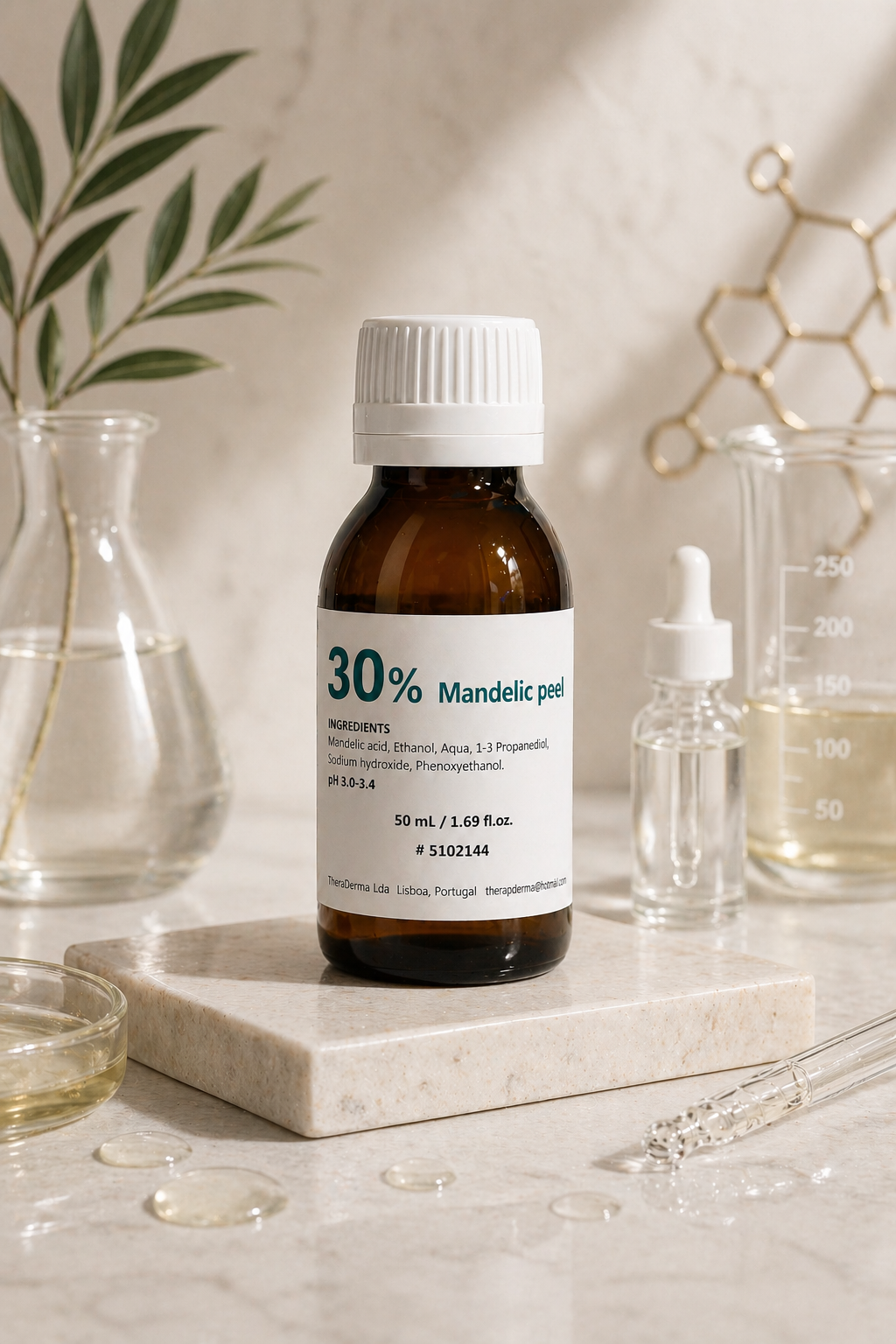
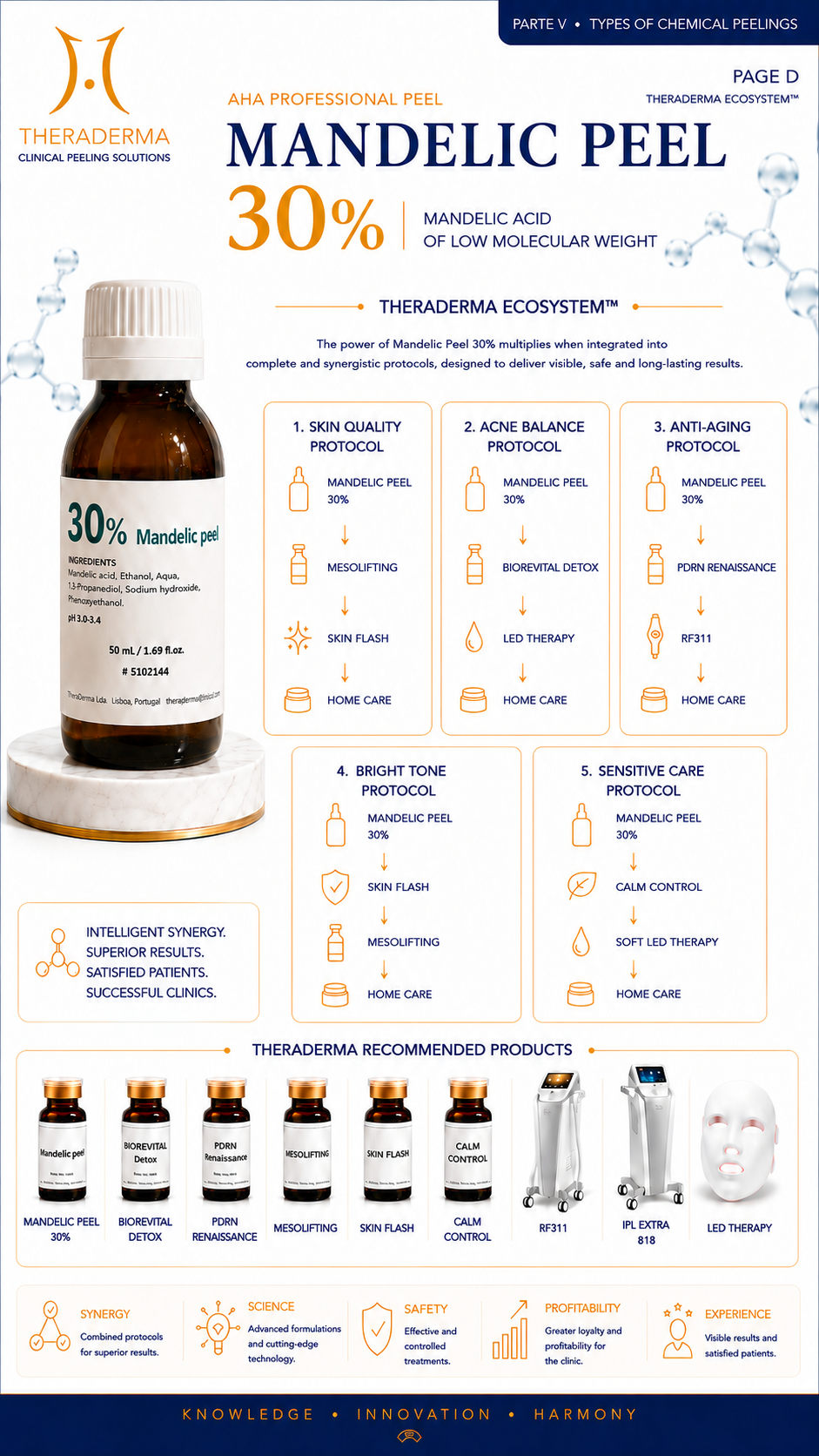
Mandelic Peel 30%
Progressive epidermal renewal, improved skin texture and tone uniformity within personalised professional protocols
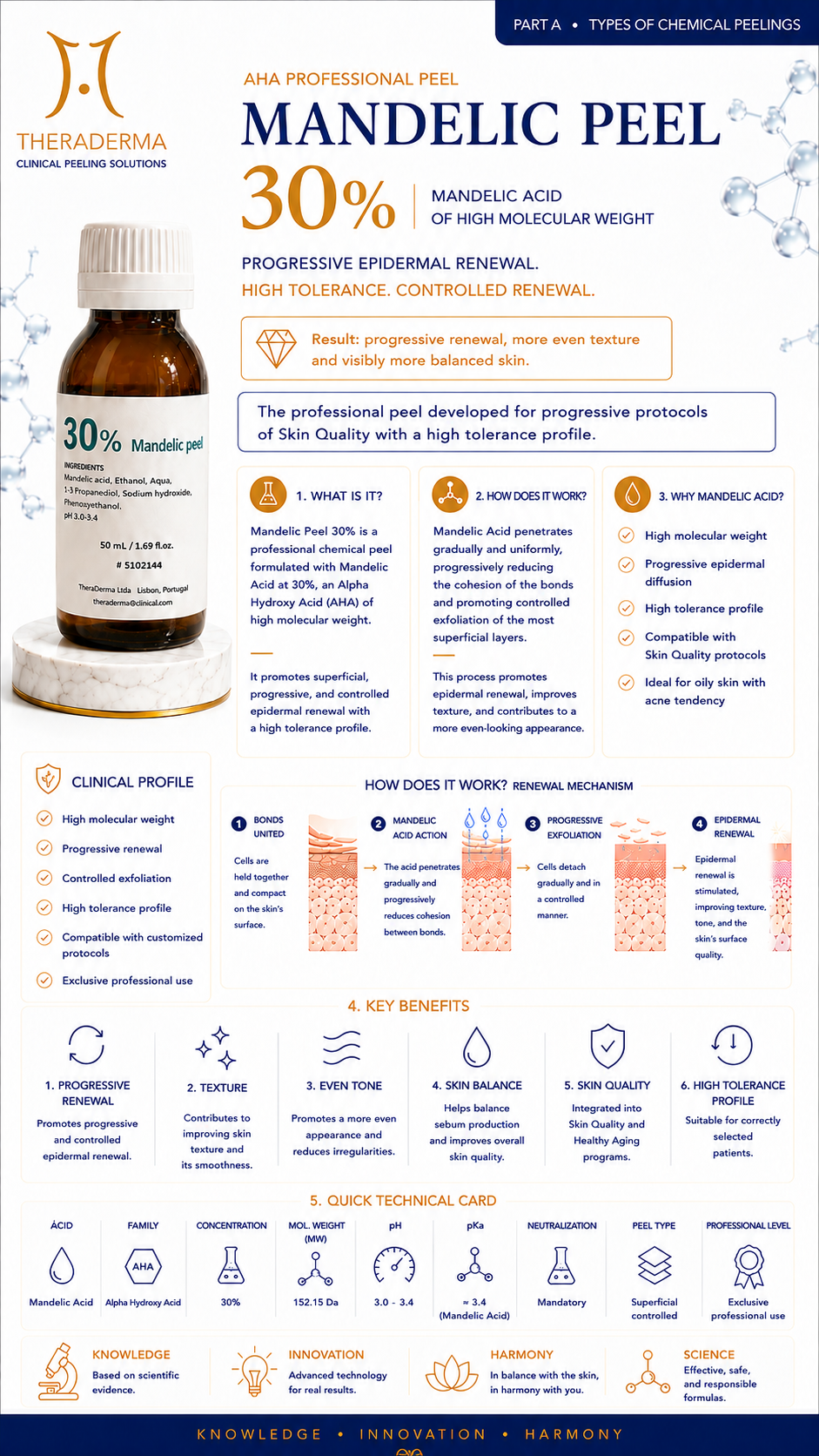
TherapDerma Mandelic Peel 30% is a professional chemical peel formulated with 30% Mandelic Acid, belonging to the Alpha Hydroxy Acid (AHA) family, developed to promote superficial, progressive and controlled epidermal renewal within advanced aesthetic medicine protocols.
Thanks to the high molecular weight of Mandelic Acid, its diffusion through the epidermis is slower and more uniform than that of other Alpha Hydroxy Acids, promoting a carefully controlled chemical exfoliation and a high tolerance profile in appropriately selected patients.
Its use may contribute to progressively improving skin texture, promoting greater tone uniformity and supporting programmes designed for oily, combination or acne-prone skin, while always respecting skin physiology and the individual biological response.
More than an isolated procedure, Mandelic Peel 30% forms part of the TherapDerma Clinical Ecosystem™, a working methodology based on diagnosis, therapeutic planning, personalisation and continuity of care.
Clinical Benefits
Clinical Benefits
Progressive epidermal renewal, improved skin texture and tone uniformity within personalised professional protocols
TherapDerma Mandelic Peel 30% has been developed to promote superficial, progressive and controlled epidermal renewal with a high tolerance profile, particularly in appropriately selected patients with oily, combination, sensitive or acne-prone skin.
Thanks to the physicochemical properties of Mandelic Acid, this peel combines carefully controlled chemical exfoliation with gradual epidermal renewal, which may contribute to improving the skin’s surface texture, promoting greater tone uniformity and supporting the physiological balance of sebum production.
When incorporated into an individualised clinical protocol, its benefits develop progressively while respecting the physiological renewal mechanisms of the epidermis and each patient’s individual biological response.
________________________________________
✨ Progressive epidermal renewal
What does it contribute clinically?
The chemical exfoliation promoted by Mandelic Acid encourages the progressive removal of corneocytes, facilitating the physiological renewal of the stratum corneum in a gradual and uniform manner.
This process contributes to the progressive reorganisation of the epidermal surface while respecting skin physiology and barrier function.
Clinical benefits
✔ Promotes physiological epidermal renewal.
✔ Contributes to the progressive improvement of the skin’s surface texture.
✔ Promotes a more even skin surface.
✔ Respects skin physiology and barrier function.
________________________________________
💧 Physiological balance of sebum production
What does it contribute clinically?
Mandelic Acid may contribute to the physiological balance of sebum production within professional protocols designed for oily or combination skin.
Its use supports progressive procedures without the need for aggressive exfoliation, while respecting barrier function and skin comfort.
Clinical benefits
✔ Promotes the physiological balance of sebum production.
✔ Contributes to reducing the appearance of excess shine.
✔ Progressively improves the appearance of oily skin.
✔ Promotes a visibly more balanced complexion.
________________________________________
🌿 Acne-prone skin
What does it contribute clinically?
Mandelic Acid is frequently used within professional protocols intended for acne-prone skin due to its tolerance profile and its ability to promote progressive epidermal renewal.
Its use should always be adapted to the clinical diagnosis and the specific characteristics of each patient.
Clinical benefits
✔ May be incorporated into protocols for acne-prone skin.
✔ Contributes to the progressive improvement of the skin’s overall appearance.
✔ Promotes a more even skin surface.
✔ High tolerance profile in appropriately selected patients.
________________________________________
🌟 Progressive skin tone uniformity
What does it contribute clinically?
The progressive renewal of the most superficial layers of the epidermis promotes a more even skin tone and may contribute to visibly improving certain superficial pigmentation irregularities.
The gradual reorganisation of the skin surface promotes a more homogeneous complexion.
Clinical benefits
✔ Promotes a more even skin tone.
✔ May contribute to improving superficial tone irregularities.
✔ Promotes a visibly more homogeneous complexion.
✔ Progressively improves the skin’s surface quality.
________________________________________
🎯 Refinement of skin texture
What does it contribute clinically?
The progressive reorganisation of the epidermal surface promotes a more even texture and smoother-feeling skin while always respecting skin physiology.
Clinical benefits
✔ Promotes a more even skin texture.
✔ Contributes to smoother skin.
✔ Progressively reduces the sensation of roughness.
✔ Improves the skin’s surface quality.
________________________________________
🌸 Natural radiance
What does it contribute clinically?
The progressive renewal of the epidermis may promote a more uniform reflection of light across the skin surface, providing a brighter and healthier-looking appearance.
This improvement develops gradually as the clinical protocol progresses.
Clinical benefits
✔ Promotes greater natural radiance.
✔ Contributes to a healthier-looking appearance.
✔ Progressively promotes a radiant complexion.
✔ May improve the visual perception of skin vitality.
________________________________________
🛡️ High tolerance profile
What does it contribute clinically?
The progressive epidermal diffusion of Mandelic Acid makes it possible to develop protocols with a high tolerance profile when the patient has been properly assessed and selected.
Clinical benefits
✔ High tolerance profile.
✔ Lower likelihood of excessive irritation.
✔ Greater comfort during the procedure.
✔ Suitable for individualised progressive protocols.
________________________________________
📈 Progressive clinical evolution
The benefits associated with Mandelic Peel 30% form part of a progressive biological process and do not depend on a single application.
The clinical response develops as the sessions progress, respecting recovery intervals, barrier function and the skin’s physiological adaptation.
An appropriate diagnosis, correct patient selection and individualised therapeutic planning promote a clinical evolution consistent with the objectives established for each protocol.
________________________________________
CLINICAL SUMMARY
Main benefits of Mandelic Peel 30%
✔ Progressive epidermal renewal.
✔ Physiological balance of sebum production.
✔ Integration into protocols for acne-prone skin.
✔ Progressive improvement of skin tone uniformity.
✔ Refinement of surface texture.
✔ Natural radiance.
✔ High tolerance profile.
✔ Progressive clinical evolution.
________________________________________
THERAPDERMA CLINICAL CONCLUSION
The clinical value of Mandelic Peel 30% lies in its ability to promote progressive epidermal renewal with a high tolerance profile, enabling the development of personalised protocols adapted to patients with oily, combination, appropriately selected sensitive or acne-prone skin.
Integrated within the TherapDerma Clinical Ecosystem™, it may form part of therapeutic strategies based on diagnosis, planning, clinical reassessment and continuity of care, promoting a progressive improvement in skin texture, tone uniformity and surface quality within an approach that respects skin physiology.
PESTAÑA 3
Why choose Mandelic Peel 30%?
A professional option for progressive and personalised epidermal renewal protocols
In professional aesthetic medicine, the choice of a chemical peel should not be based on using the highest concentration, but on selecting the active ingredient, formulation and intensity that best respond to the diagnosis, the functional condition of the skin and the clinical objectives defined for each patient.
Mandelic Peel 30% has been developed for professionals who wish to incorporate superficial, progressive and controlled epidermal renewal into protocols with a high tolerance profile.
Its formulation may contribute to gradually improving skin texture, promoting greater tone uniformity and supporting the physiological balance of sebum production in appropriately selected patients with oily, combination, sensitive or acne-prone skin.
Rather than increasing the intensity of the procedure, Mandelic Peel 30% makes it possible to build protocols based on diagnosis, individualisation and the biological response observed throughout the clinical evolution.
________________________________________
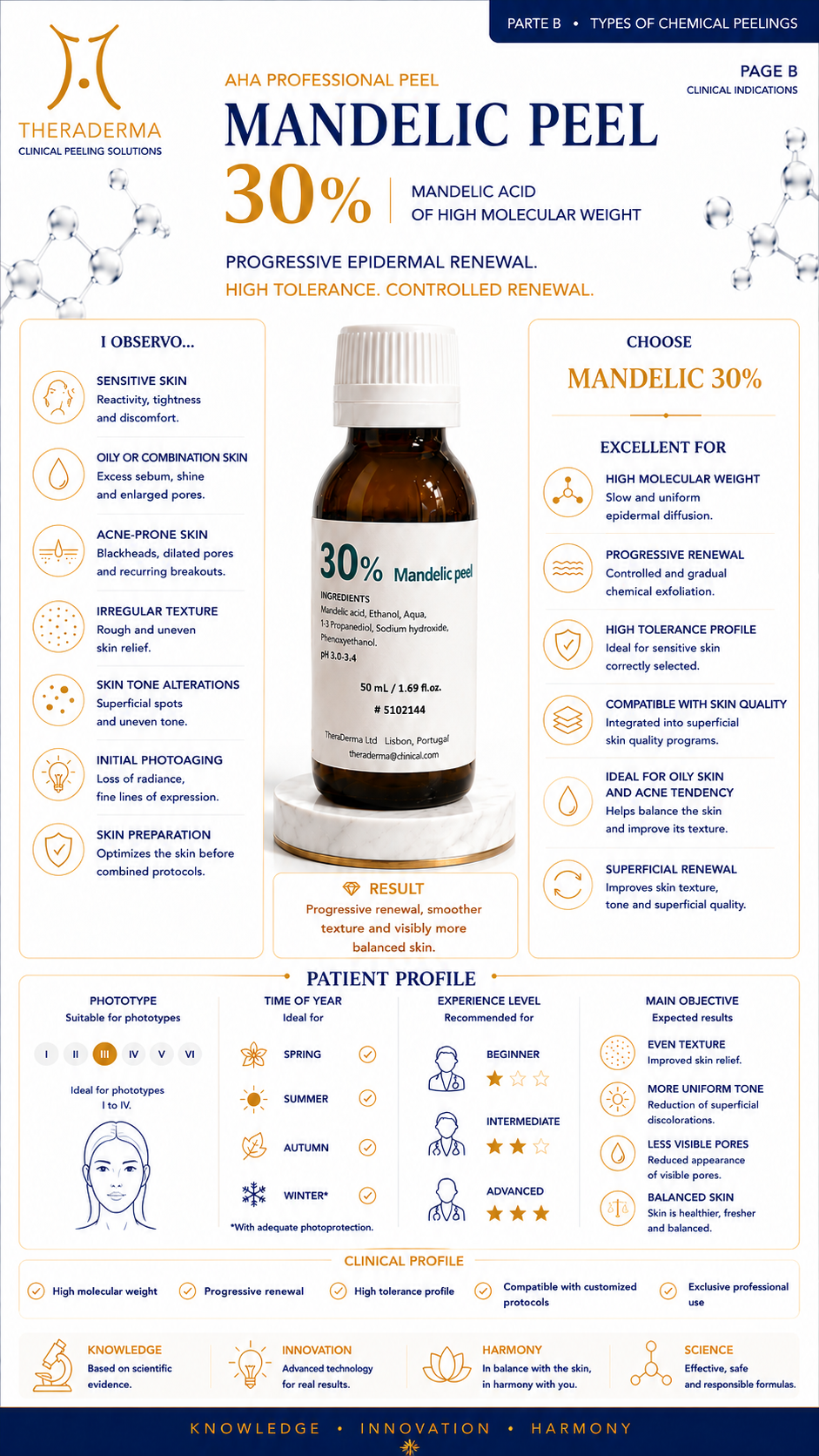
WHEN CAN IT BE AN APPROPRIATE OPTION?
Mandelic Peel 30% may be considered when the professional identifies the need to perform progressive epidermal renewal while maintaining a high tolerance profile.
It may be incorporated into personalised protocols intended for:
✔ appropriately selected sensitive skin;
✔ oily or combination skin;
✔ acne-prone skin;
✔ superficial tone irregularities;
✔ the appearance of visible pores;
✔ uneven skin texture;
✔ early photoageing;
✔ patients beginning professional programmes with Mandelic Acid;
✔ sequential preparation for other procedures when indicated;
✔ periodic skin surface quality maintenance programmes.
The choice should always be made following an individual clinical assessment, taking into account the patient’s history, the integrity of the barrier function, skin sensitivity, previous treatments and the established objectives.
________________________________________
FOR WHICH TYPE OF PROFESSIONAL HAS IT BEEN DESIGNED?
Mandelic Peel 30% is intended for professionals who understand that responsible aesthetic practice begins with an accurate assessment and the selection of the most appropriate treatment for each patient.
It may be incorporated both into clinics with established experience in chemical peels and into professional practices wishing to develop progressive epidermal renewal programmes for oily, combination, appropriately selected sensitive, acne-prone skin or skin with superficial tone irregularities.
Its versatility facilitates the planning of individualised protocols adapted to different ages, phototypes, biological characteristics and tolerance levels.
________________________________________
THERAPDERMA™ CLINICAL LADDER
Each concentration corresponds to a different indication
The TherapDerma™ Clinical Ladder does not represent a mandatory progression between concentrations.
Each peel should be selected according to:
✔ professional diagnosis;
✔ clinical objective;
✔ physiological condition of the skin;
✔ integrity of the barrier function;
✔ expected tolerance;
✔ response observed during follow-up.
________________________________________
Mandelic Peel 30%
May be considered for:
✔ superficial and progressive epidermal renewal;
✔ appropriately selected sensitive skin;
✔ oily or combination skin;
✔ acne-prone skin;
✔ superficial tone irregularities;
✔ uneven skin texture;
✔ first experience with Mandelic Acid;
✔ periodic maintenance programmes;
✔ sequential preparation for other procedures when indicated.
________________________________________
Mandelic Peel 40%
May be considered for:
✔ higher-intensity epidermal renewal protocols;
✔ more uneven skin texture;
✔ more evident superficial tone irregularities;
✔ moderate photoageing;
✔ patients with previous experience of chemical peels;
✔ skin with adequate barrier function and clinically assessed tolerance;
✔ skin correction protocols requiring a more intensive approach.
The selection of Mandelic Peel 40% does not depend on having previously used the 30% concentration.
Each concentration responds to different clinical needs and should not be interpreted as superior or inferior, but as a therapeutic personalisation tool.
________________________________________
QUICK SELECTION GUIDE
Clinical objective Option that may be considered
Superficial and progressive epidermal renewal Mandelic Peel 30%
First experience with Mandelic Acid Mandelic Peel 30%
Appropriately selected sensitive skin Mandelic Peel 30%
Oily or combination skin Mandelic Peel 30%
Acne-prone skin Mandelic Peel 30%
Superficial tone irregularities Mandelic Peel 30%
Periodic maintenance programme Mandelic Peel 30%
Higher-intensity epidermal renewal Mandelic Peel 40%
More uneven skin texture Mandelic Peel 40%
Moderate photoageing Mandelic Peel 40%
Need for more intensive superficial correction Mandelic Peel 40%
Patient previously accustomed to chemical peels Mandelic Peel 40%
This guide provides general guidance and does not replace an individual clinical assessment.
The final choice will always depend on the formulation, the functional condition of the skin, the professional technique and the expected biological response.
________________________________________
WHY INTEGRATE IT INTO A PROGRESSIVE PROGRAMME?
Epidermal renewal should be planned while respecting the skin’s physiological mechanisms of adaptation and recovery.
Within this approach, Mandelic Peel 30% may be integrated into progressive programmes designed to improve skin texture, tone uniformity and surface quality while maintaining a high tolerance profile.
Its use makes it possible to observe the patient’s individual response, reassess the barrier function and adapt the subsequent phases of the protocol according to the clinical evolution.
When indicated, it may also form part of sequential planning alongside mesotherapy, PDRN, biostimulation, LED therapy, radiofrequency or other medical-aesthetic technologies.
The integration of these procedures should be carried out in separate phases, respecting recovery intervals and the clinical conditions required before each new intervention.
This approach promotes a more organised, individualised practice that is consistent with skin physiology.
________________________________________
THERAPDERMA CLINICAL CONCLUSION
Mandelic Peel 30% is a versatile tool for professionals wishing to incorporate superficial and progressive epidermal renewal into personalised protocols.
Its tolerance profile and its ability to contribute to improving skin texture, tone uniformity and the physiological balance of sebum production allow it to be integrated into strategies intended for appropriately selected patients with oily, combination, sensitive or acne-prone skin.
Within the TherapDerma™ Clinical Ladder, its position does not necessarily represent a preliminary stage before higher concentrations.
Its selection should always be based on the diagnosis, the physiological condition of the skin and the objectives defined for each patient.
Integrated within the TherapDerma Clinical Ecosystem™, it may form part of structured programmes based on assessment, planning, clinical reassessment and continuity of care.
Areas of Application
One peel. Different clinical possibilities according to the treatment area, diagnosis and skin response
TherapDerma Mandelic Peel 30% may be integrated into different professional protocols for superficial and progressive epidermal renewal, adapted to different anatomical areas according to the diagnosis, the functional characteristics of the skin and the established clinical objectives.
Thanks to the progressive epidermal diffusion of Mandelic Acid and its high tolerance profile, it may be incorporated into programmes designed to improve the skin’s surface texture, promote greater tone uniformity and support the physiological balance of sebum production in appropriately selected patients.
Although the face is one of its main areas of application, Mandelic Peel 30% may also form part of professional protocols intended for other anatomical regions.
Each area presents differences in terms of epidermal thickness, sebaceous activity, environmental exposure, sensitivity and recovery capacity. For this reason, the technique, treatment area, exposure time and frequency of the procedure should be individualised.
________________________________________
FACE
One of the main areas of application
The face is one of the areas where Mandelic Peel 30% may most frequently be incorporated into professional epidermal renewal protocols.
Sebum production, environmental exposure, superficial tone irregularities and microrelief irregularities may progressively influence the appearance of the skin.
When professionally indicated, the procedure may contribute to improving:
✔ skin surface texture;
✔ the appearance of excess shine;
✔ the visual uniformity of skin tone;
✔ the appearance of visible pores;
✔ natural radiance;
✔ the skin’s surface quality.
________________________________________
NECK
Aesthetic continuity of facial protocols
The neck presents anatomical and functional characteristics that differ from those of the face, including lower sebaceous activity and skin that may be more vulnerable in certain patients.
When considered appropriate following clinical assessment, Mandelic Peel 30% may be incorporated into protocols designed to promote progressive epidermal renewal and maintain a more uniform appearance between the face and neck.
The application should be carefully adapted to the sensitivity, skin thickness and barrier function of this area.
________________________________________
DÉCOLLETAGE
Progressive renewal of a photo-exposed area
The décolletage is frequently exposed to ultraviolet radiation and may present superficial tone irregularities, loss of radiance, uneven texture and early signs of photoageing.
In appropriately selected patients, Mandelic Peel 30% may form part of protocols designed to promote superficial and progressive renewal, contributing to visibly improving skin texture and tone uniformity.
The extent and intensity of the procedure should be adjusted according to the sensitivity and recovery capacity of this region.
________________________________________
BACK OF THE HANDS
Progressive improvement of the skin’s surface appearance
The back of the hands is continuously exposed to ultraviolet radiation, environmental changes and factors that may contribute to an uneven skin appearance.
When professionally indicated, Mandelic Peel 30% may be incorporated into protocols intended to promote superficial epidermal renewal and progressively improve skin texture and the visual uniformity of skin tone.
The application should be performed while respecting the anatomical characteristics and the individual skin response.
________________________________________
BACK
Body application within selected protocols
The back may present increased sebaceous activity, uneven texture, visible pores and a tendency to develop superficial imperfections.
In appropriately selected patients, Mandelic Peel 30% may be incorporated into professional programmes designed to promote progressive epidermal renewal and a gradual improvement in the skin’s surface quality.
The extent of the treated area, the amount of product, the exposure time and the frequency of sessions should be adapted according to the observed clinical response.
________________________________________
CHEST
Localised and carefully selected protocols
Certain areas of the chest may present excess oiliness, superficial irregularities or a tendency to develop skin imperfections.
When the integrity of the skin and the diagnosis allow, Mandelic Peel 30% may be incorporated into localised and personalised protocols.
The sensitivity of this region, the presence of inflammatory lesions and the recovery capacity should be assessed before each procedure.
________________________________________
CLINICAL GUIDANCE ACCORDING TO THE TREATMENT AREA
Anatomical area Main considerations
Face Sebaceous activity, texture, visible pores, superficial tone irregularities and sensitivity
Neck Lower sebaceous activity, skin thickness and barrier function
Décolletage Photo-exposure, sensitivity and superficial tone irregularities
Back of the hands Photo-exposure, texture and recovery capacity
Back Sebaceous activity, treatment area and presence of imperfections
Chest Sensitivity, inflammatory lesions and localised application
This table provides general guidance to facilitate professional assessment.
It does not establish a hierarchy between treatment areas nor does it replace an individual clinical diagnosis.
________________________________________
MULTI-AREA PROTOCOLS
In some patients, it may be appropriate to plan protocols that include more than one anatomical region.
Possible combinations include:
✔ face and neck;
✔ face, neck and décolletage;
✔ face and back;
✔ face and localised areas of the chest;
✔ facial and body protocols planned in separate phases.
The selection of treatment areas should not be based solely on general aesthetic criteria.
The professional should assess the overall extent of the procedure, skin tolerance, barrier function, the expected biological response and the recovery capacity of each area.
It is not always necessary or advisable to perform the procedure on all areas during the same session.
________________________________________
CLINICAL CONSIDERATIONS
Before selecting the treatment area, the professional should assess:
✔ integrity of the barrier function;
✔ skin thickness and sensitivity;
✔ sebaceous production activity;
✔ degree of photo-exposure;
✔ presence of active inflammatory lesions;
✔ alterations in skin integrity;
✔ dermatological history;
✔ recent medical or aesthetic treatments;
✔ recovery capacity of the area;
✔ ability to comply adequately with post-treatment care;
✔ established clinical objectives.
The technique and progression of the protocol should be individually adapted according to the response observed before, during and after each session.
________________________________________
QUICK SUMMARY
Mandelic Peel 30% may be incorporated, when professionally indicated, into protocols intended for:
✔ face;
✔ neck;
✔ décolletage;
✔ back of the hands;
✔ back;
✔ localised areas of the chest;
✔ other areas appropriately assessed by the professional.
The inclusion of each region will always depend on the diagnosis, skin integrity and the skin’s recovery capacity.
________________________________________
THERAPDERMA CONCLUSION
The progressive epidermal diffusion of Mandelic Acid and its high tolerance profile allow Mandelic Peel 30% to be considered within professional protocols applied to different anatomical regions.
Its use should always be adapted to the specific characteristics of each area, the barrier function, skin sensitivity and the individual biological response.
The correct selection of the treatment area, together with rigorous planning and appropriate clinical reassessment, promotes personalised, consistent procedures that respect skin physiology.
Integrated within the TherapDerma Clinical Ecosystem™, it may form part of structured Skin Quality programmes based on diagnosis, procedure sequencing and continuity of care.
How does it work?
Understanding the biological process allows more precise protocol planning
Although the application of TherapDerma Mandelic Peel 30% is carried out over a limited period, the skin response associated with the procedure may continue to develop during the following days.
Each session promotes superficial and progressive epidermal renewal, contributing to the reorganisation of the stratum corneum, the normalisation of keratinisation and the gradual improvement of the skin’s surface quality.
Understanding the different stages of this process allows the professional to better interpret the clinical evolution, adapt the protocol and establish realistic expectations for each patient.
Thanks to its high molecular weight, Mandelic Acid exhibits more gradual epidermal diffusion than other Alpha Hydroxy Acids, promoting progressive action and a high tolerance profile in appropriately selected patients.
________________________________________
EVERYTHING BEGINS AT THE SURFACE OF THE SKIN
The peel first comes into contact with the stratum corneum, the outermost layer of the epidermis.
Under certain conditions, this structure may present an accumulation of corneocytes, excess keratin and an irregular surface organisation that influences the skin’s texture, radiance and visual tone uniformity.
The application of Mandelic Peel 30% promotes superficial and progressive chemical exfoliation, contributing to reducing the cohesion between corneocytes and facilitating their gradual removal.
This process forms part of physiological renewal and should always respect the integrity of the barrier function and the skin’s individual recovery capacity.
________________________________________
STEP 1
Superficial and progressive chemical exfoliation
Mandelic Acid acts mainly on the most superficial layers of the stratum corneum, promoting a gradual reduction in the cohesion between corneocytes.
As a result, progressive superficial desquamation may occur, facilitating the removal of corneocytes without necessarily resorting to highly intensive procedures.
Its high molecular weight is associated with more gradual and uniform epidermal diffusion.
The intensity of the response will also depend on the formulation, exposure time, application technique and the functional condition of the skin.
________________________________________
STEP 2
Reorganisation of superficial keratinisation
Once exfoliation has begun, the epidermis continues its physiological renewal process.
The gradual removal of excess corneocytes may promote a more uniform organisation of the epidermal surface and contribute to the progressive improvement of skin texture.
This process may be particularly relevant within personalised protocols for acne-prone, oily, combination skin or skin with superficial texture irregularities.
The evolution should always be assessed individually.
________________________________________
STEP 3
Progressive balance of the skin surface
As epidermal renewal progresses, the skin surface may develop a more even and balanced appearance.
The reduction of excess corneocytes and the reorganisation of the stratum corneum may contribute to visibly improving oily or combination skin and supporting the physiological balance of sebum production.
These effects are not identical in every patient and will depend on the diagnosis, the biological response and the continuity of the protocol.
________________________________________
STEP 4
Progressive reorganisation of the skin surface
As the epidermis renews itself, the skin surface may develop a more homogeneous organisation.
Within an appropriately indicated protocol, the following may progressively be observed:
✔ a more even skin texture;
✔ a more homogeneous appearance of skin tone;
✔ greater visual radiance;
✔ an improvement in the appearance of visible pores;
✔ a smoother skin surface;
✔ a healthier-looking complexion.
These changes develop gradually and should be assessed while respecting recovery intervals and individual tolerance.
________________________________________
STEP 5
Progressive clinical evolution
The response obtained after each session forms part of a biological process that requires time, observation and reassessment.
When the protocol respects barrier function recovery and appropriate intervals between sessions, the clinical evolution may continue progressively and consistently with the established objectives.
Mandelic Peel 30% may be integrated into structured and personalised programmes, in which each new session is decided according to:
✔ the observed response;
✔ skin recovery;
✔ individual tolerance;
✔ the evolution of texture and tone;
✔ previously defined clinical objectives.
Continuation of the protocol should not be considered automatic.
Each new phase should be justified through professional reassessment.
________________________________________
WHY IS PROGRESSIVE RENEWAL SO IMPORTANT?
Epidermal renewal is not simply about removing superficial cells.
A progressive approach allows the physiological mechanisms of skin adaptation and recovery to be respected, reducing the need for unnecessarily intensive procedures.
The gradual behaviour of Mandelic Acid facilitates its incorporation into personalised protocols when the objective is to promote superficial renewal while maintaining a high tolerance profile.
The intensity, frequency and duration of the programme should always be adapted to the barrier function and the observed clinical response.
These principles are explored in greater depth in the Scientific Foundations section.
________________________________________
A DIFFERENT RESPONSE IN EVERY PATIENT
Clinical evolution is not identical between patients.
It may be influenced by factors such as:
✔ biological age;
✔ sebaceous production activity;
✔ thickness and compactness of the stratum corneum;
✔ phototype;
✔ individual sensitivity;
✔ integrity of the barrier function;
✔ presence of inflammatory lesions;
✔ home skincare routine;
✔ sun exposure;
✔ previous medical or aesthetic treatments;
✔ individual recovery capacity.
For this reason, all protocols should be individualised and reassessed throughout their progression.
________________________________________
SEQUENCE OF THE BIOLOGICAL PROCESS
Professional application
↓
Interaction with the stratum corneum
↓
Progressive reduction in the cohesion between corneocytes
↓
Superficial chemical exfoliation
↓
Gradual removal of corneocytes
↓
Reorganisation of superficial keratinisation
↓
Physiological renewal of the epidermis
↓
Progressive reorganisation of the skin surface
↓
Gradual improvement in skin texture and visual tone uniformity
↓
Progressive improvement in the skin’s surface quality
________________________________________
KEY MECHANISMS OF ACTION
Mandelic Peel 30% may promote:
✔ superficial and progressive chemical exfoliation;
✔ gradual reduction in the cohesion between corneocytes;
✔ reorganisation of superficial keratinisation;
✔ physiological epidermal renewal;
✔ support for the physiological balance of sebum production;
✔ progressive improvement of the skin’s surface texture;
✔ greater visual tone uniformity;
✔ progressive clinical evolution within personalised protocols.
________________________________________
THERAPDERMA CONCLUSION
Understanding how Mandelic Peel 30% works enables the professional to integrate the product into a clinical strategy that goes beyond an isolated application.
Each session promotes a superficial biological sequence that combines progressive exfoliation, reorganisation of the stratum corneum and physiological renewal of the epidermis.
When professionally indicated, this process may contribute to gradually improving skin texture, the visual uniformity of skin tone and the skin’s surface quality.
Integrated within a personalised protocol, Mandelic Peel 30% may also form part of sequential planning alongside mesotherapy, PDRN, biostimulation, LED therapy or other medical-aesthetic technologies.
The incorporation of complementary procedures should only be carried out after adequate skin recovery and while respecting the intervals established for each intervention.
Within the TherapDerma Clinical Ecosystem™, this approach combines diagnosis, planning, clinical observation, reassessment and continuity of care, always respecting skin physiology and the individual biological response.
Mechanism of Action
The science behind superficial and progressive epidermal renewal
TherapDerma Mandelic Peel 30% exerts its action through a superficial chemical exfoliation process that acts primarily on the stratum corneum, promoting progressive epidermal renewal and the physiological reorganisation of the skin surface.
Its biological behaviour depends on the interaction between Mandelic Acid, the complete formulation, the application technique and the functional characteristics of the skin.
Thanks to its high molecular weight, Mandelic Acid exhibits more gradual epidermal diffusion than other Alpha Hydroxy Acids, which may promote progressive action and a high tolerance profile when used according to a professional protocol.
Understanding this mechanism enables the professional to adapt the procedure to the diagnosis, the barrier function and each patient’s individual biological response.
________________________________________
ACTION ON THE STRATUM CORNEUM
The stratum corneum is the outermost layer of the epidermis and plays an essential role in the skin’s barrier function.
It is composed of corneocytes arranged in multiple layers and joined together by specialised structures known as corneodesmosomes, which are responsible for maintaining the cohesion of the epidermal surface.
Various factors, such as ageing, environmental exposure, sebaceous activity or certain keratinisation disorders, may alter the organisation of this layer.
Mandelic Peel 30% initially acts on the stratum corneum by promoting superficial and progressive chemical exfoliation within appropriately indicated protocols.
The intensity of the response will depend on the formulation, exposure time, the technique used and the individual characteristics of the skin.
________________________________________
MODULATION OF CORNEODESMOSOMES
One of the main mechanisms associated with Mandelic Acid is the promotion of a gradual reduction in the cohesion between superficial corneocytes.
This action facilitates progressive desquamation and promotes the physiological renewal of the stratum corneum.
As a result, the skin surface may progressively reorganise into a more uniform structure as the protocol advances.
The clinical evolution will always depend on the individual biological response and the professional follow-up.
________________________________________
REORGANISATION OF KERATINISATION
Superficial exfoliation represents only one part of the biological process.
Following the gradual removal of corneocytes, the epidermis continues its physiological renewal, promoting the progressive reorganisation of the skin surface.
This process may contribute to improving the skin’s surface texture within personalised protocols designed for oily, combination, acne-prone skin or skin with superficial texture irregularities.
The evolution should be reassessed at every session.
________________________________________
BALANCE OF THE SKIN SURFACE
The progressive reorganisation of the stratum corneum may promote a more even appearance of the skin.
The reduction of excess superficial keratin and epidermal renewal may contribute to the physiological balance of sebum production within appropriately indicated protocols.
This behaviour explains the interest in Mandelic Acid for professional programmes designed for oily, combination or acne-prone skin.
However, the response may vary according to the patient’s individual characteristics.
________________________________________
REORGANISATION OF THE SKIN SURFACE
As epidermal renewal progresses, the skin surface may develop a more homogeneous organisation.
Within appropriately planned protocols, the following may progressively be observed:
✔ more even skin texture;
✔ greater visual tone uniformity;
✔ smoother skin surface;
✔ brighter appearance;
✔ improved appearance of visible pores;
✔ gradual improvement in the skin’s surface quality.
These changes develop progressively and should always be assessed while respecting recovery times and the individual clinical response.
________________________________________
INTEGRATION INTO SEQUENTIAL PROTOCOLS
A properly recovered epidermis may facilitate the planning of other medical-aesthetic procedures when professionally indicated.
For this reason, Mandelic Peel 30% may be incorporated as one phase within sequential protocols that subsequently include mesotherapy, PDRN, biostimulation, LED therapy, radiofrequency or other technologies.
The integration of procedures should only be carried out after adequate skin recovery and while respecting the intervals established for each intervention.
________________________________________
SEQUENCE OF THE MECHANISM OF ACTION
Professional application
↓
Interaction with the stratum corneum
↓
Gradual reduction in the cohesion between corneocytes
↓
Superficial chemical exfoliation
↓
Progressive removal of corneocytes
↓
Reorganisation of keratinisation
↓
Physiological renewal of the epidermis
↓
Progressive reorganisation of the skin surface
↓
Gradual improvement in skin texture and visual tone uniformity
↓
Progressive improvement in the skin’s surface quality
________________________________________
SCIENCE AT A GLANCE™
Parameter Mandelic Peel 30%
Active ingredient Mandelic Acid
Chemical family Alpha Hydroxy Acids (AHA)
Nominal concentration 30%
Primary level of action Epidermis
Main structure involved Stratum corneum
Predominant mechanism Progressive reduction in the cohesion between corneocytes
Distinctive behaviour Gradual epidermal diffusion and high tolerance profile
Expected physiological outcome Superficial epidermal renewal and reorganisation of keratinisation
Clinical objective To promote the skin’s surface texture, visual tone uniformity and surface quality
________________________________________
BIOLOGICAL BASIS
The mechanism of action of Mandelic Peel 30% is based on promoting superficial epidermal renewal through progressive chemical exfoliation.
The gradual reduction in the cohesion between corneocytes, together with the reorganisation of keratinisation and the physiological renewal of the stratum corneum, may contribute to the progressive improvement of the skin’s surface texture.
Its clinical behaviour will always depend on the formulation, the protocol used and the individual biological response.
Preservation of the barrier function, clinical observation and reassessment between sessions form part of the professional procedure.
________________________________________
THERAPDERMA CONCLUSION
The clinical value of Mandelic Peel 30% lies in understanding that its action goes beyond the simple removal of superficial cells.
Its mechanism of action promotes progressive epidermal renewal through the physiological reorganisation of the stratum corneum and the gradual reduction in the cohesion between corneocytes.
When integrated into personalised protocols, it may form part of sequential planning that includes other medical-aesthetic solutions, provided that skin recovery and clinical assessment allow it.
Within the TherapDerma Clinical Ecosystem™, this approach combines scientific knowledge, diagnosis, planning, clinical observation and continuity of care to develop protocols adapted to the specific characteristics and needs of each patient.
Scientific Foundations
The formulation determines the behaviour of the peel
In professional aesthetic medicine, the behaviour of a chemical peel does not depend solely on the declared acid concentration.
The skin response is determined by the interaction between different physicochemical and clinical parameters, including concentration, pH, pKa, the proportion of available non-ionised acid, the formulation vehicle, exposure time, application technique and the biological characteristics of the skin.
Understanding these principles enables the professional to better interpret the behaviour of the product, select appropriate protocols and adapt the procedure to the specific needs of each patient.
In TherapDerma Mandelic Peel 30%, these factors are integrated into a professional formulation designed to promote superficial, progressive and controlled epidermal renewal, with a high tolerance profile in appropriately selected patients.
________________________________________
CONCENTRATION
Much more than a percentage
Concentration indicates the amount of Mandelic Acid present in the formulation.
In Mandelic Peel 30%, this concentration is integrated into a formulation system developed to promote progressive epidermal renewal, contribute to improving the skin’s surface texture and support greater visual tone uniformity.
However, a higher concentration does not necessarily imply greater clinical efficacy or better suitability for every patient.
The actual behaviour of the peel depends on the interaction between:
✔ concentration;
✔ formulation pH;
✔ acid pKa;
✔ proportion of non-ionised acid;
✔ vehicle;
✔ application technique;
✔ exposure time;
✔ functional characteristics of the skin.
For this reason, concentration is only one of the factors that determine the skin response.
________________________________________
THE ROLE OF pH
pH expresses the degree of acidity of a formulation and is one of the relevant parameters in the design of a chemical peel.
Its value influences the balance between the ionised and non-ionised forms of the acid and, therefore, the fraction potentially available to interact with the stratum corneum.
Two formulations with the same concentration of Mandelic Acid may exhibit different behaviours when their pH, vehicle, buffering systems or application conditions vary.
For this reason, the evaluation of a professional peel should not be based solely on the percentage of acid indicated on the label.
________________________________________
THE SIGNIFICANCE OF pKa
The pKa is a physicochemical constant specific to each acid and describes the balance between its ionised and non-ionised forms according to the pH of the medium.
In the case of Mandelic Acid, its pKa is approximately 3.4.
When the pH of the formulation is close to this value, a significant proportion of both chemical forms is present. As the pH changes, their relative distribution also changes.
This relationship helps explain why two peels with the same nominal concentration may exhibit different activity profiles.
The final clinical behaviour will also depend on the complete formulation and the conditions of use.
________________________________________
NON-IONISED ACID FRACTION
A relevant factor in the interaction with the epidermis
The Mandelic Acid present in a formulation may exist in both ionised and non-ionised forms.
The non-ionised form has a greater ability to diffuse through the superficial lipid structures of the epidermis, making its proportion one of the factors influencing the behaviour of the peel.
This proportion mainly depends on the relationship between:
✔ pH;
✔ pKa;
✔ total concentration;
✔ formulation system.
However, the behaviour on the skin cannot be deduced solely through a theoretical calculation of free acid.
The vehicle, excipients, technique, exposure time and the patient’s individual characteristics also play a role.
________________________________________
MOLECULAR WEIGHT
Mandelic Acid has a higher molecular weight than other commonly used Alpha Hydroxy Acids, such as Glycolic Acid.
This characteristic is associated with more gradual epidermal diffusion, which may contribute to progressive behaviour and a high tolerance profile when the product is used correctly.
This property supports its incorporation into professional protocols designed for oily, combination, appropriately selected sensitive or acne-prone skin, as well as certain higher phototypes.
The clinical response will always depend on the complete formulation, the professional technique and the functional condition of the skin.
________________________________________
PEEL DEPTH AND RESPONSE
The response obtained during a chemical peel does not depend exclusively on the formulation.
It may also be influenced by:
✔ prior skin preparation;
✔ cleansing and degreasing;
✔ amount of product applied;
✔ number of layers;
✔ exposure time;
✔ extent of the treatment area;
✔ application technique;
✔ thickness and compactness of the stratum corneum;
✔ sebaceous activity;
✔ integrity of the barrier function;
✔ skin sensitivity;
✔ individual biological response;
✔ neutralisation;
✔ post-treatment care.
For this reason, the same product may produce different responses between patients and even between different anatomical areas of the same patient.
Continuous clinical observation is essential throughout the entire procedure.
________________________________________
WHY IS MOLECULAR WEIGHT RELEVANT?
The high molecular weight of Mandelic Acid is one of the factors that differentiates its behaviour from that of other Alpha Hydroxy Acids.
Its more gradual diffusion supports the planning of superficial and progressive protocols, particularly when the objective is to preserve tolerance and carefully adapt the intensity of the procedure.
This characteristic does not eliminate the risk of skin reactions or replace professional assessment.
Exposure time, the number of layers, the technique and the condition of the barrier function remain determining factors.
________________________________________
KEY SCIENTIFIC PARAMETERS
Parameter Mandelic Peel 30%
Active ingredient Mandelic Acid
Chemical family Alpha Hydroxy Acids (AHA)
Nominal concentration 30%
pH According to the final technical specification of the product
Approximate pKa 3.4
Molecular weight 152.15 g/mol
Epidermal behaviour Gradual diffusion
Expected level of action Superficial and progressive epidermal renewal
Distinctive action Progressive exfoliation with a high tolerance profile
Neutralisation Mandatory according to the TherapDerma professional protocol
Use Professional use only
Technical note: the exact pH must correspond to the manufacturing specification and the technical documentation of the final commercial formulation.
________________________________________
NEUTRALISATION
Neutralisation of Mandelic Peel 30% is mandatory.
It must be carried out using the recommended neutraliser and in accordance with the TherapDerma professional protocol, respecting the exposure time, clinical observation and the technical instructions for the product.
Neutralisation stops the residual acid activity on the skin surface.
The professional should verify the uniform application of the neutraliser and then complete the removal of the product according to the established protocol.
________________________________________
WHY IS IT IMPORTANT TO UNDERSTAND THESE CONCEPTS?
The combined interpretation of concentration, pH, pKa, the proportion of non-ionised acid, molecular weight, formulation and the physiological condition of the skin enables the professional to:
✔ select the peel on a more informed basis;
✔ adapt the procedure to the patient;
✔ adjust the exposure time and technique;
✔ preserve the barrier function;
✔ improve tolerance;
✔ recognise expected and unexpected skin responses;
✔ plan neutralisation appropriately;
✔ reassess the protocol between sessions;
✔ promote a clinical evolution consistent with the established objectives.
Science does not replace clinical assessment, but it provides a stronger foundation for every professional decision.
________________________________________
THERAPDERMA CONCLUSION
The behaviour of Mandelic Peel 30% depends on the interaction between its physicochemical characteristics, the complete formulation, the application technique and the individual biological response.
Concentration, pH, pKa, the proportion of non-ionised acid and molecular weight help to explain its activity profile, but they should not be interpreted in isolation.
At TherapDerma, scientific knowledge is integrated with diagnosis, clinical observation, mandatory neutralisation, preservation of the barrier function and reassessment between sessions.
This approach allows Mandelic Peel 30% to be incorporated into personalised, progressive professional protocols that are consistent with skin physiology and the principles of the TherapDerma Clinical Ecosystem™.
Indications
When should Mandelic Peel 30% be selected?
The selection of a professional chemical peel should always be made following an individual clinical assessment.
The professional should consider:
✔ the type and functional characteristics of the skin;
✔ the integrity of the barrier function;
✔ skin sensitivity;
✔ the presence of superficial irregularities;
✔ previous treatments;
✔ clinical objectives;
✔ recovery capacity;
✔ the expected biological response.
TherapDerma Mandelic Peel 30% may be considered when the objective is to promote superficial and progressive epidermal renewal, contribute to improving skin texture, support greater visual tone uniformity and promote the physiological balance of sebum production.
Its gradual epidermal diffusion allows it to be incorporated into protocols with a high tolerance profile in appropriately selected patients.
It may be particularly relevant in programmes designed for oily, combination, appropriately assessed sensitive or acne-prone skin, or skin with superficial tone irregularities.
The choice of this concentration should form part of an individualised strategy and should not be based solely on the percentage of Mandelic Acid.
________________________________________
OILY OR SEBORRHOEIC SKIN
High sebaceous activity may be associated with excess shine, more visible pores and a greater tendency to develop superficial irregularities.
Mandelic Peel 30% may be incorporated into professional protocols designed to promote progressive epidermal renewal and support the physiological balance of sebum production.
Its indication should be adapted to the condition of the barrier function, skin sensitivity and the presence of inflammatory lesions.
________________________________________
ACNE-PRONE SKIN
Acne-prone skin requires careful assessment of inflammatory activity, skin integrity and individual tolerance.
The superficial and progressive exfoliation promoted by Mandelic Acid allows Mandelic Peel 30% to be considered within professional protocols aimed at gradually improving the overall appearance of this skin type.
It should not be applied to open lesions, active infections or severe inflammatory conditions.
The indication and frequency of sessions should be established on an individual basis.
________________________________________
SUPERFICIAL TONE IRREGULARITIES
Following certain inflammatory processes, superficial irregularities in skin tone may persist.
The progressive renewal of the stratum corneum may contribute to visibly improving the uniformity of the skin surface.
For this reason, Mandelic Peel 30% may be integrated into protocols designed for certain superficial tone irregularities, always following appropriate clinical assessment.
The professional should consider the phototype, the risk of pigmentary response, photo-exposure and the patient’s ability to comply with post-treatment care.
________________________________________
VISIBLE PORES AND UNEVEN SKIN TEXTURE
Irregularities in the skin’s microrelief may influence the visual perception of pores and the uniformity of the skin surface.
Progressive chemical exfoliation may promote superficial reorganisation of the stratum corneum and contribute to the gradual improvement of skin texture.
Mandelic Peel 30% may be incorporated into personalised protocols when clinical assessment identifies this objective.
________________________________________
EARLY PHOTOAGEING
Cumulative exposure to ultraviolet radiation may be associated with loss of radiance, superficial tone irregularities and changes in skin texture.
In appropriately selected patients, Mandelic Peel 30% may form part of programmes designed to promote superficial epidermal renewal and gradually improve the appearance of the skin.
Photoprotection and appropriate home care are essential elements before, during and after the protocol.
________________________________________
APPROPRIATELY SELECTED SENSITIVE SKIN
The high molecular weight of Mandelic Acid is associated with more gradual epidermal diffusion than other Alpha Hydroxy Acids.
This characteristic may promote a high tolerance profile when the patient has been properly assessed and the procedure is adapted to the functional condition of the skin.
However, the term “sensitive skin” does not in itself constitute an automatic indication.
The professional should assess:
✔ the integrity of the barrier function;
✔ the degree of skin reactivity;
✔ the presence of erythema or inflammation;
✔ a history of intolerance;
✔ the skincare routine;
✔ recent procedures.
________________________________________
INTEGRATION INTO COMBINED PROTOCOLS
Mandelic Peel 30% may form part of sequential planning alongside other medical-aesthetic procedures when professionally indicated.
These may include:
✔ mesotherapy;
✔ PDRN;
✔ biostimulation;
✔ LED therapy;
✔ radiofrequency;
✔ other professional technologies or solutions.
The incorporation of complementary procedures should not be carried out automatically or necessarily during the same session.
Skin recovery, barrier function, the recommended intervals and the specific characteristics of each intervention must always be respected.
________________________________________
MAINTENANCE OF THE SKIN’S SURFACE QUALITY
In patients who have already completed a clinical programme, Mandelic Peel 30% may be considered within periodic maintenance strategies.
These sessions may be intended to promote:
✔ visual tone uniformity;
✔ skin surface texture;
✔ radiance;
✔ the balance of the skin surface.
The frequency should be established individually and reviewed according to the clinical evolution, tolerance and the patient’s needs.
________________________________________
PATIENTS BEGINNING MANDELIC ACID PROGRAMMES
Mandelic Peel 30% may be considered for patients beginning a professional Mandelic Acid programme, provided that the clinical assessment confirms its suitability.
Its progressive behaviour allows observation of the skin response, assessment of barrier function recovery and adaptation of subsequent sessions.
Starting with this concentration does not imply mandatory progression to formulations of greater intensity.
The continuation or modification of the protocol will always depend on the clinical evolution and the individualised objectives.
________________________________________
SUMMARY OF THE MAIN INDICATIONS
Mandelic Peel 30% may be incorporated, when professionally indicated, into protocols designed for:
✔ oily or seborrhoeic skin;
✔ combination skin;
✔ acne-prone skin without active inflammatory processes that would make treatment unsuitable;
✔ superficial tone irregularities;
✔ the appearance of visible pores;
✔ uneven skin texture;
✔ early photoageing;
✔ appropriately selected sensitive skin;
✔ sequential planning alongside other procedures;
✔ maintenance of the skin’s surface quality;
✔ the start of professional Mandelic Acid programmes.
This list provides general guidance and does not replace an individual clinical assessment.
________________________________________
THERAPDERMA CLINICAL CONCLUSION
Mandelic Peel 30% is a versatile tool for professionals wishing to incorporate superficial and progressive epidermal renewal into personalised protocols.
Its gradual behaviour allows it to be considered for appropriately selected patients with oily, combination, sensitive or acne-prone skin, or skin with superficial texture and tone irregularities.
The correct indication will always depend on the diagnosis, the integrity of the barrier function, sensitivity, phototype, biological response and the patient’s recovery capacity.
Within the TherapDerma Clinical Ecosystem™, its use is integrated with planning, clinical observation, reassessment between sessions and continuity of care.
This approach makes it possible to develop protocols consistent with the individual needs of each patient, while respecting skin physiology and avoiding the interpretation of concentration as an automatic indicator of therapeutic superiority.
Contraindications
Safety begins with proper clinical assessment
Every professional chemical peel should only be performed following an individual clinical assessment of the patient.
Identifying potential contraindications is an essential part of the diagnostic process and enables the selection of the most appropriate treatment, minimises the risk of complications and ensures responsible clinical practice.
Although TherapDerma Mandelic Peel 30% has an excellent tolerance profile and has been developed to provide progressive epidermal renewal while respecting skin physiology, it should always be used under professional judgement and within properly planned protocols.
Patient safety depends both on the correct selection of the treatment and on recognising situations in which the procedure is not indicated.
________________________________________
PREGNANCY AND BREASTFEEDING
As a precautionary measure, chemical peels are not recommended during pregnancy or whilst breastfeeding.
Although the systemic absorption of topically applied Mandelic Acid is very limited, standard clinical practice recommends postponing this type of procedure until these periods have ended.
Patient safety should always take precedence over any aesthetic objective.
________________________________________
ACTIVE SKIN INFECTIONS
The treatment should not be performed on skin presenting active infectious processes.
These include:
✔ active herpes simplex;
✔ bacterial infections;
✔ fungal infections;
✔ viral infections;
✔ acute inflammatory processes.
The peel should only be considered once the infection has completely resolved and the skin has regained its physiological integrity.
________________________________________
WOUNDS OR IMPAIRED SKIN INTEGRITY
Mandelic Peel 30% should not be applied to areas presenting:
✔ open wounds;
✔ abrasions;
✔ recent burns;
✔ skin erosions;
✔ recent surgical procedures without complete healing;
✔ traumatic injuries.
The epidermis must be fully intact before beginning any chemical exfoliation protocol.
________________________________________
ACTIVE DERMATOSES
The presence of inflammatory skin diseases requires particularly careful assessment.
These include:
✔ eczema;
✔ active dermatitis;
✔ psoriasis in the active phase;
✔ rosacea during the inflammatory phase;
✔ other dermatoses affecting the treatment area.
In these situations, the procedure should be postponed until the skin has achieved clinical stability.
________________________________________
HYPERSENSITIVITY TO THE PRODUCT
The treatment is contraindicated in patients with a known history of hypersensitivity to Mandelic Acid or any component of the formulation.
Where increased sensitivity is suspected, the professional should consider more appropriate therapeutic alternatives or carry out any clinical tests deemed necessary before initiating treatment.
________________________________________
RECENT DERMATOLOGICAL TREATMENTS
Before performing the peel, it is essential to review any medical and aesthetic treatments received during the preceding weeks.
Particular attention should be given to patients who have recently undergone or used:
✔ oral retinoids;
✔ ablative procedures;
✔ aggressive fractional laser treatments;
✔ other high-intensity chemical peels;
✔ treatments that may impair the skin’s barrier function.
The decision should be individualised according to the clinical evolution and the time elapsed since the previous procedure.
________________________________________
INTENSE SUN EXPOSURE
It is not recommended to begin a Mandelic Peel 30% protocol when the patient has had recent intense sun exposure or when adequate photoprotection cannot be guaranteed during the recovery period.
Ultraviolet radiation may alter the physiological response of the skin and increase the risk of complications.
Daily photoprotection is an essential part of therapeutic success.
________________________________________
OTHER SITUATIONS REQUIRING ASSESSMENT
The professional should carefully assess treatment in patients presenting:
✔ a history of post-inflammatory hyperpigmentation;
✔ extremely reactive skin;
✔ impaired wound healing;
✔ systemic diseases that may interfere with skin recovery;
✔ pharmacological treatments that alter the skin’s biological response;
✔ immunosuppression or medical conditions requiring particular caution.
Each case should be evaluated entirely on an individual basis.
________________________________________
SAFETY CHECKLIST
Before applying Mandelic Peel 30%, it is recommended to confirm that:
☐ The skin is intact.
☐ There are no active infections.
☐ The patient is neither pregnant nor breastfeeding.
☐ There is no history of hypersensitivity to the product.
☐ Recent dermatological treatments have been reviewed.
☐ The patient understands the post-treatment care requirements.
☐ The patient can comply adequately with photoprotection measures.
☐ The barrier function is in an appropriate condition to begin treatment.
A systematic assessment helps minimise risks and significantly improves the safety of the procedure.
________________________________________
CLINICAL SUMMARY
Do not use Mandelic Peel 30% in cases of:
✔ Pregnancy or breastfeeding.
✔ Active herpes.
✔ Active skin infections.
✔ Open wounds or recent burns.
✔ Dermatitis, eczema, psoriasis or inflammatory rosacea.
✔ Known hypersensitivity to the product.
✔ Recent dermatological treatments that contraindicate the procedure.
✔ Intense sun exposure without the possibility of appropriate photoprotection.
✔ Significant impairment of the barrier function that temporarily contraindicates chemical exfoliation.
________________________________________
THERAPDERMA CONCLUSION
The effectiveness of a chemical peel always begins with the correct indication and appropriate patient selection.
Although Mandelic Peel 30% has been designed to provide a high tolerance profile in appropriately selected patients, together with progressive and controlled epidermal renewal, its use requires rigorous clinical assessment, identification of potential contraindications and individual adaptation of the protocol.
At TherapDerma, we believe that safety is the first step towards clinical excellence. Respect for skin physiology, accurate diagnosis and personalised treatment make it possible to develop safer, scientifically grounded procedures aimed at achieving natural, consistent and sustainable results within the TherapDerma Clinical Ecosystem™.
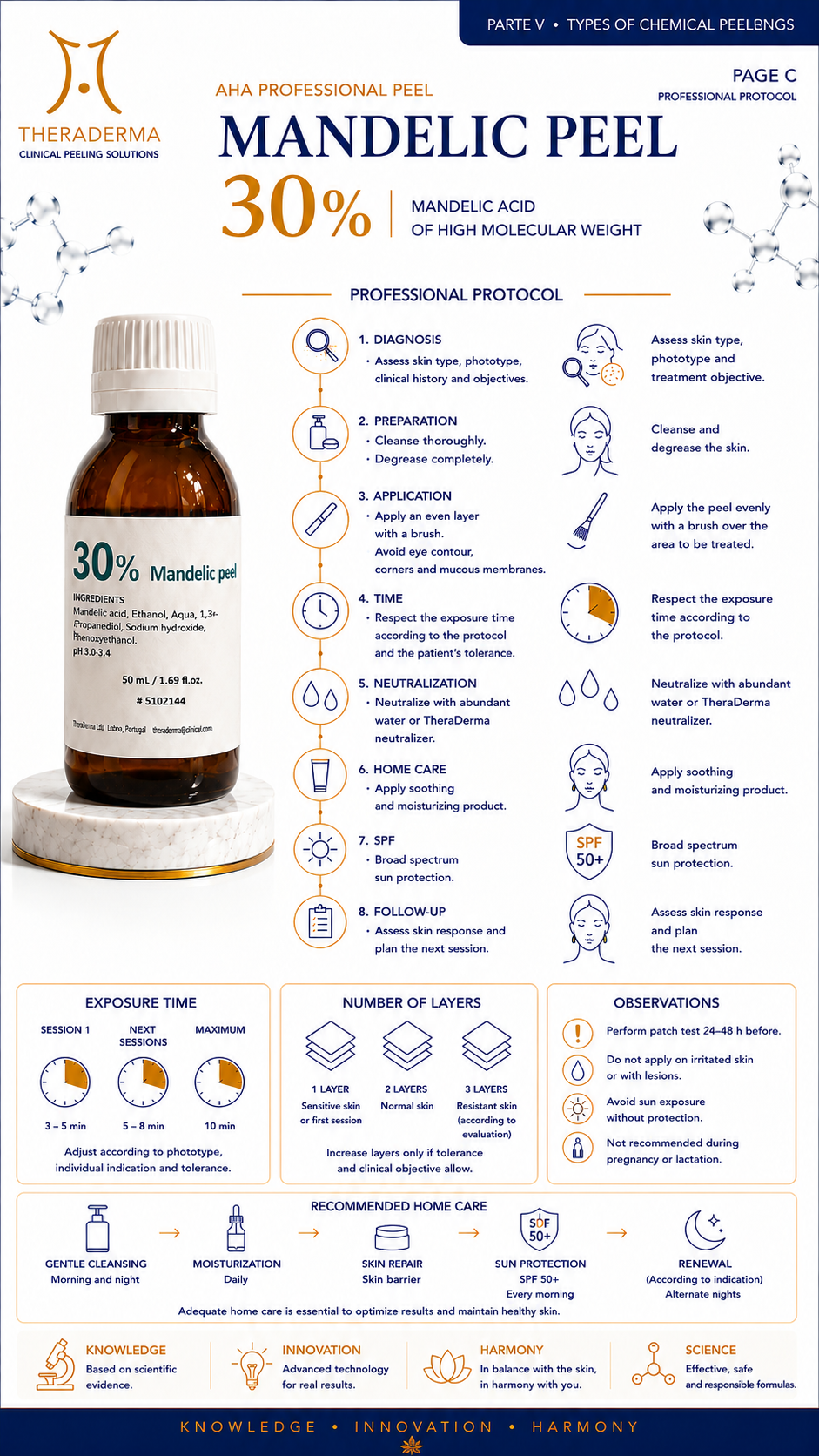
Professional Application
A procedure based on diagnosis, precision and respect for skin physiology
The clinical behaviour of a professional chemical peel does not depend solely on the formulation used.
Patient assessment, skin preparation, application technique, control of the exposure time, clinical observation and post-treatment follow-up all directly influence the skin response.
TherapDerma Mandelic Peel 30% has been developed exclusively for professional use and should be incorporated into individualised protocols that respect:
✔ the integrity of the barrier function;
✔ skin sensitivity;
✔ recovery capacity;
✔ the characteristics of the treatment area;
✔ the individual biological response.
The high tolerance profile associated with Mandelic Acid does not replace the need for rigorous clinical assessment, nor does it eliminate the possibility of undesirable reactions.
The intensity and duration of the procedure should always be adapted to the patient and to the official technical instructions for the product.
________________________________________
PRE-TREATMENT CLINICAL ASSESSMENT
Before beginning the procedure, the professional should perform a clinical assessment to confirm the suitability of the treatment.
The assessment should include, where appropriate:
✔ skin type and functional condition;
✔ phototype;
✔ sebaceous activity;
✔ integrity of the barrier function;
✔ sensitivity and degree of reactivity;
✔ presence of inflammatory lesions or impaired skin integrity;
✔ dermatological history;
✔ recent medical or aesthetic procedures;
✔ medication and home-use products;
✔ recent or anticipated sun exposure;
✔ ability to comply with post-treatment care;
✔ the patient’s objectives and expectations.
This assessment will determine the indication, the treatment area and the conditions of the procedure.
________________________________________
SKIN PREPARATION
Proper preparation of the treatment area promotes uniform application and facilitates observation of the skin response.
Before beginning, the professional should:
✔ thoroughly cleanse the treatment area;
✔ remove make-up, sunscreen and cosmetic residues;
✔ eliminate excess sebum;
✔ degrease the skin where indicated by the protocol;
✔ protect particularly sensitive areas;
✔ verify the absence of open lesions or conditions incompatible with the procedure.
The skin surface should be clean and dry before application.
________________________________________
DURING APPLICATION
Application should be performed using a uniform, systematic technique in accordance with the TherapDerma professional protocol.
Throughout the procedure, the following should be monitored:
✔ the amount of product applied;
✔ the uniformity of distribution;
✔ the number of layers, where applicable;
✔ the exposure time;
✔ the skin response;
✔ the patient’s reported comfort;
✔ the appearance of relevant clinical signs;
✔ the appropriate moment for neutralisation.
The technique and exposure time should never be determined automatically.
They should always be adapted to the functional condition of the skin and to the response observed during the session.
________________________________________
THE IMPORTANCE OF CLINICAL OBSERVATION
The same peel may produce different responses between patients and even between different anatomical areas of the same patient.
The response during the session may be influenced by:
✔ the thickness and compactness of the stratum corneum;
✔ sebaceous activity;
✔ the integrity of the barrier function;
✔ individual sensitivity;
✔ prior skin preparation;
✔ the amount of product applied;
✔ the exposure time;
✔ the technique used;
✔ previous treatments.
Continuous clinical observation enables the expected response to be recognised and allows early detection of any sign that justifies interrupting the procedure.
Patient safety should always take precedence over the intensity or duration initially planned.
________________________________________
PEEL NEUTRALISATION
Neutralisation of Mandelic Peel 30% is mandatory.
It should be carried out using the recommended neutraliser and in accordance with the TherapDerma professional protocol.
The timing of neutralisation will depend on:
✔ the defined exposure time;
✔ the observed clinical response;
✔ the characteristics of the treatment area;
✔ patient tolerance;
✔ the official technical instructions for the product.
Where the skin response justifies it, the procedure should be neutralised before the originally planned exposure time has been completed.
After applying the neutraliser, the professional should verify that the entire treatment area has been covered evenly and complete the removal of the product according to the established protocol.
Neutralisation stops the residual acid activity on the skin surface and constitutes an essential stage of the procedure.
________________________________________
IMMEDIATE POST-TREATMENT CARE
After neutralisation and complete removal of the product, solutions designed to promote skin comfort and support the barrier function may be applied.
The professional should instruct the patient to:
✔ use gentle cleansing products;
✔ apply the recommended restorative products;
✔ maintain daily broad-spectrum photoprotection;
✔ avoid direct sun exposure;
✔ temporarily discontinue potentially irritating cosmetics;
✔ avoid manipulating areas of desquamation;
✔ avoid other aesthetic procedures until the skin has recovered;
✔ report any unexpected reactions;
✔ follow the home-care instructions provided.
Post-treatment care forms part of the protocol and should be adapted to the observed skin response.
________________________________________
PATIENT FOLLOW-UP
Clinical assessment continues after the session has ended.
Follow-up enables evaluation of:
✔ the progress of epidermal renewal;
✔ recovery of the barrier function;
✔ tolerance to the procedure;
✔ the appearance of unexpected reactions;
✔ observed changes in texture and tone;
✔ the need to modify home-care recommendations;
✔ the suitability of a subsequent session;
✔ the possible integration of other procedures.
Continuation of the programme should not be considered automatic.
Each new session should be justified through appropriate professional reassessment.
________________________________________
CLINICAL DOCUMENTATION
Each procedure should be recorded clearly and comprehensively.
The documentation may include:
✔ updated medical history;
✔ assessment of indications and possible contraindications;
✔ informed consent, where applicable;
✔ standardised clinical photographs;
✔ product name;
✔ concentration and batch number;
✔ expiry date, where applicable;
✔ treatment area;
✔ preparation performed;
✔ quantity applied and number of layers;
✔ start time and exposure time;
✔ response observed during the session;
✔ neutraliser used;
✔ post-treatment care applied;
✔ home-care recommendations;
✔ planned follow-up date.
Rigorous documentation supports traceability, continuity of care and protocol reassessment.
________________________________________
PROFESSIONAL CHECKLIST
Before concluding the session, confirm that:
☐ An individual clinical assessment has been performed.
☐ The absence of contraindicating conditions has been confirmed.
☐ The skin has been properly prepared.
☐ The product has been applied evenly.
☐ Exposure time and skin response have been monitored.
☐ Mandatory neutralisation has been carried out.
☐ The product has been completely removed.
☐ Appropriate post-treatment care has been applied.
☐ The patient has received home-care instructions.
☐ The procedure has been documented.
☐ Clinical follow-up has been arranged where appropriate.
A systematic sequence promotes more organised practice and helps reduce avoidable risks.
________________________________________
GOOD CLINICAL PRACTICE
The use of Mandelic Peel 30% should form part of professional practice based on:
✔ individualised diagnosis;
✔ appropriate patient selection;
✔ compliance with the official technical instructions;
✔ proper skin preparation;
✔ controlled application technique;
✔ mandatory neutralisation;
✔ preservation of the barrier function;
✔ continuous clinical observation;
✔ documentation and traceability;
✔ clinical follow-up;
✔ reassessment before every new session;
✔ regular updating of professional protocols.
These principles promote procedures that are consistent with skin physiology and responsible clinical practice.
________________________________________
THERAPDERMA CONCLUSION
The professional application of Mandelic Peel 30% requires far more than simply distributing the product across the skin surface.
It requires rigorous clinical assessment, appropriate preparation, a controlled technique, continuous observation, mandatory neutralisation and post-treatment follow-up.
Each stage should be adapted to the functional condition of the skin, the observed biological response and the official technical instructions for the product.
Within the TherapDerma Clinical Ecosystem™, this procedure is integrated with diagnosis, planning, documentation, reassessment and continuity of care.
This approach enables the development of progressive, individualised protocols that respect skin physiology while maintaining patient safety as the highest priority throughout every stage of treatment.
Clinical Protocols
Personalised protocols to promote progressive epidermal renewal and the physiological balance of the skin
TherapDerma Mandelic Peel 30% may be incorporated into different aesthetic medicine programmes according to the diagnosis, the functional characteristics of the skin and the established clinical objectives.
There is no universal protocol applicable to every patient.
Each programme should be individually designed by adapting:
✔ the indication;
✔ the technique;
✔ the exposure time;
✔ the frequency of sessions;
✔ the recovery intervals;
✔ post-treatment care;
✔ the possible integration with other procedures.
Thanks to its gradual epidermal diffusion and high tolerance profile, Mandelic Peel 30% may form part of protocols designed to promote the skin’s surface texture, visual tone uniformity and the physiological balance of the skin surface.
Planning, clinical observation, reassessment and progressive adaptation are fundamental principles of the TherapDerma Clinical Ecosystem™.
________________________________________
PROGRESSIVE EPIDERMAL RENEWAL PROTOCOL
Objective
To promote superficial and progressive chemical exfoliation that contributes to improving the skin’s surface quality while respecting the barrier function and the individual’s recovery capacity.
Patients who may be considered
✔ oily or combination skin;
✔ appropriately selected sensitive skin;
✔ uneven skin texture;
✔ the appearance of visible pores;
✔ first experience with Mandelic Acid;
✔ periodic maintenance programmes.
Suggested structure
Initial session
Individual clinical assessment
↓
Mandelic Peel 30%
↓
Mandatory neutralisation
↓
Post-treatment care
↓
Recovery follow-up
Subsequent sessions
Clinical reassessment
↓
Assessment of the barrier function and tolerance
↓
Continuation, modification or discontinuation of the protocol according to clinical progression
Maintenance phase
Assessment of the objectives achieved
↓
Individual definition of the follow-up frequency
This structure provides general guidance and does not replace the official technical protocol for the product.
________________________________________
PROTOCOL FOR ACNE-PRONE SKIN
Objective
To promote superficial epidermal renewal, contribute to the reorganisation of keratinisation and gradually improve the overall appearance of acne-prone skin.
Before beginning the procedure, the following should be assessed:
✔ inflammatory activity;
✔ the presence of open lesions;
✔ the integrity of the barrier function;
✔ the degree of sensitivity;
✔ current dermatological treatments;
✔ the home-care routine.
It should not be applied to open lesions, active infections or severe inflammatory conditions.
May subsequently be integrated with:
✔ personalised mesotherapy;
✔ professional PDRN solutions;
✔ biostimulation protocols;
✔ LED therapy;
✔ specialised professional skincare.
The sequence and intervals between procedures should be established according to the diagnosis, skin recovery and clinical evolution.
Complementary treatments should not be applied while the skin remains irritated or until the barrier function has adequately recovered.
________________________________________
VISUAL TONE UNIFORMITY PROTOCOL
Objective
To promote a progressively more even appearance through controlled superficial epidermal renewal protocols.
May be considered for patients presenting:
✔ superficial tone irregularities;
✔ pigment irregularities following inflammatory processes;
✔ loss of visual uniformity;
✔ early photoageing.
The professional should assess:
✔ phototype;
✔ the risk of pigmentary response;
✔ recent or anticipated sun exposure;
✔ compliance with photoprotection;
✔ the use of home-care active ingredients.
Depigmenting skincare may be incorporated when indicated and always in a manner compatible with skin recovery.
Daily broad-spectrum photoprotection is an essential part of the protocol.
________________________________________
PROTOCOL FOR APPROPRIATELY SELECTED SENSITIVE SKIN
Objective
To promote superficial and progressive epidermal renewal while carefully adapting the procedure to individual tolerance.
The high molecular weight of Mandelic Acid is associated with more gradual epidermal diffusion than other Alpha Hydroxy Acids.
This characteristic may promote a high tolerance profile, but it does not eliminate the possibility of irritation or replace professional assessment.
Before beginning treatment, the following should be evaluated:
✔ the integrity of the barrier function;
✔ the degree of skin reactivity;
✔ the presence of erythema or inflammation;
✔ previous intolerance;
✔ recent procedures;
✔ home-use products.
The intensity, exposure time and frequency should be adapted according to the response observed during each session.
________________________________________
SKIN TEXTURE IMPROVEMENT PROTOCOL
Objective
To promote a more even skin surface through superficial and progressive epidermal renewal.
May be considered when the patient presents:
✔ uneven skin texture;
✔ the appearance of visible pores;
✔ rough skin surface;
✔ visually uneven skin tone;
✔ loss of radiance.
Clinical evolution should be reassessed periodically by evaluating:
✔ recovery of the barrier function;
✔ tolerance;
✔ the evolution of skin texture;
✔ response to home-care treatment;
✔ the need to continue or modify the protocol.
________________________________________
SKIN PREPARATION PROTOCOL
Objective
To promote appropriate epidermal surface conditions before incorporating other medical-aesthetic procedures, when professionally indicated.
Following adequate skin recovery, Mandelic Peel 30% may form part of sequential planning that subsequently includes:
✔ mesotherapy;
✔ PDRN;
✔ biostimulation;
✔ LED therapy;
✔ radiofrequency;
✔ other appropriately selected technologies.
Prior exfoliation alone does not guarantee a better response to subsequent procedures.
New interventions should only be introduced after reassessing the skin and confirming that the barrier function has recovered.
________________________________________
THERAPDERMA™ COMBINED PROTOCOL
The TherapDerma Clinical Ecosystem™ approach allows Mandelic Peel 30% to be integrated into personalised programmes together with other professional solutions.
Suggested example
Phase 1
Clinical assessment
↓
Skin preparation
↓
Mandelic Peel 30%
↓
Mandatory neutralisation
Phase 2
Skin recovery
↓
Clinical reassessment
Phase 3
Mesotherapy, PDRN or biostimulation, when indicated
Phase 4
Complementary medical-aesthetic technology, where appropriate
Phase 5
Professional home-care skincare
↓
Photoprotection
↓
Clinical follow-up
↓
Individualised maintenance
This sequence does not constitute a universal protocol.
Each phase should be adapted according to the diagnosis, the functional condition of the skin, skin recovery and the observed response.
________________________________________
MAINTENANCE PLANNING
Once the established objectives have been achieved, the professional may establish an individualised maintenance programme.
This may include:
✔ periodic epidermal renewal sessions;
✔ scheduled clinical reviews;
✔ updating the home-care routine;
✔ adapting the frequency according to clinical progression;
✔ incorporation of complementary procedures when indicated;
✔ maintaining appropriate photoprotection.
Maintenance should not be scheduled automatically.
Its frequency will depend on the clinical response, tolerance, barrier function and any biological or environmental changes that may influence the skin.
________________________________________
PROTOCOL PERSONALISATION
The intensity of the procedure should not be defined solely by the concentration of the peel.
Planning should take into account:
✔ biological age;
✔ sebaceous activity;
✔ the integrity of the barrier function;
✔ the thickness and compactness of the stratum corneum;
✔ phototype;
✔ sensitivity and reactivity;
✔ dermatological and aesthetic history;
✔ sun exposure;
✔ home-care treatments;
✔ recent procedures;
✔ the response observed during previous sessions;
✔ recovery capacity;
✔ clinical objectives.
Personalisation enables the procedure to be adapted to the patient’s actual characteristics while reducing avoidable risks.
________________________________________
PROTOCOL SUMMARY
Mandelic Peel 30% may be incorporated, when professionally indicated, into programmes for:
✔ progressive epidermal renewal;
✔ acne-prone skin;
✔ visual tone uniformity;
✔ appropriately selected sensitive skin;
✔ improvement of the skin’s surface texture;
✔ sequential preparation for other procedures;
✔ TherapDerma™ combined protocols;
✔ individualised maintenance.
All protocols should respect clinical assessment, mandatory neutralisation, recovery of the barrier function and reassessment between sessions.
________________________________________
THERAPDERMA CONCLUSION
The clinical value of Mandelic Peel 30% lies in its integration into carefully planned protocols adapted to the individual characteristics of each patient.
The combination of diagnosis, personalisation, clinical observation, respect for recovery times and ongoing follow-up enables the development of progressive programmes that are consistent with skin physiology.
Within the TherapDerma Clinical Ecosystem™, Mandelic Peel 30% may form part of strategies designed to promote skin texture, visual tone uniformity and the skin’s surface quality.
The continuation of treatment should always be decided according to the clinical evolution, tolerance and recovery of the barrier function, while maintaining patient safety as the highest priority.
TherapDerma™ Combinations
Integrated protocols to promote epidermal renewal and the skin’s surface quality
Modern aesthetic medicine is not based solely on isolated procedures, but on the sequential planning of different interventions adapted to the characteristics and objectives of each patient.
In this context, TherapDerma Mandelic Peel 30% may be incorporated as one phase within personalised protocols in which superficial epidermal renewal facilitates the planning of subsequent procedures when professionally indicated.
Thanks to its gradual epidermal diffusion and high tolerance profile, it may be integrated with different solutions from the TherapDerma Clinical Ecosystem™, while always respecting the barrier function, skin recovery and individual clinical evolution.
The selection of each combination, its sequence and the intervals between procedures should be established following an individual clinical assessment.
________________________________________
MANDELIC PEEL 30% + PERSONALISED MESOTHERAPY
Superficial renewal + individualised treatment
Following adequate skin recovery and when professionally indicated, Mandelic Peel 30% may form part of protocols that subsequently incorporate personalised mesotherapy.
The selection of the formulation will depend on the diagnosis and the established clinical objectives.
These may include programmes designed to:
✔ promote the physiological balance of the skin;
✔ support skin revitalisation;
✔ contribute to improving the skin’s surface quality;
✔ promote greater visual tone uniformity;
✔ provide personalised rejuvenation programmes.
The sequence should respect skin recovery and the intervals defined by the professional.
________________________________________
MANDELIC PEEL 30% + PDRN
Superficial renewal + regenerative planning
When the clinical objective is to promote the physiological recovery of the skin, Mandelic Peel 30% may be integrated into protocols that subsequently incorporate professional PDRN solutions.
Initial epidermal renewal may facilitate the sequential planning of the treatment, while always respecting clinical evolution, the barrier function and individual recovery capacity.
Each phase should be decided following the corresponding professional reassessment.
________________________________________
MANDELIC PEEL 30% + SKIN BIOSTIMULATION
Prepare before stimulating
Biostimulation forms part of different strategies designed to promote physiological processes related to skin quality.
When considered appropriate following clinical assessment, Mandelic Peel 30% may be used as a preliminary phase within sequential protocols.
The incorporation of biostimulating procedures should only be carried out when skin recovery allows it.
________________________________________
MANDELIC PEEL 30% + RADIOFREQUENCY
Epidermal renewal + complementary technology
Radiofrequency may form part of personalised programmes designed to improve the appearance of the skin.
When professionally indicated, it may be combined with Mandelic Peel 30% through procedures performed during separate phases.
The sequence, intensity and intervals should be adapted according to:
✔ the diagnosis;
✔ the barrier function;
✔ the biological response;
✔ the characteristics of the technology used.
________________________________________
MANDELIC PEEL 30% + LED THERAPY
Superficial renewal + support for recovery
LED therapy may be incorporated as a complementary procedure within individualised protocols.
Its use may be considered following adequate skin recovery and according to the objectives established for each patient.
The selection of the therapeutic modality will depend on the clinical assessment and the observed evolution.
________________________________________
MANDELIC PEEL 30% + PROFESSIONAL HOME-CARE SKINCARE
Continuity of treatment also takes place between sessions
Clinical evolution depends not only on procedures performed in the clinic, but also on home care.
Following each session, a personalised programme may be established that includes:
✔ appropriate cleansing;
✔ skincare adapted to the skin type;
✔ products designed to support the barrier function;
✔ antioxidants when indicated;
✔ active ingredients selected according to the diagnosis;
✔ daily photoprotection.
Continuity of home care promotes skin recovery and facilitates follow-up of the established protocol.
________________________________________
THERAPDERMA CLINICAL ECOSYSTEM™
A structured protocol promotes more comprehensive planning
At TherapDerma, we believe that clinical quality depends on the integration of diagnosis, planning and follow-up.
Procedures do not act in isolation.
They may be organised within a structured programme adapted to the individual characteristics of each patient.
Example of clinical planning
Professional diagnosis
↓
Skin preparation
↓
Mandelic Peel 30%
↓
Recovery and clinical reassessment
↓
Personalised mesotherapy or biostimulation
↓
Complementary medical-aesthetic technology
↓
Professional home-care skincare
↓
Clinical follow-up
↓
Personalised maintenance
Each phase should be adapted according to the diagnosis, clinical evolution and the physiological recovery of the skin.
________________________________________
BENEFITS OF COMBINED PROTOCOLS
The integration of Mandelic Peel 30% into personalised programmes may contribute to:
✔ facilitating clinical planning;
✔ respecting skin physiology;
✔ promoting progressive epidermal renewal;
✔ preparing the skin surface for subsequent procedures when indicated;
✔ organising the therapeutic sequence;
✔ personalising each phase;
✔ adapting recovery intervals;
✔ maintaining continuity of care;
✔ promoting patient adherence.
The combination of procedures should always be established through an individual clinical assessment.
________________________________________
CLINICAL SUMMARY
Mandelic Peel 30% may be integrated with:
✔ personalised mesotherapy;
✔ professional PDRN solutions;
✔ biostimulation protocols;
✔ radiofrequency;
✔ LED therapy;
✔ professional home-care skincare;
✔ other appropriately indicated medical-aesthetic technologies;
✔ personalised protocols within the TherapDerma Clinical Ecosystem™.
Each combination should respect skin recovery, the barrier function and compatibility between procedures.
________________________________________
THERAPDERMA CONCLUSION
The clinical value of Mandelic Peel 30% increases when it forms part of structured therapeutic planning rather than an isolated procedure.
Its progressive behaviour allows it to be incorporated into personalised protocols that, when professionally indicated, may subsequently integrate mesotherapy, PDRN, biostimulation, medical-aesthetic technologies and home care.
At TherapDerma, scientific knowledge, diagnosis, planning, clinical reassessment and respect for skin physiology are the pillars of the TherapDerma Clinical Ecosystem™.
This approach enables the development of individualised protocols that are consistent with each patient’s biological response and designed to promote progressive clinical evolution, while always maintaining safety, personalisation and continuity of care.
Frequently Asked Questions (FAQ)
Clear answers for responsible clinical practice
The use of chemical peels may raise questions regarding their mechanism of action, indications, tolerance and protocol planning.
The following answers bring together some of the most frequently asked questions arising during professional practice and TherapDerma training programmes.
Their purpose is to facilitate understanding of Mandelic Peel 30% and support its integration into personalised protocols, without replacing clinical assessment or the official technical instructions for the product.
________________________________________
What type of peel is Mandelic Peel 30%?
Mandelic Peel 30% is a professional superficial chemical peel formulated with 30% Mandelic Acid, belonging to the Alpha Hydroxy Acid family.
It has been developed to promote superficial and progressive epidermal renewal, with a high tolerance profile in appropriately selected patients.
Within individualised protocols, it may contribute to improving:
✔ skin surface texture;
✔ visual tone uniformity;
✔ the appearance of visible pores;
✔ the balance of the skin surface;
✔ the skin’s surface quality.
________________________________________
For which skin types may it be considered?
Mandelic Peel 30% may be considered for patients presenting:
✔ oily or combination skin;
✔ acne-prone skin without incompatible inflammatory processes;
✔ appropriately selected sensitive skin;
✔ the appearance of visible pores;
✔ uneven skin texture;
✔ superficial tone irregularities;
✔ early photoageing;
✔ the need for superficial and progressive epidermal renewal.
The final indication will always depend on the diagnosis, barrier function, sensitivity and the skin’s recovery capacity.
________________________________________
What is the difference between Mandelic Acid and Glycolic Acid?
Both belong to the Alpha Hydroxy Acid family, but they have different physicochemical properties.
Glycolic Acid has a lower molecular weight, whereas Mandelic Acid has a higher molecular weight and generally more gradual epidermal diffusion.
This characteristic may promote progressive activity and a high tolerance profile when the patient and protocol have been appropriately selected.
However, the actual intensity of a peel does not depend solely on the type of acid.
It is also influenced by:
✔ concentration;
✔ pH;
✔ vehicle;
✔ exposure time;
✔ number of layers;
✔ application technique;
✔ the functional condition of the skin.
The choice between the two should be based on the diagnosis and not on a hierarchy of superiority between acids.
________________________________________
Can it be used on sensitive skin?
It may be considered for certain patients with sensitive skin, provided that clinical assessment confirms its suitability.
The term “sensitive skin” does not in itself constitute an automatic indication.
Before beginning the procedure, the following should be assessed:
✔ the integrity of the barrier function;
✔ the degree of reactivity;
✔ the presence of erythema or inflammation;
✔ a history of intolerance;
✔ recent procedures;
✔ home-use products.
The high molecular weight of Mandelic Acid may promote more gradual diffusion, but it does not eliminate the risk of irritation.
________________________________________
How many sessions are usually recommended?
There is no universal number of sessions.
Planning will depend on:
✔ the clinical diagnosis;
✔ the functional condition of the skin;
✔ the established objectives;
✔ the observed tolerance;
✔ recovery of the barrier function;
✔ the evolution after each session;
✔ adherence to home care.
Continuation of the protocol should not be considered automatic.
Each new session should be decided following professional reassessment.
________________________________________
How frequently can it be applied?
The frequency should be established on an individual basis.
The interval between sessions will depend on:
✔ the skin response;
✔ recovery of the barrier function;
✔ the treatment area;
✔ the intensity of the procedure;
✔ post-treatment care;
✔ possible integration with other interventions.
A new session should not be performed while the skin presents irritation, unresolved desquamation or signs of incomplete recovery.
________________________________________
Can it be combined with other procedures?
Yes, when professionally indicated and once the skin has completed an adequate recovery.
Mandelic Peel 30% may form part of sequential planning alongside:
✔ mesotherapy;
✔ professional PDRN solutions;
✔ biostimulation;
✔ radiofrequency;
✔ LED therapy;
✔ professional home-care skincare;
✔ other appropriately selected medical-aesthetic technologies.
The combination should not be carried out automatically or necessarily during the same session.
The sequence and intervals should be adapted to the diagnosis, barrier function and the specific characteristics of each procedure.
________________________________________
Is it necessary to neutralise the peel?
Yes.
Neutralisation of Mandelic Peel 30% is mandatory.
It should be carried out using the recommended neutraliser and in accordance with the TherapDerma professional protocol and the official technical instructions for the product.
Where the skin response justifies it, the procedure should be neutralised before the originally planned exposure time has been completed.
Following neutralisation, complete removal of the product should be verified before applying post-treatment care.
________________________________________
What care should the patient follow after treatment?
Following the procedure, the patient should follow the recommendations provided by the professional.
These may include:
✔ using gentle cleansing products;
✔ applying the recommended restorative products;
✔ maintaining daily broad-spectrum photoprotection;
✔ avoiding direct sun exposure;
✔ temporarily discontinuing potentially irritating cosmetics;
✔ avoiding manipulation of areas of desquamation;
✔ avoiding other procedures until the skin has recovered;
✔ reporting any unexpected reactions.
Home care forms part of the protocol and contributes to promoting appropriate recovery.
________________________________________
Can it be used throughout the year?
Its use throughout the year will depend on professional assessment, anticipated sun exposure and the patient’s ability to comply with rigorous photoprotection.
Where recent or anticipated intense sun exposure exists, it may be necessary to modify the planning or postpone the procedure.
The decision should take into account:
✔ phototype;
✔ the risk of pigmentary response;
✔ the treatment area;
✔ the patient’s lifestyle;
✔ the season;
✔ adherence to photoprotection.
It should therefore not automatically be considered suitable throughout the year for every patient.
________________________________________
Can it form part of programmes addressing skin ageing?
It may be incorporated into programmes designed to promote the skin’s surface quality and address early signs of photoageing.
Within these protocols, it may contribute to:
✔ progressively improving skin surface texture;
✔ promoting a more even appearance of the skin tone;
✔ supporting visual radiance;
✔ maintaining a more uniform skin surface.
Its use alone does not prevent skin ageing.
It should be integrated with photoprotection, home care and other measures adapted to the patient’s characteristics.
________________________________________
QUICK SUMMARY
Mandelic Peel 30% is characterised by:
✔ superficial and progressive epidermal renewal;
✔ gradual epidermal diffusion;
✔ a high tolerance profile in appropriately selected patients;
✔ possible integration into protocols for oily, combination or acne-prone skin;
✔ progressive improvement in texture and visual tone uniformity;
✔ sequential integration with other procedures;
✔ possible incorporation into individualised maintenance programmes;
✔ mandatory neutralisation.
________________________________________
THERAPDERMA CONCLUSION
Frequently asked questions reflect a fundamental principle of aesthetic medicine: there is no single identical protocol for every patient.
The value of Mandelic Peel 30% lies in the possibility of integrating it into strategies based on diagnosis, appropriate patient selection, professional technique, neutralisation, skin recovery and reassessment.
Within the TherapDerma Clinical Ecosystem™, scientific knowledge is combined with individualised planning and respect for skin physiology.
This approach enables the development of progressive protocols that are consistent with each patient’s biological response and designed to promote individualised clinical evolution, while maintaining safety and continuity of care as priority criteria.
Related Content
Discover other solutions within the TherapDerma Clinical Ecosystem™
Modern aesthetic medicine is based on the integration of different procedures adapted to the characteristics and objectives of each patient.
Clinical planning, the appropriate selection of techniques and periodic reassessment make it possible to develop individualised programmes while respecting skin physiology and the biological evolution of the skin.
For this reason, Mandelic Peel 30% forms part of the TherapDerma Clinical Ecosystem™, a working model that integrates chemical peels, mesotherapy, medical-aesthetic technologies, clinical protocols, professional skincare and continuing education.
The following resources complement the professional use of Mandelic Peel 30% and facilitate its integration into structured clinical practice.
________________________________________
THERAPDERMA PEELING COLLECTION™
A solution adapted to every clinical need
Each skin presents different functional characteristics and may require different epidermal renewal strategies.
The TherapDerma peeling collection makes it possible to select the most appropriate acid and concentration according to:
✔ the diagnosis;
✔ the functional condition of the skin;
✔ the barrier function;
✔ individual tolerance;
✔ clinical objectives.
The collection includes:
✔ Glycolic Peel;
✔ Lactic Peel;
✔ Mandelic Peel;
✔ Salicylic Peel;
✔ Pyruvic Peel;
✔ TCA Peel.
Each may be incorporated into personalised protocols when professionally indicated.
________________________________________
THERAPDERMA MESOTHERAPY COLLECTION™
Integration into personalised protocols
Professional mesotherapy may be incorporated following adequate skin recovery, when indicated by the diagnosis.
Mandelic Peel 30% may subsequently be integrated with formulations selected for programmes designed to promote:
✔ skin revitalisation;
✔ improvement of the skin’s surface quality;
✔ biostimulation;
✔ support for physiological regeneration processes;
✔ visual tone uniformity;
✔ personalised rejuvenation programmes.
The selection of each formulation, the sequence and the intervals should be adapted to the clinical evolution and the patient’s individual response.
________________________________________
THERAPDERMA TECHNOLOGIES™
Technology integrated into clinical planning
Medical-aesthetic technologies may complement different protocols when professionally indicated.
Following adequate recovery, Mandelic Peel 30% may be incorporated into programmes that include technologies selected according to the clinical objectives.
Integration should respect:
✔ compatibility between procedures;
✔ recovery of the barrier function;
✔ the individual biological response;
✔ the established sequence;
✔ the intervals between treatments.
________________________________________
THERAPDERMA CLINICAL PROTOCOLS™
Structured protocols for organised clinical practice
TherapDerma protocols provide a guiding structure to facilitate clinical planning.
Each programme may include:
✔ initial assessment;
✔ diagnosis;
✔ peel selection;
✔ session planning;
✔ recovery times;
✔ possible integration with other procedures;
✔ home care;
✔ clinical follow-up;
✔ individualised maintenance.
The application of each protocol should always be adapted to the specific characteristics of each patient.
________________________________________
THERAPDERMA SKINCARE™
Continuity of treatment also depends on home care
Home care forms part of continuity of care.
Following a Mandelic Peel 30% protocol, the professional may recommend skincare adapted to the type and functional condition of the skin.
Home care may contribute to:
✔ promoting skin balance;
✔ supporting the barrier function;
✔ maintaining skin comfort;
✔ promoting physiological recovery;
✔ maintaining the skin’s surface quality;
✔ complementing clinical planning;
✔ maintaining appropriate photoprotection.
________________________________________
THERAPDERMA PROFESSIONAL EDUCATION™
Scientific updating supports better clinical practice
The evolution of aesthetic medicine makes continuing education essential.
TherapDerma training programmes include content related to:
✔ skin physiology;
✔ mechanisms of action;
✔ clinical assessment;
✔ patient selection;
✔ indications and contraindications;
✔ personalised protocols;
✔ integration of procedures;
✔ post-treatment care;
✔ recognition and initial management of potential complications.
Continuing education contributes to responsible clinical practice based on the available evidence.
________________________________________
THERAPDERMA CLINICAL ECOSYSTEM™
An integrated vision of clinical practice
At TherapDerma, each procedure is conceived as part of comprehensive clinical planning.
The different professional tools may be organised within individualised programmes adapted to the characteristics of each patient.
TherapDerma Clinical Ecosystem
Professional diagnosis
↓
Peel selection
↓
Professional application
↓
Neutralisation
↓
Recovery and clinical reassessment
↓
Personalised mesotherapy or biostimulation
↓
Complementary medical-aesthetic technologies
↓
Professional home-care skincare
↓
Clinical follow-up
↓
Individualised maintenance
Each phase should be adapted according to the diagnosis, recovery of the barrier function and the observed clinical evolution.
This sequence provides a guiding example and does not constitute a universal protocol.
________________________________________
CONTENT WE RECOMMEND CONSULTING
To expand your knowledge of Mandelic Peel 30%, the following resources may be consulted:
✔ Complete TherapDerma Peeling Catalogue.
✔ Facial Mesotherapy Guide.
✔ TherapDerma Clinical Protocols Manual.
✔ TherapDerma Clinical Decision Guide™.
✔ TherapDerma Professional Academy™.
✔ Clinical Combinations Manual.
✔ Home-Care Guide.
These resources form part of the continuing education programme developed by TherapDerma for aesthetic medicine professionals.
________________________________________
THERAPDERMA CONCLUSION
Mandelic Peel 30% forms part of a working model based on diagnosis, individualised planning and respect for skin physiology.
Its integration into the TherapDerma Clinical Ecosystem™ allows procedures, technologies and home care to be combined when professionally indicated and when clinical evolution allows it.
At TherapDerma, we believe that clinical decision-making is based on scientific knowledge, the individual assessment of each patient and continuous reassessment.
This approach promotes the development of personalised programmes adapted to the skin’s biological response and designed to maintain continuity of care, patient safety and clinical consistency throughout every phase of treatment.
TherapDerma Professional Academy™
Knowledge transforms clinical practice
Excellence in aesthetic medicine does not depend solely on having innovative products or advanced technologies.
It also depends on the professional’s ability to understand skin physiology, correctly interpret the clinical assessment and select the most appropriate strategy for each patient.
For this reason, TherapDerma Professional Academy™ has been created as an international scientific education platform dedicated to the continuous professional development of doctors, nurses, pharmacists, dentists and other aesthetic medicine professionals, within the legal and professional framework applicable in each country.
Our mission is to transform scientific knowledge into clinical decision-making criteria, working methodologies and individualised clinical protocols that respect skin physiology and support responsible professional practice.
________________________________________
EDUCATION BASED ON SCIENCE
TherapDerma educational programmes are developed from knowledge derived from dermatology, aesthetic medicine, skin biology and the available scientific evidence.
Our objective is not simply to teach the use of a product.
The training is designed to help professionals understand:
✔ the anatomy and physiology of the skin;
✔ the biological mechanisms associated with skin ageing;
✔ the behaviour of different active ingredients;
✔ the physicochemical principles of formulations;
✔ patient assessment and selection;
✔ indications and contraindications;
✔ planning of individualised protocols;
✔ the sequential integration of different procedures;
✔ the importance of follow-up and reassessment.
This approach promotes a more structured and reflective clinical practice that is consistent with the biological characteristics of each patient.
________________________________________
LEARNING TO ASSESS AND DIAGNOSE
Clinical assessment is the starting point of every professional procedure.
The same product may produce different responses depending on:
✔ the functional characteristics of the skin;
✔ the integrity of the barrier function;
✔ individual sensitivity;
✔ dermatological history;
✔ previous treatments;
✔ the technique used;
✔ recovery capacity;
✔ the patient’s biological response.
For this reason, an essential part of TherapDerma training is dedicated to developing clinical reasoning and decision-making based on objective assessment.
Rigorous assessment enables appropriate indications to be established, potential contraindications to be recognised and every protocol to be personalised.
________________________________________
LEARNING TO PERSONALISE
No two patients have identical biological characteristics.
Biological age, phototype, the functional condition of the skin, barrier function, sensitivity, clinical history, previous treatments and lifestyle may all influence the response to a procedure.
TherapDerma Professional Academy™ teaches professionals how to build dynamic protocols that can be adapted according to:
✔ clinical evolution;
✔ observed tolerance;
✔ skin recovery;
✔ the established objectives;
✔ patient adherence;
✔ the need to modify or discontinue the programme.
Personalisation is one of the fundamental principles of responsible clinical practice.
________________________________________
EDUCATION BEYOND THE PRODUCT
The TherapDerma educational model is not limited to the technical use of a chemical peel or professional solution.
Each programme may integrate knowledge related to:
✔ chemical peels;
✔ mesotherapy;
✔ PDRN;
✔ biostimulation;
✔ medical-aesthetic technologies;
✔ LED therapy;
✔ professional skincare;
✔ sequential and combined protocols;
✔ post-treatment care;
✔ clinical follow-up;
✔ prevention, recognition and initial management of potential complications.
The objective is to provide an integrated vision that enables procedures to be organised within individualised clinical strategies.
________________________________________
CONTINUOUS LEARNING
Aesthetic medicine is constantly evolving.
The emergence of new research, technologies, formulations and procedures makes the regular updating of professional knowledge essential.
TherapDerma Professional Academy™ promotes a culture of continuous learning through programmes designed to support professionals throughout their careers.
Education is no longer an isolated event but becomes part of an ongoing process of review, updating and continuous improvement of clinical practice.
________________________________________
LEARNING FORMATS
The Academy may offer different learning formats adapted to the needs of each professional:
✔ face-to-face training;
✔ online training;
✔ scientific webinars;
✔ practical workshops;
✔ clinical masterclasses;
✔ professional congresses and meetings;
✔ clinical case analysis;
✔ scientific update programmes.
Each format aims to integrate theoretical foundations with their application in professional practice.
________________________________________
FROM KNOWLEDGE TO CLINICAL PRACTICE
Education becomes valuable when it enables better-informed decision-making in everyday clinical practice.
For this reason, the content developed by TherapDerma follows a structured methodology.
TherapDerma Methodology
Scientific knowledge
↓
Clinical assessment
↓
Identification of indications and contraindications
↓
Treatment selection
↓
Design of the individualised protocol
↓
Professional application
↓
Clinical follow-up and documentation
↓
Protocol reassessment
This model transforms theory into organised, adaptable procedures that are consistent with each patient’s clinical response.
________________________________________
WHAT DOES THERAPDERMA PROFESSIONAL ACADEMY™ PROVIDE?
The training provides professionals with the tools to:
✔ better understand skin physiology;
✔ strengthen clinical assessment skills;
✔ select procedures on a stronger scientific basis;
✔ design individualised protocols;
✔ integrate different interventions in a rational manner;
✔ recognise indications and contraindications;
✔ promote safer clinical practice;
✔ improve communication with patients;
✔ document and reassess every procedure;
✔ adapt treatment according to the observed clinical evolution.
Scientific updating therefore becomes a distinguishing element of professional practice.
________________________________________
THERAPDERMA PHILOSOPHY
At TherapDerma, we believe that knowledge is one of the most valuable investments any professional can make.
Products evolve.
Technologies change.
Trends transform.
A solid scientific foundation enables professionals to interpret innovation, evaluate new developments and adapt clinical practice to the available evidence and the real needs of every patient.
For this reason, our Academy does not seek merely to train product users.
It seeks to develop professionals who are able to:
✔ understand;
✔ assess;
✔ analyse;
✔ decide;
✔ integrate;
✔ document;
✔ reassess;
✔ lead responsibly.
________________________________________
THERAPDERMA CONCLUSION
TherapDerma Professional Academy™ is one of the pillars of the TherapDerma Clinical Ecosystem™.
Its mission is to support professionals beyond the product itself by providing scientific education, clinical reasoning criteria and practical tools to support well-founded clinical decision-making.
At TherapDerma, we believe that clinical excellence does not begin with a peel, a technology or a mesotherapy solution.
It begins with a professional who understands the science, performs rigorous clinical assessment, respects skin physiology, recognises the limitations of every procedure and adapts every decision to the patient’s individual biological response.
This approach promotes personalised, structured clinical practice designed to maintain patient safety, continuity of care and professional excellence throughout the TherapDerma Clinical Ecosystem™.
TherapDerma Clinical Decision System™
Transforming scientific knowledge into clinical decisions
Modern aesthetic medicine requires far more than simply understanding the characteristics of a product.
Every patient presents different biological needs, expectations and recovery capacities. For this reason, treatment selection should not be based solely on personal experience or on the automatic application of standardised protocols.
The TherapDerma Clinical Decision System™ (TCDS™) has been developed as a structured framework for clinical reasoning, designed to help professionals transform the information obtained during assessment into individualised, scientifically grounded decisions.
Its objective is to facilitate:
✔ clinical assessment;
✔ identification of indications and contraindications;
✔ definition of realistic objectives;
✔ procedure selection;
✔ individualised planning;
✔ observation and reassessment;
✔ clinical documentation;
✔ continuity of care.
The system does not replace professional judgement or the official technical instructions for each product.
________________________________________
STEP 1
CLINICAL ASSESSMENT AND DIAGNOSIS
Every protocol begins with a comprehensive patient assessment.
Before selecting a chemical peel, the professional should identify the skin’s needs and the factors that may influence its biological response.
The assessment may include:
✔ reason for consultation;
✔ patient expectations;
✔ medical and dermatological history;
✔ current medication;
✔ known allergies;
✔ previous medical and aesthetic treatments;
✔ skin type and functional characteristics;
✔ sebaceous activity;
✔ condition of the stratum corneum;
✔ integrity of the barrier function;
✔ skin sensitivity and reactivity;
✔ phototype;
✔ presence of lesions, irritation or inflammation;
✔ home-care skincare routine;
✔ lifestyle and sun exposure;
✔ ability to comply with post-treatment care.
A rigorous assessment enables appropriate indications to be recognised, potential contraindications to be identified and planning to be adapted to each patient.
________________________________________
STEP 2
IDENTIFICATION OF THE CLINICAL OBJECTIVE
Following the initial assessment, the principal objective of the protocol should be clearly defined.
For patients who are candidates for Mandelic Peel 30%, the objectives may include:
✔ promoting superficial and progressive epidermal renewal;
✔ supporting the physiological balance of the skin surface;
✔ contributing to the improvement of skin surface texture;
✔ improving the appearance of visible pores;
✔ supporting greater visual tone uniformity;
✔ progressively improving the appearance of acne-prone skin;
✔ initiating a professional Mandelic Acid programme;
✔ sequentially preparing the skin for other procedures, when professionally indicated;
✔ maintaining the skin’s surface quality within individualised programmes.
Defining the objective enables the most appropriate procedure to be selected and realistic expectations to be communicated to the patient.
________________________________________
STEP 3
PEEL SELECTION
The professional should determine whether Mandelic Peel 30% represents an appropriate option for the assessed patient.
The decision should take into account:
✔ sebaceous activity;
✔ skin sensitivity and reactivity;
✔ integrity of the barrier function;
✔ thickness and compactness of the stratum corneum;
✔ the presence of uneven skin texture;
✔ the appearance of visible pores;
✔ superficial tone irregularities;
✔ inflammatory activity;
✔ previous experience with peels;
✔ response to previous treatments;
✔ recovery capacity;
✔ the intended depth of action;
✔ the ability to comply with post-treatment care.
Mandelic Peel 30% may be considered when the objective is to promote superficial and progressive epidermal renewal while maintaining a high tolerance profile in appropriately selected patients.
The final indication should always be established through an individualised assessment.
________________________________________
STEP 4
PROTOCOL PERSONALISATION
The concentration of the peel represents only one of the factors influencing the skin response.
The protocol should be adapted by considering:
✔ prior skin preparation;
✔ cleansing and degreasing, when indicated;
✔ the amount of product;
✔ the number of layers;
✔ the extent of the treatment area;
✔ exposure time;
✔ application technique;
✔ clinical observation during the procedure;
✔ mandatory neutralisation;
✔ complete removal of the product;
✔ post-treatment care;
✔ home-care skincare;
✔ recovery intervals;
✔ session frequency;
✔ integration with other procedures;
✔ the response observed during previous sessions.
Personalisation enables the procedure to be adapted to the functional characteristics of the skin while reducing avoidable risks.
________________________________________
STEP 5
PROFESSIONAL APPLICATION
Application should follow the official technical protocol for TherapDerma Mandelic Peel 30%.
During the procedure, the professional should monitor:
✔ appropriate preparation of the treatment area;
✔ the amount and distribution of the product;
✔ the number of layers;
✔ exposure time;
✔ patient comfort;
✔ observed clinical signs;
✔ the need for early neutralisation before the originally planned exposure time;
✔ uniform neutralisation;
✔ complete removal of the product.
Patient safety and the observed skin response should always take precedence over automatic adherence to a predefined exposure time.
________________________________________
STEP 6
RECOVERY AND INTEGRATION OF OTHER PROCEDURES
Following the peel, sufficient time should be allowed for skin recovery.
Before introducing another procedure, the professional should confirm:
✔ recovery of the barrier function;
✔ absence of persistent irritation;
✔ resolution of significant desquamation;
✔ absence of unexpected reactions;
✔ compliance with home-care recommendations;
✔ clinical suitability for the next intervention.
When professionally indicated, the following may subsequently be incorporated:
✔ personalised mesotherapy;
✔ professional PDRN solutions;
✔ biostimulation;
✔ medical-aesthetic technologies;
✔ radiofrequency;
✔ LED therapy;
✔ professional home-care skincare.
These combinations should not be introduced automatically or necessarily during the same session.
The sequence and intervals should respect the characteristics of each procedure and the patient’s biological response.
________________________________________
STEP 7
CLINICAL FOLLOW-UP AND REASSESSMENT
Clinical decision-making continues after every session.
Follow-up enables assessment of:
✔ recovery of the barrier function;
✔ tolerance;
✔ the appearance of unexpected reactions;
✔ the evolution of skin surface texture;
✔ changes in the appearance of visible pores;
✔ the evolution of visual tone uniformity;
✔ the behaviour of the skin surface;
✔ adherence to home care;
✔ patient perception and satisfaction;
✔ the need to continue, modify, postpone or discontinue the protocol.
Each review provides information for adapting the subsequent phases.
Continuation of the programme should not be considered automatic.
________________________________________
STEP 8
CLINICAL DOCUMENTATION
Every procedure should be documented appropriately.
The record may include:
✔ initial assessment;
✔ indication;
✔ excluded contraindications;
✔ informed consent;
✔ product and concentration used;
✔ batch number and expiry date, where applicable;
✔ treatment area;
✔ skin preparation;
✔ number of layers;
✔ exposure time;
✔ observed response;
✔ timing and method of neutralisation;
✔ recommended post-treatment care;
✔ incidents;
✔ follow-up date;
✔ protocol modifications.
Documentation supports traceability and continuity of care.
________________________________________
THERAPDERMA™ ALGORITHM
From assessment to clinical decision
Clinical assessment
↓
Identification of indications and contraindications
↓
Definition of the clinical objective
↓
Peel selection
↓
Protocol personalisation
↓
Professional application
↓
Mandatory neutralisation
↓
Post-treatment care
↓
Recovery and reassessment
↓
Possible integration of complementary procedures
↓
Follow-up and documentation
↓
Individualised maintenance
This algorithm provides a guiding framework for the TherapDerma Clinical Decision System™.
It does not represent a universal protocol.
Each phase should be adapted according to the diagnosis, the professional’s scope of practice, the official product instructions and the patient’s individual clinical evolution.
________________________________________
BENEFITS OF THE THERAPDERMA CLINICAL DECISION SYSTEM™
Using a structured model may help professionals to:
✔ organise the clinical assessment;
✔ recognise indications and contraindications;
✔ define realistic objectives;
✔ select procedures on a stronger scientific basis;
✔ individualise every protocol;
✔ improve clinical observation during treatment;
✔ integrate mandatory neutralisation and post-treatment care;
✔ promote safer clinical practice;
✔ improve communication with the patient;
✔ facilitate continuity of care;
✔ reduce automatic or insufficiently justified decisions;
✔ document and reassess every phase;
✔ adapt the programme according to the observed response.
Organised knowledge promotes decisions that are more consistent with each patient’s biological characteristics.
________________________________________
THE TCDS™ PHILOSOPHY
At TherapDerma, we believe that no single product represents the appropriate solution for every patient.
The value of clinical reasoning lies in understanding:
✔ when a treatment may be used;
✔ when it should not be used;
✔ in which patient;
✔ for which objective;
✔ using which technique;
✔ within which sequence;
✔ with which post-treatment care;
✔ and at what point it should be modified or discontinued.
The TherapDerma Clinical Decision System™ does not replace professional judgement, education, responsibility or the applicable legal framework.
It provides a methodology based on:
✔ assessment;
✔ diagnosis;
✔ selection;
✔ personalisation;
✔ clinical observation;
✔ mandatory neutralisation;
✔ follow-up;
✔ documentation;
✔ reassessment.
Every decision should be based on skin physiology and the functional condition of the skin, rather than solely on the commercial or technical characteristics of the product.
________________________________________
THERAPDERMA CONCLUSION
The TherapDerma Clinical Decision System™ provides a structured framework to support the assessment, selection and planning of aesthetic medicine treatments.
Rather than offering fixed protocols, it organises clinical reasoning and facilitates the transformation of scientific knowledge into individualised, well-founded decisions.
Integrated within the TherapDerma Clinical Ecosystem™, it enables Mandelic Peel 30% to be incorporated into a strategy that includes:
✔ diagnosis;
✔ appropriate patient selection;
✔ protocol personalisation;
✔ controlled application;
✔ mandatory neutralisation;
✔ skin recovery;
✔ follow-up;
✔ documentation;
✔ continuity of care.
This approach may contribute to promoting superficial and progressive epidermal renewal, as well as gradual improvement in skin texture and the skin’s surface quality, when professionally indicated.
Every decision, every procedure and every phase should be adapted to the individual needs, tolerance, recovery and biological evolution of each patient.


 +1 (786) 546-8347 (Office)