Description
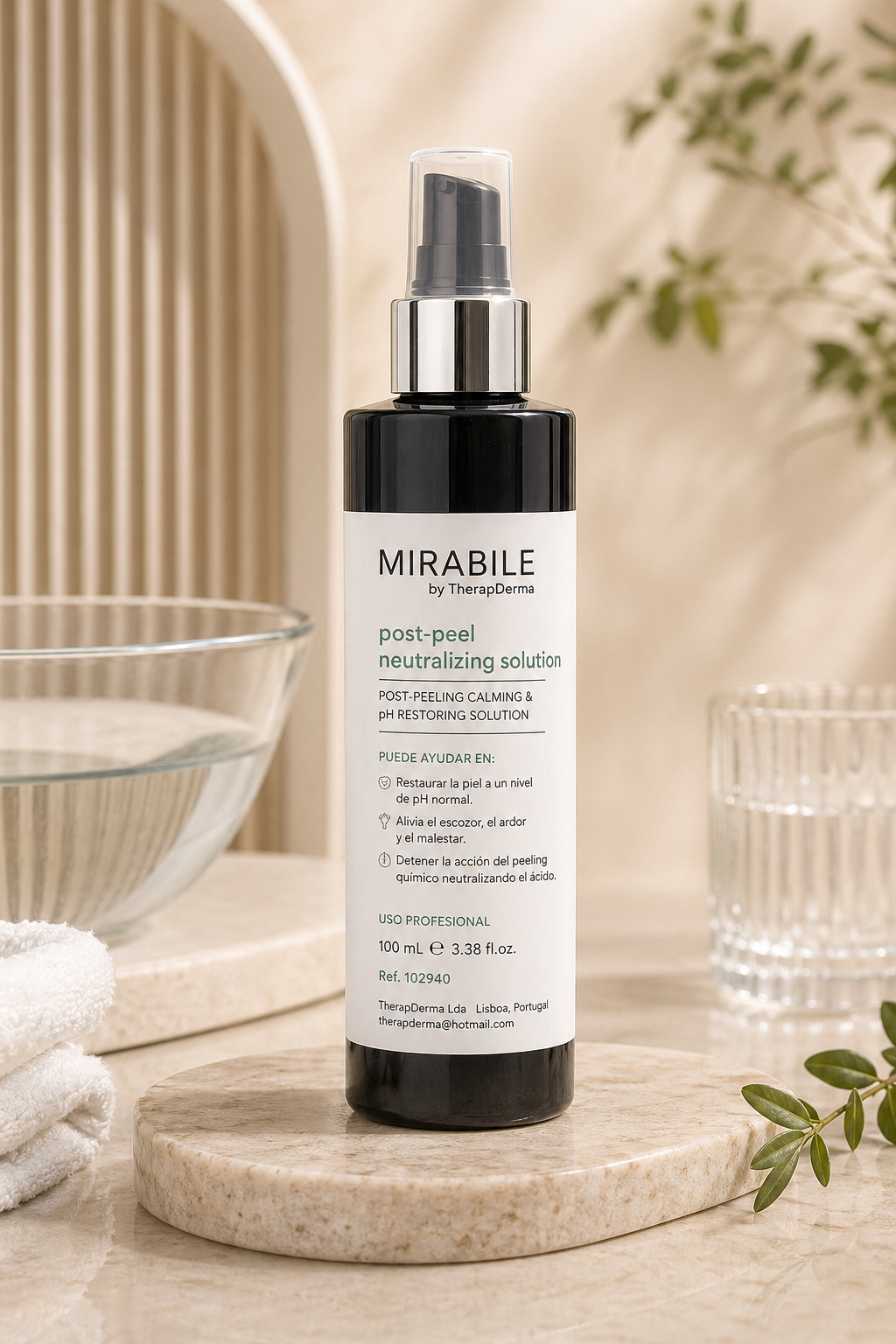
POST-PEEL NEUTRALIZING SOLUTION
Professional neutralisation and control of acid action after the peel
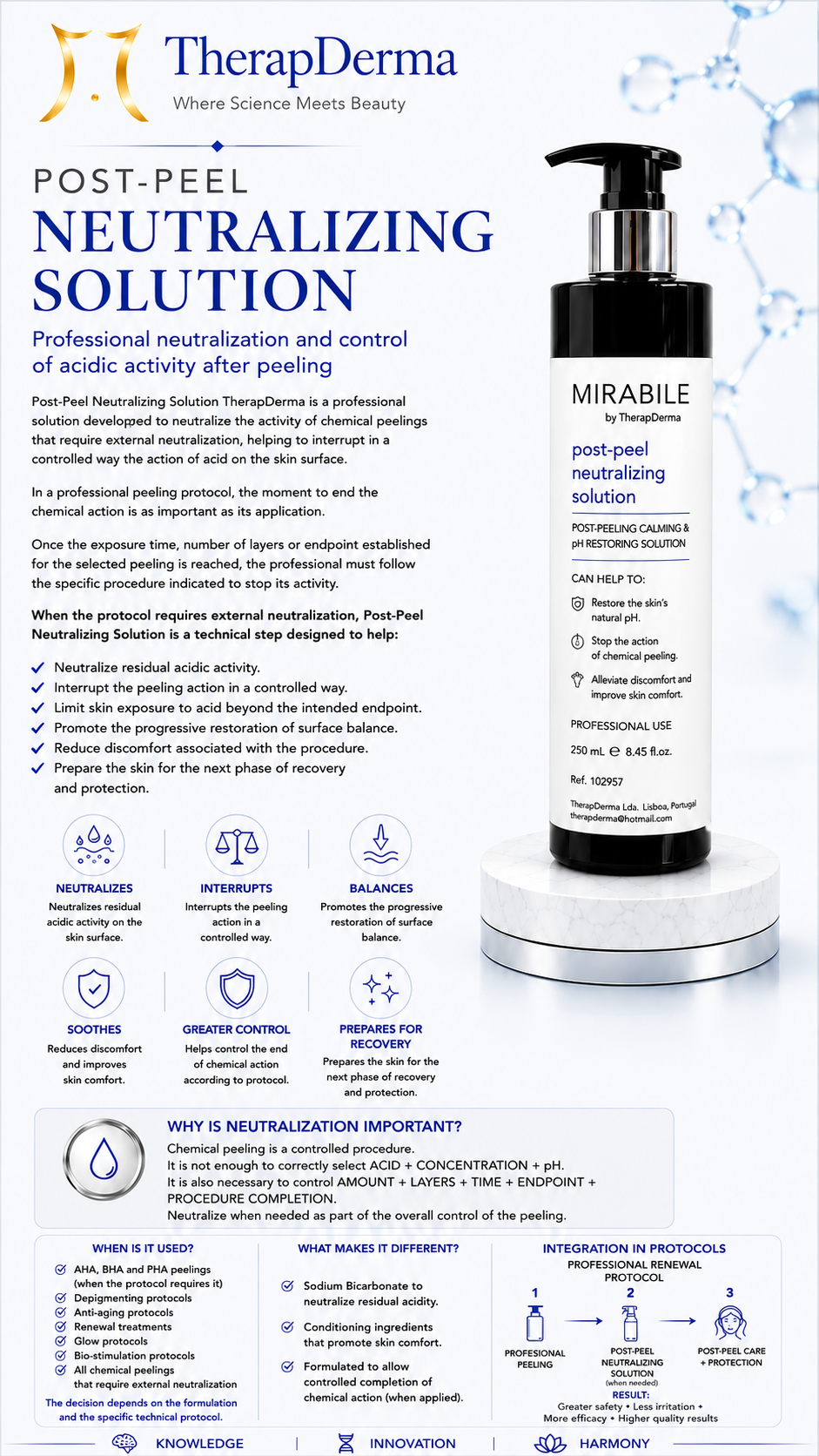
TherapDerma Post-Peel Neutralizing Solution is a professional solution developed to neutralise the activity of chemical peels that require external neutralisation, helping to interrupt the action of the acid on the skin surface in a controlled manner.
Within a professional peeling protocol, the moment at which the chemical action is stopped is just as important as its application.
Once the exposure time, number of layers or endpoint established for the selected peel has been reached, the professional must follow the specific procedure indicated to stop its activity.
When the protocol requires external neutralisation, Post-Peel Neutralizing Solution constitutes a technical stage designed to help:
✔ Neutralise residual acid activity.
✔ Interrupt the action of the peel in a controlled manner.
✔ Limit the skin’s exposure to the acid beyond the intended endpoint.
✔ Promote the progressive restoration of surface balance.
✔ Reduce discomfort associated with the procedure.
✔ Prepare the skin for the next recovery and protection phase.
Why is neutralisation important?
A chemical peel is a controlled procedure.
This means that it is not enough to correctly select:
ACID + CONCENTRATION + pH
It is also necessary to control:
AMOUNT + LAYERS + TIME + ENDPOINT + COMPLETION OF THE PROCEDURE
In those peels whose activity must be stopped by external neutralisation, this phase forms part of the control of the procedure itself.
The objective is not simply to “remove the peel”.
The objective is to end its chemical action in accordance with the established protocol.
APPLY
↓
OBSERVE
↓
REACH THE ENDPOINT
↓
NEUTRALISE WHEN REQUIRED
↓
RECOVER
↓
PROTECT
CONTROLLING THE END OF THE PEEL IS PART OF THE PEEL.
NOT ALL PEELS ARE NEUTRALISED IN THE SAME WAY
This is one of the fundamental principles of the TherapDerma Clinical Peeling System™.
The need for neutralisation and the procedure used depend on the specific formulation of the peel.
Some peels require external neutralisation.
Others may end their action through different procedures established by their formulation and technical protocol.
For this reason:
POST-PEEL NEUTRALIZING SOLUTION SHOULD NOT BE APPLIED AUTOMATICALLY AFTER EVERY PEEL.
Before using it, the professional must always confirm:
✔ The peel used.
✔ The concentration applied.
✔ The corresponding technical protocol.
✔ The established time or endpoint.
✔ Whether external neutralisation is required.
✔ The indicated neutralisation method.
THE SPECIFIC PEEL PROTOCOL ALWAYS PREVAILS.
WHAT DOES POST-PEEL NEUTRALIZING SOLUTION DO?
Its action is mainly focused on the controlled completion phase of those peels that require neutralisation.
NEUTRALISES
Helps to neutralise the activity of the acid present on the skin surface.
INTERRUPTS
Helps to stop the chemical action of the peel at the time determined by the professional protocol.
BALANCES
Contributes to the progressive restoration of more balanced surface conditions after exposure to the acid.
SOOTHES
Its formulation incorporates components with humectant and conditioning functions that help improve skin comfort after the procedure.
PREPARES FOR RECOVERY
Once the chemical phase has been correctly completed, the skin can proceed to the stages of post-peel care, barrier recovery and protection.
NEUTRALISING IS NOT THE SAME AS RINSING WITH WATER
When a protocol requires true chemical neutralisation, the objective is not merely to physically remove the product from the surface.
Neutralisation involves modifying the chemical conditions that allow the acid to remain active.
The formulation of Post-Peel Neutralizing Solution incorporates Sodium Bicarbonate, an alkaline compound used to help neutralise the residual acidity of certain peels.
During this acid-base interaction, a visible reaction may occur, including the formation of small bubbles associated with the release of CO₂.
This reaction should be interpreted within the specific protocol and professional assessment.
RINSING ≠ NEUTRALISING
When the peel requires neutralisation:
CORRECT COMPLETION MUST FOLLOW ITS TECHNICAL PROTOCOL.
NEUTRALISATION IS PART OF PEEL CONTROL
At TherapDerma, we understand professional peeling as a complete sequence of clinical and technical decisions.
It does not simply begin with the application of the acid.
Nor does it simply end when a certain number of minutes have elapsed.
THERAPDERMA
CLINICAL PEELING SYSTEM™
DIAGNOSE
↓
PREPARE
Pre-Peel
Cleanser
↓
PEEL
Selected
professional peel
↓
NEUTRALISE
Post-Peel
Neutralizing Solution
when required
↓
RECOVER
Post-Peel
Care
↓
PROTECT
Photoprotection + Home Care
↓
REASSESS
Assess the response before the next intervention
Each stage has a different function.
PRE-PEEL PREPARES.
THE PEEL PERFORMS THE CHEMICAL ACTION.
THE NEUTRALISER HELPS TO STOP IT WHEN THE PROTOCOL REQUIRES IT.
POST-PEEL HELPS TO RECOVER AND PROTECT.
A CONTROLLED TRANSITION TOWARDS RECOVERY
After the action of the peel has been completed, another fundamental stage begins:
skin recovery.
The skin may temporarily present:
• erythema;
• sensation of heat;
• tightness;
• sensitivity;
• discomfort;
• temporary alteration of barrier function.
Post-Peel Neutralizing Solution does not replace post-peel care.
Its function is to act as a bridge between two different stages of the protocol:
COMPLETION OF THE CHEMICAL ACTION
↓
NEUTRALISATION WHEN REQUIRED
↓
RECOVERY + PROTECTION
In this way, each product maintains a clearly defined function within the TherapDerma professional system.
WHEN IS IT USED?
Post-Peel Neutralizing Solution is used after application of the peel and at the time established by its specific protocol, only when the formulation used requires external neutralisation.
It may form part of professional protocols with certain:
✔ AHA Peels.
✔ BHA Peels, when the specific protocol requires neutralisation.
✔ PHA Peels, when appropriate.
✔ Compatible multicomponent peels.
✔ Professional chemical renewal protocols that include a neutralisation phase.
The acid family alone does not determine the procedure.
The decision must be established according to:
FORMULATION → CONCENTRATION → pH → TECHNIQUE → TIME/LAYERS → ENDPOINT → NEUTRALISATION PROTOCOL
THERAPDERMA CLINICAL CONTROL PRINCIPLE™
A more intense peel is not necessarily a better peel.
A correctly selected, applied, observed and completed peel is a better-controlled peel.
For this reason, Post-Peel Neutralizing Solution should not simply be understood as a product applied “after the peel”.
It is a technical neutralisation tool within those protocols in which this stage is indicated.
THERAPDERMA CONCLUSION
Post-Peel Neutralizing Solution represents the neutralisation phase within the TherapDerma Clinical Peeling System™.
Its function is to help the professional interrupt, in a controlled manner, the activity of peels that require external neutralisation, promoting the transition from the chemical phase towards the subsequent stages of skin recovery and protection.
Because in a professional protocol:
IT IS NOT ONLY IMPORTANT TO KNOW WHEN TO START THE PEEL.
YOU NEED TO KNOW WHEN AND HOW TO STOP ITS ACTION.
POST-PEEL NEUTRALIZING SOLUTION
NEUTRALIZE WITH CONTROL™
RECOVER WITH CARE™
POST-PEEL NEUTRALIZING SOLUTION
Active Ingredients And Mechanism Of Action
CHEMICAL CONTROL AFTER PEELING
During a chemical peel, the acid temporarily modifies the conditions of the skin surface to produce a controlled renewal action.
In those peels that require external neutralization, there comes a point when this activity must be interrupted according to the established technical protocol.
Post-Peel Neutralizing Solution has been formulated to intervene precisely at this stage:
NEUTRALIZE → INTERRUPT → BALANCE → SOOTHE → PREPARE FOR RECOVERY
Its function is not to perform a new exfoliation.
Its function is to help stop the acidic activity of the peel in a controlled manner when neutralization is indicated and facilitate the transition to the post-peel phase.
MAIN FUNCTIONAL COMPONENTS
SODIUM BICARBONATE
Sodium Bicarbonate is the functional component directly related to the neutralizing action of the formulation.
It is an alkaline substance capable of reacting with the acids present on the skin surface.
When it comes into contact with the residual acidic environment of the peel, it contributes to an acid-base reaction that helps to:
✔ Reduce residual acidity.
✔ Progressively interrupt the chemical activity of the acid.
✔ Promote the controlled completion of the peel.
✔ Avoid unnecessarily prolonging the active contact time.
✔ Facilitate the transition to the recovery phase.
ACIDIC MEDIUM
↓
POST-PEEL NEUTRALIZING SOLUTION
↓
ACID-BASE REACTION
↓
REDUCTION OF ACIDIC ACTIVITY
↓
CONTROLLED COMPLETION
WHY CAN BUBBLES APPEAR?
During the reaction between certain acids and bicarbonate, carbon dioxide (CO₂) may be released.
This may be visually manifested by the appearance of small bubbles or effervescence on the surface.
This reaction may form part of the chemical neutralization process.
However:
THE PRESENCE OR ABSENCE OF BUBBLES SHOULD NOT BE USED IN ISOLATION AS THE SOLE CLINICAL CRITERION.
The professional must always follow the specific instructions for the peel and the neutralization protocol used.
PANTHENOL
Panthenol is an ingredient widely used in formulations intended for skin conditioning and comfort.
After a peel, the skin may temporarily experience sensations of:
• heat;
• tightness;
• sensitivity;
• stinging;
• discomfort.
Within the formulation, Panthenol mainly contributes to:
✔ Promote skin comfort.
✔ Condition the skin after chemical exposure.
✔ Help maintain superficial hydration.
✔ Complement the transition to post-peel care.
Its function should be understood as complementary to neutralization, not as a substitute for subsequent care.
GLYCERIN
Glycerin acts primarily as a humectant.
After exposure to a chemical peel, maintaining adequate hydration conditions is especially important for skin comfort.
Its presence in the formulation helps to:
✔ Retain water in the superficial layers.
✔ Promote skin hydration.
✔ Reduce the sensation of tightness.
✔ Improve comfort after the procedure.
✔ Condition the surface for the following stages of the protocol.
PROPYLENE GLYCOL
Propylene Glycol mainly performs functions related to humectation and conditioning within the formulation.
It contributes to:
✔ Maintain superficial hydration.
✔ Promote skin conditioning.
✔ Complement the humectant action of the formula.
✔ Improve comfort during the phase immediately following the peel.
Within Post-Peel Neutralizing Solution, it forms part of the system that accompanies chemical neutralization with a superficial conditioning action.
TWO DIFFERENT FUNCTIONS WITHIN THE SAME PHASE
Post-Peel Neutralizing Solution combines two complementary objectives:
01 — CHEMICAL CONTROL
SODIUM BICARBONATE
Helps neutralize residual acidic activity when the peel requires external neutralization.
↓
02 — SKIN CONDITIONING
PANTHENOL + GLYCERIN + PROPYLENE GLYCOL
Help maintain hydration and promote skin comfort during the transition to post-peel recovery.
NEUTRALIZING IS NOT THE SAME AS RECOVERING.
Neutralization ends the chemical phase when appropriate.
Recovery subsequently continues through the appropriate Post-Peel Care protocol.
HOW DOES IT WORK?
The functional mechanism can be understood in 5 complementary stages:
1. CONTACT WITH THE ACIDIC MEDIUM
After reaching the defined time, layers or endpoint, acidic activity may remain on the skin surface.
When the peel requires neutralization:
ACTIVE PEEL → NEED TO END ITS ACTION
2. ACID-BASE NEUTRALIZATION
Sodium Bicarbonate comes into contact with the acidic medium and contributes to modifying its chemical conditions.
ACIDIC MEDIUM + NEUTRALIZER → REDUCTION OF ACIDITY
3. CONTROLLED INTERRUPTION
As neutralization occurs, the activity of the acid remaining on the surface decreases.
ACIDIC ACTIVITY → NEUTRALIZATION → CONTROLLED COMPLETION
The objective is not to prolong the chemical action beyond what is established in the protocol.
4. CONDITIONING AND COMFORT
While the acidic activity is being neutralized, the humectant and conditioning components contribute to superficial comfort.
NEUTRALIZATION + HUMECTATION + CONDITIONING
↓
MORE CONTROLLED TRANSITION TO RECOVERY
5. PREPARATION FOR POST-PEEL
Once the neutralization phase has been correctly completed, subsequent care begins.
NEUTRALIZE
↓
ASSESS
↓
RECOVER
↓
PROTECT
Post-Peel Neutralizing Solution does not represent the end of the protocol.
It represents the transition between the chemical action of the peel and subsequent skin recovery.
pH AND NEUTRALIZATION
pH is a fundamental variable in the chemistry of peels.
The activity of a peel does not depend exclusively on the stated percentage of acid.
Factors such as the following are also involved:
TYPE OF ACID + CONCENTRATION + pH + FORMULATION + AMOUNT + LAYERS + TIME + SKIN CONDITION
For this reason, correct neutralization does not simply mean attempting to immediately bring the skin to a specific numerical pH value.
The professional objective is to interrupt the activity of the peel by following the procedure established for that specific formulation.
NEUTRALIZATION ≠ DILUTION
There is an important technical difference.
RINSE / DILUTE
May physically remove or reduce the amount of product present on the surface.
NEUTRALIZE
Involves a chemical interaction intended to reduce acidity and stop the activity of the acid.
Therefore, when a peel requires specific chemical neutralization:
WATER ≠ NEUTRALIZING SOLUTION
The professional must use the procedure indicated for the formulation applied.
WHY CAN IT INFLUENCE THE SAFETY OF THE PROTOCOL?
If a peel that requires external neutralization remains active for longer than intended, chemical exposure may continue.
This may lead to:
EXCESSIVE ACTION TIME
↓
GREATER EXPOSURE TO THE ACID
↓
MORE INTENSE SKIN RESPONSE THAN EXPECTED
↓
LESS CONTROL OF THE PROCEDURE
Correctly performed neutralization seeks precisely the opposite:
CORRECT ENDPOINT
↓
CONTROLLED NEUTRALIZATION
↓
COMPLETION OF ACIDIC ACTIVITY
↓
SKIN ASSESSMENT
↓
RECOVERY
POST-PEEL NEUTRALIZING SOLUTION + POST-PEEL CARE
They are two different stages and should not be confused.
POST-PEEL NEUTRALIZING SOLUTION
NEUTRALIZES
Helps stop chemical activity when appropriate.
↓
POST-PEEL CARE
RECOVERS
Helps soothe, hydrate, condition and support the recovery of the skin barrier.
↓
PHOTOPROTECTION + HOME CARE
PROTECTS
Helps protect the skin during the period following the procedure.
NEUTRALIZE → RECOVER → PROTECT
COMPATIBILITY WITHIN THE PEELING CATALOGUE
Post-Peel Neutralizing Solution can be integrated into professional protocols when the technical instructions for the peel used require external neutralization.
Compatibility should not be established solely because a product belongs to a particular acid family.
Before using it, the following should be considered:
ACID
↓
FORMULATION
↓
CONCENTRATION
↓
pH
↓
PROTOCOL
↓
ENDPOINT
↓
COMPLETION METHOD
↓
DOES IT REQUIRE EXTERNAL NEUTRALIZATION?
YES → USE THE INDICATED NEUTRALIZATION SYSTEM
NO → FOLLOW THE SPECIFIC METHOD FOR THE PEEL
CLINICAL KEY
NOT ALL PEELS NEED TO BE NEUTRALIZED.
AND THOSE THAT REQUIRE NEUTRALIZATION SHOULD NOT AUTOMATICALLY BE TREATED IN THE SAME WAY.
Post-Peel Neutralizing Solution introduces a technical control phase between the peel and recovery when the specific protocol requires external neutralization.
THERAPDERMA CLINICAL PEELING SYSTEM™
DIAGNOSE → PREPARE → PEEL → NEUTRALIZE WHEN REQUIRED → RECOVER → PROTECT → REASSESS
The precision of a professional protocol does not depend solely on knowing which acid to apply.
It also depends on knowing:
HOW MUCH TO APPLY.
FOR HOW LONG.
WHAT RESPONSE TO OBSERVE.
AND HOW TO STOP ITS ACTION AT THE RIGHT MOMENT.
POST-PEEL NEUTRALIZING SOLUTION
CONTROL THE ACID.
RESPECT THE SKIN.
POST-PEEL NEUTRALIZING SOLUTION
Professional Protocol For Use
CORRECT NEUTRALIZATION IS PART OF PEEL CONTROL
Post-Peel Neutralizing Solution is designed as a professional neutralization stage following the application of chemical peels that require external neutralization.
Its function is to help interrupt acidic activity in a controlled manner once the time, number of layers or endpoint established by the specific peel protocol has been reached.
It is not a peel.
It does not replace professional assessment.
It does not replace the specific protocol of the acid used.
It should not be applied automatically after every peel.
It is a technical phase of chemical control when the formulation used requires external neutralization.
1. PROFESSIONAL ASSESSMENT
Before beginning the procedure, determine:
✔ Skin type and condition
✔ Phototype
✔ Skin barrier integrity
✔ Sensitivity and reactivity
✔ Area to be treated
✔ Selected peel
✔ Intended concentration
✔ pH and characteristics of the formulation
✔ Intended number of layers
✔ Exposure time
✔ Expected endpoint
✔ Peel completion method
✔ Whether external neutralization is required
✔ Intended post-peel protocol
CRITICAL POINT
Before using Post-Peel Neutralizing Solution, it must be clearly established that the peel applied requires external neutralization and that this solution is compatible with its technical protocol.
2. WHEN IS IT USED?
Post-Peel Neutralizing Solution is used after application of the peel, at the time determined by its professional protocol.
That moment may be defined by:
TIME
Maximum time or established exposure interval.
LAYERS
Number of layers defined for the protocol.
ENDPOINT
Expected skin response compatible with the peel used.
INDIVIDUAL RESPONSE
Professional observation may require the procedure to be ended before the initially planned limit.
THE CLOCK IS NOT THE ONLY CRITERION.
The professional must assess together:
TIME + LAYERS + ENDPOINT + SKIN RESPONSE
3. STEP-BY-STEP PROTOCOL
STEP 1 — CONFIRM THE PROTOCOL
Before applying the peel, check:
PEEL → CONCENTRATION → pH → LAYERS → TIME → ENDPOINT → COMPLETION METHOD
Confirm beforehand whether the peel:
REQUIRES EXTERNAL NEUTRALIZATION
YES
↓
Prepare Post-Peel Neutralizing Solution before beginning the procedure.
NO
↓
Follow exclusively the completion method indicated for that peel.
DO NOT IMPROVISE THE NEUTRALIZATION METHOD DURING THE PROCEDURE.
STEP 2 — PREPARE THE MATERIAL BEFORE THE PEEL
When external neutralization is indicated, have the neutralizer available before applying the acid.
Also prepare:
✔ Clean gauze
✔ Appropriate eye protection
✔ Material required to remove the product
✔ Post-peel recovery products
✔ Photoprotection when appropriate
The professional must be able to neutralize the peel immediately if the skin response requires it.
STEP 3 — APPLY THE PEEL
Carry out the application following exclusively the corresponding technical protocol.
Control:
✔ Amount applied
✔ Distribution
✔ Number of layers
✔ Exposure time
✔ Treated area
✔ Skin response
✔ Endpoint
THROUGHOUT THE PROCEDURE:
APPLY → OBSERVE → CONTROL
STEP 4 — IDENTIFY THE COMPLETION POINT
End the action of the peel when:
✔ The established time is reached.
✔ The intended number of layers has been completed and the protocol indicates neutralization.
✔ The defined endpoint is reached.
✔ The skin response indicates that the procedure should be interrupted.
✔ The professional determines that continuing is not appropriate.
DO NOT AUTOMATICALLY WAIT UNTIL THE MAXIMUM TIME
If a response appears that is incompatible with the safe continuation of the procedure:
STOP → NEUTRALIZE WHEN REQUIRED → ASSESS
STEP 5 — PROTECT SENSITIVE AREAS
Before spraying the solution, adequately protect the eyes.
Avoid direct contact with:
✕ Eyes
✕ Eyelids / immediate eye area
✕ Mucous membranes
✕ Inside of the nose
✕ Inside of the mouth
✕ Other areas not intended for the procedure
Application must be limited to the surface on which the peel has been performed and in accordance with its protocol.
STEP 6 — POST-PEEL NEUTRALIZING SOLUTION
When neutralization is required:
Spray Post-Peel Neutralizing Solution in a controlled manner over the treated area.
Ensure adequate distribution over the entire surface that has received the peel.
Avoid uncontrolled spraying towards the eyes, mucous membranes or untreated areas.
OBJECTIVE
UNIFORM CONTACT OF THE NEUTRALIZER WITH THE TREATED SURFACE
↓
NEUTRALIZATION REACTION
↓
REDUCTION OF ACIDIC ACTIVITY
↓
CONTROLLED COMPLETION OF THE PEEL
STEP 7 — OBSERVE THE NEUTRALIZATION
During neutralization, a visible acid-base reaction may occur.
Depending on the peel and the conditions present on the surface, the following may be observed:
EFFERVESCENCE / FORMATION OF SMALL BUBBLES
associated with the release of CO₂ during the chemical reaction.
Simultaneously observe the skin response.
IMPORTANT
Effervescence may provide information about the chemical interaction, but it should not be interpreted in isolation as the sole neutralization endpoint.
The specific protocol of the peel used must always be followed.
STEP 8 — REMOVE AND REPEAT WHEN REQUIRED
After applying the neutralizer:
Remove or gently dry with a clean gauze, following the established protocol.
When the technical procedure indicates it and activity compatible with incomplete neutralization remains, the application may be carefully repeated.
THE OBJECTIVE IS NOT TO USE THE GREATEST POSSIBLE AMOUNT.
The objective is to achieve adequate, uniform and controlled neutralization.
STEP 9 — REASSESS THE SKIN
Once neutralization has been completed, observe the entire area again.
Check:
□ Overall skin response
□ Erythema
□ Sensation reported by the patient
□ Surface integrity
□ Absence of apparently non-neutralized areas
□ Absence of unexpected reaction
□ Suitable conditions to begin Post-Peel Care
NEUTRALIZING DOES NOT MEAN STOPPING OBSERVATION.
Assessment continues after chemical activity has been stopped.
STEP 10 — POST-PEEL RECOVERY
Once the chemical phase has been correctly completed, continue with the appropriate post-peel products.
The objective of this phase is to help:
✔ Soothe
✔ Hydrate
✔ Promote skin comfort
✔ Condition the skin
✔ Support recovery of the skin barrier
✔ Protect the treated surface
POST-PEEL NEUTRALIZING SOLUTION NEUTRALIZES.
POST-PEEL CARE RECOVERS AND PROTECTS.
They are different functions.
STEP 11 — PHOTOPROTECTION + HOME CARE
When appropriate, complete the procedure with suitable SPF 50+ photoprotection.
Also establish Home Care instructions according to:
✔ Peel performed
✔ Intensity of the procedure
✔ Treated area
✔ Skin response
✔ Phototype
✔ Barrier condition
✔ Expected evolution
Home care forms part of the professional protocol and should not be considered independent of the procedure performed in the clinic.
THERAPDERMA SEQUENCE
01
DIAGNOSE
Professional assessment
↓
02
CLEANSE
Initial cleansing
↓
03
PREPARE
Pre-Peel Cleanser
↓
04
PEEL
Selected peel
↓
05
ASSESS
Time + Layers + Endpoint + Response
↓
06
NEUTRALIZE
Post-Peel Neutralizing Solution
when required
↓
07
RECOVER
Post-Peel Care
↓
08
PROTECT
SPF 50+ + Home Care
↓
09
REASSESS
Monitoring of the skin response
WHEN SHOULD IT BE USED?
Post-Peel Neutralizing Solution is indicated as a neutralization phase when the specific peel protocol requires external neutralization.
AHA PEELS
It may be integrated into those peels based on Alpha Hydroxy Acids whose protocol requires external neutralization.
BHA PEELS
Use only when the characteristics and specific instructions of the formulation indicate neutralization.
PHA PEELS
Integrate when the technical protocol expressly includes this phase.
MULTICOMPONENT PEELS
Compatibility must be determined according to the formulation and the product’s specific instructions.
THE ACID FAMILY ALONE IS NOT SUFFICIENT TO DECIDE.
THE PEEL PROTOCOL DETERMINES WHETHER IT SHOULD BE NEUTRALIZED AND HOW.
PROFESSIONAL CONTROL POINTS
BEFORE THE PEEL
Has the peel been correctly selected?
Has the concentration been defined?
Have time, layers and endpoint been defined?
Does it require external neutralization?
Is the neutralizer prepared before applying the acid?
DURING THE PEEL
Does the skin response correspond to what is expected?
Does the time remain within the protocol?
Is the endpoint developing correctly?
Is there any area requiring specific attention?
Should the procedure be ended earlier than planned?
DURING NEUTRALIZATION
Has the entire treated surface been covered uniformly?
Is there a visible reaction?
Is the skin response appropriate?
Is a new application required according to the protocol?
AFTER NEUTRALIZATION
Has the chemical activity been completed in accordance with the protocol?
Does the skin remain intact?
Is there any unexpected reaction?
Can the recovery phase begin?
STOP / REASSESS
During the peel or neutralization, reassess immediately in the event of:
⚠ Disproportionate pain or burning
⚠ Intense or unexpected erythema
⚠ Significant oedema
⚠ Whitening or skin change not corresponding to the expected endpoint
⚠ Visible damage to the surface
⚠ Unexpected reaction
⚠ Any response incompatible with the safe continuation of the protocol
THERAPDERMA RULE
OBSERVE
↓
IDENTIFY
↓
STOP THE CHEMICAL ACTION ACCORDING TO THE PROTOCOL
↓
REASSESS
↓
DECIDE THE SUBSEQUENT COURSE OF ACTION
COMMON ERROR
“ALL PEELS MUST BE NEUTRALIZED.”
NO.
Different formulations may require different completion methods.
Even within the same acid family, there may be differences related to:
FORMULATION + CONCENTRATION + pH + VEHICLE + TECHNIQUE + PROTOCOL
Therefore:
SAME ACID FAMILY ≠ SAME NEUTRALIZATION METHOD
ANOTHER COMMON ERROR
“IF I HAVE ALREADY APPLIED THE NEUTRALIZER, THE PROCEDURE IS FINISHED.”
NO.
Neutralization is only one phase of the protocol.
Afterwards, the following must be carried out:
ASSESSMENT
↓
RECOVERY
↓
PROTECTION
↓
HOME CARE
↓
FOLLOW-UP
POST-PEEL NEUTRALIZING SOLUTION
ONE STAGE. ONE FUNCTION. ONE OBJECTIVE.
NEUTRALIZE
Help reduce acidic activity.
INTERRUPT
End the chemical action when appropriate.
CONTROL
Avoid unnecessarily prolonging exposure to the acid.
BALANCE
Promote the transition towards more balanced surface conditions.
PREPARE
Create suitable conditions to begin the post-peel recovery phase.
THERAPDERMA CLINICAL PEELING SYSTEM™
THE PEEL DOESN’T END WHEN THE TIMER STOPS.
IT ENDS WHEN THE CHEMICAL ACTION IS CORRECTLY CONTROLLED.
PREPARE WITH CONTROL → PEEL WITH PRECISION → NEUTRALIZE WHEN REQUIRED → RECOVER WITH CARE
POST-PEEL NEUTRALIZING SOLUTION
Safety, Compatibility And Professional Integration
A CONTROLLED PEEL ALSO REQUIRES CONTROLLED COMPLETION
The safety of a chemical peel does not depend solely on correctly selecting the acid.
It also depends on controlling:
CONCENTRATION + pH + AMOUNT + LAYERS + TIME + ENDPOINT + COMPLETION METHOD
When a peel requires external neutralization, this phase constitutes a fundamental part of the procedure.
Post-Peel Neutralizing Solution allows neutralization to be integrated as a specific, controlled and reproducible stage within the professional protocol.
But there is one essential principle:
NOT ALL PEELS REQUIRE EXTERNAL NEUTRALIZATION.
The use of the neutralizer must always be determined by the specific technical instructions of the selected peel.
1. SAFETY BEFORE NEUTRALIZATION
Before using Post-Peel Neutralizing Solution, check:
✔ Peel used
✔ Concentration applied
✔ Treated area
✔ Number of layers applied
✔ Exposure time
✔ Endpoint reached
✔ Skin response observed
✔ Need for external neutralization
✔ Compatibility of the neutralizer with the formulation used
✔ Immediate availability of the Post-Peel Care protocol
FUNDAMENTAL PRINCIPLE
NEUTRALIZING DOES NOT MEAN IMPROVISING THE END OF THE PEEL.
Neutralization must be planned before beginning the procedure.
When the peel requires external neutralization, the product and all necessary material must be prepared before applying the acid.
2. COMPATIBILITY WITH PEELS
Post-Peel Neutralizing Solution has been designed to be integrated into professional protocols when the formulation applied requires external neutralization.
AHA
ALPHA HYDROXY ACIDS
Glycolic • Lactic • Mandelic • Malic
It may be used in those AHA protocols whose technical instructions establish an external neutralization phase.
Belonging to the AHA family does not automatically mean that all products should be neutralized in the same way.
BHA
BETA HYDROXY ACIDS
Salicylic
The use of a neutralizing solution will depend on the formulation and the specific product protocol.
DO NOT ASSUME THAT A BHA AUTOMATICALLY REQUIRES EXTERNAL NEUTRALIZATION.
PHA
POLYHYDROXY ACIDS
It may be integrated only when the characteristics of the peel and its technical instructions include external neutralization.
MULTICOMPONENT
MULTICOMPONENT PEELS
In formulations combining different acids or other active components, strictly follow the completion method indicated for the product.
THE COMPLETE COMPOSITION OF THE PEEL IS MORE IMPORTANT THAN THE NAME OF A SINGLE ACID.
3. NOT ALL PEELS END IN THE SAME WAY
Using Post-Peel Neutralizing Solution within a protocol does not mean that it can be used indiscriminately after any peel.
The decision must follow this sequence:
SELECTED PEEL
↓
FORMULATION
↓
CONCENTRATION + pH
↓
TECHNIQUE
↓
TIME + LAYERS
↓
ENDPOINT
↓
COMPLETION METHOD
↓
DOES IT REQUIRE EXTERNAL NEUTRALIZATION?
YES
↓
NEUTRALIZE ACCORDING TO THE PROTOCOL
NO
↓
FOLLOW THE SPECIFIC METHOD FOR THE PEEL
4. ERRORS THAT MAY COMPROMISE THE PROTOCOL
✕ AUTOMATICALLY NEUTRALIZING ALL PEELS
Not all peels require external neutralization.
Using a neutralizer without first checking the specific protocol constitutes incorrect practice.
✕ WAITING UNTIL THE END TO PREPARE THE NEUTRALIZER
When the peel requires neutralization, Post-Peel Neutralizing Solution must be available before beginning the application of the acid.
The professional must be able to end the chemical activity immediately when necessary.
✕ USING TIME AS THE ONLY CRITERION
Time is a fundamental variable, but it must be interpreted together with:
LAYERS + ENDPOINT + SKIN RESPONSE
The observed response may require the procedure to be ended before the initially planned time.
✕ USING EFFERVESCENCE AS THE ONLY CRITERION
The interaction between certain acids and bicarbonate may generate the release of CO₂ and produce visible bubbles.
However:
BUBBLES ≠ SOLE NEUTRALIZATION ENDPOINT
Assessment must follow the corresponding technical protocol.
✕ CONFUSING NEUTRALIZATION WITH RECOVERY
Neutralization helps stop the chemical activity.
It does not replace:
• hydration;
• conditioning;
• barrier recovery;
• photoprotection;
• Home Care.
✕ RUBBING THE SKIN AGGRESSIVELY
After a peel, the skin surface may temporarily be more reactive.
Application and removal of the product must be carried out in a controlled and careful manner, avoiding unnecessary mechanical aggression.
✕ ASSUMING THAT MORE NEUTRALIZER MEANS GREATER SAFETY
The objective is not to indiscriminately saturate the surface.
The objective is to achieve uniform and appropriate neutralization according to the protocol.
MORE PRODUCT ≠ GREATER CONTROL
5. AREAS REQUIRING PRECAUTION
Avoid direct contact with:
✕ Eyes
✕ Eyelids / immediate eye area
✕ Inside of the nose
✕ Lips / inside of the mouth
✕ Mucous membranes
✕ Areas not intended for the procedure
Adequately protect the eyes during spraying.
In the event of accidental contact with the eyes, rinse immediately with plenty of water and proceed according to the safety instructions applicable to the product.
6. PRE-PEEL + PEEL + NEUTRALIZE + POST-PEEL
A COMPLETE SYSTEM, NOT ISOLATED PRODUCTS
The TherapDerma PRE + POST PEEL SYSTEM™ allows the procedure to be structured around different technical stages.
BEFORE
PREPARE
Pre-Peel Cleanser
→ Technical cleansing
→ Reduction of residues and oiliness
→ Surface conditioning
→ Preparation for the peel
↓
DURING
RENEW
Selected professional peel
→ Specific action according to formulation
→ Adapted concentration
→ Controlled time and layers
→ Observed endpoint
↓
WHEN REQUIRED
NEUTRALIZE
Post-Peel Neutralizing Solution
→ Neutralization of acidic activity
→ Controlled completion
→ Transition to recovery
↓
AFTERWARDS
RECOVER
Post-Peel Care
→ Soothe
→ Hydrate
→ Promote comfort
→ Support barrier recovery
↓
FINALLY
PROTECT
SPF 50+ + Home Care
→ Photoprotection
→ Home care
→ Professional follow-up
7. THERAPDERMA CLINICAL PEELING WORKFLOW™
DIAGNOSE
Assess before acting.
↓
CLEANSE
Remove make-up, SPF, cosmetics and impurities.
↓
PREPARE
Pre-Peel Cleanser.
↓
PEEL
Apply the selected peel.
↓
ASSESS
Control time, layers, endpoint and skin response.
↓
NEUTRALIZE
Post-Peel Neutralizing Solution
when required by the protocol.
↓
REASSESS
Check the response after ending the chemical action.
↓
RECOVER
Apply the appropriate post-peel care.
↓
PROTECT
Photoprotection + Home Care.
↓
FOLLOW-UP
Assess the evolution before a new intervention.
8. WHAT DOES POST-PEEL NEUTRALIZING SOLUTION ADD TO THE PROTOCOL?
CONTROL
Introduces a specific phase to help end chemical activity when appropriate.
PRECISION
Allows neutralization to be integrated into a previously established protocol.
UNIFORMITY
Promotes controlled neutralization over the entire treated surface.
PREDICTABILITY
Helps avoid unnecessary prolongation of acidic activity when the peel requires external neutralization.
COMFORT
The humectant and conditioning components complement the neutralizing phase and help promote skin comfort.
INTEGRATION
Technically connects the active phase of the peel with the subsequent recovery phase.
9. NEUTRALIZATION SAFETY CHECK™
Before neutralizing:
□ Peel correctly identified
□ Concentration confirmed
□ Number of layers recorded
□ Exposure time controlled
□ Endpoint assessed
□ Skin response observed
□ Need for external neutralization confirmed
□ Compatibility with Post-Peel Neutralizing Solution confirmed
□ Eyes and sensitive areas protected
□ Application material available
□ Post-Peel Care products prepared
AFTER NEUTRALIZATION
□ The entire treated area has been correctly assessed
□ There are no areas requiring additional attention
□ Skin integrity checked
□ Patient response assessed
□ Recovery protocol initiated
10. STOP / REASSESS CRITERIA™
An unexpected response during a peel should never be ignored simply because the planned time has not yet been reached.
Reassess immediately in the event of:
⚠ Disproportionate pain or burning
⚠ Unexpectedly intense erythema
⚠ Significant oedema
⚠ Skin alteration incompatible with the expected endpoint
⚠ Visible damage to the surface
⚠ Unexpected or disproportionate reaction
⚠ Any response incompatible with the safe continuation of the procedure
THERAPDERMA CONTROL RULE™
OBSERVE
↓
RECOGNIZE
↓
STOP THE CHEMICAL ACTION ACCORDING TO PROTOCOL
↓
REASSESS
↓
RECOVER / REFER WHEN APPROPRIATE
QUICK TECHNICAL CARD
TYPE
Professional post-peel neutralizing solution
PHASE
Neutralization / Post-Peeling
MAIN ACTION
Controlled neutralization of acidic activity
FEATURED NEUTRALIZING COMPONENT
Sodium Bicarbonate
CONDITIONING COMPONENTS
Panthenol • Glycerin • Propylene Glycol
AREAS
Face • Neck • Décolleté • Hands • Body, according to protocol
APPLICATION
Professional topical use
PRESENTATION
100 mL
USE
Professional
UTILIZATION
Only when the specific peel protocol requires external neutralization
THERAPDERMA PRE + POST PEEL SYSTEM™
PREPARATION → PEELING → CONTROL → RECOVERY → PROTECTION
A professional peeling protocol should not be understood as simply applying an acid for a certain number of minutes.
It should be understood as a complete sequence of decisions and controlled stages, from the assessment and preparation of the skin to the completion of chemical activity, recovery and subsequent protection.
POST-PEEL NEUTRALIZING SOLUTION
BECAUSE CONTROL DOESN’T END WHEN THE ACID IS APPLIED.
IT ENDS WHEN ITS ACTION IS CORRECTLY MANAGED.
POST-PEEL NEUTRALIZING SOLUTION


 +1 (786) 546-8347 (Office)