Description
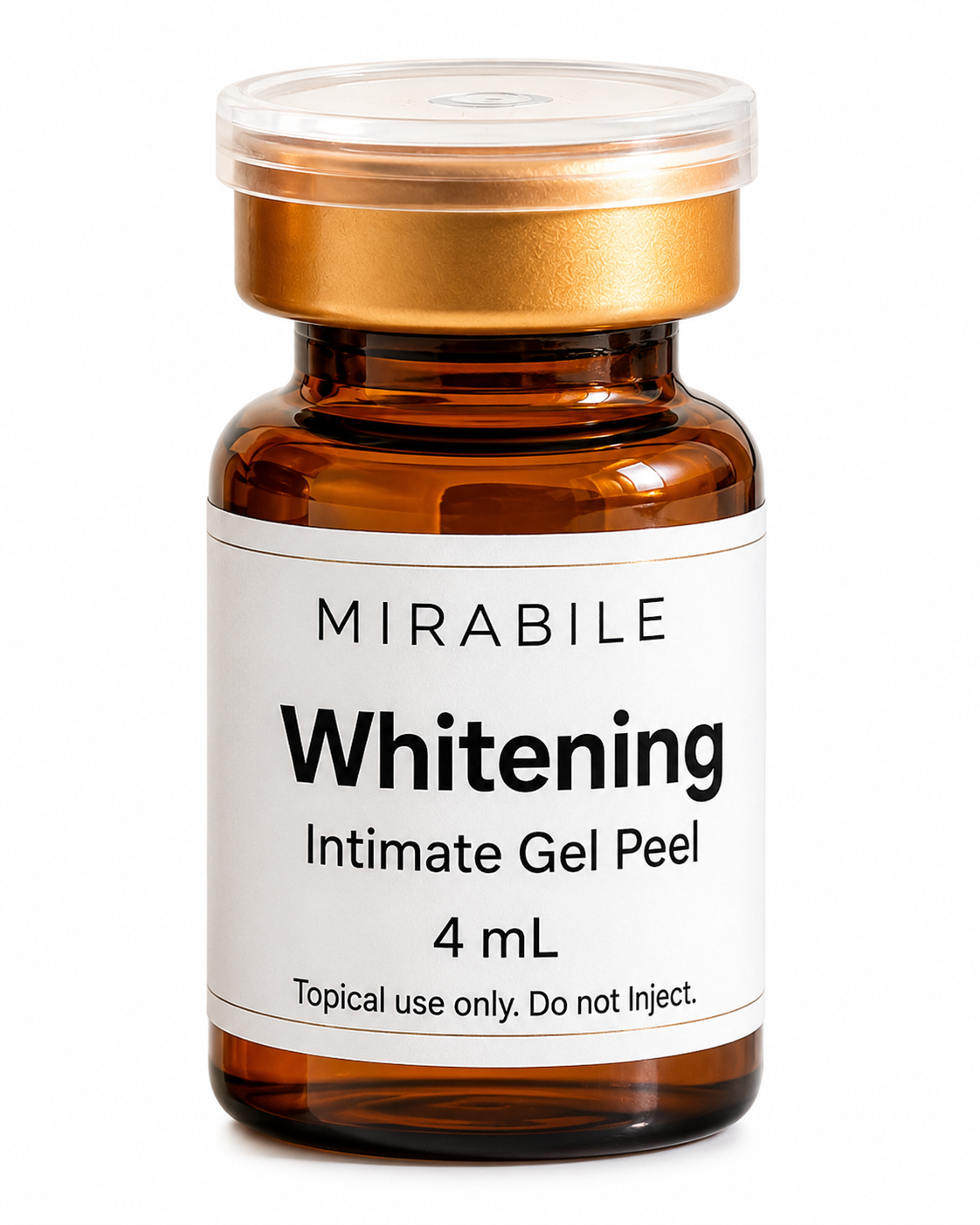
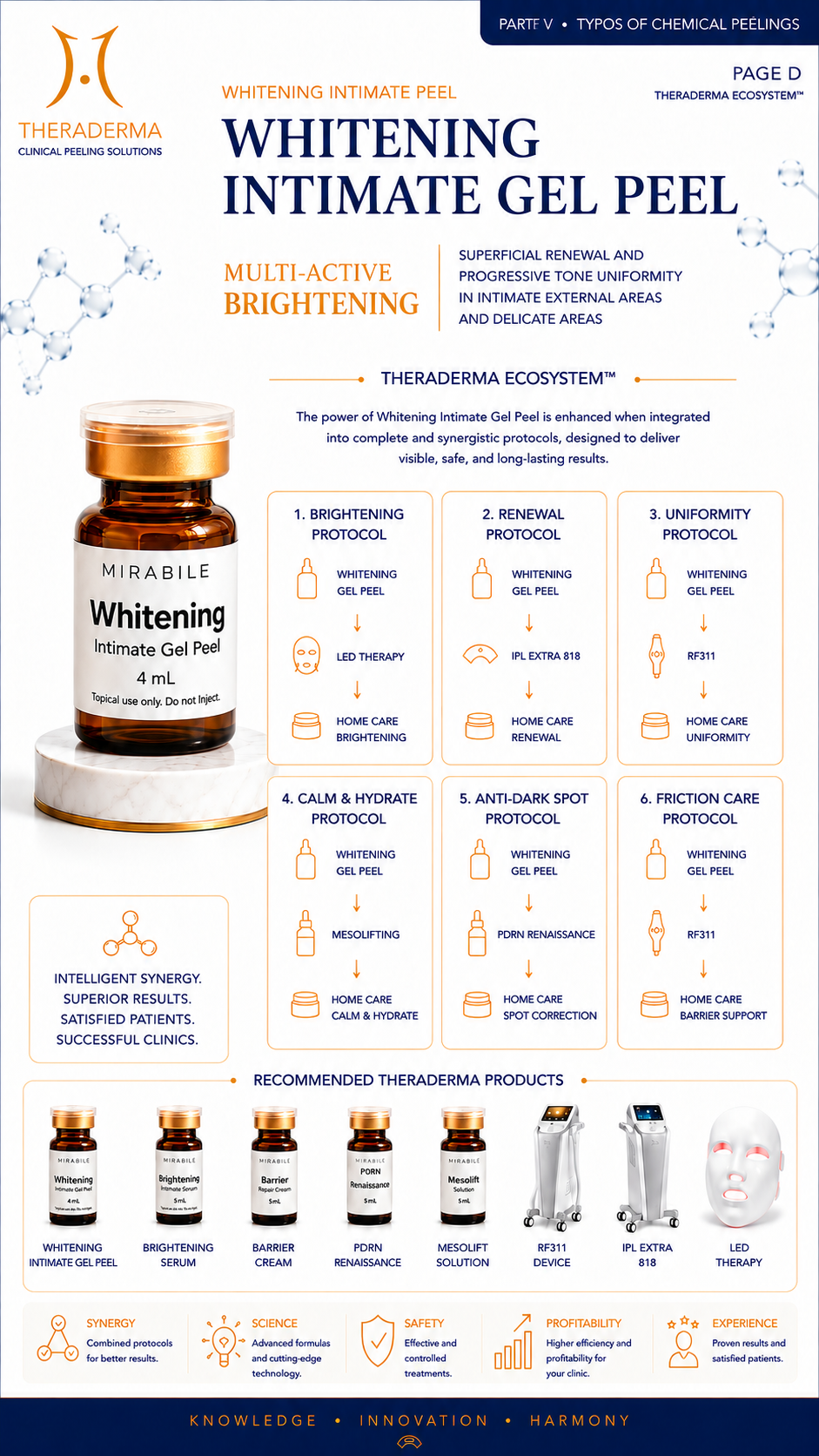
Whitening Intimate Gel Peel
Progressive brightening, superficial renewal and improved tone uniformity in external intimate areas and delicate areas
Whitening Intimate Gel Peel TherapDerma is a professional chemical peel in gel form specifically developed to address hyperpigmentation and uneven skin tone in external intimate areas and other delicate skin areas.
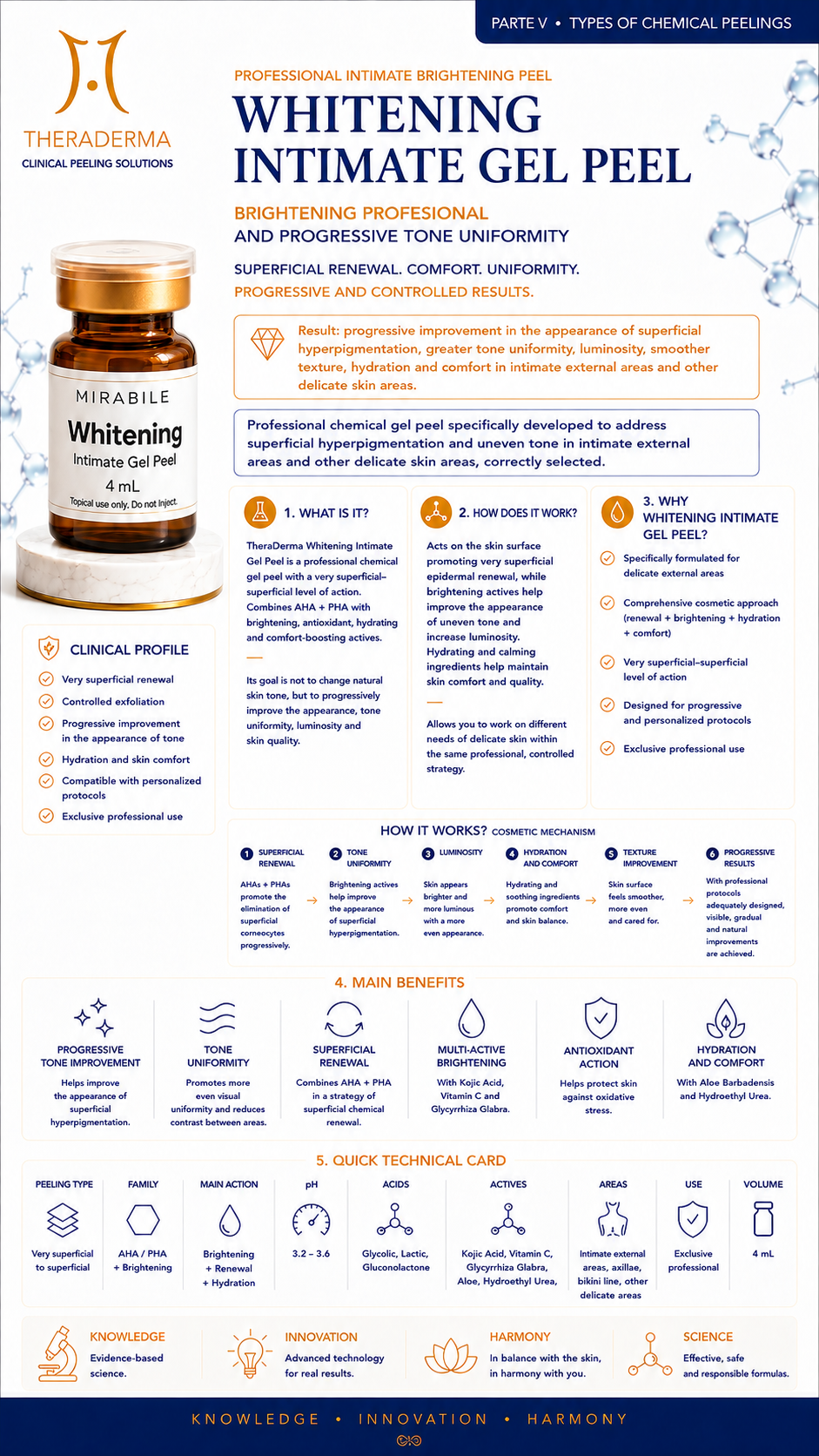
Its multi-active formulation combines Glycolic Acid, Lactic Acid and Gluconolactone with Kojic Acid, Ascorbic Acid (Vitamin C), Glycyrrhiza Glabra, Aloe Barbadensis and Hydroethyl Urea, creating a strategy that integrates superficial renewal, action on the appearance of pigmentation, luminosity, hydration and skin comfort.
Unlike a conventional peel formulated around a single acid, Whitening Intimate Gel Peel has been conceived as a multifunctional formulation specifically designed for delicate areas, where the objective is not to increase exfoliation intensity, but to combine different cosmetic mechanisms within a progressive and professionally controlled procedure.
Its main objective is to help gradually improve the appearance of superficial hyperpigmentation, uneven skin tone and visible darkening, while promoting a more uniform, smooth and luminous skin surface.
Its application is intended exclusively for external skin. It must not be applied to mucous membranes or the internal genital area.
More than an isolated procedure, Whitening Intimate Gel Peel can be integrated into the TherapDerma Clinical Ecosystem™, where professional assessment, identification of factors associated with pigmentation and individualised planning determine the treatment strategy.
What makes Whitening Intimate Gel Peel different?
Treating a delicate area does not simply mean using a less intense peel. It means formulating and planning differently.
Pigmentary alterations in external intimate areas and other delicate areas may be related to multiple factors, including repeated friction, certain hair removal practices, previous inflammatory processes, individual pigmentation characteristics and other stimuli capable of progressively altering the appearance of skin tone.
Therefore, the professional objective should not be limited to exfoliating the surface.
Whitening Intimate Gel Peel offers a more comprehensive cosmetic approach through the combination of three functional groups of active ingredients:
SUPERFICIAL RENEWAL
Glycolic Acid + Lactic Acid + Gluconolactone
TONE UNIFORMITY AND LUMINOSITY
Kojic Acid + Vitamin C + Glycyrrhiza Glabra
HYDRATION AND SKIN COMFORT
Aloe Barbadensis + Hydroethyl Urea
This formulation architecture makes it possible to simultaneously address different needs of skin requiring special attention, avoiding an approach to brightening based on aggressive exfoliation and instead directing it towards a progressive improvement in the appearance and quality of the skin.
________________________________________
A multi-active formulation for a specific objective
Whitening Intimate Gel Peel cannot be evaluated solely on the basis of the behaviour of a single ingredient.
Its identity lies precisely in the synergy of its formulation.
The exfoliating acids promote the progressive removal of superficial corneocytes and visible renewal of the skin surface.
The pigmentation-targeting active ingredients complement this action by helping to improve the appearance of uneven skin tone and restore luminosity.
The hydrating and soothing components are particularly relevant in areas where preserving comfort and the quality of the skin barrier is an essential part of the professional strategy.
In this way, the procedure does not seek merely to achieve skin that appears lighter, but rather a progression towards a more uniform, luminous, smooth and well-cared-for surface.
________________________________________
When should Whitening Intimate Gel Peel be considered?
Whitening Intimate Gel Peel can be incorporated into professional protocols when individual assessment identifies superficial tone alterations in delicate external areas that may benefit from a progressive cosmetic strategy.
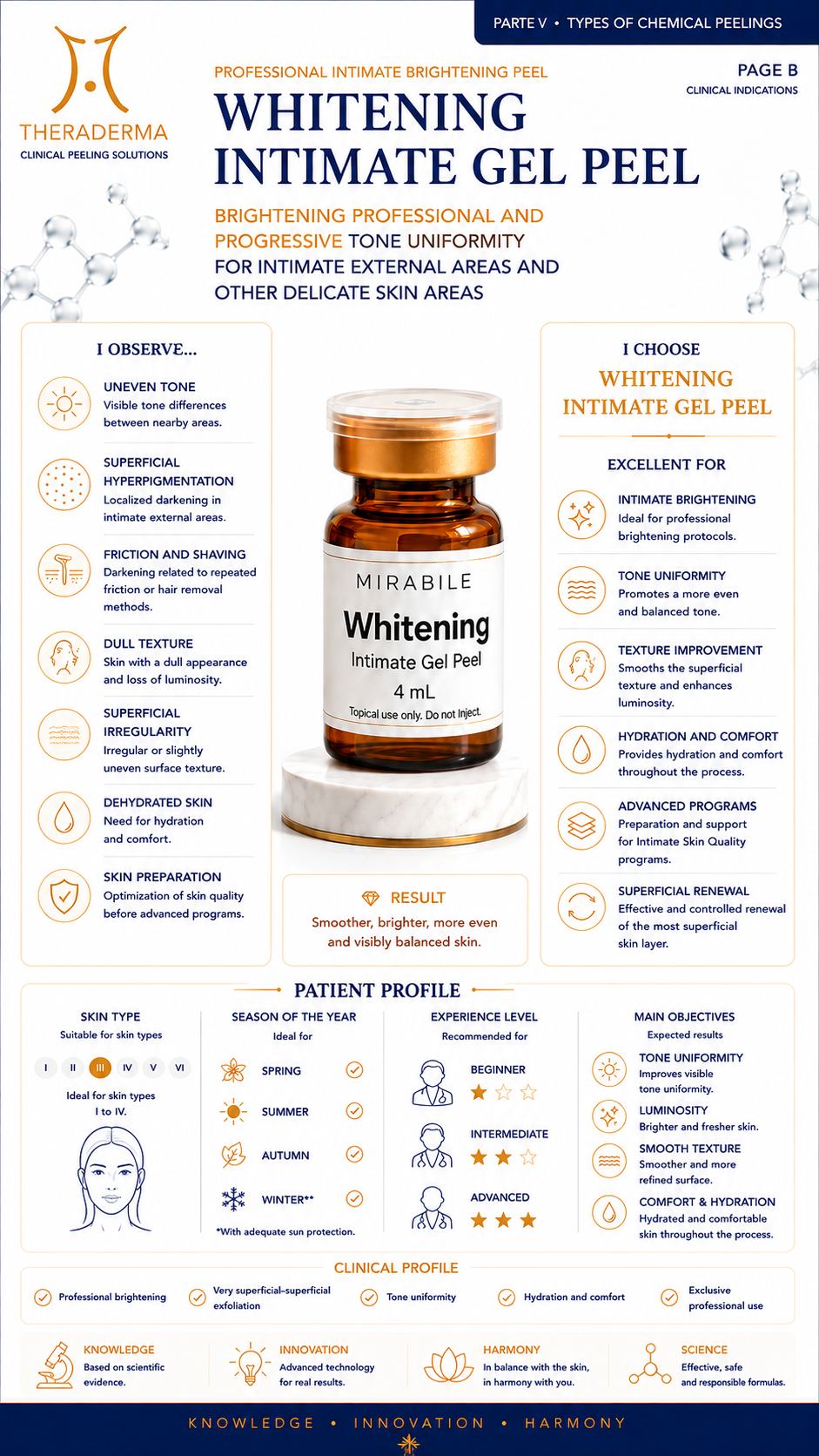
It may be considered particularly in the presence of:
• superficial hyperpigmentation in external intimate areas;
• visible darkening associated with repeated friction;
• uneven skin tone;
• visible differences in colouration between adjacent areas;
• dull appearance or lack of luminosity;
• irregular superficial texture;
• skin requiring both renewal and hydration;
• other delicate body areas with uneven skin tone, when professionally indicated.
The presence of pigmentation does not in itself constitute an automatic indication for performing a peel. Before beginning the protocol, the professional must assess the condition of the skin and determine whether the observed alteration is compatible with a cosmetic treatment of this type.
________________________________________
Positioning within the TherapDerma Clinical Ladder™
Within the TherapDerma peel portfolio, Whitening Intimate Gel Peel occupies a clearly differentiated position.
It is not a facial peel transferred to the intimate area.
It is a formulation conceived for a specific cosmetic objective: addressing the appearance of hyperpigmentation and uneven skin tone in delicate external skin through a progressive and multifunctional superficial renewal strategy.
Its cosmetic depth falls within the very superficial–superficial range, with its primary purpose being brightening, improving the appearance of hyperpigmentation and renewing the skin surface in delicate areas.
This specialisation enables the professional to incorporate into the clinic’s portfolio a treatment category that differs from conventional facial peels and to develop specific protocols for an aesthetic demand that requires professional assessment, discretion, personalisation and follow-up.
________________________________________
TherapDerma Philosophy
At TherapDerma, we approach intimate aesthetic treatment from the perspective of skin quality, treatment proportionality and respect for the anatomy of the treated area.
The objective is not to pursue an artificial skin colour or establish a universal ideal skin tone.
Physiological pigmentation varies between individuals and between different areas of the body.
Therefore, a professional protocol should be aimed at improving the aesthetic alterations identified during assessment, seeking a more uniform and balanced appearance within each patient’s natural characteristics.
Whitening Intimate Gel Peel is therefore integrated into the TherapDerma Clinical Ecosystem™ as a specialised tool that enables the development of external intimate care programmes based on professional assessment, appropriate patient selection, progressive planning and monitoring of the skin response.
________________________________________
TherapDerma Conclusion
Whitening Intimate Gel Peel represents a specific approach to the professional cosmetic treatment of superficial hyperpigmentation in external intimate areas and other delicate areas.
Its differential value lies in combining superficial renewal, improvement in the appearance of pigmentation, antioxidant action, hydration and comfort within a single formulation, avoiding the reduction of intimate treatment to simple chemical exfoliation.
For the clinic, it also offers the possibility of incorporating a specialised professional solution within an increasingly differentiated treatment category, developing personalised protocols aimed not only at visible brightening, but at the overall improvement of the uniformity, luminosity and aesthetic quality of the treated skin.
Because in a delicate area, the objective is not to exfoliate more. It is to treat better.
Clinical Benefits
Progressive brightening, management of the appearance of pigmentation and improvement of skin quality in external intimate areas and delicate areas
Whitening Intimate Gel Peel TherapDerma offers a professional approach specifically designed to improve the appearance of pigmentation and the aesthetic quality of the skin in delicate external areas.
Its clinical value lies in the complementary nature of its active ingredients: while certain components promote controlled renewal of the skin surface, others act on different processes related to the appearance of pigmentation, oxidative stress, hydration and comfort.
This combination makes it possible to develop progressive programmes whose objective is not to artificially alter the natural colour of the skin, but to visually reduce pigmentary irregularities and restore a more uniform, luminous and well-cared-for appearance.
________________________________________
🎯 Progressive improvement in the appearance of hyperpigmentation
What does it offer clinically?
Hyperpigmentation in delicate areas may present different characteristics between patients and may respond to different triggering factors.
Whitening Intimate Gel Peel incorporates Kojic Acid, Vitamin C and Glycyrrhiza Glabra, active ingredients of particular cosmetic interest within strategies designed to improve the appearance of pigmentary alterations.
Its use within professional programmes makes it possible to progressively address visually darker areas, seeking to reduce chromatic contrast and promote a more balanced appearance.
Clinical benefits
✔ Helps progressively improve the appearance of superficial hyperpigmentation.
✔ Promotes the visual reduction of areas of localised darkening.
✔ Helps reduce contrast between areas of different skin tones.
✔ Enables the development of specific professional brightening programmes.
________________________________________
🔬 Multi-pathway action on the appearance of pigmentation
What does it offer clinically?
One of the main strengths of the formulation is that the cosmetic approach to pigmentation does not depend on a single ingredient.
Kojic Acid is used in depigmenting cosmetics for its interaction with processes related to melanogenesis; Vitamin C provides antioxidant activity and participates in strategies aimed at improving luminosity; while Glycyrrhiza Glabra derivatives complement the formulation profile within the care of skin with pigmentary irregularities.
This complementary action makes it possible to design a more sophisticated strategy than the simple removal of superficial cells.
Clinical benefits
✔ Combines active ingredients with complementary cosmetic functions.
✔ Makes it possible to address the appearance of pigmentation through different mechanisms.
✔ Complements exfoliation with a specific tone-uniformity strategy.
✔ Adds greater clinical value to professional external intimate care programmes.
________________________________________
✨ Greater visual uniformity of skin tone
What does it offer clinically?
In delicate areas, the aesthetic objective should not be measured solely by how much the skin becomes lighter.
A clinically satisfactory progression also involves observing how visible differences in skin tone within the treated area itself are reduced.
Whitening Intimate Gel Peel makes it possible to direct the protocol towards this progressive aesthetic normalisation, promoting a more homogeneous visual transition between areas with different levels of pigmentation.
Clinical benefits
✔ Promotes a more homogeneous chromatic appearance.
✔ Helps reduce visible tone irregularities.
✔ Contributes to a more aesthetically balanced appearance.
✔ Enables progress to be assessed using uniformity criteria rather than exclusively by the degree of brightening.
________________________________________
🛡️ Antioxidant support
What does it offer clinically?
Oxidative stress may be involved in multiple processes that affect the quality and appearance of the skin.
The presence of Vitamin C, together with other components of the formulation, provides an antioxidant component that is particularly valuable in programmes aimed at progressively improving the appearance of skin exposed to repeated environmental or mechanical factors.
This dimension broadens the objective of the protocol beyond the visual treatment of pigmentation.
Clinical benefits
✔ Provides antioxidant support within the protocol.
✔ Helps protect against the cosmetic impact of oxidative stress.
✔ Complements luminosity and tone-uniformity strategies.
✔ Contributes to the overall care of skin quality.
________________________________________
💧 Functional hydration of the treated area
What does it offer clinically?
In delicate areas, maintaining adequate hydration is particularly relevant during any superficial renewal programme.
The presence of Hydroethyl Urea and Aloe Barbadensis provides a hydrating component that helps maintain the softness and comfort of the skin surface.
Hydration therefore ceases to be a secondary benefit and becomes part of the treatment rationale itself.
Clinical benefits
✔ Helps maintain superficial hydration.
✔ Promotes softer and more flexible skin.
✔ Complements cosmetic renewal processes.
✔ Helps preserve comfort in the treated area.
________________________________________
🌿 Comfort in delicate skin areas
What does it offer clinically?
The effectiveness of an external intimate care programme should not be assessed exclusively by the intensity of the intervention.
Tolerability and comfort are particularly important when working on areas routinely exposed to friction, occlusion, hair removal or other mechanical stimuli.
The formulation incorporates components selected to accompany the renewal process and promote a cosmetic strategy compatible with the particular characteristics of these areas.
Clinical benefits
✔ Integrates comfort as part of the treatment objective.
✔ Enables a progressive treatment strategy.
✔ Promotes programme continuity when adequate individual tolerability is present.
✔ Facilitates the incorporation of the peel into protocols specifically designed for delicate areas.
________________________________________
🌟 Restoration of luminosity
What does it offer clinically?
Luminosity does not depend solely on the level of pigmentation.
An irregular, dehydrated skin surface or one with an accumulation of corneocytes may appear visually duller.
By combining the management of pigmentary irregularities with hydrating, antioxidant and renewing active ingredients, Whitening Intimate Gel Peel makes it possible to address an additional dimension of the result: the visual quality of the skin.
Clinical benefits
✔ Promotes a more luminous appearance.
✔ Helps reduce a dull appearance.
✔ Visually improves the vitality of the treated area.
✔ Complements brightening with an overall aesthetic improvement.
________________________________________
📊 Multidimensional clinical benefit
The success of a protocol with Whitening Intimate Gel Peel should not be assessed using a single parameter.
Clinical documentation may consider different dimensions of progress:
HYPERPIGMENTATION
↓ Appearance of darkened areas
UNIFORMITY
↑ Visual homogeneity of skin tone
LUMINOSITY
↑ Quality of light reflection and healthy appearance
TEXTURE
↑ Smoothness of the skin surface
HYDRATION
↑ Comfort and superficial flexibility
This approach enables the professional to document the treatment more comprehensively and communicate a more realistic aesthetic expectation to the patient than the simple promise of “whitening” the skin.
________________________________________
CLINICAL SUMMARY
Main benefits of Whitening Intimate Gel Peel
✔ Progressive improvement in the appearance of superficial hyperpigmentation.
✔ Multi-pathway cosmetic approach to pigmentary irregularities.
✔ Greater visual uniformity of skin tone.
✔ Reduction in contrast between areas of different skin tones.
✔ Antioxidant support.
✔ Hydration of the skin surface.
✔ Greater comfort in delicate areas.
✔ Progressive restoration of luminosity.
✔ Multidimensional improvement in the aesthetic quality of the skin.
________________________________________
THERAPDERMA CLINICAL CONCLUSION
The main clinical value of Whitening Intimate Gel Peel lies in not reducing the treatment of external intimate areas to exfoliation or the result to simple brightening.
Its formulation makes it possible to build professional programmes in which progress can be assessed across different dimensions: appearance of hyperpigmentation, chromatic uniformity, luminosity, hydration, texture and skin comfort.
This perspective makes it possible to transform a treatment traditionally presented as “intimate whitening” into a more comprehensive professional concept of Intimate Skin Quality, aimed at achieving external skin that is progressively more uniform, luminous, smooth and visually balanced.
The aesthetic objective is not to change the natural colour of the skin. It is to improve the quality and uniformity of its appearance.
Why choose Whitening Intimate Gel Peel?
A professional solution specifically developed to address aesthetic tone alterations in external intimate areas and delicate skin areas
In aesthetic medicine, external intimate areas require a different approach from that commonly used on other body areas. Their anatomical characteristics, frequent exposure to friction, moisture, occlusion and hair removal, as well as the possibility of developing irritation or inflammation, make it particularly important to correctly select both the patient and the procedure.
Whitening Intimate Gel Peel TherapDerma enables the incorporation into professional practice of a solution specifically designed for the cosmetic treatment of hyperpigmentation in delicate areas, brightening, superficial exfoliation and improvement of skin appearance, with a very superficial–superficial level of action and exclusively on external skin.
Its professional value lies precisely in its specialisation: it enables a specific aesthetic need to be addressed using a product designed for this treatment category, rather than indiscriminately adapting protocols developed for other anatomical regions.
________________________________________
WHAT DOES IT BRING TO PROFESSIONAL PRACTICE?
The aesthetic care of external intimate areas has evolved towards more specific treatments, where patient expectations must be translated into realistic aesthetic objectives compatible with their individual characteristics.
Incorporating Whitening Intimate Gel Peel enables the professional to structure a consultation that does not begin directly with the procedure, but with a fundamental question:
Why does this area present a different colouration and what can we reasonably improve?
This approach makes it possible to distinguish between a physiological variation in skin colour and an aesthetic alteration that may be suitable for treatment, while also identifying circumstances that may influence the selected strategy.
From this perspective, Whitening Intimate Gel Peel provides a tool for developing a specialised professional service in which assessment, indication, procedure and follow-up form part of the same professional experience.
________________________________________
WHAT TYPE OF PROFESSIONAL HAS IT BEEN DESIGNED FOR?
Whitening Intimate Gel Peel is intended for professionals who wish to introduce or enhance a specific category of external intimate aesthetics and delicate-area treatment within their practice.
It is particularly relevant for clinics seeking to:
✔ expand their portfolio with treatments specifically designed for delicate areas;
✔ professionalise external intimate brightening protocols;
✔ replace generic approaches with procedures specifically selected for this indication;
✔ establish individualised aesthetic objectives;
✔ document the progression of tone alterations;
✔ offer complete programmes rather than isolated procedures;
✔ differentiate their offering through a specialised treatment category.
Professional use also requires clearly establishing the anatomical limits of application and recognising situations in which the procedure should not be performed or where prior medical assessment is required.
________________________________________
A FUNDAMENTAL CLINICAL DIFFERENCE: PHYSIOLOGICAL PIGMENTATION ≠ AESTHETIC HYPERPIGMENTATION
The skin of intimate areas may naturally present a different tone from that of other body regions.
This difference in colouration does not necessarily constitute an aesthetic alteration requiring correction.
Therefore, before selecting Whitening Intimate Gel Peel, the professional must determine what is actually being observed.
PHYSIOLOGICAL PIGMENTATION
Natural variation in tone associated with individual skin characteristics and the anatomical region.
It should not automatically be interpreted as an indication for treatment.
ACQUIRED PIGMENTARY ALTERATION
A visible change or intensification of skin tone that may be associated, among other factors, with repeated friction, certain hair removal methods or a history of irritation and inflammation.
It may justify a cosmetic strategy when professional assessment confirms an appropriate indication.
This distinction helps avoid unnecessary treatments and enables much more realistic aesthetic expectations to be established.
________________________________________
PROFESSIONAL SELECTION: WHEN SHOULD TREATMENT BE CONSIDERED?
Rather than using an automatic list of indications, the choice can be structured through a decision-making sequence:
1. IDENTIFY
Is there genuinely an aesthetic tone irregularity that the patient wishes to improve?
↓
2. INVESTIGATE
Are there local factors that may be contributing to the darkening?
↓
3. ASSESS
Is the skin intact and in suitable condition for an exfoliating procedure?
↓
4. DEFINE
What is a reasonable aesthetic objective for that patient and that area?
↓
5. TREAT
Select the appropriate professional protocol.
↓
6. REASSESS
Document progress before deciding whether to continue or modify the programme.
Whitening Intimate Gel Peel should be the result of this professional decision, not the starting point of the consultation.
________________________________________
THERAPDERMA CLINICAL LADDER™ — A CATEGORY OF ITS OWN
Within the TherapDerma Clinical Ladder™, Whitening Intimate Gel Peel should not be interpreted as a higher or lower intensity step in relation to facial peels.
It occupies a specific functional category:
INTIMATE & DELICATE AREA BRIGHTENING
Main objective
To progressively improve the appearance of pigmentary irregularities and the visual uniformity of delicate external skin areas.
Area
External skin of intimate areas and other correctly selected delicate body areas.
Cosmetic depth
Very superficial–superficial.
Selection criteria
Professional indication based on pigmentary characteristics, skin integrity, local history, expected tolerability and individual aesthetic objective.
Essential anatomical limitation
External use only. Do not apply to mucous membranes or the internal genital area.
________________________________________
QUICK PROFESSIONAL DECISION GUIDE
Observed situation
Professional decision
Physiological tone without an identifiable aesthetic alteration
Do not treat solely with the aim of modifying the natural skin colour
Localised superficial hyperpigmentation
Whitening Intimate Gel Peel may be considered
Uneven external skin tone
Whitening Intimate Gel Peel may be considered
Darkening related to repeated friction
Identify the triggering factor and subsequently assess the protocol
History of irritation or inflammation
Confirm complete resolution before considering the procedure
Sensitised skin or impaired barrier
Postpone and restore the skin condition first
Lesion, infection or alteration of uncertain origin
Do not perform the peel and refer for medical assessment when appropriate
Mucosa or internal genital area
Do not apply
This guide provides professional guidance and does not replace individualised assessment.
________________________________________
WHY TURN IT INTO A PROGRAMME RATHER THAN A “WHITENING SESSION”?
Because pigmentation does not behave like a surface that can simply be “erased”.
When factors contributing to darkening persist — for example, repeated friction or irritation — performing procedures without first addressing these contributing factors may limit the aesthetic progress achieved.
For this reason, Whitening Intimate Gel Peel gains greater professional value when it forms part of a structured programme:
INITIAL ASSESSMENT
↓
IDENTIFICATION OF CONTRIBUTING FACTORS
↓
REALISTIC AESTHETIC OBJECTIVE
↓
PROFESSIONAL PROTOCOL
↓
DOCUMENTATION OF PROGRESS
↓
REASSESSMENT
↓
CONTINUATION OR MODIFICATION OF THE PLAN
This model makes it possible to transform an apparently simple request for “intimate brightening” into a specialised, personalised professional service that can be clinically monitored.
________________________________________
THERAPDERMA CLINICAL CONCLUSION
Choosing Whitening Intimate Gel Peel does not simply mean adding another peel to a clinic’s portfolio.
It means having a tool specifically positioned to develop professional protocols for improving tone and the aesthetic quality of external intimate areas and delicate areas, where correct patient selection is just as important as the procedure itself.
Within the TherapDerma Clinical Ladder™, it occupies a category of its own that does not compete with other peels in terms of intensity: it responds to a different need.
Integrated into the TherapDerma Clinical Ecosystem™, it also enables external intimate treatment to be transformed into a structured programme of assessment, intervention, documentation and follow-up, increasing both the professional quality of the service and its differentiation within the professional portfolio.
It is not about offering “intimate whitening”. It is about knowing which skin to treat, why to treat it and how far it is reasonable to go.
Areas Of Application
A specialised formulation. Different external areas where irregular pigmentation may become an aesthetic concern.
Whitening Intimate Gel Peel TherapDerma has been developed for professional application on the external skin of intimate areas and other delicate body areas with hyperpigmentation or uneven skin tone.
The product’s technical documentation specifically includes hyperpigmentation in delicate areas, brightening, superficial exfoliation, improvement of skin appearance and body areas with uneven tone, expressly establishing its use exclusively on external skin.
Each anatomical region presents different conditions in terms of skin thickness, friction, moisture, occlusion, sensitivity and exposure to mechanical stress. Therefore, the same formulation does not imply the same protocol for every area.
The selection of the area, the extent of the treated surface and the procedure parameters must be established individually according to its anatomical characteristics and professional assessment.
________________________________________
EXTERNAL INTIMATE AREA
The area of application that defines the product’s specialisation
The external intimate area may present significant physiological variations in colouration and, in certain patients, develop progressive darkening that becomes an aesthetic concern.
When there is an alteration suitable for treatment and the skin is in appropriate condition, Whitening Intimate Gel Peel may be incorporated into professional programmes designed to progressively improve the appearance of these irregularities.
Application must be strictly limited to the external skin surface suitable for treatment, respecting anatomical safety boundaries.
Treatment objectives
✔ Visually reduce areas of superficial darkening.
✔ Promote a more homogeneous appearance of skin tone.
✔ Improve the aesthetic quality of the skin surface.
✔ Integrate external intimate care into a specific professional programme.
Do not apply to mucous membranes or internal genital structures.
________________________________________
GROIN AND INGUINAL FOLD
An area particularly exposed to friction and occlusion
The groin area may experience repeated rubbing between skin surfaces, contact with tight-fitting clothing, moisture and stress associated with certain hair removal methods.
When these factors are accompanied by a visible change in pigmentation, treatment should not be limited to addressing colour alone.
Professional assessment should identify and, whenever possible, reduce the factors that may be maintaining the problem before or during the aesthetic programme.
Whitening Intimate Gel Peel may be considered for intact external inguinal skin when an appropriate indication exists.
________________________________________
BIKINI LINE
Localised treatment of visible tone irregularities
The bikini line is a frequent area of aesthetic concern due to the appearance of visible differences in skin tone, particularly when there is a repeated history of hair removal, friction or local irritation.
Its location makes it possible to develop highly defined protocols for the affected skin surface, avoiding unnecessary extension of the procedure to skin without an aesthetic indication.
The objective is to achieve better visual integration between the hyperpigmented area and the surrounding skin while maintaining the natural characteristics of the patient’s phototype.
________________________________________
MONS PUBIS
Aesthetic uniformity of external skin
The mons pubis consists of external skin and may present irregular darkening, changes associated with friction or colour differences that are aesthetically relevant to certain patients.
When examination confirms skin integrity and an appropriate cosmetic indication, it may be included within the treatment area with Whitening Intimate Gel Peel.
Precise delimitation of the surface to be treated is particularly important to avoid unnecessarily extensive interventions.
________________________________________
UPPER INNER THIGHS
Colour continuity around the intimate region
The proximal area of the inner thighs may present hyperpigmentation associated with repeated contact between the legs, individual body characteristics, clothing or a history of irritation.
In these cases, there may be a visible difference between the tone of the inner region and the surrounding skin.
Whitening Intimate Gel Peel may be incorporated into localised protocols designed to improve this colour transition when the skin is intact and the alteration is compatible with cosmetic treatment.
The extent of the area is particularly important in this region and should be established before beginning the procedure.
________________________________________
UNDERARMS
Another delicate area where uneven tone may be aesthetically relevant
The underarms combine particular characteristics: skin folds, moisture, occlusion, frequent friction, hair removal and exposure to cosmetic products.
When acquired superficial darkening is present and professional assessment rules out situations requiring another approach, Whitening Intimate Gel Peel may be considered as part of a specific programme for this area.
The protocol must take local tolerability into particular consideration and avoid application to recently depilated, irritated or damaged skin.
________________________________________
OTHER DELICATE BODY AREAS WITH UNEVEN SKIN TONE
The technical documentation for Whitening Intimate Gel Peel also includes its use on body areas with uneven tone, meaning that its professional application is not necessarily restricted to the intimate region.
This makes it possible to consider other localised external areas where there is a superficial aesthetic alteration compatible with the characteristics of the product.
However, this possibility should not be interpreted as authorisation to use it indiscriminately on any body region.
The indication must be justified by the characteristics of the skin, the nature of the pigmentary alteration and the suitability of the procedure for the selected area.
________________________________________
PROFESSIONAL APPLICATION MAP
Anatomical area
Main objective
Specific consideration
External intimate area
Improve the appearance of pigmentation and tone uniformity
Strictly delimit external skin
Groin / inguinal fold
Visually reduce localised darkening
Assess friction, moisture and hair removal
Bikini line
Improve the uniformity of visible differences in skin tone
Treat only the surface for which there is an indication
Mons pubis
Improve aesthetic uniformity
Strictly respect anatomical boundaries
Upper inner thighs
Improve colour transition
Adapt the protocol to the extent of the treated area
Underarms
Improve the appearance of superficial darkening
Consider hair removal, cosmetics, friction and irritation
Other delicate external areas
Improve superficial tone irregularities
Individualised indication according to area and skin condition
________________________________________
ANATOMICAL LIMITS OF APPLICATION
With Whitening Intimate Gel Peel, knowing where not to apply the product is just as important as knowing where to use it.
DO NOT APPLY TO:
✘ mucous membranes;
✘ internal genital structures;
✘ surfaces with erosions, fissures or wounds;
✘ skin with active irritation;
✘ areas with active infection or inflammation;
✘ skin lesions of undiagnosed origin.
Whenever there is any alteration whose nature cannot be determined within the professional’s scope of practice, the procedure should be postponed until the appropriate assessment has been obtained.
________________________________________
TREATMENT OF CONTIGUOUS AREAS
In some patients, pigmentary irregularity is not limited to a single anatomical region.
For example, there may be continuity between:
BIKINI LINE
↓
INGUINAL FOLD
↓
UPPER INNER THIGH
In these cases, the objective should not be to lighten each area independently, but to develop a strategy that achieves a visually more balanced colour transition.
Planning by area makes it possible to control the total surface treated, individually assess the tolerability of each region and modify the programme according to the observed progress.
________________________________________
IMPORTANT PROFESSIONAL CONSIDERATION
Intimate areas and body folds may present darkening for very different reasons.
Not all localised pigmentation should automatically be interpreted as a purely aesthetic alteration.
When the pigmentation pattern, its progression, clinical characteristics or any other observed sign raises suspicion of a condition requiring medical assessment, the peel should not be used in an attempt to visually correct the problem without first investigating its origin.
This distinction forms part of responsible professional practice and increases the value of professional assessment within intimate aesthetics services.
________________________________________
QUICK SUMMARY
Whitening Intimate Gel Peel may be professionally considered for:
✔ external intimate area;
✔ groin and inguinal fold;
✔ bikini line;
✔ mons pubis;
✔ upper inner thighs;
✔ underarms;
✔ other delicate external body areas with uneven skin tone when an appropriate indication exists.
Fundamental principle
EXTERNAL SKIN → YES
MUCOUS MEMBRANES / INTERNAL GENITAL AREA → NO
________________________________________
THERAPDERMA CONCLUSION
Whitening Intimate Gel Peel enables professionals to work on different external areas where pigmentary irregularities may affect aesthetic perception and the visual uniformity of the skin.
Its use gains greater value when each anatomical region is analysed independently, identifying its characteristics, the possible factors contributing to darkening and the precise treatment boundaries.
This approach makes it possible to move away from the generic concept of treating a “dark area” and develop professional protocols based on anatomy, indication, precise delimitation of the area and individual progress.
Within the TherapDerma Clinical Ecosystem™, the anatomical area is not simply the place where the product is applied.
It is a professional variable that determines how the treatment should be planned.
How does it work?
A sequential action on superficial renewal, pigmentation appearance and skin balance
Whitening Intimate Gel Peel TherapDerma acts through a coordinated sequence of cosmetic mechanisms that begins during professional application and continues to evolve after the procedure.
Its action does not depend on a single acid or a single pathway. The formulation combines exfoliating agents, actives targeting the appearance of pigmentation, antioxidants, humectants and soothing components, allowing intervention on different elements involved in the aesthetic quality of delicate areas.
Understanding this sequence is essential for correctly interpreting treatment progress: the skin’s immediate response and the final pigmentary result are different phenomena and occur over different biological timeframes.
For this reason, Whitening Intimate Gel Peel should be understood as a progressively evolving procedure rather than a treatment intended to produce immediate lightening.
________________________________________
IT ALL BEGINS IN THE STRATUM CORNEUM
The first interaction of Whitening Intimate Gel Peel takes place on the skin surface.
In areas repeatedly exposed to friction, hair removal, occlusion or other local stimuli, the organisation of the stratum corneum may become altered and coexist with a rougher, duller or more irregular appearance.
The combination of Glycolic Acid, Lactic Acid and Gluconolactone promotes controlled superficial chemical exfoliation that facilitates the progressive shedding of corneocytes.
This initial action has additional importance: as the surface progressively reorganises, the skin may acquire an optically more regular texture and an improved ability to reflect light.
But this is only the beginning of the process.
________________________________________
STEP 1
Superficial chemical renewal
The exfoliating components of the formulation act on the cohesion of cells in the outermost layers, promoting their progressive shedding.
The response obtained during this phase may vary considerably between patients and between different anatomical regions.
It is influenced, among other factors, by:
✔ thickness and characteristics of the stratum corneum;
✔ hydration level;
✔ skin integrity;
✔ individual sensitivity;
✔ anatomical area;
✔ previous exposure to friction or hair removal;
✔ amount of product applied;
✔ contact time;
✔ technique used;
✔ previously performed cosmetic procedures.
A more evident superficial reaction does not necessarily mean a better pigmentary result.
The objective is to achieve controlled action compatible with the treated area.
________________________________________
STEP 2
Progressive reorganisation of the skin surface
After the procedure, the epidermis continues its physiological renewal cycle.
As the treated superficial cells complete their shedding process, the stratum corneum may progressively acquire a more regular organisation.
This evolution contributes particularly to two dimensions of the result:
TEXTURE
A less irregular surface may feel smoother and more homogeneous.
LUMINOSITY
An optically more uniform surface may reflect light more evenly.
This phase explains why part of the aesthetic result continues to develop after the product is no longer in contact with the skin.
________________________________________
STEP 3
Action on processes related to the appearance of pigmentation
Skin pigmentation depends fundamentally on melanin synthesis and its subsequent distribution within the epidermis.
Whitening Intimate Gel Peel incorporates active ingredients that complement superficial renewal with a strategy specifically targeting this component.
KOJIC ACID
Kojic Acid is known for its ability to interfere with tyrosinase activity, a key enzyme in the biochemical cascade of melanin synthesis.
VITAMIN C
Ascorbic Acid provides antioxidant activity and participates in cosmetic strategies aimed at reducing the appearance of pigmentary irregularities and promoting luminosity.
GLYCYRRHIZA GLABRA
Liquorice-derived components complement the cosmetic approach to pigmentation and are particularly interesting in formulations intended for skin where the balance between efficacy and tolerability is especially important.
The combination of these actions allows the treatment not to depend exclusively on removing pigment already visible in the superficial layers, but also to incorporate active ingredients targeting processes related to its formation and appearance.
________________________________________
STEP 4
Antioxidant action and management of the skin environment
Inflammatory stimuli and oxidative stress may influence different biological processes related to pigmentation.
This is particularly relevant in regions repeatedly exposed to friction, hair removal or other irritating factors.
The presence of antioxidant and soothing components in Whitening Intimate Gel Peel complements the treatment by creating a strategy in which progressive lightening and care of the skin environment form part of the same objective.
This dimension is especially important because addressing the appearance of pigmentation without considering the factors that may contribute to its persistence would limit the overall result of the programme.
________________________________________
STEP 5
Hydration and restoration of superficial comfort
After an exfoliating intervention, the hydration status of the skin surface becomes particularly important.
Hydroethyl Urea and Aloe Barbadensis complement the formulation by providing humectant and soothing properties that help maintain a more flexible and comfortable surface during post-procedure progress.
In a delicate area, this component should not be interpreted simply as an additional cosmetic benefit.
It forms part of the functional balance of the formulation:
RENEW
without pursuing excessive exfoliation.
ACT ON THE APPEARANCE OF PIGMENTATION
without turning irritation into the mechanism of treatment.
MAINTAIN COMFORT
to promote appropriate skin recovery.
________________________________________
STEP 6
Progressive evolution of visible skin tone
Changes in a pigmentary irregularity do not occur at the same rate as superficial exfoliation.
After each procedure, an evolution begins involving epidermal renewal, the progressive shedding of superficial cells and the cosmetic mechanisms associated with the active ingredients in the formulation.
For this reason, the professional must clearly distinguish between:
IMMEDIATE RESPONSE
What occurs during and after application.
↓
SKIN RECOVERY
How the area evolves during the following days.
↓
PIGMENTARY RESPONSE
How the visual uniformity of the tone progressively changes.
↓
CUMULATIVE RESULT
The evolution observed throughout the programme.
This temporal difference is essential to avoid decisions based exclusively on the appearance of the skin immediately after each session.
________________________________________
STEP 7
Reassessment before a new application
A new session should not be scheduled simply because a predetermined number of days has elapsed.
Before continuing, the professional should confirm:
✔ complete recovery of the treated surface;
✔ absence of persistent irritation;
✔ tolerance to the previous procedure;
✔ visual evolution of pigmentation;
✔ uniformity achieved;
✔ response of the different treated areas;
✔ presence or persistence of triggering factors;
✔ compliance with the recommended care.
The information obtained makes it possible to decide whether the programme should be maintained, modified, spaced out or discontinued.
________________________________________
WHY DOES MORE EXFOLIATION NOT MEAN MORE LIGHTENING?
Because exfoliation and pigmentation are related processes, but they are not equivalent.
Attempting to accelerate the result through excessively intensive procedures may compromise skin tolerability.
Furthermore, a significant irritative response is particularly counterproductive when the objective is precisely to improve a pigmentary alteration, since inflammation may promote subsequent pigmentary changes in susceptible patients.
For this reason, the professional objective is not to provoke the maximum possible visible reaction.
It is to achieve the minimum intervention necessary to produce favourable aesthetic progress.
________________________________________
A DIFFERENT RESPONSE IN EACH PATIENT
Two patients with an apparently similar initial appearance may progress differently.
Pigmentary behaviour is influenced by multiple individual variables, including phototype, melanocytic activity, history of post-inflammatory hyperpigmentation, characteristics of the area and persistence of local factors.
For this reason, neither the speed nor the magnitude of lightening should be predicted exclusively from the initial appearance.
Individual progress provides the information that allows the professional to adjust the programme.
________________________________________
SEQUENCE OF THE BIOLOGICAL PROCESS
Professional application on external skin
↓
Controlled superficial chemical exfoliation
↓
Progressive renewal of the skin surface
↓
Cosmetic action on processes related to pigmentation
↓
Antioxidant, hydrating and soothing support
↓
Recovery of the skin surface
↓
Progressive evolution of the visual uniformity of skin tone
↓
Professional reassessment
↓
Individual adaptation of the programme
________________________________________
KEY MECHANISMS
✔ controlled superficial exfoliation;
✔ progressive reorganisation of the skin surface;
✔ cosmetic action on different processes related to the appearance of pigmentation;
✔ antioxidant support;
✔ maintenance of hydration and comfort;
✔ progressive restoration of natural luminosity;
✔ gradual evolution of colour uniformity;
✔ reassessment before continuing the programme.
________________________________________
THERAPDERMA CONCLUSION
Understanding how Whitening Intimate Gel Peel works makes it possible to move beyond an overly simplified view of intimate treatment based solely on “applying an acid to lighten the skin”.
The procedure establishes a more complex sequence: it begins with controlled renewal of the surface, incorporates active ingredients that act on processes related to the appearance of pigmentation and supports skin progress through antioxidant, hydrating and soothing components.
The result does not occur at the moment the peel is removed. It develops progressively during subsequent skin renewal and throughout the professional programme.
This understanding allows the professional to make better decisions about when to treat, when to wait and when to modify the strategy, avoiding the use of the intensity of the skin reaction as a measure of efficacy.
Within the TherapDerma Clinical Ecosystem™, understanding the mechanism of action turns the peel into more than a technical procedure:
it makes it possible to transform a chemical application into a professionally reasoned Intimate Skin Quality strategy.
Mechanism Of Action
The science behind a multi-active formulation for the cosmetic treatment of hyperpigmentation in delicate areas
The mechanism of action of Whitening Intimate Gel Peel TherapDerma cannot be attributed to a single active ingredient.
Its behaviour derives from the interaction between Glycolic Acid, Lactic Acid, Gluconolactone, Kojic Acid, Ascorbic Acid, Glycyrrhiza Glabra, Aloe Barbadensis and Hydroethyl Urea, integrated into a formulation designed to act on different components of skin appearance.
From a scientific perspective, the strategy combines three complementary functional levels:
1. SUPERFICIAL RENEWAL
Modulation of stratum corneum cohesion and progressive shedding of corneocytes.
2. COSMETIC MODULATION OF PIGMENTATION
Action on biochemical processes related to the synthesis and visible expression of melanin.
3. SKIN BALANCE
Antioxidant, humectant and soothing support designed to accompany the response of an anatomical region particularly susceptible to irritating stimuli.
This multi-mechanism architecture constitutes the scientific basis of the formulation.
________________________________________
ARCHITECTURE OF THE EXFOLIATING SYSTEM
Whitening Intimate Gel Peel combines three hydroxy acids with different physicochemical profiles:
GLYCOLIC ACID — AHA
Its small molecular size facilitates its interaction with the stratum corneum and contributes to reducing cohesion between superficial cells, promoting the exfoliation process.
LACTIC ACID — AHA
It complements superficial renewal and also possesses humectant properties related to its affinity for water, providing a particularly valuable dimension when exfoliation and hydration need to remain balanced.
GLUCONOLACTONE — PHA
Gluconolactone belongs to the Polyhydroxy Acids (PHA). Its molecular structure and humectant profile allow it to complement the action of AHAs within formulations intended for progressive superficial exfoliation.
The AHA + AHA + PHA combination creates an exfoliating system in which different active ingredients participate complementarily in the renewal of the skin surface.
________________________________________
CORNEODESMOSOMES AND STRATUM CORNEUM COHESION
Corneocytes are not simply deposited on top of one another.
Their cohesion is regulated, among other structures, by corneodesmosomes, protein complexes involved in the mechanical integrity of the stratum corneum and in the physiological process of desquamation.
Hydroxy acids modify conditions within the stratum corneum and promote a reduction in cohesion between superficial cells.
As a result:
corneocyte cohesion
↓
shedding of superficial corneocytes
↓
reorganisation of the stratum corneum
↓
progressively more regular surface
In Whitening Intimate Gel Peel, this mechanism also has a relevant implication for pigmentation treatment: part of the visible melanin is distributed within keratinocytes that progressively reach the superficial layers of the epidermis.
Promoting their turnover helps support the physiological removal of superficial epidermal pigment.
________________________________________
THE TYROSINASE–MELANIN AXIS
The central scientific point of pigmentation treatment
Melanin is synthesised in melanocytes through a complex biochemical cascade.
Within this process, tyrosinase is a key enzyme because it catalyses initial stages of melanogenesis, including the oxidation of tyrosine and the formation of intermediates that subsequently participate in melanin production.
For this reason, tyrosinase represents one of the main cosmetic targets of depigmenting formulations.
Whitening Intimate Gel Peel incorporates different active ingredients whose value lies precisely in complementing superficial renewal with mechanisms related to this pigmentation axis.
________________________________________
KOJIC ACID
Interference with tyrosinase activity
Kojic Acid is one of the specific components of the formulation’s depigmenting strategy.
Its most recognised mechanism is related to its ability to chelate the copper present at the active site of tyrosinase, thereby interfering with the enzymatic activity required for certain stages of melanogenesis.
In simplified form:
TYROSINE
↓
TYROSINASE + Cu²⁺
↓
MELANOGENIC INTERMEDIATES
↓
MELANIN
The presence of Kojic Acid makes it possible to act cosmetically on this process, progressively contributing to a reduced visible expression of pigmentary irregularities.
________________________________________
VITAMIN C
Antioxidant action and support for pigmentary uniformity
Ascorbic Acid introduces a complementary mechanism.
During melanogenesis, oxidative processes take place that are necessary for the progressive formation of pigment. The antioxidant activity of Vitamin C allows intervention within this redox environment, complementing strategies aimed at improving the appearance of hyperpigmentation.
Its function within Whitening Intimate Gel Peel does not replace the mechanism of Kojic Acid.
It complements it.
This distinction is important because it demonstrates the multi-pathway nature of the formulation: different ingredients act through different mechanisms towards the same aesthetic objective.
________________________________________
GLYCYRRHIZA GLABRA
A third dimension within the cosmetic management of skin tone
Glycyrrhiza Glabra provides bioactive compounds of interest in formulations aimed at pigmentary uniformity and the care of skin susceptible to irritation.
Liquorice extracts may contain different flavonoids and other components whose activity depends on the specific composition of the extract used.
Therefore, from a scientifically rigorous perspective, its function within the formulation should be understood as complementary within the brightening and skin care strategy, without attributing to the ingredient a specific concentration or mechanism that has not been individually characterised in the final formulation.
________________________________________
RELATIONSHIP BETWEEN INFLAMMATION AND PIGMENTATION
A particularly relevant consideration in delicate areas
Melanogenesis does not respond exclusively to ultraviolet exposure.
Inflammatory processes can also modify melanocyte activity and promote the development or persistence of post-inflammatory hyperpigmentation, particularly in predisposed patients.
In regions repeatedly exposed to hair removal, friction or other irritating stimuli, this relationship becomes particularly relevant.
The following cycle may occur:
FRICTION / IRRITATION
↓
INFLAMMATORY RESPONSE
↓
MELANOGENIC STIMULI
↓
INCREASE IN VISIBLE PIGMENTATION
↓
FURTHER IRRITATION
↓
PERSISTENCE OF DARKENING
For this reason, a strategy aimed at improving skin tone should not be based on provoking intense skin aggression that could perpetuate the very mechanism it is intended to control.
________________________________________
FUNCTION OF ALOE BARBADENSIS AND HYDROETHYL UREA
The balance of the formulation is also part of its mechanism
Components aimed at comfort and hydration should not be interpreted as accessory elements.
ALOE BARBADENSIS
It is incorporated for its cosmetic hydrating and soothing properties, contributing to skin conditioning during an exfoliating programme.
HYDROETHYL UREA
It acts primarily as a humectant, helping to attract and retain water within the stratum corneum and promoting a more flexible and comfortable surface.
Its presence helps balance a formulation in which pigmentation efficacy must coexist with the specific needs of skin undergoing chemical renewal.
________________________________________
A DUAL STRATEGY FOR VISIBLE PIGMENT
The overall mechanism can be understood through two complementary pathways:
PATHWAY 1 — PIGMENT ALREADY PRESENT IN THE EPIDERMAL SURFACE
AHA + PHA
↓
Superficial renewal
↓
Progressive shedding of corneocytes
↓
Turnover of superficial keratinocytes containing pigment
________________________________________
PATHWAY 2 — PROCESSES RELATED TO PIGMENT FORMATION AND EXPRESSION
Kojic Acid + Vitamin C + Glycyrrhiza Glabra components
↓
Complementary cosmetic actions on melanogenesis, oxidation and pigmentary appearance
↓
Progressive reduction in visual contrast
________________________________________
DESIRED RESULT
TURNOVER OF SUPERFICIAL PIGMENT
• ________________________________________
MODULATION OF PROCESSES RELATED TO PIGMENTATION
• ________________________________________
MANAGEMENT OF THE SKIN ENVIRONMENT
↓
GREATER VISUAL UNIFORMITY OF SKIN TONE
________________________________________
THE ROLE OF THE GEL VEHICLE
The vehicle is not merely the medium in which the ingredients are contained.
In a formulation intended for defined anatomical areas, the gel texture facilitates localised and visually controlled application, allowing the professional to distribute the product over the selected surface and respect the treatment boundaries with greater precision.
The final behaviour will, however, depend on the complete formulation and the protocol used, not solely on the nature of the vehicle.
________________________________________
SCIENCE AT A GLANCE™
Functional component Main active ingredients Relevant cosmetic mechanism Objective
AHA renewal Glycolic Acid + Lactic Acid Modulation of superficial cohesion Renewal of the stratum corneum
PHA renewal Gluconolactone Superficial exfoliation + humectation Complement renewal in delicate skin
Pigmentation management Kojic Acid Interaction with tyrosinase activity Progressively reduce the appearance of hyperpigmentation
Antioxidant system Vitamin C Modulation of the oxidative environment Support luminosity and uniformity
Complementary brightening Glycyrrhiza Glabra Multifactorial cosmetic activity according to extract composition Complement the pigmentation strategy
Skin comfort Aloe Barbadensis Hydrating and soothing cosmetic action Support tolerability
Humectation Hydroethyl Urea Water retention in the stratum corneum Maintain hydration and flexibility
________________________________________
BIOLOGICAL BASIS
The scientific basis of Whitening Intimate Gel Peel lies in recognising that a pigmentary irregularity cannot be addressed solely by removing cells from the surface.
The final appearance of skin tone depends on the amount and distribution of pigment, epidermal turnover, melanogenic activity and the inflammatory environment of the skin.
For this reason, the formulation combines mechanisms that act on different components of this system.
This approach helps explain why the professional objective must be progressive: the stratum corneum may renew within a given interval, while visible modification of the pigmentary pattern requires successive biological cycles before it can be properly assessed.
________________________________________
SCIENTIFIC PRINCIPLES OF USE
✔ Superficial exfoliation and depigmentation are not the same mechanism.
✔ Tyrosinase is a relevant target within melanogenesis.
✔ Inflammation may contribute to maintaining or intensifying certain pigmentary alterations.
✔ An intense exfoliative reaction does not guarantee greater efficacy on pigmentation.
✔ The different active ingredients in the formulation have complementary functions.
✔ The condition of the skin barrier influences the tolerability of the procedure.
✔ Pigmentary evolution requires biological time and should be documented progressively.
✔ Individual response takes precedence over any rigid protocol.
________________________________________
THERAPDERMA CONCLUSION
Whitening Intimate Gel Peel represents a different concept from that of a peel based exclusively on exfoliative intensity.
Its mechanism combines superficial turnover of epidermal pigment, cosmetic action on pathways related to melanogenesis, antioxidant support and maintenance of the hydrating environment of the stratum corneum.
This architecture makes it possible to address pigmentary appearance from different biological points without assuming that greater skin aggression will necessarily produce a better result.
Understanding these mechanisms allows the professional to correctly interpret what is being treated: not simply a darker surface, but a biological system in which epidermal renewal, melanogenesis, inflammation and barrier function can influence one another.
Within the TherapDerma Clinical Ecosystem™, this scientific understanding makes it possible to replace protocols based exclusively on intensity with strategies based on mechanism, evolution and individual response.
In pigmentation, exfoliation is only one part of the treatment. Understanding and modulating the pigmentary process is what transforms the procedure into a professional strategy.
Scientific Foundations
A multi-component formulation requires a multivariable scientific interpretation
In Whitening Intimate Gel Peel TherapDerma, scientifically interpreting the formulation means going beyond analysing an acid, a concentration or a mechanism in isolation.
The product integrates two Alpha Hydroxy Acids (AHA), one Polyhydroxy Acid (PHA), active ingredients aimed at the cosmetic management of pigmentation, antioxidant, humectant and soothing components within a single system.
Therefore, its behaviour depends on the simultaneous interaction between:
FORMULATION CHEMISTRY
↓
GEL VEHICLE
↓
APPLICATION CONDITIONS
↓
ANATOMY OF THE AREA
↓
INDIVIDUAL BIOLOGY
=
SKIN RESPONSE
This perspective is particularly important in delicate areas, where efficacy must coexist with rigorous control of the skin response.
________________________________________
ONE FORMULATION. THREE FUNCTIONAL FAMILIES.
The scientific architecture of Whitening Intimate Gel Peel can be organised into three complementary systems:
KERATOLYTIC / RENEWAL SYSTEM
Glycolic Acid — AHA
Lactic Acid — AHA
Gluconolactone — PHA
Its primary function is to promote controlled chemical renewal of the epidermal surface.
BRIGHTENING / PIGMENTARY SYSTEM
Kojic Acid
Ascorbic Acid — Vitamin C
Glycyrrhiza Glabra
Provides complementary cosmetic mechanisms designed to act on the appearance of pigmentary irregularities.
HYDRATING / CONDITIONING SYSTEM
Aloe Barbadensis
Hydroethyl Urea
Contributes to maintaining hydration and conditioning the treated surface.
The scientific relevance of this organisation lies in the fact that none of these systems works independently: the final behaviour depends on the complete formulation.
________________________________________
AHA + PHA
Why combine different hydroxy acids?
Hydroxy acids do not constitute a homogeneous family.
Their structural differences determine distinct physicochemical properties and allow them to be used with complementary functions within the same formulation.
Glycolic Acid
Molecular formula: C₂H₄O₃
Molecular weight: ≈ 76.05 g/mol
Family: Alpha Hydroxy Acid (AHA)
pKa: ≈ 3.83
It is the AHA with the lowest molecular weight and has high water solubility. Its inclusion provides effective renewal activity on the stratum corneum.
Lactic Acid
Molecular formula: C₃H₆O₃
Molecular weight: ≈ 90.08 g/mol
Family: Alpha Hydroxy Acid (AHA)
pKa: ≈ 3.86
It combines exfoliating properties with humectant capacity, providing a complementary profile to Glycolic Acid.
Gluconolactone
Molecular formula: C₆H₁₀O₆
Molecular weight: ≈ 178.14 g/mol
Family: Polyhydroxy Acid (PHA)
Its molecular structure is considerably larger than that of Glycolic Acid and Lactic Acid and contains multiple hydroxyl groups associated with its humectant properties.
What does this mean professionally?
It does not mean that one acid is “better” than another.
It means that the formulation uses different chemical profiles to build a more comprehensive renewal system, particularly relevant when working on areas that require superficial and carefully controlled action.
________________________________________
SCIENTIFIC HYDROXY ACID PROFILE™
Parameter Glycolic Acid Lactic Acid Gluconolactone
Family AHA AHA PHA
Molecular formula C₂H₄O₃ C₃H₆O₃ C₆H₁₀O₆
Approx. molecular weight 76.05 g/mol 90.08 g/mol 178.14 g/mol
Relevant functional characteristic Superficial renewal Renewal + humectation Progressive renewal + humectation
Role in the formulation Exfoliant Complementary exfoliant Complement to the AHA system
Scientific note: these data describe properties of the individual molecules. They do not, by themselves, allow the behaviour of the finished product to be predicted.
________________________________________
THE FREE ACID FRACTION
Why knowing only the name of the acid does not reveal the intensity of the peel
In an acidic solution, an equilibrium exists between the ionised and non-ionised forms of each acid.
The proportion between the two depends, among other factors, on the relationship between pH and pKa.
In general, for certain hydroxy acids, a higher proportion of non-ionised molecules may modify their interaction with the skin surface.
This explains an essential principle:
CONCENTRATION ≠ PRODUCT ACTIVITY ON ITS OWN
To correctly interpret a formulation, it is necessary to consider, among other variables:
✔ individual concentration of each acid;
✔ final pH of the product;
✔ buffer system;
✔ vehicle;
✔ excipients;
✔ stability;
✔ application conditions.
The available technical documentation identifies the components of Whitening Intimate Gel Peel and establishes an approximate pH of 3.5 for the finished formulation, although it does not specify the individual concentrations of the different acids.
For scientific rigour, individual concentrations should not be estimated or invented.
________________________________________
pH AS A FORMULATION VARIABLE
pH influences the chemical equilibrium of the acids present in a formulation and is a relevant variable for understanding its potential behaviour.
In Whitening Intimate Gel Peel, the manufacturer’s technical documentation establishes an approximate pH of 3.5 for the finished product. This information should be interpreted together with the multi-active composition, the vehicle, the individual concentrations of the acids — not specified in the available documentation — and the professional application conditions.
It is not scientifically correct to use pH in isolation to predict the clinical intensity of the product or to attempt to infer the overall behaviour of the formulation solely from the individual pKa of its ingredients.
pH belongs to the finished product.
pKa relates to the acid-base behaviour of a specific molecule.
They are related concepts, but they are not interchangeable.
This distinction is essential to avoid one of the most common errors when technically interpreting a chemical peel.
________________________________________
KOJIC ACID
Scientific profile of the main specific brightening active ingredient
Name: Kojic Acid
Molecular formula: C₆H₆O₄
Molecular weight: ≈ 142.11 g/mol
Nature: heterocyclic organic compound
Its relevance in formulations aimed at pigmentation is primarily related to its interaction with tyrosinase, a copper-dependent enzyme involved in essential stages of melanogenesis.
The chelating capacity of Kojic Acid towards copper ions at the enzyme’s active site constitutes one of the biochemical foundations supporting its cosmetic use in strategies aimed at improving the appearance of hyperpigmentation.
________________________________________
ASCORBIC ACID
Scientific profile of the antioxidant component
Name: Ascorbic Acid
Molecular formula: C₆H₈O₆
Molecular weight: ≈ 176.12 g/mol
Nature: water-soluble antioxidant
Ascorbic Acid acts as a reducing agent and participates in multiple redox processes.
In formulations aimed at skin tone, its antioxidant activity complements brightening strategies and provides a functional pathway different from the action of Kojic Acid.
This complementarity is scientifically relevant:
Kojic Acid → enzymatic axis related to melanogenesis
Vitamin C → oxidative environment
They are not redundant active ingredients.
________________________________________
GLYCYRRHIZA GLABRA
The importance of not attributing more information to an extract than is available
Glycyrrhiza Glabra — liquorice — contains various bioactive constituents whose profile depends on the type of extract and its extraction process.
Among the compounds studied in liquorice extracts are different flavonoids and molecules of cosmetic interest in strategies aimed at skin tone and skin comfort.
However, the available documentation for Whitening Intimate Gel Peel identifies Glycyrrhiza Glabra as an ingredient without specifying the standardisation of the extract or the concentration of its individual components.
Therefore, it should not be scientifically assumed that the formulation contains a specific amount of glabridin, liquiritin or any other specific constituent.
This precision helps maintain scientifically robust communication without turning general data about a plant into specific product claims.
________________________________________
THE GEL VEHICLE
Physical architecture also matters
Whitening Intimate Gel Peel uses a gel vehicle, a particularly valuable characteristic for procedures performed on small, curved or clearly defined anatomical areas.
From a technical perspective, the rheology of the vehicle influences:
✔ distribution capacity;
✔ residence on the surface;
✔ control of the application area;
✔ uniformity of the applied film;
✔ reproducibility of the procedure.
In areas close to structures with which the product must not come into contact, physical control of the application becomes particularly relevant.
However, the exact viscosity and other rheological parameters of the product are not specified in the available documentation and, therefore, technical values not provided by the manufacturer should not be attributed to it.
________________________________________
STABILITY: A CRITICAL VARIABLE IN MULTI-ACTIVE FORMULATIONS
A formulation combining exfoliating acids, antioxidants, botanical extracts and active ingredients aimed at pigmentation requires all of them to remain within physicochemical conditions compatible with the finished product.
Stability may be influenced by variables such as:
✔ pH;
✔ exposure to oxygen;
✔ light;
✔ temperature;
✔ interactions between ingredients;
✔ preservation system;
✔ packaging.
This consideration is particularly relevant for components susceptible to oxidative processes, such as Ascorbic Acid.
Therefore, the storage conditions indicated by the manufacturer should be respected throughout the product’s shelf life.
________________________________________
WHY CAN THE RESPONSE NOT BE PREDICTED FROM THE FORMULA ALONE?
Because chemistry describes the potential of the product.
Biology determines how each skin responds.
In Whitening Intimate Gel Peel, variables particularly relevant to the intended areas of application should be considered:
FORMULATION
✔ composition;
✔ approximate pH of 3.5;
✔ individual concentrations;
✔ vehicle;
✔ stability.
↓
PROCEDURE
✔ surface preparation;
✔ amount applied;
✔ distribution;
✔ contact time;
✔ removal or neutralisation according to protocol.
↓
ANATOMICAL AREA
✔ skin thickness;
✔ degree of occlusion;
✔ moisture;
✔ habitual friction;
✔ proximity to mucous membranes.
↓
PATIENT
✔ phototype;
✔ pigmentary activity;
✔ history of post-inflammatory hyperpigmentation;
✔ barrier integrity;
✔ individual sensitivity.
↓
SKIN RESPONSE
↓
PROFESSIONAL DECISION
This sequence explains why an identical protocol can produce different responses even in the same patient when applied to different anatomical regions.
________________________________________
SCIENTIFIC FORMULATION PROFILE™
Parameter Whitening Intimate Gel Peel
Type of formulation Professional chemical peel in gel form
Exfoliating system AHA + AHA + PHA
AHA Glycolic Acid + Lactic Acid
PHA Gluconolactone
Skin tone-oriented system Kojic Acid + Ascorbic Acid + Glycyrrhiza Glabra
Hydrating / conditioning system Aloe Barbadensis + Hydroethyl Urea
Intended level of action Very superficial–superficial
Primary cosmetic objective Brightening and improvement of the appearance of hyperpigmentation in delicate areas
Vehicle Gel
Intended area External skin
Individual concentrations Not specified in the available documentation
Final pH ≈ 3.5 according to the manufacturer’s technical documentation
Use Professional
The available technical documentation defines the product as an “Intimate whitening gel peel”, establishes an approximate pH of 3.5 and places its depth within the “Very superficial – superficial” range, targeting hyperpigmentation in delicate areas, brightening, superficial exfoliation and improvement of skin appearance.
________________________________________
AN IMPORTANT DISTINCTION: CHEMICAL POTENCY AND PROFESSIONAL OUTCOME
A scientifically sophisticated formulation should not be judged by the amount of peeling it produces.
In pigmentation treatments performed on delicate areas, an excessively inflammatory response may be counterproductive.
Therefore, the professional outcome should seek a balance:
SUFFICIENT ACTIVITY
to generate a useful cosmetic intervention
↓
ADEQUATE TOLERABILITY
to avoid unnecessary aggression
↓
REPEATABILITY
to allow a progressive strategy when indicated
=
SUSTAINABLE COSMETIC EFFICACY
________________________________________
APPLICATION OF SCIENTIFIC KNOWLEDGE
Understanding the chemistry of Whitening Intimate Gel Peel allows the professional to make more rational decisions during treatment.
It is not about memorising molecular formulas.
It is about understanding what they imply in professional practice.
AHA + PHA explain the renewal architecture.
Kojic Acid + Vitamin C + Glycyrrhiza Glabra explain the complementary strategy aimed at skin tone.
Aloe + Hydroethyl Urea explain why surface conditioning forms part of the design.
The gel vehicle explains the importance of localised control during application.
The approximate pH of 3.5 provides an additional variable for understanding the chemical environment of the formulation, but by itself does not allow its professional behaviour to be predicted.
Phototype + anatomy + barrier + individual response explain why the protocol must be personalised.
Science acquires value when it changes a professional decision.
________________________________________
SCIENTIFIC NOTE
The molecular properties described for the ingredients help to understand their potential mechanisms, but do not in themselves constitute evidence of the quantitative performance of the finished product.
The cosmetic efficacy, tolerability and evolution of Whitening Intimate Gel Peel will depend on the complete formulation, the concentrations actually used, the protocol applied and the individual response.
This distinction between ingredient evidence and evidence for the final formulation is essential for maintaining rigorous scientific communication.
________________________________________
THERAPDERMA SCIENTIFIC INSIGHT™
The scientific sophistication of Whitening Intimate Gel Peel does not lie in using the strongest acid or pursuing the greatest possible exfoliation.
It lies in constructing a formulation in which superficial renewal, cosmetic modulation of skin tone, antioxidant action, hydration and skin conditioning perform different functions within the same strategy.
Understanding this architecture allows the professional to interpret the product as a system rather than as a simple mixture of ingredients.
________________________________________
THERAPDERMA CONCLUSION
The scientific foundations of Whitening Intimate Gel Peel demonstrate why a multi-active formulation cannot be evaluated by a single number or by the isolated presence of one ingredient.
Its behaviour arises from the interaction between different chemical families, the pH of the finished formulation, the vehicle, procedural conditions, the anatomy of the treated area and individual pigmentary biology.
This perspective makes it possible to separate simplified marketing from scientific interpretation: knowing what a formulation contains is important; understanding what can genuinely be stated about it is even more important.
Within the TherapDerma Clinical Ecosystem™, this knowledge transforms formulation science into a practical tool for selecting, applying and evaluating treatment with greater precision.
The formulation defines the potential. Biology conditions the response. Professional judgement connects the two.
Indications
When to choose Whitening Intimate Gel Peel?
Whitening Intimate Gel Peel TherapDerma should be indicated when there is a superficial aesthetic alteration of skin tone in delicate external skin that may benefit from a professional brightening and controlled renewal protocol.
Its use should not be considered solely because a particular area has a darker tone than another.
In intimate areas and body folds, there is significant physiological variability in pigmentation, so the first step is to differentiate between:
PHYSIOLOGICAL PIGMENTATION
and
AESTHETIC PIGMENTARY ALTERATION SUITABLE FOR TREATMENT
This distinction allows realistic objectives to be established, unnecessary interventions to be avoided and patients who may benefit from the procedure to be correctly selected.
________________________________________
PATIENT PROFILE
What characteristics are commonly observed?
Whitening Intimate Gel Peel may be considered in patients who seek treatment for a visible change in skin tone or uniformity in delicate external areas and whose skin surface is intact and suitable for a superficial exfoliating procedure following professional assessment.
One or more of the following characteristics may frequently be observed:
✔ localised darkening;
✔ visible differences in tone within the same region;
✔ superficial hyperpigmentation;
✔ uneven skin tone;
✔ history of repeated friction;
✔ darkening associated with certain hair removal methods;
✔ residual pigmentary changes following previous episodes of irritation that have completely resolved;
✔ loss of luminosity in the area;
✔ uneven superficial texture;
✔ aesthetic concern regarding the appearance of certain delicate areas.
The presence of any of these characteristics does not in itself constitute an automatic indication.
The skin must be intact, without active inflammation and without alterations whose origin requires prior medical assessment.
________________________________________
MAIN PROFESSIONAL INDICATIONS
Whitening Intimate Gel Peel may be incorporated into protocols aimed at:
✔ superficial hyperpigmentation of external intimate areas;
✔ localised darkening in delicate areas;
✔ visible irregularities in skin tone;
✔ residual hyperpigmentation following completely resolved irritative processes;
✔ pigmentary alterations related to repeated friction;
✔ localised colour differences in the bikini line;
✔ superficial darkening of the inguinal folds;
✔ superficial axillary hyperpigmentation;
✔ uneven tone in other correctly selected delicate external body areas;
✔ professional Intimate Skin Quality programmes.
The product’s technical documentation specifically positions it for hyperpigmentation in delicate areas, brightening, superficial exfoliation, improvement of skin appearance and body areas with uneven tone, always for external use.
________________________________________
SUPERFICIAL HYPERPIGMENTATION OF EXTERNAL INTIMATE AREAS
Superficial hyperpigmentation is the primary aesthetic indication for Whitening Intimate Gel Peel.
It may present as relatively uniform darkening of the area or as localised areas that create visible contrast with the surrounding skin.
Before beginning treatment, the professional should determine:
✔ whether the observed pigmentation represents a physiological variation or an acquired change;
✔ how long it has been present;
✔ whether it has changed recently;
✔ whether there is a history of irritation;
✔ whether the area is subject to repeated friction;
✔ which hair removal methods the patient uses;
✔ whether there is a tendency to develop post-inflammatory hyperpigmentation;
✔ what aesthetic outcome is expected.
The aesthetic objective is to progressively improve the appearance of pigmentation and reduce visible contrast, not to impose a predetermined skin tone.
________________________________________
DARKENING ASSOCIATED WITH FRICTION
Repeated friction is a common factor in darkening of certain folds and body areas.
Constant contact between skin surfaces or with clothing may promote repeated subclinical irritation and, in predisposed individuals, contribute to persistent pigmentary changes.
Whitening Intimate Gel Peel may be considered when:
✔ the skin is intact;
✔ there is no active inflammation;
✔ the mechanical component has been identified;
✔ it is possible to reduce or control the triggering factor.
If friction continues without modification, the aesthetic response may be limited and the possibility of recurrence of darkening may increase.
Therefore, for this indication, treating the consequence without addressing the maintaining factor reduces the clinical rationale of the protocol.
________________________________________
POST-IRRITATIVE PIGMENTARY CHANGES
Hair removal, shaving, friction or other local stimuli may cause episodes of irritation that subsequently leave darker residual pigmentation.
When the inflammatory process has completely resolved and only a superficial pigmentary alteration persists, the incorporation of Whitening Intimate Gel Peel into a professional programme may be considered.
Before doing so, the following should be confirmed:
✔ absence of active erythema;
✔ absence of pain, pruritus or persistent burning sensation;
✔ restoration of skin integrity;
✔ absence of open lesions;
✔ stability of the area.
The peel should not be used to treat inflammation that is still active.
________________________________________
UNEVEN SKIN TONE
In some patients, there is no single clearly hyperpigmented area, but rather an irregular distribution of different tones.
In these situations, the professional objective may be directed towards greater visual harmonisation of skin tone.
The assessment should focus on:
✔ colour distribution;
✔ symmetry;
✔ boundaries of the darker areas;
✔ relationship with areas subject to friction;
✔ evolution over time;
✔ pigmentary history.
Standardised clinical photography is particularly useful for this type of indication, as it allows assessment of changes in uniformity rather than solely colour intensity.
________________________________________
BIKINI LINE AND GROIN
Pigmentary alterations of the bikini line and external inguinal region constitute an indication particularly consistent with the positioning of the product.
These areas may combine:
✔ friction;
✔ repeated hair removal;
✔ occlusion;
✔ moisture;
✔ previous irritation;
✔ physiological differences in pigmentation.
The professional should determine which factors are present before defining the protocol.
When there is a stable superficial alteration and the skin is in suitable condition, Whitening Intimate Gel Peel may be incorporated with the objective of progressively improving the colour uniformity of the area.
________________________________________
AXILLARY HYPERPIGMENTATION
The axilla may present darkening due to multiple circumstances, not all of which are exclusively cosmetic.
Therefore, this indication requires particular attention.
Whitening Intimate Gel Peel may be considered when there is a superficial alteration compatible with a cosmetic approach and the skin is intact.
However, marked, recent or progressive axillary darkening, with a velvety appearance or accompanied by similar changes in other folds, should not automatically be treated as simple aesthetic hyperpigmentation.
In these situations, the need for medical assessment should be considered before beginning the procedure.
________________________________________
POST-INFLAMMATORY HYPERPIGMENTATION
An indication requiring particular caution
Post-inflammatory hyperpigmentation occurs when an inflammatory response triggers increased production or redistribution of melanin.
It may occur following different skin stimuli and is particularly relevant in phototypes with greater melanogenic capacity.
Whitening Intimate Gel Peel may form part of a professional strategy when:
✔ the initial inflammation has completely resolved;
✔ the pigmentary alteration is stable;
✔ the skin has a functional barrier;
✔ the protocol can be performed sufficiently conservatively.
In these patients, avoiding a new excessive inflammatory response is an essential part of the treatment.
________________________________________
AESTHETIC TREATMENT OBJECTIVES
Before beginning Whitening Intimate Gel Peel, observable and realistic objectives should be established.
These may include:
✔ visually reducing localised darkening;
✔ improving uniformity between different areas within the same region;
✔ reducing colour contrast;
✔ restoring luminosity;
✔ improving superficial texture;
✔ optimising the overall appearance of the area;
✔ developing a progressive Intimate Skin Quality programme.
The objective should not simply be formulated as:
“lightening the area”
but rather as:
“progressively improving an identified pigmentary alteration while maintaining the natural characteristics of the patient’s skin”.
This distinction changes both the expectation and the way in which the outcome is assessed.
________________________________________
CRITERIA FOR SELECTING WHITENING INTIMATE GEL PEEL
Before indicating the procedure, it is advisable to confirm:
✔ that an identifiable aesthetic alteration exists;
✔ that the pigmentation is compatible with a superficial cosmetic approach;
✔ that the skin surface is intact;
✔ that there is no active infection or inflammation;
✔ that there are no lesions of undetermined origin;
✔ that the area consists of external skin;
✔ that the patient understands that the outcome will be progressive;
✔ that factors capable of maintaining the pigmentation have been identified;
✔ that appropriate follow-up is possible;
✔ that expectations are reasonable.
________________________________________
NOT ALL HYPERPIGMENTATION IS THE SAME
This distinction is fundamental for correct indication.
STABLE SUPERFICIAL HYPERPIGMENTATION
May be compatible with Whitening Intimate Gel Peel.
RESIDUAL POST-INFLAMMATORY HYPERPIGMENTATION
May be considered once the inflammatory process has completely resolved.
DARKENING DUE TO FRICTION
May be treated, but the mechanical factor must also be addressed.
PHYSIOLOGICAL PIGMENTATION
Does not automatically constitute an indication.
PIGMENTARY ALTERATION OF UNCERTAIN ORIGIN
Should be investigated before performing a peel.
PIGMENTATION ASSOCIATED WITH ACTIVE LESIONS
Should not be addressed with the procedure until its nature has been clarified.
________________________________________
WHEN TO CHOOSE WHITENING INTIMATE GEL PEEL?
It may represent a particularly suitable option when four conditions coincide:
1. THERE IS A GENUINE AESTHETIC ALTERATION
Not merely an expectation of modifying the natural physiological skin tone.
2. THE ALTERATION IS SUPERFICIAL
Compatible with the product’s level of action.
3. THE SKIN IS IN SUITABLE CONDITION
Intact and without active inflammatory or infectious processes.
4. THERE IS A REALISTIC OBJECTIVE
To progressively improve the uniformity and appearance of the area.
When these four conditions are met, the product may be coherently incorporated into professional treatment planning.
________________________________________
INDICATION ACCORDING TO OBJECTIVE
Aesthetic situation Whitening Intimate Gel Peel
Stable superficial hyperpigmentation May be considered
Localised darkening May be considered
Uneven tone May be considered
Stabilised residual post-irritative pigmentation May be considered with particular caution
Darkening associated with friction May be considered + control the triggering factor
Physiological pigmentation without aesthetic alteration Does not constitute an automatic indication
Active irritation or inflammation Do not treat
Pigmented lesion of uncertain origin Do not treat without prior assessment
Mucosa / internal genital area Do not apply
________________________________________
SUMMARY OF THE MAIN INDICATIONS
Whitening Intimate Gel Peel may be considered within professional protocols aimed at:
✔ superficial hyperpigmentation of external intimate areas;
✔ localised darkening;
✔ visible differences in tone;
✔ bikini line with uneven tone;
✔ hyperpigmented inguinal folds;
✔ correctly assessed superficial axillary hyperpigmentation;
✔ residual post-irritative pigmentation once the inflammatory process has completely resolved;
✔ alterations associated with friction when the causative factor can be controlled;
✔ other delicate external body areas with uneven tone;
✔ specialised Intimate Skin Quality programmes.
________________________________________
THERAPDERMA CLINICAL CONCLUSION
Correct indication of Whitening Intimate Gel Peel begins before choosing the product.
It begins by determining what type of pigmentation the patient presents, why it is present and whether it genuinely constitutes an alteration suitable for cosmetic treatment.
This assessment helps avoid two common errors: treating physiological pigmentation as pathological and treating colour alone when factors capable of maintaining the problem are present.
Whitening Intimate Gel Peel acquires its true value when there is correctly identified superficial hyperpigmentation, skin in suitable condition and a realistic aesthetic objective.
Within the TherapDerma Clinical Ecosystem™, indication therefore ceases to be a list of problems that the product “treats” and becomes a professionally grounded decision.
The product can lighten a pigmentary alteration. Correct indication determines whether that alteration should be treated.
Contraindications
In intimate and delicate areas, patient selection is an essential part of treatment
Whitening Intimate Gel Peel TherapDerma is intended exclusively for the professional treatment of intact external skin.
Due to the anatomical characteristics of intimate areas, folds and other delicate areas, any condition that alters the integrity of the skin surface, increases its reactivity or makes it difficult to correctly interpret a lesion must be identified before performing the procedure.
In this type of treatment, there is also a specific consideration: unnecessary irritation may promote subsequent pigmentary alterations, especially in patients predisposed to post-inflammatory hyperpigmentation.
Therefore, correct prior assessment is not merely a safety measure. It forms part of the pigmentation strategy itself.
________________________________________
ABSOLUTE CONTRAINDICATIONS
MUCOUS MEMBRANES AND INTERNAL GENITAL AREA
Whitening Intimate Gel Peel is exclusively for external cutaneous use.
DO NOT APPLY TO:
✘ vaginal mucosa;
✘ internal vulvar mucosa;
✘ inner surface of the labia minora;
✘ vaginal opening;
✘ anal mucosa;
✘ other mucosal surfaces;
✘ any internal genital structure.
The term “intimate” identifies the aesthetic category and the anatomical proximity of certain treatment areas, but does not mean that the product may be used on mucous membranes.
________________________________________
PREGNANCY AND BREASTFEEDING
Whitening Intimate Gel Peel is an elective cosmetic procedure and the available documentation does not provide specific studies that establish the safety of the finished formulation during pregnancy or breastfeeding.
Furthermore, hormonal and pigmentary changes may occur during these stages, making the assessment of certain alterations in skin tone more difficult and their evolution less predictable.
As a precautionary principle, the procedure should be postponed during pregnancy.
During breastfeeding, its use should be assessed in accordance with the applicable professional framework and the safety information available for the formulation; in the absence of a therapeutic need and given that this is an exclusively cosmetic procedure, the most prudent option is to postpone it until this stage has ended.
________________________________________
ACTIVE INFECTIONS IN THE AREA
Whitening Intimate Gel Peel should not be applied to an area presenting signs compatible with an active infectious process.
Particular attention should be given to:
✔ active herpes;
✔ bacterial skin infections;
✔ fungal infections;
✔ pustular lesions;
✔ significant active folliculitis;
✔ warts or viral lesions on the intended application surface;
✔ any undiagnosed infectious alteration.
In intimate areas, the presence of symptoms such as discharge, pain, vesicular lesions, ulceration or discomfort of uncertain origin requires appropriate assessment before considering a cosmetic procedure.
A peel should not be used to mask, diagnose or treat an infection.
________________________________________
LOSS OF SKIN INTEGRITY
The surface must be completely intact before the procedure.
Do not apply to:
✔ wounds;
✔ fissures;
✔ erosions;
✔ abrasions;
✔ excoriations;
✔ cuts caused during shaving;
✔ burns;
✔ recent trauma;
✔ macerated skin;
✔ areas with incomplete healing.
In skin folds, minor alterations of the surface can easily go unnoticed. The prior inspection should therefore be carried out with particular care.
________________________________________
ACTIVE INFLAMMATION OR IRRITATION
Whitening Intimate Gel Peel should not be applied while there is an active inflammatory response in the area.
This includes:
✔ persistent erythema;
✔ burning sensation;
✔ pruritus;
✔ oedema;
✔ irritant dermatitis;
✔ contact dermatitis;
✔ recent reaction to cosmetic products;
✔ irritation following hair removal;
✔ inflammation caused by intense friction.
Treatment of pigmentation should begin after skin stability has been restored, not during the phase that may be generating it.
________________________________________
ACTIVE DERMATOSES
Dermatological diseases affecting the intended treatment area require particular consideration.
The procedure should be postponed when there is clinical activity of conditions such as:
✔ eczema;
✔ psoriasis;
✔ dermatitis;
✔ lichen or other genital dermatoses;
✔ inflammatory diseases of skin folds;
✔ any condition that alters the integrity or behaviour of the epidermis.
When the nature of an alteration is unclear, medical assessment should be requested before performing the peel.
________________________________________
PIGMENTED LESIONS OF UNCERTAIN ORIGIN
A particularly important rule
Whitening Intimate Gel Peel is intended to treat cosmetic irregularities of skin tone, not individual pigmented lesions whose nature has not been determined.
It should not be applied directly with the intention of lightening:
✘ moles;
✘ new pigmented lesions;
✘ lesions that have changed in size, shape or colour;
✘ pigmented areas with unusual borders or characteristics;
✘ raised lesions;
✘ pigmented ulcers;
✘ any pigmentation whose cause is uncertain.
In these cases, the objective is not to select another peel.
The objective is first to establish what is being observed.
________________________________________
HYPERSENSITIVITY TO THE FORMULATION
The procedure is contraindicated when there is a known hypersensitivity to any of the product’s components.
The formulation includes, among others:
✔ Glycolic Acid;
✔ Lactic Acid;
✔ Gluconolactone;
✔ Kojic Acid;
✔ Ascorbic Acid;
✔ Aloe Barbadensis;
✔ Glycyrrhiza Glabra;
✔ Hydroethyl Urea.
A history of a significant reaction to depigmenting cosmetics, hydroxy acids or products containing any of these ingredients should be investigated before deciding on application.
Tolerance to another peel does not automatically guarantee tolerance to this multi-component formulation.
________________________________________
TEMPORARY CONTRAINDICATIONS
RECENT HAIR REMOVAL
This consideration is particularly important for Whitening Intimate Gel Peel due to the areas where it may be applied.
Hair removal may cause microtrauma or a transient irritative response even when the skin appears visually normal immediately afterwards.
The peel should not be performed on skin recently subjected to:
✔ waxing;
✔ depilatory creams;
✔ electrolysis;
✔ mechanical epilation;
✔ shaving that has caused cuts or irritation;
✔ any hair removal procedure that has sensitised the area.
Application should be postponed until it has been confirmed that the surface has completely returned to its baseline condition.
________________________________________
LASER OR LIGHT-BASED HAIR REMOVAL
Intimate areas, the groin and axillae are areas where many patients undergo laser or IPL hair removal.
It is not appropriate to automatically overlap both procedures.
Following an energy-based hair removal session, the skin may present a transient inflammatory response even if it is mild.
Whitening Intimate Gel Peel should only be scheduled when:
✔ any erythema has completely disappeared;
✔ there is no residual sensitivity;
✔ the surface is intact;
✔ the interval recommended by the professional responsible for the treatment has been respected.
The sequence between both procedures should be planned in advance.
________________________________________
OTHER RECENT EXFOLIATING PROCEDURES
Treatment should be postponed when the same area has recently undergone procedures capable of temporarily altering barrier function.
These include:
✔ other chemical peels;
✔ intensive exfoliants;
✔ keratolytic products;
✔ microneedling;
✔ ablative or fractional lasers;
✔ resurfacing procedures;
✔ treatments that have caused significant inflammation or desquamation.
Complete recovery of the area should be confirmed before introducing a new chemical intervention.
________________________________________
RETINOIDS AND OTHER IRRITATING ACTIVES
The professional should review the products used on the area before the procedure.
Particular attention should be given to:
✔ topical retinoids;
✔ at-home hydroxy acids;
✔ potentially irritating depigmenting agents;
✔ exfoliants;
✔ products prescribed for dermatological conditions;
✔ highly active cosmetic combinations.
A universal interval should not be established without considering the product used, frequency, area and individual response.
The fundamental criterion is that the skin has recovered a functional barrier and that there is a complete absence of irritation before the peel.
________________________________________
POST-INFLAMMATORY HYPERPIGMENTATION: RISK FACTOR, NOT AN AUTOMATIC CONTRAINDICATION
A history of post-inflammatory hyperpigmentation does not necessarily mean that Whitening Intimate Gel Peel is contraindicated.
It means that the patient requires a more conservative strategy and more rigorous monitoring of the inflammatory response.
Before treatment, the following should be assessed:
✔ phototype;
✔ previous pigmentary episodes;
✔ intensity of the response to previous procedures;
✔ origin of the current pigmentation;
✔ condition of the barrier;
✔ capacity for follow-up.
In these patients, excessive intervention may generate precisely what the treatment is intended to improve.
________________________________________
DARKENING OF SKIN FOLDS WITH ATYPICAL CHARACTERISTICS
Not all darkening of the axillae, groin or other folds is exclusively cosmetic in origin.
When the darkening is:
✔ markedly velvety;
✔ progressive;
✔ extensive;
✔ bilateral across multiple folds;
✔ of recent onset without an evident cause;
✔ accompanied by other cutaneous or systemic changes;
the possibility of an underlying condition should be considered and medical assessment should be recommended before beginning a brightening programme.
Visually lightening a manifestation without understanding its origin does not constitute an appropriate professional strategy.
________________________________________
MEDICATION AND SYSTEMIC DISEASES
The prior assessment should identify treatments or conditions capable of modifying healing, the inflammatory response, skin sensitivity or tissue recovery.
When there is:
✔ relevant medication;
✔ immunosuppression;
✔ significant healing disorders;
✔ uncontrolled systemic diseases;
✔ medical treatments that may modify the skin response;
compatibility with the procedure should be established individually and, where appropriate, in consultation with the healthcare professional responsible.
________________________________________
HIGH PHOTOTYPE
Not a contraindication
Higher phototypes may present many of the pigmentary alterations for which this type of procedure is requested.
Therefore, phototype alone should not be considered a contraindication.
However, greater melanogenic capacity may be associated with increased susceptibility to developing hyperpigmentation following certain inflammatory processes.
Phototype should be used to adjust the level of caution, not to automatically exclude the patient.
________________________________________
UNREALISTIC EXPECTATIONS
There is also a professional and ethical reason not to begin the procedure: an impossible or inappropriate objective.
Treatment should be reconsidered when the patient seeks to:
✘ make the skin of the intimate area exactly the same colour as another body region;
✘ significantly alter their natural physiological pigmentation;
✘ obtain an immediate result;
✘ achieve a specific skin tone regardless of their phototype;
✘ continue treatment by progressively increasing its intensity until a predetermined colour is achieved.
Informed consent begins with a correctly formulated expectation.
________________________________________
PROFESSIONAL PRE-PROCEDURE CHECKLIST
Before performing Whitening Intimate Gel Peel, confirm:
☐ The area consists exclusively of external skin.
☐ No contact with mucous membranes is anticipated.
☐ The skin surface is completely intact.
☐ There are no wounds, fissures, erosions or micro-cuts.
☐ There is no active irritation or inflammation.
☐ There are no signs of infection.
☐ There are no pigmented lesions of uncertain nature.
☐ There is no active dermatosis in the area.
☐ There is no known hypersensitivity to the components.
☐ Recent hair removal methods and dates have been reviewed.
☐ Recent laser, IPL or other procedures have been reviewed.
☐ Relevant topical products and medication have been reviewed.
☐ The individual risk of post-inflammatory hyperpigmentation has been assessed.
☐ The aesthetic nature of the pigmentation has been reasonably established.
☐ The patient understands that the outcome will be progressive.
☐ Expectations are compatible with their physiological pigmentation.
☐ Follow-up and reassessment are possible.
________________________________________
THERAPDERMA PROFESSIONAL TRAFFIC LIGHT™
🟢 TREAT
Intact skin + compatible superficial pigmentation + absence of inflammation + realistic objective.
🟡 POSTPONE
Recent hair removal + transient irritation + recent procedure + temporarily impaired barrier.
🟠 ASSESS / REFER
Atypical pigmentation + uncertain diagnosis + skin disease + relevant medication or medical condition.
🔴 DO NOT APPLY
Mucosa + internal genital area + active infection + open lesion + known hypersensitivity to the formulation.
________________________________________
PROFESSIONAL DECISION IN THE PRESENCE OF A CONTRAINDICATION
Identifying a contraindication may lead to four different decisions:
POSTPONE
When the situation is reversible and the skin can recover suitable conditions.
MODIFY THE PLAN
When another procedure or a preliminary recovery phase is more appropriate.
REFER
When the pigmentation or observed alteration requires diagnosis or medical assessment.
DO NOT TREAT
When an appropriate benefit–risk relationship cannot be guaranteed or the product is not suitable for the anatomical surface.
Knowing how to decide between these four options is an essential part of professional competence.
________________________________________
SPECIFIC SAFETY PRINCIPLE IN PIGMENTATION
There is one rule that should accompany the entire Whitening Intimate Gel Peel programme:
DO NOT ATTEMPT TO LIGHTEN AT THE COST OF CAUSING INFLAMMATION
In pigmentation treatments, unnecessarily increasing irritation may compromise the final objective.
Safety and cosmetic efficacy are not independent concepts in this context.
A strategy capable of preserving skin integrity and limiting unnecessary inflammatory responses also contributes to creating better conditions for progressively improving the appearance of pigmentation.
________________________________________
THERAPDERMA CONCLUSION
The contraindications of Whitening Intimate Gel Peel should not be interpreted as a simple administrative checklist before the procedure.
They constitute a professional selection system designed to protect both the skin and the pigmentary outcome.
In intimate and delicate areas, three questions must be answered before opening the product:
IS THE SURFACE ANATOMICALLY APPROPRIATE?
IS THE SKIN IN A SUITABLE CONDITION FOR TREATMENT?
IS THE ALTERATION WE ARE OBSERVING GENUINELY SUITABLE FOR A COSMETIC PROCEDURE?
Only when all three answers are affirmative is there a coherent basis for beginning treatment.
Within the TherapDerma Clinical Ecosystem™, safety does not begin with the application of the peel.
It begins with the decision of whether it should be applied.
Professional Application
Anatomical precision, exposure control and continuous observation during every application
The professional application of Whitening Intimate Gel Peel TherapDerma requires a methodology specifically adapted to external intimate areas and other delicate skin areas.
With this product, precision is particularly important: small differences in anatomy, moisture, occlusion, friction, skin thickness or proximity to mucous membranes can modify the response from one region to another.
Therefore, correct application must simultaneously control:
WHERE IT IS APPLIED
• ________________________________________
HOW MUCH PRODUCT IS DISTRIBUTED
• ________________________________________
HOW LONG IT REMAINS
• ________________________________________
HOW EACH AREA RESPONDS
The professional technique must be reproducible, but the skin response must always determine the decisions made during the session.
________________________________________
BEFORE THE DAY OF THE PROCEDURE
Prior preparation should be primarily aimed at ensuring that the area reaches treatment in a stable, intact condition and without recent sensitisation.
Depending on the characteristics of the patient and the selected area, the professional should provide specific instructions regarding:
✔ prior hair removal;
✔ shaving;
✔ exfoliating products;
✔ retinoids or other potentially irritating active ingredients used on the area;
✔ fragranced or sensitising cosmetics;
✔ recent aesthetic procedures;
✔ laser or IPL hair removal;
✔ any skin changes that have appeared since the initial assessment.
An identical interval should not be established for all these factors without knowing the procedure, product or individual response.
The criterion determining whether the session can be performed should be based on professional assessment of the skin:
THE SKIN MUST HAVE COMPLETELY RETURNED TO ITS BASELINE CONDITION.
________________________________________
IMMEDIATE PREPARATION OF THE AREA
Before opening the product, the surface should be inspected again.
The professional should:
✔ reconfirm the exact application area;
✔ check skin integrity;
✔ verify the absence of irritation;
✔ identify any micro-cuts caused by shaving;
✔ check that no new lesions are present;
✔ carefully cleanse the surface;
✔ remove any traces of cosmetics, deodorants, creams, oils or products used on the area;
✔ dry the skin completely;
✔ avoid excessively aggressive cleansing techniques.
In the axillae, groin and skin folds, residual moisture requires particular attention before beginning.
________________________________________
ANATOMICAL DELIMITATION
First define where the treatment ends
Before applying Whitening Intimate Gel Peel, the exact surface to be treated must be visually established.
This delimitation is particularly important when working on:
✔ bikini line;
✔ inguinal fold;
✔ mons pubis;
✔ upper inner thighs;
✔ axillae;
✔ areas close to genital structures.
The product must remain exclusively on the previously selected external skin.
A pigmented area should not be extended during application simply to “match” the colour of adjacent anatomical regions.
The boundary must be decided beforehand, not improvised during the procedure.
________________________________________
PROTECTION OF STRUCTURES THAT MUST NOT BE TREATED
Whitening Intimate Gel Peel must not come into contact with mucous membranes or internal genital structures.
Before beginning application, the professional should identify and adequately protect at-risk areas according to the anatomy being treated.
Particular attention should be given to:
✘ genital mucosa;
✘ vaginal opening;
✘ internal surfaces not intended for treatment;
✘ anal mucosa;
✘ unnoticed wounds or fissures;
✘ any area previously excluded from the protocol.
When anatomical proximity does not allow adequate control of the application to be guaranteed, that surface should not be treated.
________________________________________
THE GEL VEHICLE AS A PRECISION TOOL
The gel presentation is particularly useful in procedures where anatomical delimitation is critical.
It allows the product to be visually distributed over the selected surface and provides greater precision in controlling:
✔ extension;
✔ uniformity;
✔ application boundaries;
✔ possible accumulations;
✔ proximity to excluded areas.
However, the gel vehicle does not eliminate the risk of displacement.
Skin folds and contact between surfaces can redistribute the product after application.
Therefore, patient positioning and adequate separation of the treated surfaces should allow the product to remain exactly where it has been applied throughout the contact time.
________________________________________
PEEL APPLICATION
Whitening Intimate Gel Peel should be distributed in a thin, controlled and uniform layer, following the corresponding professional protocol.
During application, the following should be controlled:
✔ anatomical sequence;
✔ amount used;
✔ uniformity of distribution;
✔ absence of accumulation;
✔ boundaries of the treated area;
✔ proximity to mucous membranes;
✔ response of each region;
✔ sensations reported by the patient;
✔ contact time.
It should not be assumed that all areas included in the same session will respond identically.
________________________________________
APPLICATION BY SECTORS
A particularly useful strategy in delicate areas
When treatment covers different anatomical regions, it is preferable to work according to a predefined sequence.
For example:
SECTOR 1
↓
Application
↓
SECTOR 2
↓
Application
↓
SECTOR 3
↓
Application
This organisation makes it possible to know precisely when exposure began for each region.
With a chemical formulation, applying product over several minutes to different areas and only starting to count the time after completing the entire application may result in different actual contact times.
Therefore, time control should take into account the actual moment when each sector comes into contact with the product.
________________________________________
CONTACT TIME CONTROL
Time is an active variable in the procedure.
The technical information and professional protocol established for Whitening Intimate Gel Peel must be strictly followed.
During exposure, the professional should simultaneously consider:
✔ elapsed time;
✔ anatomical region;
✔ visual response;
✔ reported sensation;
✔ the patient’s previous experience, where applicable;
✔ behaviour of previously treated sectors.
The established maximum time should never be interpreted as a target that must be reached.
If the skin response indicates that the procedure should be ended earlier, professional observation takes priority.
________________________________________
WHAT SHOULD THE PATIENT FEEL?
During a chemical peel, transient sensations of varying intensity may occur.
The professional should maintain active communication and ask the patient to describe any changes.
It is not enough simply to ask:
“Are you okay?”
It is more useful to know:
Where do you feel it?
Is it uniform or localised?
Is it increasing?
Is it heat, itching, stinging or pain?
Has it changed since the last assessment?
A localised and intensely increasing sensation may provide different information from a mild and uniform sensation.
Communication therefore becomes a monitoring tool during the procedure.
________________________________________
VISUAL OBSERVATION DURING EXPOSURE
The skin must remain visible throughout the procedure.
The professional should monitor:
✔ erythema;
✔ distribution of the response;
✔ differences between both sides;
✔ product accumulation;
✔ displacement towards skin folds;
✔ unexpected colour changes;
✔ any disproportionate localised response.
In naturally pigmented skin, erythema may be less visually evident.
Therefore, assessment should not depend exclusively on colour: patient sensation + observation + knowledge of the area should be interpreted together.
________________________________________
DIFFERENT AREAS, DIFFERENT RESPONSES
The same patient may present different levels of tolerance within the same session.
For example:
AXILLA ≠ GROIN ≠ INNER THIGH
Even two apparently symmetrical areas may have been exposed to different degrees of:
✔ friction;
✔ hair removal;
✔ previous irritation;
✔ moisture;
✔ cosmetic products.
Therefore, a different response between regions should not automatically be compensated for by increasing the time in the area that apparently “reacts less”.
The absence of an intense visible reaction does not mean the absence of chemical activity.
________________________________________
CRITERIA FOR ENDING EXPOSURE
Application should be ended when:
✔ the time established in the protocol has been reached;
✔ the expected skin response appears;
✔ discomfort increases significantly;
✔ pain occurs;
✔ a disproportionate localised reaction appears;
✔ the product moves towards an unintended surface;
✔ the professional considers that continuing would unnecessarily increase the risk.
In the event of accidental contact with an excluded area, immediate action should be taken in accordance with the corresponding professional protocol.
________________________________________
REMOVAL / COMPLETION OF THE PEEL
The correct method for stopping and removing Whitening Intimate Gel Peel must follow the specific technical instructions for the formulation exactly.
It should not be assumed that all TherapDerma peels require the same neutralisation method.
If the official protocol specifies the use of a particular neutraliser, it should be used according to those instructions.
If removal by another procedure is specified, that method should be followed.
A NEUTRALISATION SYSTEM MUST NEVER BE IMPROVISED.
The documentation for Malic Peel 15%, for example, expressly establishes a neutralisation phase within its professional procedure. This does not automatically mean that Whitening Intimate Gel Peel should be handled in exactly the same way.
________________________________________
VERIFICATION AFTER REMOVAL
Once the product has been completely removed, the entire treated surface should be inspected again.
The professional should check:
✔ immediate skin response;
✔ uniformity between sectors;
✔ absence of residue;
✔ absence of product in skin folds;
✔ absence of inadvertent contact with excluded areas;
✔ patient comfort.
This assessment should be documented because it constitutes the post-procedure baseline against which subsequent progress can be compared.
________________________________________
IMMEDIATE CARE OF THE AREA
After the procedure, the immediate objective is to reduce unnecessary stimuli on the treated surface and promote its recovery.
The professional should select post-procedure products compatible with the area and the observed response.
In external intimate areas and skin folds, particular attention should be paid to minimising the following during recovery:
✔ friction;
✔ excessive heat;
✔ prolonged moisture;
✔ irritating cosmetics;
✔ fragranced products;
✔ further exfoliation;
✔ hair removal;
✔ additional procedures on the same surface.
Instructions should be adapted to the treated area and should not be automatically copied from a facial protocol.
________________________________________
PHOTOGRAPHIC DOCUMENTATION
In pigmentation, visual memory is not sufficient
Assessment of skin tone may be affected by lighting, position, camera, photographic exposure and even by the subjective perception of both the patient and the professional.
Where appropriate consent has been obtained, clinical photography should be standardised:
✔ before beginning the programme;
✔ using reproducible lighting;
✔ maintaining a similar distance;
✔ maintaining the same angle;
✔ avoiding filters;
✔ maintaining consistent photographic parameters;
✔ strictly respecting patient privacy.
In intimate treatments, protecting these images requires particular rigour regarding consent, storage, access and confidentiality.
________________________________________
PROFESSIONAL RECORD OF EACH SESSION
To reproduce or rationally modify the treatment, it is advisable to record:
TREATED AREA
SECTORS
AMOUNT / DISTRIBUTION
START TIME BY SECTOR
ACTUAL CONTACT TIME
OBSERVED RESPONSE
PATIENT SENSATIONS
REMOVAL METHOD ACCORDING TO PROTOCOL
POST-PROCEDURE PRODUCTS
INCIDENTS
HOME-CARE INSTRUCTIONS
This information turns the next session into a data-based decision rather than one based on memory.
________________________________________
ERRORS TO AVOID
✘ applying to mucous membranes;
✘ treating without first delimiting the surface;
✘ allowing the gel to accumulate within skin folds;
✘ allowing contact between surfaces that could displace the product;
✘ applying an excessive layer in an attempt to increase efficacy;
✘ automatically using the same time for all areas;
✘ waiting for an intense reaction as an indicator of efficacy;
✘ prolonging exposure because “nothing can be seen yet”;
✘ improvising neutralisation;
✘ repeating a session without knowing the outcome of the previous one;
✘ performing hair removal or irritating procedures on skin that is still recovering;
✘ documenting intimate photographs without strict consent and confidentiality measures.
________________________________________
PROFESSIONAL CHECKLIST
BEFORE
☐ Anatomical area correctly identified.
☐ Intact external skin.
☐ No irritation or infection.
☐ Clean and dry surface.
☐ Mucous membranes and excluded areas identified/protected.
☐ Sectors and application sequence defined.
☐ Timing prepared.
☐ Material for removal/completion available.
DURING
☐ Thin and uniform distribution.
☐ No accumulation in skin folds.
☐ Product within the established boundaries.
☐ Time controlled by sector.
☐ Active communication with the patient.
☐ Skin response continuously observed.
AFTER
☐ Product completely removed.
☐ Skin folds checked.
☐ Immediate response documented.
☐ Post-procedure care performed.
☐ Home-care instructions provided.
☐ Session recorded.
☐ Follow-up defined.
________________________________________
THERAPDERMA PRECISION PRINCIPLE™
With Whitening Intimate Gel Peel, there is a direct relationship between technical precision and anatomical safety.
A good procedure is not characterised by using more product, reaching the maximum possible time or producing a more visible skin response.
It is characterised by ensuring that:
THE RIGHT PRODUCT
remains
ON THE RIGHT SURFACE
for
THE NECESSARY TIME
with
THE APPROPRIATE RESPONSE
and is
ENDED AT THE RIGHT MOMENT.
________________________________________
THERAPDERMA CONCLUSION
The professional application of Whitening Intimate Gel Peel requires more than knowing how to distribute a peel over the skin.
It requires anatomical expertise, precise delimitation, time control, observation of the skin response and the ability to respond immediately to any variation during the procedure.
In external intimate areas and other delicate areas, precision is not merely a technical matter: it directly determines the ability to keep the formulation within the intended boundaries and avoid unnecessary exposure of structures that should not be treated.
A well-executed application should also be documentable and reproducible, allowing each session to provide information for rationally deciding the next one.
Within the TherapDerma Clinical Ecosystem™, professional excellence does not consist of repeating a protocol identically.
It consists of executing a precise methodology and knowing exactly when it should be adapted to the skin in front of us.
Professional Protocols
Specific strategies for different pigmentation patterns in external intimate areas and delicate areas
Whitening Intimate Gel Peel TherapDerma can be integrated into different professional brightening programmes when the pigmentation alteration has been correctly identified and the skin meets the appropriate conditions for the procedure.
With this product, designing a protocol does not simply mean deciding how many sessions to perform.
It means identifying what may be maintaining the darkening, establishing what result can reasonably be achieved and building a strategy that addresses the aesthetic alteration without causing an unnecessary inflammatory response capable of promoting further pigmentation.
Therefore, there is no single protocol suitable for all patients.
Planning should be adapted to:
✔ probable origin of the pigmentation;
✔ anatomical location;
✔ intensity and distribution of the darkening;
✔ phototype;
✔ history of post-inflammatory hyperpigmentation;
✔ hair removal methods;
✔ exposure to friction;
✔ response observed after each session.
The following protocols constitute professional planning models and should always be developed in accordance with the product’s official technical instructions and professional judgement.
________________________________________
INTIMATE BRIGHTENING™ PROTOCOL
Stable superficial hyperpigmentation
Objective
Develop a progressive programme aimed at visually reducing superficial darkening and promoting a more uniform colour appearance of the treated external skin.
May be considered when there is
✔ stable superficial hyperpigmentation;
✔ localised darkening;
✔ visible contrast between adjacent areas;
✔ intact skin with no active inflammation;
✔ a realistic aesthetic objective.
Strategy
PHASE 1 — DOCUMENT
Establish the baseline through professional assessment and standardised photography.
↓
PHASE 2 — TREAT
Apply Whitening Intimate Gel Peel according to the professional protocol.
↓
PHASE 3 — RECOVER
Allow the skin surface to recover completely.
↓
PHASE 4 — REASSESS
Compare progress with the baseline before deciding on a new application.
Final objective
Do not pursue a predetermined colour, but rather achieve a progressive reduction in pigmentation contrast while preserving a natural skin appearance.
________________________________________
FRICTION CONTROL & BRIGHTENING™ PROTOCOL
When darkening is related to repeated friction
Objective
Simultaneously address the visible pigmentation alteration and one of the factors capable of maintaining it.
May be considered when there is
✔ inguinal darkening associated with friction;
✔ friction between skin surfaces;
✔ repeated contact with clothing;
✔ localised hyperpigmentation in skin folds;
✔ currently stable skin.
Professional strategy
IDENTIFY THE FRICTION
↓
REDUCE THE MECHANICAL STIMULUS
↓
BEGIN THE BRIGHTENING PROGRAMME
↓
CONTROL THE INFLAMMATORY RESPONSE
↓
REASSESS THE PIGMENTATION
PROFESSIONAL PRINCIPLE
IF THE FACTOR CONTRIBUTING TO THE PIGMENTATION REMAINS ACTIVE, THE PEEL IS WORKING AGAINST A STIMULUS THAT IS STILL OCCURRING.
Therefore, friction control forms part of the strategy and should not be regarded simply as a complementary recommendation.
________________________________________
POST-HAIR REMOVAL PIGMENT CONTROL™ PROTOCOL
Pigmentation alterations related to hair removal
Objective
Progressively improve uneven tone when there is a history consistent with repeated irritation associated with hair removal methods.
May be considered in patients with
✔ darkening of the bikini line;
✔ superficial axillary hyperpigmentation;
✔ residual pigmentation associated with repeated episodes of shaving or hair removal;
✔ tendency to develop irritation after hair removal.
The strategy has two components
1. CONTROL OF THE TRIGGERING FACTOR
Review the hair removal method and its temporal relationship with episodes of irritation.
2. PROGRESSIVE PIGMENT CORRECTION
Introduce Whitening Intimate Gel Peel only when the surface has completely recovered.
The peel should not be scheduled to coincide with periods of sensitisation caused by hair removal.
The timing of both procedures should form part of the same professional plan.
________________________________________
POST-INFLAMMATORY PIGMENT RECOVERY™ PROTOCOL
Residual pigmentation after resolved irritation
Objective
Conservatively address a residual pigmentation alteration while avoiding reactivation of the inflammatory component that may have contributed to its development.
May be considered when
✔ the inflammatory episode has completely resolved;
✔ there is no erythema;
✔ there is no pruritus;
✔ there is no burning sensation;
✔ the skin barrier has recovered;
✔ only the residual colour alteration remains.
Strategy
RESOLVED INFLAMMATION
↓
SKIN STABILITY
↓
CONSERVATIVE INTERVENTION
↓
COMPLETE RECOVERY
↓
PIGMENTATION REASSESSMENT
In these patients, the absence of an intense reaction is an advantage and not a sign of an insufficient response.
PROFESSIONAL PRINCIPLE
Pigmentation that developed following inflammation should not be addressed by generating unnecessary new inflammation.
________________________________________
BIKINI LINE UNIFORMITY™ PROTOCOL
Bikini line and external groin areas
Objective
Promote a progressively more uniform appearance when visible differences in tone are present along the bikini line and in correctly selected external inguinal regions.
Before beginning
The possible involvement of the following should be assessed:
✔ hair removal;
✔ friction;
✔ tight clothing;
✔ recurrent irritation;
✔ physiological differences in pigmentation;
✔ history of post-inflammatory hyperpigmentation.
Professional strategy
The area to be treated should be delimited from the beginning of the programme.
Progress should be assessed over that same surface, avoiding progressively extending the area with the intention of modifying the physiological pigmentation of adjacent regions.
Objectives
• reduce visible contrast;
• promote greater colour uniformity;
• improve the surface appearance;
• preserve the natural appearance of the skin tone;
• optimise Intimate Skin Quality.
________________________________________
AXILLARY BRIGHTENING™ PROTOCOL
Superficial axillary hyperpigmentation
Objective
Develop a brightening programme for correctly selected patients presenting aesthetic axillary darkening.
Before beginning the protocol
Any presentation suggesting the need for medical evaluation should be ruled out.
Once suitability for a cosmetic approach has been established, the following should be reviewed:
✔ hair removal method;
✔ deodorant products used;
✔ history of irritation;
✔ friction;
✔ skin sensitivity;
✔ symmetry of pigmentation;
✔ progression over time.
Strategy
ASSESSMENT OF THE PIGMENTATION PATTERN AND ASSOCIATED FACTORS
↓
CONTROL OF IRRITATING FACTORS
↓
WHITENING INTIMATE GEL PEEL
↓
RECOVERY
↓
BILATERAL AND PHOTOGRAPHIC COMPARISON
↓
DECISION ON CONTINUATION
The axillae also allow careful comparison of progress between both sides, provided that documentation is performed under standardised conditions.
________________________________________
INTIMATE SKIN QUALITY™ PROTOCOL
When the objective is not only colour
Objective
Integrate management of the pigmentation appearance within a strategy aimed at improving the overall aesthetic quality of the skin surface.
May be considered when the patient simultaneously presents:
✔ uneven tone;
✔ loss of luminosity;
✔ uneven surface texture;
✔ dull appearance;
✔ a need to optimise the overall appearance of the area.
In this programme, success should not be measured exclusively by the degree of lightening.
The assessment may consider different dimensions
TONE
Greater visual uniformity.
LUMINOSITY
A surface with a less dull appearance.
TEXTURE
Improved surface regularity.
COMFORT
Absence of persistent irritation during progress.
OVERALL QUALITY
A progressively more cared-for and uniform external appearance.
This approach makes it possible to transform an exclusively “whitening” protocol into a more comprehensive Intimate Skin Quality programme.
________________________________________
PROTOCOL FOR PHOTOTYPES AT GREATER RISK OF PIH
Conservative brightening
Higher phototypes do not in themselves constitute a contraindication to Whitening Intimate Gel Peel.
However, when there is high melanogenic capacity or a history of post-inflammatory hyperpigmentation, the strategy should place particular emphasis on controlling the inflammatory response.
Objective
Achieve progressive pigmentation improvement using the minimum stimulus necessary to promote a skin response compatible with the established aesthetic objectives.
Principles
✔ rigorous patient selection;
✔ completely stable skin surface;
✔ conservative application;
✔ particular attention to tolerance;
✔ complete recovery between procedures;
✔ photographic documentation;
✔ no automatic escalation of intensity;
✔ reassessment before each new application.
TherapDerma Rule
GREATER PIGMENTATION RISK ≠ GREATER INTENSITY
It means:
GREATER PIGMENTATION RISK = GREATER PROFESSIONAL CONTROL
________________________________________
THERAPDERMA PIGMENT CONTROL CYCLE™
A specific model for this product
The progression of the programme can be structured into five phases:
1 — IDENTIFY™
What pigmentation are we treating?
Determine the pattern, location and possible associated factors.
2 — CONTROL™
What may be maintaining it?
Friction, hair removal, irritation or other modifiable factors.
3 — TREAT™
What intervention does this skin need?
Apply Whitening Intimate Gel Peel within the selected protocol.
4 — RECOVER™
Has the skin fully recovered its balance?
Do not begin a new intervention during recovery.
5 — REASSESS™
What has actually changed?
Compare with the baseline and decide whether to continue, modify, space out or end the programme.
↓
IDENTIFY → CONTROL → TREAT → RECOVER → REASSESS
↓
REPEAT ONLY WHEN THERE IS PROFESSIONAL JUSTIFICATION
________________________________________
HOW MANY SESSIONS DOES THE PATIENT NEED?
A universal promise regarding the number of sessions required to achieve a particular degree of lightening should not be established.
Progress may vary according to:
✔ origin of the pigmentation;
✔ apparent depth;
✔ initial intensity;
✔ phototype;
✔ duration of the alteration;
✔ continued exposure to friction;
✔ hair removal method;
✔ individual tendency towards PIH;
✔ response to the first applications;
✔ adherence to the recommended care.
Therefore, the programme should be understood as a sequence determined by the observed progress, not as an automatic package of sessions.
________________________________________
WHEN SHOULD THE NEXT SESSION BE PERFORMED?
The next application should not be decided solely because a certain number of days have elapsed.
Before continuing, the following should be confirmed:
✔ complete recovery of the surface;
✔ absence of residual erythema;
✔ absence of persistent sensitivity;
✔ absence of significant active desquamation;
✔ absence of new irritation;
✔ absence of recent incompatible procedures;
✔ documented pigmentation progress;
✔ existence of a potential aesthetic benefit from continuing.
The decision to continue should be based on individual progress rather than an identical sequence for all patients.
________________________________________
WHEN SHOULD THE INTENSITY NOT BE INCREASED?
A slow pigmentation response does not automatically mean that the treatment is insufficient.
The following should not be increased automatically:
✘ amount of product;
✘ exposure time;
✘ surface area;
✘ application frequency;
✘ number of combined procedures.
The following questions should be asked first:
WAS THE INITIAL PIGMENTATION ASSESSMENT CORRECT?
IS THE TRIGGERING FACTOR STILL ACTIVE?
IS THE SKIN PROGRESSING WITHOUT INFLAMMATION?
IS THE PATIENT’S OBJECTIVE BIOLOGICALLY REALISTIC?
Increasing intensity without first answering these questions may increase risk without resolving the cause of insufficient progress.
________________________________________
THERAPDERMA COMBINATION PROTOCOLS™
Whitening Intimate Gel Peel can form part of broader programmes when there is clear professional justification.
Combinations should be selected by function, not by accumulating treatments.
BRIGHTENING
Whitening Intimate Gel Peel
↓
RECOVERY
Soothing and hydrating care compatible with the treated area
↓
PHOTOBIOMODULATION
LED when there is an independent indication and it can be appropriately applied to the region
↓
HOME CARE
Home-care cosmetics specifically compatible with the area
The sequence and intervals should be established individually.
COMBINING MORE PROCEDURES DOES NOT NECESSARILY MEAN ACHIEVING BETTER RESULTS.
These integrations represent professional planning possibilities and do not imply that they have been clinically validated as specific combinations with Whitening Intimate Gel Peel. Each intervention should have its own indication and comply with the corresponding instructions.
________________________________________
MAINTENANCE PROTOCOL
Once an aesthetically satisfactory improvement has been achieved, the objective changes.
It no longer necessarily consists of continuing to lighten the skin.
It consists of preserving the progress achieved while avoiding reactivation of the factors that contributed to the problem.
Maintenance may include:
✔ friction control;
✔ review of the hair removal method;
✔ compatible home-care cosmetics;
✔ prevention of episodes of irritation;
✔ periodic reassessments;
✔ further sessions only when indicated;
✔ photographic follow-up when appropriate.
A WELL-DESIGNED PROGRAMME MUST KNOW WHEN TO CONTINUE.
BUT IT MUST ALSO KNOW WHEN TO STOP.
________________________________________
CRITERIA FOR MODIFYING, SPACING OUT OR DISCONTINUING THE PROGRAMME
The protocol should be reassessed if any of the following occurs:
✔ irritation lasting longer than expected;
✔ increased darkening;
✔ new hyperpigmentation;
✔ persistent sensitivity;
✔ inflammation;
✔ change in the pigmentation pattern;
✔ appearance of lesions;
✔ changes in hair removal methods;
✔ introduction of new procedures on the area;
✔ lack of progress despite adequate control of modifiable factors;
✔ achievement of the previously established result.
After reassessment, the professional may:
MAINTAIN
the current programme;
SPACE OUT
the interventions;
MODIFY
the strategy;
PRIORITISE RECOVERY
before continuing;
REFER
when an alteration requiring medical evaluation appears;
or
END
when the objective of the programme has been achieved or continuing no longer provides a favourable benefit–risk balance.
________________________________________
PROFESSIONAL PROTOCOL MATRIX™
Observed pattern Strategic priority Approach
Stable superficial hyperpigmentation Brightening Intimate Brightening™
Darkening caused by friction Associated factor + pigment Friction Control & Brightening™
Pigmentation associated with hair removal Repeated irritation + pigment Post-Hair Removal Pigment Control™
Residual PIH Control of the inflammatory response Post-Inflammatory Pigment Recovery™
Bikini line / groin Colour uniformity Bikini Line Uniformity™
Aesthetic axillary hyperpigmentation Selection + brightening Axillary Brightening™
Tone + texture + luminosity Overall quality Intimate Skin Quality™
Greater risk of PIH Maximum professional control Conservative Brightening
________________________________________
PROTOCOL PERSONALISATION
Two patients may visually present similar darkening and yet require different strategies.
Therefore, personalisation may involve modifying:
✔ treated surface;
✔ included sectors;
✔ contact time within the technical instructions;
✔ application sequence;
✔ session frequency;
✔ care between procedures;
✔ control of associated factors;
✔ integration of complementary treatments;
✔ timing of programme completion.
PERSONALISING DOES NOT MEAN DOING MORE.
IT MEANS DOING ONLY WHAT PROVIDES PROFESSIONAL VALUE FOR THAT PATIENT.
________________________________________
THERAPDERMA CONCLUSION
Protocols with Whitening Intimate Gel Peel should not be built around a single question:
“HOW MANY SESSIONS ARE NEEDED TO LIGHTEN THE SKIN?”
They should begin with three others:
WHY DOES THIS AREA PRESENT A DARKER TONE?
WHAT FACTORS MAY BE MAINTAINING THAT PIGMENTATION?
WHAT LEVEL OF IMPROVEMENT IS REALISTIC WITHOUT COMPROMISING SKIN INTEGRITY?
When these answers are clear, Whitening Intimate Gel Peel is no longer used as a simple depigmenting product and instead becomes part of a professional Pigment Management strategy.
Within the TherapDerma Clinical Ecosystem™, each programme is built through professional assessment, control of associated factors, cosmetic intervention, recovery and reassessment.
Because in professional brightening, the objective is not to lighten more and more.
IT IS TO ACHIEVE THE BEST POSSIBLE BALANCE BETWEEN UNIFORMITY, NATURAL APPEARANCE, TOLERABILITY AND SKIN QUALITY.
Therapderma™ Combinations
Strategic integration of Whitening Intimate Gel Peel within professional Intimate Skin Quality programmes
Whitening Intimate Gel Peel TherapDerma can be integrated within combination programmes when there is a clear indication and each procedure provides a different function within the professional plan.
In external intimate areas and other delicate areas, combining treatments should not mean accumulating interventions.
It should mean correctly sequencing different tools to improve pigmentation, skin quality, recovery and maintenance, while always respecting skin integrity.
The integration logic should answer four questions:
WHAT NEEDS TO BE IMPROVED?
WHAT FACTOR NEEDS TO BE CONTROLLED?
WHAT DOES EACH PROCEDURE ADD THAT IS DIFFERENT?
WHEN IS THE SKIN READY TO RECEIVE IT?
Within the TherapDerma Clinical Ecosystem™, Whitening Intimate Gel Peel can act as the specific superficial renewal and brightening phase, while other interventions are incorporated only when they address a clearly identified additional need.
The combinations described below represent professional planning possibilities and do not imply that they have been specifically validated as combinations with the finished product. Each intervention should be selected independently, respecting its own indication, instructions for use, anatomical compatibility and complete recovery of the skin surface.
________________________________________
WHITENING INTIMATE GEL PEEL + LED THERAPY
Brightening + complementary recovery support
LED therapy may be considered within programmes where there is an independent indication to complement pigmentation treatment with a non-exfoliative strategy compatible with the treated region.
Both interventions perform different functions.
Whitening Intimate Gel Peel
May contribute to:
✔ superficial renewal;
✔ progressive improvement in the appearance of hyperpigmentation;
✔ greater visual uniformity of skin tone.
LED Therapy
May be considered as support within programmes aimed at:
✔ skin comfort;
✔ supporting recovery;
✔ programme continuity;
✔ other objectives compatible with the specific indications of the device used.
The selection of wavelength, parameters, area and timing of application should be established according to the characteristics and instructions of the equipment.
LED therapy should not be incorporated automatically simply because it forms part of the protocol. There should be a specific reason for using it.
________________________________________
WHITENING INTIMATE GEL PEEL + HOME-CARE COSMETICS
The strategy begins in the clinic. Home care helps maintain it.
In pigmentation management, the periods between procedures can significantly influence the overall progress of the programme.
A correctly selected home-care routine can complement the work performed in the clinic without the need to increase exfoliative intensity.
When appropriately indicated, the home-care programme may include:
✔ products aimed at promoting visual uniformity of skin tone;
✔ antioxidants;
✔ moisturisers;
✔ soothing cosmetics;
✔ formulations designed to support skin comfort;
✔ products specifically compatible with delicate external areas.
It should not be assumed that a facial depigmenting product is automatically appropriate for an external intimate area.
Selection should consider:
ANATOMY + TOLERABILITY + FORMULATION + OBJECTIVE
The patient should clearly understand where to apply each product, how frequently to use it and on which surfaces it should not be applied.
________________________________________
WHITENING INTIMATE GEL PEEL + FRICTION CONTROL
A non-technological intervention that may be essential
In certain patients, one of the most relevant complementary measures does not involve adding another procedure.
It involves reducing the mechanical stimulus that may be contributing to darkening.
When there is a clear relationship with repeated friction, the programme can be structured as:
IDENTIFICATION OF THE MECHANICAL FACTOR
↓
FRICTION CONTROL
↓
WHITENING INTIMATE GEL PEEL
↓
HOME CARE
↓
REASSESSMENT
The strategy may include individualised recommendations related to:
✔ garments that cause repeated friction;
✔ friction between skin surfaces;
✔ habits capable of promoting irritation;
✔ conditions of moisture or occlusion when relevant;
✔ reduction of avoidable mechanical stimuli.
IN THESE CASES, CONTROLLING THE ASSOCIATED FACTOR MAY PROVIDE MORE VALUE THAN ADDING A SECOND TECHNOLOGY.
________________________________________
WHITENING INTIMATE GEL PEEL + OPTIMISATION OF THE HAIR REMOVAL METHOD
When hair removal contributes to the pigmentation problem
If the assessment suggests a relationship between hair removal, repeated irritation and darkening, reviewing the method used forms part of the overall strategy.
The programme may include:
ASSESSMENT OF THE CURRENT METHOD
↓
IDENTIFICATION OF REPEATED IRRITATION
↓
MODIFICATION OF THE FACTOR WHEN POSSIBLE
↓
COMPLETE RECOVERY OF THE SURFACE
↓
WHITENING INTIMATE GEL PEEL
↓
REASSESSMENT OF SKIN TONE
The purpose is not to impose a universal hair removal method.
It is to determine whether the method being used is causing microtrauma, inflammation or repeated irritation capable of maintaining or promoting darkening.
SOMETIMES, IMPROVING THE RESULT DOES NOT REQUIRE ADDING ANOTHER TREATMENT.
IT REQUIRES REDUCING THE FACTOR THAT IS LIMITING IT.
________________________________________
WHITENING INTIMATE GEL PEEL + LASER / IPL HAIR REMOVAL
Two independent procedures within separate phases
Laser or IPL hair removal may form part of an overall programme when there is a specific indication for hair control and previously used methods have contributed to repeated episodes of irritation.
Both procedures should be regarded as independent interventions and carefully sequenced.
POSSIBLE SEQUENCE
ENERGY-BASED HAIR REMOVAL
↓
COMPLETE RECOVERY
↓
REASSESSMENT OF THE SURFACE
↓
WHITENING INTIMATE GEL PEEL WHEN APPROPRIATE
The reverse sequence should only be considered when the specific instructions and conditions of both procedures allow it.
Whitening Intimate Gel Peel should not be performed on an area that is still reactive after laser or IPL.
Nor should an energy-based hair removal procedure automatically be performed on a surface that is still recovering after the peel.
OBJECTIVE OF THE INTEGRATION
Coordinate two different needs:
HAIR CONTROL
+
IMPROVEMENT IN THE APPEARANCE OF PIGMENTATION
without unnecessarily accumulating stimuli on the same surface.
________________________________________
WHITENING INTIMATE GEL PEEL + HYDRATING AND SOOTHING PROTOCOLS
Recovery forms part of a well-designed pigmentation strategy
An altered, dehydrated or reactive surface may have reduced tolerability to any brightening programme.
Therefore, hydrating and soothing care may be incorporated before, after or between procedures when there is a specific need and the selected formulation is compatible with the treated region.
Objectives
✔ maintain comfort;
✔ promote superficial hydration;
✔ reduce avoidable irritating stimuli;
✔ support recovery;
✔ maintain the surface in suitable condition for a future intervention when appropriate;
✔ avoid overuse of exfoliating actives.
This strategy is particularly relevant when the reactivity of the area, and not only the intensity of pigmentation, represents an important variable within the programme.
________________________________________
WHITENING INTIMATE GEL PEEL + INTIMATE SKIN QUALITY™ PROGRAMME
When the patient’s concern is not limited to skin tone
Some patients may simultaneously present:
✔ uneven tone;
✔ loss of luminosity;
✔ uneven surface texture;
✔ dryness;
✔ loss of comfort;
✔ concern about the overall aesthetic appearance of the area.
In these cases, a multidimensional programme can be developed without the need to accumulate procedures.
PHASE 1 — TONE
Whitening Intimate Gel Peel
Objective:
improve the appearance of pigmentation and visual uniformity.
↓
PHASE 2 — RECOVERY
Compatible hydrating and soothing care
Objective:
promote comfort and superficial recovery.
↓
PHASE 3 — QUALITY
Complementary intervention only when there is a different need and an independent indication.
Objective:
address an additional aspect of the aesthetic quality of the area.
↓
PHASE 4 — MAINTENANCE
Home-care cosmetics + control of associated factors
Objective:
preserve the progress achieved.
In this way, the programme is no longer structured exclusively around the concept of whitening and instead addresses a broader vision of Intimate Skin Quality.
________________________________________
COMBINATIONS REQUIRING PARTICULAR CAUTION
Not everything that can be done should be done at the same time
The simultaneous or excessively close use of procedures or products capable of significantly increasing irritation on the same surface should be particularly avoided.
These may include:
✘ other chemical peels;
✘ intensive home exfoliants;
✘ microneedling;
✘ ablative or fractional lasers;
✘ resurfacing procedures;
✘ hair removal that has caused irritation;
✘ multiple potentially irritating topical actives.
Integration, when appropriate, should be performed sequentially and with complete recovery of the skin surface between interventions.
THERAPDERMA PRINCIPLE
A SECOND INTERVENTION SHOULD NOT BE ADDED TO SKIN THAT IS STILL RESPONDING TO THE FIRST.
________________________________________
THERAPDERMA COMBINATION LOGIC™
Before adding another procedure, answer five questions
1. DOES IT PROVIDE A DIFFERENT FUNCTION?
If it only increases exfoliation or reproduces the same objective, it may not provide an additional benefit.
2. IS THERE A GENUINE SECOND NEED?
Every combination requires independent justification.
3. HAS THE SKIN FULLY RECOVERED TO ITS BASELINE CONDITION?
If not, the next phase should wait.
4. COULD THE COMBINATION UNNECESSARILY INCREASE IRRITATION?
If the answer is yes, the sequence should be reconsidered.
5. DOES THE EXPECTED BENEFIT JUSTIFY ADDING COMPLEXITY?
More procedures also involve greater cost, time, follow-up and the possibility of unwanted responses.
IF IT DOES NOT PROVIDE A CLEARLY DIFFERENTIATED BENEFIT, IT SHOULD NOT BE ADDED.
________________________________________
THERAPDERMA CLINICAL ECOSYSTEM™
From a session to an integrated programme
A programme can be structured as follows:
PIGMENTATION ASSESSMENT
↓
IDENTIFICATION OF ASSOCIATED FACTORS
↓
WHITENING INTIMATE GEL PEEL
↓
SKIN RECOVERY
↓
REASSESSMENT
↓
COMPLEMENTARY PROCEDURE ONLY IF THERE IS A SECOND INDICATION
↓
HOME-CARE COSMETICS
↓
CONTROL OF FRICTION / HAIR REMOVAL / IRRITATION
↓
FOLLOW-UP
↓
MAINTENANCE
This model prevents a combination programme from becoming an automatic succession of procedures.
________________________________________
CLINICAL COMBINATION MATRIX™
Additional objective Intervention that may be considered within an independent phase Primary function
Recovery and comfort LED therapy when appropriate Complementary support
Pigmentation continuity Specific Home Care Between-session care
Pigmentation related to friction Friction control Reduce the associated factor
Pigmentation related to hair removal Optimisation of the hair removal method Reduce repeated stimuli
Need for energy-based hair removal Laser / IPL in an independent phase Hair control
Reactivity / dryness Hydrating and soothing protocol Recovery and comfort
Overall objective Intimate Skin Quality™ Programme Tone + texture + hydration + comfort
These possibilities represent professional planning strategies and do not imply specific validation of each combination with Whitening Intimate Gel Peel.
________________________________________
BENEFITS OF AN INTEGRATED STRATEGY
When correctly designed, an integrated strategy may allow the professional to:
✔ address the appearance of pigmentation and associated factors within the same programme;
✔ improve continuity between sessions;
✔ incorporate different objectives without unnecessarily increasing exfoliative intensity;
✔ avoid relying exclusively on repeated procedures;
✔ maintain the surface in better condition throughout the programme;
✔ personalise planning according to observed needs;
✔ improve the professional experience through more comprehensive follow-up;
✔ transform a single session into an organised programme of care, recovery and reassessment.
________________________________________
A PROFESSIONAL AND COMMERCIAL OPPORTUNITY
A patient requesting to “lighten an area” may initially be presenting an apparently simple need.
An appropriate assessment may reveal different variables:
PIGMENTATION
+
FRICTION
+
IRRITATING HAIR REMOVAL
+
TEXTURE
+
HYDRATION
+
NEED FOR MAINTENANCE
Responding appropriately to these needs makes it possible to develop a more structured proposal and increase perceived professional value.
The commercial objective is not to add unnecessary treatments.
IT IS TO IDENTIFY GENUINE NEEDS AND ADDRESS EACH ONE WITH THE APPROPRIATE TOOL.
When the patient understands why each phase exists, the perception of professional specialisation also increases.
________________________________________
THERAPDERMA PHILOSOPHY
An intelligent combination is not an extensive combination
At TherapDerma, we understand that the sophistication of a programme is not measured by the number of procedures included.
It is measured by the precision with which each intervention addresses a need.
A correctly designed programme may require different tools.
Or it may require only:
WHITENING INTIMATE GEL PEEL
+
CONTROL OF THE ASSOCIATED FACTOR
+
HOME CARE
Both strategies can be equally professional if they respond appropriately to the assessment performed.
________________________________________
THERAPDERMA CONCLUSION
Whitening Intimate Gel Peel can be integrated within programmes that incorporate home care, LED therapy, optimisation of hair removal, laser/IPL or other compatible procedures when there is a clearly identified independent need.
Its true value within a combination strategy emerges when each intervention serves a different and sufficiently justified purpose.
The best combination is not necessarily the one that uses the most procedures.
It is the one that successfully addresses:
THE VISIBLE ALTERATION
+
THE FACTORS THAT MAY MAINTAIN IT
+
SKIN RECOVERY
+
MAINTENANCE OF THE PROGRESS ACHIEVED
Within the TherapDerma Clinical Ecosystem™, combination treatment therefore ceases to be a collection of products and technologies and becomes a structured professional sequence.
WE DO NOT COMBINE TO DO MORE.
WE COMBINE WHEN DOING SO ALLOWS US TO PROVIDE GREATER VALUE.
Frequently Asked Questions (FAQ)
Clear answers to facilitate the professional use of Whitening Intimate Gel Peel
Whitening Intimate Gel Peel TherapDerma is a professional peel developed for brightening protocols and improvement of the appearance of pigmentation in external intimate areas and other delicate skin areas.
The following questions address practical concerns that may arise during patient selection, treatment planning and programme follow-up.
Their purpose is to facilitate professional decision-making and complement the information provided in this catalogue, without replacing the product’s official technical instructions or the individual assessment of each patient.
________________________________________
WHAT TYPE OF PEEL IS WHITENING INTIMATE GEL PEEL?
Whitening Intimate Gel Peel is a professional chemical peel in gel form with a very superficial–superficial level of action, specifically intended to progressively improve the appearance of superficial hyperpigmentation and uneven tone in delicate external areas.
Its formulation combines:
✔ Glycolic Acid;
✔ Lactic Acid;
✔ Gluconolactone;
✔ Kojic Acid;
✔ Ascorbic Acid;
✔ Glycyrrhiza Glabra;
✔ Aloe Barbadensis;
✔ Hydroethyl Urea.
The technical documentation positions it for protocols targeting superficial hyperpigmentation in delicate areas, brightening, superficial exfoliation, improvement of skin appearance and external body areas with uneven tone.
For external use only.
________________________________________
WHAT DOES “INTIMATE” MEAN IN THIS PRODUCT?
It means that it has been designed for use on the external skin of intimate and delicate areas, not on mucous membranes or internal genital structures.
It may be considered for areas such as:
✔ bikini line;
✔ external groin areas;
✔ mons pubis;
✔ upper inner thighs;
✔ underarms;
✔ other correctly selected delicate external body areas.
DO NOT APPLY TO MUCOUS MEMBRANES OR INTERNAL GENITAL AREAS.
________________________________________
IS IT INDICATED FOR “WHITENING” INTIMATE SKIN?
The professional objective should not be formulated as transforming a person’s natural physiological pigmentation.
Whitening Intimate Gel Peel is intended to improve pigment irregularities, superficial darkening and visible differences in tone when there is an appropriate aesthetic indication.
The reasonable objective is to promote an appearance that is progressively:
✔ more uniform;
✔ less contrasted;
✔ more luminous;
✔ visually balanced.
A predetermined colour should not be promised, nor should the aim be to artificially match the tone of an intimate area with that of another body region.
THE OBJECTIVE IS TO IMPROVE UNIFORMITY, NOT TO ARTIFICIALLY MODIFY THE PHYSIOLOGICAL COLOUR OF THE SKIN.
________________________________________
IN WHICH PATIENTS MAY IT BE CONSIDERED?
It may be considered when there is:
✔ stable superficial hyperpigmentation;
✔ uneven tone;
✔ localised darkening;
✔ residual pigmentation after completely resolved irritation;
✔ changes related to repeated friction;
✔ darkening associated with certain hair removal methods;
✔ intact external skin without active inflammation.
The indication will always depend on the nature of the alteration, the current condition of the skin and the individual assessment of the patient.
________________________________________
CAN IT BE USED ON ALL PHOTOTYPES?
Phototype alone does not constitute an automatic contraindication.
However, patients with greater melanogenic activity or a history of post-inflammatory hyperpigmentation may require a particularly conservative strategy.
In these cases, particular attention should be paid to:
✔ history of PIH;
✔ response to previous procedures;
✔ intensity of any inflammatory response;
✔ skin recovery capacity;
✔ progress between sessions.
In pigmentation management, an excessively aggressive strategy may be counterproductive if it triggers an inflammatory response capable of promoting new pigmentation.
GREATER INTENSITY DOES NOT NECESSARILY MEAN A BETTER RESULT.
________________________________________
CAN IT BE USED ON SENSITIVE SKIN?
It may only be considered when sensitive skin is stable, intact and correctly selected.
Sensitive skin should not be confused with skin that is:
✘ irritated;
✘ inflamed;
✘ eroded;
✘ recently depilated;
✘ sensitised by another procedure;
✘ affected by an impaired barrier function.
If active reactivity is present, the peel should be postponed until the surface has recovered to an appropriate condition.
________________________________________
CAN IT BE APPLIED IMMEDIATELY AFTER HAIR REMOVAL?
NO.
Hair removal can cause microtrauma and temporary irritation even when the surface appears visually normal.
The peel should only be performed once the area has fully returned to its baseline condition.
This is particularly important after:
✔ waxing;
✔ depilatory creams;
✔ mechanical epilation;
✔ shaving that has caused irritation;
✔ electrolysis;
✔ laser or IPL.
The interval should be established according to the procedure performed, the individual response and complete recovery of the area.
________________________________________
CAN IT BE COMBINED WITH LASER OR IPL HAIR REMOVAL?
It may be integrated sequentially within the same programme when there is an independent indication for both procedures and anatomical compatibility allows it.
They should not overlap on skin that is still reacting to the previous procedure.
SEQUENCING PRINCIPLE
PROCEDURE
↓
COMPLETE RECOVERY
↓
REASSESSMENT
↓
NEXT PROCEDURE IF INDICATED
The objective is to avoid the unnecessary accumulation of inflammatory stimuli on the same surface.
________________________________________
HOW MANY SESSIONS ARE REQUIRED?
There is no universal number of sessions.
Progress depends on factors such as:
✔ origin of the darkening;
✔ initial intensity;
✔ duration of the pigmentation;
✔ phototype;
✔ history of PIH;
✔ persistence of friction;
✔ hair removal method;
✔ individual response;
✔ adherence to professional recommendations.
Therefore, a specific number of sessions should not be presented as a guarantee of a particular degree of lightening.
EACH NEW APPLICATION SHOULD BE DECIDED AFTER EVALUATING THE RESPONSE TO THE PREVIOUS ONE.
________________________________________
WHEN SHOULD THE NEXT SESSION BE PERFORMED?
When the skin has fully recovered to its baseline condition and there is justification for continuing the programme.
Before scheduling it, the following should be confirmed:
✔ absence of residual irritation;
✔ absence of persistent sensitivity;
✔ intact surface;
✔ absence of significant desquamation still in progress;
✔ absence of recent incompatible procedures;
✔ favourable treatment progress.
Frequency should be adapted to the skin’s response and should not be used as an automatic schedule.
________________________________________
DOES IT NEED TO CAUSE PEELING TO BE EFFECTIVE?
Not necessarily.
The amount of visible desquamation is not a reliable measure of pigmentation-related efficacy.
Whitening Intimate Gel Peel integrates different mechanisms within its formulation, and the professional objective is to promote progressive improvement without causing unnecessary aggression.
MORE DESQUAMATION ≠ MORE LIGHTENING
In patients predisposed to post-inflammatory hyperpigmentation, an excessive inflammatory response may even be counterproductive.
________________________________________
IS THE RESULT VISIBLE IMMEDIATELY?
There may be an early perception of greater softness or luminosity, but pigmentation-related progress should be understood as a gradual process.
The appearance of the tone may evolve as:
✔ epidermal renewal progresses;
✔ pigmented superficial cells are replaced;
✔ the brightening-oriented components of the formulation act;
✔ treatment, recovery and reassessment cycles are completed.
Therefore, the result should be documented longitudinally and not judged solely at the end of a single session.
________________________________________
WHAT HAPPENS IF THE PIGMENTATION DOES NOT IMPROVE AS EXPECTED?
The intensity of the treatment should not automatically be increased.
The following should first be reassessed:
WAS THE ORIGIN OF THE PIGMENTATION CORRECTLY IDENTIFIED?
IS FRICTION STILL PRESENT?
IS HAIR REMOVAL CONTINUING TO CAUSE IRRITATION?
IS INFLAMMATION OCCURRING BETWEEN SESSIONS?
WAS THE INITIAL OBJECTIVE REALISTIC?
IS THERE A PATTERN THAT REQUIRES MEDICAL ASSESSMENT?
An insufficient response may indicate that the strategy needs to be modified, not necessarily intensified.
________________________________________
CAN IT BE USED ON THE UNDERARMS?
It may be considered for the underarms when there is a superficial alteration of an aesthetic nature and the skin is in an appropriate condition.
However, intense or progressive underarm darkening, with a velvety appearance or simultaneously present in several skin folds, should not automatically be assumed to be a simple cosmetic alteration.
When there is uncertainty regarding its origin, the procedure should be postponed until an appropriate assessment has been obtained.
________________________________________
CAN IT BE USED ON THE GROIN AND BIKINI LINE?
Yes, on correctly selected external skin.
These regions are compatible with the intended purpose of the product when there is:
✔ superficial hyperpigmentation;
✔ uneven tone;
✔ darkening associated with friction;
✔ residual pigmentation related to hair removal.
The treated surface should be carefully delimited and always remain on external skin.
________________________________________
CAN IT BE APPLIED TO THE LABIA?
This question should not be answered solely by using the general term “labia”, because there are important anatomical differences between the various surfaces of the vulvar region.
Whitening Intimate Gel Peel is intended exclusively for external skin and should not be applied to mucous membranes or internal genital structures.
Any surface whose anatomical nature or compatibility with the product cannot be determined with certainty should not be treated.
ANATOMICAL SAFETY ALWAYS TAKES PRECEDENCE OVER THE AESTHETIC OBJECTIVE.
________________________________________
DOES IT NEED TO BE NEUTRALISED?
The procedure should be completed exactly according to the official technical instructions for Whitening Intimate Gel Peel.
The same neutralisation system used with other TherapDerma peels should not automatically be assumed.
If the official instructions require neutralisation, the indicated procedure and product should be used.
If they establish another completion or removal method, that methodology should be followed.
NEUTRALISATION SHOULD NOT BE IMPROVISED.
________________________________________
WHAT SHOULD BE DONE IF THE PRODUCT COMES INTO CONTACT WITH A MUCOUS MEMBRANE?
Application to that area should be stopped immediately and the removal and response procedure established in the product’s technical and safety instructions should be followed.
The priority is to eliminate accidental contact and assess the local response.
If persistent or severe symptoms occur, or if any reaction raises clinical concern, appropriate healthcare assessment should be sought.
________________________________________
CAN IT BE COMBINED WITH OTHER TREATMENTS?
It may be integrated sequentially with other interventions when there is a clearly identified second need and each procedure has its own indication.
Strategies that may be considered include:
✔ LED therapy, when appropriate;
✔ specific home-care cosmetics;
✔ hydrating and soothing protocols;
✔ appropriately planned laser/IPL hair removal;
✔ other procedures compatible with the treated region when there is an independent indication.
Combinations should not be performed simply to “enhance” the peel.
EACH PROCEDURE SHOULD PROVIDE A DIFFERENT FUNCTION AND HAVE ITS OWN JUSTIFICATION.
________________________________________
WHAT HOME CARE IS IMPORTANT?
The routine should be adapted to the area, the procedure performed and the individual response.
In general, it may be necessary to:
✔ maintain gentle hygiene;
✔ avoid fragranced or potentially irritating products;
✔ use compatible moisturising cosmetics;
✔ avoid exfoliants while the skin is recovering;
✔ avoid hair removal until complete recovery;
✔ reduce friction;
✔ follow the professional’s specific instructions;
✔ use photoprotection when the treated surface may be exposed to UV radiation.
A FACIAL ROUTINE SHOULD NOT AUTOMATICALLY BE TRANSFERRED TO AN INTIMATE AREA.
________________________________________
IS IT NECESSARY TO USE SPF ON AN INTIMATE AREA?
It depends on the actual possibility of sun exposure to the treated surface.
An area that is usually covered does not require exactly the same photoprotection strategy as an area directly exposed to sunlight.
However, areas such as the bikini line or upper inner thighs may be exposed in certain circumstances.
The recommendation should be adapted according to:
✔ treated region;
✔ time of year;
✔ clothing worn;
✔ planned activities;
✔ actual sun exposure.
________________________________________
CAN IT BE USED THROUGHOUT THE YEAR?
The season alone does not determine whether the procedure can be performed.
The decision should consider:
✔ treated area;
✔ expected sun exposure;
✔ actual possibility of protecting the region;
✔ scheduled procedures;
✔ current condition of the skin;
✔ individual pigmentation risk.
In areas that are usually covered, UV exposure may be less relevant than in treatments performed on photoexposed surfaces, but this does not eliminate the need for individual assessment.
________________________________________
CAN IT BE USED FOR POST-INFLAMMATORY PIGMENTATION?
It may be considered when the inflammatory process has completely resolved and only the residual pigmentation remains.
It should not be applied during a phase of:
✘ active erythema;
✘ itching;
✘ pain;
✘ burning;
✘ irritative desquamation;
✘ skin lesions.
In these patients, the objective is to address residual pigmentation without triggering a new inflammatory cycle capable of worsening it.
________________________________________
WHAT HAPPENS IF THE AREA BECOMES DARKER AFTER TREATMENT?
Automatic progression of the protocol should be suspended and a reassessment performed before any further application.
Increased darkening may be related to:
✔ inflammatory response;
✔ friction;
✔ manipulation;
✔ hair removal;
✔ exposure to irritating substances;
✔ individual pigmentation behaviour;
✔ other causes requiring assessment.
THE RESPONSE SHOULD NOT BE TO INCREASE EXFOLIATION.
The reason for the unfavourable evolution should first be identified.
________________________________________
WHAT IS THE MAIN OBJECTIVE OF WHITENING INTIMATE GEL PEEL?
Its main objective is to progressively improve the appearance of superficial hyperpigmentation and uneven tone in delicate external areas, integrating brightening, superficial renewal and overall improvement of skin appearance.
The professional result should be evaluated through:
✔ visual uniformity;
✔ reduction in pigmentation contrast;
✔ luminosity;
✔ appearance of texture;
✔ tolerability;
✔ natural-looking results.
________________________________________
WHEN SHOULD THE PROGRAMME BE COMPLETED?
When:
✔ the previously agreed objective has been achieved;
✔ continuing provides little additional benefit;
✔ the patient is satisfied with the progress;
✔ the remaining pigmentation mainly corresponds to physiological characteristics;
✔ a response appears that indicates treatment should be stopped;
✔ the balance between benefit and risk no longer justifies further interventions.
A GOOD PROGRAMME IS NOT DEFINED BY PERFORMING THE GREATEST POSSIBLE NUMBER OF SESSIONS.
It is also defined by knowing when the treatment has fulfilled its purpose.
________________________________________
QUICK SUMMARY
Key concepts about Whitening Intimate Gel Peel
✔ Professional chemical peel in gel form.
✔ For external use only.
✔ Very superficial–superficial level of action.
✔ Intended for superficial hyperpigmentation in delicate areas and uneven tone.
✔ Combines AHA + PHA + specific brightening actives.
✔ Should not be applied to mucous membranes or internal genital areas.
✔ Does not require intense desquamation to achieve favourable progress.
✔ Pigmentation response is progressive.
✔ Friction and hair removal can influence progress.
✔ A higher phototype does not in itself constitute an automatic contraindication.
✔ A history of PIH requires a particularly conservative strategy.
✔ Combinations should be performed sequentially and only when there is an independent indication.
✔ The next session should be decided after recovery and reassessment.
✔ Expectations should focus on uniformity, visual balance and natural-looking results, not on achieving a predetermined colour.
✔ Follow-up forms part of the treatment.
________________________________________
THERAPDERMA CONCLUSION
The frequently asked questions about Whitening Intimate Gel Peel reveal an essential characteristic of this treatment: most important decisions do not depend solely on the product.
They depend on correctly recognising the anatomy, understanding the origin of the darkening, assessing individual pigmentation behaviour and controlling the factors capable of maintaining or reactivating the alteration.
When these variables are correctly managed, Whitening Intimate Gel Peel can be integrated within professional external brightening programmes with clear, progressive and assessable objectives.
Within the TherapDerma Clinical Ecosystem™, resolving professional questions does not mean providing automatic answers.
It means providing criteria that enable better decisions to be made for each patient.
BECAUSE A SAFE PROTOCOL DOES NOT COME FROM MEMORISING A SET OF INSTRUCTIONS.
IT COMES FROM UNDERSTANDING WHEN, WHERE, HOW AND WHY TO USE IT.
Related Content
Resources to expand professional Intimate Skin Quality protocols
The professional management of pigmentation alterations in external intimate areas and other delicate areas should not be limited to the choice of a peel.
Whitening Intimate Gel Peel TherapDerma forms part of a broader approach in which professional assessment, control of associated factors, professional procedure, recovery, home care and follow-up should be integrated within the same strategy.
For this reason, TherapDerma develops complementary resources designed to help professionals deepen their understanding of treatment selection, combination planning and monitoring of pigmentation progress.
________________________________________
THERAPDERMA PEELING COLLECTION™
A collection for different skin needs
The TherapDerma peeling collection brings together professional formulations based on different acid families and action profiles.
Within this portfolio, Whitening Intimate Gel Peel occupies a specific position:
INTIMATE & DELICATE AREA BRIGHTENING
Intended for:
✔ superficial hyperpigmentation in delicate areas;
✔ uneven tone;
✔ brightening;
✔ superficial exfoliation;
✔ improvement of skin appearance;
✔ external body areas with pigmentation irregularities.
Its selection does not replace other peels within the portfolio, nor does it represent a higher level of intensity.
It responds to a different indication, anatomy and cosmetic objective.
The solutions available within the collection include formulations based on:
✔ Glycolic Acid;
✔ Lactic Acid;
✔ Malic Acid;
✔ Mandelic Acid;
✔ Salicylic Acid;
✔ Pyruvic Acid;
✔ Phytic Acid;
✔ Azelaic Acid;
✔ TCA and combined formulations;
✔ Whitening Intimate Gel Peel.
Selection should always be based on the aesthetic objective, the characteristics of the treated area and professional assessment.
________________________________________
THERAPDERMA PIGMENTATION KNOWLEDGE™
Understanding pigmentation before attempting to modify its appearance
Skin pigmentation is a complex biological process.
For this reason, professionals developing brightening protocols should have access to tools that enable them to understand aspects such as:
✔ melanogenesis;
✔ tyrosinase function;
✔ epidermal distribution of melanin;
✔ post-inflammatory hyperpigmentation;
✔ influence of phototype;
✔ relationship between inflammation and pigmentation;
✔ impact of friction;
✔ alterations related to hair removal;
✔ criteria for recognising patterns that require medical assessment.
This foundation makes it possible to differentiate a professional Pigment Management strategy from a purely cosmetic approach focused solely on “lightening”.
________________________________________
THERAPDERMA INTIMATE SKIN QUALITY™
A broader category than brightening
Whitening Intimate Gel Peel can provide the entry point to professional programmes where the objective is not limited exclusively to colour.
The Intimate Skin Quality concept makes it possible to assess the area across different dimensions:
TONE
↓
UNIFORMITY
↓
LUMINOSITY
↓
TEXTURE
↓
HYDRATION
↓
COMFORT
↓
OVERALL AESTHETIC QUALITY
This model facilitates a more comprehensive professional conversation with the patient and allows aesthetic objectives to be established without depending solely on how many shades of lightening are intended.
________________________________________
THERAPDERMA CLINICAL PROTOCOLS™
Protocols for different pigmentation patterns
TherapDerma Clinical Protocols™ makes it possible to organise specific strategies according to the probable origin and behaviour of the observed alteration.
Models that are particularly relevant to Whitening Intimate Gel Peel include:
✔ Intimate Brightening™;
✔ Friction Control & Brightening™;
✔ Post-Hair Removal Pigment Control™;
✔ Post-Inflammatory Pigment Recovery™;
✔ Bikini Line Uniformity™;
✔ Axillary Brightening™;
✔ Intimate Skin Quality™;
✔ conservative protocols for patients at greater risk of PIH.
The purpose of these resources is to help transform an isolated application into a structured, personalised and reproducible professional strategy.
________________________________________
THERAPDERMA CLINICAL DECISION GUIDE™
Choosing when to treat also means knowing when not to
In external intimate aesthetics, patient selection can be just as important as technique.
A professional decision guide can help classify each situation before the procedure:
TREAT
Compatible superficial pigmentation + intact skin + realistic objective.
POSTPONE
Irritation, recent hair removal or incomplete recovery.
REASSESS
Unexpected response or change in pigmentation pattern.
REFER
Alteration of uncertain origin or possible medical condition.
DO NOT APPLY
Mucous membrane, active infection, open lesion or other contraindication.
This type of tool facilitates rapid decision-making without reducing decisions to automatic protocols.
________________________________________
THERAPDERMA SKINCARE™
Pigmentation management continues between sessions
The results of a brightening programme do not depend exclusively on what happens during the consultation.
Between procedures, the home-care routine can help maintain the skin in an appropriate condition and reduce stimuli capable of compromising progress.
Depending on the indication and treated region, the professional may consider products intended for:
✔ hydration;
✔ skin comfort;
✔ maintenance of barrier function;
✔ antioxidant action;
✔ tone uniformity;
✔ control of irritating factors;
✔ maintenance of results.
The selected skincare products must be compatible with the specific anatomy.
A facial formulation should not automatically be transferred to an external intimate area.
________________________________________
THERAPDERMA TECHNOLOGIES™
When a second technology addresses a second need
Whitening Intimate Gel Peel may be sequentially integrated with certain technologies when there is a clearly defined additional objective and the anatomical region is compatible with their use.
Depending on the independent indication for each procedure, the following may be considered:
✔ LED therapy when appropriate;
✔ laser hair removal;
✔ IPL;
✔ other technologies compatible with the anatomical area.
The combination should be justified by function.
For example:
PIGMENTATION
→ Whitening Intimate Gel Peel
HAIR + IRRITATION FROM REPEATED HAIR REMOVAL
→ energy-based hair removal strategy when indicated
RECOVERY
→ LED when appropriate
Technology should address a different need, rather than simply adding complexity to the protocol.
These possibilities represent professional planning strategies and do not imply that they have been specifically validated as combinations with Whitening Intimate Gel Peel.
________________________________________
THERAPDERMA PROFESSIONAL EDUCATION™
Specific training for a category that demands precision
External intimate treatments require knowledge that extends beyond the application technique of a peel.
Professional training may include:
✔ anatomy of external intimate areas;
✔ recognition of skin versus mucous membrane;
✔ assessment of pigmentation patterns;
✔ fundamentals of melanogenesis;
✔ risk of post-inflammatory hyperpigmentation;
✔ relationship between hair removal and irritation;
✔ contraindication criteria;
✔ professional photography and documentation;
✔ privacy and consent;
✔ expectation management;
✔ planning of combined protocols;
✔ criteria for medical referral.
A specialised category also requires specialised training.
________________________________________
THERAPDERMA CLINICAL PHOTOGRAPHY™
Documenting pigmentation requires a method
Standardised photography can become one of the most useful tools for evaluating brightening programmes.
But only when performed under reproducible conditions.
Documentation should control:
✔ lighting;
✔ distance;
✔ angle;
✔ exposure;
✔ white balance whenever possible;
✔ anatomical position;
✔ absence of filters;
✔ timing of the photograph in relation to the procedure.
In intimate areas, an especially rigorous level of the following should also be added:
✔ consent;
✔ confidentiality;
✔ secure storage;
✔ restricted access;
✔ authorised use only.
Professional imaging is not only documentation of the result.
It also forms part of protecting both the patient and the professional.
________________________________________
THERAPDERMA PATIENT COMMUNICATION™
Correctly explaining the objective also improves the treatment experience
Pre-treatment communication is particularly important in this category.
The patient should understand:
WHAT CAN BE IMPROVED
↓
pigmentation irregularity and uniformity
WHAT SHOULD NOT BE PROMISED
↓
a specific colour or complete transformation of physiological pigmentation
WHEN RESULTS APPEAR
↓
progressively
WHAT CAN LIMIT THEM
↓
friction, irritation, hair removal and individual pigmentation behaviour
WHEN TO STOP
↓
when the reasonable objective has been achieved or continuing no longer provides benefit
Correctly managed expectations reduce dissatisfaction and improve the perceived quality of the entire programme.
________________________________________
THERAPDERMA CLINICAL ECOSYSTEM™
A specific model for pigmentation treatment in delicate areas
CONSULTATION
↓
PIGMENTATION ASSESSMENT
↓
IDENTIFICATION OF ASSOCIATED FACTORS
↓
PATIENT SELECTION
↓
WHITENING INTIMATE GEL PEEL
when indicated
↓
SKIN RECOVERY
↓
DOCUMENTATION OF PROGRESS
↓
REASSESSMENT
↓
COMPLEMENTARY PROCEDURE
only when there is an independent indication
↓
HOME CARE
↓
CONTROL OF FRICTION / HAIR REMOVAL / IRRITATION
↓
MAINTENANCE
This framework makes it possible to organise treatment around the patient rather than around the product.
________________________________________
RECOMMENDED RESOURCES
To explore this professional category in greater depth, the following resources may be consulted:
✔ Complete TherapDerma Peeling Catalogue™
✔ TherapDerma Clinical Decision Guide™
✔ TherapDerma Intimate Skin Quality Guide™
✔ TherapDerma Pigmentation Guide™
✔ TherapDerma Clinical Protocols™
✔ TherapDerma Combination Guide™
✔ TherapDerma Professional Skincare Guide™
✔ TherapDerma Professional Education™
✔ Professional Photography and Follow-Up Guide
✔ Professional patient communication materials
Each resource should provide a specific function: understand, decide, apply, document or maintain.
________________________________________
PATIENT CONTENT
An opportunity to educate without turning the consultation into a theoretical lesson
Patient-facing information may address particularly relevant topics such as:
✔ why intimate areas may have different pigmentation;
✔ how friction and hair removal influence pigmentation;
✔ why brightening should be progressive;
✔ why greater exfoliation does not mean a better result;
✔ how to care for the area between sessions;
✔ which changes should be reported to the professional;
✔ why the aim is not to modify the natural physiological colour.
This content can be used in:
✔ consultations;
✔ website;
✔ social media;
✔ brochures;
✔ educational videos;
✔ patient acquisition campaigns;
✔ home follow-up.
Properly designed education does more than provide information.
It also helps the patient understand why a professional protocol offers greater value than a generic “whitening” solution.
________________________________________
THERAPDERMA PHILOSOPHY
From product to knowledge
Whitening Intimate Gel Peel can be a useful tool within professional practice.
But an isolated tool has limited value if the professional does not have the criteria to select the patient, interpret pigmentation, control associated factors and decide how to proceed.
For this reason, TherapDerma does not aim merely to build a product catalogue.
It aims to build an environment where:
PRODUCT
+
KNOWLEDGE
+
PROTOCOL
+
PROFESSIONAL DECISION-MAKING
+
FOLLOW-UP
=
PROFESSIONAL VALUE
________________________________________
THERAPDERMA CONCLUSION
Whitening Intimate Gel Peel represents a specialised solution within a category that requires much more than a depigmenting product.
External intimate aesthetics requires knowledge of pigmentation, anatomy, inflammation, barrier function, hair removal, professional documentation and patient communication.
For this reason, its integration within the TherapDerma Clinical Ecosystem™ makes it possible to connect the procedure with resources designed to improve every stage of the professional experience: from initial selection through to maintenance of the result.
The objective is not merely for the professional to have a peel to sell.
It is to provide them with sufficient knowledge, tools and methodology to build a specialised service around it.
BECAUSE WHEN KNOWLEDGE ACCOMPANIES THE PRODUCT, THE PRODUCT STOPS COMPETING SOLELY ON PRICE AND STARTS COMPETING ON PROFESSIONAL VALUE.
TherapDerma Professional Academy™
Where specialised knowledge is transformed into more precise professional practice
The aesthetic treatment of pigmentation in external intimate areas and other delicate areas requires knowledge that goes beyond learning how to apply a peel.
In this category, the professional must be able to understand the anatomy of the area, interpret pigmentation behaviour, recognise the factors that may modify skin tone, establish realistic expectations and distinguish situations that can be addressed aesthetically from those that require a different type of assessment.
With this philosophy, TherapDerma Professional Academy™ integrates specialised training designed to help professionals develop the knowledge required to use Whitening Intimate Gel Peel within structured Intimate Brightening and Intimate Skin Quality programmes.
Rather than simply teaching a technical application sequence, the objective is to provide tools that make it possible to understand what is being treated, why it may have developed and which variables may influence the evolution of the result.
________________________________________
OUR MISSION
Training professionals to interpret before intervening
At TherapDerma, we believe that a sensitive category such as external intimate aesthetics particularly requires training based on knowledge, judgement and professional responsibility.
Mastering the procedure represents only one part of the process.
True competence begins when the professional knows how to:
✔ correctly interpret the patient’s concern;
✔ understand the physiological foundations of pigmentation;
✔ recognise the particular characteristics of delicate areas;
✔ differentiate a physiological variation from an acquired aesthetic alteration;
✔ identify factors capable of promoting darkening;
✔ recognise situations that should not be treated cosmetically;
✔ establish proportionate and realistic objectives;
✔ adapt the strategy to the individual response;
✔ communicate the procedure with accuracy and sensitivity.
Our purpose is to transform scientific knowledge into professional judgement applicable to everyday practice.
________________________________________
INTIMATE PIGMENTATION EDUCATION™
Understanding pigment before attempting to modify its appearance
Skin pigmentation depends on multiple biological processes and cannot be interpreted solely by observing whether a surface appears “lighter” or “darker”.
For this reason, training related to Whitening Intimate Gel Peel may explore in greater depth:
✔ melanocyte biology;
✔ melanin synthesis and distribution;
✔ tyrosinase function;
✔ influence of phototype;
✔ individual pigmentation behaviour;
✔ post-inflammatory hyperpigmentation;
✔ relationship between inflammation and melanogenesis;
✔ influence of mechanical stimuli;
✔ pigment evolution during epidermal turnover;
✔ objective criteria for documenting changes in tone.
Understanding these processes makes it possible to assess pigmentation as a dynamic biological phenomenon rather than as a simple difference in colour.
________________________________________
INTIMATE AREA ANATOMY™
In delicate areas, understanding anatomy forms part of safety
The proximity between external skin and mucosal surfaces makes anatomical knowledge an essential competence.
Training may cover:
✔ identification of external keratinised skin;
✔ recognition of mucosal surfaces;
✔ anatomical boundaries of treatable areas;
✔ characteristics of skin folds;
✔ regional variations in thickness, moisture and occlusion;
✔ differences between the external intimate area, inguinal region, bikini line and adjacent body areas;
✔ criteria for precise delimitation of the application area.
The professional must be able to answer with absolute clarity:
WHERE CAN THE PRODUCT BE APPLIED?
and, equally importantly:
WHERE SHOULD IT NOT BE APPLIED?
________________________________________
PIGMENTATION TRIGGER EDUCATION™
Visible colour may be the consequence of another process
One of the most important competencies is identifying which circumstances may have contributed to progressively altering the appearance of pigmentation.
Training may analyse situations related to:
FRICTION
Repeated rubbing between skin surfaces or against certain garments.
HAIR REMOVAL
Recurrent irritation associated with shaving, waxing, mechanical procedures or other methods.
PREVIOUS INFLAMMATION
Residual pigmentation changes following inflammatory episodes that have already resolved.
OCCLUSION AND MOISTURE
Conditions inherent to certain skin-fold areas that may alter skin behaviour.
TOPICAL PRODUCTS
Cosmetics, deodorants or other formulations capable of causing irritation in susceptible patients.
Understanding these factors helps avoid a strategy focused solely on the visible consequence.
________________________________________
FORMULATION SCIENCE™
Understanding why a multi-active formulation works differently
Whitening Intimate Gel Peel combines components with different cosmetic functions.
For this reason, training should not be limited to memorising the ingredient list.
It should make it possible to understand the functional role of each group:
AHA
Glycolic Acid + Lactic Acid
Superficial chemical renewal.
PHA
Gluconolactone
Progressive exfoliation associated with humectant properties.
BRIGHTENING
Kojic Acid + Vitamin C + Glycyrrhiza Glabra
Complementary actives within strategies designed to improve the appearance of pigmentation and visual uniformity.
HYDRATION & COMFORT
Aloe Barbadensis + Hydroethyl Urea
Support for conditioning, hydration and comfort of the skin surface.
Training makes it possible to understand why these mechanisms should be interpreted together and why greater exfoliation does not automatically mean greater pigmentation-related efficacy.
________________________________________
MELANOGENESIS MASTERCLASS™
The scientific foundation behind brightening programmes
Specialised programmes may explore the main processes involved in pigment formation in greater depth:
MELANOCYTE
↓
TYROSINE
↓
TYROSINASE
↓
MELANOGENIC INTERMEDIATES
↓
MELANIN
↓
TRANSFER TO KERATINOCYTES
↓
EPIDERMAL DISTRIBUTION
↓
VISIBLE EXPRESSION OF SKIN TONE
This knowledge makes it possible to better interpret the role of different cosmetic strategies and understand why pigmentation changes require biological time.
________________________________________
PIH EDUCATION™
An essential competence when working with pigmentation
Post-inflammatory hyperpigmentation is a particularly important consideration in predisposed patients.
Training can help professionals recognise:
✔ a history compatible with PIH;
✔ individual susceptibility factors;
✔ relationship between inflammatory intensity and pigmentation response;
✔ importance of avoiding unnecessarily aggressive procedures;
✔ need to observe progress before modifying the protocol;
✔ criteria for adopting more conservative strategies.
The educational principle is simple:
WHEN THE OBJECTIVE IS TO IMPROVE PIGMENTATION, CAUSING MORE INFLAMMATION SHOULD NOT BECOME THE STRATEGY.
________________________________________
PATIENT SELECTION WORKSHOPS™
Different cases require different decisions
Case-based training makes it possible to develop professional reasoning in a practical way.
Examples:
CASE A
Patient with stable superficial irregularity and intact skin.
Training objective: determine whether there is a reasonable indication.
________________________________________
CASE B
Patient with darkening after hair removal and current signs of irritation.
Training objective: understand why the timing of the procedure may be inappropriate.
________________________________________
CASE C
Patient with naturally more intense physiological pigmentation but no identifiable acquired alteration.
Training objective: manage expectations and avoid turning a natural characteristic into an automatic indication.
________________________________________
CASE D
Patient with axillary pigmentation presenting atypical characteristics or unexplained progression.
Training objective: recognise when the aesthetic process should be stopped and appropriate assessment requested.
________________________________________
CASE E
Patient with good initial progress but persistence of the friction factor.
Training objective: decide whether continuing to act solely on the pigment makes sense.
Clinical cases teach a competence that no rigid protocol can replace:
KNOWING HOW TO DECIDE.
________________________________________
CLINICAL PHOTOGRAPHY EDUCATION™
Better measurement enables better interpretation
In pigmentation treatments, small variations in lighting or photographic exposure can create the impression of changes that do not correspond to genuine progress.
Training may include:
✔ standardisation of lighting;
✔ patient positioning;
✔ distance;
✔ angle;
✔ exposure;
✔ anatomical reference;
✔ comparison over time;
✔ absence of filters;
✔ archiving criteria;
✔ specific consent for documentation of intimate areas.
Professional photography makes it possible to transform a subjective perception into a much more consistent follow-up tool.
________________________________________
COMMUNICATION & EXPECTATION MANAGEMENT™
Knowing how to talk about pigmentation also forms part of the treatment
Intimate aesthetics requires particularly careful communication.
TherapDerma Professional Academy™ promotes language that makes it possible to explain the concern without:
✘ causing embarrassment;
✘ pathologising physiological variations;
✘ establishing a universal “ideal tone”;
✘ promising a specific number of shades of lightening;
✘ creating unrealistic expectations.
Training can help the professional explain:
✔ what is being observed;
✔ what can reasonably be improved;
✔ which factors may limit the result;
✔ why progress is gradual;
✔ why certain areas should not be treated;
✔ when the objective has already been achieved.
Rigorous communication simultaneously improves:
CONSENT
↓
TRUST
↓
ADHERENCE
↓
SATISFACTION
________________________________________
PRIVACY & PROFESSIONAL ETHICS™
A category that demands particularly high standards of confidentiality
Privacy should not be limited to fulfilling an administrative obligation.
It should form an integral part of the professional experience.
Training programmes may address:
✔ confidentiality;
✔ consent;
✔ image management;
✔ restricted access to documentation;
✔ strictly necessary anatomical exposure;
✔ respectful communication;
✔ data protection;
✔ responsible use of clinical cases;
✔ specific authorisation before any educational or promotional use.
In intimate treatments, patient trust may depend as much on how their privacy is protected as on the aesthetic result itself.
________________________________________
PROTOCOL DESIGN EDUCATION™
Learning to build a programme, not repeat a recipe
TherapDerma Professional Academy™ promotes a methodology in which the protocol is built around the variables identified during assessment.
The educational process may be structured as follows:
ANALYSE THE AREA
↓
UNDERSTAND THE PIGMENTATION PATTERN
↓
IDENTIFY ASSOCIATED FACTORS
↓
ASSESS TOLERABILITY
↓
DEFINE THE OBJECTIVE
↓
SELECT THE INTERVENTION
↓
OBSERVE THE RESPONSE
↓
REASSESS
↓
DECIDE THE NEXT STEP
The training objective is not to produce professionals capable of memorising exactly the same sequence.
It is to train professionals capable of understanding when a sequence needs to be modified.
________________________________________
TRAINING FORMATS
Different formats for different professional needs
TherapDerma Professional Academy™ may provide Intimate Brightening training through:
✔ scientific masterclasses;
✔ online training;
✔ professional webinars;
✔ workshops;
✔ in-person sessions;
✔ case analyses;
✔ Clinical Decision Workshops™;
✔ literature updates;
✔ professional demonstrations;
✔ photography and documentation sessions;
✔ patient communication training;
✔ pigmentation update programmes.
Each format may focus on a specific competence within professional practice.
________________________________________
INTIMATE SKIN QUALITY LEARNING PATH™
A progressive knowledge pathway
LEVEL 1 — FOUNDATION
Anatomy + pigmentation + safety
↓
LEVEL 2 — FORMULATION SCIENCE
AHA + PHA + brightening actives + hydration
↓
LEVEL 3 — PATIENT ASSESSMENT
Selection + pigmentation patterns + triggering factors
↓
LEVEL 4 — PROTOCOL DESIGN
Planning + application + follow-up
↓
LEVEL 5 — ADVANCED PIGMENT MANAGEMENT
PIH + complex cases + combined strategies
↓
LEVEL 6 — INTIMATE SKIN QUALITY SPECIALIST™
Global integration of knowledge
This model allows professionals to progress from the fundamentals to a more comprehensive understanding of the category.
________________________________________
WHAT MAKES THERAPDERMA PROFESSIONAL ACADEMY™ DIFFERENT?
We do not only teach how to use Whitening Intimate Gel Peel
We teach how to understand the pigmentation that is intended to be improved.
________________________________________
We do not only teach where to apply the product.
We teach how to interpret anatomy and recognise its boundaries.
________________________________________
We do not only teach a protocol.
We teach how to decide whether that protocol makes sense for that patient.
________________________________________
We do not only teach ingredients.
We teach the mechanisms that justify their presence in the formulation.
________________________________________
We do not only teach how to observe results.
We teach how to document them reproducibly.
________________________________________
We do not only teach how to treat.
We also teach how to recognise when to postpone, modify, refer or conclude treatment.
________________________________________
PROFESSIONAL DEVELOPMENT™
Knowledge can also become professional differentiation
Specialised training makes it possible to develop a service category with greater depth.
A trained professional can progress from:
“I PERFORM AN INTIMATE PEEL”
↓
to
“I DEVELOP PROFESSIONAL INTIMATE BRIGHTENING PROGRAMMES”
↓
through to
“I WORK AS A SPECIALIST IN INTIMATE PIGMENTATION & SKIN QUALITY”
This progression increases the value of knowledge within professional practice itself.
________________________________________
THERAPDERMA EDUCATION MODEL™
Knowledge → Decision → Excellence
SCIENCE
Understand the mechanisms.
↓
ASSESSMENT
Interpret the case correctly.
↓
DECISION
Select the strategy.
↓
APPLICATION
Execute correctly.
↓
DOCUMENTATION
Measure progress.
↓
REFLECTION
Analyse the result.
↓
IMPROVEMENT
Incorporate what has been learned into future decisions.
↓
PROFESSIONAL EXCELLENCE
Excellence is not built through a single training programme.
It develops through a continuous cycle of knowledge, application and reassessment.
________________________________________
THERAPDERMA PHILOSOPHY
The more specialised the treatment, the greater the knowledge that should accompany it
Whitening Intimate Gel Peel is a specific professional tool.
But having a specialised tool does not automatically make a practice specialised.
Specialisation emerges when the professional understands:
ANATOMY
↓
PIGMENT BIOLOGY
↓
TRIGGERING FACTORS
↓
THE FORMULATION
↓
SKIN RESPONSE
↓
THE LIMITS OF THE PROCEDURE
↓
COMMUNICATION
↓
FOLLOW-UP
This vision forms the educational foundation of TherapDerma Professional Academy™.
________________________________________
THERAPDERMA CONCLUSION
TherapDerma Professional Academy™ integrates knowledge as one of the essential pillars in the development of professional Intimate Brightening and Intimate Skin Quality programmes.
Whitening Intimate Gel Peel can teach professionals much more than how to use a depigmenting formulation.
It can become a gateway to the study of melanogenesis, post-inflammatory hyperpigmentation, the anatomy of delicate areas, mechanical factors related to darkening, professional selection, documentation and patient communication.
Within the TherapDerma Clinical Ecosystem™, the Academy transforms this knowledge into a professional development methodology aimed at making increasingly well-founded decisions.
Because mastering a procedure means knowing how to apply it.
MASTERING A CATEGORY MEANS UNDERSTANDING EVERYTHING THAT DETERMINES WHEN, WHY AND TO WHAT EXTENT IT SHOULD BE USED.
TherapDerma Clinical Decision System™
Transforming knowledge about pigmentation into structured professional decisions
Brightening treatments for external intimate areas and delicate areas require much more than selecting a depigmenting product.
Pigmentation may be influenced by anatomy, phototype, previous inflammation, friction, hair removal methods and multiple factors capable of modifying both the indication and the response to the procedure.
For this reason, the use of Whitening Intimate Gel Peel TherapDerma must be integrated into a professional reasoning process that makes it possible to decide whether to treat, what to treat, when to do so and how to subsequently evaluate the result.
The TherapDerma Clinical Decision System™ (TCDS™) provides a structured framework for transforming the information obtained during assessment into individualised decisions, maintaining the following as fundamental principles:
✔ anatomical safety;
✔ correct identification of the pigmentation alteration;
✔ patient selection;
✔ control of triggering factors;
✔ definition of realistic objectives;
✔ professional application;
✔ skin recovery;
✔ reassessment;
✔ documentation;
✔ maintenance.
The system does not replace professional judgement or the product’s official technical instructions.
________________________________________
STEP 1
IDENTIFY THE REAL REASON FOR CONSULTATION
Before deciding whether Whitening Intimate Gel Peel is indicated, it is necessary to understand exactly what the patient wishes to improve.
Expressions such as:
“I want to lighten the area”
may describe very different situations.
The professional should determine:
✔ which region concerns the patient;
✔ how long the patient has noticed the darkening;
✔ whether the area has always had that tone;
✔ whether the change appeared progressively;
✔ whether there is any relationship with hair removal;
✔ whether it coincides with periods of increased friction;
✔ whether there have been previous episodes of irritation;
✔ whether the tone has changed recently;
✔ what result the patient expects to achieve.
This initial conversation makes it possible to differentiate between an acquired alteration that may be improved and an expectation aimed at modifying normal physiological pigmentation.
________________________________________
STEP 2
CLASSIFY THE PIGMENTATION PATTERN
The next step is to interpret the type of alteration being observed.
PATTERN A — PHYSIOLOGICAL PIGMENTATION
Colouration compatible with the natural characteristics of the region and the patient.
Decision:
Do not turn a normal physiological characteristic into an indication for aesthetic treatment.
________________________________________
PATTERN B — STABLE SUPERFICIAL HYPERPIGMENTATION
Acquired, stable darkening without active inflammation.
Decision:
Whitening Intimate Gel Peel may be considered within a professional brightening programme.
________________________________________
PATTERN C — FRICTION-ASSOCIATED PIGMENTATION
Distribution compatible with repeated mechanical friction.
Decision:
Simultaneously control the mechanical factor and address the pigmentation alteration when the surface is in suitable condition.
________________________________________
PATTERN D — HAIR REMOVAL-ASSOCIATED PIGMENTATION
History compatible with repeated irritation following shaving, waxing or other hair removal methods.
Decision:
Review the triggering factor first and introduce the peel only on completely recovered skin.
________________________________________
PATTERN E — RESIDUAL POST-INFLAMMATORY HYPERPIGMENTATION
There is a history of inflammation, but the inflammatory phase has completely resolved.
Decision:
A particularly conservative strategy aimed at improving residual pigmentation while minimising the risk of generating a new inflammatory stimulus may be considered.
________________________________________
PATTERN F — ALTERATION OF UNCERTAIN ORIGIN
The distribution, appearance or evolution do not reasonably allow it to be established as an alteration suitable for aesthetic management.
Decision:
Do not initiate treatment until the appropriate assessment has been obtained.
________________________________________
STEP 3
CLASSIFY THE ANATOMICAL SURFACE
With Whitening Intimate Gel Peel, there is one decision that precedes even protocol selection:
CAN THE SURFACE BE TREATED?
The professional must classify the region as:
🟢 EXTERNAL SKIN
Clearly identifiable skin surface compatible with product application.
→ Treatment may be considered.
🔴 MUCOSA / INTERNAL SURFACE
Anatomical structure not intended for application.
→ Do not treat.
🟠 UNCERTAIN ANATOMICAL BOUNDARY
There is uncertainty regarding the exact nature of the surface or precise application cannot be guaranteed.
→ Do not treat until the anatomical uncertainty has been resolved.
TCDS™ PRINCIPLE
IF THE END OF THE TREATABLE SURFACE CANNOT BE PRECISELY DEFINED, APPLICATION SHOULD NOT BEGIN.
________________________________________
STEP 4
DETERMINE THE CURRENT CONDITION OF THE SKIN
A correct pigmentation indication does not mean that the skin is ready to undergo the procedure that day.
Before continuing, classify its condition:
🟢 STABLE
✔ intact;
✔ without inflammation;
✔ without irritation;
✔ without lesions;
✔ without recent sensitisation.
→ The algorithm may proceed.
🟡 TEMPORARILY UNSUITABLE
✔ recent hair removal;
✔ mild irritation;
✔ recent procedure;
✔ transient sensitisation;
✔ incomplete recovery.
→ Postpone and reassess.
🔴 UNSUITABLE
✔ active infection;
✔ wound;
✔ erosion;
✔ significant active dermatosis;
✔ lesion of uncertain nature;
✔ another relevant contraindication.
→ Do not perform the peel.
The presence of pigmentation does not take priority over the integrity and functional condition of the skin surface.
________________________________________
STEP 5
IDENTIFY FACTORS THAT MAY MAINTAIN DARKENING
Before attempting to modify the appearance of pigmentation, it must be determined whether any stimulus capable of contributing to its persistence remains active.
Assess:
✔ skin-to-skin friction;
✔ garments that cause repeated rubbing;
✔ frequent shaving;
✔ waxing;
✔ hair removal products;
✔ irritation following hair removal;
✔ sensitising cosmetics;
✔ deodorants when treating the underarms;
✔ moisture and occlusion when relevant;
✔ recurrent inflammatory episodes.
The objective is to classify these factors as:
CONTROLLED
or
ACTIVE
If they remain active, their modification should be incorporated into the programme.
TCDS™ PRINCIPLE
DO NOT ADDRESS ONLY THE CONSEQUENCE WHEN THE FACTOR CONTRIBUTING TO ITS PERSISTENCE REMAINS PRESENT.
________________________________________
STEP 6
STRATIFY PIGMENTATION RISK
The next decision is not yet to determine how much product to use.
It is to assess how that patient’s pigmentation may respond to a chemical procedure.
Consider:
✔ phototype;
✔ personal history of PIH;
✔ hyperpigmentation following hair removal;
✔ response to previous procedures;
✔ tendency to develop pigmentation after inflammation;
✔ sensitivity of the area;
✔ recent episodes of irritation;
✔ barrier stability.
STANDARD RISK
No relevant history and stable skin.
INCREASED RISK
History of PIH, high pigmentation reactivity or a combination of several predisposing factors.
Decision
Higher risk does not automatically mean excluding the patient.
It means increasing the level of control and adopting a more conservative strategy when treatment remains indicated.
HIGHER PIGMENTATION RISK
≠
HIGHER INTENSITY
↓
HIGHER PIGMENTATION RISK
=
GREATER PROFESSIONAL CAUTION
________________________________________
STEP 7
DEFINE THE OBJECTIVE BEFORE STARTING THE PROGRAMME
The objective must be capable of being described and subsequently evaluated.
It may be established as:
✔ reducing pigmentation contrast;
✔ improving visual uniformity;
✔ promoting greater luminosity;
✔ improving superficial appearance;
✔ optimising Intimate Skin Quality;
✔ addressing residual pigmentation after controlling the triggering factor.
Objectives such as the following should be avoided:
✘ “complete whitening”;
✘ achieving a specific tone;
✘ necessarily matching the region to another part of the body;
✘ eliminating all physiological pigmentation;
✘ achieving an immediate change.
THE OBJECTIVE MUST BE EVALUABLE AND BIOLOGICALLY REALISTIC.
________________________________________
STEP 8
SELECT THE STRATEGY
Once the previous variables have been classified, the corresponding approach can be selected.
Identified situation TCDS™ Decision
Stable superficial hyperpigmentation Intimate Brightening™
Pigmentation + friction Friction Control & Brightening™
Hair removal-associated pigmentation Post-Hair Removal Pigment Control™
Residual PIH with resolved inflammation Post-Inflammatory Pigment Recovery™
Bikini line / external groin area Bikini Line Uniformity™
Aesthetic axillary pigmentation Axillary Brightening™
Tone + texture + luminosity Intimate Skin Quality™
Increased risk of PIH Conservative Brightening Strategy™
Active inflammation or irritation RECOVER → REASSESS
Alteration of uncertain origin REFER / ASSESS BEFORE TREATING
Mucosa or internal surface DO NOT APPLY
The selected strategy should subsequently be adapted to the individual response.
________________________________________
STEP 9
PERSONALISE THE APPLICATION
Once it has been decided that the patient and the area are suitable, the protocol must always be adapted within the product’s official technical instructions.
Planning should consider:
✔ exact surface;
✔ anatomical delimitation;
✔ sections;
✔ quantity and distribution;
✔ contact time;
✔ application sequence;
✔ tolerance;
✔ visual response;
✔ reported sensations;
✔ completion method indicated for the formulation.
Personalisation does not mean improvising outside the technical instructions.
It means correctly using the permitted variables to respond to the patient’s characteristics.
________________________________________
STEP 10
DECIDE WHAT TO DO AFTER THE SESSION
The TCDS™ does not end when the product is removed.
After each procedure, a new decision-making phase begins.
EXPECTED RESPONSE
↓
Aftercare
↓
Recovery
↓
Follow-up
MORE INTENSE RESPONSE THAN EXPECTED
↓
Prioritise recovery
↓
Do not intensify
↓
Reassess before continuing
UNFAVOURABLE PIGMENTATION RESPONSE
↓
Stop automatic progression
↓
Investigate inflammation / friction / hair removal / other factors
↓
Modify strategy
ABSENCE OF PROGRESS
↓
Review initial assessment and maintaining factors
↓
Do not automatically increase aggressiveness
OBJECTIVE ACHIEVED
↓
End corrective phase
↓
Move to maintenance when appropriate
________________________________________
STEP 11
REASSESS BEFORE EACH NEW APPLICATION
The question should not be:
“Is it already time for the next session?”
It should be:
“IS THERE A REASON TO PERFORM IT?”
Before continuing, check:
✔ complete recovery;
✔ absence of irritation;
✔ pigmentation stability;
✔ response obtained;
✔ control of triggering factors;
✔ adherence to home care;
✔ patient satisfaction;
✔ distance from the agreed objective;
✔ benefit–risk balance of a new intervention.
The next session therefore becomes a professional decision, not an automatic appointment.
________________________________________
STEP 12
DOCUMENT PIGMENTATION PROGRESS
In a brightening programme, documentation makes it possible to separate subjective perception from objectively assessable progress.
The professional record may include:
✔ initial pigmentation pattern;
✔ exact anatomical area;
✔ identified triggering factors;
✔ phototype;
✔ estimated risk of PIH;
✔ agreed objective;
✔ standardised photographs with consent;
✔ product used;
✔ batch and expiry date;
✔ treated sections;
✔ actual contact time;
✔ immediate response;
✔ incidents;
✔ subsequent progress;
✔ modifications made;
✔ professional decision for the next phase.
Good documentation makes it possible to answer:
WHAT DID WE DO?
HOW DID THE PATIENT RESPOND?
WHAT CHANGED?
WHAT SHOULD WE DO NOW?
________________________________________
THERAPDERMA INTIMATE DECISION ALGORITHM™
From observed darkening to professional decision
REASON FOR CONSULTATION
↓
PHYSIOLOGICAL PIGMENTATION OR ACQUIRED ALTERATION?
↓
IDENTIFY THE PIGMENTATION PATTERN
↓
CONFIRM TREATABLE EXTERNAL SKIN
↓
IS THE SURFACE INTACT AND STABLE?
↓
IDENTIFY FRICTION / HAIR REMOVAL / IRRITATION
↓
STRATIFY PIH RISK
↓
DEFINE A REALISTIC OBJECTIVE
↓
SELECT STRATEGY
↓
PERSONALISE THE APPLICATION
↓
WHITENING INTIMATE GEL PEEL
↓
RECOVERY
↓
DOCUMENT RESULT
↓
REASSESS
↓
CONTINUE / MODIFY / SPACE OUT / MAINTAIN / REFER / CONCLUDE
This algorithm does not constitute a universal protocol.
It represents a reasoning structure designed to help professionals maintain a logical sequence of decisions.
________________________________________
THERAPDERMA 5D DECISION MODEL™
Five questions before each intervention
1. DIAGNOSE™
What am I actually observing?
2. DETECT™
What may be causing or maintaining it?
3. DECIDE™
Is Whitening Intimate Gel Peel the appropriate tool at this time?
4. DELIVER™
How should I perform the procedure for this patient and this area?
5. DOCUMENT™
What happened and what information does it provide for the next decision?
DIAGNOSE → DETECT → DECIDE → DELIVER → DOCUMENT
This model turns each session into a source of information for the next.
________________________________________
BENEFITS OF THE THERAPDERMA CLINICAL DECISION SYSTEM™
Using a model specifically designed for Whitening Intimate Gel Peel can help the professional to:
✔ differentiate physiological pigmentation from acquired alterations;
✔ recognise when pigmentation should not be treated for aesthetic purposes;
✔ identify factors capable of maintaining darkening;
✔ correctly select anatomical surfaces;
✔ reduce applications to unsuitable areas;
✔ assess the risk of PIH;
✔ establish more realistic expectations;
✔ select protocols according to the observed pattern;
✔ avoid automatic escalation of intensity;
✔ integrate recovery and maintenance;
✔ decide when to continue or conclude;
✔ improve communication with the patient;
✔ document progress;
✔ increase the reproducibility of procedures;
✔ develop more structured professional Intimate Skin Quality services.
________________________________________
TCDS™ PHILOSOPHY
At TherapDerma, we believe that a professional product acquires true value when it is supported by a knowledge system that enables it to be used correctly.
With Whitening Intimate Gel Peel, professional reasoning should make it possible to answer:
WHAT AM I TREATING?
WHY HAS IT DEVELOPED?
CAN I TREAT THIS SURFACE?
IS THE SKIN READY TODAY?
WHAT PIGMENTATION RISK EXISTS?
WHAT RESULT IS REALISTIC?
WHAT STRATEGY SHOULD I USE?
HOW DID THE PATIENT RESPOND?
SHOULD I CONTINUE?
When these questions have answers, treatment ceases to depend on an automatic protocol and becomes part of a structured professional process.
________________________________________
THERAPDERMA CONCLUSION
The TherapDerma Clinical Decision System™ applied to Whitening Intimate Gel Peel transforms a brightening procedure into an organised decision-making model.
Pigmentation in external intimate areas and delicate areas should not be approached solely from the perspective of colour.
It should be interpreted by considering anatomy, origin, inflammation, friction, hair removal, pigmentation behaviour, barrier condition and patient expectations.
Within the TherapDerma Clinical Ecosystem™, Whitening Intimate Gel Peel can therefore be integrated into a professional sequence based on:
IDENTIFY
↓
UNDERSTAND
↓
SELECT
↓
TREAT
↓
RECOVER
↓
DOCUMENT
↓
REASSESS
↓
DECIDE
The true objective of the TCDS™ is not to tell the professional that a peel should be performed.
It is to provide a methodology for determining when to perform it, when to modify the strategy and when the best decision is not to treat.


 +1 (786) 546-8347 (Office)