Description
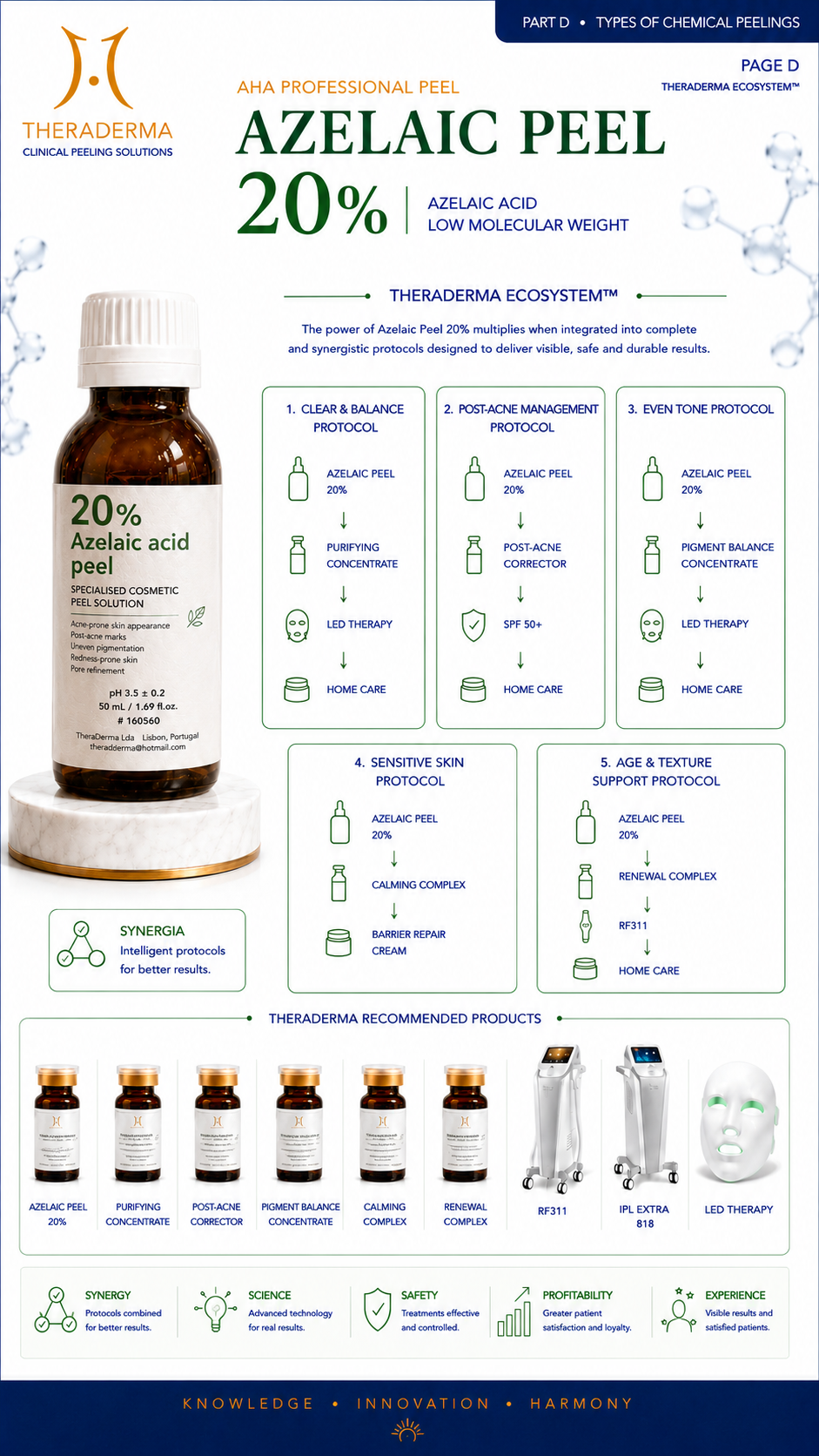
Azelaic Peel 20%
Blemish control, balance for acne-prone skin and progressive improvement in skin tone uniformity.
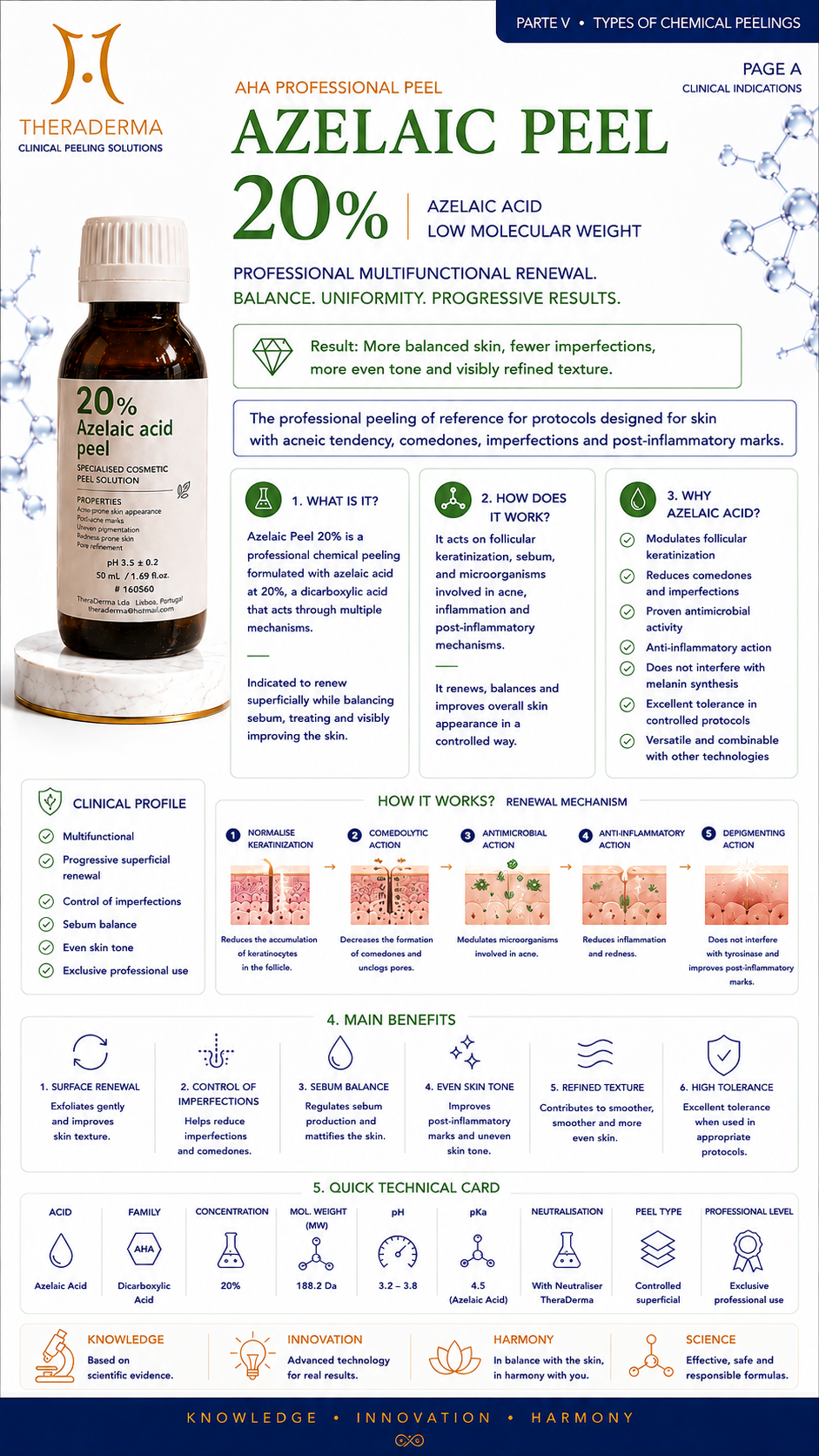
Azelaic Peel 20% TherapDerma is a professional chemical peel formulated with 20% Azelaic Acid, a dicarboxylic acid with follicular keratinisation-modulating, comedolytic, antimicrobial, anti-inflammatory and pigmentation-modulating activity. Its profile makes it a particularly relevant tool within professional protocols aimed at acne-prone, seborrhoeic skin, skin prone to blemishes and post-inflammatory pigmentation alterations.
Unlike peels whose main objective is simply to increase exfoliation, Azelaic Acid presents a multifunctional profile: it contributes to normalising follicular keratinisation, reducing comedone formation, modulating the activity of microorganisms involved in acne, reducing inflammatory processes and acting on mechanisms related to hyperpigmentation.
This combination makes it possible to address several components frequently present in acne-prone skin at the same time: excess sebum, follicular obstruction, inflammation, blemishes and residual pigmentation.
Azelaic Peel 20% is integrated into the TherapDerma Clinical Ecosystem™ as a tool designed to form part of structured and personalised therapeutic strategies, selected according to the patient’s diagnosis and skin condition.
What makes Azelaic Peel 20% different?
Not all chemical peels have intense exfoliation as their main objective.
The differential value of Azelaic Acid lies precisely in the fact that its activity is not limited to superficial renewal. Its clinical interest derives from the combination of different biological mechanisms that allow intervention on factors associated with acne-prone skin and certain pigmentation alterations.
Azelaic Peel 20% is particularly interesting when the professional objective is to develop a superficial renewal strategy associated with blemish control and the progressive improvement of skin uniformity.
Its profile allows it to be positioned as a functional peel within protocols in which the priority is not simply to exfoliate, but to act rationally on skin with an acne-prone, inflammatory or seborrhoeic tendency, or with post-inflammatory pigmentation.
________________________________________
What is Azelaic Acid?
Azelaic Acid is a saturated nine-carbon dicarboxylic acid naturally present in small amounts and which can also originate through the metabolism of fatty acids by microorganisms present on the skin. For cosmetic and dermatological applications, Azelaic Acid obtained through controlled industrial processes is used.
Its dermatological interest is related to several complementary mechanisms of action.
It acts on follicular keratinisation, helping to reduce the abnormal accumulation of keratinocytes that promotes comedone formation.
It also has antimicrobial activity against microorganisms associated with acne and anti-inflammatory properties related, among other mechanisms, to the reduction of reactive oxygen species generated during the inflammatory process.
In the field of pigmentation, Azelaic Acid may interfere with the activity of tyrosinase, a key enzyme in melanin synthesis, which explains its interest in protocols aimed at certain forms of hyperpigmentation, especially when there is a post-inflammatory component.
This combination of actions explains why Azelaic Acid occupies a particular position among the acids used in dermatology and aesthetic medicine.
________________________________________
When to choose Azelaic Peel 20%?
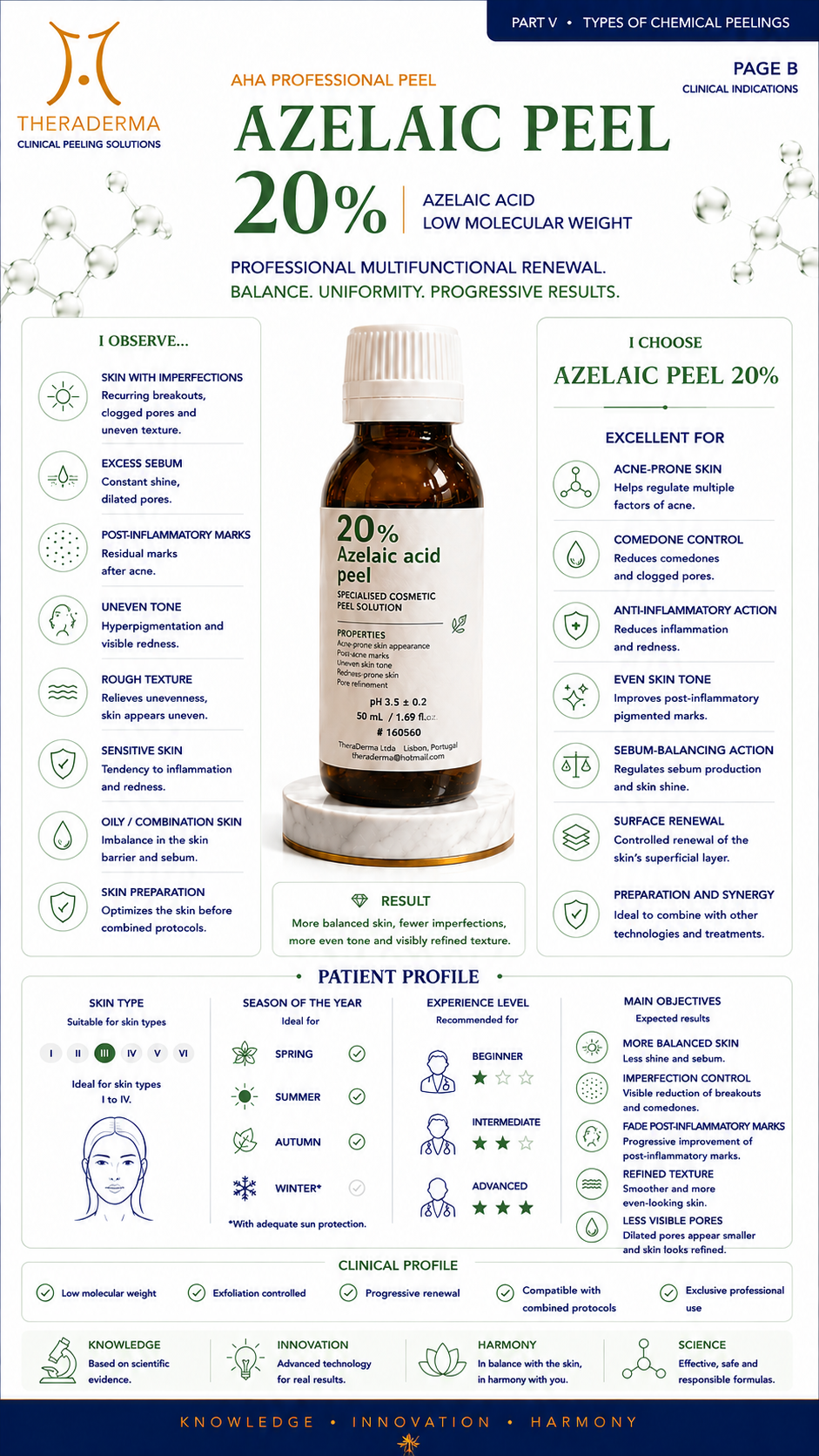
Azelaic Peel 20% may be considered when professional assessment identifies skin in which alterations related to keratinisation, oiliness, blemishes, inflammation or residual pigmentation coexist.
It may be incorporated into personalised protocols aimed at:
• acne-prone skin;
• oily or seborrhoeic skin;
• comedonal tendency and clogged pores;
• recurrent blemishes;
• post-inflammatory hyperpigmentation associated with acne;
• uneven skin tone associated with pigmentation alterations;
• skin prone to inflammation and redness, when clinically indicated;
• certain correctly selected sensitive skin types;
• professional blemish-control and progressive tone-evening programmes.
Patient selection must be carried out through individualised assessment, differentiating between conditions suitable for aesthetic treatment and dermatological situations requiring medical diagnosis or follow-up.
________________________________________
Positioning within the TherapDerma Clinical Ladder™
At TherapDerma, the concentration of a peel is not interpreted as an isolated measure of potency or as an automatic indicator of clinical superiority.
Selection must simultaneously consider the acid used, its concentration, the formulation, the condition of the skin barrier, the clinical condition, individual tolerance and the therapeutic objective.
Within this logic, Azelaic Peel 20% occupies a specialised position in protocols aimed at the management of acne-prone and seborrhoeic skin, blemishes and post-inflammatory hyperpigmentation, providing an alternative to peels primarily intended for rejuvenation or general epidermal renewal.
Its selection should respond to the diagnosis and not simply to the intensity of exfoliation intended to be achieved.
________________________________________
TherapDerma Philosophy
At TherapDerma, we understand chemical peeling as a tool within a clinical strategy and not as a treatment defined exclusively by a percentage of acid.
In acne-prone or reactive skin, indiscriminately increasing exfoliation intensity may compromise the skin barrier and worsen inflammation. Therefore, the strategy must be established according to the predominant pathophysiology and the skin’s individual capacity for recovery.
Azelaic Peel 20% is integrated into the TherapDerma Clinical Ecosystem™ following this principle: diagnose first, select the appropriate mechanism and then build the professional protocol around the real needs of the skin.
________________________________________
TherapDerma Conclusion
Azelaic Peel 20% is a professional tool particularly differentiated by the multifunctional nature of Azelaic Acid.
Its interest does not lie solely in producing superficial renewal, but in combining actions on follicular keratinisation, acne-related blemishes, inflammatory processes and certain pigmentation mechanisms, making it possible to address skin conditions that frequently occur simultaneously.
Within a correctly indicated professional strategy, Azelaic Peel 20% makes it possible to develop protocols aimed at progressively restoring more balanced skin, with fewer blemishes and a more visually uniform appearance, while maintaining individualised patient selection as a fundamental principle.
Clinical Benefits
Blemish control, regulation of keratinisation and progressive improvement in skin uniformity within personalised professional protocols
Azelaic Peel 20% TherapDerma has been developed for integration into professional protocols aimed at acne-prone skin, oiliness, keratinisation alterations and post-inflammatory hyperpigmentation, when individual assessment confirms its indication.
Azelaic Acid has a particularly interesting multifunctional profile because it acts on different mechanisms related to the formation and persistence of blemishes: modulation of follicular keratinisation, antimicrobial activity, anti-inflammatory action and effects on processes related to melanin synthesis. The available clinical evidence on topical Azelaic Acid formulations supports its usefulness in acne and acne-associated post-inflammatory hyperpigmentation.
When incorporated into an individualised protocol, these mechanisms make it possible to develop a progressive strategy aimed at improving skin balance without making intense exfoliation the primary objective of the treatment.
________________________________________
🎯 Control of Acne-Related Blemishes
What does it offer clinically?
Azelaic Acid has comedolytic and keratinisation-modulating activity, mechanisms that are particularly relevant in skin where the accumulation of keratinised cells contributes to follicular obstruction and comedone formation.
Within correctly indicated protocols, this action makes it possible to address one of the fundamental components of acne-prone skin.
Clinical Benefits
✔ Contributes to the progressive reduction of blemishes.
✔ Helps limit comedone formation.
✔ Promotes more balanced follicular keratinisation.
✔ Can be incorporated into professional programmes for acne-prone skin.
________________________________________
🦠 Complementary Antimicrobial Action
What does it offer clinically?
Azelaic Acid has antimicrobial activity against microorganisms associated with acne, including Cutibacterium acnes, formerly known as Propionibacterium acnes. This property complements its action on keratinisation and helps explain its historical use in the topical management of acne.
Clinical Benefits
✔ Provides antimicrobial support within the anti-blemish protocol.
✔ Acts on a biological factor related to the development of acne.
✔ Complements the control of follicular obstruction.
✔ Supports a multifactorial strategy for managing blemishes.
________________________________________
🌿 Modulation of the Inflammatory Response
What does it offer clinically?
The anti-inflammatory activity of Azelaic Acid represents another of its clinically relevant mechanisms. This property is supported by its dermatological use in inflammatory conditions such as acne and papulopustular rosacea.
In correctly selected protocols, it may contribute to progressively improving the appearance of skin where inflammation, redness and blemishes form part of the clinical presentation.
Clinical Benefits
✔ Helps visibly reduce the inflammatory component of blemishes.
✔ May contribute to reducing the appearance of redness associated with certain lesions.
✔ Promotes a more visually balanced complexion.
✔ Complements strategies aimed at the overall management of acne-prone skin.
________________________________________
🌟 Improvement of Post-Inflammatory Hyperpigmentation
What does it offer clinically?
Azelaic Acid has inhibitory activity on tyrosinase, an enzyme involved in melanogenesis. This mechanism helps explain its relevance in post-inflammatory hyperpigmentation, particularly when it occurs as a consequence of acne lesions. Clinical studies using topical formulations at concentrations of 15–20% have shown improvement in acne-associated post-inflammatory pigmentation.
Clinical Benefits
✔ May contribute to progressively reducing the appearance of post-acne pigmented marks.
✔ Promotes greater visual uniformity of skin tone.
✔ Makes it possible to address blemishes and residual pigmentation simultaneously.
✔ Can be integrated into professional strategies for acne-prone skin with PIH.
________________________________________
⚖️ Balance of Oily-Prone Skin
What does it offer clinically?
Scientific literature has described a possible influence of Azelaic Acid on mechanisms related to sebogenesis, although this effect should not be interpreted as a direct or absolute suppression of sebum production.
Within a professional protocol, its main value in oily skin lies in combining the management of keratinisation, blemishes and inflammation within a single strategy.
Clinical Benefits
✔ Promotes a more balanced skin appearance.
✔ May help improve the appearance associated with excess oiliness.
✔ Complements the management of clogged pores and blemishes.
✔ Makes it possible to integrate oily skin into a multifactorial approach.
________________________________________
🔬 Progressive Improvement of Surface Texture
What does it offer clinically?
The regulation of keratinisation and progressive renewal of the skin surface may contribute to the evolution of the skin’s microrelief towards a more uniform appearance.
This benefit is particularly relevant when irregular texture is associated with comedones, superficial corneous build-up or mild residual changes following inflammatory processes.
Clinical Benefits
✔ Promotes a visually more uniform surface.
✔ Contributes to the progressive refinement of skin texture.
✔ Helps reduce the appearance of superficial irregularities.
✔ Improves the overall perception of skin quality.
________________________________________
🎨 Dual Approach: Blemishes + Tone
What does it offer clinically?
One of the most interesting aspects of Azelaic Acid is that it can act simultaneously on acne lesions and on the residual pigmentation they may subsequently leave behind.
This dual benefit has been observed in clinical studies in which topical Azelaic Acid formulations improved both acne and the associated post-inflammatory hyperpigmentation.
Clinical Benefits
✔ Makes it possible to address two common needs within the same programme.
✔ Reduces the need to consider acne and post-inflammatory marks as completely separate concerns.
✔ Promotes a more visually uniform evolution.
✔ Increases the strategic value of the active ingredient within protocols for acne-prone skin.
________________________________________
📈 Progressive Clinical Evolution
The benefits associated with Azelaic Peel 20% should be understood as part of a progressive evolution rather than as the expected result of a single application.
The response will depend on skin type, the intensity and extent of the alterations, the condition of the skin barrier, individual tolerance, home care and the professional strategy selected.
Periodic reassessment makes it possible to determine whether the same approach should be maintained, the protocol adapted or another tool selected within the programme.
________________________________________
CLINICAL SUMMARY
Main Benefits of Azelaic Peel 20%
✔ Progressive control of acne-related blemishes.
✔ Modulation of follicular keratinisation.
✔ Complementary antimicrobial action.
✔ Anti-inflammatory support.
✔ Progressive improvement of post-inflammatory hyperpigmentation.
✔ Greater visual uniformity of skin tone.
✔ Refinement of surface texture.
✔ Overall improvement in skin balance.
✔ Simultaneous approach to blemishes and post-acne marks.
✔ Progressive clinical evolution within personalised protocols.
________________________________________
THERAPDERMA CLINICAL CONCLUSION
The main clinical value of Azelaic Peel 20% lies in its combination of different mechanisms relevant to acne-prone skin: regulation of keratinisation, antimicrobial activity, modulation of inflammation and action on processes related to post-inflammatory hyperpigmentation.
This combination makes it possible to develop professional strategies that are not limited to exfoliating the skin surface, but instead address more comprehensively several alterations that frequently coexist in the same patient.
Integrated within the TherapDerma Clinical Ecosystem™, Azelaic Peel 20% can contribute to a progressive evolution towards skin with fewer blemishes, a more uniform texture and less visible contrast from post-inflammatory marks, always through appropriate patient selection, individualised planning and professional reassessment.
Why Choose Azelaic Peel 20%?
A professional option for protocols targeting acne-prone skin, blemishes and post-inflammatory hyperpigmentation
In professional aesthetic medicine, the choice of a chemical peel should not be based solely on acid concentration, but on the correspondence between the behaviour of the active ingredient, the skin condition and the primary clinical objective.
Azelaic Peel 20% TherapDerma occupies a particularly well-defined position within a professional portfolio because Azelaic Acid combines several mechanisms of interest in acne-prone skin: activity on follicular keratinisation, antimicrobial and anti-inflammatory action, and the ability to act on processes related to post-inflammatory hyperpigmentation. The efficacy of Azelaic Acid at 20% in acne and pigmentary alterations is supported by clinical studies using topical formulations at this concentration.
For this reason, Azelaic Peel 20% may be particularly valuable when the professional needs to develop a progressive superficial strategy for skin in which blemishes, comedones, inflammation and post-inflammatory marks may coexist.
Rather than simply representing “a peel for acne”, it is a tool designed to act on several characteristics that frequently form part of the same skin condition.
________________________________________
WHEN CAN IT BE A SUITABLE OPTION?
Azelaic Peel 20% may be considered when the clinical priority is to progressively address alterations compatible with the functional profile of Azelaic Acid.
It can be incorporated into personalised protocols aimed at:
✔ acne-prone skin;
✔ comedonal or inflammatory acne compatible with a professional superficial strategy;
✔ presence of comedones and follicular obstruction;
✔ recurrent skin blemishes;
✔ post-inflammatory hyperpigmentation associated with acne lesions;
✔ visually uneven skin tone secondary to post-inflammatory marks;
✔ oily-prone skin when blemishes coexist;
✔ irregular texture associated with superficial keratinisation alterations;
✔ professional programmes simultaneously targeting blemish control and visual uniformity of skin tone.
Available evidence shows that Azelaic Acid at 20% can reduce inflammatory and comedonal lesions and improve post-inflammatory hyperpigmentation, although the response will depend on the diagnosis, the specific formulation and the individual characteristics of the skin.
Final selection should always be established following an individualised professional assessment.
________________________________________
WHAT TYPE OF PROFESSIONAL HAS IT BEEN DESIGNED FOR?
Azelaic Peel 20% is intended for professionals who wish to structure protocols for acne-prone skin using a multifactorial approach rather than limiting therapeutic decisions to exfoliation alone.
It is particularly useful in clinics seeking to differentiate between:
• follicular obstruction;
• inflammatory lesions;
• residual post-inflammatory pigmentation;
• superficial texture irregularities;
• visual alterations in skin tone.
Its use requires an understanding of which component represents the priority in each patient, interpretation of the skin response and subsequent determination of whether the same approach should be maintained or another strategy selected.
The objective is not to use Azelaic Peel 20% for every blemish, but to select it when its functional profile provides a genuine advantage over other available options.
________________________________________
THERAPDERMA CLINICAL LADDER™
Each peel addresses a different clinical need
The TherapDerma Clinical Ladder™ does not represent a mandatory progression from a “milder” peel to a “stronger” one.
Each solution should be selected according to:
✔ professional diagnosis;
✔ predominant alteration;
✔ estimated depth of the condition;
✔ condition of the skin barrier;
✔ presence or absence of active inflammation;
✔ individual pigmentation risk;
✔ skin tolerance;
✔ clinical objectives;
✔ response observed throughout the course of treatment.
________________________________________
Azelaic Peel 20%
May be of particular interest when the predominant concerns are:
✔ acne-prone skin;
✔ comedones;
✔ altered follicular keratinisation;
✔ inflammatory blemishes compatible with the procedure;
✔ post-inflammatory hyperpigmentation;
✔ pigmented post-acne marks;
✔ irregular surface texture associated with blemishes;
✔ the need to address lesions and residual pigmentation simultaneously.
Clinical literature on Azelaic Acid at 20% particularly supports its role in comedonal and inflammatory acne and in facial or post-inflammatory hyperpigmentation.
________________________________________
QUICK SELECTION GUIDE
Primary Clinical Objective Option That May Be Considered
Acne-prone skin Azelaic Peel 20%
Comedones / follicular obstruction Azelaic Peel 20%
Correctly selected inflammatory blemishes Azelaic Peel 20%
Pigmented post-acne marks Azelaic Peel 20%
Post-inflammatory hyperpigmentation Azelaic Peel 20%
Blemishes + uneven tone Azelaic Peel 20%
Irregular texture associated with superficial keratinisation Azelaic Peel 20%
Multifactorial strategy for acne-prone skin Azelaic Peel 20%
This guide provides general guidance and does not replace individual assessment, nor does it imply that Azelaic Peel 20% is the appropriate option for all acne-related or pigmentary conditions.
________________________________________
WHY IS ITS PROFILE PARTICULARLY INTERESTING?
Because it helps avoid an overly simplified view of the patient with acne.
In many cases, the patient does not present with a single alteration. The following may coexist:
COMEDONE
+
INFLAMMATION
+
POST-INFLAMMATORY MARK
+
IRREGULAR TEXTURE
+
UNEVEN TONE
Azelaic Acid has mechanisms that may be relevant to several of these components. Its antikeratinising, antimicrobial and anti-inflammatory activity is well described, and its clinical usefulness in acne has been demonstrated in controlled studies using 20% formulations.
This characteristic makes Azelaic Peel 20% a particularly logical choice when the professional needs to address a multifactorial skin profile without reducing the entire strategy to “more exfoliation”.
________________________________________
WHEN IS IT NOT THE MOST LOGICAL CHOICE?
Choosing correctly also means recognising when another procedure may better address the primary objective.
Azelaic Peel 20% should not be selected automatically when the predominant need is:
✔ more intensive resurfacing;
✔ a pigmentary alteration whose depth exceeds the scope of a superficial strategy;
✔ a structural scar requiring a different mechanism of action;
✔ a skin condition whose clinical status makes the procedure unsuitable;
✔ a need better suited to the profile of another TherapDerma peel.
Selection should be driven by diagnosis, not by product availability.
________________________________________
THERAPDERMA CLINICAL CONCLUSION
Azelaic Peel 20% represents a particularly differentiated tool when the skin presents a combination of acne tendency, keratinisation alterations, inflammation and residual post-inflammatory pigmentation.
Its value lies not only in its 20% concentration, but in the multifunctional profile of Azelaic Acid and in the possibility of selecting a single tool when several interrelated characteristics form part of the same skin condition.
Within the TherapDerma Clinical Ladder™, it therefore occupies a specific position for strategies targeting acne-prone skin and the progressive improvement of associated post-inflammatory marks.
As part of the TherapDerma Clinical Ecosystem™, it should be selected on the basis of one simple but essential question:
Do the mechanisms of Azelaic Acid genuinely address the clinical priority of this skin?
When the answer is yes, Azelaic Peel 20% ceases to be simply “another peel for acne” and becomes an evidence-based professional choice.
Areas of Application
One peel. Different clinical possibilities depending on the anatomical area, diagnosis and distribution of skin alterations.
Azelaic Peel 20% TherapDerma can be integrated into superficial professional protocols targeting anatomical areas where alterations compatible with the functional profile of Azelaic Acid are present, particularly acne-prone skin, comedones, correctly selected inflammatory blemishes and post-inflammatory hyperpigmentation.
The area should not be selected simply because oiliness or a visible alteration in skin tone is present. There must be correspondence between the diagnosis, the depth of the alteration, the condition of the skin and the objective defined for the procedure.
Published clinical experience with Azelaic Acid at 20% is concentrated mainly on the face and on areas affected by acne such as the face, chest and back. There is also specific evidence relating to facial hyperpigmentation and facial papulopustular rosacea with topical 20% formulations.
This does not mean that a topical formulation used in clinical studies is automatically equivalent to Azelaic Peel 20%. Therefore, use of the peel in each region must always comply with its specific technical documentation and professional assessment.
________________________________________
FACE
The main area of professional application
The face represents the area of greatest interest for Azelaic Peel 20% due to the frequency with which acne-prone skin, comedones, inflammatory lesions, post-inflammatory marks and visual alterations in skin tone may coexist.
Clinical evidence with Azelaic Acid at 20% demonstrates activity on inflammatory and non-inflammatory acne lesions, as well as results in facial hyperpigmentation.
When professionally indicated, Azelaic Peel 20% may be incorporated into facial protocols targeting:
✔ acne-prone skin;
✔ comedones and follicular obstruction;
✔ correctly selected inflammatory blemishes;
✔ post-inflammatory hyperpigmentation;
✔ pigmented post-acne marks;
✔ irregular surface texture associated with blemishes;
✔ visually uneven skin tone related to superficial marks.
The periocular region, lips, mucous membranes and any area with impaired skin integrity must be excluded in accordance with the precautions applicable to the procedure.
________________________________________
FOREHEAD, NOSE AND CHIN
Areas where the distribution of comedones may influence the strategy
In some patients, acneiform alterations are not distributed evenly across the entire face.
The forehead, nose and chin may present a higher concentration of comedones, follicular obstruction or superficial blemishes and may therefore require specific regional assessment within the facial protocol.
Azelaic Acid has demonstrated effects on follicular keratinisation and a reduction in comedonal lesions in clinical studies, without demonstrating a specific reduction in the rate of sebum excretion.
Therefore, in these areas the professional objective should focus on:
✔ progressively improving follicular obstruction;
✔ promoting superficial normalisation of keratinisation;
✔ reducing the appearance of blemishes;
✔ improving texture associated with comedones;
and not on presenting the procedure simply as a strategy intended to “remove oil”.
________________________________________
CHEEKS AND REGIONS WITH POST-INFLAMMATORY MARKS
When the active lesion and the residual mark are not the same problem
The cheeks may simultaneously present acne lesions, residual erythema, post-inflammatory hyperpigmentation and texture alterations.
This coexistence requires differentiation of which alteration is intended to be addressed and its depth.
Azelaic Acid at 20% has clinical evidence supporting improvement in facial hyperpigmentation and may be particularly interesting when pigmentary alterations are associated with previous inflammatory processes.
When indicated, the protocol may be aimed at:
✔ visually improving superficial pigmented marks;
✔ promoting greater uniformity of skin tone;
✔ simultaneously addressing blemishes compatible with superficial treatment;
✔ progressively improving the overall appearance of the area.
Structural atrophic scars should not be confused with post-inflammatory pigmented marks, as they require a different assessment and therapeutic strategy.
________________________________________
CHEST
A possible area of application when truncal acne is present
Acne is not limited to the face. The chest may present inflammatory lesions, comedones and residual marks that require a specific strategy according to their extent and characteristics.
In a clinical study of Azelaic Acid at 20% in adult women with acne, the evolution of lesions located on the face, chest and back was assessed, with improvement also observed in truncal areas.
Therefore, Azelaic Peel 20% may be considered on localised areas of the chest when a compatible indication exists and the professional product documentation allows its use in that region.
It may be considered particularly in cases of:
✔ localised acne tendency;
✔ comedones;
✔ superficial blemishes;
✔ post-inflammatory pigmented marks.
The total treated surface area must be carefully individualised.
________________________________________
BACK
A particularly relevant region in patients with body acne
The back is another common location for acne and may present a combination of inflammatory lesions, comedones and residual pigmentation.
Clinical evidence with Azelaic Acid at 20% includes patients assessed for facial, chest and back acne, with improvement also observed on the back.
When the condition of the skin and the extent of the lesions allow, Azelaic Peel 20% may be considered within professional protocols aimed at:
✔ addressing superficial acneiform blemishes;
✔ improving the appearance of comedones;
✔ progressively promoting a more uniform texture;
✔ addressing superficial post-inflammatory pigmented marks.
In extensive body areas, the total amount of product, the surface area treated and the skin response become particularly important and should not be automatically extrapolated from a facial protocol.
________________________________________
FACIAL ROSACEA: A SITUATION REQUIRING DIFFERENTIATION
Azelaic Acid has clinical evidence in papulopustular rosacea, particularly in relation to inflammatory lesions and erythema.
However, this evidence relates mainly to topical Azelaic Acid formulations and should not be automatically transferred to a professional chemical peel.
Therefore, the presence of rosacea should not be interpreted as automatic authorisation to apply Azelaic Peel 20%.
Before considering the procedure, particular attention should be given to:
✔ rosacea subtype and stability;
✔ presence of active inflammation;
✔ skin barrier function;
✔ level of reactivity;
✔ integrity of the skin surface;
✔ individual tolerance;
✔ compatibility with the specific technical instructions for the peel.
This distinction avoids confusing evidence relating to the active ingredient with an automatic indication for a specific exfoliating formulation.
________________________________________
CLINICAL GUIDANCE BY AREA
Anatomical Area Main Clinical Objective Clinical Observations
Face Blemishes, comedones, post-inflammatory marks and uneven tone. Main area of use; adapt application to the distribution of the alterations.
Forehead / nose / chin Follicular obstruction and comedones. Do not automatically interpret the objective as direct reduction of sebum production.
Cheeks Blemishes + superficial post-inflammatory hyperpigmentation. Differentiate pigmented marks from structural scars.
Chest Body acne and superficial residual marks. Carefully adjust the treated area and total amount of product.
Back Truncal acne, comedones and post-inflammatory pigmentation. The treated body surface requires specific planning.
Facial rosacea Only when the specific situation is compatible with the procedure. Evidence relating to topical Azelaic Acid does not automatically constitute an indication for a peel.
________________________________________
REGIONAL DISTRIBUTION OF LESIONS
The same person may require different strategies in different areas.
For example:
FACE
comedones + inflammatory lesions + post-inflammatory marks
while
BACK
may mainly present inflammatory lesions and residual pigmentation.
The professional should not assume that all regions must receive exactly the same application simply because they belong to the same patient.
The decision should independently consider:
✔ predominant lesion type;
✔ extent;
✔ skin integrity;
✔ inflammatory response;
✔ residual pigmentation;
✔ regional sensitivity;
✔ observed tolerance.
________________________________________
MULTI-AREA PROTOCOLS
When compatible alterations are present in more than one anatomical region, a multi-area strategy may be considered provided it is contemplated within the professional instructions for the product.
Simultaneous or sequential use on the face, chest or back should be planned taking into account the total exposed surface area, the amount applied and the ability to adequately observe the response of each region.
In certain patients, it may be more reasonable to treat the areas in phases:
AREA 1
↓
OBSERVATION AND RECOVERY
↓
REASSESSMENT
↓
AREA 2
This methodology makes it possible to assess tolerance more precisely before increasing the extent of treatment.
________________________________________
CLINICAL CONSIDERATIONS
Before selecting any area for Azelaic Peel 20%, it must be confirmed that the identified alteration is compatible with superficial treatment and that the skin is in suitable condition to receive a chemical procedure.
It should not be applied automatically to every region presenting acne, pigmentation or redness.
Each area should be assessed according to:
✔ diagnosis;
✔ lesion type;
✔ extent;
✔ skin integrity;
✔ presence of inflammation;
✔ sensitivity;
✔ risk of pigmentary response;
✔ previous treatments;
✔ expected recovery.
Particularly in extensive body areas, planning should avoid directly extrapolating the quantities and exposure times used on the face.
________________________________________
QUICK SUMMARY
Azelaic Peel 20% may be considered primarily within professional protocols targeting:
✔ the face;
✔ facial areas with a concentration of comedones;
✔ facial regions with post-inflammatory marks;
✔ the chest when compatible body acne is present;
✔ the back when compatible body acne is present.
Priority objectives according to the region:
✔ acneiform blemishes;
✔ comedones and follicular obstruction;
✔ associated superficial texture alterations;
✔ post-inflammatory hyperpigmentation;
✔ residual pigmented marks;
✔ visual uniformity of skin tone.
The anatomical area alone never constitutes an indication.
The indication arises from the combination of area + alteration + skin condition + professional objective.
________________________________________
THERAPDERMA CONCLUSION
Azelaic Peel 20% has a particularly coherent application in regions affected by acne tendency and by the residual alterations that frequently accompany the process, particularly the face, chest and back.
Its professional relevance increases when the selection of each area responds to the predominant lesion type rather than to a standardised body or facial protocol.
Available evidence on Azelaic Acid at 20% supports its topical use in facial and truncal acne, facial hyperpigmentation and papulopustular rosacea; however, these data should not be used to automatically assume that every exfoliating formulation at 20% shares exactly the same indications or conditions of use.
Within the TherapDerma Clinical Ecosystem™, the fundamental principle is simple:
do not decide first where to apply the peel; first identify what alteration is present in that area and whether Azelaic Peel 20% is genuinely the appropriate tool to address it.
TAB 5
How Does It Work?
Understanding the biological process makes it possible to plan more precise protocols
Although Azelaic Peel 20% TherapDerma is applied for a limited period of time, the skin response associated with the procedure continues to evolve after application.
Its action should not be understood solely as exfoliation. Azelaic Acid has a particularly interesting profile because it combines activity on follicular keratinisation, action against microorganisms involved in acne, modulation of inflammatory processes and activity on melanogenesis.
This combination makes it possible to act on different mechanisms related to acne-prone skin and post-inflammatory hyperpigmentation, while maintaining a superficial and progressive action within correctly indicated professional protocols.
Understanding these mechanisms allows the professional to better interpret the evolution of lesions, differentiate the inflammatory response from the pigmentary response and decide when to continue, adapt or modify the protocol.
________________________________________
IT ALL BEGINS AT THE SKIN SURFACE AND WITHIN THE PILOSEBACEOUS UNIT
In acne-prone skin, the problem is not limited to the visible presence of oil or inflammatory lesions.
Altered follicular keratinisation may promote the accumulation of cells within the pilosebaceous duct and contribute to the formation of microcomedones and comedones.
At the same time, the proliferation of Cutibacterium acnes and the associated inflammatory response contribute to the development of certain acne lesions.
Azelaic Acid is particularly interesting because it can act on several of these components, helping to normalise keratinisation and reduce factors related to microbial proliferation and inflammation.
When post-inflammatory hyperpigmentation is also present, its activity on tyrosinase adds a second relevant mechanism within the same professional strategy.
________________________________________
STEP 1
Progressive normalisation of follicular keratinisation
Azelaic Acid has comedolytic activity and helps normalise altered keratinisation processes within the follicle.
This action may promote a progressive reduction in follicular obstruction and contribute to the management of non-inflammatory lesions such as comedones.
The objective is not simply to “remove oil” from the surface.
It is to act on one of the mechanisms involved in the formation of acne-related blemishes.
This action may contribute to:
✔ progressively reducing follicular obstruction;
✔ promoting more balanced keratinisation;
✔ improving the appearance of comedones;
✔ progressively refining texture associated with blemishes.
________________________________________
STEP 2
Antimicrobial action on acne-prone skin
Azelaic Acid has antimicrobial and bacteriostatic activity against microorganisms related to the development of acne, including Cutibacterium acnes.
This action helps create an environment that is less favourable to microbial proliferation associated with certain acne lesions.
Unlike a strategy based exclusively on exfoliating the surface, this mechanism makes it possible to address another relevant component of acne pathophysiology.
It may contribute to:
✔ reducing microbial factors associated with blemishes;
✔ supporting professional protocols for acne-prone skin;
✔ progressively promoting more balanced skin;
✔ complementing the action on follicular obstruction.
________________________________________
STEP 3
Modulation of the inflammatory response
Inflammation is a fundamental component of many acne lesions and may subsequently contribute to the appearance of erythema and residual pigmentary alterations.
Azelaic Acid has anti-inflammatory properties related, among other mechanisms, to the reduction of reactive oxygen species produced by inflammatory cells.
Within a correctly selected protocol, this activity may help progressively reduce the visible expression of certain inflammatory blemishes and promote a more balanced skin appearance.
It may contribute to:
✔ modulating inflammatory processes associated with acne;
✔ progressively improving the appearance of redness linked to blemishes;
✔ supporting skin comfort in correctly selected patients;
✔ reducing the cascade that may contribute to the subsequent development of post-inflammatory marks.
________________________________________
STEP 4
Regulation of melanogenesis and post-inflammatory hyperpigmentation
After an inflammatory lesion, some patients develop increased melanin production that may remain visible even once the acne lesion has resolved.
Azelaic Acid may interfere with melanogenesis through inhibition of tyrosinase, a key enzyme in melanin synthesis.
This action explains its particular interest within strategies aimed at post-inflammatory hyperpigmentation.
With progressive evolution, it may contribute to:
✔ visually improving post-inflammatory pigmented marks;
✔ promoting a more uniform appearance of skin tone;
✔ progressively reducing the visibility of certain superficial pigmentary alterations;
✔ integrating the management of blemishes and some of their pigmentary consequences within the same strategy.
Post-inflammatory pigmented marks should not be confused with atrophic or hypertrophic scars, whose mechanisms and management are different.
________________________________________
STEP 5
Progressive evolution of blemishes and professional reassessment
The evolution of acne-prone skin should not be assessed solely immediately after the procedure.
Comedones, inflammatory lesions, texture and post-inflammatory hyperpigmentation may respond at different rates.
For this reason, reassessment should analyse separately:
✔ evolution of inflammatory lesions;
✔ evolution of comedones;
✔ appearance of new blemishes;
✔ response of post-inflammatory marks;
✔ visual uniformity of skin tone;
✔ skin tolerance;
✔ integrity of the skin barrier;
✔ recovery between procedures.
Continuation of the protocol should never be automatic.
Each new application should be decided according to the observed response and the clinical objective that remains the priority.
________________________________________
WHY IS ITS MECHANISM PARTICULARLY INTERESTING IN ACNE-PRONE SKIN?
Because acne is multifactorial.
A strategy focused exclusively on exfoliation may not take into account all the mechanisms involved.
The profile of Azelaic Acid allows action on different relevant components:
FOLLICULAR KERATINISATION
↓
OBSTRUCTION / COMEDONES
+
ANTIMICROBIAL ACTIVITY
↓
MICROBIAL FACTORS ASSOCIATED WITH ACNE
+
INFLAMMATORY MODULATION
↓
INFLAMMATORY LESIONS
+
TYROSINASE INHIBITION
↓
POST-INFLAMMATORY HYPERPIGMENTATION
This multifunctional action is one of the main reasons why Azelaic Acid occupies a specific position within professional protocols for acne-prone skin.
________________________________________
A DIFFERENT RESPONSE IN EVERY PATIENT
The response to Azelaic Peel 20% may vary considerably between patients even when they present apparently similar alterations.
Factors such as the type and severity of the lesions, inflammatory activity, integrity of the skin barrier, phototype, presence of post-inflammatory hyperpigmentation, treatments previously used and adherence to home care may modify the evolution.
For this reason, the professional should interpret each response individually and avoid using an intense visible reaction as an indicator of efficacy.
Greater irritation or peeling does not necessarily mean a better clinical response.
The objective is to achieve progressive improvement in the identified alterations while maintaining an appropriate balance between efficacy, tolerance and skin recovery.
________________________________________
SEQUENCE OF THE BIOLOGICAL PROCESS
AZELAIC PEEL 20%
↓
Superficial action
↓
Progressive normalisation of follicular keratinisation
↓
Reduction of obstruction and comedonal blemishes
↓
Antimicrobial activity + inflammatory modulation
↓
Progressive evolution of acne lesions
↓
Tyrosinase inhibition when a pigmentary component is present
↓
Progressive improvement of post-inflammatory hyperpigmentation
↓
Professional reassessment
↓
Progressive optimisation of Skin Quality
________________________________________
KEY MECHANISMS
Azelaic Peel 20% may act through different complementary mechanisms:
✔ normalisation of follicular keratinisation;
✔ comedolytic action;
✔ antimicrobial activity;
✔ modulation of inflammatory processes;
✔ tyrosinase inhibition;
✔ progressive improvement in the appearance of post-inflammatory hyperpigmentation;
✔ progressive refinement of texture associated with blemishes;
✔ greater visual uniformity of skin tone;
✔ progressive optimisation of Skin Quality.
The relative importance of each mechanism will depend on the predominant concern in each patient.
________________________________________
THERAPDERMA CONCLUSION
Understanding how Azelaic Peel 20% works allows the professional to move beyond the simplified concept of exfoliation and develop protocols targeting specific mechanisms involved in acne-prone skin and post-inflammatory hyperpigmentation.
Its functional profile combines normalisation of follicular keratinisation, antimicrobial activity, inflammatory modulation and action on melanogenesis, making it possible to progressively address different components that may coexist in the same patient.
This combination is particularly relevant because an acne lesion and the pigmented mark that may remain after its resolution represent different phases of the same clinical process and may require different timescales of evolution.
Integrated within the TherapDerma Clinical Ecosystem™, Azelaic Peel 20% makes it possible to structure progressive strategies based on lesion assessment, biological response, recovery of skin barrier function and periodic reassessment.
Understanding these mechanisms makes it possible to decide not only when to perform the procedure, but also which variable should be observed afterwards to determine the next professional decision.
Mechanism of Action
The molecular science that explains why Azelaic Acid acts on different components of acne-prone and pigment-prone skin
The mechanism of action of Azelaic Peel 20% TherapDerma should be interpreted based on the biological properties of Azelaic Acid as a dicarboxylic acid and not solely through the classic logic of chemical exfoliation.
Azelaic Acid has different documented biological activities on keratinocytes, microorganisms associated with acne, inflammatory mediators and processes related to melanogenesis. This multiplicity of mechanisms explains its relevance in skin where altered keratinisation, comedones, inflammatory lesions and post-inflammatory hyperpigmentation may coexist.
From a scientific perspective, its true value lies precisely in acting on different processes involved in the pathophysiology of these skin alterations.
________________________________________
CHEMICAL NATURE OF AZELAIC ACID
A dicarboxylic acid with its own biological behaviour
Azelaic Acid is a saturated nine-carbon dicarboxylic acid.
Its chemical identity differentiates it from families such as Alpha Hydroxy Acids (AHA), Beta Hydroxy Acids (BHA) or Polyhydroxy Acids (PHA), and its behaviour should therefore not be directly extrapolated from the characteristic mechanisms of these other families.
Its cutaneous activity is related to different cellular and enzymatic effects that include:
✔ modulation of keratinocyte proliferation and differentiation;
✔ antikeratinising action;
✔ antimicrobial activity;
✔ interference with certain oxidoreductase enzymes;
✔ modulation of inflammatory and oxidative processes;
✔ interference with mechanisms related to melanogenesis.
Therefore, Azelaic Peel 20% should not be interpreted simply as an acid that removes superficial cells.
________________________________________
MODULATION OF FOLLICULAR KERATINISATION
Acting on one of the mechanisms that promotes comedone formation
The pilosebaceous unit has a specific keratinisation process. When the proliferation, differentiation and shedding of follicular keratinocytes become altered, corneous material may accumulate and contribute to microcomedone formation.
Azelaic Acid has antikeratinising activity and antiproliferative effects on keratinocytes. Experimental and clinical studies have shown modifications in epidermal differentiation and normalisation of certain keratinisation patterns in acne-prone skin treated with Azelaic Acid.
From a pathophysiological perspective, this means that its action does not simply consist of removing cells that have already accumulated.
It may contribute to modifying the process through which that accumulation develops.
This mechanism is particularly relevant in:
MICROCOMEDONE
↓
ALTERED KERATINISATION
↓
ACCUMULATION OF CORNEOUS MATERIAL
↓
FOLLICULAR OBSTRUCTION
Intervention in this sequence constitutes one of the scientific foundations of its relevance in comedone-prone skin.
________________________________________
EFFECTS ON CELLULAR METABOLISM
The activity of Azelaic Acid reaches intracellular biochemical processes
Scientific literature describes the ability of Azelaic Acid to interfere with certain mitochondrial and microsomal oxidoreductases and with processes related to cellular metabolism and proliferation.
These effects help explain its cytostatic activity on keratinocytes and certain microorganisms, as well as part of its biological behaviour on metabolically active cells.
The professional significance of this mechanism does not lie in attempting to produce cellular damage.
It lies in understanding that the action of Azelaic Acid is biochemically more complex than simple superficial exfoliation.
________________________________________
ANTIMICROBIAL ACTIVITY
Interference with one of the biological components associated with acne
Azelaic Acid has antimicrobial activity against aerobic and anaerobic microorganisms and has demonstrated activity against Cutibacterium acnes, historically known as Propionibacterium acnes.
This activity forms part of a multifactorial mechanism.
It should not be interpreted in isolation as though acne were simply a bacterial infection.
Its relevance lies in the fact that Azelaic Acid can act simultaneously on:
FOLLICULAR KERATINISATION
+
MICROBIAL MICROENVIRONMENT
+
INFLAMMATORY RESPONSE
This combination helps explain why the active ingredient has a different positioning from an exfoliant whose primary function is simply to renew the epidermal surface.
________________________________________
MODULATION OF INFLAMMATORY AND OXIDATIVE PROCESSES
Inflammation is not merely a visible consequence of the acne lesion
Azelaic Acid has anti-inflammatory and antioxidant activity associated with different cellular mechanisms.
These include a reduction in the generation of reactive oxygen species by neutrophils and modulation of pathways related to the inflammatory response.
This mechanism is particularly relevant because inflammation may participate both in the evolution of the acne lesion and in the subsequent development of residual alterations.
INFLAMMATION
↓
SKIN LESION
↓
POST-INFLAMMATORY RESPONSE
↓
POSSIBLE RESIDUAL ALTERATION IN SKIN TONE
Therefore, acting on the inflammatory component forms part of a broader strategy than simply treating the visible lesion.
________________________________________
INTERACTION WITH MELANOGENESIS
A specific mechanism that explains its relevance in pigmentary alterations
Melanogenesis is a complex biochemical process through which melanocytes synthesise melanin.
Tyrosinase is one of the essential enzymes in this pathway.
Azelaic Acid has demonstrated the ability to competitively inhibit tyrosinase and may also interfere with other metabolic processes in hyperactive melanocytes. These mechanisms help explain its historical use in certain hyperpigmentation disorders.
This action is particularly relevant when an inflammatory lesion leaves residual pigmentation.
INFLAMMATORY LESION
↓
MELANOGENIC STIMULUS
↓
LOCAL INCREASE IN PIGMENTATION
↓
POST-INFLAMMATORY HYPERPIGMENTATION
↓
PROGRESSIVE MODULATION THROUGH AN APPROPRIATE STRATEGY
Not all pigmentary alterations respond to the same mechanism or occur at the same depth. Therefore, the antimelanogenic activity of Azelaic Acid does not make Azelaic Peel 20% a universal solution for every form of hyperpigmentation.
________________________________________
DOES IT ACT DIRECTLY ON SEBUM PRODUCTION?
An important scientific distinction
Azelaic Acid is frequently used in oily and acne-prone skin, but this does not mean that its main clinically demonstrated mechanism consists of directly reducing sebum production.
A study carried out with Azelaic Acid at 20% did not observe significant changes in the sebum excretion rate, sebum composition or sebaceous gland size, while relevant changes in epidermal keratinisation were identified.
Therefore, scientifically, it is more accurate to position its effect on oily skin around:
NORMALISATION OF KERATINISATION
+
ANTICOMEDOGENIC ACTIVITY
+
ANTIMICROBIAL ACTIVITY
+
INFLAMMATORY MODULATION
rather than simply stating that it “reduces oil production”.
This distinction is important in order to maintain the scientific rigour of the TherapDerma catalogue.
________________________________________
CONCENTRATION AND SKIN RESPONSE
20% is a formulation parameter. It does not determine the clinical response on its own.
Azelaic Peel contains Azelaic Acid at 20%.
However, the response to a professional peel cannot be inferred solely from this percentage.
Other variables also play a role, including:
✔ complete formulation;
✔ vehicle;
✔ availability of the active ingredient;
✔ amount applied;
✔ contact time;
✔ treated area;
✔ prior skin preparation;
✔ integrity of the skin barrier;
✔ level of inflammatory activity present;
✔ individual sensitivity;
✔ phototype;
✔ treatments previously used.
The documentation provided for Azelaic Peel 20% does not specify a pH or pKa value for the formulation.
Therefore, these parameters should not be invented or extrapolated from other Azelaic Acid products.
The specific formulation should be interpreted only on the basis of the technical data officially available for this product.
________________________________________
SCIENCE AT A GLANCE™
Parameter Azelaic Peel 20%
Active ingredient Azelaic Acid
Concentration 20%
Chemical family Dicarboxylic acid
Declared level of action Superficial
Mechanism on keratinocytes Modulation of proliferation, differentiation and keratinisation
Follicular activity Antikeratinising and anticomedogenic
Microbiological activity Action against microorganisms associated with acne
Inflammatory activity Modulation of inflammatory and oxidative processes
Pigmentary activity Interference with melanogenesis processes, including tyrosinase
Priority clinical profile Correctly selected acne-prone skin, comedones and post-inflammatory hyperpigmentation
Professional purpose To act on different components of a multifactorial skin condition
________________________________________
BIOLOGICAL BASIS
The scientific relevance of Azelaic Acid lies in the fact that different mechanisms may converge within the same patient.
Acne-prone skin may simultaneously present:
FOLLICULAR HYPERKERATINISATION
+
COMEDONES
+
ALTERATION OF THE MICROBIAL MICROENVIRONMENT
+
INFLAMMATION
+
POST-INFLAMMATORY HYPERPIGMENTATION
Azelaic Acid has biological mechanisms that are relevant at several of these stages.
This characteristic helps explain why its true positioning lies not solely in exfoliation, but in its ability to form part of a strategy targeting a multifactorial skin condition.
________________________________________
SCIENTIFIC PRINCIPLES OF USE
Professional interpretation of Azelaic Peel 20% should take into account that:
✔ Azelaic Acid is a dicarboxylic acid and not an AHA, BHA or PHA;
✔ its mechanism does not depend solely on superficial exfoliation;
✔ normalisation of keratinisation is one of its fundamental mechanisms in acne-prone skin;
✔ its antimicrobial activity complements, but does not replace, the other mechanisms involved in acne;
✔ inflammatory modulation forms part of its functional profile;
✔ its activity on melanogenesis explains its relevance in certain pigmentary alterations;
✔ oily skin does not automatically mean that the active ingredient acts by directly reducing sebaceous secretion;
✔ the 20% concentration alone does not allow the response of a professional formulation to be predicted;
✔ evidence relating to topical Azelaic Acid should not be automatically extrapolated to every peeling protocol;
✔ the final response always depends on correct patient selection, the formulation and professional execution.
________________________________________
THERAPDERMA CONCLUSION
Understanding the mechanism of action of Azelaic Peel 20% makes it possible to understand why Azelaic Acid occupies a distinctive position within a professional peel portfolio.
Its activity is not limited to producing superficial renewal. It acts on processes related to follicular keratinisation, the microbial microenvironment, inflammation and melanogenesis, four dimensions that may simultaneously participate in the evolution of acne-prone skin and in the alterations that remain after lesions resolve.
This scientific interpretation prevents Azelaic Peel 20% from being reduced to simplified commercial concepts such as “peel for oily skin” or “peel for pigmentation”.
Within the TherapDerma Clinical Ecosystem™, its true value lies in selecting an active ingredient whose biological mechanisms correspond to the predominant processes in the skin being assessed.
Because understanding the mechanism makes it possible to draw an essential distinction:
not merely treating what we see on the surface, but selecting the tool according to the processes that help explain why that alteration is present.
Scientific Foundations
Concentration matters. Solubility, pH and the vehicle determine how Azelaic Acid is actually available to interact with the skin.
In a professional chemical peel, the declared percentage of the active ingredient represents only part of the information required to interpret the behaviour of the formulation.
In Azelaic Peel 20% TherapDerma, this consideration is particularly important because Azelaic Acid has its own physicochemical characteristics: it is a dicarboxylic acid, has limited aqueous solubility and its cutaneous availability may be significantly modified according to the pH and vehicle of the formulation. Experimental studies have demonstrated that the skin absorption and penetration of Azelaic Acid show a marked dependence on pH and vehicle. (PubMed)
Therefore, correctly interpreting Azelaic Peel 20% requires considering together:
CONCENTRATION + pH + IONISATION STATE + SOLUBILITY + VEHICLE + PROTOCOL + SKIN
and not only the visible 20% figure.
________________________________________
CONCENTRATION
20% indicates how much Azelaic Acid the formulation contains. It does not determine on its own how it will behave.
Azelaic Peel contains Azelaic Acid at 20% according to the TherapDerma documentation provided.
This concentration defines the nominal amount of active ingredient present, but does not allow isolated prediction of:
✔ how much acid is functionally available;
✔ how it is distributed over the skin surface;
✔ how much may interact with the skin;
✔ what intensity the procedure will have;
✔ what level of tolerance each patient will present.
The final behaviour also depends on physicochemical and technical variables such as pH, vehicle, solubilisation of the active ingredient, amount applied, contact time and the characteristics of the skin.
The existence of 20% topical dermatological formulations confirms that this concentration has a long clinical history for Azelaic Acid, but it does not mean that all 20% formulations are equivalent to one another or that a cream, gel and peel share the same cutaneous behaviour.
________________________________________
THE ROLE OF pH
pH modifies the chemical state of Azelaic Acid and may alter its cutaneous availability
pH is a particularly relevant variable in a formulation containing Azelaic Acid because it influences the balance between the ionised and non-ionised forms of the active ingredient.
In experimental studies of skin penetration, Azelaic Acid formulations with different pH values showed important differences in absorption, flux and cutaneous retention, demonstrating that the behaviour of the active ingredient cannot be interpreted solely from its concentration. (PubMed)
Therefore:
SAME ACID
+
SAME CONCENTRATION
but
DIFFERENT pH
↓
may produce different cutaneous availability.
The documentation currently available for Azelaic Peel 20% TherapDerma provided for this catalogue does not specify the final pH of the formulation.
For scientific rigour, this value should not be invented or extrapolated from other commercial Azelaic Acid formulations.
________________________________________
THE MEANING OF pKa
Understanding when Azelaic Acid changes its ionisation state
Azelaic Acid has two carboxyl groups and therefore two stages of acid–base dissociation.
Experimental values reported for the compound are approximately:
pKa₁ ≈ 4.5
pKa₂ ≈ 5.3
although slight variations may be observed depending on the experimental conditions and the source used. (PubChem)
These values help explain how the proportion between the different ionised forms of Azelaic Acid changes according to the pH of the medium.
However, pKa should not be used in isolation to predict penetration or clinical intensity.
With Azelaic Acid, it is particularly important to consider simultaneously:
pKa + pH + SOLUBILITY + VEHICLE
because the chemically available fraction depends on the interaction between these parameters.
________________________________________
PHYSICOCHEMICAL PROFILE OF AZELAIC ACID
A dicarboxylic acid with characteristics different from AHA, BHA and PHA
Azelaic Acid, also chemically known as nonanedioic acid, is a saturated dicarboxylic acid with the molecular formula C₉H₁₆O₄ and a molecular weight of approximately 188.22 g/mol. (PubChem)
It does not belong to the AHA, BHA or PHA families.
This chemical difference is important because it prevents concepts specific to other hydroxy acids from being automatically transferred to Azelaic Acid.
Its professional behaviour should be interpreted according to its own physicochemical and biological characteristics.
________________________________________
SCIENTIFIC MOLECULAR PROFILE™
Parameter Azelaic Acid
Name Azelaic Acid
Chemical name Nonanedioic acid
Chemical family Dicarboxylic acid
Molecular formula C₉H₁₆O₄
Molecular weight 188.22 g/mol
Number of carboxyl groups 2
Approximate pKa₁ ≈ 4.5
Approximate pKa₂ ≈ 5.3
Relevant physicochemical characteristic Limited aqueous solubility
Formulation-dependent behaviour High influence of pH, vehicle and degree of solubilisation
Concentration in Azelaic Peel TherapDerma 20%
Documented level of action for the product Superficial
The molecular data correspond to Azelaic Acid as a chemical compound. (PubChem)
________________________________________
SOLUBILITY
A particularly important variable in Azelaic Acid
One of the most important formulation characteristics of Azelaic Acid is its limited solubility in water.
This aspect is particularly relevant because an active ingredient does not act simply by being present at a certain concentration.
It must be present under conditions that allow adequate availability within the vehicle.
Skin absorption studies have specifically identified solubilisation of Azelaic Acid as a limiting factor in its percutaneous absorption. (PubMed)
This means that:
20% PRESENT IN THE FORMULATION
does not automatically equal
20% FUNCTIONALLY AVAILABLE IN THE SAME WAY IN ALL FORMULATIONS.
The way in which the active ingredient is incorporated into the formulation system is therefore fundamental.
________________________________________
THE VEHICLE
The formulation can radically change the availability of the same active ingredient
The vehicle is not simply the medium that “carries” Azelaic Acid.
It may modify:
✔ solubilisation of the active ingredient;
✔ its distribution over the skin;
✔ release from the formulation;
✔ skin penetration;
✔ the amount retained in different layers;
✔ tolerance and experience during application.
The influence of the vehicle on the cutaneous behaviour of Azelaic Acid has been demonstrated experimentally, with differences in penetration and retention observed between different formulations. (PubMed)
Therefore, two products labelled as:
AZELAIC ACID 20%
should not automatically be considered equivalent.
The formulation should be interpreted as a complete system:
ACTIVE INGREDIENT + CONCENTRATION + pH + SOLUBILISATION + VEHICLE
________________________________________
WHY CAN TWO 20% AZELAIC ACID FORMULATIONS BEHAVE DIFFERENTLY?
Sharing the same percentage does not mean sharing the same behaviour
Even when two products nominally contain Azelaic Acid at 20%, relevant differences may exist in:
✔ pH;
✔ degree of ionisation;
✔ solubilisation of the active ingredient;
✔ nature of the vehicle;
✔ excipients;
✔ release from the formulation;
✔ distribution over the skin;
✔ amount applied;
✔ contact time;
✔ intended purpose of the product;
✔ professional technique used.
These variables are compounded by the individual characteristics of the patient:
✔ barrier function;
✔ hydration;
✔ sensitivity;
✔ inflammatory activity;
✔ phototype;
✔ treated area;
✔ previous treatments.
This interaction explains why comparing formulations solely by percentage may lead to incorrect conclusions.
________________________________________
PROFESSIONAL FORMULATION
The chemistry of the active ingredient must be interpreted within the actual product
With Azelaic Peel 20%, the professional must clearly differentiate between two levels of information:
ACTIVE INGREDIENT DATA
General scientific characteristics of Azelaic Acid.
↓
FORMULATION DATA
Specific characteristics of the TherapDerma product.
This distinction is fundamental.
For example, we scientifically know the molecular formula, molecular weight and approximate dissociation constants of Azelaic Acid.
However, the documentation currently provided does not include the specific final pH value of Azelaic Peel 20%.
Therefore, it would not be correct to complete this information using the pH of a cream, gel, experimental formulation or any other product containing Azelaic Acid.
Data relating to the active ingredient do not replace formulation-specific data.
________________________________________
CONTACT TIME
A procedural variable, not a tool for pursuing greater irritation
The length of time Azelaic Peel 20% remains in contact with the skin may modify cutaneous exposure to the product.
Its duration must be adjusted exclusively according to the current professional protocol for this formulation and the response observed during application.
The time used with AHA, BHA, PHA or other products containing Azelaic Acid should not be automatically extrapolated.
More time does not automatically mean a better result.
The professional objective is to achieve the appropriate exposure for the established goal while keeping the procedure within the specific parameters of the product and individual tolerance.
________________________________________
THE SKIN BARRIER
The same formulation may behave differently on two different skin surfaces
The integrity of the skin barrier influences the interaction between any topical formulation and the skin.
A compromised surface may modify penetration, sensitivity and response to the procedure.
With Azelaic Peel 20%, this assessment is particularly important because many candidates may simultaneously present inflammation, previous anti-acne treatments or home-care routines that temporarily alter skin tolerance.
Therefore, particular consideration should be given before the procedure to:
✔ integrity of the skin surface;
✔ pre-existing irritation;
✔ peeling or desquamation;
✔ hydration level;
✔ topical treatments being used;
✔ recent procedures;
✔ individual sensitivity.
A diagnosis of “acne-prone skin” alone does not provide sufficient information about the functional state of the barrier.
________________________________________
BIOLOGICAL VARIABILITY
The formulation can be standardised. The skin response cannot.
Even when exactly the same product is used, the response may vary according to:
✔ type and distribution of lesions;
✔ intensity of inflammation;
✔ presence of comedones;
✔ phototype;
✔ tendency towards post-inflammatory hyperpigmentation;
✔ condition of the skin barrier;
✔ sensitivity;
✔ previous treatments;
✔ anatomical area;
✔ adherence to home care.
Clinical predictability does not therefore mean expecting an identical response in every patient.
It means having sufficient information to interpret why responses may differ and to correctly adapt the next decision.
________________________________________
FACTORS THAT MODIFY THE CLINICAL RESPONSE
An integrated perspective
FORMULATION
Azelaic Acid 20%
• ionisation state
• solubility
• vehicle and excipients
• formulation-specific pH when documented
↓
PROCEDURE
Skin preparation
• amount applied
• distribution
• extent
• contact time
• method of completion according to protocol
↓
PATIENT
Barrier function
• sensitivity
• phototype
• inflammatory activity
• treatment history
• diagnosis
↓
INDIVIDUAL SKIN RESPONSE
↓
PROFESSIONAL DECISION
________________________________________
SCIENCE AT A GLANCE™
Parameter Azelaic Peel 20%
Active ingredient Azelaic Acid
Concentration 20%
Chemical family Dicarboxylic acid
Molecular formula C₉H₁₆O₄
Molecular weight 188.22 g/mol
Approximate pKa₁ ≈ 4.5
Approximate pKa₂ ≈ 5.3
Product-specific pH Not stated in the documentation currently available
Documented level of action Superficial
Particularly relevant formulation variable Solubilisation of Azelaic Acid
Determining factors pH, ionisation, vehicle, solubility, protocol and skin characteristics
Professional presentation 50 mL
Use Professional
________________________________________
SCIENTIFIC FORMULATION PROFILE™
Data that can be stated specifically for Azelaic Peel 20% based on the documentation currently available
Parameter Azelaic Peel 20%
Active ingredient Azelaic Acid
Concentration 20%
Chemical category of the active ingredient Dicarboxylic acid
Declared depth Superficial
Main professional profile Acne-prone skin, blemishes and hyperpigmentation
Presentation 50 mL
Final pH of the formulation Not documented in the information available
Removal / neutralisation protocol Follow the current technical instructions exclusively
Intended use Professional
Not incorporating undocumented technical data is also a form of scientific rigour.
________________________________________
COMPLETION OF THE PROCEDURE
Do not assume the protocol used with other acids
The method used to complete Azelaic Peel 20% must comply specifically with the current professional instructions for the product.
Based on the documentation currently provided, there is insufficient basis to state that the formulation requires a specific TherapDerma neutraliser or to establish a universal neutralisation sequence.
Therefore, the instruction should always be:
REMOVAL / RINSING / NEUTRALISATION ACCORDING TO THE CURRENT SPECIFIC PROFESSIONAL PROTOCOL
and procedures established for glycolic, salicylic, malic or other peels should not be transferred automatically.
________________________________________
APPLYING SCIENTIFIC KNOWLEDGE
From “20% Azelaic Acid” to understanding a professional formulation
A patient may ask:
“Is it strong because it contains 20%?”
A more precise professional explanation would be:
“The percentage indicates the amount of Azelaic Acid present, but the behaviour of the product also depends on how it is formulated, its availability within the vehicle and how your skin responds.”
This explanation transforms:
PERCENTAGE
into
FORMULATION CRITERIA
and helps prevent simplistic comparisons between apparently similar products.
________________________________________
SCIENTIFIC NOTE
The physicochemical data of Azelaic Acid help us understand its potential behaviour, but they do not allow us to reconstruct specific parameters that are not included in the documentation for Azelaic Peel 20%.
The science of the active ingredient
+
the specific formulation data
+
the assessment of the skin
must be maintained as different and complementary levels of information.
________________________________________
THERAPDERMA SCIENTIFIC INSIGHT™
With Azelaic Acid, the relevant scientific question is not only how much active ingredient the formulation contains.
It is also:
under what chemical conditions is that active ingredient present, and how do those conditions modify its availability to interact with the skin?
Experimental evidence demonstrates precisely that the penetration of Azelaic Acid may change significantly according to the pH and vehicle used. (PubMed)
Understanding this difference makes it possible to stop comparing percentages and start comparing formulations.
________________________________________
THERAPDERMA CONCLUSION
The scientific foundations of Azelaic Peel 20% demonstrate why concentration is only the starting point for interpreting a professional formulation.
Azelaic Acid has a specific physicochemical identity as a dicarboxylic acid, with two carboxyl groups, limited aqueous solubility and cutaneous behaviour that is particularly dependent on ionisation state, vehicle and the solubilisation capacity of the formulation. (PubMed)
This means that “Azelaic Acid 20%” describes how much active ingredient Azelaic Peel 20% contains, but does not by itself explain how that active ingredient will be available or how a particular skin will respond.
Within the TherapDerma Clinical Ecosystem™, this distinction constitutes a fundamental principle:
KNOW THE ACTIVE INGREDIENT
↓
UNDERSTAND THE FORMULATION
↓
ASSESS THE SKIN
↓
INTERPRET THE RESPONSE
↓
DECIDE
Because true scientific rigour begins when we stop filling in the data we do not know and use only what the formulation, the evidence and the clinical response allow us to state.
Indications
When to choose Azelaic Peel 20%?
The indication for Azelaic Peel 20% TherapDerma should be established according to the predominant skin concern, the depth of the alterations and the patient’s suitability for a professional superficial procedure.
Its clinical territory is focused particularly on acne-prone skin, comedones, correctly selected inflammatory blemishes and superficial pigmentary alterations, especially when post-inflammatory marks appear following acne lesions.
The clinical evidence available for 20% Azelaic Acid in topical formulations supports its relevance in mild or moderate acne, facial hyperpigmentation, acne-associated post-inflammatory hyperpigmentation and melasma. However, these results relate mainly to creams or gels and should not be automatically extrapolated to a professional peel; the indication for Azelaic Peel 20% must always comply with its specific technical documentation. (PubMed)
________________________________________
PATIENT PROFILE
What characteristics may particularly justify its selection?
Azelaic Peel 20% may be considered when the diagnosis identifies one or more alterations compatible with its superficial action profile:
✔ acne-prone skin;
✔ correctly selected mild or moderate acne;
✔ comedones and follicular obstruction;
✔ superficial inflammatory blemishes;
✔ oily skin associated with acne tendency;
✔ post-inflammatory hyperpigmentation;
✔ residual dark marks following acne;
✔ visually uneven skin tone of superficial origin;
✔ altered superficial texture associated with blemishes;
✔ melasma when professional assessment and the product-specific protocol allow its incorporation into the strategy;
✔ selected patients with stable papulopustular rosacea only when a specific professional assessment confirms the suitability of the procedure.
The presence of any of these characteristics does not in itself constitute an automatic indication.
Final selection must always take into account the specific contraindications of Azelaic Peel 20%, the condition of the skin and the relationship between expected benefit and individual tolerance.
________________________________________
MILD OR MODERATE ACNE
One of the indications of greatest interest for Azelaic Acid
Azelaic Acid at 20% has clinical evidence in patients with mild or moderate acne vulgaris, with significant reductions in lesion counts and severity indices compared with vehicle in controlled studies. (PubMed)
Azelaic Peel 20% may be considered within professional protocols when the predominant concerns are:
✔ superficial acne lesions;
✔ open or closed comedones;
✔ correctly selected inflammatory blemishes;
✔ irregular texture associated with acne tendency;
✔ coexistence of active lesions and residual pigmented marks.
Selection must always differentiate acne compatible with a superficial aesthetic procedure from more extensive, severe, nodular or cystic conditions requiring dermatological assessment and a different strategy.
________________________________________
COMEDONES AND FOLLICULAR OBSTRUCTION
When the predominant blemish is non-inflammatory
Azelaic Peel 20% may be particularly useful within strategies for patients with predominantly comedonal lesions and superficial follicular obstruction.
In these cases, the professional objective may focus on:
✔ progressively reducing the appearance of comedones;
✔ promoting a visually cleaner and more regular surface;
✔ improving texture associated with follicular obstruction;
✔ reducing recurrent blemish formation within a correctly planned programme.
The presence of oily skin may form part of the patient profile, but it should not be used as an argument to state that Azelaic Acid directly reduces sebum production, as this action has not been consistently demonstrated.
________________________________________
POST-INFLAMMATORY HYPERPIGMENTATION
A particularly relevant indication when acne leaves a visible mark
After an inflammatory lesion resolves, a pigmentary alteration may remain visible for weeks or months, particularly in predisposed patients.
Azelaic Acid at 20% has demonstrated clinical usefulness in acne-associated post-inflammatory hyperpigmentation, with progressive improvement in pigmentation indices during treatment. (PubMed)
When the alteration is compatible with superficial treatment, Azelaic Peel 20% may be incorporated into protocols aimed at:
✔ progressively improving the appearance of post-acne marks;
✔ promoting greater visual uniformity of skin tone;
✔ reducing the visible difference between pigmented areas and the surrounding skin;
✔ addressing both the tendency to blemishes and certain residual pigmentary consequences within the same strategy.
Post-inflammatory hyperpigmentation must be differentiated from a structural scar.
A pigmented mark and an atrophic scar do not represent the same alteration and do not necessarily require the same strategy.
________________________________________
SUPERFICIAL FACIAL HYPERPIGMENTATION
When the predominant concern is uneven skin tone
Azelaic Acid at 20% has clinical evidence in facial hyperpigmentation and has shown a significant reduction in pigmentation intensity in controlled studies. (PubMed)
Azelaic Peel 20% may be considered when the professional identifies:
✔ predominantly superficial pigmentary alterations;
✔ visually uneven skin tone;
✔ residual marks associated with previous inflammatory processes;
✔ the need to integrate tone correction within a broader professional programme.
Before establishing the indication, the origin and depth of the pigmentary alteration should be differentiated.
Not every visible dark spot constitutes an indication for a superficial peel.
________________________________________
MELASMA
An indication requiring specific diagnosis and planning
Azelaic Acid at 20% has been clinically studied in melasma and has shown the ability to improve pigmentation during prolonged topical treatment. (PubMed)
However, melasma is a complex and recurrent condition that should not be reduced to the performance of an isolated peel.
When the use of Azelaic Peel 20% is compatible with the product-specific documentation, its incorporation should take place within a strategy that considers:
✔ differential diagnosis;
✔ predominant depth of pigmentation;
✔ sun exposure;
✔ triggering factors;
✔ individual risk of post-inflammatory hyperpigmentation;
✔ photoprotection;
✔ follow-up and maintenance.
The product should not be presented as a universal or definitive solution for melasma.
________________________________________
OILY ACNE-PRONE SKIN
Treat the clinical context, not simply the shine
Azelaic Peel 20% may be of interest in oily skin when this characteristic is associated with:
✔ comedones;
✔ follicular obstruction;
✔ acne lesions;
✔ recurrent blemishes;
✔ irregular texture;
✔ post-inflammatory marks.
The indication should be established according to the combination of alterations present and not solely because the patient has visibly oily skin.
The professional objective is not to “degrease” the skin, but to improve the cutaneous factors accompanying acne tendency while maintaining a strategy compatible with the actual condition of the skin surface.
________________________________________
PAPULOPUSTULAR ROSACEA
Differentiate evidence relating to the active ingredient from the indication for the peel
Azelaic Acid at 20% has clinical evidence for reducing inflammatory lesions and improving certain signs of papulopustular rosacea when used in topical formulations. (PubMed)
However, this evidence does not allow the automatic assumption that a chemical peel containing Azelaic Acid is appropriate for every patient with rosacea.
Azelaic Peel 20% should only be considered in this context when:
✔ the rosacea has been correctly diagnosed;
✔ the skin condition is stable;
✔ no contraindication is present;
✔ the skin barrier function allows the procedure to be considered;
✔ the product-specific professional instructions contemplate its use;
✔ the professional determines that an exfoliative procedure provides a genuine benefit.
Active rosacea, high reactivity or a compromised skin barrier may justify a different strategy.
________________________________________
TEXTURE ASSOCIATED WITH BLEMISHES
Not all irregular texture has the same origin
Azelaic Peel 20% may be considered when superficial irregularity is primarily related to:
✔ comedones;
✔ superficial build-up associated with follicular obstruction;
✔ recurrent blemishes;
✔ superficial post-inflammatory marks.
In contrast, atrophic depressions, deep scars or structural irregularities should not be presented as a primary indication for the product.
This distinction helps avoid creating expectations that exceed the superficial action of the peel.
________________________________________
CLINICAL TREATMENT OBJECTIVES
Before starting Azelaic Peel 20%, the professional should establish which variable is intended to be modified.
Objectives may include:
✔ progressively reducing superficial acne-related blemishes;
✔ improving the appearance of comedones;
✔ promoting a more regular texture associated with reduced follicular obstruction;
✔ visibly reducing post-inflammatory pigmented marks;
✔ improving visual uniformity of skin tone;
✔ integrating the treatment of active lesions and residual pigmentary alterations within the same professional strategy;
✔ progressively optimising Skin Quality in correctly selected patients.
Defining the objective in advance makes it possible to subsequently assess whether the selected indication is producing clinically relevant progress.
________________________________________
CRITERIA FOR SELECTING AZELAIC PEEL 20%
Before indicating the procedure, it is particularly important to confirm:
✔ that the alterations are compatible with superficial treatment;
✔ that a clearly identified clinical need exists;
✔ that the skin is in suitable condition to receive the peel;
✔ that none of the product-specific contraindications are present;
✔ that the type and severity of acne are compatible with a professional aesthetic procedure;
✔ that pigmentary alterations have been correctly assessed;
✔ that post-acne marks are not being confused with structural scars;
✔ that the patient’s expectations are realistic;
✔ that follow-up and reassessment can be ensured.
A correct indication does not consist of using Azelaic Peel 20% because the patient has “acne or pigmentation”.
It consists of determining which type of acne, which type of pigmentary alteration and which specific objective may genuinely benefit from this formulation.
________________________________________
WHEN TO CHOOSE AZELAIC PEEL 20%?
It may represent a particularly strategic option when the professional needs to:
✔ address acne-prone skin through a superficial strategy;
✔ manage correctly selected comedones and blemishes;
✔ simultaneously address acne tendency and post-inflammatory pigmented marks;
✔ improve uneven tone associated with superficial pigmentary alterations;
✔ incorporate Azelaic Acid within a strategy targeting melasma when a specific indication exists;
✔ develop a professional programme in which the active lesion and its pigmentary consequences are assessed separately.
________________________________________
SUMMARY OF THE MAIN INDICATIONS
Azelaic Peel 20% may be considered particularly within professional protocols targeting:
✔ correctly selected mild or moderate acne;
✔ acne-prone skin;
✔ comedones;
✔ follicular obstruction;
✔ superficial inflammatory blemishes;
✔ oily skin associated with acne tendency;
✔ post-inflammatory hyperpigmentation;
✔ dark marks following acne;
✔ superficial facial hyperpigmentation;
✔ melasma within a correctly assessed strategy;
✔ selected cases of papulopustular rosacea only when the procedure is specifically appropriate;
✔ altered superficial texture associated with blemishes.
The clinical evidence supporting several of these applications comes mainly from topical formulations of Azelaic Acid at 20%; the specific use of Azelaic Peel 20% must always comply with the product-specific technical documentation. (PubMed)
________________________________________
THERAPDERMA CLINICAL CONCLUSION
Azelaic Peel 20% occupies a particularly interesting clinical territory when the skin presents a combination of acne-related blemishes and superficial alterations that may remain after them.
Its selection makes it possible to develop strategies in which the professional does not treat an active lesion, a comedone, a post-inflammatory pigmented mark or a structural irregularity in the same way, but instead differentiates each alteration and determines whether it can respond to superficial treatment.
This ability to segment is particularly important because many patients with acne tendency do not present a single concern: active lesions, comedones, irregular texture and residual pigmentation may coexist to varying degrees.
Within the TherapDerma Clinical Ecosystem™, Azelaic Peel 20% should be selected when there is a clear correspondence between the identified alteration, the product’s depth of action and the established professional objective.
Because a good indication does not begin by asking “does it work for acne or pigmentation?”
It begins by asking:
“what specific alteration does this skin present, and is Azelaic Peel 20% genuinely the right tool to treat it?”
Contraindications
Safety begins before treatment
The indication for Azelaic Peel 20% TherapDerma should only be established after confirming that both the patient and the area to be treated meet the appropriate conditions for a professional chemical peel.
Although Azelaic Acid has a particularly interesting profile in acne-prone skin, post-inflammatory hyperpigmentation and blemishes, the existence of an aesthetic indication does not eliminate the need to first rule out the specific contraindications of the formulation.
The technical documentation currently available for Azelaic Peel 20% establishes contraindications related both to certain local skin alterations and to some general patient conditions.
Therefore, safe professional practice requires a clear distinction between:
PATIENT WITH AN INDICATION
and
PATIENT SUITABLE FOR THE PROCEDURE
Both conditions must be met before starting treatment.
________________________________________
DOCUMENTED CONTRAINDICATIONS FOR AZELAIC PEEL 20%
According to the available product-specific documentation, Azelaic Peel 20% is contraindicated in the presence of:
✔ breastfeeding;
✔ herpes;
✔ warts;
✔ secondary infection;
✔ small skin lesions or scratches;
✔ skin hypersensitivity;
✔ oncological diseases;
✔ eczema;
✔ psoriasis;
✔ sunburned skin;
✔ Fitzpatrick skin phototypes IV–VI;
✔ age under 18 years;
✔ history or formation of hypertrophic or keloid scars;
✔ direct use of retinoids;
✔ recent tanning using artificial methods;
✔ photodermatitis;
✔ hypertension.
These contraindications should be checked before every procedure.
________________________________________
BREASTFEEDING
The technical documentation for Azelaic Peel 20% includes breastfeeding among the product contraindications.
Therefore, the procedure should not be performed during this period.
This indication should be differentiated from the general information available on certain topical Azelaic Acid formulations.
Azelaic Peel 20% is a specific professional formulation and should be used exclusively in accordance with its own current technical instructions.
________________________________________
HERPES
The presence of active herpes constitutes a documented contraindication.
The peel should not be applied to an area affected by a herpetic process.
Once the episode has completely resolved, any possible subsequent treatment should begin with a new professional assessment of the skin.
________________________________________
WARTS
Warts are expressly listed among the contraindications for Azelaic Peel 20%.
When present in the intended treatment area, the product should not be applied over these lesions.
A prior visual inspection of the entire surface intended for treatment therefore constitutes an essential phase of the procedure.
________________________________________
SECONDARY INFECTION
Skin with an active infectious process is not in a suitable condition for the peel.
The product documentation specifically includes secondary infection among its contraindications.
The procedure should be postponed until the process has completely resolved and until a new assessment confirms that the integrity and functional condition of the skin are compatible with treatment.
________________________________________
LOSS OF SKIN INTEGRITY
The surface must be intact before application
Azelaic Peel 20% is contraindicated when small skin lesions or scratches are present.
Therefore, it should not be applied over:
✔ wounds;
✔ scratches;
✔ excoriations;
✔ erosions;
✔ recently traumatised areas;
✔ any area where the integrity of the skin surface is compromised.
An apparently minor alteration may significantly modify local product penetration and the skin response.
________________________________________
SKIN HYPERSENSITIVITY
Skin hypersensitivity is specifically listed among the documented contraindications.
This should be differentiated from general commercial concepts such as “sensitive skin” or “reactive skin”.
Skin presenting an exaggerated response, significant intolerance or a state of hypersensitivity should not be considered suitable for the procedure simply because Azelaic Acid may be used in certain strategies intended for sensitive skin.
The actual condition of the skin should always take precedence over the aesthetic category used to describe it.
________________________________________
ECZEMA AND PSORIASIS
The documentation for Azelaic Peel 20% includes both eczema and psoriasis among the contraindications.
Therefore, the product should not be applied to areas affected by these conditions.
The decision should not be based solely on the visual intensity of the alteration on the day of consultation.
The presence of a specifically contraindicated condition requires appropriate assessment before considering any subsequent procedure.
________________________________________
SUNBURNED SKIN
Skin recently exposed to sufficient solar radiation to cause erythema, burning or inflammation has an altered skin barrier and a potentially less predictable response.
Azelaic Peel 20% is contraindicated on sunburned skin.
The procedure should be postponed until the skin has fully recovered its normal physiological state and a new professional assessment confirms its suitability.
________________________________________
PHOTOTYPES IV–VI
A specific contraindication in the Azelaic Peel 20% documentation
The available technical data sheet includes Fitzpatrick skin phototypes IV, V and VI among the product contraindications.
Therefore, Azelaic Peel 20% should not be used in these phototypes while this indication remains part of the current technical instructions.
This criterion is particularly important because general literature on topical Azelaic Acid should not be used to override a specific contraindication established for this professional formulation.
Within the TherapDerma catalogue, the product-specific technical documentation should always take precedence.
________________________________________
AGE UNDER 18 YEARS
The use of Azelaic Peel 20% is contraindicated in patients under 18 years of age according to the available documentation.
The presence of acne during adolescence is therefore not a reason to automatically use this professional formulation.
The product should be reserved for patients who meet the age and selection criteria established in its specific instructions.
________________________________________
HYPERTROPHIC AND KELOID SCARRING
The documentation includes the formation of hypertrophic and keloid scars among the contraindications.
During the medical history, particular attention should be paid to any personal history of abnormal scarring.
When this profile is present, the procedure should not be performed in accordance with the available technical instructions for the product.
________________________________________
RETINOIDS
The technical documentation contraindicates use in patients who are directly using retinoids.
Before each procedure, recent or current use of the following should be checked:
✔ topical retinoids;
✔ systemic retinoids;
✔ related dermatological treatments that may modify skin tolerance.
An arbitrary discontinuation interval should not be established without consulting the applicable professional instructions and, where appropriate, the healthcare professional responsible for the treatment.
The patient should never be advised to discontinue prescribed medication on their own initiative in order to undergo the peel.
________________________________________
RECENT ARTIFICIAL TANNING
The documentation contraindicates the procedure in relation to recent artificial tanning.
Exposure to tanning systems may temporarily modify the skin response and increase the complexity of pigmentary assessment.
Before performing Azelaic Peel 20%, it should be confirmed that this contraindicated condition is not present and that the skin is in a stable state.
________________________________________
PHOTODERMATITIS
Photodermatitis is a specific contraindication for Azelaic Peel 20%.
The presence of an abnormal skin response associated with radiation requires appropriate assessment and excludes the procedure according to the available technical documentation.
This contraindication should not be compensated for simply by reducing the amount applied or the contact time.
________________________________________
ONCOLOGICAL DISEASES
Oncological diseases are listed among the documented contraindications for Azelaic Peel 20%.
The patient’s medical condition must always take precedence over any aesthetic objective.
When this history or a current oncological condition is present, the procedure should not be initiated solely on the basis of an aesthetic indication.
________________________________________
HYPERTENSION
Hypertension is included among the specific contraindications provided for Azelaic Peel 20%.
It should therefore be identified during the pre-treatment medical history and taken into account before deciding whether to perform the procedure.
The superficial nature of the peel is not a reason to disregard a systemic condition expressly included in the product documentation.
________________________________________
A PARTICULARLY IMPORTANT DISTINCTION
Azelaic Acid as an active ingredient ≠ Azelaic Peel 20% as a professional formulation
Azelaic Acid may have dermatological evidence in specific clinical situations and in different topical formulations.
However, that evidence does not automatically eliminate or modify the contraindications established for Azelaic Peel 20% TherapDerma.
Correct interpretation requires separating:
GENERAL EVIDENCE RELATING TO THE ACTIVE INGREDIENT
from
SPECIFIC INSTRUCTIONS FOR THE PROFESSIONAL PRODUCT
For clinical use of the peel, the current technical instructions for the specific formulation should always take precedence.
________________________________________
PRE-PROCEDURE CLINICAL CHECKLIST
Before performing Azelaic Peel 20%, it should at least be confirmed that:
☐ The patient is not breastfeeding.
☐ There is no herpes in the treatment area.
☐ There are no warts in the intended area.
☐ There is no secondary infection.
☐ The skin surface is intact and free from scratches or lesions.
☐ There is no skin hypersensitivity incompatible with the procedure.
☐ There is no eczema.
☐ There is no psoriasis.
☐ The skin is not sunburned.
☐ The patient does not have Fitzpatrick phototype IV, V or VI.
☐ The patient is 18 years of age or older.
☐ There is no incompatible history of hypertrophic or keloid scarring.
☐ There is no retinoid use incompatible with the procedure.
☐ There is no recent artificial tanning incompatible with treatment.
☐ There is no photodermatitis.
☐ There is no contraindicated oncological disease.
☐ There is no hypertension contraindicated according to the product documentation.
☐ A clearly defined professional indication exists.
☐ The patient understands the recommendations and limitations associated with the procedure.
________________________________________
PROFESSIONAL DECISION WHEN A CONTRAINDICATION IS IDENTIFIED
Identifying a contraindication should not lead to an attempt to arbitrarily “adapt” the peel in order to perform it.
The course of action will depend on the situation identified.
POSTPONE
When a temporary condition is present and the procedure may be reconsidered after complete resolution.
DO NOT TREAT THE AREA
When a localised alteration makes application to that region inappropriate.
REQUEST MEDICAL ASSESSMENT
When the patient’s condition requires additional healthcare assessment before any aesthetic procedure.
SELECT ANOTHER STRATEGY
When Azelaic Peel 20% is not appropriate but another professional option is compatible with the patient’s characteristics.
DO NOT PERFORM THE PROCEDURE
When a specific contraindication of the formulation excludes its use.
Arbitrarily reducing concentration, amount or contact time does not transform a contraindication into a safe indication.
________________________________________
SAFETY PRINCIPLES
AZELAIC PEEL 20%
+
APPROPRIATE INDICATION
is not sufficient without
SCREENING FOR CONTRAINDICATIONS
↓
SKIN INTEGRITY
↓
CORRECT PATIENT SELECTION
↓
PROFESSIONAL PROTOCOL
↓
OBSERVATION OF THE RESPONSE
↓
REASSESSMENT
Safety begins before the product comes into contact with the skin.
________________________________________
THERAPDERMA CONCLUSION
Azelaic Peel 20% can occupy a particularly interesting place within professional protocols aimed at acne-prone skin and certain pigmentary alterations, but its therapeutic versatility should not be confused with universal use.
The product-specific documentation establishes specific contraindications related to the condition of the skin surface, certain dermatoses, phototype, age, concomitant treatments and medical conditions that must be identified before initiating any procedure.
Correct clinical selection therefore requires asking two different questions:
IS THERE AN INDICATION FOR AZELAIC PEEL 20%?
and then
CAN THIS PATIENT RECEIVE AZELAIC PEEL 20% ACCORDING TO ITS CONTRAINDICATIONS?
Only when both answers are compatible should the procedure be considered.
Within the TherapDerma Clinical Ecosystem™, knowing when not to use a formulation forms part of the same professional judgement that allows us to know when to select it.
Because safety does not mean adapting every treatment to every patient.
It also means recognising when the appropriate treatment is not to perform that procedure.
Professional Application
A professional procedure requiring surface control, continuous observation and strict adherence to the specific Azelaic Peel 20% protocol
The application of Azelaic Peel 20% TherapDerma must be carried out within a structured procedure that allows precise control of skin preparation, formulation distribution, skin response and completion of the session.
The fact that Azelaic Acid has an extensive dermatological history and a generally favourable tolerance profile in 20% topical formulations does not allow these data to be automatically transferred to a professional peel. Clinical studies with Azelaic Acid at 20% relate mainly to topical creams used over prolonged periods and document local reactions such as stinging, burning, peeling or irritation in a proportion of patients. (PubMed)
Therefore, Azelaic Peel 20% must be used exclusively according to the current professional instructions for this formulation and under direct professional observation throughout the entire procedure.
________________________________________
PRE-PROCEDURE PATIENT PREPARATION
Session safety begins before applying the product
Before each procedure, it must be reconfirmed that the patient continues to meet the selection criteria established for Azelaic Peel 20% and that none of the formulation-specific contraindications have appeared.
Pre-procedure preparation should pay particular attention to factors capable of temporarily modifying skin tolerance, such as anti-acne treatments, retinoids, exfoliants, sun exposure or recent aesthetic procedures.
Before starting the session, it should be confirmed that there is:
✔ no herpes, warts or secondary infection;
✔ no small lesions, scratches or loss of skin integrity;
✔ no eczema or psoriasis;
✔ no sunburn;
✔ no skin hypersensitivity incompatible with the procedure;
✔ compliance with the contraindications related to age, phototype and medical conditions specified for the product;
✔ no retinoid use incompatible with application;
✔ no relevant changes in the condition of the skin since the previous assessment.
The presence of acne or blemishes should not cause the professional to overlook the actual condition of the skin barrier.
________________________________________
SKIN PREPARATION
A clean and stable surface allows more controlled application
The area intended for treatment must be clean, dry and free from products that could interfere with the homogeneous distribution of Azelaic Peel 20%.
Before application, the professional should:
✔ remove make-up, sunscreen and cosmetics;
✔ cleanse carefully;
✔ remove surface residues;
✔ dry the area completely;
✔ inspect the skin surface again;
✔ identify active lesions, eroded areas or regions that should not come into contact with the product;
✔ carry out any additional preparation only when it forms part of the specific professional protocol for Azelaic Peel 20%.
Aggressive manoeuvres intended to artificially increase product penetration should not be used.
________________________________________
ASSESSMENT OF LESIONS BEFORE APPLICATION
In acne-prone skin, not all areas necessarily need to be treated in the same way
Before distributing the peel, it is advisable to identify the nature and location of the alterations present.
The professional should particularly differentiate between:
✔ comedones;
✔ superficial inflammatory lesions;
✔ areas with greater sensitivity;
✔ post-inflammatory pigmented marks;
✔ recently manipulated lesions;
✔ excoriations;
✔ areas with loss of skin integrity.
This differentiation is important because acne-prone skin may simultaneously contain areas suitable for treatment and areas that should not receive the product at that time.
The overall diagnosis does not replace local inspection of the surface.
________________________________________
PROTECTION OF SENSITIVE AREAS
The product must be kept away from areas not intended for treatment
Before starting application, the following should be identified and protected where appropriate:
✔ eye contour;
✔ eyelids;
✔ lips;
✔ mucous membranes;
✔ corners of the mouth;
✔ eroded or injured areas;
✔ areas with visible irritation;
✔ regions expressly excluded by the professional protocol.
Any accidental contact with the eyes or mucous membranes must be avoided.
If accidental exposure or an abnormal skin response occurs, immediate action should be taken in accordance with the product-specific technical instructions.
________________________________________
APPLICATION OF AZELAIC PEEL 20%
Uniformity, precision and control
Azelaic Peel 20% should be applied exclusively to the previously selected areas and according to the technique established in its current professional protocol.
During application, particular attention should be given to:
✔ amount of product;
✔ uniformity of distribution;
✔ extent of the treated surface;
✔ order of application;
✔ possible areas of accumulation;
✔ proximity to protected areas;
✔ response of the different regions;
✔ sensations reported by the patient.
The formulation should not be applied with the aim of producing the greatest possible visible reaction.
The priority is to keep the procedure within the expected response for the selected skin.
________________________________________
APPLICATION BY AREAS
An organised sequence facilitates clinical observation
Dividing the surface into regions allows greater control over product distribution and the effective contact time of each area.
On the face, it may be particularly useful to work according to a predefined sequence that allows documentation of:
✔ order of application;
✔ amount used;
✔ response of each region;
✔ differences in tolerance;
✔ the moment each area comes into contact with the formulation.
The exact sequence must always correspond to the current Azelaic Peel 20% protocol and should not be extrapolated from other TherapDerma peels.
________________________________________
OBSERVATION OF THE SKIN RESPONSE
The professional must observe the skin throughout the entire session
Although topical formulations of Azelaic Acid at 20% have generally shown favourable clinical tolerance, studies also describe local reactions such as burning, stinging, dryness, oedema or peeling, confirming that the active ingredient can produce irritative responses in certain patients. (PubMed)
During Azelaic Peel 20%, particular attention should be paid to:
✔ erythema;
✔ burning;
✔ stinging;
✔ rapid increase in sensitivity;
✔ significant differences between areas;
✔ appearance of oedema;
✔ any disproportionate or unexpected response.
Direct observation of the skin should always take priority over the intention to complete a previously planned application time.
________________________________________
CONTACT TIME
There is no basis for establishing a universal time from the information currently available
The documentation provided for Azelaic Peel 20% does not specify a standard contact time that can be reproduced identically in every patient.
For this reason, contact time must follow exclusively the current professional instructions for the formulation.
It should not be automatically extrapolated from:
✘ Malic Peel;
✘ Glycolic Peel;
✘ Salicylic Peel;
✘ other peels containing Azelaic Acid;
✘ dermatological creams containing Azelaic Acid at 20%.
A shared concentration does not make different products equivalent procedures.
________________________________________
CRITERIA FOR INTERRUPTING APPLICATION
The actual skin response takes precedence over the initial plan
The procedure should be completed when:
✔ the criterion established in the specific protocol has been met;
✔ the expected skin response has been reached;
✔ a response greater than expected appears;
✔ the patient reports abnormal burning, pain or discomfort;
✔ one region shows a different evolution from the rest of the surface;
✔ the professional considers that continuing could unnecessarily increase risk.
The product should not be left on merely to reach a theoretical time if the clinical response indicates that the procedure should be completed earlier.
________________________________________
COMPLETION OF THE PROCEDURE
Removal, rinsing or neutralisation only according to the specific Azelaic Peel 20% protocol
The available documentation does not allow it to be stated that Azelaic Peel 20% obligatorily requires a specific neutraliser or that there is a universal completion technique.
Therefore, the exact sequence set out in the current professional instructions should be followed:
REMOVAL
or
RINSING
or
NEUTRALISATION
as appropriate for the formulation.
It is not correct to automatically use the neutraliser employed with other peels or to transfer protocols belonging to other chemical families.
Each formulation must be completed according to its own technical procedure.
________________________________________
IMMEDIATE AFTERCARE
After the procedure, preserve skin stability
Once the removal or completion phase has been correctly carried out, the priority is to maintain skin comfort and avoid unnecessary stimuli during the recovery period.
According to the condition observed and the protocol instructions, the following may be considered:
✔ gentle cleansing;
✔ hydration compatible with the treated skin;
✔ appropriate post-procedure products;
✔ broad-spectrum photoprotection;
✔ temporary discontinuation of irritating products where appropriate;
✔ avoiding additional exfoliants;
✔ avoiding manipulation of lesions;
✔ avoiding further procedures until recovery is confirmed;
✔ reporting any unexpected reaction.
In acne-prone patients, aftercare should also avoid both over-exfoliation and the indiscriminate use of multiple potentially irritating active ingredients.
________________________________________
SPECIFIC CARE FOR ACNE-PRONE SKIN
Do not turn the post-procedure phase into another aggressor
Patients selected for Azelaic Peel 20% may routinely use anti-acne products, exfoliants or dermatological treatments capable of modifying skin tolerance.
Therefore, after the session it should be clearly established:
✔ which products may be continued;
✔ which should be temporarily discontinued;
✔ when they may be reintroduced;
✔ which active ingredients should not be combined during the recovery phase;
✔ which signs should prompt contact with the professional.
The patient should never be instructed to discontinue or modify prescribed medication on their own initiative.
When concomitant dermatological treatment exists, any adjustment should be coordinated with the healthcare professional responsible.
________________________________________
PROFESSIONAL EVOLUTION AND FOLLOW-UP
The relevant response does not end on the day of the peel
The evolution should be observed over the following days to determine whether the skin has adequately recovered its functional state and whether the selected objective remains appropriate.
During reassessment, the following may be documented:
✔ post-procedure tolerance;
✔ presence or absence of residual irritation;
✔ evolution of comedones and blemishes;
✔ behaviour of inflammatory lesions;
✔ evolution of post-inflammatory pigmented marks;
✔ surface texture;
✔ visual uniformity of skin tone;
✔ appearance of new lesions;
✔ adherence to home care;
✔ need to maintain or modify the strategy.
Studies with topical Azelaic Acid at 20% show that results on acne develop over weeks of continuous treatment, reinforcing the importance of assessing evolution rather than basing efficacy on an isolated immediate reaction. (PubMed)
________________________________________
NEW SESSION
It should not be scheduled solely because a certain interval has elapsed
Before repeating Azelaic Peel 20%, it should be confirmed that there is:
✔ complete recovery of the treated surface;
✔ absence of residual irritation;
✔ skin barrier function compatible with a new application;
✔ adequate tolerance of the previous procedure;
✔ persistence of a professional indication;
✔ absence of new contraindications;
✔ adequate compliance with home-care recommendations.
The available documentation does not establish a universal interval between sessions.
Frequency must correspond to the current technical protocol and the actual evolution of the skin.
________________________________________
PROFESSIONAL BEST PRACTICES
The use of Azelaic Peel 20% should always maintain the following principles:
✔ confirm the indication before each application;
✔ recheck contraindications;
✔ treat only intact and appropriately selected skin;
✔ differentiate active lesions, pigmented marks and injured areas;
✔ respect the specific technical protocol;
✔ use a uniform and controlled application;
✔ continuously observe the skin response;
✔ do not pursue irritation as a marker of efficacy;
✔ complete the application when the response indicates;
✔ do not improvise contact times;
✔ do not improvise neutralisation;
✔ document the session;
✔ reassess before any new application.
________________________________________
ERRORS TO AVOID
During professional use of Azelaic Peel 20%, it is particularly important to avoid:
✘ applying the product over excoriated or manipulated lesions;
✘ treating acne-prone skin as though its entire surface presented the same conditions;
✘ interpreting greater irritation as a superior result;
✘ arbitrarily prolonging contact time;
✘ using times established for other peels;
✘ assuming that all 20% Azelaic Acid formulations are equivalent;
✘ neutralising with a product not included in the specific protocol;
✘ ignoring concomitant use of retinoids or other irritating active ingredients;
✘ restarting an intensive exfoliating home-care routine too soon;
✘ automatically repeating the session without assessing recovery;
✘ using the peel in the presence of any documented contraindication.
________________________________________
PROFESSIONAL CHECKLIST
Before considering the session complete, confirm that:
☐ The indication was verified.
☐ Contraindications were ruled out again.
☐ The skin was intact before application.
☐ Lesions and areas that should not be treated were identified.
☐ Product distribution was uniform.
☐ Sensitive areas remained protected.
☐ The skin response was observed throughout the procedure.
☐ The procedure was interrupted if an inappropriate response appeared.
☐ The formulation was removed, rinsed or neutralised according to its specific protocol.
☐ The skin was reassessed after completing the application.
☐ Clear home-care instructions were provided.
☐ Compatibility with the patient’s anti-acne treatments was reviewed.
☐ The session was correctly documented.
☐ Any new application will be subject to professional reassessment.
________________________________________
KEY APPLICATION PRINCIPLE
Azelaic Peel 20% should not be applied according to the logic of “treat more because the patient has more acne”.
Skin with multiple lesions may in fact be skin that requires more careful selection of which areas to treat, which areas to avoid and when to perform the procedure.
Professional precision consists of differentiating:
A LESION THAT MAY FORM PART OF THE TREATMENT OBJECTIVE
from
A SURFACE THAT SHOULD NOT RECEIVE THE PRODUCT
and adapting the session to that reality.
________________________________________
THERAPDERMA CONCLUSION
The professional application of Azelaic Peel 20% requires converting the clinical indication into rigorous technical execution.
Its use in patients with acne-prone skin or pigmentary alterations requires particular attention because the same surface may simultaneously contain comedones, inflammatory lesions, residual marks, manipulated areas and regions with different levels of sensitivity.
Proper skin preparation, selection of treatable areas, uniform distribution, continuous observation of the response and completion of the procedure exclusively according to the formulation-specific protocol are the elements that transform the product into a controlled professional tool.
Within the TherapDerma Clinical Ecosystem™, Azelaic Peel 20% should not be applied as an automatic sequence defined only by the acid and its concentration.
It should be applied according to a more precise logic:
ASSESS
↓
SELECT THE SURFACE
↓
APPLY WITH CONTROL
↓
OBSERVE
↓
COMPLETE ACCORDING TO PROTOCOL
↓
RECOVER
↓
REASSESS
Because in acne-prone skin, the quality of the procedure depends as much on knowing where to act as on knowing where not to.
Clinical Protocols
Differentiated strategies for acne-prone skin, follicular obstruction and post-inflammatory pigmentary alterations
Azelaic Peel 20% TherapDerma can be integrated into different professional programmes when the diagnosis identifies alterations compatible with superficial action and the patient meets the product-specific selection criteria.
Its main relevance within a protocol-based strategy lies in enabling the professional to differentiate between situations that frequently coexist in acne-prone skin: comedones, superficial inflammatory lesions, irregular texture and residual pigmented marks.
The available clinical evidence for 20% Azelaic Acid in topical formulations supports its use in mild or moderate acne and acne-associated post-inflammatory hyperpigmentation. However, these data should not automatically be converted into a peeling regimen: the frequency, contact time and sequence of Azelaic Peel 20% must always follow the specific technical instructions for this formulation. (PubMed)
The following protocols represent professional decision-making frameworks rather than rigid sequences or predetermined session programmes.
________________________________________
ACNE CONTROL™ PROTOCOL
Objective
To integrate Azelaic Peel 20% within a superficial programme for correctly selected adult patients with mild or moderate acne and a combination of inflammatory and non-inflammatory lesions.
May be considered when there is
✔ mild or moderate acne compatible with the procedure;
✔ comedones;
✔ superficial inflammatory lesions;
✔ irregular texture associated with blemishes;
✔ recurrent tendency to new breakouts.
Professional objectives
• Progressively reduce the visible burden of blemishes.
• Improve the appearance of superficial lesions.
• Promote a more regular skin surface.
• Monitor clinical evolution through successive reassessments.
• Differentiate during follow-up which component remains the priority: comedonal, inflammatory or pigmentary.
Clinical studies with Azelaic Acid at 20% have shown significant reductions in lesions in mild or moderate acne, scientifically supporting the relevance of the active ingredient within this therapeutic territory, although this does not by itself establish the specific peel protocol. (PubMed)
TherapDerma Approach
Do not treat “acne” as a single alteration. Identify which component predominates and reassess how it changes throughout the programme.
________________________________________
COMEDONAL BALANCE™ PROTOCOL
Objective
To orient the programme towards patients in whom comedones and superficial follicular obstruction predominate, with a less prominent inflammatory component.
May be considered when there is
✔ open comedones;
✔ closed comedones;
✔ irregular surface associated with follicular obstruction;
✔ recurrent predominantly non-inflammatory blemishes;
✔ oily skin associated with a comedonal tendency.
Professional objectives
• Progressively reduce the appearance of comedones.
• Promote a visually more regular surface.
• Improve texture related to follicular obstruction.
• Assess the appearance of new lesions during follow-up.
• Avoid interpreting shine or sebum production as the only indicator of progress.
Differential value
This protocol is not structured around “degreasing the skin”.
It is structured around the predominant follicular alteration.
________________________________________
INFLAMMATORY ACNE SUPPORT™ PROTOCOL
Objective
To develop a carefully selected strategy for adult patients with a superficial inflammatory component compatible with a professional peel.
May be considered when there is
✔ correctly assessed superficial papules;
✔ mild or moderate inflammatory lesions;
✔ coexistence of comedones;
✔ pigmented marks caused by previous inflammatory episodes.
Professional objectives
• Progressively improve the overall appearance of the lesions.
• Assess the reduction of the inflammatory component throughout the course of treatment.
• Reduce the development of new post-inflammatory marks through appropriate management of the overall process.
• Detect early any evolution requiring modification of the strategy or referral for dermatological assessment.
Azelaic Acid at 20% has demonstrated efficacy on inflammatory lesions in clinical acne studies, although severe, nodular or cystic cases require a different medical strategy and should not be treated as a simple indication for peeling. (PubMed)
________________________________________
POST-ACNE EVEN TONE™ PROTOCOL
Objective
To specifically address residual post-inflammatory hyperpigmentation when acne lesions have left superficial dark marks.
May be considered when there is
✔ pigmented post-acne marks;
✔ superficial post-inflammatory hyperpigmentation;
✔ visually uneven tone related to previous lesions;
✔ coexistence of some active blemishes and residual pigmentation.
Professional objectives
• Progressively promote greater visual uniformity of skin tone.
• Reduce the appearance of post-inflammatory pigmented marks.
• Clearly differentiate residual pigmentation from structural scarring.
• Document progress through standardised photography where appropriate.
• Control factors that may promote new pigmentation.
Topical use of Azelaic Acid at 20% has shown significant improvement in acne-related hyperpigmentation over programmes lasting several weeks. (PubMed)
TherapDerma Principle
The lesion may disappear before its pigmentary consequence.
When the priority problem changes, the way the result is measured must also change.
________________________________________
CLEAR & EVEN SKIN™ PROTOCOL
Objective
To address a particularly common profile in which active blemishes, comedones and post-inflammatory pigmented marks coexist.
May be considered when there is
✔ acne tendency;
✔ comedones;
✔ active superficial lesions;
✔ residual dark marks;
✔ visually irregular texture;
✔ uneven tone.
The programme should establish priorities sequentially.
CLINICAL PHASE 1
Determine the burden of active lesions and skin tolerance.
↓
CLINICAL PHASE 2
Azelaic Peel 20% when indicated and the surface is suitable for the procedure.
↓
CLINICAL PHASE 3
Reassess separately:
ACTIVE LESIONS
+
COMEDONES
+
PIGMENTED MARKS
↓
CLINICAL PHASE 4
Define which concern now becomes the priority.
The value of this protocol lies precisely in not measuring all progress through a single parameter.
A reduction in active lesions does not necessarily mean that residual pigmentation has disappeared, and an improvement in tone does not mean that the acne tendency is under control.
________________________________________
EVEN TONE AZELAIC™ PROTOCOL
Objective
To integrate Azelaic Peel 20% within a programme aimed primarily at correctly diagnosed superficial pigmentary alterations when the acne component is not the current priority.
May be considered when there is
✔ superficial facial hyperpigmentation compatible with the procedure;
✔ visual unevenness of skin tone;
✔ residual post-inflammatory pigmentation;
✔ the need to progressively improve visual skin homogeneity.
Professional objectives
• Progressively reduce the visible contrast of pigmented areas.
• Promote a visually more homogeneous skin tone.
• Monitor the appearance of new pigmentation.
• Integrate photoprotection and follow-up as essential elements of the programme.
Azelaic Acid at 20% has demonstrated clinical activity on facial hyperpigmentation in controlled studies. It is important, however, to distinguish this evidence relating to topical formulations from the specific use of Azelaic Peel 20%, which must comply with this product’s own contraindications, including the phototype criterion stated in its technical documentation. (PubMed)
________________________________________
MELASMA SUPPORT™ PROTOCOL
Objective
To consider Azelaic Peel 20% only as a possible superficial component of a broader strategy for correctly diagnosed melasma, when current documentation and the patient profile permit its use.
Melasma requires particularly cautious planning because it is a complex, recurrent pigmentary disorder influenced by multiple factors.
The programme should consider:
✔ correct diagnosis;
✔ predominant depth of pigment;
✔ pigmentary history;
✔ ultraviolet and visible-light exposure;
✔ triggering factors;
✔ adherence to photoprotection;
✔ risk of subsequent pigmentary response;
✔ genuine possibility of follow-up.
Professional objective
Do not present Azelaic Peel 20% as an isolated solution for melasma, but assess whether its profile can perform a specific role within a correctly structured pigmentary strategy.
________________________________________
MAINTENANCE PROTOCOL FOR ACNE-PRONE SKIN
Maintenance begins when the objective is no longer to correct an active alteration but to detect its recurrence early.
Once a clinically satisfactory situation has been achieved, follow-up may focus on:
✔ reassessing the appearance of new blemishes;
✔ monitoring the evolution of comedones;
✔ monitoring new post-inflammatory marks;
✔ maintaining a home-care routine compatible with the skin;
✔ periodically reviewing treatments being used;
✔ maintaining appropriate photoprotection;
✔ deciding whether there is or is not an indication for a new professional intervention.
Maintenance does not mean establishing indefinite peels.
It means preserving the ability to intervene when a clearly identified need reappears.
________________________________________
PROTOCOL PERSONALISATION
In acne-prone skin, personalisation should respond both to the patient and to the actual distribution of the lesions.
The professional may adapt, always within the current technical instructions:
✔ treated area;
✔ extent of application;
✔ areas that should be excluded;
✔ amount of product;
✔ contact time according to protocol;
✔ frequency determined by recovery and reassessment;
✔ priority objectives;
✔ home care;
✔ criteria used to measure progress.
The same person may require a change in objective during the programme.
Initially, the predominant concern may be:
ACTIVE ACNE
and later:
POST-INFLAMMATORY HYPERPIGMENTATION
or
MAINTENANCE
Changing the objective does not represent protocol failure.
It represents patient evolution.
________________________________________
WHAT SHOULD BE MEASURED IN EACH PROTOCOL?
Each programme requires indicators consistent with its objective.
Programme Main Follow-Up Parameters
Acne Control™ Number and evolution of inflammatory and non-inflammatory lesions
Comedonal Balance™ Comedones, visible obstruction and associated texture
Inflammatory Acne Support™ Inflammatory lesions, tolerance and appearance of new lesions
Post-Acne Even Tone™ Intensity and visual extent of pigmented marks
Clear & Even Skin™ Active lesions + comedones + residual pigmentation
Even Tone Azelaic™ Visual uniformity and evolution of pigmented areas
Maintenance Recurrence, stability and appearance of new needs
Measuring the correct parameter prevents the conclusion that the treatment “works” or “does not work” from being based on an imprecise overall impression.
________________________________________
CRITERIA FOR MODIFYING, SPACING OR DISCONTINUING THE PROGRAMME
The programme should be reassessed when there is:
✔ irritation greater than expected;
✔ insufficient skin recovery;
✔ deterioration of skin barrier function;
✔ increase in the inflammatory component;
✔ significant manipulation or excoriation of lesions;
✔ appearance of a new contraindication;
✔ change in medication;
✔ development of lesions requiring dermatological assessment;
✔ insufficient response justifying reconsideration of the strategy;
✔ change in the priority need;
✔ achievement of the established objectives.
After reassessment, the professional may:
• maintain the programme;
• modify the objective;
• space the applications;
• temporarily prioritise skin recovery;
• select another strategy;
• request dermatological assessment where appropriate;
• complete the programme.
The quality of a protocol is not demonstrated by completing a predetermined number of sessions.
It is demonstrated by making the right decision when the skin changes.
________________________________________
QUICK PROTOCOL SELECTOR™
Clinical Priority Azelaic Peel 20% Programme
Mild or moderate acne Acne Control™
Predominance of comedones Comedonal Balance™
Predominantly superficial inflammatory component Inflammatory Acne Support™
Post-acne marks Post-Acne Even Tone™
Acne + comedones + residual pigmentation Clear & Even Skin™
Superficial uneven tone Even Tone Azelaic™
Correctly selected melasma Melasma Support™
Stability after the initial objective Maintenance Program™
Selection should always be based on diagnosis and never solely on the commercial name of the programme.
________________________________________
THERAPDERMA PRINCIPLE
A patient with acne does not necessarily need “an acne protocol”.
They need to determine which component of their condition requires attention at that particular moment.
COMEDONES
≠
INFLAMMATORY LESIONS
≠
POST-INFLAMMATORY HYPERPIGMENTATION
≠
STRUCTURAL SCARS
Even though they may coexist in the same patient.
This differentiation is what allows Azelaic Peel 20% to evolve from a generic solution for “acne and pigmentation” into a tool selected for a specific clinical objective.
________________________________________
THERAPDERMA CONCLUSION
The true clinical potential of Azelaic Peel 20% emerges when it is no longer used under the single label of an “anti-acne peel” and instead becomes part of programmes built around the different components that may coexist in acne-prone skin.
Comedones, superficial inflammatory lesions and post-inflammatory pigmentation represent different alterations, require different follow-up parameters and may successively become the priority in the same patient.
Therefore, the protocol must evolve with the skin:
IDENTIFY THE PRIORITY
↓
SELECT THE PROGRAMME
↓
APPLY WHEN INDICATED
↓
MEASURE THE CORRECT PARAMETER
↓
REASSESS
↓
MAINTAIN · MODIFY · SPACE · CHANGE · REFER · COMPLETE
Within the TherapDerma Clinical Ecosystem™, Azelaic Peel 20% therefore acquires a much more precise professional positioning:
not treating “acne and pigmentation” as a single category, but enabling the professional to build a different strategy according to what actually needs to be corrected at each stage of skin evolution.
TherapDerma™ Combinations
Integrate different tools only when each one addresses a different clinical need
Azelaic Peel 20% TherapDerma can become a strategic phase within combined programmes aimed at acne-prone skin, post-inflammatory alterations and certain superficial irregularities of skin tone.
Professional combination should not be understood as the simultaneous or automatic application of different procedures. Its purpose is to identify which need is addressed by Azelaic Peel 20% and which additional need may subsequently justify another therapeutic tool.
The available product documentation contemplates its integration with regulatory mesotherapies, anti-acne strategies, depigmenting protocols, LED therapy, gentle radiofrequency and skin revitalisation programmes.
Each combination must be planned sequentially, respecting skin recovery, the contraindications of each procedure and the individual evolution observed.
Within the TherapDerma Clinical Ecosystem™, combining means assigning a specific function to each stage.
________________________________________
AZELAIC PEEL 20% + REGULATORY MESOTHERAPY
From superficial renewal to a targeted complementary intervention
In certain patients, the clinical problem does not end at the skin surface.
After using Azelaic Peel 20% and once adequate recovery has been confirmed, a mesotherapy phase selected specifically according to the need that continues to be the priority may be considered.
It may be particularly interesting when the following persist:
✔ recurrent tendency to blemishes;
✔ general skin imbalance;
✔ need to complement an anti-acne strategy;
✔ reduced skin quality associated with repeated episodes of inflammation;
✔ need for complementary revitalisation.
Integration logic
AZELAIC PEEL 20%
Superficial renewal and action on selected blemishes
↓
SKIN RECOVERY
↓
REASSESSMENT
↓
MESOTHERAPY SELECTED ACCORDING TO THE NEW PRIORITY
The selection of mesotherapy should not be made solely because it forms part of a predetermined protocol.
It must respond to what the reassessment demonstrates that the skin still needs.
________________________________________
AZELAIC PEEL 20% + ANTI-ACNE STRATEGY
When a single modality does not address every component of the condition
Acne is a multifactorial condition and may require different tools according to the predominance of comedones, inflammatory lesions, concomitant dermatological treatments and post-inflammatory consequences.
Azelaic Peel 20% can occupy a superficial phase within a broader strategy, but it should not be presented as a substitute for all treatments used in acne management.
Integrated planning may make it possible to:
✔ address the skin surface with Azelaic Peel 20% when indicated;
✔ maintain or incorporate other compatible anti-acne treatments;
✔ adapt the home-care routine;
✔ reassess active lesions and residual consequences separately;
✔ request dermatological assessment when the severity or evolution of the condition requires it.
Azelaic Acid at 20% has clinical evidence in mild or moderate acne, with effects on both inflammatory and non-inflammatory lesions, but these data come mainly from topical formulations and do not by themselves establish a specific combination for the professional peel. (PubMed)
TherapDerma Principle
The peel can form part of an anti-acne strategy.
The anti-acne strategy should not be reduced to the peel.
________________________________________
AZELAIC PEEL 20% + LED THERAPY
Technological integration according to the predominant clinical component
The documentation provided for Azelaic Peel 20% includes LED therapy among the possible professional integrations.
Its incorporation should only take place when there is a defined clinical purpose and when the specific protocol of the device allows its use within the established sequence.
The choice of LED modality should respond to the patient’s objective and not simply to the generic diagnosis of “acne”.
It may be considered within programmes aimed at:
✔ complementing the professional management of acne-prone skin;
✔ supporting later phases of the programme when the skin is ready;
✔ integrating technology within recovery or Skin Quality strategies;
✔ developing sequential programmes without unnecessarily increasing chemical aggressiveness.
Example of architecture
AZELAIC PEEL 20%
↓
RECOVERY + REASSESSMENT
↓
LED WHEN INDICATED AND COMPATIBLE WITH THE PROTOCOL
↓
NEW REASSESSMENT
The selection of parameters, wavelength, intensity, duration and frequency belongs to the specific protocol of the equipment used.
________________________________________
AZELAIC PEEL 20% + DEPIGMENTING PROTOCOL
When active lesions decrease but the pigmentary trace remains
One of the most interesting scenarios for a combined strategy appears when the patient evolves from a predominantly acne-related problem towards one that is mainly pigmentary.
Post-inflammatory hyperpigmentation may persist after the original inflammatory lesion has disappeared.
Azelaic Acid at 20% has specific clinical evidence in acne-associated post-inflammatory hyperpigmentation. (PubMed)
After reassessing the origin and depth of the alteration, the sequential integration of Azelaic Peel 20% with a professional depigmenting strategy may be considered when indicated.
Objectives of the integration
✔ progressively address visual irregularity of skin tone;
✔ differentiate active lesions from residual pigmentation;
✔ subsequently select active ingredients or procedures specifically targeting the pigmentary component;
✔ reduce dependence on a single tool for biologically different problems;
✔ organise photoprotection and follow-up as structural parts of the programme.
Conceptual sequence
ACTIVE LESIONS
↓
CONTROL AND REASSESSMENT
↓
PREDOMINANT RESIDUAL PIGMENTATION
↓
SPECIFIC DEPIGMENTING STRATEGY
Changing treatment does not mean that the first procedure has failed.
It may simply mean that the clinical priority has changed.
________________________________________
AZELAIC PEEL 20% + GENTLE RADIOFREQUENCY
Two tools with different functions within the same programme
Gentle radiofrequency is listed among the integrations contemplated in the available product information.
Its association with Azelaic Peel 20% should not be presented as a treatment specifically intended to eliminate acne through radiofrequency.
The technology should only be incorporated when there is a different need that justifies its use within the overall programme.
It may be considered, after complete recovery, when the professional wishes to:
✔ expand the programme towards overall skin quality objectives;
✔ incorporate a technology with a function different from chemical exfoliation;
✔ respond to needs that appear after the initial priority has been controlled;
✔ structure Skin Quality programmes in correctly selected patients.
The sequence must always respect:
COMPLETE RECOVERY
+
COMPATIBILITY BETWEEN PROCEDURES
+
SPECIFIC INDICATION FOR RADIOFREQUENCY
+
TECHNICAL PROTOCOL OF THE EQUIPMENT
________________________________________
AZELAIC PEEL 20% + SKIN REVITALISATION
When controlling blemishes is no longer the only objective
Some patients initially consult for acne or residual marks and, once the predominant alteration has been controlled, wish to improve other parameters of the skin’s overall appearance.
At this stage, a new therapeutic opportunity may arise:
moving from
CORRECTING AN ALTERATION
to
OPTIMISING OVERALL SKIN QUALITY
When indicated, Azelaic Peel 20% may form part of a sequential strategy that subsequently incorporates revitalisation procedures aimed at new priorities such as:
✔ luminosity;
✔ hydration;
✔ overall texture;
✔ visual uniformity;
✔ Skin Quality.
Revitalisation should not be added automatically to the anti-acne protocol.
It should begin when reassessment determines that there is a new need that justifies this change of objective.
________________________________________
AZELAIC PEEL 20% + PROFESSIONAL HOME-CARE COSMETICS
Between sessions, the skin remains exposed to factors capable of improving or compromising the programme
The home-care routine is one of the most important components in patients with acne-prone skin or post-inflammatory pigmentation because it can directly influence tolerance, the appearance of new lesions and the evolution of skin tone.
Depending on individual needs, the programme may include:
✔ adapted cleansing;
✔ hydration compatible with the skin profile;
✔ non-comedogenic products where appropriate;
✔ compatible anti-acne active ingredients;
✔ compatible depigmenting strategies;
✔ skin barrier support when necessary;
✔ daily photoprotection;
✔ products intended to maintain Skin Quality.
In patients using dermatological medication, the home-care routine should be coordinated with the prescribed treatment.
Discontinuation, modification or introduction of medication should not be recommended solely to facilitate an aesthetic protocol without the involvement of the responsible healthcare professional.
________________________________________
A SPECIAL DECISION: TO COMBINE OR NOT TO COMBINE?
The availability of several tools does not mean that the patient needs to use them.
After Azelaic Peel 20%, reassessment may lead to different scenarios:
SCENARIO A
The response is adequate and the same strategy remains sufficient.
→ There is no need to add another procedure.
________________________________________
SCENARIO B
Active lesions decrease but residual pigmentation persists.
→ A depigmenting strategy may be considered.
________________________________________
SCENARIO C
The acne component requires broader management.
→ It may be necessary to integrate dermatological treatment or another anti-acne strategy.
________________________________________
SCENARIO D
The initial priority is under control and a Skin Quality objective emerges.
→ Revitalisation or complementary technology may be considered.
________________________________________
SCENARIO E
The skin has not fully recovered.
→ Add nothing. Prioritise recovery and reassessment.
The final option may be just as clinically correct as any of the others.
________________________________________
THERAPDERMA CLINICAL ECOSYSTEM™
The same entry point may lead to completely different therapeutic pathways
ASSESSMENT
↓
INITIAL PRIORITY
Acne
Comedones
Superficial inflammation
Post-inflammatory pigmentation
↓
AZELAIC PEEL 20%
when appropriate
↓
RECOVERY
↓
REASSESSMENT
↓
WHAT DOES THE SKIN NEED NOW?
↓
SAME STRATEGY
or
MESOTHERAPY
or
ANTI-ACNE STRATEGY
or
DEPIGMENTING PROTOCOL
or
LED
or
GENTLE RADIOFREQUENCY
or
REVITALISATION
or
RECOVERY / HOME CARE ONLY
↓
NEW REASSESSMENT
↓
MAINTENANCE WHEN INDICATED
Each arrow represents a new clinical decision.
Not an obligation to progress towards an additional procedure.
________________________________________
COMBINING DOES NOT MEAN PERFORMING EVERYTHING IN THE SAME SESSION
Sequencing is part of the treatment
A combination may be organised:
✔ in different sessions;
✔ after confirming recovery of skin barrier function;
✔ after assessing the response obtained;
✔ by modifying the clinical priority between one phase and another;
✔ by incorporating only what continues to have an indication.
It should not be assumed that the possibility of integrating two procedures means that they are appropriate simultaneously.
The interval, order and compatibility must be established according to the specific technical protocols of each product and technology.
________________________________________
BENEFITS OF AN INTEGRATED STRATEGY
A correctly indicated combination may make it possible to:
✔ assign a different function to each procedure;
✔ respond to problems that evolve during treatment;
✔ differentiate the management of an active lesion from its pigmentary consequence;
✔ avoid demanding results from a single product that exceed its intended purpose;
✔ personalise the sequence according to the actual response;
✔ connect in-clinic treatment with home care;
✔ incorporate technology only when it provides an additional function;
✔ transform independent sessions into a coherent clinical strategy.
Value does not increase because the programme contains more procedures.
It increases when every procedure has a clear reason for being included.
________________________________________
QUICK COMBINATION SELECTOR™
Need Identified After Reassessment Integration That May Be Considered
Complementary need for regulation / revitalisation Azelaic Peel 20% + Selected Mesotherapy
Acne requiring a broader approach Azelaic Peel 20% + Anti-Acne Strategy
Predominant post-inflammatory pigmentation Azelaic Peel 20% + Depigmenting Protocol
Need for compatible technological integration Azelaic Peel 20% + LED Therapy
New Skin Quality priority Azelaic Peel 20% + Gentle Radiofrequency when indicated
Need for subsequent revitalisation Azelaic Peel 20% + Revitalisation Programme
Continuity between sessions Azelaic Peel 20% + Professional Home-Care Cosmetics
Recovery still incomplete Do not combine: recovery + reassessment
All combinations must comply with the specific professional instructions for each procedure and with the contraindications specific to Azelaic Peel 20%.
________________________________________
THERAPDERMA PHILOSOPHY
A professional combination responds to a need. Not to an opportunity to add treatments.
At TherapDerma, the starting point is not:
“What can we combine Azelaic Peel 20% with?”
The starting point is:
“What need still exists after using Azelaic Peel 20%?”
Only then should it be decided whether another tool can provide a different function.
This logic transforms:
PEEL + PROCEDURE + TECHNOLOGY
into
DIAGNOSIS + SEQUENCE + DECISION
and makes it possible to build truly personalised programmes.
________________________________________
THERAPDERMA CONCLUSION
Azelaic Peel 20% may acquire greater clinical value when it forms part of a sequential strategy capable of evolving with the patient’s needs.
Its integration with mesotherapy, anti-acne strategies, depigmenting protocols, LED therapy, gentle radiofrequency, skin revitalisation and home-care cosmetics may expand the programme’s possibilities provided that each tool addresses a specific indication and is incorporated at the appropriate time.
In acne-prone skin, this logic is particularly important because the predominant problem may change during treatment: active lesions may dominate initially, followed by pigmented marks and finally the need for maintenance or overall improvement in Skin Quality.
Within the TherapDerma Clinical Ecosystem™, the correct combination is not decided at the beginning as a closed sequence.
It is built progressively:
TREAT THE PRIORITY
↓
RECOVER
↓
REASSESS
↓
IDENTIFY THE NEXT NEED
↓
INTEGRATE ONLY IF IT PROVIDES A FUNCTION
Because combining well does not mean doing more.
It means knowing exactly why each action is taken.
Frequently Asked Questions (FAQ)
Clear answers to support professional practice
Azelaic Peel 20% TherapDerma occupies a particularly interesting position within a professional portfolio because Azelaic Acid can be related to different concerns that frequently coexist in the same patient: acne tendency, comedones, superficial inflammation and subsequent pigmentary alterations.
Precisely because of this versatility, it is important to avoid simplified interpretations. A professional peel containing Azelaic Acid at 20% should not be confused with a 20% dermatological cream, nor should all manifestations of acne, sensitivity or pigmentation be treated in the same way.
The following questions address particularly relevant concerns for correctly understanding the place Azelaic Peel 20% occupies within professional practice.
________________________________________
IS AZELAIC PEEL 20% THE SAME AS A 20% AZELAIC ACID CREAM?
No.
Sharing the same active ingredient and the same nominal concentration does not make two formulations equivalent products.
A dermatological cream containing Azelaic Acid at 20% is formulated to remain on the skin and be used according to its own therapeutic regimen. Azelaic Peel 20% is a professional chemical peel with its own formulation, application technique, contact time, completion criteria, contraindications and instructions for use.
The clinical evidence available for Azelaic Acid at 20% in acne and hyperpigmentation comes largely from topical formulations used continuously. These data help explain the biological relevance of the active ingredient, but should not be used to invent technical parameters for the professional peel. (PubMed)
Fundamental principle:
SAME ACTIVE INGREDIENT
≠
SAME FORMULATION
≠
SAME PROTOCOL
________________________________________
DOES 20% MEAN THAT IT IS A VERY AGGRESSIVE PEEL?
The aggressiveness of a peel cannot be determined solely by the percentage indicated on the label.
Concentration is only one variable. Actual behaviour also depends on the complete formulation, vehicle, physicochemical characteristics of the active ingredient, amount applied, contact time, professional technique and condition of the skin.
For this reason, comparing two peels simply by saying:
“this one contains 20% and that one 15%”
does not reliably establish which one will produce a more intense response.
The concentration tells us how much active ingredient the formulation contains.
It does not explain by itself how it will behave clinically.
________________________________________
DOES AZELAIC PEEL 20% DIRECTLY REDUCE SEBUM PRODUCTION?
It should not be communicated in this way as a demonstrated claim.
Azelaic Acid is clinically relevant in acne-prone skin and may improve different components associated with acne, but the evidence does not support simplistically presenting direct and consistent inhibition of sebum production as its main mechanism.
Therefore, in oily skin it is more accurate to explain its selection according to alterations such as:
comedones;
follicular obstruction;
blemishes;
superficial inflammation;
and
post-inflammatory marks
when present.
OILY SKIN
should not automatically become
“SEBUM-REGULATING TREATMENT”.
________________________________________
CAN IT BE APPLIED DIRECTLY TO A SPOT THAT THE PATIENT HAS MANIPULATED?
Not when manipulation has caused loss of skin integrity.
An acne lesion and an excoriated lesion do not represent the same treatment surface.
If the patient has manipulated a blemish and there is:
erosion;
bleeding;
a recent crust;
a scratch;
or
loss of epidermal continuity,
that area should be considered according to the product-specific contraindications and should not be treated as though it were simply an intact acne lesion.
This is one of the reasons why inspecting the skin immediately before application is essential.
________________________________________
CAN IT TREAT ACNE AND POST-ACNE MARKS AT THE SAME TIME?
It may be particularly interesting when both components coexist, but they must be assessed separately.
Azelaic Acid at 20% has clinical evidence in both mild or moderate acne and acne-associated post-inflammatory hyperpigmentation. (PubMed)
However, during follow-up the professional should distinguish between:
ACTIVE LESIONS
and
COMEDONES
and
RESIDUAL PIGMENTED MARKS
because each may evolve at a different rate.
A patient may show clear improvement in the inflammatory component while continuing to present residual pigmentation.
This does not necessarily mean that the treatment has failed.
It means that the clinical priority may have changed.
________________________________________
ARE A POST-ACNE MARK AND AN ACNE SCAR THE SAME THING?
No.
This distinction is essential for establishing correct expectations.
A post-inflammatory mark may primarily correspond to a visible alteration in skin colour after a lesion has resolved.
An atrophic scar involves a structural alteration of the skin surface.
Azelaic Peel 20% should not be presented as though superficial action could resolve indiscriminately:
residual pigmentation
and
deep structural scars.
Before recommending the procedure, the professional should identify which type of sequela is being observed.
________________________________________
CAN IT BE USED ON SENSITIVE SKIN?
This should not simply be answered “yes” or “no” without differentiating the actual condition of the skin.
Individual tolerance must be clinically assessed and the specific documentation for Azelaic Peel 20% includes skin hypersensitivity among its contraindications.
Therefore:
SKIN THE PATIENT DESCRIBES AS SENSITIVE
does not automatically equal
SKIN HYPERSENSITIVITY
but neither does it guarantee that the peel is appropriate.
The decision will depend on the condition of the barrier, the presence of inflammation or irritation, the history of reactivity and the product-specific contraindications.
________________________________________
CAN IT BE USED IN ROSACEA?
The answer once again requires differentiating the active ingredient from the professional formulation.
Azelaic Acid has established dermatological use in certain forms of rosacea through specific topical formulations.
This does not mean that every patient with rosacea is a candidate for an Azelaic Acid chemical peel.
With Azelaic Peel 20%, priority should be given to:
✔ the formulation-specific instructions;
✔ the current condition of the skin;
✔ integrity of skin barrier function;
✔ absence of a contraindicated condition;
✔ professional judgement as to whether an exfoliative procedure genuinely provides an advantage.
The dermatological reputation of the active ingredient should not be used to indiscriminately justify the peel in inflamed or highly reactive skin.
________________________________________
CAN IT BE USED ON HIGHER PHOTOTYPES?
Not according to the technical documentation currently available for Azelaic Peel 20%.
The product-specific data sheet includes Fitzpatrick phototypes IV, V and VI among its contraindications.
This point may appear particularly striking because studies with 20% Azelaic Acid cream have been conducted specifically in patients with phototypes IV–VI and facial hyperpigmentation. (PubMed)
But these two pieces of information should not be mixed.
EVIDENCE FROM A TOPICAL CREAM
≠
AUTHORISATION TO USE THIS PEEL
As long as this contraindication remains in the professional documentation for Azelaic Peel 20%, it must be respected.
________________________________________
CAN IT BE USED DURING PREGNANCY OR BREASTFEEDING?
Safety recommendations belonging to topical medicines containing Azelaic Acid should not be automatically extrapolated to the professional peel.
For medicinal topical formulations at 20%, regulatory information addresses pregnancy and breastfeeding according to the data specific to those medicines. (Medicines.org.uk)
Azelaic Peel 20%, however, has its own professional documentation, which specifically includes breastfeeding among its contraindications.
Therefore, use must follow exclusively the current instructions for the TherapDerma product.
The safety of one formulation cannot automatically be transferred to another simply because they share the same active ingredient.
________________________________________
CAN IT BE USED WHILE THE PATIENT IS USING RETINOIDS?
It should not be assumed that it can.
The specific documentation provided for Azelaic Peel 20% includes direct use of retinoids among the contraindicated situations.
In addition, retinoids can significantly modify the tolerance and functional integrity of the skin surface.
The professional should always review:
✔ which retinoid the patient is using;
✔ whether it is topical or systemic;
✔ who prescribed it;
✔ the current condition of the skin;
✔ the applicable specific technical instructions.
The patient should never be advised to discontinue prescribed medication on their own initiative simply in order to undergo the peel.
________________________________________
HOW MANY SESSIONS ARE REQUIRED?
There is no universal number of sessions that can be correctly recommended for all patients.
The programme should depend on the objective being pursued.
For example, it does not make sense to use exactly the same duration criteria for:
ACTIVE ACNE
and
POST-INFLAMMATORY PIGMENTATION
because they are different variables and may evolve differently.
A new session should only be considered when:
the skin has recovered;
an indication still exists;
and
reassessment justifies maintaining the same strategy.
It is not about completing a commercially defined number of sessions.
It is about continuing while the procedure still makes clinical sense.
________________________________________
HOW FREQUENTLY SHOULD IT BE PERFORMED?
The available information does not allow a universal interval to be established for Azelaic Peel 20%.
Frequency should follow the current technical protocol for the formulation and be determined by the actual recovery of the skin.
Before repeating the procedure, it should be confirmed, among other aspects, that there is:
✔ no residual irritation;
✔ adequate recovery of the surface;
✔ skin stability;
✔ good tolerance of the previous application;
✔ persistence of the professional objective.
The calendar should not take priority over the biology of the skin.
________________________________________
IS IT NECESSARY TO NEUTRALISE AZELAIC PEEL 20%?
Mandatory neutralisation should not be stated without having that specific instruction for the formulation.
The information currently available does not allow it to be established that Azelaic Peel 20% must obligatorily be neutralised with a specific TherapDerma neutraliser.
Therefore, completion must follow the current professional protocol exactly and may consist of:
REMOVAL
RINSING
or
NEUTRALISATION
according to the product-specific instructions.
The method used for Malic Peel, Glycolic Peel or another formulation should not automatically be transferred to Azelaic Peel 20%.
________________________________________
DOES MORE PEELING MEAN GREATER EFFICACY?
No.
The amount of visible peeling is not by itself a reliable measure of the result.
In a strategy targeting acne-prone skin or post-inflammatory pigmentation, it is much more relevant to document parameters such as:
✔ evolution of lesions;
✔ number of new blemishes;
✔ evolution of comedones;
✔ intensity of pigmented marks;
✔ tolerance;
✔ skin stability.
Deliberately pursuing a more intense reaction may increase risk without necessarily providing a superior result.
________________________________________
CAN IT BE COMBINED WITH DERMATOLOGICAL ACNE TREATMENTS?
A combined strategy may be possible, but it must be professionally planned and not improvised.
Patients with acne may simultaneously use medicines and cosmetics with irritant or exfoliating potential.
Therefore, before incorporating Azelaic Peel 20%, it is essential to know exactly what the patient is using.
The combination should avoid:
✔ unnecessarily duplicating irritative mechanisms;
✔ over-exfoliation;
✔ altering a prescribed medical regimen without authorisation;
✔ introducing several changes simultaneously that make it difficult to interpret the response.
When medical treatment is involved, coordination with the responsible healthcare professional may be necessary.
________________________________________
WHAT IS THE MOST IMPORTANT HOME CARE?
There is no single routine suitable for all patients with acne-prone skin.
Home care should be built around two objectives:
keeping the priority need under control
and
allowing the skin to recover properly between procedures.
This means avoiding a common mistake:
PROFESSIONAL PEEL
+
MULTIPLE HOME EXFOLIANTS
+
RETINOIDS
+
OTHER IRRITATING ACTIVE INGREDIENTS
without coherent planning.
More active ingredients do not necessarily mean better acne control.
The routine must be compatible with the professional programme and with any concomitant dermatological treatment.
________________________________________
CAN IT BE USED THROUGHOUT THE YEAR?
The season of the year alone does not determine the indication.
The decision should consider:
✔ actual sun exposure;
✔ skin condition;
✔ ability to maintain photoprotection;
✔ presence of tanning or sunburn;
✔ pigmentary risk;
✔ product-specific contraindications.
With Azelaic Peel 20%, the restrictions relating to phototype and certain photoexposure conditions stated in its technical documentation must also be respected.
The concept of a “summer peel” or “winter peel” should never replace individual assessment.
________________________________________
HOW DO WE KNOW WHETHER THE TREATMENT IS WORKING?
By defining in advance what we want to measure.
In a patient with multiple alterations, relying solely on an overall impression may be misleading.
If the priority is acne:
→ assess inflammatory and non-inflammatory lesions.
If comedones predominate:
→ assess obstruction and number of comedones.
If post-inflammatory marks predominate:
→ document pigmentary evolution.
If there is a combined programme:
→ assess separately the objective corresponding to each phase.
Efficacy should be measured against the objective defined initially and not against a generic expectation of “improving the whole skin”.
________________________________________
WHAT IS THE MAIN VALUE OF AZELAIC PEEL 20%?
Its main value does not lie in having a long list of indications.
It lies in occupying a particularly useful clinical territory in patients where the following may coexist:
ACNE TENDENCY
+
FOLLICULAR OBSTRUCTION
+
SUPERFICIAL INFLAMMATION
+
POST-INFLAMMATORY PIGMENTATION
and allowing the professional to determine which of these components constitutes the priority at each stage of the programme.
This ability to segment is far more valuable than presenting the product simply as:
“a peel for acne and pigmentation”.
________________________________________
QUICK SUMMARY
Essential concepts about Azelaic Peel 20%
✔ A professional 20% peel is not equivalent to a dermatological cream containing 20% Azelaic Acid.
✔ Concentration alone does not determine the intensity of the procedure.
✔ Oily skin does not mean that the product should automatically be attributed a demonstrated sebum-regulating action.
✔ An intact acne lesion and a manipulated or eroded lesion require different decisions.
✔ A pigmented post-acne mark and a structural scar are not the same alteration.
✔ Evidence relating to Azelaic Acid as an active ingredient does not replace the specific instructions for Azelaic Peel 20%.
✔ Phototype, sensitivity, retinoids and other variables must be interpreted according to the formulation-specific contraindications.
✔ Number of sessions and frequency should not be established universally.
✔ The method of removal or neutralisation must follow exclusively the product-specific protocol.
✔ The response should be measured according to the defined clinical objective and not according to the intensity of peeling.
________________________________________
KEY QUESTION FOR THE PROFESSIONAL
Before using Azelaic Peel 20%, the most important question is not:
“Does this product work for acne?”
The correct question is:
“Which component of this patient’s condition am I trying to modify, and is superficial action with Azelaic Peel 20% the appropriate strategy to do so?”
That question completely changes the quality of the decision.
________________________________________
THERAPDERMA CONCLUSION
The most important questions regarding Azelaic Peel 20% arise precisely because Azelaic Acid is a well-known active ingredient used in different dermatological contexts.
The professional must avoid turning that familiarity into simplification.
A 20% topical cream is not a 20% peel.
Oily skin is not automatically an indication.
A post-acne mark is not necessarily a scar.
Skin that the patient describes as sensitive is not automatically suitable or contraindicated.
And a formulation with evidence relating to its active ingredient still requires its own professional protocol.
Within the TherapDerma Clinical Ecosystem™, Azelaic Peel 20% acquires real value when the professional knows how to differentiate:
ACTIVE INGREDIENT
↓
FORMULATION
↓
CLINICAL ALTERATION
↓
OBJECTIVE
↓
PROTOCOL
↓
RESPONSE
↓
REASSESSMENT
Because properly understanding a product does not mean memorising what it is “used for”.
It means knowing exactly when its profile responds — and when it does not respond — to the specific needs of the skin in front of us.
Related Content
Discover the TherapDerma professional universe
Azelaic Peel 20% should not be understood as an isolated solution within a professional portfolio, but rather as a tool that acquires greater value when the professional can compare it with other formulations, relate it to different clinical needs and integrate it into a broader therapeutic strategy.
For this reason, it forms part of the TherapDerma Clinical Ecosystem™, a professional environment that connects chemical peels, mesotherapy, medical-aesthetic technologies, clinical protocols, decision systems, education and home care within the same working methodology.
In the specific case of Azelaic Peel 20%, related content is particularly useful in helping the professional differentiate three areas that may coexist but should not be confused:
ACNE-PRONE SKIN
↓
POST-INFLAMMATORY ALTERATIONS
↓
SUPERFICIAL TONE ALTERATIONS
Correct selection of complementary resources makes it possible to transform an individual formulation into a more precise professional strategy.
________________________________________
THERAPDERMA PEELING COLLECTION™
Each acid occupies a different position within the portfolio
The TherapDerma professional peeling collection brings together different chemical families, concentrations and action profiles designed to address different skin needs.
The purpose of a broad portfolio is not to offer multiple apparently similar products, but to provide the professional with different mechanisms of action for different clinical situations.
The collection may include formulations such as:
✔ Glycolic Peel;
✔ Lactic Peel;
✔ Malic Peel;
✔ Mandelic Peel;
✔ Salicylic Peel;
✔ Gluconolactone Peel;
✔ Lactobionic Peel;
✔ Pyruvic Peel;
✔ Phytic Peel;
✔ Azelaic Peel 20%;
✔ other professional TherapDerma formulations.
Within this collection, Azelaic Peel 20% occupies a position particularly related to acne-prone skin, follicular obstruction and certain superficial pigmentary alterations, always within its specific selection criteria.
________________________________________
RELATED CONTENT PARTICULARLY RELEVANT TO AZELAIC PEEL 20%
Comparing mechanisms helps improve selection
Azelaic Peel 20% may share certain general indications with other peels in the collection, but this does not mean that they are equivalent.
Some formulations are particularly relevant for establishing a professional comparison.
________________________________________
SALICYLIC PEEL
When the lipophilic component becomes more relevant
Salicylic Acid belongs to the Beta Hydroxy Acid (BHA) family and has an affinity for lipid environments, a characteristic that gives it a particularly recognised position within strategies targeting oily skin, visible pores and acne-prone skin.
Comparison with Azelaic Peel 20% is useful because both may appear within the same general clinical territory, but not necessarily through the same mechanism or for the same priority.
The choice should respond to questions such as:
✔ predominant lesion type;
✔ level of inflammation;
✔ presence of comedones;
✔ condition of the skin barrier;
✔ skin tolerance;
✔ presence of post-inflammatory pigmentation;
✔ priority objective of the protocol.
The question should not be:
“Which one is better for acne?”
But rather:
“Which mechanism responds better to the predominant component in this patient?”
________________________________________
MANDELIC PEEL
Another possible pathway when tolerance and blemish-prone skin influence selection
Mandelic Peel may also occupy a place within protocols related to acne-prone skin and certain superficial alterations.
Its inclusion in the portfolio provides the professional with another tool with different physicochemical behaviour.
Comparing it with Azelaic Peel 20% may be particularly useful when the decision depends on variables such as:
✔ individual tolerance;
✔ sensitivity;
✔ predominance of blemishes;
✔ texture;
✔ uneven tone;
✔ previous response to other procedures.
Two products may appear within the same clinical territory without performing exactly the same function.
________________________________________
PHYTIC PEEL
When the pigmentary objective becomes more prominent
In patients where the priority is no longer primarily acne-related and becomes focused on superficial tone alterations, other TherapDerma formulations may occupy a more specific position within the programme.
Phytic Peel may form part of the related content when the professional needs to compare different strategies aimed at visual uniformity and pigmentation.
This comparison helps differentiate:
ACTIVE ACNE
from
POST-INFLAMMATORY PIGMENTATION
from
OTHER PIGMENTARY ALTERATIONS
because they do not all require the same strategy.
________________________________________
THERAPDERMA MESOTHERAPY COLLECTION™
When the identified need goes beyond the action of the peel
Azelaic Peel 20% may act as a superficial phase within a broader programme, but it is not intended to resolve by itself all the alterations that may coexist in acne-prone skin or residual pigmentation.
When reassessment identifies complementary needs, the TherapDerma mesotherapy collection allows solutions to be selected for different professional objectives.
Depending on the indication, strategies related to the following may be considered:
✔ skin regulation and balance;
✔ hydration;
✔ revitalisation;
✔ antioxidant support;
✔ regeneration;
✔ Skin Quality;
✔ personalised protocols.
The selection of a mesotherapy treatment should always depend on the new priority identified after reassessment.
________________________________________
THERAPDERMA TECHNOLOGIES™
Technology should provide a function that the peel does not
Medical-aesthetic technologies may be incorporated when there is a need different from the one intended to be addressed through chemical exfoliation.
Within programmes related to Azelaic Peel 20%, the available documentation specifically considers possible integration with:
✔ LED therapy;
✔ gentle radiofrequency;
✔ other compatible technologies when professionally indicated.
The integration criteria should always answer three questions:
WHAT NEED EXISTS NOW?
↓
WHAT FUNCTION DOES THE TECHNOLOGY PROVIDE?
↓
IS THE SKIN READY FOR ITS INCORPORATION?
Technology should not be added simply to increase the number of procedures within the programme.
________________________________________
THERAPDERMA CLINICAL PROTOCOLS™
Transforming a general indication into a specific strategy
One of the main purposes of related content is to help the professional move from a broad category such as “acne” to a much more precise decision.
TherapDerma protocols allow programmes to be structured according to the priority component, for example:
✔ Acne Control™;
✔ Comedonal Balance™;
✔ Inflammatory Acne Support™;
✔ Post-Acne Even Tone™;
✔ Clear & Even Skin™;
✔ Even Tone Azelaic™;
✔ maintenance programmes.
Each protocol should use different indicators to assess progress.
The existence of several programmes is not intended to complicate treatment.
It is intended to avoid applying the same logic to different alterations.
________________________________________
THERAPDERMA CLINICAL DECISION GUIDE™
When several options exist, clinical priority should guide the choice
A broad professional portfolio increases treatment possibilities, but also demands a greater capacity for selection.
The TherapDerma Clinical Decision Guide™ can be used as a support tool to connect:
ASSESSMENT
↓
PREDOMINANT ALTERATION
↓
DEPTH
↓
TOLERANCE
↓
PRIORITY OBJECTIVE
↓
PEEL SELECTION
↓
POSSIBLE INTEGRATIONS
↓
REASSESSMENT
With Azelaic Peel 20%, this methodology is particularly useful in preventing all skin presenting acne or pigmentation from being treated as though it represented the same problem.
________________________________________
THERAPDERMA CLINICAL DECISION SYSTEM™
From information to a reproducible decision
The TherapDerma Clinical Decision System™ expands this logic through a structured clinical reasoning process.
In the case of Azelaic Peel 20%, it helps organise decisions such as:
IS THERE AN INDICATION?
↓
ARE THERE SPECIFIC CONTRAINDICATIONS?
↓
WHICH COMPONENT IS THE PRIORITY?
Comedonal
Inflammatory
Pigmentary
↓
IS SUPERFICIAL ACTION APPROPRIATE?
↓
IS AZELAIC PEEL 20% THE MOST COHERENT TOOL?
↓
HOW SHOULD THE RESPONSE BE MEASURED?
↓
WHAT DECISION SHOULD BE TAKEN NEXT?
This structure facilitates more consistent practice and reduces automatic product selection.
________________________________________
THERAPDERMA SKINCARE™
Continuity between sessions can influence the evolution of the programme
Home care is particularly relevant in patients with acne-prone skin because it can influence both the appearance of new lesions and tolerance to professional procedures.
Depending on individual needs, the routine may be structured around:
✔ adapted cleansing;
✔ hydration;
✔ skin barrier support;
✔ blemish control;
✔ compatible pigmentary strategies;
✔ photoprotection;
✔ maintenance of Skin Quality.
The objective is not to accumulate active ingredients.
It is to maintain a routine that is compatible with the professional treatment and sufficiently simple to promote adherence, recovery and follow-up.
________________________________________
THERAPDERMA PROFESSIONAL EDUCATION™
The more multifactorial the problem, the greater the value of professional judgement
Acne represents one of the best examples of why professional education cannot be reduced to learning about a product.
TherapDerma education may explore areas such as:
✔ pathophysiology of acne;
✔ comedogenesis;
✔ inflammation;
✔ skin microbiota;
✔ post-inflammatory hyperpigmentation;
✔ differences between a pigmented mark and a scar;
✔ peeling families;
✔ patient selection;
✔ combined protocols;
✔ safety and contraindications;
✔ clinical photography;
✔ monitoring progress;
✔ criteria for dermatological referral;
✔ planning Skin Quality programmes.
The purpose is not to memorise which product corresponds to a condition.
It is to understand why a formulation may be appropriate at one stage and cease to be appropriate at another.
________________________________________
THERAPDERMA PROFESSIONAL ACADEMY™
From knowledge of the active ingredient to clinical reasoning
Azelaic Peel 20% is a particularly useful example for education because it allows analysis of a common situation in aesthetic medicine: the same active ingredient may exist in different formulations, concentrations, dermatological contexts and professional forms of use.
Within TherapDerma Professional Academy™, this formulation may be used to develop competencies such as:
✔ differentiating the active ingredient from the finished product;
✔ correctly interpreting concentration and formulation;
✔ distinguishing active acne, pigmentary sequelae and scars;
✔ selecting the patient;
✔ identifying contraindications;
✔ building protocols according to priority;
✔ deciding when to combine;
✔ measuring results using appropriate parameters.
Understanding these differences prevents the professional from treating only the names of problems.
It enables the treatment of specific clinical situations.
________________________________________
THERAPDERMA CLINICAL ECOSYSTEM™
A system in which every tool responds to a decision
PATIENT
↓
ASSESSMENT
↓
WHAT IS THE PRIORITY PROBLEM?
Active acne
Comedones
Superficial inflammation
Post-inflammatory pigmentation
Uneven tone
↓
PEEL SELECTION
Azelaic Peel 20%
or another TherapDerma formulation when more appropriate
↓
PROFESSIONAL APPLICATION
↓
RECOVERY
↓
REASSESSMENT
↓
WHAT DOES THE SKIN NEED NOW?
↓
SAME PEEL
or
ANOTHER PEEL
or
MESOTHERAPY
or
TECHNOLOGY
or
HOME CARE
or
DERMATOLOGICAL ASSESSMENT
or
MAINTENANCE
↓
NEW REASSESSMENT
The ecosystem is not intended for every patient to receive every available tool.
It is intended to provide the professional with sufficient options to select only those that have a justified function.
________________________________________
RECOMMENDED RESOURCES
To explore the professional selection and use of Azelaic Peel 20% in greater depth, consult:
✔ TherapDerma Complete Peeling Catalogue™
To compare chemical families, concentrations and action profiles.
✔ Comparative Guide to Peels for Acne-Prone Skin™
To differentiate the positioning of Azelaic, Salicylic, Mandelic and other relevant formulations.
✔ TherapDerma Clinical Decision Guide™
To select the procedure according to the priority need.
✔ TherapDerma Clinical Decision System™
To structure assessment, selection, follow-up and reassessment.
✔ TherapDerma Mesotherapy Collection™
To identify possible complementary phases when another professional need exists.
✔ TherapDerma Clinical Combination Guide™
To structure sequential integrations without accumulating unnecessary procedures.
✔ TherapDerma Professional Academy™
To explore acne, post-inflammatory pigmentation, peels, safety and clinical reasoning in greater depth.
________________________________________
FROM INFORMATION TO DECISION
Related content only provides real value when it helps the professional answer specific questions.
1. What is actually the predominant alteration?
↓
2. Is Azelaic Peel 20% the most specific tool for that priority?
↓
3. Is there another TherapDerma peel with a more appropriate mechanism?
↓
4. Does the skin only require the peel, or is there a second need that justifies another tool?
↓
5. Which indicator will I use to determine whether the programme is working?
When these questions can be answered clearly, the catalogue ceases to be a collection of products.
It becomes a clinical decision-making tool.
________________________________________
THERAPDERMA CONCLUSION
Azelaic Peel 20% forms part of a professional portfolio in which each formulation should occupy a clearly defined territory and have a specific reason for being selected.
Its relationship with acne-prone skin, follicular obstruction and certain superficial pigmentary alterations allows it to be connected with different TherapDerma resources without turning it into a universal solution.
The true value of related content lies precisely in helping the professional compare, differentiate and decide.
Compare Azelaic Peel 20% with other formulations.
Differentiate an active lesion from its pigmentary consequence.
Determine when mesotherapy or technology provides a new function.
Connect the procedure with home care, education and follow-up.
And continuously reassess whether the selected tool remains the appropriate one.
Within the TherapDerma Clinical Ecosystem™, our objective is not to provide the professional with the greatest possible number of products.
It is to provide something more important:
more tools to analyse, more criteria to select and a methodology that makes it possible to build a different strategy for each real skin need.
TherapDerma Professional Academy™
Where knowledge transforms a familiar formulation into professional judgement
Azelaic Acid is an excellent example of why professional aesthetic medicine requires more than simply knowing ingredients, concentrations or general indications.
The same active ingredient may be found in topical dermatological formulations, professional cosmetics and chemical peels, but sharing the same active ingredient does not mean sharing the same formulation, behaviour, protocol, indications or safety criteria.
With this vision, TherapDerma Professional Academy™ was created as an international education platform designed to support physicians, nurses, pharmacists, dentists and other aesthetic medicine professionals, always within the legal and professional scope applicable in each country.
With Azelaic Peel 20%, education becomes particularly relevant because the professional must be able to distinguish concepts that are frequently confused in practice:
AZELAIC ACID AS AN ACTIVE INGREDIENT
≠
PROFESSIONAL FORMULATION
≠
CHEMICAL PEEL
≠
PROTOCOL OF USE
Understanding these differences makes it possible to transform information about an ingredient into a properly supported professional decision.
________________________________________
OUR MISSION
Educating professionals to interpret before they apply
At TherapDerma, we believe that learning what a product is “for” represents only the first level of knowledge.
Our mission is to help professionals develop the ability to analyse which alteration they are observing, determine which one is truly the priority and identify which tool responds best to that need.
In the case of Azelaic Peel 20%, this means learning to correctly differentiate:
✔ acne-prone skin from a generic diagnosis of “acne”;
✔ comedones from inflammatory lesions;
✔ post-inflammatory hyperpigmentation from structural scars;
✔ sensitive skin from cutaneous hypersensitivity;
✔ scientific evidence relating to Azelaic Acid from the specific instructions for this formulation;
✔ potential indication from a documented contraindication;
✔ justified combination from unnecessary accumulation of procedures.
The objective is not to memorise more answers.
It is to learn how to ask better clinical questions.
________________________________________
AZELAIC PEEL 20% AS A LEARNING MODEL
The same active ingredient. Different contexts. Different decisions.
Azelaic Peel 20% allows us to explore one of the most important educational principles of TherapDerma Professional Academy™:
evidence relating to an active ingredient should not automatically be extrapolated to every formulation containing that ingredient.
For this reason, during education, the professional can learn to distinguish between:
ACTIVE INGREDIENT DATA
↓
FORMULATION DATA
↓
PROFESSIONAL PRODUCT INSTRUCTIONS
↓
PATIENT CHARACTERISTICS
↓
CLINICAL DECISION
This distinction is essential to prevent errors such as assuming that a regimen, indication or safety condition belonging to a dermatological cream can automatically be applied to a professional peel with the same nominal concentration.
________________________________________
OUR EDUCATIONAL MODEL
Learning to reason before learning to repeat
Education acquires true value when it enables the professional to correctly approach a situation that was never presented in exactly the same way during training.
For this reason, TherapDerma Professional Academy™ follows a structured process:
LEARN
Understand active ingredients, formulations, indications and scientific foundations.
↓
UNDERSTAND
Recognise which mechanisms and variables influence product behaviour.
↓
DIFFERENTIATE
Separate clinical problems that may coexist but do not mean the same thing.
↓
PRIORITISE
Determine which alteration should be addressed first.
↓
SELECT
Choose the tool most coherent with that priority.
↓
APPLY
Perform the procedure according to its specific professional protocol.
↓
MEASURE
Evaluate parameters related to the initially defined objective.
↓
REASSESS
Determine what has changed and what remains the priority.
↓
DECIDE
Maintain, adapt, integrate, change, refer or conclude.
The purpose is not to create professionals who depend on rigid sequences.
It is to develop professionals capable of justifying every decision.
________________________________________
AREAS OF EDUCATION
A multidisciplinary approach to multifactorial clinical problems
TherapDerma Professional Academy™ programmes may address areas such as:
✔ pathophysiology of acne;
✔ comedogenesis and follicular obstruction;
✔ cutaneous inflammation;
✔ post-inflammatory hyperpigmentation;
✔ differences between pigmented marks and scars;
✔ professional chemical peels;
✔ behaviour of different acid families;
✔ interpretation of concentration and formulation;
✔ patient selection and exclusion;
✔ sensitivity, hypersensitivity and barrier function;
✔ concomitant dermatological treatments;
✔ retinoids and other potentially irritating active ingredients;
✔ combined protocols;
✔ standardised clinical photography;
✔ follow-up criteria;
✔ criteria for dermatological referral;
✔ patient communication;
✔ clinical documentation;
✔ scientific updates.
Each area follows the same philosophy:
transforming dispersed information into structured professional decisions.
________________________________________
SPECIFIC EDUCATION IN ACNE-PRONE SKIN
There is no single “acne protocol”
One of the main educational objectives is to prevent the term “acne” from obscuring the clinical diversity that may exist within the same patient.
During education, the professional learns to identify and differentiate:
COMEDONES
↓
INFLAMMATORY LESIONS
↓
POST-INFLAMMATORY PIGMENTATION
↓
STRUCTURAL SCARS
These alterations may coexist, but they should not be measured or approached as though they were a single entity.
With Azelaic Peel 20%, this differentiation makes it possible to understand when superficial action may be coherent and when another strategy should take priority.
________________________________________
CLINICAL CASE LEARNING™
Knowledge changes when variables appear together
Clinical cases are an essential part of the educational model because they allow professionals to work with situations that more closely resemble real clinical practice.
For example:
Patient with
oily skin
+
comedones
+
some inflammatory lesions
+
post-inflammatory marks
+
home use of retinoids
The question should not be:
“Is Azelaic Peel 20% suitable for this patient?”
The question should be broken down into:
Which component is the priority?
Is the skin surface intact?
Is there any contraindication?
Do retinoids modify the decision?
Which areas can be treated?
Which parameter will we use to measure progress?
Is there any need that requires another professional or treatment?
This type of analysis develops an ability that no memorised protocol can replace.
________________________________________
DIFFERENTIAL DECISION TRAINING™
Learning to choose between apparently similar alternatives
A broad professional portfolio requires the ability to differentiate solutions that may appear within the same clinical territory.
In acne-prone skin, education may compare profiles such as:
AZELAIC PEEL
SALICYLIC PEEL
MANDELIC PEEL
and other related TherapDerma formulations.
The comparison should not be reduced to:
“Which one is better?”
It should analyse:
✔ predominant mechanism;
✔ lesion type;
✔ tolerance;
✔ condition of the skin barrier;
✔ pigmentary component;
✔ depth of the alteration;
✔ history;
✔ previous response;
✔ priority objective.
The ability to select between alternatives is a far more valuable professional competency than memorising a list of indications.
________________________________________
FROM EVIDENCE TO PRACTICE
Reading a study does not mean transferring it directly into a protocol
TherapDerma Professional Academy™ aims to develop critical interpretation of scientific evidence.
The professional should learn to ask:
Which formulation was studied?
What concentration?
In which vehicle?
At what frequency?
For how long?
In which population?
What was the objective of the study?
Is that context equivalent to the product I use?
With Azelaic Peel 20%, this ability is particularly important because much of the published knowledge on Azelaic Acid comes from topical dermatological formulations rather than from this specific professional formulation.
Distinguishing transferable evidence from evidence that cannot be directly extrapolated forms part of responsible clinical reasoning.
________________________________________
EDUCATIONAL FORMATS
Knowledge adapted to different stages of professional development
TherapDerma Professional Academy™ may provide different learning formats:
✔ in-person education;
✔ online education;
✔ scientific webinars;
✔ specialised masterclasses;
✔ practical workshops;
✔ clinical case analysis;
✔ differential diagnosis sessions;
✔ education on peeling families;
✔ combined protocol programmes;
✔ scientific updates;
✔ professional meetings.
The format may change.
The objective remains the same:
for knowledge to translate into better clinical decisions.
________________________________________
WHAT MAKES THERAPDERMA PROFESSIONAL ACADEMY™ DIFFERENT?
We do not only teach what to use. We teach how to decide whether it should be used.
We do not only teach active ingredients.
We teach how to differentiate an active ingredient from a formulation.
We do not only teach indications.
We teach how to identify priorities.
We do not only teach protocols.
We teach how to modify them when the patient’s evolution justifies it.
We do not only teach combinations.
We teach how to recognise when nothing else should be added.
We do not only teach results.
We teach how to define which result should be measured.
We do not only teach safety.
We teach how to identify when an apparently treatable situation requires postponement, exclusion or referral.
We do not only teach scientific evidence.
We teach how to interpret the limits of its applicability.
This judgement remains valuable even as new products, technologies and trends emerge.
________________________________________
FROM KNOWLEDGE TO PATIENT COMMUNICATION
Better understanding also enables better explanation
A professional might say:
“We are going to perform a 20% Azelaic Acid peel because it is good for acne.”
But a higher-value explanation would be:
“Your skin predominantly presents comedones and pigmented marks following previous lesions. We have selected this strategy because we want to address these superficial components, monitor how your skin responds and then reassess which need remains the priority.”
The second explanation communicates:
✔ diagnosis;
✔ individualisation;
✔ objective;
✔ clinical judgement;
✔ follow-up;
✔ more realistic expectations.
The patient no longer receives simply the name of a product.
They begin to understand the logic behind their treatment.
________________________________________
FROM PRODUCTS TO CLINICAL DECISIONS
The same Azelaic Peel 20% may perform different functions depending on the priority
Within professional planning, the product may form part of programmes such as:
Acne Control™
Comedonal Balance™
Inflammatory Acne Support™
Post-Acne Even Tone™
Clear & Even Skin™
Even Tone Azelaic™
Maintenance Program™
The difference between these programmes does not lie in arbitrarily changing the name of the same procedure.
It lies in:
changing the objective,
changing the parameters being observed
and
changing the decision that will be made during reassessment.
This transforms a product portfolio into a clinical methodology.
________________________________________
THERAPDERMA PROFESSIONAL DEVELOPMENT™
Education that accompanies the evolution of professional practice
Professional development can progress through different levels:
KNOW THE PRODUCT
↓
UNDERSTAND THE ACTIVE INGREDIENT
↓
DIFFERENTIATE FORMULATIONS
↓
IDENTIFY CLINICAL ALTERATIONS
↓
ESTABLISH PRIORITIES
↓
SELECT THE TOOL
↓
BUILD PROGRAMMES
↓
INTERPRET THE RESPONSE
↓
INTEGRATE OR CHANGE WHEN NECESSARY
↓
COMMUNICATE THE REASONING TO THE PATIENT
↓
DEVELOP A MORE DIFFERENTIATED PRACTICE
Education therefore ceases to be a one-off event.
It becomes part of the strategic and clinical evolution of the practice.
________________________________________
THERAPDERMA CLINICAL ECOSYSTEM™
Product + decision + knowledge
ASSESSMENT
↓
CLINICAL DECISION SYSTEM™
Analyse · Prioritise · Select
↓
PRODUCTS
Peelings · Mesotherapy · Skincare
↓
TECHNOLOGIES
Complementary procedures
↓
PROTOCOLS
Treatment organisation
↓
PROFESSIONAL ACADEMY™
Understand · Interpret · Decide
↓
REASSESSMENT
↓
PERSONALISED PROGRAMME
The Academy connects all these tools through the element that gives them coherence:
professional judgement.
________________________________________
THERAPDERMA PHILOSOPHY
The product may change. The ability to reason remains.
Formulations evolve.
Evidence changes.
New technologies emerge.
Recommendations are modified.
New active ingredients and new concepts appear.
But a professional capable of differentiating evidence from extrapolation, interpreting skin biology, questioning automatic assumptions and justifying decisions possesses a competency that does not depend on any particular trend.
For this reason, our education is not intended solely to teach what we know today.
It is intended to prepare professionals to correctly analyse what will emerge tomorrow.
________________________________________
THERAPDERMA CONCLUSION
TherapDerma Professional Academy™ represents the educational component of the TherapDerma Clinical Ecosystem™ and has a precise mission: to transform scientific knowledge into real decision-making ability.
Azelaic Peel 20% is a particularly clear example of why this education matters.
Knowing that it contains 20% Azelaic Acid is information.
Understanding that the same active ingredient may exist in different formulations, distinguishing an active lesion from a pigmentary sequela, recognising when a surface should not be treated, identifying which evidence can be extrapolated and knowing when another strategy is more appropriate constitutes professional judgement.
This ability makes it possible to evolve from:
“What is this product used for?”
to:
“What does this skin need, which tool responds best to that need and what evidence supports my decision?”
At TherapDerma Professional Academy™, we do not want professionals to finish their education knowing only how to repeat the protocol they were taught.
We want them to finish prepared to correctly analyse a case they have never encountered before.
Because the best procedure begins long before a product is applied.
It begins when knowledge makes it possible to make the right decision.
TherapDerma Clinical Decision System™
Turning the complexity of acne-prone and pigmented skin into a structured professional decision
The selection of Azelaic Peel 20% TherapDerma should not begin by asking whether Azelaic Acid “works for acne” or “works for pigmentation”.
It should begin by identifying exactly which condition the patient presents, which one constitutes the current priority, and whether superficial treatment with a professional peel truly represents the appropriate strategy.
The TherapDerma Clinical Decision System™ (TCDS™) has been developed as a structured reasoning framework designed to organise this process and transform professional assessment into an individualised decision.
With Azelaic Peel 20%, this methodology becomes particularly relevant because biologically different conditions may coexist in the same patient:
COMEDONES
+
INFLAMMATORY LESIONS
+
POST-INFLAMMATORY HYPERPIGMENTATION
+
SCARRING
+
SENSITIVITY OR IMPAIRED BARRIER FUNCTION
The purpose of the TCDS™ is precisely to prevent all of these from being grouped under a single label of “acne” and automatically receiving the same treatment.
________________________________________
STEP 1
DEFINE WHAT WE ARE OBSERVING
Correct identification of the condition comes before the product
The first decision is to determine which manifestations are actually present and to differentiate them from one another.
The assessment should identify, among other aspects:
✔ presence and predominance of comedones;
✔ presence of inflammatory lesions;
✔ severity and extent of the condition;
✔ presence of post-inflammatory hyperpigmentation;
✔ presence of structural changes consistent with scarring;
✔ superficial textural irregularity;
✔ sebaceous activity;
✔ skin sensitivity and reactivity;
✔ integrity of the epidermal surface;
✔ dermatological or cosmetic treatments currently being used.
This initial classification prevents a fundamental error:
PIGMENTED MARK
≠
SCAR
and
COMEDONE
≠
INFLAMMATORY LESION
Even though all of them may occur in the same patient.
________________________________________
STEP 2
ESTABLISH THE CLINICAL PRIORITY
Not every condition needs to be addressed at the same time
After identifying the different components, the professional should determine which one constitutes the current priority of the programme.
The predominant priority may be:
PRIORITY A — COMEDONAL
Follicular obstruction and predominance of non-inflammatory lesions.
PRIORITY B — INFLAMMATORY
Predominance of superficial inflammatory lesions.
PRIORITY C — PIGMENTARY
Active lesions have decreased and post-inflammatory marks predominate.
PRIORITY D — STRUCTURAL
The primary concern is scarring or changes in skin relief that cannot simply be interpreted as superficial pigmentation.
PRIORITY E — RECOVERY
The skin presents irritation, surface disruption or conditions suggesting that a new exfoliative intervention should not yet be initiated.
The priority may change during treatment.
The initial diagnosis should therefore not become a permanent label.
________________________________________
STEP 3
RULE OUT ANY REASON NOT TO PERFORM THE PROCEDURE
The decision to treat begins by confirming that treatment can be performed
Before considering Azelaic Peel 20%, the specific contraindications detailed in Tab 9 and the current professional instructions for the product should be reviewed.
Within the TCDS™, this step acts as a safety filter:
IS THERE A CONTRAINDICATION?
YES
↓
DO NOT AUTOMATICALLY PERFORM THE PROCEDURE
↓
POSTPONE · REASSESS · REQUEST FURTHER EVALUATION · EXCLUDE
as appropriate
________________________________________
IS THERE NO CONTRAINDICATION?
↓
CONTINUE WITH THE SELECTION PROCESS
A contraindication should not be addressed by arbitrarily reducing the amount of product, contact time or treatment area.
It should be addressed through a professional decision.
________________________________________
STEP 4
DOES SUPERFICIAL TREATMENT ACTUALLY ADDRESS THE PROBLEM?
Not all consequences of acne occur at the same depth
Azelaic Peel 20% should be considered for objectives compatible with superficial treatment.
Therefore, before selecting it, it is essential to differentiate:
SUPERFICIAL CONDITION
↓
A peel-based strategy may be considered when indicated
from
STRUCTURAL OR DEEPER CONDITION
↓
Consider whether another modality would address the problem more effectively
This step is particularly important when the patient uses terms such as:
“pigmentation”
“marks”
“scars”
interchangeably, because clinically they do not necessarily represent the same condition.
________________________________________
STEP 5
IS AZELAIC PEEL 20% THE RIGHT TOOL?
This is where differential selection begins
Once it has been confirmed that there is a need compatible with superficial treatment, the professional should determine whether the profile of Azelaic Peel 20% addresses the identified priority more effectively than other available formulations.
It may be of particular interest when the predominant needs are related to:
✔ correctly selected acne-prone skin;
✔ a comedonal component;
✔ superficial imperfections;
✔ a mild or moderate inflammatory component compatible with the procedure;
✔ superficial post-inflammatory hyperpigmentation;
✔ visual unevenness of skin tone associated with previous lesions.
Clinical evidence for Azelaic Acid 20% in topical formulations supports its relevance in mild or moderate acne and acne-related post-inflammatory hyperpigmentation. However, these data describe the active ingredient in the formulations studied and do not replace the specific technical protocol for Azelaic Peel 20%.
Therefore:
EVIDENCE FOR THE ACTIVE INGREDIENT
+
FORMULATION DOCUMENTATION
+
PATIENT CHARACTERISTICS
=
PROFESSIONAL DECISION
________________________________________
STEP 6
DIFFERENTIAL DECISION BETWEEN PEELS
The general diagnosis does not automatically determine the acid
Acne-prone skin may be suitable for different families of peels depending on the predominant component.
The TCDS™ requires a comparative question to be asked before making the selection:
WHAT DO I PRIMARILY NEED TO MODIFY?
↓
OBSTRUCTION / LIPID COMPONENT
Does another peel offer a more specific mechanism?
↓
ACNE + POST-INFLAMMATORY COMPONENT
Does Azelaic Peel 20% offer a particularly coherent profile?
↓
SENSITIVITY / TOLERANCE
Does the current condition of the skin allow an exfoliative procedure?
↓
PIGMENTATION
Is it superficial and correctly diagnosed?
↓
STRUCTURAL SCARRING
Should another therapeutic modality be selected?
The objective is not to demonstrate that Azelaic Peel 20% can be used.
It is to demonstrate that there is a reason to choose it over the alternatives.
________________________________________
STEP 7
REVIEW CONCOMITANT TREATMENTS
What the patient uses at home may alter the professional decision
Before applying Azelaic Peel 20%, the professional should carefully review topical treatments, medications and recent procedures.
Particular attention should be paid to circumstances capable of altering tolerance or the integrity of the skin surface.
Within the TCDS™, the question is:
IS THERE ANY CURRENT TREATMENT THAT CHANGES THE EXPECTED SAFETY OR RESPONSE?
↓
YES
Review compatibility and proceed according to the specific documentation.
↓
NO
Continue with planning.
The documentation provided for Azelaic Peel 20% includes retinoids among the circumstances that should be considered within its restrictions of use.
A prescribed medical treatment should never be modified on the patient’s own initiative simply to allow the peel to be performed.
________________________________________
STEP 8
DEFINE A MEASURABLE OBJECTIVE
“Improve acne” is too imprecise
Before the first application, the parameter that will subsequently determine whether the programme is progressing appropriately should be established.
Examples:
IF THE PRIORITY IS COMEDONAL
Objective
↓
Progressively reduce the number and visibility of comedones.
________________________________________
IF THE PRIORITY IS INFLAMMATORY
Objective
↓
Reduce the burden of inflammatory lesions compatible with the programme.
________________________________________
IF THE PRIORITY IS POST-INFLAMMATORY
Objective
↓
Progressively reduce the visual intensity of pigmented marks.
________________________________________
IF SEVERAL COMPONENTS COEXIST
Objective
↓
Measure them separately.
The ability to evaluate the result correctly begins before treatment, when what is intended to be modified is defined.
________________________________________
STEP 9
PERSONALISE THE APPLICATION WITHOUT INVENTING THE PROTOCOL
The product may be the same. The skin is not.
Planning should consider the variables established in the current professional instructions for Azelaic Peel 20%, including, where appropriate:
✔ selected area and extent;
✔ surface preparation;
✔ amount applied;
✔ uniformity of distribution;
✔ contact time;
✔ response observed during the session;
✔ criteria for ending the procedure;
✔ post-procedure care.
One point is particularly important:
the information currently available does not allow mandatory neutralisation with a specific TherapDerma neutraliser to be established for Azelaic Peel 20%.
Therefore, within the TCDS™, the following should be recorded:
PROCEDURE COMPLETION ACCORDING TO THE CURRENT TECHNICAL PROTOCOL
rather than automatically transferring the technique used with other peels.
________________________________________
STEP 10
OBSERVE THE RESPONSE IN REAL TIME
The protocol provides guidance. The skin determines whether the procedure can continue.
During application, the following should be continuously assessed:
✔ uniformity of the response;
✔ comfort reported by the patient;
✔ erythema;
✔ stinging or burning sensation;
✔ differences between different areas;
✔ appearance of an unexpected reaction;
✔ need for early termination.
The absence of an intense visible reaction is not a reason to arbitrarily prolong the procedure.
Likewise, an excessive reaction should not be maintained simply to reach a previously planned contact time.
ACTUAL SKIN RESPONSE
takes priority over
THEORETICAL PLANNING
________________________________________
STEP 11
RECOVERY BEFORE A NEW DECISION
The next session does not automatically begin after the peel
The post-procedure phase should be used to obtain new information about how the skin behaves.
Before any new intervention, the following should be confirmed:
✔ adequate recovery of the surface;
✔ absence of significant residual irritation;
✔ skin integrity;
✔ evolution of the priority initially treated;
✔ adherence to home care;
✔ appearance of any new clinical circumstances.
Recovery is not a passive interval.
It forms part of the decision-making process.
________________________________________
STEP 12
REASSESS EACH COMPONENT SEPARATELY
Skin may improve in one parameter while still requiring treatment for another
During reassessment, the professional should avoid generic questions such as:
“Is the skin better?”
The TCDS™ proposes analysing:
COMEDONES
↓
Have they decreased?
INFLAMMATORY LESIONS
↓
Have they decreased?
POST-INFLAMMATORY PIGMENTATION
↓
Has its intensity changed?
TEXTURE
↓
Is there a structural alteration requiring another modality?
TOLERANCE
↓
Has the skin recovered adequately?
This approach prevents partial improvement from being incorrectly interpreted as overall success or failure.
________________________________________
STEP 13
NEXT BEST PROFESSIONAL ACTION™
The next phase depends on what the skin now needs
Following reassessment, several decisions may be possible:
CONTINUE
When the same priority persists, the response is favourable and an indication remains.
ADAPT
When the strategy remains appropriate but an element permitted by the protocol needs to be modified.
CHANGE THE OBJECTIVE
When, for example, active lesions decrease and residual pigmentation becomes the priority.
INTEGRATE
When another tool provides a different and clinically justified function.
CHANGE STRATEGY
When another procedure better addresses the new need.
REFER
When the evolution, severity or characteristics of the condition require specific medical or dermatological assessment.
END
When the objectives have been achieved or continuing no longer provides a justified benefit.
The next professional action should never exist simply because “another session was due”.
It should exist because reassessment justifies it.
________________________________________
DECISION PATHWAY™
Example: acne + post-inflammatory marks
ASSESSMENT
↓
Comedones + superficial inflammatory lesions + pigmented marks
↓
INITIAL PRIORITY
Active lesions
↓
SELECTION
Azelaic Peel 20% when indicated and no contraindications are present
↓
APPLICATION ACCORDING TO CURRENT PROTOCOL
↓
RECOVERY
↓
REASSESSMENT
Fewer active lesions
+
Persistent pigmented marks
↓
NEW PRIORITY
Post-inflammatory hyperpigmentation
↓
NEXT BEST PROFESSIONAL ACTION™
Continue with Azelaic Peel 20%
or
adapt the pigmentary strategy
or
integrate another tool when indicated
↓
REASSESSMENT
↓
MAINTENANCE OR COMPLETION
The protocol changes because the skin changes.
________________________________________
QUICK DECISION MATRIX™
Professional question Indicative decision
Are there lesions compatible with superficial treatment? Continue assessment for a peel
Do correctly selected comedones or mild/moderate acne predominate? Azelaic Peel 20% may be considered
Does superficial post-inflammatory hyperpigmentation predominate? Azelaic Peel 20% may be of particular interest
Is the main alteration structural scarring? Consider another strategy
Is there a specific contraindication to the product? Do not perform the procedure
Are retinoids or other factors present that may alter safety? Reassess compatibility before proceeding
Is the skin damaged, irritated or not fully recovered? Postpone
Has the initial priority changed? Redefine the objective before repeating
Does another tool provide a different function? Consider sequential integration
Has the objective been achieved? Maintenance or completion
This matrix represents a decision-making framework and does not replace the product-specific technical instructions.
________________________________________
PROFESSIONAL DOCUMENTATION
Record not only what was done, but why it was done
With Azelaic Peel 20%, documentation is particularly useful for monitoring the evolution of different components whose importance may change throughout the programme.
The record may include:
✔ initial assessment;
✔ predominant component;
✔ defined clinical priority;
✔ contraindications ruled out;
✔ concomitant treatments;
✔ reason for selecting Azelaic Peel 20%;
✔ product, concentration, batch and expiry date where appropriate;
✔ treatment area;
✔ parameters established by the technical protocol;
✔ response during the procedure;
✔ method used to complete the procedure according to current instructions;
✔ home-care recommendations provided;
✔ evolution of comedones;
✔ evolution of inflammatory lesions;
✔ pigmentary evolution;
✔ standardised photography where appropriate;
✔ subsequent decision taken.
A good clinical record makes it possible to reconstruct not only the treatment performed, but also the reasoning that led to it.
________________________________________
THERAPDERMA ALGORITHM™
From the condition to the next decision
1. IDENTIFY THE COMPONENTS
↓
2. RULE OUT CONTRAINDICATIONS
↓
3. ESTABLISH THE PRIORITY
↓
4. CONFIRM THAT SUPERFICIAL TREATMENT IS APPROPRIATE
↓
5. COMPARE THE ALTERNATIVES
↓
6. SELECT AZELAIC PEEL 20% WHEN ITS PROFILE IS THE MOST APPROPRIATE
↓
7. DEFINE A MEASURABLE OBJECTIVE
↓
8. APPLY ACCORDING TO THE SPECIFIC PROTOCOL
↓
9. RECOVER
↓
10. REASSESS EACH COMPONENT
↓
11. NEXT BEST PROFESSIONAL ACTION™
Continue · Adapt · Change objective · Integrate · Change strategy · Refer · End
↓
12. DOCUMENT
This algorithm constitutes a reasoning framework.
It is not a universal application protocol.
________________________________________
BENEFITS OF THE THERAPDERMA CLINICAL DECISION SYSTEM™
Using this framework makes it possible to:
✔ avoid treating “acne” as a single category;
✔ differentiate active lesions, residual pigmentation and scarring;
✔ establish priorities in patients with several simultaneous conditions;
✔ reduce automatic peel selection;
✔ compare Azelaic Peel 20% with other alternatives more rationally;
✔ incorporate contraindications into the decision itself;
✔ avoid automatically extrapolating protocols from other formulations;
✔ define objective monitoring parameters;
✔ modify the strategy when the priority changes;
✔ identify when another modality is more appropriate;
✔ facilitate clearer communication with the patient;
✔ improve the traceability of professional reasoning.
________________________________________
TCDS™ PHILOSOPHY
Do not begin by asking what we can do with the product
The TherapDerma Clinical Decision System™ proposes completely reversing the traditional order.
DO NOT BEGIN WITH:
“What can I treat with Azelaic Peel 20%?”
BEGIN WITH:
“What does this skin actually present?”
↓
“What is the priority?”
↓
“How deep is the problem?”
↓
“Is there a contraindication?”
↓
“What mechanism do I need?”
↓
“Which tool addresses it best?”
↓
and only then:
“Is Azelaic Peel 20% the right choice?”
This order transforms an available product into a justified professional decision.
________________________________________
THERAPDERMA CONCLUSION
The TherapDerma Clinical Decision System™ allows Azelaic Peel 20% to be transformed from a product generically associated with “acne and pigmentation” into a tool selected for a clearly defined condition and objective.
Its true value becomes apparent when the professional distinguishes between the different components of acne-prone skin, establishes which one constitutes the priority, confirms that superficial treatment is appropriate, and selects the formulation only after comparing the available alternatives.
Within the TherapDerma Clinical Ecosystem™, the TCDS™ organises the decision through a clear sequence:
IDENTIFY
↓
DIFFERENTIATE
↓
PRIORITISE
↓
RULE OUT CONTRAINDICATIONS
↓
SELECT
↓
APPLY
↓
RECOVER
↓
MEASURE
↓
REASSESS
↓
DECIDE AGAIN
Because in skin presenting acne, comedones and post-inflammatory marks, the best decision is not to find a product capable of “treating everything”.
It is to know what needs to be treated first, which tool best addresses that priority, and when the skin’s evolution requires a new decision.


 +1 (786) 546-8347 (Office)