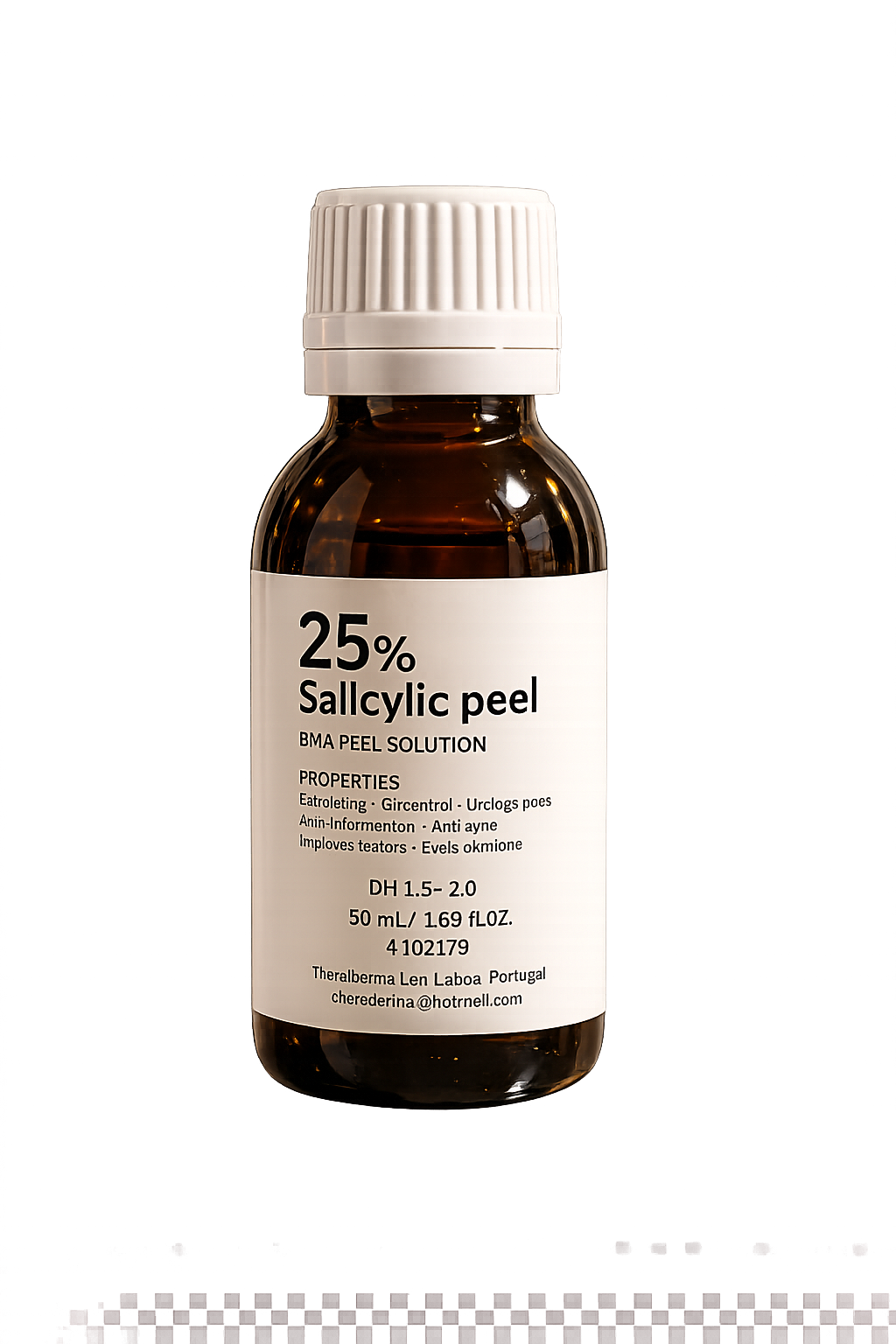
Description
Salicylic Peel 15%
Sebum regulation, pore purification and superficial renewal of oily or acne-prone skin within personalised professional treatment protocols
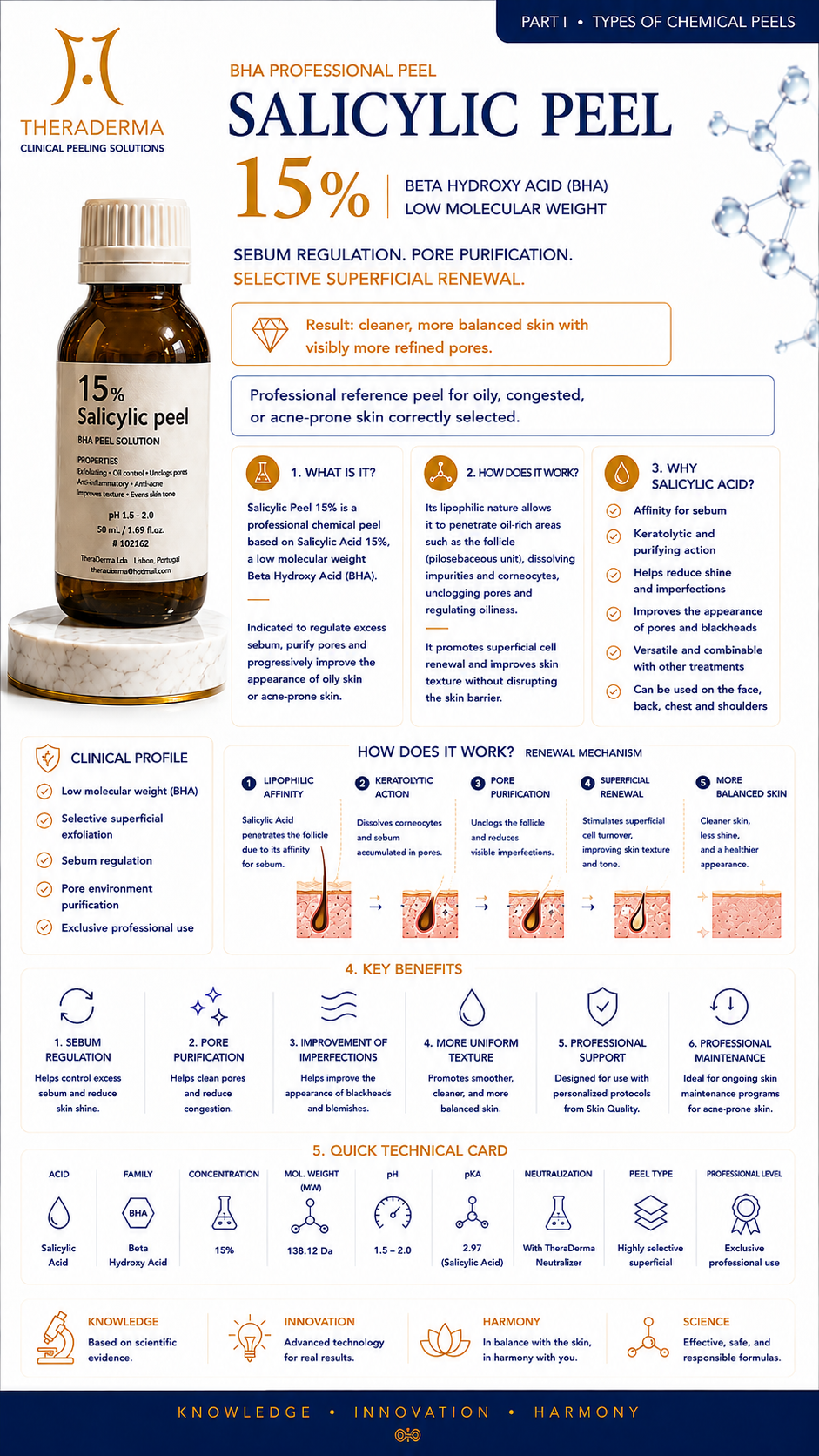
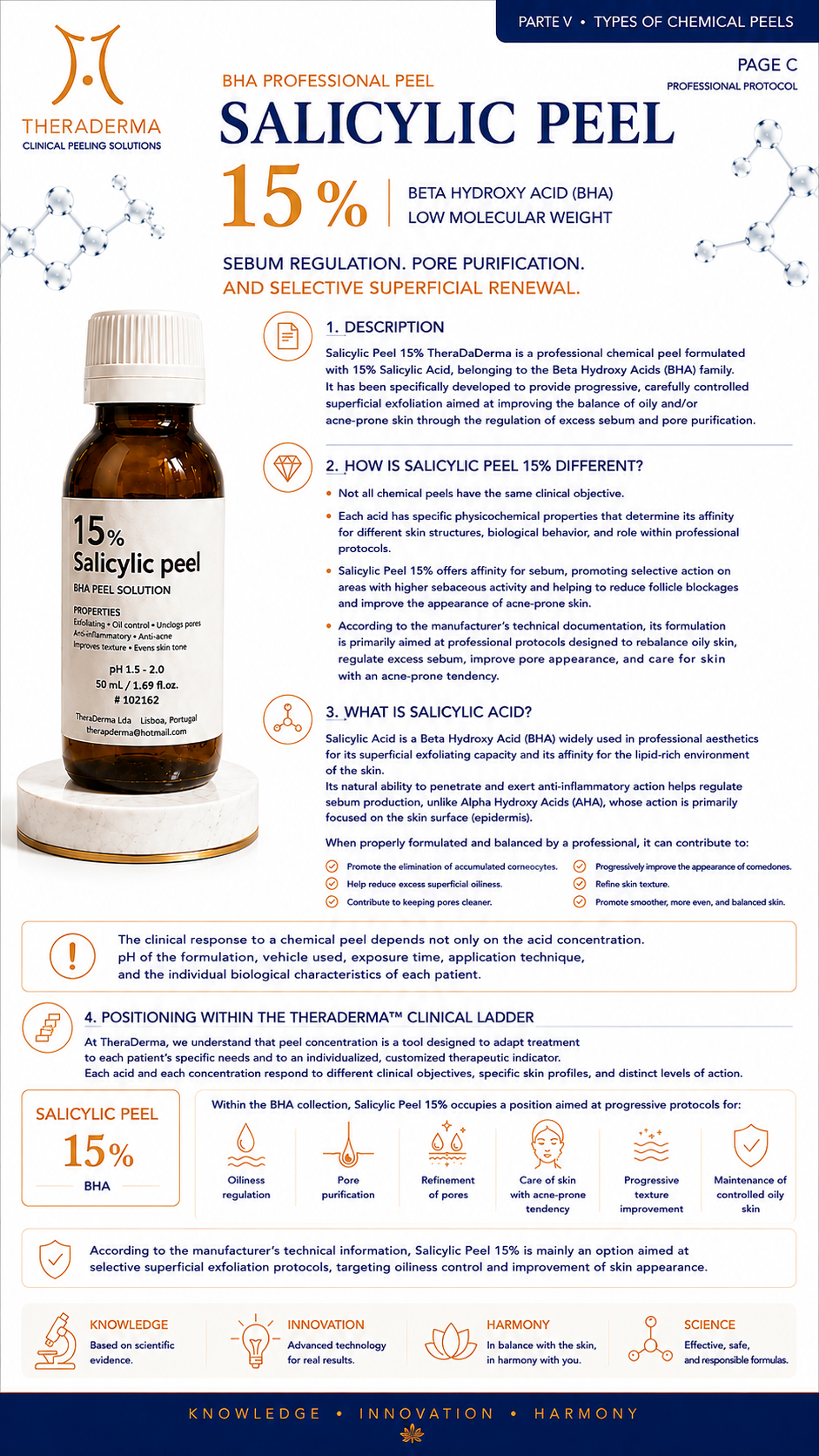
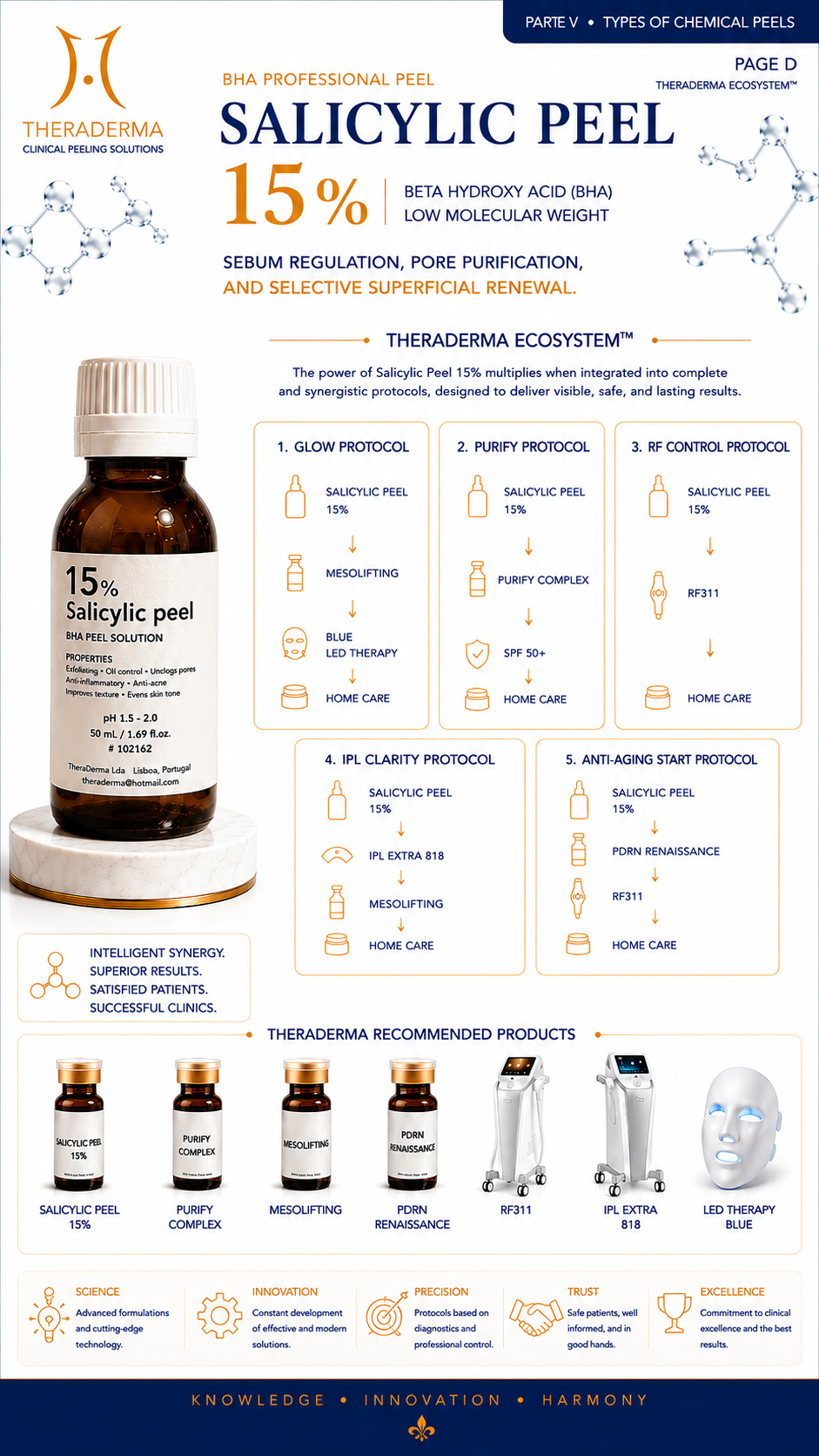
Salicylic Peel 15% TherapDerma is a professional chemical peel formulated with 15% Salicylic Acid, belonging to the Beta Hydroxy Acid (BHA) family. It has been developed to promote progressive, carefully controlled superficial exfoliation, aimed at improving the balance of oily or acne-prone skin by regulating excess sebum and purifying the pilosebaceous environment.
Unlike Alpha Hydroxy Acids (AHAs), Salicylic Acid has a lipophilic nature, giving it an affinity for areas with a higher concentration of sebum. This characteristic promotes targeted action within the pilosebaceous follicle, helping to remove accumulated corneocytes, superficial impurities and excess oil while progressively improving the appearance of pores and superficial imperfections.
When incorporated into a properly planned professional treatment protocol, it may help improve the appearance of oily skin, promote a more even skin texture and support a visibly cleaner, more balanced and healthier-looking complexion, while always respecting skin physiology and the individual biological response.
According to the manufacturer’s technical documentation, Salicylic Peel 15% is classified as a very superficial formulation, particularly indicated for protocols designed to control excess oil, refine pores and provide professional care for acne-prone skin.
More than a stand-alone procedure, Salicylic Peel 15% forms part of the TherapDerma Clinical Ecosystem™, a methodology based on diagnosis, therapeutic planning, treatment personalisation and continuity of care.
What makes Salicylic Peel 15% different?
Not all chemical peels are designed to achieve the same clinical objective.
Each acid possesses specific physicochemical properties that determine its affinity for different skin structures, its biological behaviour and its role within professional treatment protocols.
Salicylic Peel 15% has been developed for professionals seeking to incorporate a selective superficial exfoliation strategy aimed at controlling excess oil, purifying pores and progressively improving the appearance of oily, congested or acne-prone skin.
Its main distinguishing characteristic is Salicylic Acid’s affinity for sebum. This property promotes targeted action in areas with increased sebaceous activity, helping to reduce visible obstruction within the pilosebaceous follicle and progressively improve the overall appearance of the skin.
According to the manufacturer’s technical documentation, this concentration is primarily intended for professional protocols focused on balancing oily skin, regulating excess sebum, improving the appearance of pores and caring for acne-prone skin.
________________________________________
What is Salicylic Acid?
Salicylic Acid is a Beta Hydroxy Acid (BHA) widely used in professional aesthetics for its superficial exfoliating properties and its affinity for the skin’s lipid environment.
Its lipophilic nature enables it to act preferentially in areas with increased sebum production, distinguishing it from Alpha Hydroxy Acids (AHAs), whose action occurs mainly on the aqueous surface of the epidermis.
When incorporated into a properly balanced professional formulation, it may help to:
• promote the removal of accumulated corneocytes;
• help reduce excess surface oil;
• contribute to keeping pores clearer;
• progressively improve the appearance of comedones;
• refine skin texture;
• promote a visibly more even and balanced complexion.
The clinical response to a chemical peel does not depend solely on the acid concentration. Factors such as formulation pH, the vehicle used, exposure time, application technique and each patient’s individual biological characteristics also play an important role.
________________________________________
Position within the TherapDerma Clinical Ladder™
At TherapDerma, we believe that the concentration of a chemical peel is a tool designed to adapt treatment to each patient’s specific needs rather than an isolated indicator of greater therapeutic intensity.
Each acid and each concentration serves different clinical objectives, specific skin profiles and distinct levels of action.
Within the BHA collection, Salicylic Peel 15% occupies a position intended for progressive protocols focused on:
• sebum regulation;
• superficial purification;
• pore refinement;
• professional care for acne-prone skin;
• progressive improvement of skin texture;
• maintenance of properly controlled oily skin.
According to the manufacturer’s technical information, Salicylic Peel 15% is primarily intended to balance oily skin and refine pores, whereas Salicylic Peel 25% is designed for more intensive superficial exfoliation when clinically indicated.
The choice between both concentrations should always be based on professional diagnosis, the individual biological response and the observed clinical progression.
________________________________________
TherapDerma Philosophy
At TherapDerma, we believe that the best clinical outcomes do not depend solely on the intensity of exfoliation.
They depend on understanding skin biology, establishing an accurate diagnosis and selecting the most appropriate therapeutic strategy for each patient.
The treatment of oily or acne-prone skin requires respecting the skin barrier, evaluating the individual response and developing progressive protocols that achieve visible results without compromising the skin’s physiological balance.
For this reason, Salicylic Peel 15% is integrated within the TherapDerma Clinical Ecosystem™, a working model that combines chemical peels, mesotherapy, medical-aesthetic technologies and home care through personalised protocols based on sound clinical criteria.
________________________________________
TherapDerma Conclusion
Salicylic Peel 15% is a professional solution developed for progressive superficial exfoliation protocols aimed at controlling excess oil, purifying the pilosebaceous environment and improving the appearance of oily or acne-prone skin.
Its principal value lies in Salicylic Acid’s affinity for sebum, enabling the development of personalised treatment protocols that promote a visibly cleaner, more balanced and more even complexion when performed under professional supervision.
When integrated into an appropriate clinical treatment plan, Salicylic Peel 15% represents a professional solution designed to achieve progressive results while always respecting skin physiology and each patient’s individual biological response.
Clinical Benefits
Sebum regulation, pore purification and progressive improvement in the appearance of oily or acne-prone skin within personalised professional treatment protocols
Salicylic Peel 15% TherapDerma has been developed to promote progressive, clinically controlled superficial exfoliation aimed at restoring balance to oily, seborrhoeic, congested or acne-prone skin.
Thanks to the lipophilic nature of Salicylic Acid, this peel has an affinity for skin areas with a higher sebaceous content, promoting the progressive removal of accumulated corneocytes, purification of the pilosebaceous environment and control of excess oil.
When incorporated into an individualised professional treatment protocol, its benefits develop gradually, while respecting the skin barrier, cutaneous tolerance and each patient’s individual biological response.
________________________________________
💧 Progressive regulation of excess sebum
What are the clinical benefits?
Salicylic Acid helps to progressively regulate excess surface oil, promoting a more balanced and less shiny complexion.
When incorporated into properly planned professional protocols, it may help normalise the characteristic appearance of oily or seborrhoeic skin.
Clinical benefits
✔ Helps control excess oil.
✔ Promotes a visibly more balanced complexion.
✔ Helps reduce surface shine.
✔ Can be incorporated into professional sebum-regulating treatment programmes.
________________________________________
🫧 Progressive pore purification
What are the clinical benefits?
The exfoliating action of Salicylic Acid promotes the removal of accumulated corneous debris and superficial impurities that may build up around the pilosebaceous follicle.
This action helps keep pores cleaner and progressively reduces skin congestion.
Clinical benefits
✔ Promotes pore cleansing.
✔ Helps remove accumulated impurities.
✔ Contributes to reducing superficial congestion.
✔ Promotes visibly cleaner-looking skin.
________________________________________
⚪ Improvement in the appearance of comedones and superficial imperfections
What are the clinical benefits?
Progressive exfoliation promotes the removal of accumulated corneocytes involved in obstruction of the pilosebaceous follicle.
When used within appropriately indicated treatment protocols, it may help improve the appearance of comedones and the superficial imperfections commonly associated with acne-prone skin.
Clinical benefits
✔ Helps improve the appearance of blackheads.
✔ Contributes to reducing superficial comedones.
✔ Promotes a less congested-looking complexion.
✔ Supports professional protocols for acne-prone skin.
________________________________________
🎯 Refinement of skin texture
What are the clinical benefits?
The progressive renewal of the most superficial layers of the epidermis helps reorganise the skin microrelief, promoting a visibly smoother and more even skin texture.
Clinical benefits
✔ Helps improve superficial skin texture.
✔ Promotes smoother-looking skin.
✔ Progressively reduces the sensation of roughness.
✔ Contributes to a more even skin surface.
________________________________________
🌟 Improvement in the visual uniformity of skin tone
What are the clinical benefits?
Recurring imperfections may leave superficial irregularities in skin tone.
Progressive epidermal renewal may help visibly improve these irregularities and promote a more even-looking complexion.
Clinical benefits
✔ Promotes greater visual uniformity of skin tone.
✔ May help improve the appearance of superficial post-acne marks.
✔ Helps reduce visible tonal irregularities.
✔ Promotes a visibly more even complexion.
________________________________________
✨ A cleaner and more balanced appearance
What are the clinical benefits?
The combination of superficial exfoliation, sebum regulation and pore purification progressively promotes skin that appears cleaner, more balanced and healthier.
Clinical benefits
✔ Promotes visibly cleaner-looking skin.
✔ Contributes to a more balanced appearance.
✔ Helps improve overall skin clarity.
✔ Promotes a healthier-looking complexion.
________________________________________
🛡️ Clinically controlled superficial exfoliation
What are the clinical benefits?
The 15% concentration enables the development of progressive treatment protocols where professionally indicated, providing superficial exfoliation suitable for regular maintenance programmes and the management of oily skin.
Clinical benefits
✔ Enables the development of progressive treatment protocols.
✔ Promotes controlled superficial exfoliation.
✔ Facilitates treatment adaptation to each individual patient.
✔ Can be incorporated into regular professional maintenance programmes.
________________________________________
📈 Progressive clinical evolution
The benefits associated with Salicylic Peel 15% are part of a progressive biological process and do not depend on a single treatment session.
The clinical response develops gradually throughout the course of treatment, while respecting recovery of the skin barrier, individual tolerance and the natural evolution of the skin.
An accurate diagnosis, appropriate patient selection and personalised therapeutic planning make it possible to develop treatment protocols that are consistent with the established clinical objectives.
________________________________________
CLINICAL SUMMARY
Main benefits of Salicylic Peel 15%
✔ Progressive regulation of excess sebum.
✔ Pore purification.
✔ Improvement in the appearance of comedones and superficial imperfections.
✔ Refinement of skin texture.
✔ Improvement in the visual uniformity of skin tone.
✔ A cleaner and more balanced appearance.
✔ Clinically controlled superficial exfoliation.
✔ Progressive clinical evolution.
________________________________________
THERAPDERMA CLINICAL CONCLUSION
The principal clinical value of Salicylic Peel 15% lies in combining progressive superficial exfoliation with a purifying and sebum-regulating action, particularly suited to oily or acne-prone skin.
Integrated within the TherapDerma Clinical Ecosystem™, it can form part of therapeutic strategies based on diagnosis, clinical planning and regular reassessment, enabling the development of personalised, progressive treatment protocols that respect skin physiology.
Its objective is not to produce aggressive exfoliation, but rather to promote a gradual improvement in overall skin quality through treatment protocols designed to achieve skin that appears less oily, more even, cleaner and visibly better balanced.
Why choose Salicylic Peel 15%?
A professional solution for sebum-regulating protocols, pore purification and the progressive care of oily or acne-prone skin
In professional aesthetic medicine, the choice of a chemical peel should not be based solely on the concentration of the acid, but on selecting the active ingredient best suited to the biological characteristics and specific needs of each patient.
Salicylic Peel 15% TherapDerma has been developed for professionals wishing to incorporate a Beta Hydroxy Acid (BHA) specifically intended for the cosmetic treatment of oily, seborrhoeic, congested or acne-prone skin.
Its main distinguishing feature is the lipophilic nature of Salicylic Acid, which promotes selective action on areas with a higher sebaceous content, making it particularly suitable when the clinical objective is to control excess oil and progressively improve the appearance of pores and superficial imperfections.
Rather than simply representing a particular concentration, Salicylic Peel 15% is a clinical solution designed to be integrated into progressive, personalised treatment protocols that respect skin physiology.
________________________________________
WHEN CAN IT BE AN APPROPRIATE OPTION?
Salicylic Peel 15% may be considered when the primary treatment objective is to promote superficial exfoliation with a purifying and sebum-regulating action.
It may be particularly suitable for protocols designed for:
✔ oily or seborrhoeic skin;
✔ acne-prone skin;
✔ excess oil;
✔ open and closed comedones;
✔ blackheads;
✔ visible pores;
✔ congested skin;
✔ uneven superficial skin texture;
✔ superficial post-acne marks;
✔ professional skin purification programmes;
✔ regular maintenance of oily skin.
The indication should always be established following an individual professional assessment.
________________________________________
WHAT TYPE OF PROFESSIONAL HAS IT BEEN DESIGNED FOR?
Salicylic Peel 15% is intended for professionals who understand that the treatment of oily skin requires an accurate diagnosis, appropriate patient selection and personalised therapeutic planning.
It is particularly suitable for clinics wishing to develop protocols aimed at progressively restoring balance to oily skin through procedures compatible with regular maintenance and follow-up programmes.
Its use requires accurate interpretation of the skin response and adaptation of treatment frequency, exposure time and protocol progression according to each patient’s biological characteristics.
________________________________________
THERAPDERMA CLINICAL LADDER™
Every peel addresses a different clinical need
The TherapDerma Clinical Ladder™ does not represent a mandatory progression between concentrations.
Each solution should be selected according to:
✔ professional diagnosis;
✔ clinical objective;
✔ physiological condition of the skin;
✔ integrity of the skin barrier;
✔ level of oiliness;
✔ expected tolerance;
✔ therapeutic strategy;
✔ observed clinical progression.
Within the BHA collection, Salicylic Peel 15% occupies a position intended for superficial treatment protocols focused on balancing oily skin and progressively improving its appearance.
________________________________________
SALICYLIC PEEL 15%
May be considered for:
✔ oily or seborrhoeic skin;
✔ excess oil;
✔ acne-prone skin;
✔ blackheads and comedones;
✔ visible pores;
✔ congested skin;
✔ uneven skin texture;
✔ superficial post-acne marks;
✔ skin purification programmes;
✔ regular maintenance protocols.
Each treatment protocol should always be adapted to the professional diagnosis and the patient’s individual biological response.
________________________________________
QUICK SELECTION GUIDE
Clinical Objective Treatment Option to Consider
Control of excess sebum Salicylic Peel 15%
Oily or seborrhoeic skin Salicylic Peel 15%
Acne-prone skin Salicylic Peel 15%
Comedones and blackheads Salicylic Peel 15%
Visible pores Salicylic Peel 15%
Congested skin Salicylic Peel 15%
Pore purification Salicylic Peel 15%
Skin texture refinement Salicylic Peel 15%
Maintenance programmes Salicylic Peel 15%
This guide is intended as general guidance and does not replace an individual professional assessment.
________________________________________
WHY INTEGRATE IT INTO A PROGRESSIVE TREATMENT PROGRAMME?
Achieving balance in oily skin does not depend on a single treatment session.
Improving the appearance of the skin requires progressive treatment protocols that respect the skin’s physiological recovery and allow the individual response to be assessed after each application.
Within this approach, Salicylic Peel 15% may be incorporated into professional programmes designed to control excess oil, progressively improve the appearance of pores and maintain skin that appears cleaner and more balanced.
Where clinically indicated, it may subsequently be integrated with other procedures within the TherapDerma Clinical Ecosystem™, always respecting skin barrier recovery and the established therapeutic treatment plan.
________________________________________
THERAPDERMA CLINICAL CONCLUSION
Salicylic Peel 15% is a professional solution particularly suited to treatment protocols aimed at the cosmetic management of oily skin, pore purification and the progressive improvement of the appearance of superficial imperfections.
Its affinity for the sebum-rich environment makes it possible to develop therapeutic strategies tailored to the specific needs of this skin type, promoting progressive results within personalised, clinically planned treatment protocols.
Within the TherapDerma Clinical Ladder™, it represents a solution for professionals who prioritise accurate diagnosis, treatment individualisation and respect for skin physiology as the foundation for achieving natural, safe and sustainable results.
Areas Of Application
One peel. Multiple clinical applications depending on the anatomical area and professional diagnosis.
Salicylic Peel 15% TherapDerma may be incorporated into a variety of professional treatment protocols aimed at controlling excess sebum, purifying pores and caring for oily or acne-prone skin.
Thanks to the lipophilic nature of Salicylic Acid, this formulation has a particular affinity for areas with greater sebaceous activity, allowing treatment protocols to be adapted to different anatomical regions whenever professionally indicated.
Each area differs in terms of epidermal thickness, sebaceous gland density, sensitivity and recovery capacity. For this reason, the application technique should always be individualised according to the specific characteristics of each patient.
________________________________________
FACE
The primary treatment area
The face is the principal indication for Salicylic Peel 15%.
It may be incorporated into professional treatment protocols for patients presenting with oily skin, excess sebum, visible pores, comedones or acne-prone skin.
Common treatment objectives:
✔ help restore balance to oily skin;
✔ improve the appearance of pores;
✔ contribute to visibly cleaner-looking skin;
✔ progressively improve skin texture.
Application should always be adapted to the different facial regions and to the patient’s individual skin sensitivity.
________________________________________
NECK
Application in carefully selected cases
The neck has lower sebaceous activity and is generally more sensitive than the face.
For this reason, Salicylic Peel 15% should only be applied when there is a specific clinical indication and the practitioner considers the area suitable for treatment.
________________________________________
DÉCOLLETAGE
Oily skin and superficial imperfections
In appropriately selected patients, the décolletage may benefit from treatment protocols aimed at the cosmetic management of excess oil and superficial imperfections.
The treatment area and treatment frequency should always be carefully individualised.
________________________________________
BACK
One of the main body treatment indications
The back is one of the body regions with the highest sebaceous activity and a common site for acne manifestations.
Salicylic Peel 15% may be incorporated into professional treatment protocols designed to:
✔ control excess oil;
✔ improve the appearance of body acne;
✔ promote cleaner-looking skin;
✔ progressively improve skin texture.
The amount of product applied and the treatment area should always be adapted to each patient.
________________________________________
CHEST
Localised treatment protocols
Certain areas of the chest may present with excess oil, comedones or minor superficial imperfections.
Where professionally indicated, Salicylic Peel 15% may form part of localised treatment protocols aimed at restoring balance to oily skin.
________________________________________
BEARD AREA AND MALE SKIN
An excellent option for male skin
Male skin generally has greater sebaceous activity and a higher incidence of ingrown hairs and shaving-related pseudofolliculitis.
In appropriately selected patients, Salicylic Peel 15% may be incorporated into treatment protocols designed to:
✔ control excess oil;
✔ improve the appearance of ingrown hairs;
✔ promote a smoother and more even-looking complexion after shaving.
Treatment frequency should be adapted to shaving habits and the individual’s clinical response.
________________________________________
SHOULDERS
Body treatment protocols for oily skin
The shoulders are another common area affected by body acne and excess sebaceous activity.
In appropriately selected patients, Salicylic Peel 15% may be incorporated into treatment protocols aimed at progressively improving the appearance of this area.
________________________________________
CLINICAL GUIDANCE BY ANATOMICAL AREA
Anatomical Area Primary Objective
Face Control of excess oil, pores and comedones
Neck Localised application in selected cases
Décolletage Oily skin and superficial imperfections
Back Body acne and excess sebum
Chest Localised treatment protocols for oily skin
Beard Area Male skin and pseudofolliculitis
Shoulders Body acne and uneven skin texture
________________________________________
MULTI-AREA TREATMENT PROTOCOLS
In certain patients, Salicylic Peel 15% may be incorporated into therapeutic programmes involving the sequential treatment of different anatomical areas.
The selection of treatment areas should always be based on professional diagnosis and an individual assessment of:
• sebaceous activity;
• the presence of imperfections;
• skin barrier integrity;
• skin recovery capacity;
• individual tolerance.
Treatment planning should always respect the physiological intervals between procedures and be adapted to each patient’s clinical progression.
________________________________________
CLINICAL CONSIDERATIONS
Before each procedure, the practitioner should assess:
✔ the physiological condition of the skin;
✔ sebaceous activity;
✔ skin sensitivity;
✔ skin barrier integrity;
✔ relevant medical history;
✔ possible allergy to Salicylic Acid, aspirin or other salicylates.
The application technique should always be individualised according to the treatment area and the observed biological response.
________________________________________
QUICK SUMMARY
Salicylic Peel 15% may be incorporated into professional treatment protocols for:
✔ face;
✔ neck (selected cases);
✔ décolletage;
✔ back;
✔ chest;
✔ shoulders;
✔ beard area and male skin.
Main treatment objectives
✔ control of excess oil;
✔ pore purification;
✔ improvement in the appearance of comedones;
✔ support for acne-prone skin;
✔ progressive refinement of skin texture.
________________________________________
THERAPDERMA CONCLUSION
Salicylic Peel 15% is a versatile professional solution for treatment protocols aimed at the cosmetic management of oily or acne-prone skin on both the face and body.
Its application should be adapted to the specific characteristics of each anatomical area and always performed within an individualised clinical treatment plan, enabling the development of progressive protocols designed to restore balance to oily skin and improve its overall appearance.
How does it work?
Understanding the biological process makes it possible to plan more precise treatment protocols
Although Salicylic Peel 15% TherapDerma is applied for a limited period of time, the skin’s biological response continues to evolve during the days following the procedure.
Each treatment session initiates a progressive process of superficial exfoliation that promotes the physiological renewal of the epidermis, helps purify the pilosebaceous environment and gradually improves the appearance of oily or acne-prone skin.
Understanding these stages enables the practitioner to correctly interpret the clinical progression, establish personalised treatment protocols and adapt each session to the patient’s individual response.
________________________________________
EVERYTHING BEGINS AT THE SKIN SURFACE
The peel first interacts with the stratum corneum, particularly in areas with greater sebaceous activity.
Over time, the accumulation of corneocytes, excess sebum and the progressive obstruction of the pilosebaceous follicle may contribute to congested-looking skin, more visible pores and superficial irregularities.
The application of Salicylic Peel 15% initiates a carefully controlled superficial chemical exfoliation that promotes the progressive removal of these accumulations while always respecting the skin barrier when the procedure is performed under professional supervision.
________________________________________
STEP 1
Controlled superficial exfoliation
During the first few minutes after application, Salicylic Acid begins to act on the most superficial layers of the epidermis.
This process promotes the progressive removal of accumulated corneocytes and prepares the skin for its natural renewal process.
The clinical response will depend on multiple factors, including:
✔ the formulation;
✔ the pH;
✔ the amount applied;
✔ the contact time;
✔ the professional application technique;
✔ the physiological condition of the skin;
✔ individual sensitivity.
________________________________________
STEP 2
Progressive renewal of the epidermis
Once exfoliation has begun, the epidermis continues its physiological renewal process.
The progressive reorganisation of the stratum corneum promotes a visibly more even skin surface and facilitates the gradual improvement of the skin’s appearance.
This process forms part of the skin’s normal biological evolution and requires respect for the physiological recovery time between treatment sessions.
________________________________________
STEP 3
Progressive purification of the pilosebaceous environment
Thanks to the lipophilic nature of Salicylic Acid, superficial exfoliation progressively promotes improved cleansing of the sebum-rich environment.
As treatment progresses, the skin may appear visibly less congested, with a gradual improvement in the appearance of pores and superficial imperfections.
Results will always depend on the diagnosis, the biological characteristics of the skin and appropriate therapeutic planning.
________________________________________
STEP 4
Progressive improvement in the appearance of the skin
As the epidermis completes its renewal process, the skin may progressively present:
✔ a less oily appearance;
✔ a more even skin texture;
✔ visibly less noticeable pores;
✔ cleaner-looking skin;
✔ greater visual uniformity of skin tone;
✔ progressive optimisation of Skin Quality.
These changes develop gradually and should always be assessed while respecting the patient’s individual biological response.
________________________________________
STEP 5
Clinical progression and professional reassessment
Each treatment session represents one stage within a progressive treatment programme.
Continuation of the protocol should always be determined after assessing:
✔ the observed clinical response;
✔ recovery of the skin barrier;
✔ individual tolerance;
✔ changes in oil production;
✔ the appearance of the pores;
✔ the progression of superficial imperfections;
✔ compliance with the home care programme;
✔ the established therapeutic objectives.
Treatment planning should never be based solely on a fixed schedule, but rather on each patient’s clinical progression.
________________________________________
WHY IS A PROGRESSIVE APPROACH IMPORTANT?
Improving oily or acne-prone skin is a cumulative process.
The objective is not to perform increasingly intensive procedures, but to promote controlled superficial renewal that is compatible with the skin’s physiological recovery.
A progressive treatment plan allows each session to be adapted according to the clinical progression while maintaining a high safety profile.
________________________________________
A DIFFERENT RESPONSE IN EVERY PATIENT
Every skin responds differently to a chemical peel.
Clinical progression will depend on factors such as:
✔ the degree of oiliness;
✔ sebaceous activity;
✔ the condition of the skin barrier;
✔ skin sensitivity;
✔ phototype;
✔ age;
✔ previous treatments;
✔ adherence to the home care programme;
✔ the individual biological response.
For this reason, two patients undergoing the same treatment protocol may experience different recovery times and clinical outcomes.
________________________________________
SEQUENCE OF THE BIOLOGICAL PROCESS
Professional application
↓
Controlled superficial exfoliation
↓
Progressive renewal of the stratum corneum
↓
Purification of the pilosebaceous environment
↓
Progressive improvement in the appearance of pores
↓
Visibly cleaner and more balanced skin
↓
Progressive optimisation of Skin Quality
________________________________________
KEY MECHANISMS OF ACTION
✔ progressive superficial exfoliation;
✔ physiological renewal of the epidermis;
✔ preferential action on areas with greater sebaceous content;
✔ progressive purification of the pilosebaceous environment;
✔ gradual improvement in the appearance of pores;
✔ progressive refinement of skin texture;
✔ improvement in the overall appearance of the skin;
✔ progressive optimisation of Skin Quality;
✔ personalised, cumulative treatment protocols.
________________________________________
THERAPDERMA CONCLUSION
Understanding how Salicylic Peel 15% works enables practitioners to correctly interpret clinical progression and plan treatment protocols tailored to each patient’s specific needs.
Its progressive action promotes carefully controlled superficial exfoliation that contributes to the gradual improvement of oily or acne-prone skin through physiological renewal that respects the integrity of the skin barrier.
When incorporated into an individualised professional treatment plan, each session represents another step towards skin that appears cleaner, more even and better balanced.
Mechanism Of Action
The science behind the biological response of Salicylic Acid
The mechanism of action of Salicylic Peel 15% TherapDerma is based on the interaction between Salicylic Acid, the formulation, the pH and the skin’s individual biological characteristics.
From a scientific perspective, the objective of the procedure is to promote selective superficial exfoliation, help progressively regulate excess sebum and support epidermal renewal compatible with professional treatment protocols intended for the care of oily or acne-prone skin.
The clinical response will always depend on the diagnosis, the physiological condition of the epidermis, sebaceous activity, the patient’s individual characteristics and the correct application of the professional treatment protocol.
________________________________________
ACTION ON THE STRATUM CORNEUM AND THE PILOSEBACEOUS ENVIRONMENT
The stratum corneum represents the skin’s primary protective barrier and is one of the principal sites of action of Salicylic Peel 15%.
At the same time, the lipophilic nature of Salicylic Acid promotes preferential action within the sebum-rich environment, where corneocytes, superficial impurities and keratinised material may accumulate.
When professionally indicated, the peel promotes progressive superficial exfoliation and reorganisation of the skin microrelief through the characteristic mechanisms of Beta Hydroxy Acids (BHAs).
________________________________________
MODULATION OF CORNEOCYTE COHESION
Superficial corneocytes remain connected by specialised structures known as corneodesmosomes.
Salicylic Acid promotes a progressive reduction in the cohesion between these cellular junctions, facilitating the physiological elimination of corneocytes that have completed their biological life cycle.
As a result of this process, the skin surface may progressively present:
• a more even skin texture;
• visibly cleaner-looking skin;
• reduced superficial accumulation of impurities;
• a more uniform appearance;
• improved visual skin quality.
The intensity of this response will always depend on the individual characteristics of the skin and the selected treatment protocol.
________________________________________
ACTION ON THE SEBUM-RICH ENVIRONMENT
One of the principal characteristics of Salicylic Acid is its affinity for lipids.
This property promotes preferential action in areas with greater sebaceous activity, helping to maintain the pilosebaceous environment in better condition and promoting skin that appears more balanced.
When incorporated into appropriately planned treatment protocols, it may help to:
✔ promote the balance of oily skin;
✔ help keep pores cleaner;
✔ reduce the superficial accumulation of impurities;
✔ progressively improve the appearance of comedones;
✔ promote a less congested-looking complexion.
________________________________________
EPIDERMAL RENEWAL AND SUPERFICIAL REORGANISATION
Epidermal renewal is a continuous physiological process through which the epidermis progressively replaces its superficial cells.
When this process becomes less efficient, particularly in skin with increased sebaceous activity, irregularities in skin texture and visible alterations of the skin surface may develop.
By promoting carefully controlled superficial exfoliation, Salicylic Peel 15% contributes to a more organised renewal process, promoting progressively more even and balanced-looking skin.
________________________________________
RELATIONSHIP BETWEEN CONCENTRATION, pH AND SKIN RESPONSE
Concentration represents only one of the factors influencing the clinical behaviour of a chemical peel.
The biological response also depends on variables such as:
✔ the formulation pH;
✔ the fraction of available acid;
✔ the vehicle used;
✔ the contact time;
✔ the application technique;
✔ skin preparation prior to treatment;
✔ sebaceous activity;
✔ the condition of the skin barrier;
✔ individual sensitivity.
For this reason, two formulations with the same concentration may produce different clinical responses.
Professional assessment should always consider all of these variables before establishing the treatment protocol.
________________________________________
INTEGRATION INTO THERAPEUTIC PROTOCOLS
Salicylic Peel 15% may be incorporated into sequential therapeutic strategies whenever clinically indicated.
Once the skin barrier has recovered, the practitioner may consider integrating it with other procedures within the TherapDerma Clinical Ecosystem™, including:
• mesotherapy;
• sebum-regulating treatment protocols;
• LED therapy;
• biostimulation;
• medical-aesthetic technologies;
• personalised programmes for oily skin;
• maintenance protocols.
The combination of different procedures should always be individualised according to each patient’s clinical progression.
________________________________________
SCIENCE AT A GLANCE™
Parameter Salicylic Peel 15%
Active ingredient Salicylic Acid
Chemical family Beta Hydroxy Acids (BHA)
Primary site of action Stratum corneum and pilosebaceous environment
Predominant mechanism Selective superficial exfoliation
Associated physiological process Progressive epidermal renewal
Expected physiological outcome Visibly cleaner, more even and better-balanced skin
Determining variables pH, formulation, technique, contact time and individual characteristics
Clinical purpose To support professional treatment protocols for oily or acne-prone skin
________________________________________
BIOLOGICAL FOUNDATION
The clinical behaviour of a chemical peel depends on the biological response developed by the skin following application of the active ingredient, and not exclusively on its concentration.
In the case of Salicylic Acid, its affinity for the sebum-rich environment promotes selective superficial action that contributes to the progressive improvement in the appearance of oily or acne-prone skin.
Treatment progression will always depend on professional diagnosis, the functional condition of the skin and the individual’s biological response.
________________________________________
SCIENTIFIC PRINCIPLES OF USE
Interpretation of the mechanism of action should be based on several fundamental principles:
✔ the biological response is always individual;
✔ concentration alone does not determine clinical behaviour;
✔ the skin barrier influences treatment tolerance;
✔ sebaceous activity affects clinical progression;
✔ pH and formulation modify the availability of the active ingredient;
✔ treatment planning is more important than the isolated intensity of a single session;
✔ clinical reassessment allows treatment to be adapted to each patient;
✔ treatment outcomes depend on diagnosis, indication and correct execution of the procedure.
________________________________________
THERAPDERMA CONCLUSION
Understanding the mechanism of action of Salicylic Peel 15% makes it possible to interpret the skin’s biological response from a scientific perspective and to plan more precise professional treatment protocols.
Its effectiveness is based on the interaction between the formulation, pH, application technique and each patient’s biological characteristics, promoting carefully controlled superficial exfoliation and a progressive improvement in the appearance of oily or acne-prone skin.
Integrated within the TherapDerma Clinical Ecosystem™, it represents a professional solution for developing personalised treatment protocols that respect skin physiology and each patient’s individual clinical progression.
Scientific Foundations
The formulation determines clinical behaviour
In a professional chemical peel, the acid concentration represents only one of the many factors involved in the skin’s biological response.
The clinical behaviour of a formulation depends on the interaction between its physicochemical properties, the functional availability of the active ingredient, the application technique and each patient’s individual biological characteristics.
For this reason, formulations that appear similar may produce different clinical responses, even when they contain the same nominal concentration of Salicylic Acid.
Salicylic Peel 15% TherapDerma has been developed to be integrated into professional treatment protocols in which the complete formulation is an essential element for achieving a predictable, reproducible clinical response consistent with the physiology of oily or acne-prone skin.
________________________________________
CONCENTRATION
An important factor, but never sufficient on its own
Concentration expresses the nominal amount of Salicylic Acid present in the formulation, but on its own it does not determine the intensity or clinical behaviour of the procedure.
Two peels with the same concentration may behave differently due to variations in:
• pH;
• the vehicle;
• formulation stability;
• contact time;
• sebaceous activity;
• the condition of the skin barrier;
• the physiological condition of the skin.
In Salicylic Peel 15%, the concentration of the active ingredient has been selected to support progressive treatment protocols aimed at balancing oily skin and gradually improving its appearance.
________________________________________
THE ROLE OF pH
A regulator of formulation behaviour
pH is one of the most important physicochemical parameters in the design of a professional chemical peel.
In addition to expressing the acidity of the formulation, it influences the functional availability of Salicylic Acid and determines its behaviour during the procedure.
Small variations in pH may modify the clinical response of formulations with a similar concentration.
For this reason, pH is one of the elements that contributes to the safety, reproducibility and predictability of treatment.
________________________________________
THE SIGNIFICANCE OF pKa
Understanding the chemical balance of Salicylic Acid
pKa is an intrinsic physicochemical property of every acid that describes the equilibrium between its ionised and non-ionised forms.
Salicylic Acid has an approximate pKa of 2.97, a value that helps explain its chemical behaviour within different formulations.
This parameter is useful for interpreting the functional availability of the active ingredient, although it cannot by itself predict the clinical response.
Its interpretation should always be considered together with the pH, the formulation and the patient’s biological characteristics.
________________________________________
PHYSICOCHEMICAL PROFILE OF SALICYLIC ACID
Scientific characteristics of the active ingredient
Salicylic Acid belongs to the Beta Hydroxy Acid (BHA) family.
Its lipophilic nature provides a strong affinity for skin lipids and the pilosebaceous environment, a characteristic that distinguishes it from Alpha Hydroxy Acids (AHAs).
These properties promote selective superficial exfoliation and make it possible to develop professional treatment protocols specifically intended for the cosmetic management of oily or acne-prone skin.
________________________________________
SCIENTIFIC MOLECULAR PROFILE™
Parameter Salicylic Acid
Chemical name Salicylic Acid
Chemical family Beta Hydroxy Acid (BHA)
Molecular formula C₇H₆O₃
Molecular weight 138.12 g/mol
Chemical nature Lipophilic aromatic acid
pKa ≈ 2.97
Solubility Lipophilic
Primary site of action Stratum corneum and pilosebaceous environment
Type of exfoliation Selective superficial chemical exfoliation
The clinical relevance of these characteristics lies in the interaction between the active ingredient, the complete formulation and the biology of the skin.
________________________________________
WHY CAN TWO PEELS BEHAVE DIFFERENTLY?
Much more than concentration
Although two peels may contain the same active ingredient and an apparently similar concentration, their clinical behaviour may differ.
The biological response depends on the interaction between:
✔ Salicylic Acid concentration;
✔ pH;
✔ pKa;
✔ vehicle and excipients;
✔ formulation stability;
✔ application technique;
✔ number of layers;
✔ contact time;
✔ sebaceous activity;
✔ the condition of the skin barrier;
✔ the individual biological response.
The scientific interpretation of a chemical peel should always take all of these factors into consideration.
________________________________________
THE VEHICLE AND THE FORMULATION
The invisible architecture of the peel
In addition to the active ingredient, every formulation contains a vehicle and various excipients that determine product stability and its distribution across the skin surface.
These components influence application uniformity, the functional availability of Salicylic Acid and the clinical reproducibility of the procedure.
A properly developed formulation supports more consistent and uniform treatment protocols.
________________________________________
CONTACT TIME
A variable that should be individualised
The length of time the peel remains on the skin is one of the most important clinical variables.
Its duration should be determined according to:
• the diagnosis;
• the treatment area;
• sebaceous activity;
• the thickness of the stratum corneum;
• the observed tolerance;
• the clinical progression during the session.
There is no universal contact time suitable for every patient.
________________________________________
THE SKIN BARRIER
The foundation of an appropriate physiological response
The integrity of the skin barrier is one of the principal factors influencing tolerance to any chemical peel.
Factors such as hydration, sebaceous activity, previous treatments or certain dermatological conditions may modify the clinical response to the procedure.
For this reason, an initial assessment of the skin barrier is an essential step before beginning any treatment protocol.
________________________________________
BIOLOGICAL VARIABILITY
Every skin responds differently
The biological response is never identical between two patients.
Age, phototype, sebaceous activity, stratum corneum thickness, skin sensitivity, inflammation and previous treatments may all influence the clinical progression of treatment.
For this reason, every procedure should be adapted according to the observed progression through continuous clinical reassessment.
________________________________________
FACTORS THAT INFLUENCE THE CLINICAL RESPONSE
An integrated view of the procedure
FORMULATION
✔ Concentration.
✔ pH.
✔ pKa.
✔ Vehicle.
✔ Stability.
↓
PROCEDURE
✔ Skin preparation.
✔ Application technique.
✔ Number of layers.
✔ Contact time.
✔ Neutralisation where applicable.
↓
PATIENT
✔ Skin barrier.
✔ Sebaceous activity.
✔ Phototype.
✔ Individual sensitivity.
✔ Diagnosis.
↓
BIOLOGICAL RESPONSE
↓
CLINICAL OUTCOME
________________________________________
SCIENCE AT A GLANCE™
Parameter Salicylic Peel 15%
Active ingredient Salicylic Acid
Concentration 15%
Primary site of action Stratum corneum and the pilosebaceous environment
Type of exfoliation Selective superficial chemical exfoliation
Predominant mechanism Superficial exfoliation and affinity for the sebum-rich environment
Expected outcome Progressive optimisation of Skin Quality
Determining variables Formulation, pH, technique, contact time and biological response
Clinical purpose Professional treatment protocols for oily or acne-prone skin
________________________________________
SCIENTIFIC FORMULATION PROFILE™
Parameter Salicylic Peel 15%
Active ingredient Salicylic Acid
Chemical family Beta Hydroxy Acid (BHA)
Molecular formula C₇H₆O₃
Molecular weight 138.12 g/mol
Chemical nature Lipophilic aromatic acid
pKa ≈ 2.97
Professional presentation 50 mL
Intended use Professional use only
________________________________________
NEUTRALISATION
Restoring physiological balance
Where required by the peeling protocol, neutralisation is an essential stage of the procedure.
Its purpose is to stop the activity of the formulation in a controlled manner and initiate the physiological recovery of the skin surface.
The decision to neutralise should always be based on the professional treatment protocol and the observed clinical response.
________________________________________
APPLYING SCIENTIFIC KNOWLEDGE
From the laboratory to clinical practice
Understanding the physicochemical properties of a formulation makes it possible to better interpret its behaviour during the clinical procedure.
Integrating this information with patient assessment facilitates the selection of the most appropriate treatment protocol and the progressive adaptation of treatment.
________________________________________
SCIENTIFIC NOTE
Physicochemical properties help explain the potential behaviour of a formulation, but they never replace the clinical assessment carried out by the practitioner.
Treatment progression will always depend on the interaction between the formulation, the application technique and the individual biological response.
________________________________________
THERAPDERMA CONCLUSION
The true scientific value of Salicylic Peel 15% does not lie exclusively in the concentration of Salicylic Acid, but in the interaction between the complete formulation, the physicochemical properties of the active ingredient and each patient’s individual biological response.
Understanding these scientific principles makes it possible to develop safer, more reproducible and more personalised treatment protocols, integrating scientific knowledge into clinical practice based on diagnosis, therapeutic planning and respect for skin physiology.
Indications
When should Salicylic Peel 15% be selected?
The indication for a professional chemical peel should always be based on a comprehensive clinical assessment and the definition of specific therapeutic objectives.
Beyond the acid concentration, the decision depends on the skin’s biological characteristics, the degree of sebaceous activity, the condition of the skin barrier and the clinical objectives established for each patient.
Within this context, Salicylic Peel 15% may be incorporated whenever the practitioner considers selective superficial exfoliation appropriate for balancing oily skin, progressively purifying the pilosebaceous environment and optimising Skin Quality.
Each indication should be established individually, adapting the treatment protocol according to the clinical progression and avoiding standardised treatment approaches.
________________________________________
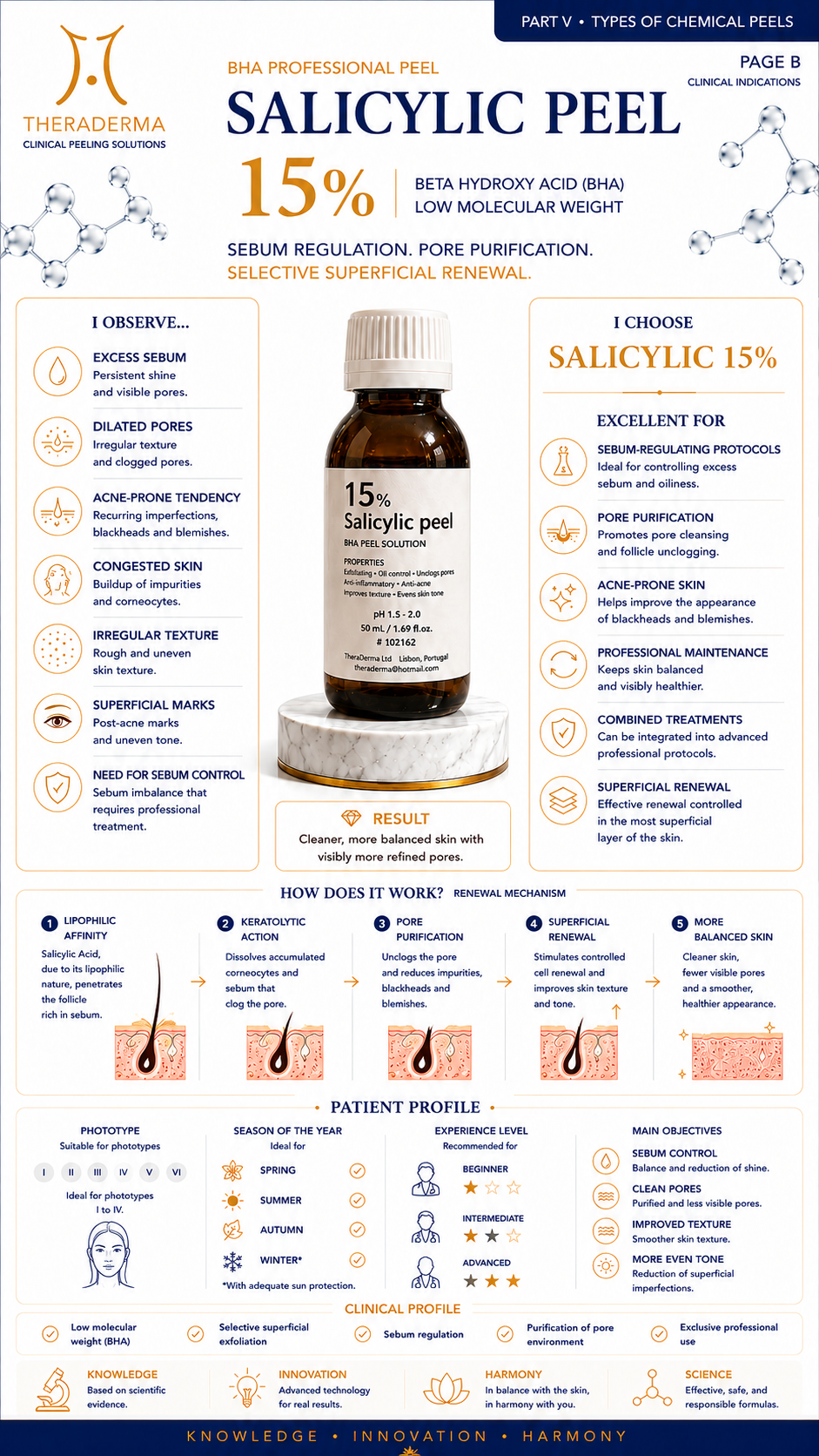
PATIENT PROFILE
What characteristics are commonly observed?
Salicylic Peel 15% may be considered for appropriately selected patients presenting superficial alterations associated with excess sebum production and hyperkeratinisation.
These patients commonly present one or more of the following characteristics:
✔ oily or seborrhoeic skin;
✔ excessive skin shine;
✔ visible pores;
✔ open and closed comedones;
✔ acne-prone skin;
✔ uneven skin texture;
✔ congested skin;
✔ superficial post-acne marks;
✔ the need for progressive improvement of Skin Quality.
The presence of one or more of these characteristics does not in itself constitute an automatic indication. The final decision should always depend on the professional assessment and the established therapeutic plan.
________________________________________
MAIN CLINICAL INDICATIONS
Salicylic Peel 15% may be incorporated into professional treatment protocols intended for:
✔ oily or seborrhoeic skin;
✔ excessive sebaceous secretion;
✔ acne-prone skin;
✔ comedones;
✔ visible pores;
✔ uneven superficial skin texture;
✔ congested skin;
✔ superficial post-acne marks;
✔ progressive improvement of Skin Quality;
✔ maintenance programmes for oily skin.
Each of these indications requires individualised treatment planning and may be integrated into different therapeutic strategies.
________________________________________
OILY OR SEBORRHOEIC SKIN
Hyperactivity of the sebaceous glands may lead to shiny skin with a greater tendency towards pore blockage and the appearance of imperfections.
In these cases, Salicylic Peel 15% may form part of treatment protocols intended to progressively improve the balance of the pilosebaceous environment.
Common objectives include:
✔ promoting balanced oil production;
✔ reducing skin shine;
✔ improving the appearance of pores;
✔ promoting visibly cleaner-looking skin;
✔ progressively optimising Skin Quality.
The treatment protocol should always be adapted to the clinical characteristics observed in each patient.
________________________________________
ACNE-PRONE SKIN
The accumulation of keratin and excess sebum may promote progressive obstruction of the pilosebaceous follicle.
When considered clinically appropriate, Salicylic Peel 15% may be incorporated into treatment protocols intended to progressively improve the appearance of this type of skin.
Before establishing the indication, the practitioner should assess:
✔ the type and progression of the lesions;
✔ the presence of active inflammation;
✔ lesion distribution;
✔ phototype;
✔ dermatological history;
✔ current pharmacological treatments;
✔ clinical objectives.
Treatment planning should always be accompanied by appropriate follow-up and individualised home care.
________________________________________
COMEDONES AND VISIBLE PORES
The progressive accumulation of sebum and keratin may contribute to the formation of comedones and increase the visibility of pores.
When these alterations predominate in the clinical assessment, Salicylic Peel 15% may be incorporated into treatment protocols intended to promote progressive cleansing of the pilosebaceous environment.
Clinical objectives may include:
✔ improving the appearance of pores;
✔ progressively reducing comedones;
✔ promoting a more even complexion;
✔ improving superficial skin texture;
✔ progressively optimising Skin Quality.
________________________________________
UNEVEN SKIN TEXTURE
Irregularities in the skin microrelief may be associated with skin congestion, hyperkeratinisation and the accumulation of corneocytes.
When these alterations are predominantly superficial, Salicylic Peel 15% may be incorporated into treatment protocols intended to progressively improve skin texture.
Clinical objectives may include:
✔ promoting a more even skin texture;
✔ smoothing the skin microrelief;
✔ improving the appearance of the skin surface;
✔ promoting a more homogeneous-looking complexion;
✔ progressively optimising Skin Quality.
________________________________________
SUPERFICIAL POST-ACNE MARKS
Following the resolution of certain acne lesions, superficial irregularities in skin tone and texture may persist.
In appropriately selected patients, Salicylic Peel 15% may form part of programmes intended to progressively improve these alterations.
Common objectives include:
✔ promoting greater visual uniformity of skin tone;
✔ improving skin texture;
✔ optimising the appearance of superficial marks;
✔ promoting a more even complexion;
✔ progressively optimising Skin Quality.
Clinical progression will depend on treatment consistency, daily photoprotection and adherence to the prescribed home care programme.
________________________________________
MALE SKIN
Male skin generally presents greater sebaceous activity, a thicker stratum corneum and an increased tendency towards congestion of the pilosebaceous environment.
Within appropriately planned treatment protocols, Salicylic Peel 15% may be incorporated to promote selective superficial exfoliation and contribute to the progressive balance of this type of skin.
________________________________________
CLINICAL TREATMENT OBJECTIVES
The selection of Salicylic Peel 15% should always be based on clearly defined clinical objectives established before initiating the treatment protocol.
The most common objectives include:
✔ promoting the progressive balance of oil production;
✔ improving the appearance of pores;
✔ progressively reducing comedones;
✔ promoting a more even skin texture;
✔ improving the appearance of acne-prone skin;
✔ progressively optimising Skin Quality.
Clearly defining these objectives facilitates treatment planning and enables a more accurate clinical assessment of treatment progression.
________________________________________
CRITERIA FOR SELECTING SALICYLIC PEEL 15%
The decision to use Salicylic Peel 15% should be based on a comprehensive patient assessment and the correlation between the observed clinical characteristics and the established therapeutic objectives.
Before recommending Salicylic Peel 15%, it is advisable to confirm:
✔ that the alterations are predominantly superficial;
✔ that there is a clearly defined clinical indication;
✔ that oily or acne-prone skin predominates;
✔ that the patient understands the treatment objectives;
✔ that appropriate follow-up can be provided;
✔ that the treatment protocol is consistent with the expected clinical progression.
Concentration is only one of the factors involved in therapeutic planning and should never be used as the sole criterion for clinical decision-making.
________________________________________
WHEN SHOULD SALICYLIC PEEL 15% BE CHOSEN?
Salicylic Peel 15% may represent an excellent option when the primary objective is to:
✔ promote the balance of oily skin;
✔ improve the appearance of pores;
✔ progressively reduce comedones;
✔ perform selective superficial exfoliation;
✔ develop treatment programmes for oily skin;
✔ complement treatment protocols for acne-prone skin;
✔ progressively optimise Skin Quality.
The decision should always be based on the clinical diagnosis and the therapeutic objectives established for each patient.
________________________________________
SUMMARY OF THE MAIN INDICATIONS
Salicylic Peel 15% may be considered within professional treatment protocols for patients presenting:
✔ oily or seborrhoeic skin;
✔ excessive sebaceous secretion;
✔ acne-prone skin;
✔ comedones;
✔ visible pores;
✔ uneven superficial skin texture;
✔ superficial post-acne marks;
✔ reduced Skin Quality;
✔ the need for maintenance programmes for oily skin.
These indications constitute general clinical guidance and should always be interpreted within the context of the individual assessment carried out by the practitioner.
________________________________________
THERAPDERMA CLINICAL CONCLUSION
Correct patient selection is one of the fundamental pillars of safe, personalised and clinically consistent treatment.
Salicylic Peel 15% has been developed for integration into professional treatment protocols intended for patients who may benefit from selective superficial exfoliation aimed at the progressive balance of oily skin, purification of the pilosebaceous environment and optimisation of Skin Quality.
Its use should always be based on a thorough clinical assessment, clearly defined therapeutic objectives and individualised treatment planning adapted to each patient’s biological progression.
As part of the TherapDerma Clinical Ecosystem™, it represents a clinical solution designed to be integrated into personalised programmes combining diagnosis, therapeutic planning and continuous follow-up, supporting professional practice based on scientific evidence and respect for skin physiology.
Contraindicaciones
La seguridad comienza antes del tratamiento
La decisión de realizar un peeling químico profesional no depende únicamente de la existencia de una indicación clínica. Antes de iniciar cualquier procedimiento resulta imprescindible identificar aquellas situaciones que pueden comprometer la seguridad del paciente o modificar la respuesta esperada al tratamiento.
La detección precoz de las contraindicaciones permite reducir el riesgo de complicaciones, establecer el momento más adecuado para intervenir o, cuando sea necesario, optar por una estrategia terapéutica diferente.
En el caso de Salicylic Peel 15%, además de las contraindicaciones generales aplicables a cualquier peeling químico, debe prestarse especial atención a la posible hipersensibilidad al Ácido Salicílico, a la aspirina (ácido acetilsalicílico) y a otros salicilatos, ya que puede existir reacción cruzada.
La práctica clínica segura no consiste únicamente en saber cuándo tratar, sino también en reconocer cuándo es preferible posponer o evitar el procedimiento.
________________________________________
CONTRAINDICACIONES ABSOLUTAS
Las siguientes situaciones contraindican la realización de Salicylic Peel 15% hasta que desaparezca la causa que las motiva o una nueva evaluación clínica permita reconsiderar el tratamiento.
________________________________________
EMBARAZO Y LACTANCIA
Como medida de precaución, no se recomienda realizar peelings químicos durante el embarazo ni durante el período de lactancia.
Aunque la absorción sistémica del Ácido Salicílico aplicado tópicamente es limitada, no existen suficientes datos clínicos que permitan recomendar su utilización rutinaria durante estas etapas.
La seguridad de la paciente deberá prevalecer siempre sobre cualquier objetivo estético.
________________________________________
ALERGIA A LA ASPIRINA O A LOS SALICILATOS
Esta constituye la principal contraindicación específica de Salicylic Peel 15%.
El procedimiento no debe realizarse en pacientes con antecedentes conocidos de:
✔ alergia a la aspirina (ácido acetilsalicílico);
✔ hipersensibilidad a los salicilatos;
✔ reacciones alérgicas previas al Ácido Salicílico;
✔ antecedentes de reacción grave tras productos que contengan salicilatos.
La existencia de cualquiera de estos antecedentes deberá motivar la exclusión del procedimiento o la valoración de una alternativa terapéutica diferente.
________________________________________
INFECCIONES CUTÁNEAS ACTIVAS
Salicylic Peel 15% no debe aplicarse sobre piel que presente procesos infecciosos activos, ya que la inflamación y la alteración tisular pueden modificar la respuesta cutánea al procedimiento.
Entre las principales situaciones se incluyen:
✔ herpes simple activo;
✔ infecciones bacterianas;
✔ infecciones víricas;
✔ infecciones fúngicas;
✔ lesiones pustulosas de origen infeccioso;
✔ cualquier proceso inflamatorio asociado a infección.
El tratamiento solo podrá reconsiderarse cuando el proceso infeccioso haya desaparecido completamente y la piel haya recuperado su integridad clínica.
________________________________________
HERIDAS Y PÉRDIDA DE INTEGRIDAD CUTÁNEA
No deberá realizarse el procedimiento sobre áreas que presenten alteraciones visibles de la superficie cutánea.
Esto incluye:
✔ heridas abiertas;
✔ abrasiones;
✔ erosiones;
✔ fisuras;
✔ excoriaciones;
✔ quemaduras recientes;
✔ quemadura solar;
✔ zonas sometidas a procedimientos quirúrgicos o traumáticos con cicatrización incompleta.
La piel deberá encontrarse completamente recuperada antes de valorar cualquier procedimiento de exfoliación química.
________________________________________
DERMATOSIS INFLAMATORIAS ACTIVAS
La presencia de enfermedades inflamatorias activas en la zona de tratamiento contraindica temporalmente la realización del peeling.
Entre ellas destacan:
✔ dermatitis;
✔ eccema;
✔ psoriasis activa;
✔ rosácea inflamatoria;
✔ dermatitis de contacto;
✔ dermatitis seborreica descompensada;
✔ otras dermatosis que cursen con inflamación o alteración de la epidermis.
El procedimiento solo podrá plantearse nuevamente cuando la enfermedad se encuentre estabilizada y la evaluación clínica confirme la recuperación de la piel.
________________________________________
HIPERSENSIBILIDAD A LA FORMULACIÓN
Salicylic Peel 15% está contraindicado en pacientes con antecedentes conocidos de hipersensibilidad al Ácido Salicílico o a cualquiera de los componentes de la formulación.
Ante cualquier antecedente de reacción alérgica, intolerancia significativa o respuesta inesperada a procedimientos similares deberá realizarse una evaluación individual antes de considerar el tratamiento.
La tolerancia previa a otros Beta Hidroxiácidos no implica necesariamente una respuesta equivalente frente al Ácido Salicílico.
________________________________________
PIEL EXTREMADAMENTE REACTIVA
En pacientes con una marcada tendencia a desarrollar respuestas cutáneas exageradas, el profesional deberá valorar cuidadosamente la conveniencia del procedimiento.
Especialmente cuando existan antecedentes de:
✔ irritación persistente;
✔ episodios repetidos de dermatitis;
✔ intolerancia a múltiples cosméticos;
✔ reacciones intensas tras procedimientos superficiales;
✔ sensibilidad cutánea desproporcionada.
En estos casos puede ser preferible estabilizar previamente la piel o seleccionar una estrategia terapéutica alternativa según el criterio clínico.
________________________________________
CONTRAINDICACIONES TEMPORALES
Determinadas circunstancias no contraindican de forma permanente la utilización de Salicylic Peel 15%, pero hacen recomendable retrasar el procedimiento hasta que la piel haya recuperado sus condiciones fisiológicas habituales.
La decisión deberá basarse siempre en la evolución clínica observada y no únicamente en un intervalo de tiempo predeterminado.
________________________________________
TRATAMIENTOS DERMATOLÓGICOS O ESTÉTICOS RECIENTES
Antes de indicar el peeling es imprescindible conocer los procedimientos realizados durante las semanas previas, ya que algunos pueden modificar temporalmente la respuesta cutánea.
Será necesario valorar especialmente a los pacientes que hayan recibido recientemente:
✔ retinoides tópicos u orales;
✔ otros agentes exfoliantes;
✔ tratamientos queratolíticos;
✔ procedimientos con láser;
✔ resurfacing cutáneo;
✔ dermoabrasión o microdermoabrasión;
✔ microneedling;
✔ otros peelings químicos.
La incorporación de Salicylic Peel 15% deberá posponerse hasta confirmar una recuperación completa de la piel y la ausencia de signos clínicos de irritación residual.
________________________________________
DEPILACIÓN Y PROCEDIMIENTOS QUE AUMENTAN LA SENSIBILIDAD
Algunas técnicas cosméticas pueden producir una alteración transitoria de la superficie cutánea y aumentar la sensibilidad al procedimiento.
Entre ellas se incluyen:
✔ depilación con cera;
✔ depilación con hilo;
✔ cremas depilatorias;
✔ electrólisis;
✔ rasurado especialmente agresivo;
✔ extracciones intensivas;
✔ otros procedimientos que puedan sensibilizar la piel.
El tratamiento deberá aplazarse hasta comprobar que la zona tratada ha recuperado completamente su estado habitual.
________________________________________
EXPOSICIÓN SOLAR RECIENTE
No resulta aconsejable iniciar un protocolo cuando la piel presenta signos de exposición solar intensa, eritema solar o bronceado reciente.
Asimismo, el procedimiento deberá posponerse si el paciente prevé una exposición significativa durante el período de recuperación y no puede garantizar una fotoprotección adecuada.
La programación del tratamiento deberá adaptarse siempre al contexto clínico individual.
________________________________________
SITUACIONES QUE REQUIEREN UNA EVALUACIÓN CLÍNICA ESPECÍFICA
Existen circunstancias que no constituyen una contraindicación absoluta, pero requieren una valoración más detallada antes de decidir la realización del procedimiento.
Entre ellas destacan:
✔ antecedentes de hiperpigmentación postinflamatoria;
✔ tendencia a cicatrización hipertrófica o queloidea;
✔ enfermedades sistémicas que puedan modificar la reparación cutánea;
✔ tratamientos farmacológicos con influencia sobre la respuesta de la piel;
✔ antecedentes de reacciones intensas a procedimientos estéticos;
✔ diabetes mal controlada;
✔ inmunosupresión;
✔ otras situaciones médicas que aconsejen una valoración complementaria.
En estos casos, el protocolo deberá individualizarse tras valorar cuidadosamente la relación beneficio-riesgo.
________________________________________
TRATAMIENTOS FARMACOLÓGICOS
La revisión de la medicación habitual forma parte de la evaluación previa al tratamiento.
Especial atención requieren los medicamentos que puedan:
✔ aumentar la fotosensibilidad;
✔ modificar la respuesta inflamatoria;
✔ alterar la cicatrización;
✔ interferir con los procesos normales de recuperación cutánea.
Cuando existan dudas sobre la compatibilidad del tratamiento farmacológico con el procedimiento, será recomendable solicitar la valoración del profesional sanitario responsable antes de continuar.
________________________________________
COLABORACIÓN DEL PACIENTE
La seguridad del procedimiento también depende de la capacidad del paciente para seguir correctamente las recomendaciones profesionales.
El tratamiento deberá reconsiderarse cuando exista una alta probabilidad de incumplimiento de aspectos esenciales como:
✔ los cuidados posteriores;
✔ la utilización diaria de fotoprotección;
✔ las revisiones programadas;
✔ las indicaciones relativas a los productos domiciliarios.
La colaboración activa del paciente constituye un elemento indispensable para minimizar riesgos y favorecer una evolución clínica adecuada.
________________________________________
CHECKLIST CLÍNICO PREVIO AL PROCEDIMIENTO
Antes de realizar Salicylic Peel 15%, se recomienda confirmar que todos los criterios esenciales de seguridad han sido verificados.
☐ La piel se encuentra íntegra y sin lesiones visibles.
☐ No existen signos de infección cutánea activa.
☐ No hay dermatosis inflamatorias en la zona de tratamiento.
☐ La paciente no está embarazada ni en período de lactancia.
☐ No existen antecedentes de alergia a la aspirina o a los salicilatos.
☐ No existen antecedentes conocidos de hipersensibilidad a la formulación.
☐ Se han revisado los tratamientos médicos y estéticos recientes.
☐ No existe exposición solar reciente que pueda interferir con el procedimiento.
☐ Se ha valorado el riesgo de alteraciones pigmentarias cuando sea pertinente.
☐ El paciente comprende las recomendaciones antes y después del tratamiento.
☐ Existe una indicación clínica claramente establecida.
☐ Se dispone de todo el material necesario para realizar el procedimiento conforme al protocolo profesional.
Una evaluación sistemática antes de cada sesión contribuye a mantener un elevado nivel de seguridad y favorece una toma de decisiones clínicas más consistente.
________________________________________
DECISIÓN CLÍNICA ANTE UNA POSIBLE CONTRAINDICACIÓN
La identificación de una contraindicación no implica siempre la cancelación definitiva del tratamiento.
Dependiendo de la situación clínica, el profesional podrá optar por una de las siguientes actuaciones:
APLAZAR EL PROCEDIMIENTO
Cuando la condición identificada sea transitoria y pueda resolverse con el paso del tiempo o mediante la recuperación fisiológica de la piel.
MODIFICAR LA ESTRATEGIA TERAPÉUTICA
Cuando otra alternativa resulte más adecuada para las características clínicas del paciente o para los objetivos del tratamiento.
SOLICITAR VALORACIÓN MÉDICA
Cuando existan enfermedades, tratamientos farmacológicos o circunstancias clínicas que requieran una evaluación complementaria antes de continuar.
NO REALIZAR EL PROCEDIMIENTO
Cuando el riesgo potencial supere claramente el beneficio esperado o no sea posible garantizar unas condiciones adecuadas de seguridad.
La decisión de no tratar, cuando está clínicamente justificada, también forma parte de una práctica profesional responsable.
________________________________________
PRINCIPIOS DE SEGURIDAD CLÍNICA
La prevención de complicaciones comienza mucho antes de la aplicación del peeling.
Una evaluación clínica rigurosa permite:
✔ identificar situaciones de riesgo antes del tratamiento;
✔ seleccionar el momento más adecuado para intervenir;
✔ adaptar la estrategia terapéutica a las características del paciente;
✔ reducir la probabilidad de respuestas no deseadas;
✔ favorecer procedimientos más seguros y predecibles.
La seguridad debe entenderse como un proceso continuo que acompaña todas las fases del tratamiento, desde la primera consulta hasta la valoración final de los resultados.
________________________________________
CONCLUSIÓN THERAPDERMA
La identificación de las contraindicaciones constituye uno de los pilares fundamentales de una práctica clínica segura en los peelings químicos profesionales.
En el caso de Salicylic Peel 15%, la valoración previa adquiere una importancia especial debido a la necesidad de identificar pacientes con alergia al Ácido Salicílico, a la aspirina o a otros salicilatos, así como cualquier situación que pueda comprometer la correcta respuesta biológica del procedimiento.
Antes de cada sesión, el profesional debe confirmar que la piel reúne las condiciones adecuadas para el tratamiento y que los beneficios esperados justifican plenamente su realización.
Reconocer el momento adecuado para tratar, posponer o incluso descartar un procedimiento forma parte de la toma de decisiones clínicas responsable y representa un elemento esencial para minimizar riesgos y favorecer una evolución clínica segura y predecible.
Como parte del TherapDerma Clinical Ecosystem™, Salicylic Peel 15% se integra en un modelo asistencial basado en la evaluación individual del paciente, la prevención de complicaciones y la aplicación rigurosa de protocolos fundamentados en la evidencia científica.
Contraindications
Safety begins before treatment
The decision to perform a professional chemical peel should never depend solely on the existence of a clinical indication. Before beginning any procedure, it is essential to identify any situations that may compromise patient safety or modify the expected response to treatment.
Early identification of contraindications helps reduce the risk of complications, determine the most appropriate time for treatment or, when necessary, select an alternative therapeutic strategy.
In the case of Salicylic Peel 15%, in addition to the general contraindications applicable to all chemical peels, particular attention should be paid to possible hypersensitivity to Salicylic Acid, aspirin (acetylsalicylic acid) and other salicylates, as cross-reactivity may occur.
Safe clinical practice is not only about knowing when to treat, but also recognising when it is preferable to postpone or avoid the procedure.
________________________________________
ABSOLUTE CONTRAINDICATIONS
The following situations contraindicate the use of Salicylic Peel 15% until the underlying cause has resolved or a new clinical assessment allows treatment to be reconsidered.
________________________________________
PREGNANCY AND BREASTFEEDING
As a precautionary measure, chemical peels are not recommended during pregnancy or while breastfeeding.
Although the systemic absorption of topically applied Salicylic Acid is limited, there is insufficient clinical evidence to recommend its routine use during these periods.
Patient safety should always take precedence over any aesthetic objective.
________________________________________
ALLERGY TO ASPIRIN OR SALICYLATES
This is the main specific contraindication for Salicylic Peel 15%.
The procedure should not be performed in patients with a known history of:
✔ allergy to aspirin (acetylsalicylic acid);
✔ hypersensitivity to salicylates;
✔ previous allergic reactions to Salicylic Acid;
✔ previous severe reactions following the use of products containing salicylates.
The presence of any of these conditions should lead to exclusion of the procedure or consideration of an alternative therapeutic option.
________________________________________
ACTIVE SKIN INFECTIONS
Salicylic Peel 15% should not be applied to skin affected by active infections, as inflammation and tissue disruption may alter the skin’s response to the procedure.
The main situations include:
✔ active herpes simplex;
✔ bacterial infections;
✔ viral infections;
✔ fungal infections;
✔ pustular lesions of infectious origin;
✔ any inflammatory process associated with infection.
Treatment should only be reconsidered once the infection has completely resolved and the skin has fully recovered its clinical integrity.
________________________________________
WOUNDS AND LOSS OF SKIN INTEGRITY
The procedure should not be performed on areas presenting visible disruption of the skin surface.
This includes:
✔ open wounds;
✔ abrasions;
✔ erosions;
✔ fissures;
✔ excoriations;
✔ recent burns;
✔ sunburn;
✔ areas subjected to surgical or traumatic procedures with incomplete healing.
The skin should be completely healed before any chemical exfoliation procedure is considered.
________________________________________
ACTIVE INFLAMMATORY DERMATOSES
The presence of active inflammatory skin diseases in the treatment area temporarily contraindicates the procedure.
These include:
✔ dermatitis;
✔ eczema;
✔ active psoriasis;
✔ inflammatory rosacea;
✔ contact dermatitis;
✔ uncontrolled seborrhoeic dermatitis;
✔ other dermatoses associated with inflammation or epidermal disruption.
The procedure should only be reconsidered once the condition has stabilised and clinical assessment confirms complete skin recovery.
________________________________________
HYPERSENSITIVITY TO THE FORMULATION
Salicylic Peel 15% is contraindicated in patients with a known history of hypersensitivity to Salicylic Acid or to any component of the formulation.
Any previous history of allergic reactions, significant intolerance or unexpected responses to similar procedures should prompt an individual clinical assessment before treatment is considered.
Previous tolerance to other Beta Hydroxy Acids does not necessarily imply an equivalent response to Salicylic Acid.
________________________________________
EXTREMELY REACTIVE SKIN
In patients with a marked tendency to develop exaggerated skin reactions, the practitioner should carefully evaluate whether the procedure is appropriate.
Particularly where there is a history of:
✔ persistent irritation;
✔ recurrent episodes of dermatitis;
✔ intolerance to multiple cosmetic products;
✔ intense reactions following superficial procedures;
✔ disproportionate skin sensitivity.
In these situations, it may be preferable to stabilise the skin first or select an alternative therapeutic strategy according to clinical judgement.
________________________________________
TEMPORARY CONTRAINDICATIONS
Certain circumstances do not permanently contraindicate the use of Salicylic Peel 15%, but it is advisable to postpone treatment until the skin has returned to its normal physiological condition.
The decision should always be based on the observed clinical progression rather than on a predetermined time interval.
________________________________________
RECENT DERMATOLOGICAL OR AESTHETIC TREATMENTS
Before recommending the peel, it is essential to review any procedures performed during the previous weeks, as some may temporarily modify the skin’s response.
Particular attention should be given to patients who have recently received:
✔ topical or oral retinoids;
✔ other exfoliating agents;
✔ keratolytic treatments;
✔ laser procedures;
✔ skin resurfacing;
✔ dermabrasion or microdermabrasion;
✔ microneedling;
✔ other chemical peels.
Salicylic Peel 15% should be postponed until complete skin recovery has been confirmed and there are no residual signs of irritation.
________________________________________
HAIR REMOVAL AND PROCEDURES THAT INCREASE SKIN SENSITIVITY
Certain cosmetic procedures may temporarily disrupt the skin surface and increase sensitivity to treatment.
These include:
✔ waxing;
✔ threading;
✔ depilatory creams;
✔ electrolysis;
✔ aggressive shaving;
✔ intensive extractions;
✔ any other procedure capable of sensitising the skin.
Treatment should be postponed until the treated area has completely returned to its normal condition.
________________________________________
RECENT SUN EXPOSURE
It is not advisable to begin treatment when the skin shows signs of intense sun exposure, sunburn or a recent tan.
Likewise, the procedure should be postponed if the patient anticipates significant sun exposure during the recovery period and cannot ensure appropriate photoprotection.
Treatment scheduling should always be adapted to the individual clinical situation.
________________________________________
CONDITIONS REQUIRING SPECIFIC CLINICAL ASSESSMENT
Certain circumstances are not absolute contraindications but require a more detailed assessment before deciding whether to proceed.
These include:
✔ history of post-inflammatory hyperpigmentation;
✔ tendency towards hypertrophic or keloid scarring;
✔ systemic diseases that may affect skin repair;
✔ pharmacological treatments that influence skin response;
✔ previous severe reactions to aesthetic procedures;
✔ poorly controlled diabetes;
✔ immunosuppression;
✔ other medical conditions requiring additional assessment.
In these cases, the treatment protocol should be individualised following careful evaluation of the benefit-risk ratio.
________________________________________
PHARMACOLOGICAL TREATMENTS
Reviewing the patient’s regular medication forms part of the pre-treatment assessment.
Particular attention should be given to medicines that may:
✔ increase photosensitivity;
✔ modify the inflammatory response;
✔ impair wound healing;
✔ interfere with normal skin recovery processes.
Whenever there is uncertainty regarding compatibility between medication and the procedure, consultation with the responsible healthcare professional is recommended before proceeding.
________________________________________
PATIENT COMPLIANCE
The safety of the procedure also depends on the patient’s ability to follow professional recommendations correctly.
Treatment should be reconsidered where there is a high likelihood of failing to comply with essential aspects such as:
✔ post-treatment care;
✔ daily use of photoprotection;
✔ scheduled follow-up visits;
✔ home care recommendations.
Active patient cooperation is essential for minimising risks and promoting appropriate clinical progression.
________________________________________
PRE-PROCEDURE CLINICAL CHECKLIST
Before performing Salicylic Peel 15%, it is recommended to confirm that all essential safety criteria have been verified.
☐ The skin is intact and free from visible lesions.
☐ There are no signs of active skin infection.
☐ There are no inflammatory dermatoses in the treatment area.
☐ The patient is not pregnant or breastfeeding.
☐ There is no history of allergy to aspirin or salicylates.
☐ There is no known hypersensitivity to the formulation.
☐ Recent medical and aesthetic treatments have been reviewed.
☐ There has been no recent sun exposure that could interfere with the procedure.
☐ The risk of pigmentary alterations has been assessed where appropriate.
☐ The patient understands the recommendations before and after treatment.
☐ There is a clearly established clinical indication.
☐ All necessary materials are available to perform the procedure according to the professional protocol.
A systematic assessment before every session helps maintain a high level of safety and supports more consistent clinical decision-making.
________________________________________
CLINICAL DECISION WHEN A CONTRAINDICATION IS IDENTIFIED
Identifying a contraindication does not always mean that treatment must be permanently cancelled.
Depending on the clinical situation, the practitioner may choose one of the following approaches:
POSTPONE THE PROCEDURE
When the identified condition is temporary and may resolve over time or following physiological skin recovery.
MODIFY THE THERAPEUTIC STRATEGY
When an alternative treatment is more appropriate for the patient’s clinical characteristics or treatment objectives.
REQUEST MEDICAL ASSESSMENT
When diseases, pharmacological treatments or clinical circumstances require further evaluation before proceeding.
DO NOT PERFORM THE PROCEDURE
When the potential risks clearly outweigh the expected benefits or appropriate safety conditions cannot be guaranteed.
Choosing not to treat, when clinically justified, is also an essential part of responsible professional practice.
________________________________________
PRINCIPLES OF CLINICAL SAFETY
The prevention of complications begins long before the peel is applied.
A thorough clinical assessment makes it possible to:
✔ identify risk situations before treatment;
✔ determine the most appropriate time to intervene;
✔ adapt the therapeutic strategy to the patient’s characteristics;
✔ reduce the likelihood of unwanted responses;
✔ promote safer and more predictable procedures.
Safety should be understood as a continuous process that accompanies every stage of treatment, from the initial consultation through to the final evaluation of results.
________________________________________
THERAPDERMA CONCLUSION
Identifying contraindications is one of the fundamental pillars of safe clinical practice in professional chemical peels.
In the case of Salicylic Peel 15%, the pre-treatment assessment is particularly important because of the need to identify patients with allergy to Salicylic Acid, aspirin or other salicylates, as well as any condition that could compromise the skin’s biological response to the procedure.
Before every session, the practitioner should confirm that the skin is suitable for treatment and that the expected benefits clearly justify performing the procedure.
Recognising the appropriate moment to treat, postpone or even avoid a procedure forms part of responsible clinical decision-making and is essential for minimising risks while promoting safe and predictable clinical outcomes.
As part of the TherapDerma Clinical Ecosystem™, Salicylic Peel 15% is integrated into a clinical care model based on individual patient assessment, prevention of complications and the rigorous application of evidence-based treatment protocols.
Professional Application
A procedure based on precision, clinical observation and personalisation
The quality of a professional chemical peel does not depend solely on the formulation used, but also on the way each treatment session is planned, performed and monitored.
Every treatment should be adapted to the individual’s skin characteristics, the anatomical area being treated, the degree of sebaceous activity and the clinical response observed throughout the procedure.
Salicylic Peel 15% has been developed exclusively for professional use and should be applied according to a structured treatment protocol, in which every stage contributes to a safe, precise procedure that respects skin physiology.
Appropriate patient preparation, a consistent application technique and continuous clinical observation are the foundations of controlled and reproducible professional practice.
________________________________________
PATIENT PREPARATION
Preparation begins before the treatment session and aims to create the most favourable conditions for the procedure.
Depending on the clinical assessment and the patient’s individual characteristics, the practitioner may temporarily recommend:
✔ avoiding intense sun exposure;
✔ maintaining appropriate daily photoprotection;
✔ discontinuing potentially irritating cosmetic products when appropriate;
✔ avoiding physical or chemical exfoliants;
✔ avoiding products containing retinoids or exfoliating acids before treatment;
✔ avoiding procedures that may sensitise the skin;
✔ maintaining a gentle home care routine compatible with the treatment;
✔ reporting any relevant changes in skin condition before the procedure.
These recommendations should always be individualised according to each patient’s needs.
Before beginning the session, it is essential to confirm that the skin is stable and suitable for treatment.
________________________________________
SKIN PREPARATION
Appropriate skin preparation promotes uniform peel application and allows greater control of the procedure.
Before treatment, the practitioner should:
✔ thoroughly cleanse the treatment area;
✔ remove make-up, sunscreen and cosmetic residues;
✔ eliminate superficial impurities;
✔ appropriately degrease the skin when indicated by the treatment protocol, particularly in patients with increased sebaceous activity;
✔ ensure the skin surface is completely dry;
✔ confirm that no visible lesions incompatible with the procedure are present.
All preparation should be carried out gently, avoiding manoeuvres that may unnecessarily increase skin sensitivity.
________________________________________
PROTECTION OF SENSITIVE AREAS
Before applying Salicylic Peel 15%, it is advisable to identify areas requiring specific protection in order to minimise the risk of accidental contact.
These may include:
✔ the eye contour;
✔ the lips and mucous membranes;
✔ the corners of the mouth;
✔ the nasal folds;
✔ skin folds;
✔ recently treated areas;
✔ particularly sensitive regions.
Protection should be applied precisely without interfering with the treatment area.
The practitioner should also prevent contact between the product and the eyes, mucous membranes or any region not included within the treatment protocol.
________________________________________
PEEL APPLICATION
Salicylic Peel 15% should be applied in a uniform and methodical manner, following the established professional treatment protocol.
Throughout the procedure, continuous monitoring should include:
✔ uniform product distribution;
✔ the amount applied to each area;
✔ the application sequence;
✔ contact time;
✔ the observed skin response;
✔ the patient’s reported comfort.
The technique should always be adapted to the individual’s skin characteristics and should never be applied identically to every patient.
________________________________________
ORDER AND CONSISTENCY OF APPLICATION
Following a predefined working sequence helps maintain precise control of the procedure and promotes consistent exposure time across all treated areas.
It is recommended to:
✔ begin with the least sensitive areas according to the professional protocol;
✔ maintain a consistent amount of product;
✔ avoid product accumulation within skin folds or depressions;
✔ carefully monitor proximity to mucous membranes and protected areas;
✔ continuously observe the response of each treated region.
A structured application allows appropriate adjustments to be made whenever clinical progression indicates.
________________________________________
CONTROL OF CONTACT TIME
Contact time is one of the most important variables in the procedure and should always be established according to the professional treatment protocol and the clinical response observed during the session.
The practitioner should consider:
✔ the anatomical treatment area;
✔ the degree of oiliness;
✔ the thickness of the stratum corneum;
✔ the presence of comedones;
✔ patient tolerance;
✔ the skin response during application.
The planned maximum contact time should be regarded as a safety limit rather than a target that must always be reached.
Whenever clinical progression indicates, neutralisation should be performed before the initially planned contact time.
Under no circumstances should exposure time be extended in an attempt to obtain a more intense response.
________________________________________
CLINICAL OBSERVATION DURING THE SESSION
The skin response may vary between patients and even between different areas of the same patient.
For this reason, continuous clinical observation should be maintained throughout the procedure.
The practitioner should particularly monitor:
✔ the appearance of erythema;
✔ sensations of warmth or stinging reported by the patient;
✔ the uniformity of the skin response;
✔ possible differences between anatomical regions;
✔ any changes indicating that the procedure should be modified or concluded.
The observed clinical response should always take priority over the original treatment plan.
________________________________________
CRITERIA FOR ENDING THE APPLICATION
Application should be discontinued when:
✔ the intended clinical response has been achieved;
✔ the protocol contact time has been completed;
✔ the patient experiences significant discomfort;
✔ an excessive or unexpected response occurs;
✔ the practitioner considers that continuing the procedure may increase the risk.
Ending the procedure at the appropriate moment is an essential part of responsible clinical practice.
________________________________________
NEUTRALISATION
Neutralisation is an essential stage of the procedure and should be performed exclusively using the TherapDerma Neutraliser recommended for professional chemical peels.
Its purpose is to stop the activity of the peel in a controlled manner and allow precise control over treatment intensity.
Once the neutralising solution has been applied, the practitioner should:
✔ cover the entire treated surface evenly;
✔ pay particular attention to skin folds and areas where product may accumulate;
✔ completely remove the product according to the established protocol;
✔ immediately reassess the skin response before continuing with post-treatment care.
Neutralisation performed at the appropriate time is fundamental for ensuring safety, procedural consistency and appropriate clinical progression.
________________________________________
IMMEDIATE POST-TREATMENT CARE
Once neutralisation has been completed and the product has been completely removed, the next objective is to restore skin comfort and support the physiological recovery process.
According to the observed response, the practitioner may apply the post-procedure products included within the TherapDerma protocol and recommend the most appropriate home care measures.
It is advisable to:
✔ use gentle cleansing products;
✔ apply the recommended repairing products;
✔ maintain adequate skin hydration;
✔ use a broad-spectrum sunscreen daily;
✔ avoid direct sun exposure during the recovery period;
✔ temporarily discontinue potentially irritating cosmetic products;
✔ avoid exfoliants and other procedures until complete skin recovery;
✔ report any unexpected reactions.
Post-treatment care forms part of the overall treatment and contributes to gradual, controlled recovery while respecting skin physiology.
________________________________________
CLINICAL PROGRESSION AND FOLLOW-UP
Professional assessment does not end when the peel has been applied.
During the following days, recovery may vary between patients according to their individual skin characteristics and the response observed during treatment.
At the follow-up appointment, the practitioner should assess:
✔ skin progression;
✔ tolerance to the procedure;
✔ physiological recovery of the epidermis;
✔ the degree of desquamation;
✔ changes in oil production;
✔ the appearance of the pores;
✔ improvement in skin texture;
✔ the need to adapt the home care programme;
✔ whether a further treatment session should be scheduled.
Every treatment should be individually reassessed before continuing the therapeutic protocol.
________________________________________
PROFESSIONAL BEST PRACTICES
The application of Salicylic Peel 15% should always form part of an organised and standardised clinical methodology.
It is recommended to always:
✔ follow the TherapDerma professional protocol;
✔ respect the product’s technical instructions;
✔ adapt the procedure to each patient;
✔ continuously observe the clinical response;
✔ maintain constant communication with the patient;
✔ document every treatment session appropriately;
✔ reassess the patient before scheduling further procedures.
A systematic methodology and precise technique contribute to improved safety, reproducibility and clinical consistency.
________________________________________
ERRORS TO AVOID
During the professional use of Salicylic Peel 15%, particular care should be taken to avoid:
✘ applying the same procedure identically to every patient;
✘ using an excessive amount of product;
✘ allowing product to accumulate within skin folds or sensitive areas;
✘ unnecessarily extending the contact time;
✘ ignoring differences in response between anatomical regions;
✘ delaying neutralisation when clinical progression indicates the procedure should be concluded;
✘ applying the peel to skin with active inflammation or open wounds;
✘ combining treatments without respecting recovery time;
✘ omitting home care recommendations;
✘ beginning additional treatment sessions without prior clinical reassessment.
Preventing these errors forms part of responsible clinical practice and is one of the principal factors in maintaining procedural safety.
________________________________________
PROFESSIONAL CHECKLIST
Before completing the procedure, confirm that:
☐ The peel was applied uniformly.
☐ The professional protocol was followed.
☐ Neutralisation was performed correctly.
☐ The product was completely removed.
☐ The immediate skin response was assessed.
☐ Appropriate post-treatment care was applied.
☐ The patient received clear home care instructions.
☐ The treatment session was properly documented.
☐ A follow-up appointment has been scheduled when appropriate.
A systematic verification at the end of every session supports continuity of care, facilitates clinical follow-up and contributes to maintaining high professional standards.
________________________________________
THERAPDERMA CONCLUSION
Correct application of a professional chemical peel requires much more than good technique. It demands careful planning, continuous clinical observation and the ability to adapt every decision to the skin’s individual biological response.
Salicylic Peel 15% has been developed for integration into structured professional treatment protocols, in which every stage—from initial preparation to clinical follow-up—contributes to maintaining high standards of safety, technical precision and therapeutic consistency.
The lipophilic nature of Salicylic Acid makes it particularly important to monitor the degree of sebaceous activity, the response of the pilosebaceous environment and the clinical progression throughout the procedure, allowing every treatment session to be adapted to each patient’s individual needs.
As part of the TherapDerma Clinical Ecosystem™, Salicylic Peel 15% represents a professional solution for developing personalised, reproducible and scientifically based treatment protocols, where diagnosis, technique and clinical reassessment form the foundation for the progressive optimisation of Skin Quality.
Clinical Protocols
Personalised strategies for different therapeutic objectives
Salicylic Peel 15% may be integrated into different aesthetic medicine programmes whenever there is an appropriate clinical indication and the patient has been correctly selected.
There is no single protocol suitable for every case. Treatment planning should be adapted to the skin’s biological characteristics, the degree of sebaceous activity, the established therapeutic objectives and the clinical progression observed between sessions.
The following protocols provide general guidance intended to facilitate therapeutic planning and should always be applied according to professional judgement and the official TherapDerma technical instructions.
________________________________________
SEBUM REGULATION PROTOCOL
Objective
To promote the progressive control of excess sebum and improve the balance of oily skin through superficial exfoliation with a sebum-regulating action.
May be considered when there is:
✔ oily skin;
✔ seborrhoeic skin;
✔ excessive skin shine;
✔ increased sebum production;
✔ visible pores;
✔ congested skin.
Clinical objectives
• Promote balanced sebum secretion.
• Progressively reduce surface shine.
• Improve the overall appearance of oily skin.
• Promote a more even complexion.
• Progressively optimise Skin Quality.
Treatment continuation should always be determined according to the clinical progression observed, with regular reassessment of tolerance, skin barrier function and the therapeutic objectives achieved.
________________________________________
PORE PURIFICATION PROTOCOL
Objective
To promote the progressive removal of corneocytes, sebum and superficial impurities accumulated within the pilosebaceous environment, contributing to visibly cleaner and less congested skin.
May be considered when there are:
✔ clogged pores;
✔ open comedones;
✔ closed comedones;
✔ blackheads;
✔ uneven skin texture;
✔ superficial sebum accumulation;
✔ congested skin.
Clinical objectives
• Promote the progressive cleansing of pores.
• Reduce follicular congestion.
• Improve the appearance of comedones.
• Visually refine skin texture.
• Progressively optimise Skin Quality.
Clinical progression should always be reassessed before modifying the contact time, treatment frequency or procedure intensity.
________________________________________
ACNE-PRONE SKIN PROTOCOL
Objective
To integrate Salicylic Peel 15% into a professional strategy designed to progressively improve the appearance of acne-prone skin through exfoliating, purifying and sebum-regulating actions.
May be considered when there are:
✔ mild acne vulgaris;
✔ comedonal tendency;
✔ recurrent imperfections;
✔ excess sebum;
✔ clogged pores;
✔ uneven skin texture;
✔ oily skin with superficial congestion.
Clinical objectives
• Promote a less congested pilosebaceous environment.
• Progressively improve the appearance of imperfections.
• Reduce the accumulation of sebum and keratin.
• Promote the reduction of comedones.
• Encourage cleaner, more balanced-looking skin.
This protocol should always be adapted according to the type of acne, the degree of inflammation, current medication and individual tolerance.
Moderate or severe inflammatory acne should always be assessed by a medical professional before treatment.
________________________________________
COMEDONES AND BLACKHEADS PROTOCOL
Objective
To promote the progressive decongestion of pores by reducing the accumulation of keratin and sebum.
May be considered when there are:
✔ blackheads;
✔ microcomedones;
✔ closed comedones;
✔ clogged pores;
✔ congested skin;
✔ uneven skin texture.
Clinical objectives
• Promote progressive pore decongestion.
• Improve the appearance of blackheads.
• Reduce superficial keratin accumulation.
• Refine skin texture.
• Support the professional maintenance of oily skin.
Whenever professional extractions are incorporated, they should only be performed when clinically indicated and with full respect for skin integrity.
________________________________________
PORE REFINEMENT PROTOCOL
Objective
To progressively improve the appearance of visible pores through sebum regulation, follicular purification and superficial epidermal renewal.
May be considered when there are:
✔ visible pores;
✔ excess sebum;
✔ uneven skin texture;
✔ congested skin;
✔ comedones;
✔ loss of surface uniformity.
Clinical objectives
• Visually reduce the appearance of pores.
• Promote a more refined skin texture.
• Improve sebaceous balance.
• Progressively optimise Skin Quality.
The anatomical size of the pore cannot be permanently altered. The objective is to reduce its visibility by controlling sebum, reducing follicular congestion and improving skin texture.
________________________________________
SKIN TEXTURE IMPROVEMENT PROTOCOL
Objective
To progressively optimise the skin microrelief through selective superficial exfoliation.
May be considered when there are:
✔ uneven skin texture;
✔ rough skin surface;
✔ corneocyte accumulation;
✔ visible pores;
✔ comedones;
✔ oily or congested skin.
Clinical objectives
• Progressively refine skin texture.
• Promote a smoother skin surface.
• Reduce the sensation of roughness.
• Improve skin clarity.
• Progressively optimise Skin Quality.
Each treatment session should be reassessed before continuing the protocol.
________________________________________
POST-ACNE SUPERFICIAL MARKS PROTOCOL
Objective
To progressively improve the appearance of superficial post-acne marks through controlled chemical exfoliation programmes.
May be considered when there are:
✔ superficial post-acne marks;
✔ residual skin tone irregularities;
✔ uneven skin texture;
✔ oily skin prone to new imperfections;
✔ loss of visual uniformity.
Clinical objectives
• Promote a more even skin tone.
• Progressively improve skin texture.
• Optimise skin clarity.
• Reduce the appearance of residual irregularities.
• Integrate treatment into Skin Quality programmes.
Treatment planning should always take phototype, pigmentation history and photoprotection into consideration.
________________________________________
MALE SKIN PROTOCOL
Objective
To adapt the sebum-regulating and keratolytic action of Salicylic Peel 15% to the specific characteristics of male skin.
May be considered when there are:
✔ increased sebum production;
✔ visible pores;
✔ blackheads;
✔ uneven skin texture;
✔ pseudofolliculitis;
✔ ingrown hairs;
✔ shaving-related imperfections.
Clinical objectives
• Promote balanced sebum secretion.
• Improve the appearance of ingrown hairs.
• Progressively refine skin texture.
• Promote cleaner, more even-looking skin.
Treatment planning should be adapted according to shaving frequency and the skin’s clinical condition.
________________________________________
BODY ACNE PROTOCOL
Objective
To integrate Salicylic Peel 15% into treatment protocols designed to progressively improve the appearance of body acne and follicular congestion.
Areas that may be considered
✔ back;
✔ shoulders;
✔ chest;
✔ décolletage in selected cases;
✔ other areas with increased sebaceous activity.
May be considered when there are:
✔ mild body acne;
✔ comedones;
✔ appropriately assessed superficial folliculitis;
✔ excess oiliness;
✔ clogged pores;
✔ uneven skin texture.
Clinical objectives
• Promote balanced sebaceous activity.
• Encourage follicular purification.
• Progressively improve the appearance of body acne.
• Reduce superficial congestion.
• Optimise body skin texture and Skin Quality.
The treated area, product quantity and treatment frequency should always be individualised.
________________________________________
SKIN QUALITY PROTOCOL FOR OILY SKIN
Objective
To integrate Salicylic Peel 15% into a comprehensive programme designed to progressively optimise the Skin Quality of oily and acne-prone skin.
Treatment targets
✔ oiliness;
✔ pores;
✔ comedones;
✔ skin texture;
✔ visual uniformity;
✔ skin clarity;
✔ Skin Quality.
Therapeutic integration
When clinically indicated, Salicylic Peel 15% may be combined with:
✔ personalised mesotherapy;
✔ sebum-regulating protocols;
✔ soothing active ingredients;
✔ blue LED therapy;
✔ red LED therapy;
✔ compatible aesthetic technologies;
✔ professional home skincare.
Combination procedures should always be carefully planned while respecting the skin’s physiological recovery periods.
________________________________________
THERAPDERMA COMBINED PROTOCOLS™
Integration within a comprehensive therapeutic strategy
When clinically indicated, Salicylic Peel 15% may be incorporated into multidisciplinary programmes designed to progressively improve oily skin and enhance treatment outcomes through an integrated approach.
Sequential treatment options may include:
✔ personalised mesotherapy;
✔ sebum-regulating protocols;
✔ soothing and regenerative active ingredients;
✔ blue LED therapy;
✔ red LED therapy;
✔ compatible aesthetic technologies;
✔ professional home skincare;
✔ skin barrier recovery programmes.
Every procedure should always be selected according to a specific clinical objective and the patient’s individual progression.
________________________________________
THERAPDERMA™ INTEGRATION EXAMPLE
Purifying Skin Balance Protocol
Objective
To promote progressively less oily, less congested and more even-looking skin through a sequential professional strategy.
Phase 1 — Exfoliation and purification
Salicylic Peel 15%
Objectives:
✔ remove accumulated corneocytes;
✔ promote pore cleansing;
✔ progressively regulate excess sebum;
✔ prepare the skin for subsequent treatment stages.
Phase 2 — Sebum regulation and skin comfort
Mesotherapy or professional skincare selected according to the clinical diagnosis.
Objectives:
✔ complement the sebum-regulating action;
✔ promote skin comfort;
✔ support recovery of the skin barrier;
✔ progressively improve the overall appearance of the skin.
Phase 3 — Photobiomodulation
LED therapy selected according to the clinical objectives.
Objectives:
✔ support protocols for acne-prone skin;
✔ promote comfort and recovery;
✔ complement the overall therapeutic strategy.
The sequence and intervals between procedures should always be individualised.
________________________________________
THERAPDERMA CLINICAL LADDER™
Individualised treatment selection
The TherapDerma Clinical Ladder™ facilitates selection of the most appropriate therapeutic strategy according to each patient’s clinical needs and progression.
Initial BHA Level
Salicylic Peel 15%
May be considered when the objective is to:
✔ progressively regulate excess sebum;
✔ improve the appearance of pores;
✔ promote superficial decongestion;
✔ cosmetically treat comedones;
✔ support acne-prone skin protocols;
✔ develop maintenance programmes for oily skin;
✔ progressively optimise Skin Quality.
Therapeutic progression should always be based on the patient’s clinical evolution.
Progression to Salicylic Peel 25% should never be automatic. It should always be justified according to the clinical diagnosis, therapeutic objectives, recovery of the skin barrier and the clinical response achieved.
________________________________________
PROTOCOL PERSONALISATION
Every patient presents different biological and clinical characteristics.
For this reason, treatment planning should be individualised at every session.
Personalisation may include adapting:
✔ the size of the treatment area;
✔ the contact time;
✔ the amount of product;
✔ the number of layers where permitted by the protocol;
✔ the treatment sequence;
✔ session frequency;
✔ combination with complementary procedures;
✔ home care recommendations.
Protocol flexibility helps optimise the therapeutic response while always respecting skin physiology.
________________________________________
CRITERIA FOR MODIFYING OR SUSPENDING THE PROGRAMME
During follow-up, the therapeutic strategy may be modified whenever clinical progression indicates.
Situations that may justify adaptation include:
✔ slower-than-expected recovery;
✔ prolonged skin sensitivity;
✔ persistent erythema;
✔ excessive desquamation;
✔ impaired skin barrier function;
✔ insufficient therapeutic response;
✔ increased inflammation;
✔ changes in medication or home care routine;
✔ recent sun exposure;
✔ new clinical circumstances;
✔ achievement of the therapeutic objectives.
Following reassessment, the practitioner may:
• maintain the protocol;
• reduce treatment intensity;
• increase the interval between sessions;
• modify the home care routine;
• integrate complementary procedures;
• temporarily prioritise skin barrier recovery;
• temporarily or permanently suspend treatment.
Modifying a treatment protocol when clinically indicated represents a professional decision based on safety, individualisation and scientific evidence.
________________________________________
THERAPDERMA CONCLUSION
Clinical protocols provide a structured framework for treatment but should never replace professional judgement or the individual assessment of each patient.
Salicylic Peel 15% enables the development of personalised programmes designed to progressively regulate oiliness, purify the pilosebaceous environment, improve the appearance of comedones, refine skin texture and optimise the Skin Quality of oily and acne-prone skin.
As part of the TherapDerma Clinical Ecosystem™, every protocol should evolve through continuous clinical reassessment, therapeutic personalisation and the rational integration of complementary procedures, supporting progressive, reproducible and scientifically based treatment strategies.
Therapderma™ Combinations
Integrated protocols to optimise therapeutic planning
Modern aesthetic medicine is based on the strategic integration of different procedures, carefully selected and sequenced according to the diagnosis, the skin’s biological characteristics and each patient’s therapeutic objectives.
Within this context, Salicylic Peel 15% may be incorporated as one phase of personalised programmes designed for the professional treatment of oily or acne-prone skin, promoting the progressive regulation of excess sebum, purification of the pilosebaceous environment and optimisation of Skin Quality.
Each combination should address a specific clinical objective while always respecting physiological recovery times, skin barrier function and the clinical progression observed between procedures.
As part of the TherapDerma Clinical Ecosystem™, Salicylic Peel 15% is a versatile professional solution that may be integrated with other therapies to develop fully individualised treatment protocols.
________________________________________
SALICYLIC PEEL 15% + PERSONALISED MESOTHERAPY
Epidermal purification and targeted treatment
Once the skin has completed its physiological recovery, Salicylic Peel 15% may be integrated with personalised mesotherapy protocols whenever clinically indicated.
The selected formulation should always depend on the therapeutic objectives, the physiological condition of the skin and the patient’s individual needs.
Combination objectives
✔ complement professional programmes for oily skin;
✔ promote the progressive balance of sebaceous secretion;
✔ support treatment protocols for acne-prone skin;
✔ progressively optimise Skin Quality;
✔ improve skin texture and visual uniformity;
✔ incorporate soothing, regenerative or sebum-regulating active ingredients according to the clinical indication.
Mesotherapy should only be introduced once the skin barrier has recovered appropriately.
________________________________________
SALICYLIC PEEL 15% + SEBUM-REGULATING PROTOCOLS
Progressive regulation of the pilosebaceous environment
When the primary objective is to control excess oiliness and reduce the tendency towards congestion, Salicylic Peel 15% may be integrated with professional sebum-regulating solutions.
Combination objectives
✔ promote the progressive balance of sebum production;
✔ reduce surface shine;
✔ encourage a less congested pilosebaceous environment;
✔ improve the appearance of pores;
✔ reduce the recurrence of comedones;
✔ maintain visibly cleaner and more balanced skin.
The selection of active ingredients and treatment timing should always be based on the observed clinical progression.
________________________________________
SALICYLIC PEEL 15% + PDRN
Purification and planned regeneration
When the therapeutic objective includes improving the overall quality of oily skin presenting sensitivity, superficial post-acne changes or impaired skin barrier function, Salicylic Peel 15% may form part of a sequential strategy that subsequently incorporates professional PDRN-based solutions.
Combination objectives
✔ promote the physiological recovery of the skin;
✔ complement programmes for superficial post-acne marks;
✔ progressively optimise Skin Quality;
✔ integrate personalised regenerative strategies;
✔ promote healthier and more even-looking skin.
Each procedure should only be incorporated once favourable clinical progression has been confirmed.
________________________________________
SALICYLIC PEEL 15% + SKIN BIOSTIMULATION
Preparing the skin for a regenerative strategy
Biostimulation procedures may be incorporated into personalised programmes designed to optimise Skin Quality.
When clinically indicated, Salicylic Peel 15% may be used as a preparatory phase for superficial purification and epidermal renewal.
Combination objectives
✔ promote structured therapeutic planning;
✔ initially improve skin texture and superficial congestion;
✔ progressively prepare the skin for subsequent procedures;
✔ integrate regenerative strategies;
✔ develop personalised treatment protocols;
✔ optimise overall skin quality.
Biostimulation should only be introduced once complete skin recovery has been achieved.
________________________________________
SALICYLIC PEEL 15% + BLUE LED THERAPY
Supporting treatment protocols for acne-prone skin
Blue LED therapy may be incorporated as a complementary procedure within personalised programmes designed for oily or acne-prone skin.
Combination objectives
✔ complement professional protocols for acne-prone skin;
✔ promote a more balanced skin environment;
✔ support the progressive control of imperfections;
✔ improve therapeutic continuity between sessions;
✔ complement the purifying action of Salicylic Peel 15%;
✔ integrate into comprehensive sebum-regulation programmes.
Treatment parameters should always be individualised for each patient.
________________________________________
SALICYLIC PEEL 15% + RED LED THERAPY
Recovery, skin comfort and therapeutic continuity
Red LED therapy may be incorporated into protocols intended to promote physiological recovery and skin comfort following exfoliating procedures.
Combination objectives
✔ support physiological recovery;
✔ promote skin comfort;
✔ assist skin barrier recovery;
✔ complement programmes for post-acne marks;
✔ optimise clinical progression between sessions;
✔ promote therapeutic continuity.
Red LED therapy does not replace appropriate post-treatment care or daily photoprotection.
________________________________________
SALICYLIC PEEL 15% + RADIOFREQUENCY
Superficial purification and complementary technology
Radiofrequency may be incorporated, whenever clinically indicated, into programmes designed to optimise Skin Quality.
Following adequate physiological recovery, Salicylic Peel 15% may form part of a sequential therapeutic strategy.
Combination objectives
✔ integrate sebum regulation into comprehensive Skin Quality programmes;
✔ progressively improve skin texture;
✔ promote structured therapeutic planning;
✔ integrate complementary technologies;
✔ adapt treatment to individual patient needs.
Radiofrequency should never be applied to irritated skin or areas with active inflammation.
________________________________________
SALICYLIC PEEL 15% + POST-ACNE MARKS PROTOCOLS
Purification, renewal and progressive improvement of skin uniformity
In patients with oily or acne-prone skin presenting superficial post-acne marks, Salicylic Peel 15% may be incorporated into a sequential therapeutic strategy.
Combination objectives
✔ reduce the tendency towards new pore obstruction;
✔ progressively improve skin texture;
✔ promote greater visual uniformity of skin tone;
✔ complement post-acne treatment protocols;
✔ progressively optimise Skin Quality;
✔ maintain the skin’s physiological balance.
Treatment planning should always take phototype and the risk of post-inflammatory hyperpigmentation into consideration.
________________________________________
SALICYLIC PEEL 15% + PROFESSIONAL HOME SKINCARE
Treatment continuity also takes place at home
The results of any professional treatment programme also depend on adherence to the prescribed home care routine.
The programme may include:
✔ gentle, non-comedogenic cleansing products;
✔ professional skincare adapted to oily skin;
✔ sebum-regulating active ingredients when clinically indicated;
✔ soothing and repairing products;
✔ moisturisers suitable for acne-prone skin;
✔ products designed to improve the visual uniformity of skin tone;
✔ daily photoprotection;
✔ products intended to maintain skin barrier function.
Every home care programme should be individualised according to the skin’s clinical progression.
________________________________________
THERAPDERMA CLINICAL ECOSYSTEM™
An integrated therapeutic approach
At TherapDerma, we believe that the best clinical outcomes depend on the correct integration of every stage of treatment.
Each procedure forms part of a comprehensive therapeutic strategy in which diagnosis, treatment, recovery, follow-up and home care work together in a coordinated manner.
Example of integrated treatment planning
Clinical diagnosis
↓
Assessment of skin type, sebaceous activity, congestion and skin barrier function
↓
Definition of therapeutic objectives
↓
Salicylic Peel 15%
↓
Recovery and clinical reassessment
↓
Personalised mesotherapy · PDRN · Sebum-regulating protocols (when clinically indicated)
↓
LED therapy or compatible medical-aesthetic technologies
↓
Professional home skincare
↓
Clinical follow-up
↓
Personalised maintenance programme
Each stage should always be individualised according to the patient’s clinical progression.
________________________________________
BENEFITS OF INTEGRATED PROTOCOLS
Integrating Salicylic Peel 15% into personalised therapeutic programmes allows practitioners to:
✔ facilitate therapeutic planning;
✔ address different components of oily skin;
✔ integrate procedures within a coherent clinical strategy;
✔ progressively control oiliness and congestion;
✔ improve the appearance of pores and comedones;
✔ prepare the skin for subsequent treatment phases;
✔ adapt each phase according to clinical progression;
✔ promote continuity of care;
✔ coordinate in-clinic treatments with home care;
✔ progressively optimise Skin Quality.
________________________________________
CLINICAL SUMMARY
Clinical objective Combination that may be considered
Sebum regulation Salicylic Peel 15% + Personalised Mesotherapy
Oil control Salicylic Peel 15% + Sebum-Regulating Protocol
Acne-prone skin Salicylic Peel 15% + Blue LED Therapy
Recovery and skin comfort Salicylic Peel 15% + Red LED Therapy
Regeneration and post-acne marks Salicylic Peel 15% + PDRN
Skin Quality programmes Salicylic Peel 15% + Biostimulation
Technology integration Salicylic Peel 15% + Radiofrequency
Superficial post-acne marks Salicylic Peel 15% + Post-Acne Protocol
Therapeutic continuity Salicylic Peel 15% + Professional Home Skincare
All combinations should always be planned on an individual basis.
________________________________________
PRINCIPLES OF SAFE COMBINATION THERAPY
Before combining Salicylic Peel 15% with any additional procedure, the practitioner should confirm:
✔ the existence of a clearly defined therapeutic objective;
✔ adequate recovery of the skin barrier;
✔ absence of persistent irritation;
✔ absence of significant active inflammation;
✔ compatibility between procedures;
✔ respect for physiological recovery times;
✔ low risk of cumulative sensitisation;
✔ patient compliance with home care;
✔ clinical reassessment before every new treatment phase.
Simply accumulating procedures does not, by itself, constitute an advanced therapeutic strategy.
________________________________________
COMBINATIONS REQUIRING SPECIAL CAUTION
The combination of Salicylic Peel 15% with potentially irritating procedures should always be planned with particular care.
These include:
✔ other chemical peels;
✔ professional retinoids;
✔ microneedling;
✔ dermabrasion or microdermabrasion;
✔ fractional or ablative laser procedures;
✔ intensive resurfacing treatments;
✔ waxing;
✔ aggressive extractions;
✔ highly exfoliating home skincare products.
These procedures should never be performed on skin presenting erythema, desquamation or impaired skin barrier function.
________________________________________
THERAPDERMA PHILOSOPHY
A clinical strategy, not simply a combination of procedures
At TherapDerma, we believe that every treatment forms part of a much broader therapeutic process.
The true clinical value lies in correctly integrating each stage of treatment, adapting it to each patient’s biological progression through personalised planning based on scientific criteria.
________________________________________
THERAPDERMA CONCLUSION
The intelligent combination of procedures is one of the cornerstones of modern aesthetic medicine. Its success depends on appropriate planning, correct sequencing of every treatment phase and the ability to continuously adapt the therapeutic strategy.
Salicylic Peel 15% is a versatile professional solution that may be integrated, whenever clinically indicated, with personalised mesotherapy, sebum-regulating protocols, PDRN, biostimulation, LED therapy, compatible technologies and professional home skincare.
As part of the TherapDerma Clinical Ecosystem™, these combinations make it possible to develop progressive, personalised treatment programmes consistent with the physiology of oily and acne-prone skin, supporting professional practice based on diagnosis, continuous reassessment and the progressive optimisation of Skin Quality.
Frequently Asked Questions (FAQs)
Clear answers to support clinical practice
During the planning and performance of a professional chemical peel, it is common for questions to arise regarding patient selection, treatment planning and the integration of the procedure into personalised protocols.
The following questions bring together some of the most common enquiries raised by professionals during clinical practice and TherapDerma training programmes.
Their purpose is to facilitate clinical decision-making and complement the information presented throughout this catalogue, without replacing individual patient assessment or the official technical instructions for the product.
________________________________________
WHAT TYPE OF PEEL IS SALICYLIC PEEL 15%?
Salicylic Peel 15% is a professional superficial chemical peel formulated with 15% Salicylic Acid, belonging to the Beta Hydroxy Acid (BHA) family.
It has been developed to promote superficial chemical exfoliation, the progressive purification of the pilosebaceous environment and the gradual regulation of excess sebum while respecting skin physiology when applied under professional supervision.
Within personalised treatment protocols, it may be incorporated with the objective of progressively promoting:
✔ sebum regulation;
✔ pore purification;
✔ reduction of skin congestion;
✔ improvement of superficial skin texture;
✔ reduction in the appearance of visible pores;
✔ progressive optimisation of Skin Quality.
________________________________________
IN WHICH PATIENTS MAY IT BE CONSIDERED?
Salicylic Peel 15% may be considered when the clinical assessment identifies characteristics compatible with treatment protocols designed for oily or acne-prone skin.
It may commonly be considered in patients presenting:
✔ excess oiliness;
✔ oily or combination skin;
✔ enlarged pores;
✔ open and closed comedones;
✔ uneven skin texture;
✔ congested skin;
✔ superficial imperfections;
✔ superficial post-acne marks.
The final indication should always depend on the clinical diagnosis, the functional condition of the skin and the therapeutic objectives established for each patient.
________________________________________
WHAT IS THE DIFFERENCE BETWEEN SALICYLIC ACID AND ALPHA HYDROXY ACIDS (AHAs)?
Although both AHAs and BHAs are used in professional chemical peels, they have different physicochemical properties and mechanisms of action.
Salicylic Acid belongs to the Beta Hydroxy Acid (BHA) family and has a lipophilic nature that allows it to act preferentially within the sebum-rich environment of the pilosebaceous follicle.
Alpha Hydroxy Acids (AHAs), on the other hand, primarily act on the epidermal surface by promoting renewal of the stratum corneum.
The choice between an AHA and a BHA should always be based on:
✔ the diagnosis;
✔ the skin characteristics;
✔ the degree of oiliness;
✔ the therapeutic objective;
✔ individual tolerance;
✔ clinical treatment planning.
________________________________________
CAN IT BE USED ON SENSITIVE SKIN?
The indication for Salicylic Peel 15% should always be established following an individual clinical assessment.
In patients with sensitive skin, particular attention should be paid to:
✔ skin barrier integrity;
✔ the presence of erythema;
✔ a history of skin reactions;
✔ recent procedures;
✔ the use of retinoids or other potentially irritating active ingredients;
✔ known sensitivity to Salicylic Acid or salicylates.
Appropriate patient selection remains one of the most important factors associated with the safety of the procedure.
________________________________________
HOW MANY SESSIONS ARE USUALLY RECOMMENDED?
There is no fixed number of sessions suitable for every patient.
The duration of the treatment programme depends on several clinical factors, including:
✔ the initial diagnosis;
✔ the degree of oiliness;
✔ the presence of comedones;
✔ the response observed after each session;
✔ the skin’s recovery capacity;
✔ clinical progression.
Each treatment session should form part of a personalised therapeutic strategy and should only be decided following appropriate professional reassessment.
________________________________________
HOW OFTEN CAN IT BE APPLIED?
The interval between treatment sessions should always be individualised according to each patient’s clinical progression.
Before scheduling a new application, it is essential to confirm that the skin has adequately recovered its physiological condition.
When determining the most appropriate treatment interval, the practitioner should consider:
✔ the observed skin response;
✔ the degree of recovery;
✔ the intensity of the protocol performed;
✔ the treatment area;
✔ integration with other procedures;
✔ the progression of oiliness and skin imperfections.
A new treatment session should not be initiated while signs of irritation or incomplete recovery persist.
________________________________________
CAN IT BE COMBINED WITH OTHER PROCEDURES?
Yes.
Salicylic Peel 15% may be integrated into personalised therapeutic programmes whenever there is an appropriate clinical indication.
Depending on the treatment objectives, it may be sequentially combined with procedures such as:
✔ personalised mesotherapy;
✔ sebum-regulating protocols;
✔ professional PDRN solutions;
✔ biostimulation;
✔ LED therapy;
✔ radiofrequency;
✔ professional home skincare;
✔ other compatible medical-aesthetic technologies.
Combination treatments should always be carefully planned while respecting the skin’s physiological recovery times.
________________________________________
IS PEEL NEUTRALISATION MANDATORY?
Yes.
Salicylic Peel 15% requires neutralisation at the end of the recommended exposure time or earlier if the clinical response indicates that this is necessary.
Neutralisation should be performed exclusively using the TherapDerma neutralising solution and in accordance with the official technical protocol.
Once the procedure has been completed, the practitioner should verify that the product has been completely removed before initiating post-treatment care.
________________________________________
WHAT AFTERCARE SHOULD THE PATIENT FOLLOW?
Post-treatment care forms an essential part of the treatment programme and contributes to optimal skin recovery between sessions.
Following each procedure, the practitioner may recommend an individualised home care programme, which may include:
✔ gentle cleansing products;
✔ personalised professional skincare;
✔ moisturisation adapted to the skin type;
✔ daily broad-spectrum photoprotection;
✔ temporary suspension of potentially irritating products;
✔ avoiding procedures that may compromise skin recovery until physiological regeneration has been completed.
Following these recommendations helps optimise clinical progression and maintain treatment continuity.
________________________________________
CAN IT BE USED ALL YEAR ROUND?
The possibility of performing a chemical peel does not depend solely on the season of the year, but rather on the clinical assessment and each patient’s individual circumstances.
Before planning treatment, the practitioner should evaluate:
✔ the patient’s skin phototype;
✔ anticipated sun exposure;
✔ the individual risk of pigmentary alterations;
✔ the treatment area;
✔ the patient’s ability to maintain appropriate photoprotection.
Whenever circumstances may compromise skin recovery or make adequate photoprotection difficult, the practitioner may modify the treatment protocol or temporarily postpone the procedure.
________________________________________
CAN IT BE INCLUDED IN PROGRAMMES FOR ACNE-PRONE SKIN?
Yes.
Whenever clinically indicated, Salicylic Peel 15% may be incorporated into personalised treatment protocols designed to progressively improve oily or acne-prone skin.
Within these programmes, it may contribute to promoting:
✔ less oily skin;
✔ a progressive reduction in skin congestion;
✔ improved pore appearance;
✔ a more even skin texture;
✔ visibly cleaner skin;
✔ progressive optimisation of Skin Quality.
Like any professional procedure, it should always be integrated into a comprehensive therapeutic strategy that includes diagnosis, photoprotection, home care and additional treatments whenever clinically indicated.
________________________________________
WHAT IS THE MAIN OBJECTIVE OF SALICYLIC PEEL 15%?
The principal objective of Salicylic Peel 15% is to promote selective superficial exfoliation aimed at the progressive control of oiliness, purification of the pilosebaceous environment and optimisation of Skin Quality.
Its use may contribute to:
✔ progressively regulate excess sebum;
✔ promote pore cleansing;
✔ improve superficial skin texture;
✔ reduce the appearance of visible pores;
✔ promote a more even-looking complexion;
✔ complement professional treatment protocols for oily or acne-prone skin.
Treatment planning should always be adapted to each patient’s individual needs.
________________________________________
QUICK SUMMARY
Key concepts about Salicylic Peel 15%
✔ Professional superficial chemical peel with 15% Salicylic Acid.
✔ Beta Hydroxy Acid (BHA) with affinity for the lipid-rich environment of the pilosebaceous follicle.
✔ Promotes progressive superficial exfoliation.
✔ Helps regulate excess oiliness.
✔ Contributes to pore purification and improves the appearance of congested skin.
✔ May promote a more even skin texture.
✔ Suitable only following an individual clinical assessment.
✔ Can be integrated into personalised protocols within the TherapDerma Clinical Ecosystem™.
✔ Compatible with sequential therapeutic strategies whenever professionally indicated.
✔ Neutralisation is mandatory in accordance with the official technical protocol.
✔ Treatment planning, follow-up and clinical reassessment are integral parts of the procedure.
________________________________________
THERAPDERMA CONCLUSION
Frequently Asked Questions provide a practical reference designed to support daily clinical practice and answer the most common questions regarding the use of Salicylic Peel 15%.
Beyond the characteristics of the formulation itself, the success of a chemical peel depends on appropriate patient selection, individualised treatment planning, meticulous application technique and continuous monitoring of the patient’s clinical progression.
As part of the TherapDerma Clinical Ecosystem™, Salicylic Peel 15% is integrated as a therapeutic solution designed to support personalised protocols focused on oil control, the progressive improvement of acne-prone skin and the optimisation of Skin Quality, always based on objective clinical criteria.
Our commitment is to provide solutions supported by scientific knowledge, promoting responsible, personalised aesthetic medicine focused on achieving progressive, reproducible results while respecting normal skin physiology.
Related Content
Discover the TherapDerma professional universe
Modern aesthetic medicine requires a comprehensive approach that combines scientific knowledge, clinical planning and continuous professional development.
For this reason, Salicylic Peel 15% forms part of the TherapDerma Clinical Ecosystem™, a professional environment that integrates scientific resources, clinical protocols, technologies, educational programmes and complementary solutions designed to support practitioners throughout every stage of clinical practice.
In addition to this catalogue, TherapDerma provides a collection of guides, protocols and professional tools that help develop personalised, structured and evidence-based treatment plans.
________________________________________
THERAPDERMA PEELING COLLECTION™
A collection designed for different clinical objectives
The TherapDerma peeling collection brings together a range of professional solutions that enable practitioners to select the most appropriate acid and concentration according to each patient’s clinical characteristics.
The range includes different formulations designed to address a wide variety of therapeutic needs while maintaining a common philosophy based on treatment personalisation.
Available collection
✔ Glycolic Peel
✔ Lactic Peel
✔ Malic Peel
✔ Mandelic Peel
✔ Salicylic Peel
✔ Pyruvic Peel
✔ TCA Peel
Each formulation has been developed for integration into professional treatment protocols adapted to different clinical indications.
Within the Salicylic Peel collection, practitioners may select different concentrations according to the clinical diagnosis, the desired level of action, skin tolerance and the therapeutic objectives established for each patient.
________________________________________
THERAPDERMA MESOTHERAPY COLLECTION™
Professional solutions for personalised treatment protocols
The TherapDerma mesotherapy collection brings together formulations developed to complement aesthetic medicine programmes tailored to each patient’s individual needs.
The collection includes solutions designed for different treatment areas, including:
✔ sebum regulation;
✔ protocols for acne-prone skin;
✔ professional hydration;
✔ biostimulation;
✔ skin regeneration;
✔ body treatments;
✔ hair restoration treatments.
Each formulation forms part of a personalised therapeutic approach and may be integrated into clinical strategies designed by the practitioner.
________________________________________
THERAPDERMA TECHNOLOGIES™
Technology supporting clinical practice
TherapDerma medical-aesthetic technologies have been selected to expand therapeutic possibilities and complement a wide range of treatment programmes.
The collection includes devices designed for different clinical applications, allowing practitioners to develop protocols tailored to each patient’s therapeutic objectives.
Within Salicylic Peel 15% protocols, technologies may be incorporated sequentially whenever there is an appropriate clinical indication and physiological recovery times are fully respected.
The combination of professional technologies and clinical procedures supports a more versatile, organised and personalised approach to patient care.
________________________________________
THERAPDERMA CLINICAL PROTOCOLS™
Protocols developed to facilitate clinical planning
TherapDerma provides structured clinical protocols designed to support the organisation and planning of professional treatments.
These documents offer a clear therapeutic methodology that promotes procedural standardisation while preserving the essential need for clinical individualisation.
The protocols are intended as professional guidance and should always be adapted according to clinical judgement and each patient’s individual characteristics.
They include dedicated programmes for:
✔ oily skin;
✔ acne-prone skin;
✔ sebum regulation;
✔ comedones;
✔ enlarged pores;
✔ optimisation of skin texture;
✔ Skin Quality;
✔ combination treatment protocols.
________________________________________
THERAPDERMA SKINCARE™
Professional skincare to complement every treatment
The TherapDerma Skincare™ line has been developed to complement in-clinic procedures through personalised home care programmes adapted to different skin needs.
The collection includes professional solutions designed to support treatment progression and promote continuity of care between clinical sessions.
Its principal categories include:
✔ professional cleansing;
✔ balanced hydration;
✔ restoration of the skin barrier function;
✔ soothing active ingredients;
✔ sebum control;
✔ care for acne-prone skin;
✔ antioxidants;
✔ pigmentation management;
✔ photoprotection;
✔ Skin Quality maintenance.
Every home care programme should be individualised according to each patient’s characteristics and treatment objectives.
________________________________________
THERAPDERMA PROFESSIONAL EDUCATION™
Scientific education for professionals
Continuous professional development is one of the foundations of modern aesthetic medicine.
Through TherapDerma Professional Education™, practitioners have access to educational programmes designed to expand clinical knowledge and remain up to date with scientific advances within the field.
Educational activities include:
✔ specialised courses;
✔ clinical masterclasses;
✔ practical workshops;
✔ treatment protocols;
✔ clinical case studies;
✔ scientific updates;
✔ chemical peel training;
✔ protocols for oily and acne-prone skin;
✔ education in new technologies and procedures.
Our objective is to provide educational resources that contribute to professional development and evidence-based clinical practice.
________________________________________
THERAPDERMA CLINICAL DECISION GUIDE™
Diagnosis and therapeutic selection
The TherapDerma Clinical Decision Guide™ is a rapid reference tool designed to assist practitioners in selecting the most appropriate treatment according to each patient’s clinical characteristics.
It supports clinical decision-making by considering factors such as:
✔ skin type;
✔ degree of oiliness;
✔ presence of comedones;
✔ level of inflammation;
✔ skin texture alterations;
✔ Skin Quality;
✔ therapeutic objectives;
✔ integration with complementary procedures.
Its purpose is to promote a more structured clinical approach consistent with individual diagnosis.
________________________________________
THERAPDERMA CLINICAL ECOSYSTEM™
A clinical ecosystem designed for professional practice
All TherapDerma resources form part of the same clinical philosophy, in which every tool complements the others and contributes to a comprehensive vision of patient care.
TherapDerma Clinical Ecosystem
Clinical Assessment
↓
Professional Diagnosis
↓
Therapeutic Planning
↓
Selection of the Appropriate Peel
↓
Professional Procedure
↓
Complementary Treatments
↓
Home Care
↓
Clinical Follow-up
↓
Personalised Maintenance Programme
This model represents a recommended framework for clinical planning and should always be adapted according to professional judgement and each patient’s individual needs.
________________________________________
RECOMMENDED RESOURCES
To further expand your knowledge of TherapDerma programmes, we recommend consulting:
✔ TherapDerma Complete Peeling Catalogue™
✔ Salicylic Peel Clinical Guide™
✔ TherapDerma Mesotherapy Collection™
✔ TherapDerma Clinical Protocols Manual™
✔ TherapDerma Clinical Decision Guide™
✔ TherapDerma Professional Education™
✔ TherapDerma Business Intelligence™
✔ Clinical Combination Guide™
✔ TherapDerma Professional Skincare Guide™
✔ TherapDerma Skin Quality Manual™
Each of these resources has been developed to provide practical information and facilitate the planning of personalised treatments in professional aesthetic medicine.
________________________________________
DISCOVER MORE SCIENTIFIC CONTENT
Professional development requires continuous education and permanent access to up-to-date scientific information.
For this reason, TherapDerma provides practitioners with an expanding scientific library that includes:
✔ clinical guides;
✔ professional manuals;
✔ complete treatment protocols;
✔ decision-making algorithms;
✔ educational videos;
✔ international masterclasses;
✔ commented clinical cases;
✔ scientific documentation;
✔ online education.
All these resources form part of TherapDerma’s commitment to evidence-based aesthetic medicine and clinical excellence.
________________________________________
THERAPDERMA AUDIOVISUAL CONTENT
Learn from our specialists
In addition to written documentation, TherapDerma develops audiovisual educational content designed to facilitate practical learning and continuous scientific development.
Professionals can access:
✔ TherapDerma Masterclasses;
✔ Clinical Series;
✔ clinical demonstrations;
✔ step-by-step treatment protocols;
✔ specialist interviews;
✔ scientific presentations;
✔ scientific webinars;
✔ therapeutic innovations;
✔ product and technology updates.
This content complements theoretical education with practical examples directly applicable to everyday clinical practice.
________________________________________
THERAPDERMA PHILOSOPHY
Much more than a chemical peel
At TherapDerma, we believe that an isolated procedure rarely provides a complete solution to a clinical need.
The best outcomes are achieved when diagnosis, therapeutic planning, scientific education, procedure selection and clinical follow-up form part of the same integrated strategy.
For this reason, Salicylic Peel 15% represents far more than a professional chemical peel. It is a clinical tool integrated within the TherapDerma Clinical Ecosystem™, designed to support personalised, progressive and evidence-based treatment protocols.
________________________________________
THERAPDERMA CONCLUSION
Scientific knowledge is the foundation of responsible clinical practice.
For this reason, Salicylic Peel 15% is presented not as an isolated procedure, but as part of the TherapDerma Clinical Ecosystem™, a professional environment that integrates scientific resources, continuing education, clinical protocols, technologies and complementary solutions designed to support practitioners in their daily clinical activity.
Through the TherapDerma Clinical Ecosystem™, we provide a comprehensive collection of professional tools designed to facilitate therapeutic planning, promote continuous scientific development and contribute to personalised, consistent and evidence-based aesthetic medicine.
Our commitment is to support practitioners beyond the procedure itself by providing solutions that encourage continuous clinical development and promote personalised, responsible aesthetic medicine focused on achieving progressive, reproducible results while respecting normal skin physiology.
TherapDerma Professional Academy™
Where Knowledge Becomes Clinical Excellence
Aesthetic medicine is constantly evolving. New scientific knowledge, technologies and procedures make continuous professional development essential to provide increasingly evidence-based clinical practice tailored to patients’ needs.
It is with this vision that TherapDerma Professional Academy™ was created: an international educational platform designed to support physicians, nurses, pharmacists, dentists, aestheticians and other professionals involved in aesthetic medicine, always within the legal and professional framework applicable in each country.
More than simply delivering information, our mission is to help professionals develop sound clinical judgement, strengthen their analytical skills and transform scientific knowledge into responsible therapeutic decision-making.
Within this context, training in Salicylic Peel 15% extends far beyond learning how to apply a chemical peel. Its purpose is to develop a thorough understanding of oily skin physiology, the behaviour of the pilosebaceous environment, appropriate patient selection and the integration of the procedure within a personalised therapeutic strategy.
________________________________________
OUR MISSION
Educating professionals, not simply teaching procedures
At TherapDerma, we believe that true professional excellence depends on far more than understanding a product or mastering a technique.
Above all, it depends on the ability to interpret scientific information, analyse each clinical situation and select the most appropriate strategy for every patient.
For this reason, our Academy has been developed to promote education based on critical thinking, continuous learning and professional development.
Our purpose is to help professionals:
✔ understand the scientific foundations of aesthetic medicine;
✔ develop a broader clinical perspective;
✔ strengthen professional reasoning;
✔ make evidence-based decisions;
✔ correctly interpret the skin’s biological response;
✔ integrate scientific knowledge into daily clinical practice;
✔ distinguish between indications, precautions and contraindications;
✔ build personalised, clinically coherent treatment protocols.
________________________________________
OUR EDUCATIONAL MODEL
Learning to think clinically
Education only achieves its true value when it enables practitioners to better interpret clinical reality and make decisions with greater confidence and clinical judgement.
For this reason, the TherapDerma Professional Academy™ methodology is based on a continuous learning process that supports long-term professional development.
Our learning philosophy
Learn
↓
Understand
↓
Analyse
↓
Diagnose
↓
Decide
↓
Apply
↓
Evaluate
↓
Reassess
↓
Keep Learning
This model transforms education into a dynamic process of continuous improvement, where every new piece of knowledge contributes to professional growth and to more reflective, organised and responsible clinical practice.
________________________________________
AREAS OF EDUCATION
Multidisciplinary knowledge for modern aesthetic medicine
The educational programmes developed by TherapDerma Professional Academy™ cover multiple areas of professional practice, providing a comprehensive approach to aesthetic medicine.
The principal educational areas include:
✔ professional chemical peels;
✔ scientific foundations of AHAs, BHAs, PHAs and other acids;
✔ clinical assessment of oily and acne-prone skin;
✔ patient selection;
✔ sebum regulation;
✔ protocols for comedones and enlarged pores;
✔ cosmetic management of acne-prone skin;
✔ mesotherapy;
✔ biostimulation;
✔ PDRN;
✔ medical-aesthetic technologies;
✔ Skin Quality;
✔ professional skincare;
✔ clinical protocols;
✔ clinical case studies;
✔ clinical documentation;
✔ patient communication;
✔ expectation management;
✔ prevention and management of adverse reactions;
✔ scientific updates.
Each programme has been designed to complement professional experience while promoting structured, progressive learning aligned with the latest advances in the field.
________________________________________
SPECIALISED TRAINING IN SALICYLIC PEEL 15%
Understanding the procedure before performing it
Training in Salicylic Peel 15% is designed to provide professionals with a comprehensive understanding of the product, its clinical behaviour and its integration into personalised treatment protocols.
Educational content may include:
✔ physicochemical characteristics of Salicylic Acid;
✔ lipophilic nature and affinity for sebum;
✔ action on the stratum corneum and the pilosebaceous environment;
✔ differences between BHAs and AHAs;
✔ the relationship between concentration, pH, pKa and skin response;
✔ professional indications;
✔ specific contraindications;
✔ aspirin and salicylate allergy;
✔ skin preparation;
✔ application technique;
✔ contact time control;
✔ clinical observation during the procedure;
✔ neutralisation where indicated;
✔ post-treatment care;
✔ treatment planning;
✔ integration with mesotherapy, PDRN, LED therapy and professional home care;
✔ documentation and monitoring of clinical progression.
The objective is not simply to teach a technical sequence, but to help practitioners understand the rationale behind every clinical decision throughout the treatment process.
________________________________________
TRAINING FORMATS
Education adapted to different professional profiles
Every practitioner has different educational needs, objectives and learning styles.
For this reason, TherapDerma Professional Academy™ offers programmes in a variety of formats, providing flexible access to knowledge throughout every stage of professional development.
Training formats may include:
✔ face-to-face courses;
✔ online education;
✔ scientific webinars;
✔ practical workshops;
✔ specialised masterclasses;
✔ professional congresses and meetings;
✔ clinical case discussions;
✔ protocol demonstrations;
✔ question-and-answer sessions;
✔ scientific update programmes;
✔ product-specific training;
✔ advanced therapeutic integration programmes.
All programmes share the same objective: to promote continuous, practical education aligned with the ongoing evolution of aesthetic medicine.
________________________________________
CASE-BASED LEARNING
From theory to clinical decision-making
Clinical case analysis transforms scientific knowledge into practical tools applicable to everyday clinical practice.
Within Salicylic Peel 15% training programmes, case discussions may include variables such as:
✔ skin type;
✔ degree of oiliness;
✔ presence of comedones;
✔ level of inflammation;
✔ skin barrier integrity;
✔ skin phototype;
✔ history of post-inflammatory hyperpigmentation;
✔ previous medical or aesthetic treatments;
✔ home skincare routine;
✔ response observed between sessions;
✔ the need to modify, extend or discontinue the treatment protocol.
This approach demonstrates that the same formulation may require different therapeutic strategies according to each patient’s biological and clinical characteristics.
________________________________________
WHAT MAKES THERAPDERMA PROFESSIONAL ACADEMY™ DIFFERENT?
More than teaching procedures—we develop clinical judgement
At TherapDerma, we believe that learning a technique represents only one part of professional development.
Our educational philosophy aims to develop professionals capable of interpreting scientific information, analysing each clinical situation and making evidence-based decisions.
Our way of teaching
We do not simply teach products.
We teach the scientific principles behind them.
We do not simply teach concentrations.
We teach how to interpret the formulation as a whole.
We do not simply teach protocols.
We teach how to build therapeutic strategies.
We do not simply teach techniques.
We teach how to observe the biological response.
We do not simply teach indications.
We also teach how to recognise contraindications.
We do not simply teach treatments.
We teach how to individualise every clinical decision.
We do not simply teach innovation.
We teach how to interpret scientific evidence and apply it responsibly.
We believe that knowledge achieves its greatest value when it enables professionals to make better decisions for every patient.
________________________________________
CLINICAL COMPETENCIES WE PROMOTE
Knowledge applied to professional practice
TherapDerma education is designed to develop competencies that enable professionals to work with greater clinical judgement, precision and confidence.
These competencies include:
✔ performing structured clinical assessments;
✔ identifying the skin’s priority needs;
✔ selecting the appropriate chemical peel;
✔ interpreting the skin response during treatment;
✔ adapting protocols according to individual tolerance;
✔ recognising signs of irritation or excessive response;
✔ deciding when to continue, modify or conclude a treatment session;
✔ planning intervals between procedures;
✔ integrating home care;
✔ documenting clinical progression;
✔ communicating realistic expectations to patients;
✔ maintaining a practice based on continuous reassessment.
These competencies transform technical knowledge into a structured clinical methodology.
________________________________________
CLINICAL SAFETY TRAINING
Prevention is also part of treatment
Safety is one of the fundamental pillars of every TherapDerma Professional Academy™ programme.
Training in chemical peels includes educational content designed to:
✔ identify contraindications;
✔ recognise alterations of the skin barrier;
✔ assess compatibility with previous treatments;
✔ identify a history of aspirin or salicylate allergy;
✔ prevent over-exfoliation;
✔ avoid potentially irritating combinations;
✔ correctly control contact time;
✔ respond appropriately to unexpected skin reactions;
✔ provide appropriate post-treatment guidance;
✔ establish criteria for medical referral whenever necessary.
Safe clinical practice begins before the procedure and continues throughout every stage of patient follow-up.
________________________________________
TRAINING IN COMBINATION PROTOCOLS
Integrating procedures with clinical judgement
Modern aesthetic medicine allows multiple therapeutic approaches to be combined; however, combining procedures does not automatically guarantee better outcomes.
For this reason, the Academy teaches how to integrate Salicylic Peel 15% into sequential treatment strategies that may include:
✔ personalised mesotherapy;
✔ sebum-regulating protocols;
✔ PDRN;
✔ biostimulation;
✔ blue LED therapy;
✔ red LED therapy;
✔ compatible medical-aesthetic technologies;
✔ professional home skincare;
✔ maintenance programmes.
Every combination should respond to a specific clinical objective and always respect skin barrier recovery before progressing to the next treatment phase.
________________________________________
CLINICAL DOCUMENTATION TRAINING
Organised clinical practice also requires accurate records
Proper documentation facilitates patient follow-up, treatment reproducibility and continuity of care.
Within our educational programmes, practitioners are encouraged to record:
✔ initial diagnosis;
✔ treatment indication;
✔ relevant medical history;
✔ products used;
✔ treatment areas;
✔ quantity applied;
✔ contact time;
✔ immediate skin response;
✔ neutralisation and product removal;
✔ post-treatment care;
✔ progression between sessions;
✔ protocol modifications;
✔ observed outcomes;
✔ clinical decisions taken.
Clinical documentation is an essential tool for evaluating patient progression and continuously improving the quality of professional practice.
________________________________________
THERAPDERMA PROFESSIONAL COMMUNITY
Learn, share and grow
TherapDerma Professional Academy™ also promotes the development of an international community of professionals committed to continuous education and responsible clinical practice.
This professional environment allows participants to:
✔ share professional experience;
✔ discuss clinical cases;
✔ exchange treatment approaches;
✔ discover new protocols;
✔ update scientific knowledge;
✔ explore new technologies;
✔ participate in international masterclasses;
✔ maintain continuous interaction within the TherapDerma ecosystem.
Learning becomes even more valuable when knowledge is shared within a professional community committed to excellence.
________________________________________
THERAPDERMA PHILOSOPHY
Knowledge as the driving force behind professional excellence
Innovation continues to evolve.
Products change.
Technologies advance.
Trends transform.
Yet scientific knowledge and sound clinical reasoning remain the foundation upon which outstanding professional practice is built.
For this reason, TherapDerma Professional Academy™ promotes a culture of lifelong learning, where every educational experience represents an opportunity to expand knowledge, refine skills and grow professionally.
Our commitment is to support practitioners throughout their professional journey by providing educational tools that promote increasingly safe, organised, personalised and evidence-based clinical practice.
________________________________________
THERAPDERMA PROFESSIONAL ACADEMY™ WITHIN THE CLINICAL ECOSYSTEM
Education is not an activity separate from treatment.
It forms part of a professional model in which every element is interconnected.
Scientific Knowledge
↓
Professional Education
↓
Clinical Assessment
↓
Individualised Diagnosis
↓
Therapeutic Planning
↓
Professional Application
↓
Clinical Follow-up
↓
Outcome Evaluation
↓
Continuous Professional Development
This process allows clinical practice to evolve continuously while adapting to the real needs of every patient.
________________________________________
THERAPDERMA CONCLUSION
TherapDerma Professional Academy™ is one of the fundamental pillars of the TherapDerma Clinical Ecosystem™, integrating scientific education, professional development and continuous learning within a single philosophy of clinical practice.
In the case of Salicylic Peel 15%, education enables practitioners to understand that successful treatment depends not only on the application of the product itself, but also on appropriate skin assessment, correct patient selection, accurate interpretation of the biological response and careful planning of every stage of the treatment protocol.
We believe that clinical excellence begins long before the first procedure.
It begins with a professional committed to continuous learning, capable of interpreting scientific evidence critically and adapting every clinical decision to each patient’s individual needs.
Beyond delivering educational programmes, our mission is to contribute to the growth of a community of professionals committed to ethical, personalised and knowledge-based aesthetic medicine.
Because the best treatment begins long before the first procedure.
It begins with a professional prepared to make the right decision.
TherapDerma Clinical Decision System™
Transforming Scientific Knowledge into Clinical Decision-Making
Modern aesthetic medicine requires far more than simply understanding the characteristics of a product.
Every patient presents different biological needs, clinical manifestations, expectations and recovery capacity. For this reason, treatment selection should never be based solely on personal experience or on the automatic application of standardised protocols.
The TherapDerma Clinical Decision System™ (TCDS™) has been developed as a structured clinical reasoning framework designed to help professionals transform the information obtained during patient assessment into individualised, scientifically based clinical decisions.
Its objectives are to facilitate:
✔ clinical assessment;
✔ identification of indications and contraindications;
✔ definition of therapeutic objectives;
✔ selection of the most appropriate procedure;
✔ personalised treatment planning;
✔ clinical observation and reassessment;
✔ clinical documentation;
✔ continuity of patient care.
The system does not replace professional judgement, the applicable professional scope of practice or the official technical instructions for each product.
________________________________________
STEP 1
CLINICAL ASSESSMENT AND DIAGNOSIS
Every treatment protocol begins with a comprehensive patient assessment.
Before selecting a chemical peel, the practitioner should identify the skin’s needs and the factors that may influence its biological response.
The assessment may include:
✔ reason for consultation;
✔ patient expectations;
✔ medical and dermatological history;
✔ current medication;
✔ known allergies;
✔ history of allergy to aspirin or other salicylates;
✔ previous medical and aesthetic treatments;
✔ skin type and functional characteristics;
✔ sebaceous activity;
✔ presence of excessive shine;
✔ condition of the stratum corneum;
✔ integrity of the skin barrier function;
✔ skin sensitivity and reactivity;
✔ skin phototype;
✔ presence of comedones;
✔ appearance of pores;
✔ type and severity of acne;
✔ presence of lesions, irritation, infection or inflammation;
✔ superficial post-acne marks;
✔ home skincare routine;
✔ lifestyle and sun exposure;
✔ ability to comply with post-treatment care.
A thorough assessment enables practitioners to recognise indications, identify potential contraindications and establish treatment planning tailored to each patient’s characteristics and needs.
________________________________________
STEP 2
IDENTIFICATION OF THE CLINICAL OBJECTIVE
Following the initial assessment, the primary therapeutic objective should be clearly defined.
For patients who may be candidates for Salicylic Peel 15%, objectives may include:
✔ progressively regulating excess sebum;
✔ reducing skin shine;
✔ promoting pore purification;
✔ reducing follicular congestion;
✔ improving the appearance of comedones;
✔ supporting protocols for acne-prone skin;
✔ progressively refining superficial skin texture;
✔ promoting greater visual skin uniformity;
✔ improving the appearance of superficial post-acne marks;
✔ progressively optimising Skin Quality;
✔ sequentially preparing the skin for additional procedures where clinically indicated;
✔ maintaining the balance of oily skin within personalised treatment programmes.
Defining the objective beforehand allows the practitioner to select the most appropriate procedure, establish follow-up criteria and communicate realistic expectations to the patient.
________________________________________
STEP 3
PEEL SELECTION
The practitioner should determine whether Salicylic Peel 15% represents the most appropriate option for the patient being assessed.
This decision should take into account:
✔ sebaceous activity;
✔ presence of comedones;
✔ degree of follicular congestion;
✔ appearance of pores;
✔ type and severity of acne;
✔ presence of active inflammation;
✔ skin sensitivity and reactivity;
✔ integrity of the skin barrier;
✔ thickness and functional condition of the stratum corneum;
✔ presence of uneven skin texture;
✔ superficial skin tone irregularities;
✔ post-acne marks;
✔ skin phototype;
✔ risk of post-inflammatory hyperpigmentation;
✔ previous experience with chemical peels;
✔ response to previous treatments;
✔ recovery capacity;
✔ established therapeutic objectives;
✔ ability to comply with post-treatment care.
Salicylic Peel 15% may be considered when the objective is to promote selective superficial exfoliation, progressively control excess sebum and improve the appearance of oily, congested or acne-prone skin.
The final indication should always be established through an individual clinical assessment.
________________________________________
STEP 4
EXCLUSION OF CONTRAINDICATIONS
Before planning the procedure, the practitioner should confirm that no circumstances are present that could compromise treatment safety.
Particular attention should be given to excluding:
✔ pregnancy or breastfeeding;
✔ aspirin allergy;
✔ hypersensitivity to Salicylic Acid or other salicylates;
✔ hypersensitivity to any component of the formulation;
✔ active skin infections;
✔ active herpes simplex;
✔ wounds, abrasions or erosions;
✔ sunburn;
✔ active dermatitis or eczema;
✔ active psoriasis in the treatment area;
✔ inflammatory rosacea;
✔ extremely reactive skin;
✔ significant impairment of the skin barrier;
✔ incompatible recent medical or aesthetic procedures;
✔ recent use of retinoids or other keratolytic agents;
✔ inability to comply with post-treatment care.
Whenever clinical uncertainty exists, the procedure should be postponed, modified or avoided until appropriate assessment has been completed.
________________________________________
STEP 5
PROTOCOL PERSONALISATION
The concentration of a chemical peel represents only one of the factors influencing the skin response.
The treatment protocol should be adapted by considering:
✔ skin preparation;
✔ temporary discontinuation of potentially irritating active ingredients;
✔ cleansing and degreasing where indicated;
✔ protection of sensitive areas;
✔ quantity of product;
✔ number of layers where permitted by the protocol;
✔ size of the treatment area;
✔ contact time;
✔ application technique and sequence;
✔ clinical observation throughout the procedure;
✔ neutralisation according to the official technical instructions;
✔ complete product removal;
✔ immediate post-treatment care;
✔ home skincare;
✔ recovery intervals;
✔ treatment frequency;
✔ integration with complementary procedures;
✔ response observed during previous sessions.
Personalisation allows the procedure to be adapted to the skin’s functional characteristics, improving predictability while reducing avoidable risks.
________________________________________
STEP 6
PROFESSIONAL APPLICATION
Application should always follow the official technical protocol for Salicylic Peel 15% TherapDerma.
During the procedure, the practitioner should monitor:
✔ appropriate preparation of the treatment area;
✔ protection of the eyes, lips, mucous membranes and sensitive areas;
✔ quantity and distribution of the product;
✔ number of layers;
✔ uniformity of application;
✔ contact time;
✔ patient comfort;
✔ development of erythema;
✔ sensations of warmth, stinging or burning;
✔ variations in skin response between different anatomical areas;
✔ the need to terminate the procedure earlier than initially planned;
✔ neutralisation where indicated;
✔ complete removal of the product.
Patient safety and the observed skin response should always take priority over automatically following a predetermined contact time.
________________________________________
STEP 7
RECOVERY AND INTEGRATION OF OTHER PROCEDURES
Following the peel, sufficient time should be allowed for physiological skin recovery.
Before introducing any additional procedure, the practitioner should confirm:
✔ restoration of skin barrier function;
✔ absence of persistent irritation;
✔ resolution of significant erythema;
✔ resolution of relevant desquamation;
✔ absence of open lesions;
✔ absence of unexpected reactions;
✔ compliance with home care recommendations;
✔ clinical suitability for the next therapeutic stage.
Where clinically indicated, subsequent treatment may include:
✔ personalised mesotherapy;
✔ sebum-regulating protocols;
✔ professional PDRN solutions;
✔ biostimulation;
✔ blue LED therapy;
✔ red LED therapy;
✔ compatible medical-aesthetic technologies;
✔ radiofrequency;
✔ professional home skincare.
Procedures should never be combined automatically or necessarily within the same treatment session.
The sequence and intervals between procedures should always respect the characteristics of each treatment, recovery of the skin barrier and the patient’s individual biological response.
________________________________________
STEP 8
CLINICAL FOLLOW-UP AND REASSESSMENT
Clinical decision-making continues after every treatment session.
Follow-up allows practitioners to evaluate:
✔ recovery of the skin barrier;
✔ tolerance to the procedure;
✔ occurrence of unexpected reactions;
✔ progression of oiliness;
✔ reduction in skin shine;
✔ evolution of comedones;
✔ appearance of pores;
✔ progression of congestion;
✔ changes in superficial skin texture;
✔ evolution of post-acne marks;
✔ visual uniformity of the skin;
✔ progression of Skin Quality;
✔ adherence to home care;
✔ patient perception and satisfaction;
✔ the need to continue, modify, postpone or discontinue the treatment protocol.
Every review provides valuable information that supports adaptation of subsequent treatment stages.
Continuation of the programme should never be considered automatic.
________________________________________
STEP 9
CLINICAL DOCUMENTATION
Every procedure should be documented appropriately.
Clinical records may include:
✔ initial assessment;
✔ professional diagnosis;
✔ clinical indication;
✔ treatment objectives;
✔ excluded contraindications;
✔ confirmation that aspirin and salicylate allergy has been excluded;
✔ informed consent;
✔ product and concentration used;
✔ batch number and expiry date where applicable;
✔ treatment area;
✔ skin preparation;
✔ number of layers;
✔ approximate quantity applied;
✔ contact time;
✔ observed skin response;
✔ timing and method of neutralisation where applicable;
✔ complete product removal;
✔ recommended post-treatment care;
✔ incidents;
✔ patient-reported progression;
✔ photographic documentation where authorised;
✔ follow-up date;
✔ protocol modifications.
Comprehensive documentation supports traceability, facilitates comparison between treatment sessions and contributes to continuity of patient care.
________________________________________
THERAPDERMA™ ALGORITHM
From assessment to clinical decision
Clinical Assessment
↓
Assessment of sebaceous activity, pores, comedones and skin barrier function
↓
Identification of indications and contraindications
↓
Exclusion of aspirin and salicylate allergy
↓
Definition of the clinical objective
↓
Selection of the peel and concentration
↓
Protocol personalisation
↓
Controlled professional application
↓
Neutralisation where indicated
↓
Complete removal and post-treatment care
↓
Recovery and reassessment
↓
Possible integration of complementary procedures
↓
Follow-up and documentation
↓
Personalised maintenance
This algorithm provides a structured framework within the TherapDerma Clinical Decision System™.
It does not represent a universal protocol.
Every stage should be adapted according to the diagnosis, the practitioner’s professional scope of practice, the official product instructions and the patient’s individual clinical progression.
________________________________________
CLINICAL DECISION TREE
Can Salicylic Peel 15% be considered?
1. Is oily skin, excess sebum, comedones, visible pores or acne-prone skin present?
NO
→ Consider another TherapDerma solution more appropriate to the clinical objective.
YES
↓
2. Is the condition predominantly superficial and compatible with a progressive BHA approach?
NO
→ Reassess the diagnosis and consider an alternative therapeutic strategy.
YES
↓
3. Is the skin barrier intact?
NO
→ Prioritise skin recovery and postpone the peel.
YES
↓
4. Is there any allergy to aspirin, Salicylic Acid or other salicylates?
YES
→ Do not perform Salicylic Peel 15%.
NO
↓
5. Is there active infection, significant inflammation, wounds or active dermatosis?
YES
→ Postpone or avoid the procedure and consider medical referral where appropriate.
NO
↓
6. Is the patient able to comply with photoprotection and home care?
NO
→ Reconsider the timing of the procedure.
YES
↓
7. Does Salicylic Peel 15% meet the defined clinical objective?
YES
→ Personalise and perform the professional treatment protocol.
NO
→ Select a different formulation, concentration or therapeutic strategy.
________________________________________
CRITERIA FOR CHOOSING BETWEEN SALICYLIC PEEL 15% AND 25%
Selection between the two concentrations should never be based on automatic progression.
Salicylic Peel 15% may be considered when the objective is:
✔ progressive superficial exfoliation;
✔ control of excess sebum;
✔ improvement of pore appearance;
✔ reduction of comedones;
✔ development of initial or maintenance programmes;
✔ prioritising a high level of clinical control;
✔ initial assessment of Salicylic Acid tolerance.
Salicylic Peel 25% may be considered when the objective is:
✔ more intensive superficial exfoliation;
✔ management of more pronounced superficial alterations;
✔ improvement in the appearance of selected post-acne marks;
✔ treatment of visible irregularities in appropriately selected patients;
✔ incorporation into advanced treatment protocols under professional supervision.
Progression from one concentration to the other should always be justified by:
✔ diagnosis;
✔ observed clinical progression;
✔ tolerance;
✔ recovery of the skin barrier;
✔ response to previous sessions;
✔ therapeutic objective.
________________________________________
BENEFITS OF THE THERAPDERMA CLINICAL DECISION SYSTEM™
Using a structured decision-making model may help practitioners to:
✔ organise clinical assessment;
✔ recognise indications and contraindications;
✔ identify allergies and risk factors;
✔ define realistic therapeutic objectives;
✔ select procedures based on sound clinical reasoning;
✔ personalise every treatment protocol;
✔ improve clinical observation during treatment;
✔ correctly integrate neutralisation and post-treatment care;
✔ promote safer clinical practice;
✔ improve communication with patients;
✔ facilitate continuity of care;
✔ reduce automatic or insufficiently justified decisions;
✔ document and reassess every treatment stage;
✔ adapt programmes according to the observed clinical response;
✔ make rational decisions between Salicylic Peel 15% and Salicylic Peel 25%.
Organised knowledge promotes clinical decisions that are more consistent with each patient’s biological characteristics.
________________________________________
TCDS™ PHILOSOPHY
At TherapDerma, we believe that no single product represents the ideal solution for every patient.
The value of clinical reasoning lies in understanding:
✔ when a treatment may be used;
✔ when it should not be used;
✔ for which patient;
✔ for which therapeutic objective;
✔ with which formulation and concentration;
✔ using which technique;
✔ for how long;
✔ within which therapeutic sequence;
✔ with which post-treatment care;
✔ when it should be modified or discontinued.
The TherapDerma Clinical Decision System™ does not replace professional judgement, education, responsibility or the applicable legal framework.
It provides a methodology based on:
✔ assessment;
✔ diagnosis;
✔ selection;
✔ personalisation;
✔ clinical observation;
✔ neutralisation where indicated;
✔ recovery;
✔ follow-up;
✔ documentation;
✔ reassessment.
Every decision should be based on skin physiology and functional status rather than solely on the technical or commercial characteristics of the product.
________________________________________
TCDS™ QUICK CHECK
Before performing Salicylic Peel 15%, confirm:
☐ A compatible clinical indication exists.
☐ The therapeutic objective is clearly defined.
☐ The skin presents sebaceous activity, congestion, comedones or characteristics compatible with the product.
☐ The skin barrier is intact.
☐ There are no open lesions or active infection.
☐ There are no active inflammatory dermatoses.
☐ Allergy to aspirin and other salicylates has been excluded.
☐ Recent medical and aesthetic treatments have been reviewed.
☐ Pigmentation risk has been assessed.
☐ The appropriate concentration has been selected.
☐ The treatment protocol has been individualised.
☐ The patient understands treatment expectations and post-treatment care.
☐ Clinical follow-up can be provided.
________________________________________
THERAPDERMA CONCLUSION
The TherapDerma Clinical Decision System™ provides a structured framework to support the assessment, selection and planning of aesthetic medicine treatments.
Rather than offering rigid protocols, it organises clinical reasoning and facilitates the transformation of scientific knowledge into individualised, justified and evidence-based clinical decisions.
Integrated within the TherapDerma Clinical Ecosystem™, it enables Salicylic Peel 15% to be incorporated into a therapeutic strategy that includes:
✔ diagnosis;
✔ appropriate patient selection;
✔ exclusion of aspirin and salicylate allergy;
✔ definition of clinical objectives;
✔ protocol personalisation;
✔ controlled application;
✔ neutralisation where indicated;
✔ skin recovery;
✔ follow-up;
✔ documentation;
✔ continuity of patient care.
This approach may contribute to the progressive regulation of excess sebum, purification of the pilosebaceous environment, improvement of the appearance of comedones and pores, and optimisation of Skin Quality whenever there is an appropriate professional indication.
Every decision, every procedure and every treatment stage should always be adapted to each patient’s individual needs, tolerance, recovery and biological progression.


 +1 (786) 546-8347 (Office)