Description
Lactic Peel 30%
Gentle Epidermal Renewal and Deep Hydration for Sensitive Skin and Progressive Treatment Protocols
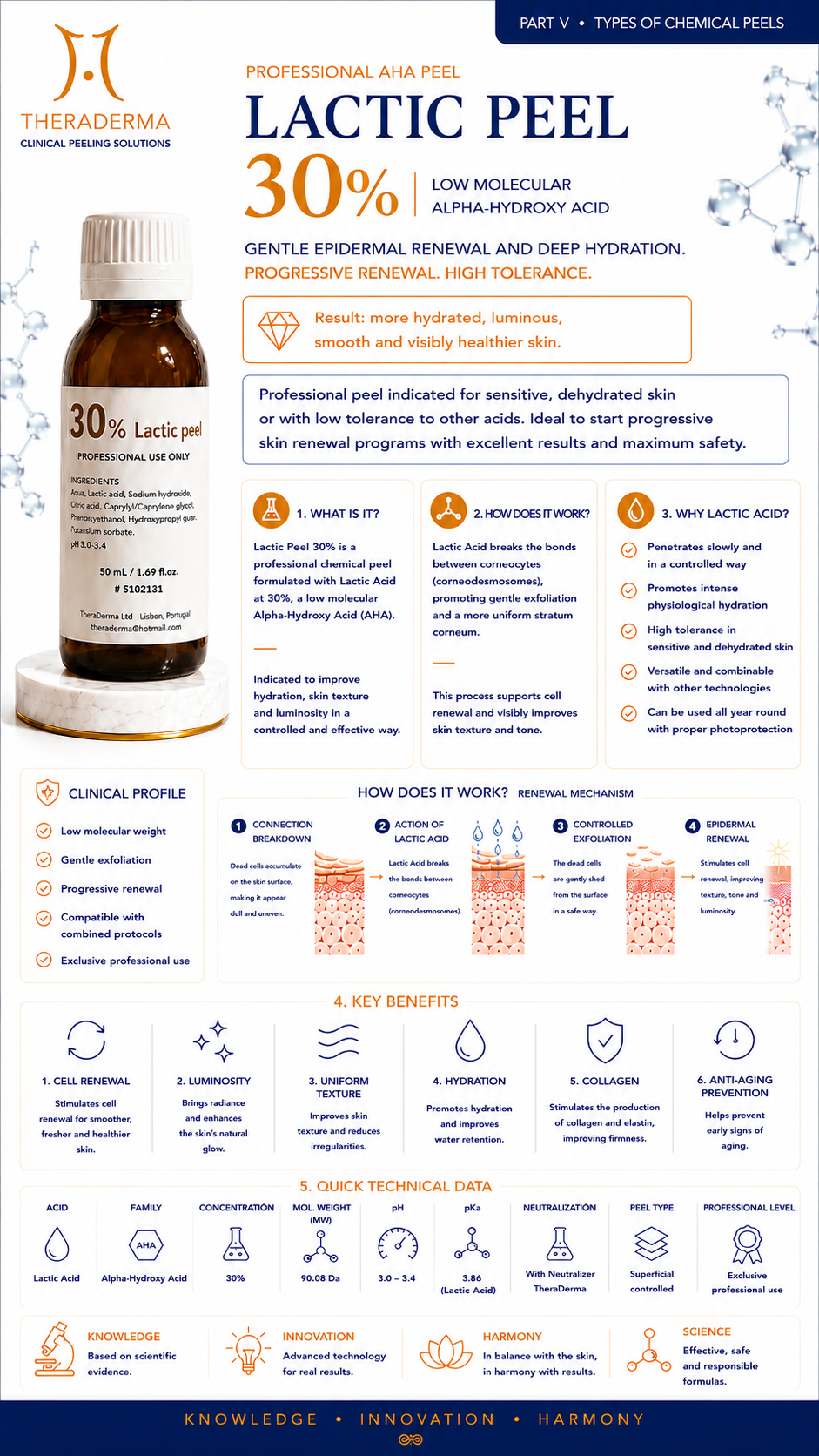
Lactic Peel 30% TherapDerma is a professional chemical peel formulated with 30% Lactic Acid, belonging to the Alpha Hydroxy Acid (AHA) family, developed to provide superficial, progressive and highly tolerable epidermal renewal, while simultaneously promoting skin hydration and improving overall skin quality.
This concentration represents the entry point of professional Lactic Acid protocols within the TherapDerma peel range and has been developed for professionals wishing to perform effective treatments while fully respecting skin physiology, particularly in patients with sensitive, reactive, dehydrated skin or with low tolerance to other exfoliating agents.
Thanks to its higher molecular weight compared with other Alpha Hydroxy Acids, Lactic Acid penetrates the epidermis more slowly and in a more controlled manner, promoting uniform exfoliation with a lower risk of irritation. This characteristic makes it possible to combine epidermal renewal with a unique hydrating action among AHAs, progressively delivering brighter, smoother and more comfortable skin.
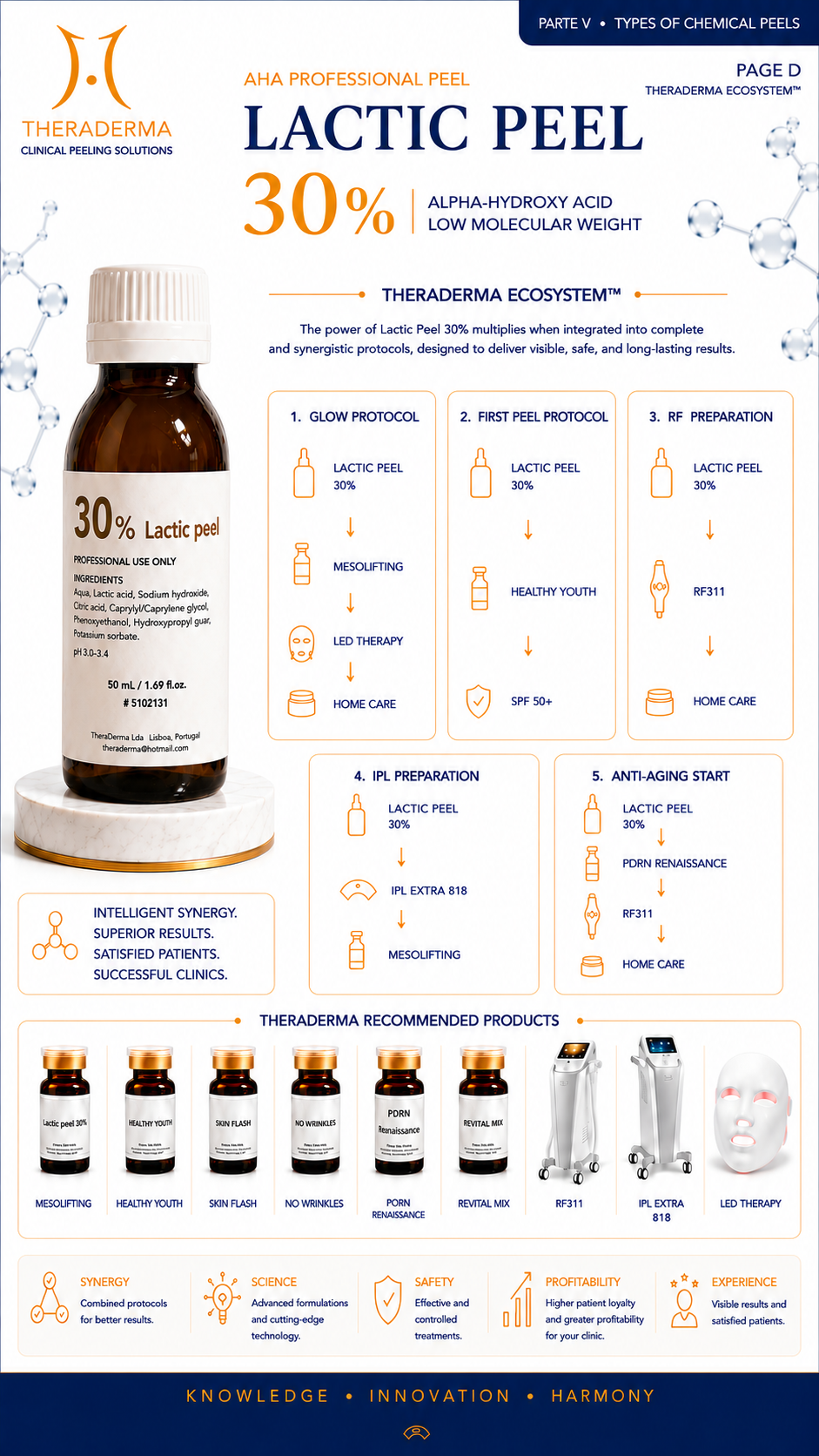
More than simply a chemical peel, Lactic Peel 30% forms part of the TherapDerma Clinical Ecosystem™, a clinical model based on progressive treatment protocols integrating chemical peels, mesotherapy, medical aesthetic technologies and home care to develop personalised, reproducible treatments focused on sustainable results.
What makes Lactic Peel 30% different?
Not all chemical peels are designed to achieve the same level of exfoliation.
While some acids are formulated to produce faster epidermal renewal, Lactic Acid stands out by offering an exceptional balance between efficacy, hydration and tolerability.
Lactic Peel 30% has been developed for professionals wishing to initiate skin renewal programmes progressively, improving skin texture, radiance and overall surface quality without compromising patient comfort.
Its formulation allows the peel to be incorporated into treatment protocols intended for patients requiring controlled exfoliation or presenting skin sensitivity that limits the use of more aggressive acids.
This combination of gradual renewal, high safety and excellent tolerability makes Lactic Peel 30% a particularly versatile tool for everyday clinical practice.
________________________________________
What is Lactic Acid?
Lactic Acid is one of the most widely used Alpha Hydroxy Acids (AHAs) in aesthetic medicine due to its ability to promote controlled superficial exfoliation while helping to maintain the skin’s physiological hydration.
It occurs naturally in various biological processes and forms part of the Natural Moisturising Factor (NMF), a group of substances responsible for maintaining the moisture balance of the stratum corneum.
Its higher molecular weight, compared with Glycolic Acid, slows its diffusion through the epidermis, providing a more gradual and predictable action. This characteristic makes it possible to perform treatment protocols with excellent tolerability, even on delicate skin or skin with a compromised barrier function.
In addition to promoting the progressive removal of aged corneocytes, Lactic Acid helps optimise the skin barrier function and improve the skin’s ability to maintain adequate hydration levels, resulting in a more even, supple and radiant appearance.
________________________________________
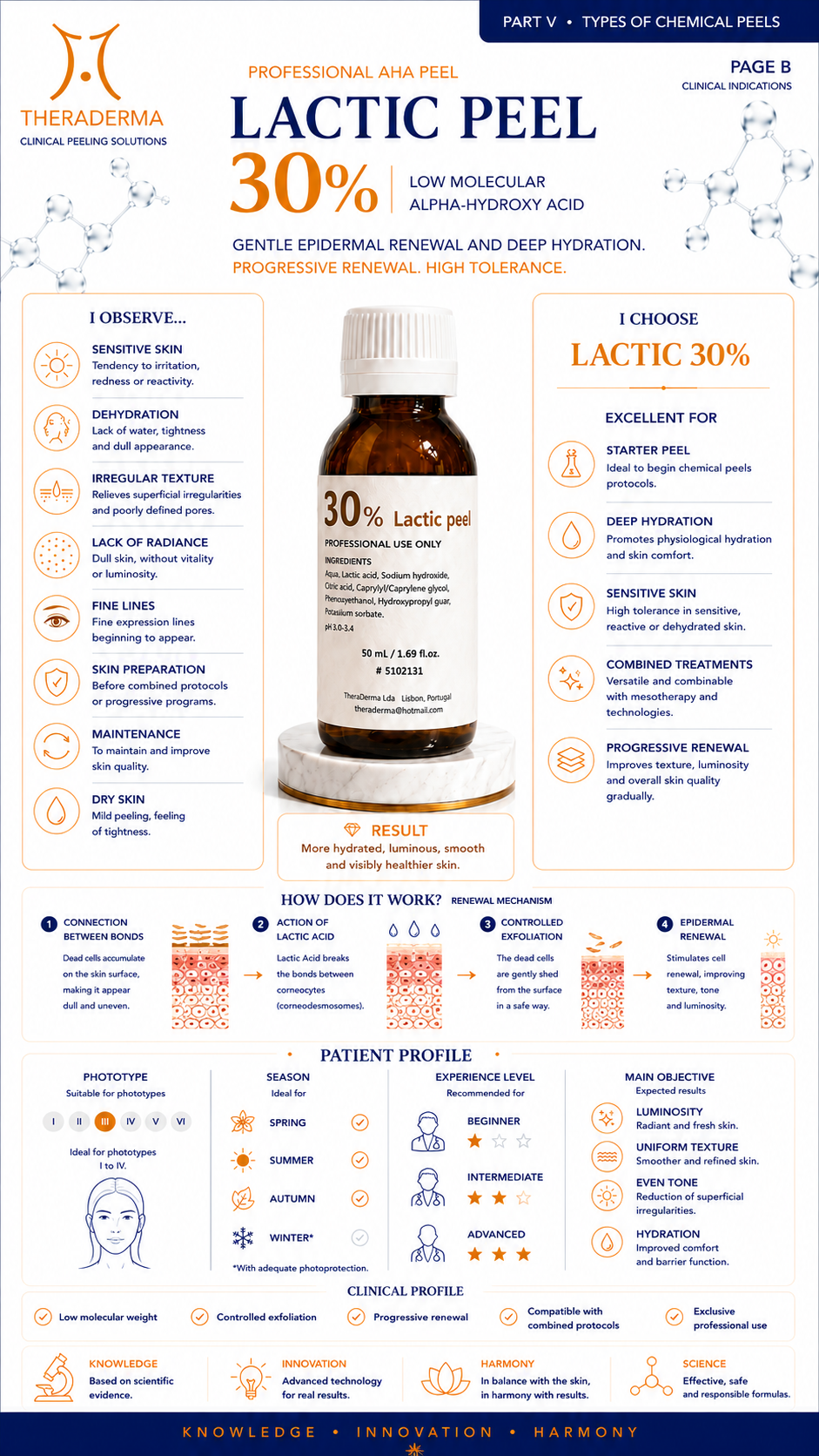
When should Lactic Peel 30% be selected?
Lactic Peel 30% is particularly indicated when professional diagnosis determines the need for gentle epidermal renewal without compromising the skin’s physiological balance.
It may be incorporated into treatment protocols for patients presenting:
• sensitive or reactive skin;
• dry or dehydrated skin;
• early changes in skin texture;
• loss of radiance;
• uneven skin tone;
• early photoageing;
• skin tightness associated with an impaired skin barrier;
• patients beginning professional chemical peel programmes;
• skin preparation before combined treatment protocols;
• skin quality maintenance programmes.
Individual clinical assessment remains the key element in selecting the most appropriate treatment and adapting the protocol to the specific characteristics of each patient.
________________________________________
Position within the TherapDerma Clinical Ladder™
At TherapDerma, we understand that the concentration of a chemical peel is a clinical tool designed to personalise treatment rather than an indicator of therapeutic superiority.
Within the TherapDerma Clinical Ladder™, each concentration corresponds to a specific stage in the patient’s clinical progression.
Lactic Peel 30% represents the first level of renewal using Lactic Acid and is intended to initiate protocols focused on gentle exfoliation, deep hydration and the progressive improvement of skin quality.
Its excellent tolerability profile allows an appropriate biological foundation to be established before progressing to higher concentrations whenever clinical diagnosis and patient evolution indicate this is appropriate.
This step-by-step approach facilitates safer, more personalised treatments that remain consistent with skin physiology.
________________________________________
TherapDerma Philosophy
At TherapDerma, we believe that the best results do not depend on performing increasingly intensive treatments, but on understanding the biological needs of the skin and selecting the most appropriate protocol for each patient.
Skin renewal should always be performed while respecting the integrity of the epidermal barrier, promoting gradual improvement that delivers visible results without compromising treatment tolerability or patient comfort.
For this reason, Lactic Peel 30% has been developed to integrate naturally within the TherapDerma Clinical Ecosystem™, where chemical peels, mesotherapy, medical aesthetic technologies and professional home care work together under a single scientific approach, enabling the development of personalised treatment protocols with a high level of clinical reproducibility.
________________________________________
TherapDerma Conclusion
Lactic Peel 30% represents an essential tool for professionals wishing to initiate epidermal renewal programmes through a progressive, safe approach that fully respects skin physiology.
Its combination of controlled superficial exfoliation, excellent tolerability and intensive hydrating capacity allows gradual improvement in skin quality, enhances patient comfort and establishes a solid foundation for personalised aesthetic medicine protocols.
Integrated within the TherapDerma Clinical Ecosystem™, Lactic Peel 30% forms part of a clinical strategy designed to achieve natural, cumulative and sustainable results through scientifically based treatments tailored to the genuine needs of every patient.
Clinical Benefits
Gentle Epidermal Renewal and Deep Hydration to Progressively Improve Skin Quality
Lactic Peel 30% TherapDerma has been developed for professionals seeking progressive epidermal renewal with an excellent tolerability profile, particularly in patients whose skin requires controlled exfoliation without compromising the skin barrier function.
Thanks to the specific properties of Lactic Acid, this peel combines the gradual removal of corneocytes with a remarkable ability to promote the epidermis’ moisture balance, progressively improving various parameters related to both skin health and overall skin quality.
When incorporated into a personalised professional treatment protocol, its benefits develop session after session, respecting the physiological processes of skin renewal while promoting natural and sustainable results.
________________________________________
💧 Deep Epidermal Hydration
What are the clinical benefits?
Unlike other Alpha Hydroxy Acids, Lactic Acid forms part of the Natural Moisturising Factor (NMF), a group of molecules responsible for maintaining the moisture balance of the stratum corneum.
This characteristic enables the peel not only to renew the skin surface, but also to promote skin that is more comfortable, supple and better able to maintain its physiological hydration.
Clinical benefits
✔ Promotes the epidermis’ moisture balance.
✔ Helps reduce the sensation of dryness.
✔ Improves skin comfort.
✔ Promotes softer, more supple and elastic skin.
________________________________________
✨ Progressive Epidermal Renewal
What are the clinical benefits?
The controlled exfoliation promoted by Lactic Acid facilitates the gradual removal of aged corneocytes, allowing the physiological renewal of the epidermis to take place progressively and evenly.
This action helps improve the skin’s surface quality without causing unnecessary stress to the tissues.
Clinical benefits
✔ Promotes the physiological epidermal turnover.
✔ Progressively improves surface texture.
✔ Contributes to a more even complexion.
✔ Respects skin physiology.
________________________________________
🌟 Enhanced Natural Radiance
What are the clinical benefits?
The gradual removal of aged superficial skin cells allows the skin to reflect light more evenly, promoting a visibly brighter, fresher and healthier appearance.
The combination of renewal and hydration provides an especially natural radiance.
Clinical benefits
✔ Brighter-looking skin.
✔ Fresher overall appearance.
✔ Progressive glow effect.
✔ Healthy and revitalised appearance.
________________________________________
🌿 Improved Skin Comfort
What are the clinical benefits?
The excellent tolerability profile of Lactic Acid allows epidermal renewal protocols to be performed while minimising the discomfort that may occur with more aggressive chemical peels.
This characteristic provides a more comfortable treatment experience for both the practitioner and the patient.
Clinical benefits
✔ Excellent tolerability.
✔ Reduced sensation of irritation.
✔ Greater comfort throughout the treatment protocol.
✔ Suitable for delicate skin.
________________________________________
🎯 Progressive Improvement in Skin Tone Uniformity
What are the clinical benefits?
The even renewal of the superficial layers promotes a more uniform skin appearance, helping to visibly improve minor irregularities affecting the overall complexion.
Clinical benefits
✔ Visibly more even skin tone.
✔ More balanced skin surface.
✔ Improved skin uniformity.
✔ More refined appearance.
________________________________________
🌸 Smoother and More Refined Skin Texture
What are the clinical benefits?
The progressive reorganisation of the epidermal surface provides skin that feels softer to the touch and displays a visibly finer texture, improving overall skin quality without the need for aggressive exfoliation.
Clinical benefits
✔ Smoother skin texture.
✔ Silkier skin.
✔ Reduced feeling of roughness.
✔ Improved surface quality.
________________________________________
🛡️ Respect for the Skin Barrier Function
What are the clinical benefits?
The gradual action of Lactic Acid allows treatment protocols to better preserve the integrity of the skin barrier, promoting appropriate physiological recovery between sessions and enabling progressive treatment plans with an excellent safety profile.
Clinical benefits
✔ Preserves the physiological balance.
✔ Supports skin recovery.
✔ Excellent safety profile.
✔ Ideal for progressive treatment protocols.
________________________________________
📈 Progressive and Cumulative Results
The benefits of Lactic Peel 30% do not depend on a single application.
Epidermal renewal is a continuous physiological process, therefore the most noticeable improvements appear progressively as the treatment protocol advances and the skin’s natural recovery time between sessions is respected.
The combination of appropriate patient selection, individualised diagnosis and proper clinical planning allows increasingly consistent, natural and long-lasting results to be achieved.
________________________________________
CLINICAL SUMMARY
Main Benefits of Lactic Peel 30%
✔ Deep epidermal hydration.
✔ Progressive epidermal renewal.
✔ Enhanced natural radiance.
✔ Improved skin comfort.
✔ Progressive improvement in skin tone uniformity.
✔ Refinement of surface texture.
✔ Respect for the skin barrier function.
✔ Progressive and cumulative results.
________________________________________
THERAPDERMA CLINICAL CONCLUSION
The true value of Lactic Peel 30% lies in its ability to combine gentle epidermal renewal with an intensive hydrating action, providing professionals with a particularly suitable solution for patients requiring effective treatments with an excellent tolerability profile.
When integrated into personalised treatment protocols, it progressively improves the skin’s surface quality while preserving its physiological balance, expanding therapeutic possibilities through an approach based on personalisation, safety and the gradual evolution of results within the TherapDerma Clinical Ecosystem™.
Why Choose Lactic Peel 30%?
The Smart Choice for Gentle Skin Renewal and Professional Hydration Protocols
In professional aesthetic medicine, the success of a treatment does not depend on using the strongest peel, but on selecting the active ingredient and concentration that best match the clinical diagnosis, the functional condition of the skin and the therapeutic objectives of each patient.
Lactic Peel 30% has been developed for professionals wishing to perform effective epidermal renewal while maintaining a high level of skin comfort, making it an excellent choice for patients requiring progressive treatments with excellent tolerability.
Its formulation combines superficial exfoliation, physiological hydration and the gradual improvement of skin quality, expanding therapeutic possibilities without compromising the balance of the epidermal barrier.
Rather than increasing treatment intensity, Lactic Peel 30% enables professionals to develop smarter treatment protocols, where skin physiology guides every clinical decision.
________________________________________
WHEN IS IT THE BEST CHOICE?
Lactic Peel 30% is particularly suitable when the practitioner wishes to perform gentle epidermal renewal while maintaining maximum respect for skin physiology.
It may be considered an excellent option in situations such as:
✔ patients with sensitive or reactive skin;
✔ dry or dehydrated skin;
✔ early signs of photoageing;
✔ loss of radiance and freshness;
✔ slightly uneven skin texture;
✔ patients beginning chemical peel treatments;
✔ skin quality maintenance programmes;
✔ biological skin preparation before combined treatment protocols;
✔ patients who do not tolerate more aggressive chemical peels.
The choice of peel should always be based on an individual clinical assessment, taking into account the patient’s medical history, skin barrier function and established therapeutic objectives.
________________________________________
WHO HAS IT BEEN DESIGNED FOR?
Lactic Peel 30% has been developed for professionals who understand that high-quality aesthetic medicine begins with an accurate diagnosis and the selection of the most appropriate treatment for each skin type.
Its excellent safety profile allows it to be incorporated both into clinics with extensive experience in chemical peels and by professionals wishing to develop progressive treatment protocols based on treatment personalisation.
Its versatility facilitates the planning of skin renewal programmes adapted to different age groups, skin phototypes and levels of sensitivity, enabling effective treatments with high levels of patient satisfaction.
________________________________________
THERAPDERMA CLINICAL LADDER™
Each concentration represents a different stage in the patient’s therapeutic progression.
Clinical progression allows treatment intensity to be increased gradually only when the biological response and skin tolerability justify doing so.
Lactic Peel 30%
Ideal for:
✔ first experience with Lactic Acid peels;
✔ sensitive skin;
✔ dry or dehydrated skin;
✔ active hydration protocols;
✔ skin quality maintenance;
✔ preparation for combined treatment protocols.
Lactic Peel 40%
Ideal for:
✔ more intensive epidermal renewal;
✔ early or moderate photoageing;
✔ more noticeable loss of radiance;
✔ advanced skin texture improvement;
✔ patients already adapted to Lactic Acid;
✔ progressive rejuvenation protocols.
Each concentration corresponds to a different stage within the patient’s clinical progression and should never be interpreted as a superior treatment, but rather as a tool designed to personalise therapy according to each patient’s actual needs.
________________________________________
QUICK SELECTION GUIDE
Clinical Objective Recommended Peel
First AHA treatment ✅ Lactic Peel 30%
Sensitive skin ✅ Lactic Peel 30%
Dry or dehydrated skin ✅ Lactic Peel 30%
Restore radiance ✅ Lactic Peel 30%
Gentle skin renewal ✅ Lactic Peel 30%
Deep hydration ✅ Lactic Peel 30%
Progressive skin renewal ✅ Lactic Peel 40%
More irregular skin texture ✅ Lactic Peel 40%
Greater need for exfoliation ✅ Lactic Peel 40%
Moderate photoageing ✅ Lactic Peel 40%
This guidance facilitates the selection of the most appropriate peel within a personalised therapeutic strategy, always respecting the skin’s clinical progression and avoiding unnecessarily intensive treatments.
________________________________________
WHY INTEGRATE IT INTO A PROGRESSIVE PROGRAMME?
The skin responds more effectively when epidermal renewal develops gradually while respecting its natural adaptation mechanisms.
Within this context, Lactic Peel 30% represents the ideal starting point for building progressive rejuvenation protocols, allowing skin quality to improve from the very first sessions without disrupting the skin barrier function.
Its use promotes excellent tissue adaptation before considering higher concentrations or complementary treatments, enabling the practitioner to plan each stage of the protocol based on the biological response achieved.
This approach reduces the likelihood of unnecessary reactions, improves treatment continuity and facilitates treatment personalisation according to the clinical evolution observed in each patient.
________________________________________
THERAPDERMA CLINICAL CONCLUSION
Lactic Peel 30% is a highly valuable tool for professionals seeking to initiate epidermal renewal programmes through a progressive, safe approach that fully respects skin physiology.
Its ability to combine superficial exfoliation, hydration and excellent tolerability makes it possible to develop treatment protocols adapted to patients with different needs, reinforcing an approach to aesthetic medicine based on diagnosis, personalisation and clinical progression.
Within the TherapDerma Clinical Ladder™, it represents the first step towards more advanced skin renewal treatments, providing a solid foundation for building effective, predictable and scientifically based protocols within the TherapDerma Clinical Ecosystem™.
Areas of Application
One Peel. Multiple Clinical Applications with Maximum Tolerability.
Lactic Peel 30% TherapDerma has been developed to integrate into a wide range of professional epidermal renewal and skin hydration protocols, allowing different anatomical areas to be treated according to the clinical diagnosis, skin characteristics and established therapeutic objectives.
Thanks to its excellent tolerability and its ability to simultaneously promote superficial renewal and physiological hydration, it is an excellent choice for areas where the skin is more sensitive or where an optimal balance between efficacy and comfort is desired.
Although the face represents its primary clinical indication, Lactic Peel 30% may also be incorporated into programmes designed to progressively improve the skin quality of other photo-exposed areas, always under professional judgement.
Each anatomical area has a different epidermal thickness, skin barrier function and biological response; therefore, every treatment protocol should be individually adapted to each patient.
________________________________________
FACE
The Primary Clinical Indication
The face is the anatomical area where Lactic Peel 30% delivers the greatest part of its therapeutic potential.
Continuous exposure to ultraviolet radiation, environmental pollution, moisture imbalance and physiological ageing progressively contribute to dull, rough or dehydrated skin.
The combination of gentle exfoliation and deep hydration progressively improves:
✔ skin radiance;
✔ surface texture;
✔ skin hydration;
✔ skin tone uniformity;
✔ skin softness;
✔ overall skin quality.
________________________________________
NECK
The Natural Continuation of Facial Rejuvenation
The skin of the neck has a lower dermal density and a more delicate barrier function than facial skin.
These characteristics require treatments capable of respecting its physiology while progressively improving its surface quality.
Lactic Peel 30% may be incorporated into treatment protocols designed to maintain a harmonious aesthetic transition between the face and neck, promoting skin that is more hydrated, even and radiant.
________________________________________
DÉCOLLETAGE
Renewal and Hydration for One of the Most Photo-Exposed Areas
The décolletage often displays the cumulative effects of sun exposure and the progressive loss of skin hydration at an early stage.
The combined action of Lactic Acid progressively improves the skin’s surface texture while promoting a more even appearance without compromising comfort in this particularly delicate area.
________________________________________
BACK OF THE HANDS
Maintaining Skin Quality in a Constantly Exposed Area
The hands are among the anatomical regions that show signs of skin ageing most rapidly due to continuous exposure to sunlight and environmental factors.
Lactic Peel 30% may form part of treatment protocols aimed at progressively improving the softness, radiance and superficial hydration of the back of the hands, promoting a more even and well-cared-for appearance.
________________________________________
ARMS
Progressive Improvement of Surface Texture
In selected patients, particularly those presenting dry skin or mild textural irregularities, Lactic Peel 30% may be incorporated into treatment programmes designed to improve the skin quality of the arms.
Its excellent tolerability makes it possible to treat these areas through progressive treatment protocols adapted to each patient’s individual needs.
________________________________________
BACK
Selected Protocols to Improve Skin Quality
In appropriately assessed patients, Lactic Peel 30% may be used on selected areas of the back when the clinical objective is to promote gentle epidermal renewal together with a progressive improvement in hydration and surface texture.
The treatment area and treatment frequency should always be adapted according to the observed clinical response.
________________________________________
CLINICAL PRIORITISATION OF TREATMENT AREAS
Anatomical Area Clinical Potential
⭐⭐⭐⭐⭐ Face
⭐⭐⭐⭐ Neck
⭐⭐⭐⭐ Décolletage
⭐⭐⭐⭐ Back of the hands
⭐⭐⭐ Arms
⭐⭐⭐ Back (selected areas)
This classification is intended as a practical guide to facilitate clinical planning and the selection of treatment areas with the greatest therapeutic potential according to the patient’s profile.
________________________________________
MULTI-AREA PROTOCOLS
In many patients, the best results are not achieved by treating a single anatomical region, but by developing treatment protocols that maintain aesthetic harmony between different photo-exposed areas.
The most common combinations include:
✔ Face + neck.
✔ Face + neck + décolletage.
✔ Face + back of the hands.
✔ Facial programmes combined with localised body hydration protocols.
The final choice should always depend on the professional diagnosis, the skin’s hydration status and the therapeutic objectives established for each patient.
________________________________________
CLINICAL CONSIDERATIONS
Before selecting the treatment area, the practitioner should assess:
✔ skin hydration status;
✔ integrity of the skin barrier function;
✔ epidermal thickness;
✔ skin sensitivity;
✔ degree of photoageing;
✔ dermatological history;
✔ previous aesthetic treatments;
✔ the patient’s therapeutic objectives.
Each treatment protocol should progress individually according to the biological response observed during the different treatment sessions.
________________________________________
QUICK SUMMARY
Lactic Peel 30% may be incorporated into professional treatment protocols for:
✔ Face.
✔ Neck.
✔ Décolletage.
✔ Back of the hands.
✔ Arms.
✔ Back (selected areas).
✔ Other areas, always subject to professional assessment and clinical judgement.
________________________________________
THERAPDERMA CONCLUSION
The excellent tolerability and hydrating properties of Lactic Peel 30% allow it to be integrated into multiple anatomical areas through personalised treatment protocols designed to progressively improve the skin’s surface quality.
The correct selection of the treatment area, together with thorough clinical assessment and individual adaptation of the treatment protocol, enables safe, consistent and highly reproducible procedures while respecting skin physiology and reinforcing the scientific approach that defines the TherapDerma Clinical Ecosystem™.
How Does It Work?
Understanding the Biological Process Makes It Possible to Optimise Clinical Results
Although the application of Lactic Peel 30% TherapDerma takes only a few minutes, the biological response it initiates continues to develop over the following days.
Each treatment session triggers a carefully controlled physiological process designed to promote progressive epidermal renewal, preserve the balance of the skin barrier and improve the skin’s natural ability to maintain adequate hydration.
Understanding each of these stages enables the practitioner to plan more precise treatment protocols, correctly interpret the clinical progression and establish realistic expectations for every patient.
Unlike other Alpha Hydroxy Acids with greater penetration capacity, Lactic Acid develops a more gradual action, making it an excellent tool for treatments where comfort, tolerability and progressive recovery are therapeutic priorities.
________________________________________
EVERYTHING BEGINS AT THE SKIN SURFACE
The peel first comes into contact with the stratum corneum, the outermost layer of the epidermis.
Over time, this structure accumulates aged corneocytes, keratin debris and alterations in the skin’s moisture balance that reduce radiance, affect skin texture and diminish the skin’s natural suppleness.
The application of Lactic Peel 30% initiates a carefully controlled chemical exfoliation that promotes the progressive removal of these superficial cells while helping to maintain optimal epidermal hydration.
This process represents the first step towards smoother, more radiant and more comfortable skin.
________________________________________
STEP 1
Gentle and Controlled Chemical Exfoliation
Lactic Acid begins by acting on the outermost layers of the stratum corneum, gradually reducing the cohesion between aged corneocytes.
As a result, the epidermis initiates a physiological process of controlled desquamation that facilitates the even removal of superficial skin cells without significantly disturbing the skin’s natural balance.
Thanks to its higher molecular weight, this action develops progressively and in a highly predictable manner.
________________________________________
STEP 2
Physiological Renewal of the Epidermis
Once exfoliation has begun, the epidermis responds by activating its natural cell renewal process.
New cells gradually migrate from the basal layers towards the surface, progressively replacing those removed during treatment.
This physiological mechanism promotes the gradual reorganisation of the epidermis while fully respecting each patient’s natural biological renewal cycle.
________________________________________
STEP 3
Restoration of the Skin’s Moisture Balance
As epidermal renewal progresses, Lactic Acid helps create a more favourable environment for maintaining the physiological hydration of the stratum corneum.
Its role within the Natural Moisturising Factor (NMF) makes this a distinctive characteristic compared with other Alpha Hydroxy Acids, allowing the skin to progressively regain greater suppleness, softness and comfort.
This hydrating action accompanies epidermal renewal throughout the entire treatment protocol.
________________________________________
STEP 4
Visible Improvement in Skin Quality
As the epidermis reorganises, the skin surface develops a more homogeneous structure.
As a result, the skin may progressively present:
✔ improved hydration;
✔ more refined texture;
✔ a more even appearance;
✔ natural radiance;
✔ greater softness to the touch;
✔ enhanced skin comfort.
These changes appear gradually as treatment progresses and the recommended intervals between sessions are respected.
________________________________________
STEP 5
Cumulative Results
Each treatment session acts as a new biological stimulus for the epidermis.
When the treatment protocol respects the skin’s physiological recovery time, the benefits accumulate progressively, allowing more predictable treatments with consistent clinical progression.
For this reason, Lactic Peel 30% reaches its full potential when incorporated into a structured and personalised programme, where each session prepares the skin for the next stage of treatment.
________________________________________
WHY IS HYDRATION SO IMPORTANT?
Epidermal renewal is not simply about removing superficial skin cells.
A properly hydrated epidermis maintains a better-organised stratum corneum, a more efficient barrier function and responds more favourably to professional treatments.
Lactic Acid offers the particular advantage of combining progressive exfoliation with physiological hydration within the same procedure, allowing treatment protocols to achieve an excellent balance between efficacy and tolerability.
These concepts are explored in greater depth in the Scientific Foundations section.
________________________________________
A DIFFERENT RESPONSE IN EVERY PATIENT
Clinical progression is never exactly the same in two individuals.
Factors such as:
✔ biological age;
✔ skin hydration status;
✔ thickness of the stratum corneum;
✔ skin phototype;
✔ individual sensitivity;
✔ skincare routine;
✔ previous aesthetic treatments;
✔ the skin’s regenerative capacity;
directly influence the response observed after each treatment session.
For this reason, every treatment protocol should be individually adapted.
________________________________________
BIOLOGICAL PROCESS SEQUENCE
Professional application
↓
Gentle chemical exfoliation
↓
Progressive removal of corneocytes
↓
Physiological renewal of the epidermis
↓
Optimisation of the skin’s moisture balance
↓
Reorganisation of the skin surface
↓
Progressive improvement in skin texture
↓
Enhanced natural radiance
↓
Overall improvement in skin quality
________________________________________
KEY MECHANISMS OF ACTION
Lactic Peel 30% promotes:
✔ Controlled chemical exfoliation.
✔ Progressive epidermal renewal.
✔ Maintenance of physiological skin hydration.
✔ Improvement of surface texture.
✔ Enhanced natural radiance.
✔ Preservation of the skin barrier function.
✔ Cumulative results through personalised treatment protocols.
________________________________________
THERAPDERMA CONCLUSION
Understanding how Lactic Peel 30% works enables the practitioner to go far beyond the simple application of a chemical peel.
Each treatment session initiates an organised biological sequence that combines progressive epidermal renewal, preservation of the skin’s moisture balance and the gradual improvement of skin quality. Integrated into a personalised treatment protocol, this process enables the development of scientifically based, highly tolerable treatments designed to deliver natural, consistent and sustainable results within the TherapDerma Clinical Ecosystem™.
Mechanism of Action
The Science Behind Epidermal Renewal that Respects Skin Physiology
Lactic Peel 30% TherapDerma exerts its action through a progressive chemical exfoliation mechanism that acts primarily on the most superficial layers of the epidermis, promoting controlled renewal of the stratum corneum while helping to preserve the skin’s moisture balance and barrier function.
Its biological behaviour is based on the interaction between Lactic Acid and the structures responsible for corneocyte cohesion, initiating a physiological renewal process that continues to develop gradually during the days following treatment.
Unlike other Alpha Hydroxy Acids with a lower molecular weight, Lactic Acid penetrates the skin more slowly and in a more controlled manner, allowing effective exfoliation with excellent clinical tolerability.
Understanding this mechanism enables practitioners to select more precise treatment protocols, correctly interpret skin progression and adapt treatment to the individual characteristics of each patient.
________________________________________
ACTION ON THE STRATUM CORNEUM
The stratum corneum constitutes the body’s first protective barrier against the external environment.
It is composed of corneocytes organised into multiple layers and connected by specialised protein structures known as corneodesmosomes, which are responsible for maintaining the cohesion and stability of the epidermis.
With ageing, ultraviolet radiation and environmental factors, physiological skin renewal may slow down, promoting the accumulation of aged cells, loss of radiance and a progressive decline in the skin’s surface quality.
Lactic Peel 30% initially acts on this layer, promoting gradual renewal without significantly altering the integrity of the epidermal barrier.
________________________________________
MODULATION OF CORNEODESMOSOMES
The primary cosmetic mechanism of Lactic Acid is to promote a gradual reduction in cohesion between superficial corneocytes.
This action facilitates controlled and even desquamation, allowing aged cells to be eliminated in accordance with the epidermis’ natural physiological renewal cycle.
As a result, the skin surface progressively develops a more regular architecture, contributing to improved overall skin quality.
Thanks to the characteristics of Lactic Acid, this process occurs gradually, providing an excellent balance between clinical efficacy and tolerability.
________________________________________
PHYSIOLOGICAL RENEWAL OF THE EPIDERMIS
Superficial exfoliation represents only the beginning of the biological process.
Once aged corneocytes have been removed, the epidermis responds by activating its natural cell renewal mechanism.
New cells generated within the basal layers gradually migrate towards the surface, replacing the structures removed during treatment and promoting the progressive reorganisation of the epidermal tissue.
This process contributes to restoring a smoother, brighter and healthier skin surface without disrupting the skin’s normal physiology.
________________________________________
OPTIMISATION OF THE SKIN’S MOISTURE BALANCE
One of the distinguishing characteristics of Lactic Acid compared with other Alpha Hydroxy Acids is its role within the Natural Moisturising Factor (NMF).
This group of molecules plays an essential role in the epidermis’ ability to retain water and maintain optimal hydration.
Throughout the epidermal renewal process, Lactic Acid promotes a physiological environment that helps preserve superficial hydration, allowing the skin to maintain greater elasticity, suppleness and comfort.
This characteristic makes Lactic Peel 30% particularly suitable for treatment protocols designed for dry, sensitive or dehydration-prone skin.
________________________________________
REORGANISATION OF THE SKIN SURFACE
As physiological renewal progresses, the architecture of the stratum corneum gradually becomes more homogeneous.
The organised reorganisation of the skin surface promotes:
✔ a more even texture;
✔ improved light reflection;
✔ a smoother skin surface;
✔ greater softness to the touch;
✔ a healthier appearance;
✔ improved overall skin quality.
These changes appear progressively as the treatment protocol advances.
________________________________________
BIOLOGICAL PREPARATION FOR SUBSEQUENT TREATMENTS
A properly renewed and hydrated epidermis provides an optimal biological foundation for integrating other medical aesthetic therapies.
For this reason, Lactic Peel 30% may be incorporated as the initial stage of sequential treatment protocols followed by mesotherapy, biostimulation, regenerative technologies or other personalised treatments.
This strategy promotes more structured treatment planning without compromising the skin’s natural physiology.
________________________________________
MECHANISM OF ACTION SEQUENCE
Professional application
↓
Action on the stratum corneum
↓
Progressive reduction of corneocyte cohesion
↓
Controlled chemical exfoliation
↓
Physiological renewal of the epidermis
↓
Optimisation of the skin’s moisture balance
↓
Reorganisation of the skin microrelief
↓
Progressive improvement in skin texture and radiance
↓
Overall optimisation of the skin’s surface quality
________________________________________
SCIENCE AT A GLANCE™
Parameter Lactic Peel 30%
Active ingredient Lactic Acid
Chemical family Alpha Hydroxy Acids (AHA)
Concentration 30%
Primary level of action Epidermis
Target structure Stratum corneum
Biological action Progressive modulation of corneocyte cohesion
Distinctive action Promotes physiological epidermal hydration
Physiological result Progressive epidermal renewal
Cosmetic objective Improve skin surface quality and hydration
________________________________________
BIOLOGICAL FOUNDATION
The mechanism of action of Lactic Peel 30% is based on promoting the progressive physiological renewal of the epidermis through carefully controlled chemical exfoliation.
The combination of superficial renewal, reorganisation of the stratum corneum and maintenance of the skin’s moisture balance progressively optimises skin quality while respecting its barrier function and natural regenerative mechanisms.
This balance between clinical efficacy, hydration and excellent tolerability is one of the defining characteristics that distinguishes Lactic Acid within the Alpha Hydroxy Acid family.
________________________________________
THERAPDERMA CONCLUSION
The true value of Lactic Peel 30% lies in understanding that its action extends far beyond simple superficial exfoliation.
Its biological mechanism promotes organised epidermal renewal while helping to preserve physiological hydration and the skin’s functional balance, enabling the development of highly personalised, safe and scientifically based treatment protocols.
Integrated within the TherapDerma Clinical Ecosystem™, it represents an essential tool for professionals seeking to combine efficacy, comfort and clinical excellence through progressive treatments tailored to the genuine needs of every patient.
Scientific Foundations
The Formulation Determines the Behaviour of the Peel
In professional aesthetic medicine, the efficacy of a chemical peel does not depend solely on the acid concentration.
The clinical behaviour of a formulation is determined by the interaction between different physicochemical parameters that regulate the availability of free acid, the rate of penetration, the intensity of exfoliation and the skin’s biological response.
Understanding these principles enables the practitioner to correctly interpret the peel’s mechanism of action, select the most appropriate treatment protocols and personalise treatment according to the specific characteristics of each patient.
In Lactic Peel 30% TherapDerma, all of these factors have been carefully considered to provide progressive, highly tolerable and scientifically controlled exfoliation, particularly suitable for sensitive, dry skin or skin with a compromised barrier function.
________________________________________
CONCENTRATION
Much More Than a Percentage
Concentration indicates the amount of Lactic Acid present in the formulation.
In Lactic Peel 30%, this concentration has been designed to provide progressive epidermal renewal that improves the skin’s surface quality while maintaining an excellent tolerability profile.
However, a higher concentration does not necessarily imply greater clinical efficacy.
The actual behaviour of the peel depends on the interaction between the concentration, the formulation’s pH, the acid’s pKa, the amount of free acid available and the application technique used by the practitioner.
For this reason, concentration represents only one of the factors determining the biological response to treatment.
________________________________________
THE ROLE OF pH
The pH represents the level of acidity of the formulation and is one of the most important parameters in the design of any chemical peel.
Its value directly influences the amount of free acid available to act on the epidermis and, consequently, the intensity of exfoliation.
Two peels containing the same concentration of Lactic Acid may display different clinical behaviour if the pH of their formulations is not the same.
For this reason, the development of a professional peel requires a precise balance between efficacy, safety and tolerability.
________________________________________
THE SIGNIFICANCE OF pKa
The pKa is a physicochemical constant characteristic of each acid and explains the balance between its ionised and non-ionised forms.
In the case of Lactic Acid, the pKa is approximately 3.86, a value that helps determine the proportion of free acid available to exert its exfoliating action.
When the formulation’s pH approaches this value, the balance between these two chemical forms changes, influencing the biological activity of the peel.
Understanding this relationship explains why concentration alone does not determine the clinical behaviour of a chemical peel.
________________________________________
FREE ACID
The True Driver of Exfoliation
Not all of the Lactic Acid present in the formulation acts on the skin simultaneously.
The fraction known as free acid is responsible for interacting directly with the stratum corneum and initiating the chemical exfoliation process.
The amount of free acid available depends on the balance between:
✔ concentration;
✔ pH;
✔ pKa.
This balance allows progressive and highly controlled exfoliation, a characteristic that distinguishes Lactic Peel 30% as an excellent choice for treatment protocols where safety and tolerability are key clinical priorities.
________________________________________
MOLECULAR WEIGHT
Lactic Acid has a higher molecular weight than Glycolic Acid.
This characteristic partially limits its rate of diffusion through the stratum corneum, promoting slower penetration and a more controlled clinical response.
As a result, exfoliation develops progressively, allowing excellent tolerability even in patients with sensitive or dehydrated skin.
This difference is one of the main reasons why Lactic Acid occupies a prominent place in treatment protocols designed to preserve the skin barrier while simultaneously improving skin hydration.
________________________________________
PEEL DEPTH
The depth reached during a chemical peel never depends exclusively on the formulation.
It is also influenced by factors such as:
✔ skin preparation;
✔ exposure time;
✔ number of layers applied;
✔ application technique;
✔ skin hydration status;
✔ thickness of the stratum corneum;
✔ individual biological response;
✔ neutralisation.
For this reason, the same product may produce different clinical responses depending on each patient’s specific characteristics and the treatment plan established by the practitioner.
________________________________________
THE IMPORTANCE OF HYDRATION
One of the distinguishing characteristics of Lactic Acid is its ability to support the maintenance of the epidermis’ moisture balance during the skin renewal process.
As a component of the Natural Moisturising Factor (NMF), it helps preserve physiological conditions that support the skin barrier while exfoliation takes place.
This combination of superficial renewal and hydration is one of the principal scientific foundations supporting its use in sensitive, dry or dehydration-prone skin.
________________________________________
KEY SCIENTIFIC PARAMETERS
Parameter Lactic Peel 30%
Active ingredient Lactic Acid
Chemical family Alpha Hydroxy Acids (AHA)
Concentration 30%
pH Approximately 3.5*
pKa 3.86
Molecular weight Higher than Glycolic Acid
Penetration profile Progressive and controlled
Distinctive action Renewal + Physiological Hydration
Neutralisation Recommended according to the professional treatment protocol
Use Professional use only
*The exact value may vary slightly depending on the final product formulation.
________________________________________
WHY IS IT IMPORTANT TO UNDERSTAND THESE CONCEPTS?
When practitioners correctly understand the relationship between concentration, pH, pKa, free acid, molecular weight and the physiological condition of the skin, they are able to:
✔ select the most appropriate peel;
✔ personalise every treatment protocol;
✔ optimise treatment tolerability;
✔ preserve the skin barrier function;
✔ improve clinical predictability;
✔ increase procedural safety;
✔ achieve progressive and reproducible results.
Science enables knowledge to be transformed into better clinical decisions.
________________________________________
THERAPDERMA CONCLUSION
Lactic Peel 30% has been developed based on physicochemical principles widely recognised in dermatology and aesthetic medicine.
The interaction between concentration, pH, pKa, free acid, molecular weight and the skin’s hydration status determines the peel’s biological behaviour and enables progressive epidermal renewal protocols to be carried out with a high level of control and safety.
At TherapDerma, we believe that clinical excellence begins with scientific knowledge and the practitioner’s ability to apply that knowledge in a personalised manner, always respecting skin physiology while promoting natural, consistent and sustainable results within the TherapDerma Clinical Ecosystem™.
Indications
When Should Lactic Peel 30% Be Selected?
The selection of a professional chemical peel should always be based on a comprehensive clinical assessment, taking into account the skin type, the condition of the skin barrier, hydration levels, therapeutic objectives and the expected biological response.
Lactic Peel 30% TherapDerma is particularly indicated when the practitioner wishes to perform gentle epidermal renewal while progressively improving hydration and the skin’s surface quality, maintaining an excellent tolerability profile.
Its biological behaviour makes it an excellent choice for patients requiring progressive treatments, sensitive skin or treatment protocols where preserving the skin’s physiological balance is a primary objective.
The selection of this concentration should always form part of a personalised therapeutic strategy and should never be based solely on the acid concentration.
________________________________________
DRY OR DEHYDRATED SKIN
Increased transepidermal water loss and a reduction in the skin’s natural moisturising factors contribute to skin that appears dull, rough and less supple.
Thanks to the ability of Lactic Acid to support the maintenance of the epidermis’ moisture balance, Lactic Peel 30% represents an excellent option within treatment protocols designed to progressively improve superficial hydration and the overall quality of this type of skin.
________________________________________
SENSITIVE OR REACTIVE SKIN
Sensitive skin frequently displays increased susceptibility to external stimuli and requires treatments that respect its natural physiology.
The progressive behaviour of Lactic Acid allows epidermal renewal protocols to be carried out with an excellent level of tolerability, promoting the gradual improvement of skin quality without resorting to excessively aggressive exfoliation.
Treatment planning should always be adapted to the individual clinical response of each patient.
________________________________________
LOSS OF RADIANCE
The accumulation of aged corneocytes and the reduction in physiological cell turnover may cause the skin to appear dull and tired.
The controlled exfoliation promoted by Lactic Peel 30% progressively improves the skin’s ability to reflect light evenly, resulting in a brighter, fresher and healthier-looking complexion.
________________________________________
UNEVEN SKIN TEXTURE
Minor irregularities in the skin’s surface are among the most common reasons for consultation in aesthetic medicine.
The progressive epidermal renewal promoted by Lactic Acid helps reorganise the skin surface, resulting in smoother, more even skin with an improved tactile feel.
________________________________________
EARLY PHOTOAGEING
The first manifestations of ultraviolet-induced skin ageing are often accompanied by reduced radiance, mild textural irregularities and decreased superficial hydration.
In appropriately selected patients, Lactic Peel 30% may be incorporated into treatment protocols designed to progressively improve the skin’s overall appearance through gentle, physiological renewal.
________________________________________
EARLY SIGNS OF AGEING
Fine lines and the gradual decline in skin quality are common changes during the early stages of the ageing process.
The progressive improvement in skin texture, hydration and surface uniformity promoted by Lactic Peel 30% makes this peel suitable for inclusion in preventative skin rejuvenation programmes.
________________________________________
PREPARATION FOR COMBINED TREATMENT PROTOCOLS
A properly renewed and hydrated epidermis provides an optimal biological foundation for integrating other medical aesthetic treatments.
For this reason, Lactic Peel 30% may be used as the initial stage of personalised treatment protocols that subsequently incorporate mesotherapy, biostimulation, regenerative technologies or other professional solutions, always according to the clinical diagnosis and therapeutic treatment plan.
________________________________________
MAINTAINING SKIN QUALITY
In patients who have already completed skin rejuvenation or epidermal renewal programmes, Lactic Peel 30% may be incorporated into maintenance strategies designed to preserve hydration, radiance and overall skin quality.
The frequency of maintenance sessions should always be established individually according to the patient’s clinical progression and specific needs.
________________________________________
PATIENTS BEGINNING PROFESSIONAL CHEMICAL PEEL PROGRAMMES
The excellent tolerability profile of Lactic Peel 30% makes it a particularly suitable choice for patients starting a professional chemical peel programme for the first time.
Its progressive action allows the skin to adapt gradually to the epidermal renewal process, facilitating the subsequent planning of more advanced treatment protocols whenever clinical progression justifies this approach.
________________________________________
SUMMARY OF THE MAIN INDICATIONS
Lactic Peel 30% may be incorporated into professional treatment protocols designed for:
✔ Dry or dehydrated skin.
✔ Sensitive or reactive skin.
✔ Loss of radiance.
✔ Uneven skin texture.
✔ Early photoageing.
✔ Early signs of ageing.
✔ Preparation for combined treatments.
✔ Skin quality maintenance programmes.
✔ Initiation of professional chemical peel protocols.
________________________________________
THERAPDERMA CLINICAL CONCLUSION
Lactic Peel 30% is a particularly versatile tool for professionals wishing to incorporate progressive epidermal renewal into treatment protocols focused on preserving skin hydration and barrier function.
The correct selection of indications, together with an accurate diagnosis and individualised treatment planning, enables the development of highly personalised, safe and reproducible procedures, reinforcing the scientific and progressive approach that defines the TherapDerma Clinical Ecosystem™.
Contraindications
Safety Always Begins with a Proper Clinical Assessment
Every professional chemical peel should only be performed following an individual clinical assessment of the patient.
Identifying potential contraindications is an essential part of the diagnostic process, allowing the practitioner to select the most appropriate treatment, minimise the risk of complications and ensure responsible clinical practice.
Although Lactic Peel 30% TherapDerma offers an excellent tolerability profile and has been developed to provide progressive epidermal renewal while respecting skin physiology, it should always be used under professional judgement and within properly planned treatment protocols.
Patient safety depends not only on selecting the correct treatment but also on recognising situations in which the procedure is not indicated.
________________________________________
PREGNANCY AND BREASTFEEDING
As a precautionary measure, chemical peels are not recommended during pregnancy or while breastfeeding.
Although the systemic absorption of topically applied Lactic Acid is extremely limited, current clinical practice recommends postponing this type of procedure until these periods have ended.
The safety of both the patient and the practitioner should always take precedence over any aesthetic objective.
________________________________________
ACTIVE SKIN INFECTIONS
Treatment should not be performed on skin presenting active infectious processes.
These include:
✔ active herpes simplex;
✔ bacterial infections;
✔ fungal infections;
✔ viral infections;
✔ acute inflammatory conditions.
The peel should only be considered once the infection has completely resolved and the skin has fully recovered its physiological integrity.
________________________________________
WOUNDS OR IMPAIRED SKIN INTEGRITY
Lactic Peel 30% should not be applied to areas presenting:
✔ open wounds;
✔ abrasions;
✔ recent burns;
✔ skin erosions;
✔ recent surgical procedures without complete healing;
✔ traumatic skin injuries.
The epidermis must be fully intact before commencing any chemical exfoliation protocol.
________________________________________
ACTIVE DERMATOSES
The presence of inflammatory skin disorders requires particularly careful assessment.
These include:
✔ eczema;
✔ active dermatitis;
✔ active psoriasis;
✔ inflammatory rosacea;
✔ other dermatoses affecting the treatment area.
In these situations, treatment should be postponed until the skin has reached clinical stability.
________________________________________
HYPERSENSITIVITY TO THE PRODUCT
Treatment is contraindicated in patients with a known history of hypersensitivity to Lactic Acid or to any component of the formulation.
Where increased sensitivity is suspected, the practitioner should consider more appropriate therapeutic alternatives or perform any clinical tests deemed necessary before commencing treatment.
________________________________________
RECENT DERMATOLOGICAL TREATMENTS
Before performing the peel, it is essential to review all medical and aesthetic treatments received during the previous weeks.
Particular attention should be given to patients who have recently undergone:
✔ oral retinoid therapy;
✔ ablative procedures;
✔ aggressive fractional laser treatments;
✔ other high-intensity chemical peels;
✔ treatments that may impair the skin barrier function.
The final decision should always be individualised according to the patient’s clinical progression and the time elapsed since the previous procedure.
________________________________________
INTENSE SUN EXPOSURE
It is not recommended to begin a Lactic Peel 30% treatment protocol when the patient has experienced recent intense sun exposure or cannot guarantee adequate photoprotection during the recovery period.
Ultraviolet radiation may interfere with the skin’s physiological response and increase the risk of complications.
Daily photoprotection is an essential component of successful treatment.
________________________________________
OTHER SITUATIONS REQUIRING CLINICAL ASSESSMENT
The practitioner should carefully evaluate treatment in patients presenting:
✔ a history of post-inflammatory hyperpigmentation;
✔ extremely reactive skin;
✔ impaired wound healing;
✔ systemic diseases that may interfere with skin recovery;
✔ pharmacological treatments capable of modifying the skin’s response;
✔ immunosuppression or medical conditions requiring particular caution.
Each case should always be assessed individually.
________________________________________
SAFETY CHECKLIST
Before applying Lactic Peel 30%, it is recommended to confirm that:
☐ The skin is intact.
☐ There are no active infections.
☐ The patient is neither pregnant nor breastfeeding.
☐ There is no known hypersensitivity to the product.
☐ Recent dermatological treatments have been reviewed.
☐ The patient understands the post-treatment care instructions.
☐ The patient is able to comply with appropriate photoprotection measures.
☐ The skin barrier function is suitable for initiating treatment.
A systematic assessment helps minimise risks and significantly improves procedural safety.
________________________________________
CLINICAL SUMMARY
Do not use Lactic Peel 30% in cases of:
✔ Pregnancy or breastfeeding.
✔ Active herpes simplex.
✔ Active skin infections.
✔ Open wounds or recent burns.
✔ Dermatitis, eczema, psoriasis or inflammatory rosacea.
✔ Known hypersensitivity to the product.
✔ Recent dermatological treatments that contraindicate the procedure.
✔ Intense sun exposure without the possibility of adequate photoprotection.
✔ Significant impairment of the skin barrier function making chemical exfoliation temporarily inadvisable.
________________________________________
THERAPDERMA CONCLUSION
The efficacy of a chemical peel always begins with the correct indication and appropriate patient selection.
Although Lactic Peel 30% has been designed to provide excellent tolerability and epidermal renewal that respects skin physiology, its use requires thorough clinical assessment, identification of potential contraindications and individual adaptation of the treatment protocol.
At TherapDerma, we believe that safety is the first step towards clinical excellence. Respect for skin biology, accurate diagnosis and treatment personalisation enable practitioners to deliver safer, more predictable procedures aimed at achieving natural, sustainable and high-quality results within the TherapDerma Clinical Ecosystem™.
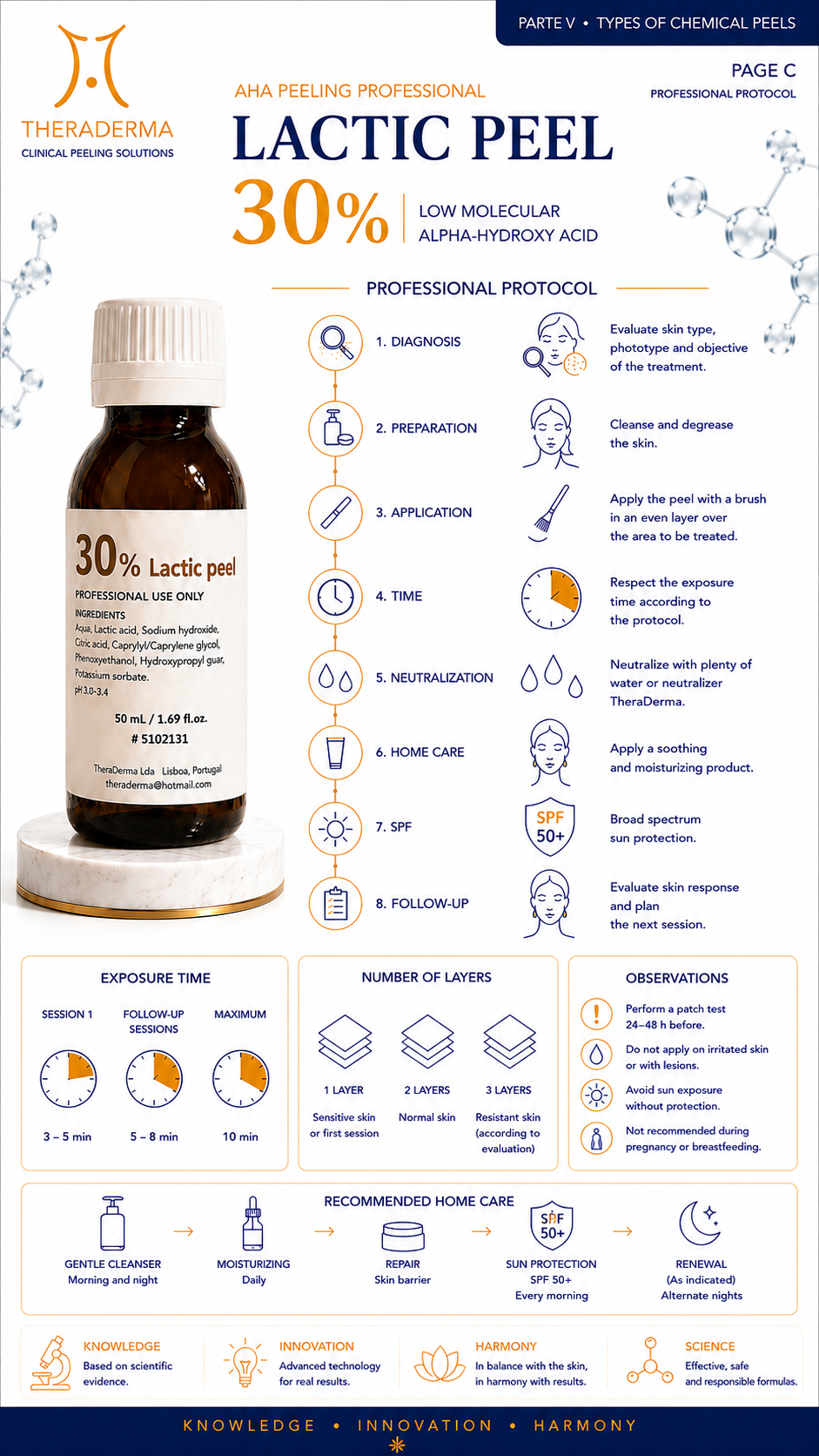
Professional Application
A Procedure Based on Diagnosis, Precision and Respect for Skin Physiology
The success of a professional chemical peel does not depend exclusively on the formulation used.
Proper patient assessment, appropriate skin preparation, application technique, continuous clinical observation and post-treatment follow-up are essential factors in achieving safe, reproducible results tailored to the individual needs of each patient.
Lactic Peel 30% TherapDerma has been developed exclusively for professional use and should be incorporated into carefully planned treatment protocols that respect the skin barrier function, hydration status and regenerative capacity of the skin.
The excellent tolerability of Lactic Acid does not replace the need for an accurate diagnosis. On the contrary, it enables practitioners to develop highly personalised treatments while maintaining an excellent balance between clinical efficacy and safety.
________________________________________
PRE-TREATMENT CLINICAL ASSESSMENT
Before beginning any procedure, the practitioner should carry out a comprehensive clinical assessment to confirm that the patient is suitable for treatment.
The initial assessment should include:
✔ skin type;
✔ skin phototype;
✔ level of skin hydration;
✔ condition of the skin barrier function;
✔ skin sensitivity;
✔ dermatological history;
✔ recent aesthetic treatments;
✔ current medication;
✔ patient expectations.
This assessment forms the basis for designing a personalised treatment protocol and selecting the appropriate treatment intensity.
________________________________________
SKIN PREPARATION
Proper preparation promotes even peel application and improves procedural control.
Before beginning treatment, it is recommended to:
✔ thoroughly cleanse the treatment area;
✔ remove all traces of make-up, sunscreen and excess sebum;
✔ degrease the skin surface when required by the treatment protocol;
✔ protect particularly sensitive areas such as the corners of the mouth, the nasal folds and the eye contour.
The skin should be completely clean and dry before applying the product.
________________________________________
DURING APPLICATION
The peel should be applied using a consistent, methodical and carefully controlled technique.
Throughout the procedure, the practitioner should continuously observe the skin’s response and adapt the treatment according to the clinical progression.
It is important to monitor:
✔ uniformity of application;
✔ skin response;
✔ patient comfort;
✔ exposure time;
✔ the appearance of relevant clinical signs;
✔ the need for neutralisation according to the established treatment protocol.
Every treatment should be individualised and adapted to the physiological response observed.
________________________________________
THE IMPORTANCE OF CLINICAL OBSERVATION
Every patient’s skin responds differently to the same chemical peel.
Factors such as hydration status, stratum corneum thickness, individual sensitivity and regenerative capacity influence the clinical response during the procedure.
The practitioner’s experience allows these responses to be interpreted correctly and helps determine the most appropriate moment to conclude the treatment.
Patient safety should always take precedence over treatment intensity.
________________________________________
PEEL NEUTRALISATION
For peels formulated with Lactic Acid, the need for neutralisation depends on the specific characteristics of the formulation and on the clinical treatment protocol established by the manufacturer.
When neutralisation is required, it should be performed once the intended therapeutic endpoint has been reached in order to stop the activity of the acid in a controlled manner.
Once this step has been completed, the skin should be carefully cleansed before proceeding to the subsequent stages of treatment.
Practitioners should always follow the official product instructions to ensure maximum safety and procedural reproducibility.
________________________________________
IMMEDIATE POST-TREATMENT CARE
Once the treatment session has been completed, products designed to promote skin comfort, preserve hydration and support the physiological recovery of the skin barrier should be applied.
The practitioner should advise the patient to:
✔ use appropriate moisturising products;
✔ apply broad-spectrum sunscreen daily;
✔ avoid direct sun exposure;
✔ avoid potentially irritating cosmetic products during the first few days;
✔ strictly follow the recommended home care instructions.
Post-treatment care forms an integral part of the treatment and plays a decisive role in optimising clinical results.
________________________________________
PATIENT FOLLOW-UP
Clinical assessment does not end when the treatment session is completed.
Follow-up appointments allow the practitioner to evaluate:
✔ progression of epidermal renewal;
✔ recovery of the skin barrier function;
✔ skin hydration levels;
✔ treatment tolerability;
✔ clinical response achieved;
✔ the need to adjust the treatment protocol;
✔ planning of the next treatment session.
Each review provides essential information for personalising the patient’s therapeutic progression.
________________________________________
CLINICAL DOCUMENTATION
It is recommended that every procedure be documented through:
✔ an updated clinical history;
✔ informed consent where applicable;
✔ standardised clinical photographs;
✔ concentration used;
✔ exposure time;
✔ skin response observed during treatment;
✔ complementary products used;
✔ home care recommendations.
Comprehensive documentation facilitates clinical follow-up, improves treatment continuity and enhances the overall quality of patient care.
________________________________________
PROFESSIONAL CHECKLIST
Before concluding the treatment session, confirm that:
☐ A complete clinical assessment has been carried out.
☐ The skin has been properly prepared.
☐ The peel has been applied evenly.
☐ The skin response has been monitored throughout the procedure.
☐ Neutralisation has been performed where required by the treatment protocol.
☐ Appropriate post-treatment care has been provided.
☐ The patient has received home care instructions.
☐ The next clinical review has been scheduled.
A systematic approach promotes safer procedures and more consistent clinical outcomes.
________________________________________
GOOD CLINICAL PRACTICE
The application of Lactic Peel 30% should form part of professional practice based on:
✔ individualised diagnosis;
✔ personalised treatment protocols;
✔ respect for the skin barrier function;
✔ preservation of skin hydration;
✔ continuous clinical observation;
✔ comprehensive documentation;
✔ ongoing clinical follow-up;
✔ continuous treatment improvement.
These principles enable highly safe, reproducible procedures fully aligned with modern evidence-based aesthetic medicine.
________________________________________
THERAPDERMA CONCLUSION
The professional application of Lactic Peel 30% requires much more than correct exfoliation technique.
It requires thorough clinical assessment, individualised treatment planning and continuous observation of the skin’s physiological response in order to adapt each treatment to the patient’s specific needs.
At TherapDerma, we believe that clinical excellence is achieved through the combination of scientific knowledge, professional expertise and carefully structured treatment protocols. This approach enables the development of progressive, highly tolerable treatments designed to deliver natural, safe and sustainable results within the TherapDerma Clinical Ecosystem™.
Clinical Protocols
Personalised Protocols for Progressive Epidermal Renewal and Long-Lasting Skin Hydration
Lactic Peel 30% TherapDerma may be incorporated into a variety of aesthetic medicine programmes depending on the clinical diagnosis, the physiological characteristics of the skin and the established therapeutic objectives.
There is no universal protocol suitable for every patient. Each treatment should be individually designed, adapting the treatment intensity, session frequency and combination with other professional solutions according to the observed clinical progression.
Thanks to its excellent tolerability profile, Lactic Peel 30% is a particularly versatile tool for developing progressive treatment protocols aimed at improving skin hydration, radiance and overall skin quality.
Personalised treatment planning remains one of the fundamental principles of the TherapDerma Clinical Ecosystem™.
________________________________________
PROGRESSIVE EPIDERMAL RENEWAL PROTOCOL
Objective
To promote gentle chemical exfoliation that progressively improves the skin’s surface quality while respecting the skin barrier function and the physiological mechanisms of skin regeneration.
Ideal Patient
✔ Dry or dehydrated skin.
✔ Sensitive skin.
✔ Loss of radiance.
✔ Slightly uneven skin texture.
✔ First experience with chemical peels.
Protocol Structure
Session 1
Clinical assessment + Lactic Peel 30%
↓
Following Sessions
Clinical reassessment + repeat treatment according to skin progression
↓
Final Stage
Evaluation of results + planning of a personalised maintenance programme.
________________________________________
DEEP HYDRATION PROTOCOL
Objective
To progressively improve the epidermis’ ability to maintain an appropriate moisture balance, promoting skin that is more comfortable, supple and radiant.
May be combined with
✔ Hydrating mesotherapy.
✔ Non-cross-linked hyaluronic acid.
✔ Skinboosters.
✔ Professional restorative skincare.
✔ LED therapy.
The combination of treatments should always be determined according to the clinical diagnosis and the patient’s individual response.
________________________________________
GLOW SKIN PROTOCOL
Objective
To restore a brighter, more even and healthier-looking complexion through carefully controlled superficial skin renewal.
This protocol is particularly suitable for patients presenting loss of radiance, dull skin or reduced overall skin quality.
The practitioner may complement the treatment with revitalising solutions and a personalised home care programme to enhance the continuity of the results.
________________________________________
PROTOCOL FOR SENSITIVE SKIN
Objective
To perform epidermal renewal while fully respecting skin physiology and minimising the risk of irritation.
The excellent tolerability of Lactic Acid makes this protocol an excellent option for patients whose skin demonstrates increased sensitivity to other exfoliating procedures.
Clinical progression should be carefully assessed at every session in order to progressively adapt treatment intensity whenever necessary.
________________________________________
SKIN TEXTURE IMPROVEMENT PROTOCOL
Objective
To promote a more homogeneous skin surface through gradual epidermal renewal.
It may be incorporated into treatment protocols for patients presenting:
✔ uneven skin texture;
✔ rough skin;
✔ loss of softness;
✔ reduced radiance;
✔ superficial changes associated with dehydration.
Clinical progression should be reassessed regularly in order to adapt the protocol according to the results achieved.
________________________________________
SKIN PREPARATION PROTOCOL
Objective
To optimise the physiological condition of the epidermis before incorporating other medical aesthetic treatments.
Properly hydrated and renewed skin provides a superior biological foundation for the subsequent integration of mesotherapy, biostimulation, regenerative technologies or other personalised treatment protocols.
This approach enables the development of more structured, predictable treatments tailored to each patient’s individual needs.
________________________________________
THERAPDERMA™ COMBINED PROTOCOL
The comprehensive TherapDerma approach allows Lactic Peel 30% to be incorporated into personalised therapeutic programmes alongside other professional solutions.
Example Treatment Sequence
Phase 1
Lactic Peel 30%
↓
Phase 2
Personalised mesotherapy according to the clinical diagnosis
↓
Phase 3
Complementary medical aesthetic technology
↓
Phase 4
Professional home care skincare
↓
Clinical Follow-Up
Reassessment and personalised maintenance.
The treatment sequence should always be adapted according to the clinical diagnosis, the patient’s progression and individual therapeutic needs.
________________________________________
MAINTENANCE PLANNING
Once the therapeutic objectives have been achieved, the practitioner may establish a maintenance programme tailored to each patient’s individual characteristics.
Maintenance may include:
✔ periodic epidermal renewal sessions;
✔ ongoing hydration programmes;
✔ scheduled clinical reviews;
✔ updates to the home care programme;
✔ adaptation of the treatment protocol according to the skin’s physiological progression.
This strategy helps preserve the results achieved while responding to the biological changes that naturally occur over time.
________________________________________
TREATMENT PERSONALISATION
Treatment intensity should never depend solely on the peel concentration.
Factors such as:
✔ biological age;
✔ hydration status;
✔ skin barrier function;
✔ skin phototype;
✔ skin sensitivity;
✔ previous aesthetic treatments;
✔ response observed during previous sessions;
should all form part of the clinical treatment plan.
Personalisation is the most important factor in optimising treatment efficacy while maintaining a high level of safety throughout the entire protocol.
________________________________________
PROTOCOL SUMMARY
Lactic Peel 30% may be incorporated into programmes for:
✔ Progressive epidermal renewal.
✔ Deep hydration.
✔ Glow Skin.
✔ Sensitive skin.
✔ Skin texture improvement.
✔ Preparation for combined treatments.
✔ TherapDerma™ combined treatment protocols.
✔ Personalised maintenance programmes.
________________________________________
THERAPDERMA CONCLUSION
The true potential of Lactic Peel 30% is achieved when it forms part of a carefully planned clinical protocol tailored to the individual characteristics of each patient.
The combination of accurate diagnosis, therapeutic personalisation, clinical follow-up and complementary treatments enables the development of progressive programmes that respect skin physiology while consistently improving hydration, radiance and overall skin surface quality.
Within the TherapDerma Clinical Ecosystem™, Lactic Peel 30% represents an essential tool for developing scientifically based, highly tolerable treatments designed to deliver natural, reproducible and sustainable long-term results.
TherapDerma™ Combinations
Integrated Protocols to Enhance Hydration, Skin Renewal and Overall Skin Quality
Modern aesthetic medicine is no longer based on isolated treatments, but on the intelligent integration of different therapies capable of working together to address each patient’s specific needs.
Within this context, Lactic Peel 30% TherapDerma represents an excellent tool for initiating personalised treatment protocols in which progressive epidermal renewal and physiological hydration create the ideal conditions for enhancing the effectiveness of subsequent treatments.
Thanks to its excellent tolerability, it can be combined with a variety of solutions within the TherapDerma Clinical Ecosystem™, enabling the development of more comprehensive, safe and scientifically structured therapeutic programmes.
The selection of each combination should always depend on the professional diagnosis, the biological characteristics of the skin and the established clinical objectives.
________________________________________
LACTIC PEEL 30% + HYDRATING MESOTHERAPY
Renewal + Biological Hydration
Following an appropriate clinical assessment, Lactic Peel 30% may be combined with mesotherapy treatments designed to improve the skin’s moisture content and optimise its overall quality.
Depending on the clinical diagnosis, the practitioner may select formulations aimed at:
✔ deep hydration;
✔ skin revitalisation;
✔ restoring skin comfort;
✔ improving elasticity;
✔ preventative anti-ageing programmes.
The combination should always follow the clinical treatment sequence established by the practitioner.
________________________________________
LACTIC PEEL 30% + NON-CROSS-LINKED HYALURONIC ACID
Renewal + Moisture Replenishment
The superficial renewal promoted by Lactic Acid may be integrated with hydration protocols using non-cross-linked hyaluronic acid.
This combination allows the development of treatment programmes for patients presenting:
✔ dehydrated skin;
✔ loss of elasticity;
✔ reduced radiance;
✔ early signs of ageing.
Treatment planning should always be personalised according to each patient’s individual needs.
________________________________________
LACTIC PEEL 30% + SKINBOOSTERS
Skin Quality + Long-Lasting Hydration
In patients requiring improvement in overall skin quality, Lactic Peel 30% may form part of treatment programmes that subsequently incorporate Skinboosters.
The initial epidermal renewal provides the basis for a progressive therapeutic strategy aimed at optimising hydration, softness and surface uniformity.
Each treatment protocol should be adapted according to the patient’s clinical progression and individual response.
________________________________________
LACTIC PEEL 30% + SKIN BIOSTIMULATION
Prepare Before Stimulating
Biostimulation aims to activate the skin’s natural regenerative mechanisms.
When considered appropriate following clinical diagnosis, Lactic Peel 30% may be used as the initial stage to promote a more even epidermal surface before introducing biostimulatory treatments.
This approach enables structured, progressive treatment protocols while respecting skin physiology.
________________________________________
LACTIC PEEL 30% + RADIOFREQUENCY
Renewal + Tissue Stimulation
Radiofrequency is a widely used technology for improving skin firmness and overall skin quality.
When incorporated into a properly planned treatment protocol, it may be combined with Lactic Peel 30% to provide comprehensive treatments aimed at improving the skin’s appearance through complementary mechanisms.
The therapeutic sequence should always be established according to the practitioner’s clinical judgement.
________________________________________
LACTIC PEEL 30% + LED THERAPY
Renewal + Physiological Recovery
LED therapy may be incorporated into treatment programmes designed to promote skin comfort and support physiological recovery following chemical exfoliation.
Its integration with Lactic Peel 30% enables the development of particularly suitable protocols for patients with sensitive skin or those requiring highly comfortable treatment procedures.
The choice of protocol should always depend on the individual diagnosis and the therapeutic objectives.
________________________________________
LACTIC PEEL 30% + PROFESSIONAL HOME CARE SKINCARE
Treatment Continuity Begins at Home
The results achieved in the clinic largely depend on the care provided between treatment sessions.
Following treatment, it is recommended to establish a personalised home care programme that includes:
✔ gentle cleansing;
✔ intensive hydration;
✔ restoration of the skin barrier function;
✔ antioxidants where indicated;
✔ daily broad-spectrum photoprotection.
Treatment continuity promotes more stable and sustainable long-term results.
________________________________________
THERAPDERMA CLINICAL ECOSYSTEM™
A Complete Protocol Delivers Better Results
At TherapDerma, we believe that clinical excellence does not depend on a single product.
The best results are achieved through the integration of different therapeutic tools carefully organised within a single treatment protocol.
Example of Clinical Integration
Professional Diagnosis
↓
Lactic Peel 30%
↓
Personalised Mesotherapy
↓
Medical Aesthetic Technology
↓
Professional Home Care Skincare
↓
Clinical Follow-Up
↓
Personalised Maintenance
Each stage prepares the next, enabling the development of progressive, highly personalised and scientifically based treatments.
________________________________________
ADVANTAGES OF COMBINED PROTOCOLS
The integration of Lactic Peel 30% into personalised treatment programmes makes it possible to:
✔ improve therapeutic planning;
✔ respect skin physiology;
✔ optimise epidermal hydration;
✔ prepare the skin for subsequent treatments;
✔ personalise every treatment protocol according to the clinical diagnosis;
✔ promote more consistent results;
✔ increase patient satisfaction;
✔ reinforce treatment continuity.
The intelligent combination of therapies represents one of the fundamental pillars of modern aesthetic medicine.
________________________________________
CLINICAL SUMMARY
Lactic Peel 30% may be combined with:
✔ Hydrating mesotherapy.
✔ Non-cross-linked hyaluronic acid.
✔ Skinboosters.
✔ Skin biostimulation.
✔ Radiofrequency.
✔ LED therapy.
✔ Professional home care skincare.
✔ Personalised protocols within the TherapDerma Clinical Ecosystem™.
________________________________________
THERAPDERMA CONCLUSION
The true potential of Lactic Peel 30% is achieved when it is no longer considered an isolated treatment but becomes part of a comprehensive aesthetic medicine protocol.
Its ability to combine progressive epidermal renewal with excellent tolerability and a hydrating action makes it an outstanding foundation for integrating mesotherapy, biostimulation, medical aesthetic technologies and professional skincare within a single therapeutic strategy.
At TherapDerma, we believe that the best results arise from the combination of accurate diagnosis, scientific knowledge and intelligent treatment protocols. For this reason, Lactic Peel 30% occupies an essential position within the TherapDerma Clinical Ecosystem™, enabling the development of personalised, reproducible treatments designed to deliver natural, long-lasting results of the highest clinical quality.
Frequently Asked Questions (FAQ)
Clear Answers for Safer Clinical Practice
The use of chemical peels frequently raises questions regarding their mechanism of action, clinical indications and treatment planning.
The following answers address some of the most common questions asked by professionals during daily clinical practice and throughout TherapDerma training programmes.
Their purpose is to facilitate clinical decision-making and reinforce the correct use of Lactic Peel 30% within personalised aesthetic medicine protocols.
________________________________________
What type of peel is Lactic Peel 30%?
Lactic Peel 30% is a professional superficial chemical peel formulated with 30% Lactic Acid, belonging to the Alpha Hydroxy Acid (AHA) family.
It has been developed to promote progressive epidermal renewal while helping to maintain the skin’s natural moisture balance, offering an excellent tolerability profile.
________________________________________
Which skin types is it particularly suitable for?
Lactic Peel 30% is especially suitable for patients presenting:
✔ dry skin;
✔ dehydrated skin;
✔ sensitive skin;
✔ reactive skin;
✔ loss of radiance;
✔ uneven skin texture;
✔ early signs of ageing.
The final indication should always depend on the professional clinical diagnosis.
________________________________________
What is the difference between Lactic Acid and Glycolic Acid?
Although both belong to the Alpha Hydroxy Acid (AHA) family, they possess different characteristics.
Glycolic Acid has a lower molecular weight, allowing faster penetration and producing a more intensive exfoliating effect.
Lactic Acid, on the other hand, has a higher molecular weight, resulting in a more gradual action together with a greater ability to support the skin’s physiological hydration.
For this reason, it is often an excellent choice when the objective is to combine gentle epidermal renewal with superior skin comfort.
________________________________________
Can it be used on sensitive skin?
Yes.
One of the main advantages of Lactic Acid is its excellent clinical tolerability.
When the patient has been properly assessed and the treatment protocol is adapted to their individual characteristics, Lactic Peel 30% may be incorporated into programmes designed for sensitive or reactive skin.
A comprehensive clinical assessment remains essential before initiating any treatment.
________________________________________
How many treatment sessions are usually recommended?
There is no universal number of treatment sessions.
Treatment planning depends on:
✔ clinical diagnosis;
✔ skin quality;
✔ therapeutic objectives;
✔ the response observed after each session;
✔ the patient’s individual clinical progression.
The practitioner should periodically reassess the clinical response and adapt the treatment protocol whenever necessary.
________________________________________
How often can it be applied?
Treatment frequency should always be determined on an individual basis.
The interval between sessions depends on the skin’s physiological response, the clinical objective and the therapeutic plan established by the practitioner.
Respecting the skin’s natural recovery time is essential for optimising results and preserving the skin barrier function.
________________________________________
Can it be combined with other treatments?
Yes.
Lactic Peel 30% may be incorporated into personalised treatment protocols alongside:
✔ mesotherapy;
✔ non-cross-linked hyaluronic acid;
✔ Skinboosters;
✔ biostimulation;
✔ radiofrequency;
✔ LED therapy;
✔ professional home care skincare.
The combination should always be determined according to the clinical diagnosis and the therapeutic sequence established by the practitioner.
________________________________________
Does the peel require neutralisation?
The need for neutralisation depends on the specific characteristics of the formulation and on the treatment protocol established by the manufacturer.
Practitioners should always follow the official product instructions to ensure a safe and reproducible procedure.
________________________________________
What post-treatment care should the patient follow?
Following the peel, patients are advised to:
✔ maintain adequate skin hydration;
✔ apply broad-spectrum sunscreen daily;
✔ avoid direct sun exposure;
✔ avoid potentially irritating cosmetic products during the first few days;
✔ strictly follow the professional aftercare recommendations.
Home care forms an essential part of the treatment and contributes significantly to optimising clinical outcomes.
________________________________________
Can it be used throughout the year?
Yes, provided that the patient is able to comply with appropriate photoprotection measures and the practitioner considers the treatment clinically suitable.
For patients expecting prolonged or intense sun exposure, it may be advisable to adjust the treatment schedule in order to maintain maximum procedural safety.
________________________________________
Can it be included in preventative anti-ageing programmes?
Yes.
Thanks to its combination of progressive epidermal renewal and physiological hydration, Lactic Peel 30% is an excellent tool for preventative programmes designed to maintain skin quality, improve radiance and preserve a healthy-looking complexion.
Treatment planning should always be personalised according to the patient’s age, skin characteristics and therapeutic objectives.
________________________________________
QUICK SUMMARY
Lactic Peel 30% is distinguished by:
✔ Progressive epidermal renewal.
✔ Excellent clinical tolerability.
✔ Outstanding suitability for sensitive skin.
✔ Physiological hydrating action.
✔ Easy integration into combined treatment protocols.
✔ High therapeutic versatility.
✔ An excellent option for preventative and maintenance programmes.
________________________________________
THERAPDERMA CONCLUSION
The most frequently asked questions reflect one fundamental reality in aesthetic medicine: there are no identical treatment protocols for every patient.
The true value of Lactic Peel 30% lies in providing practitioners with a versatile, scientifically based solution that can be adapted to a wide range of clinical needs.
At TherapDerma, we believe that providing clear answers to professional questions is part of the treatment itself. Scientific knowledge, combined with accurate diagnosis and personalised treatment planning, enables safer, more predictable procedures designed to achieve natural and sustainable results within the TherapDerma Clinical Ecosystem™.
Related Content
Discover More Solutions Within the TherapDerma Clinical Ecosystem™
In modern aesthetic medicine, an isolated treatment is rarely the most effective solution.
Achieving consistent results depends on the practitioner’s ability to select the right treatment at the right time, integrating different solutions into a personalised clinical strategy.
For this reason, Lactic Peel 30% forms part of the TherapDerma Clinical Ecosystem™, a clinical framework that brings together chemical peels, mesotherapy, medical aesthetic technologies, clinical protocols and specialised education to help professionals develop more comprehensive, safe and scientifically based treatment programmes.
The following resources complement the use of Lactic Peel 30% and expand its therapeutic possibilities within everyday clinical practice.
________________________________________
THERAPDERMA PEELING COLLECTION™
One Solution for Every Clinical Need
Every skin type presents unique biological characteristics and requires a specific level of epidermal renewal.
The TherapDerma Peeling Collection enables practitioners to select the most appropriate acid and concentration for each patient, facilitating progressive and highly personalised treatment planning.
The range includes several peel families developed to address different clinical objectives:
✔ Glycolic Peel.
✔ Lactic Peel.
✔ Mandelic Peel.
✔ Salicylic Peel.
✔ Pyruvic Peel.
✔ TCA Peel.
Each occupies a specific position within the TherapDerma Clinical Ladder™, allowing treatment protocols to be tailored according to the patient’s clinical progression.
________________________________________
THERAPDERMA MESOTHERAPY COLLECTION™
Enhancing Results Through Combined Protocols
Professional mesotherapy is one of the principal therapeutic complements to chemical peels.
Following appropriate clinical planning, Lactic Peel 30% may be integrated with formulations designed to address different skin concerns, including:
✔ intensive hydration;
✔ skin revitalisation;
✔ biostimulation;
✔ prevention of skin ageing;
✔ improvement of overall skin quality.
The combination should always be established according to the clinical diagnosis and the patient’s progression.
________________________________________
THERAPDERMA TECHNOLOGIES™
Innovation at the Service of Professionals
Medical aesthetic technologies expand therapeutic possibilities when correctly integrated into personalised treatment protocols.
Depending on the clinical objective, Lactic Peel 30% may be combined with various TherapDerma technologies to develop more comprehensive treatments tailored to each patient’s individual needs.
The planning of these combinations should always respect the therapeutic sequence established by the practitioner.
________________________________________
THERAPDERMA CLINICAL PROTOCOLS™
Structured Protocols for Evidence-Based Aesthetic Medicine
One of TherapDerma’s primary objectives is to facilitate clinical decision-making through clearly structured treatment protocols.
Each protocol integrates:
✔ initial clinical diagnosis;
✔ peel selection;
✔ treatment session planning;
✔ complementary therapies;
✔ personalised maintenance;
✔ clinical follow-up.
This approach improves treatment reproducibility while providing a more consistent experience for both practitioner and patient.
________________________________________
THERAPDERMA SKINCARE™
Treatment Continuity Begins at Home
Home skincare is an essential component of therapeutic success.
Following a Lactic Peel 30% protocol, practitioners may recommend skincare products specifically adapted to each patient’s needs in order to:
✔ preserve hydration;
✔ protect the skin barrier function;
✔ maintain skin radiance;
✔ support physiological recovery;
✔ prolong the clinical results achieved in the clinic.
Continuity between professional treatment and home care is one of the fundamental pillars of the TherapDerma approach.
________________________________________
THERAPDERMA PROFESSIONAL EDUCATION™
Knowledge Improves Clinical Results
The continuous evolution of aesthetic medicine makes ongoing professional education essential.
TherapDerma develops scientific educational resources designed to improve understanding of:
✔ skin physiology;
✔ mechanisms of action;
✔ patient selection;
✔ personalised treatment protocols;
✔ treatment combinations;
✔ prevention of complications.
Scientific knowledge forms the foundation of safe, high-quality clinical practice.
________________________________________
THERAPDERMA CLINICAL ECOSYSTEM™
A Comprehensive Vision of Aesthetic Medicine
At TherapDerma, we believe that no product should ever be used in isolation.
Every solution forms part of an organised clinical system in which different therapeutic tools work together towards one common objective: improving skin quality through personalised, scientifically based treatment programmes.
TherapDerma Clinical Ecosystem
Professional Diagnosis
↓
Peel Selection
↓
Personalised Mesotherapy
↓
Medical Aesthetic Technologies
↓
Professional Home Care
↓
Clinical Follow-Up
↓
Personalised Maintenance
Each stage complements the previous one, enabling progressive, coherent and highly reproducible treatment programmes.
________________________________________
RECOMMENDED RELATED RESOURCES
To further expand your knowledge of Lactic Peel 30%, we also recommend consulting:
✔ Complete TherapDerma Peeling Catalogue.
✔ Facial Mesotherapy Guide.
✔ TherapDerma Clinical Protocols Manual.
✔ TherapDerma Clinical Decision Guide™.
✔ TherapDerma Professional Academy™.
✔ Clinical Combination Manual.
✔ Home Care Guide.
Each of these resources forms part of the continuous professional education programme developed by TherapDerma for aesthetic medicine professionals.
________________________________________
THERAPDERMA CONCLUSION
Lactic Peel 30% represents much more than a chemical peel.
It forms part of a comprehensive clinical ecosystem designed to help practitioners better understand skin biology, select treatments with greater precision and develop integrated treatment protocols tailored to each individual patient.
At TherapDerma, we believe that true expertise is not simply about understanding a product, but about knowing how to integrate it into a complete therapeutic strategy. This comprehensive vision transforms isolated treatments into structured clinical programmes capable of delivering natural, consistent and sustainable results within the TherapDerma Clinical Ecosystem™.
TherapDerma Professional Academy™
Knowledge Transforms Treatments into Results
Excellence in aesthetic medicine does not depend solely on having innovative products or advanced technologies.
The best results arise from the practitioner’s ability to understand skin biology, accurately interpret the clinical diagnosis and select the most appropriate treatment for every patient.
For this reason, TherapDerma Professional Academy™ has been created as an international scientific education platform dedicated to supporting the continuous development of physicians, nurses, pharmacists, dentists and other aesthetic medicine professionals.
Our mission is to transform scientific knowledge into safe, reproducible clinical protocols designed to deliver natural results.
________________________________________
EDUCATION BASED ON SCIENCE
All TherapDerma educational programmes are built upon scientific principles widely recognised in dermatology, aesthetic medicine and skin biology.
Our objective is not simply to teach how to use a product, but to help practitioners understand:
✔ skin physiology;
✔ the biological mechanisms of ageing;
✔ the behaviour of different active ingredients;
✔ correct patient selection;
✔ the planning of personalised treatment protocols;
✔ the integration of multiple therapies within a single clinical strategy.
This approach promotes safer, more rational clinical practice focused on achieving consistent results.
________________________________________
LEARNING HOW TO DIAGNOSE
Clinical diagnosis is the starting point of every successful treatment.
At TherapDerma, we believe that the same product can produce completely different outcomes depending on the practitioner’s ability to correctly identify the patient’s genuine skin needs.
For this reason, an essential part of our educational programmes is dedicated to developing clinical reasoning and evidence-based decision-making through objective patient assessment.
Learning how to diagnose accurately enables practitioners to personalise every treatment protocol while avoiding unnecessary or ineffective procedures.
________________________________________
LEARNING HOW TO PERSONALISE
No two patients are alike.
Differences in biological age, skin phototype, skin quality, barrier function, hydration levels, aesthetic history and lifestyle make it essential to personalise every treatment.
TherapDerma Professional Academy™ teaches practitioners how to design dynamic treatment protocols that evolve alongside the patient’s clinical response.
Personalisation is one of the fundamental pillars of modern aesthetic medicine.
________________________________________
EDUCATION BEYOND THE PRODUCT
Our educational model extends far beyond learning how to use a chemical peel.
Each programme integrates knowledge covering:
✔ chemical peels;
✔ mesotherapy;
✔ biostimulation;
✔ medical aesthetic technologies;
✔ professional skincare;
✔ combined treatment protocols;
✔ clinical follow-up;
✔ prevention of complications.
The objective is to provide a comprehensive clinical perspective that enables practitioners to develop complete and highly structured treatment programmes.
________________________________________
CONTINUOUS LEARNING
Aesthetic medicine is constantly evolving.
New research, technologies and treatment protocols emerge every year, making continuous professional education essential.
TherapDerma Professional Academy™ promotes a culture of lifelong learning through programmes designed to accompany practitioners throughout their entire clinical career.
Education therefore becomes an ongoing process of professional development rather than a single educational event.
________________________________________
LEARNING FORMATS
The Academy offers different educational formats tailored to the needs of every professional:
✔ face-to-face training;
✔ online education;
✔ scientific webinars;
✔ practical workshops;
✔ clinical masterclasses;
✔ international congresses;
✔ commented clinical case studies;
✔ scientific update programmes.
Each learning format is designed to combine theoretical knowledge with practical application in everyday clinical practice.
________________________________________
FROM KNOWLEDGE TO CLINICAL PRACTICE
Education only acquires its true value when it can be immediately applied in professional practice.
For this reason, all educational content developed by TherapDerma follows a structured methodology designed to facilitate clinical decision-making.
TherapDerma Methodology
Scientific Knowledge
↓
Clinical Diagnosis
↓
Treatment Selection
↓
Protocol Design
↓
Professional Application
↓
Clinical Follow-Up
↓
Optimisation of Results
This model transforms theory into organised, reproducible clinical procedures focused on achieving excellence.
________________________________________
WHAT DOES THERAPDERMA PROFESSIONAL ACADEMY™ PROVIDE?
Professionals acquire the knowledge and tools required to:
✔ better understand skin biology;
✔ improve diagnostic skills;
✔ select treatments with greater precision;
✔ design personalised treatment protocols;
✔ integrate multiple therapies;
✔ increase clinical safety;
✔ enhance the patient experience;
✔ achieve more consistent and reproducible results.
Scientific education therefore becomes a genuine competitive advantage in everyday clinical practice.
________________________________________
THE THERAPDERMA PHILOSOPHY
At TherapDerma, we believe that knowledge is the most valuable investment any professional can make.
Products evolve.
Technologies change.
Trends emerge and disappear.
However, a practitioner with a solid scientific foundation will always be prepared to adapt to innovation while continuing to provide treatments of the highest clinical quality.
For this reason, our Academy does not simply train product users.
It develops professionals capable of understanding, making informed decisions and leading the future of aesthetic medicine.
________________________________________
THERAPDERMA CONCLUSION
TherapDerma Professional Academy™ is one of the fundamental pillars of the TherapDerma Clinical Ecosystem™.
Our mission is to support practitioners far beyond the product itself by providing scientific education, clinical reasoning and practical tools that transform knowledge into intelligent therapeutic decisions.
At TherapDerma, we believe that true clinical excellence does not begin with a peel, a technology or a mesotherapy treatment.
It begins with a professional who understands the science, masters clinical diagnosis and is able to transform that knowledge into natural, safe and sustainable results for every patient.
TherapDerma Clinical Decision System™
Transforming Scientific Knowledge into Clinical Decisions
Modern aesthetic medicine requires much more than simply understanding the characteristics of a product.
Every patient presents different biological needs, individual expectations and a unique clinical progression. For this reason, treatment selection should not rely solely on personal experience or standardised protocols, but on a structured process of clinical reasoning.
The TherapDerma Clinical Decision System™ (TCDS™) has been developed to help practitioners transform the information gathered during the diagnostic process into coherent, personalised and scientifically based therapeutic decisions.
Its objective is to facilitate the selection of the most appropriate treatment protocol, optimise treatment safety and improve the reproducibility of clinical outcomes.
________________________________________
STEP 1
CLINICAL DIAGNOSIS
Every treatment protocol begins with a comprehensive patient assessment.
Before selecting a chemical peel, the practitioner should identify the skin’s genuine needs and understand the factors influencing its biological response.
The clinical assessment should include:
✔ reason for consultation;
✔ medical and dermatological history;
✔ previous aesthetic treatments;
✔ skin type and quality;
✔ hydration level;
✔ condition of the skin barrier function;
✔ skin sensitivity;
✔ skin phototype;
✔ lifestyle and sun exposure.
An accurate diagnosis forms the foundation of every successful treatment.
________________________________________
STEP 2
IDENTIFYING THE CLINICAL OBJECTIVE
Once the initial assessment has been completed, the next step is to clearly define the primary therapeutic objective.
For patients suitable for Lactic Peel 30%, the most common objectives include:
✔ improving superficial hydration;
✔ restoring skin radiance;
✔ refining skin texture;
✔ achieving gentle epidermal renewal;
✔ improving the comfort of sensitive skin;
✔ initiating a professional chemical peel programme;
✔ preparing the skin for combined treatment protocols;
✔ maintaining long-term skin quality.
Clearly defining the treatment objective enables more precise treatment selection.
________________________________________
STEP 3
PEEL SELECTION
The next step is to determine whether Lactic Peel 30% represents the most appropriate treatment option for the patient.
The practitioner should evaluate:
✔ degree of skin sensitivity;
✔ hydration level;
✔ condition of the stratum corneum;
✔ expected treatment tolerability;
✔ previous experience with chemical peels;
✔ desired depth of epidermal renewal.
When the objective is to achieve progressive exfoliation while maintaining a high level of skin comfort and hydration, Lactic Peel 30% represents an excellent therapeutic choice.
________________________________________
STEP 4
PROTOCOL PERSONALISATION
The peel concentration represents only one component of the overall treatment.
The protocol should be personalised by considering:
✔ treatment frequency;
✔ exposure time;
✔ the need for neutralisation according to the treatment protocol;
✔ home care recommendations;
✔ complementary treatments;
✔ clinical review appointments;
✔ the patient’s biological progression.
Personalisation enables safer and more predictable clinical outcomes.
________________________________________
STEP 5
COMBINING TREATMENTS
Once the peel has been selected, the practitioner may consider integrating additional solutions from the TherapDerma Clinical Ecosystem™.
Depending on the clinical diagnosis, the treatment plan may incorporate:
✔ personalised mesotherapy;
✔ non-cross-linked hyaluronic acid;
✔ Skinboosters;
✔ biostimulation;
✔ radiofrequency;
✔ LED therapy;
✔ professional home care skincare.
Every combination should correspond to a clearly defined clinical objective.
________________________________________
STEP 6
CLINICAL FOLLOW-UP
Clinical decision-making continues after every treatment session.
Follow-up appointments allow the practitioner to evaluate:
✔ hydration progression;
✔ epidermal renewal response;
✔ clinical tolerability;
✔ recovery of the skin barrier function;
✔ patient satisfaction;
✔ the need to modify the treatment protocol.
Each clinical review provides valuable information that helps optimise the subsequent stages of treatment.
________________________________________
THERAPDERMA™ ALGORITHM
From Diagnosis to Clinical Decision
Clinical Assessment
↓
Individual Diagnosis
↓
Therapeutic Objective
↓
Peel Selection
↓
Protocol Design
↓
Complementary Treatments
↓
Clinical Follow-Up
↓
Personalised Maintenance
This algorithm forms the methodological foundation of the TherapDerma Clinical Decision System™, supporting structured and reproducible clinical practice.
________________________________________
BENEFITS OF THE THERAPDERMA CLINICAL DECISION SYSTEM™
Using a structured clinical decision-making model enables practitioners to:
✔ improve diagnostic accuracy;
✔ select treatments with greater objectivity;
✔ personalise every treatment protocol;
✔ increase clinical safety;
✔ optimise the patient experience;
✔ facilitate treatment continuity;
✔ achieve more consistent clinical outcomes;
✔ reduce variability between treatments.
Organised knowledge leads to better clinical decisions.
________________________________________
THE TCDS™ PHILOSOPHY
At TherapDerma, we believe that no single product represents the solution for every patient.
True clinical success lies in knowing when to use each treatment, for which patient and within which treatment protocol.
The TherapDerma Clinical Decision System™ does not replace the practitioner’s clinical judgement.
It strengthens it through a methodology based on diagnosis, clinical reasoning and therapeutic personalisation.
Every clinical decision should be built upon skin biology rather than solely upon product characteristics.
________________________________________
THERAPDERMA CONCLUSION
The TherapDerma Clinical Decision System™ represents an evolution in the way aesthetic medicine treatments are planned.
Rather than offering rigid treatment protocols, it provides a structured framework for clinical reasoning that helps practitioners transform scientific knowledge into intelligent, personalised and reproducible therapeutic decisions.
Integrated within the TherapDerma Clinical Ecosystem™, this system enables Lactic Peel 30% to become much more than a chemical peel—it becomes a strategic clinical tool within treatment programmes designed to achieve natural, safe and sustainable results, always tailored to the genuine needs of each individual patient.


 +1 (786) 546-8347 (Office)